REVIEW 3 major objections 5 minor 11 references
A family of non Minkowski measurable fractals in $\mathbb{R}^2$
T0 review · 3 major / 5 minor · reviewed 2026-08-07 · deepseek-v4-flash
Pith's one-line read The paper proves that a family of lattice-type planar Cantor dusts $C_r$ with dimension $D_r=\ln 4/\ln r$ is not Minkowski measurable for every $r\ge30$, and conjectures the same for all $r>2$.
desk verdict First infinite family of non-Minkowski measurable lattice-type sets in the plane; main theorem likely right, but the key geometric estimate is argued from figures and has a reversed inclusion typo. read the letter →
The pith
A machine-rendered reading of the paper's core claim, the machinery that carries it, and where it could break.
The reading
What carries the argument
The central object is the planar Cantor dust $C_r$, the unique attractor of the four similarities that map the unit square onto the four corner subsquares of side $1/r$; it is lattice-type with base $r$ and Minkowski dimension $D_r=\ln4/\ln r$. The argument is carried by decomposing each connected component of the $\varepsilon$-neighbourhood $C_r^\varepsilon$ into a central square $B$, four quarter-circles $R$ of radius $\varepsilon$, and four 'green' regions $G$ whose area the proof must control. For the two null sequences $\varepsilon_{1,n}$ and $\varepsilon_{2,n}$, the proof bounds the green area from below by a geometric estimate (Equation (9)) and from above by the convex hull of a component; the resulting separation of the accumulation points $H_1^r>H_2^r$ is what forces non-measurability.
What would settle it
For $r=30$, evaluate the exact areas $\lambda_2(G_{1,n})$ for $n=1,2,3$ by numerical integration of the decomposition into squares, quarter-circles, and green regions, and compare them with the claimed lower bound $4^n\cdot4\cdot\frac{3}{4}\cdot r^{-n}\sqrt{1/2}\,r^{-n}$; a single violation would invalidate the proof's separation step, while verifying the bound at these values would directly support the theorem.
Extended reading notes
Core claim
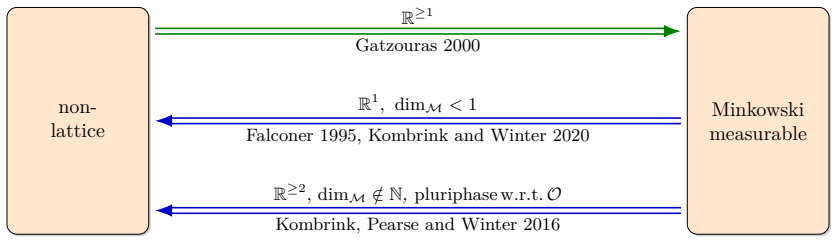
The central result is Theorem 4.1: for every $r\in[30,\infty)$, the attractor $C_r$ of the self-similar system $S_r=\{S_1^r,S_2^r,S_3^r,S_4^r\}$ whose maps send the unit square onto the four corner squares of side $1/r$ is not Minkowski measurable. Equivalently, the limit $\lim_{\varepsilon\downarrow0}\lambda_2(C_r^\varepsilon)/\varepsilon^{2-D_r}$ does not exist, where $D_r=\ln4/\ln r$. The proof exhibits two null sequences $\varepsilon_{1,n}=\sqrt{1/2}\,r^{-n}$ and $\varepsilon_{2,n}=r^{-n}$ along which the normalized areas are bounded below by a constant that exceeds $5+\pi$ and bounded above by $5+\pi$ once $r\ge30$, producing two distinct accumulation points and hence no limit. The paper also proves that $C_r$ is not pluriphase with respect to the canonical generator, so the earlier pluriphase criterion does not cover these sets, and it states as Conjecture 4.3 that non-measurability holds for all $r>2$, supported by a numerical check of $f_1(r)\ge f_2(r)$ on $(2,30)$.
Load-bearing premise
The proof rests on the geometric lower bound (9) for the area of the green parts of the thickened Cantor-dust components, a bound that is justified by figures rather than by a written area computation and whose displayed set-inclusion step has the reversed direction; if the bound fails, the two accumulation points need not be separated and the conclusion of Theorem 4.1 does not follow.
Editorial extensions
If this is right
- For every $r\ge30$, $C_r$ gives an explicit lattice-type self-similar set in $\mathbb{R}^2$ with non-integer Minkowski dimension $\ln4/\ln r$ that is not Minkowski measurable, so the open direction of the conjecture is confirmed on an uncountable family.
- The failure of the pluriphase condition for the canonical generator means the sufficient criterion of Theorem 2.3 cannot explain these examples; the two-sequence comparison is a different, elementary route to non-measurability.
- The proof reduces the remaining range $2<r<30$ to a single explicit inequality $f_1(r)\ge f_2(r)$, so for those parameters the whole question is now one analytic estimate away from a complete proof.
- If Conjecture 4.3 holds, the entire family $r>2$ would be non-Minkowski measurable, providing a continuum of lattice bases for which the higher-dimensional Lapidus conjecture is verified.
Reading between the lines
- The same two-sequence comparison may generalize to product-like Cantor dusts in $\mathbb{R}^d$ built from $N$ maps of ratio $1/r$ with dimension $\ln N/\ln r$, whenever the 'green' regions can be bounded geometrically at two separated scales.
- The numerical inequality for $r\in(2,30)$ could likely be promoted to a proof by showing monotonicity or a uniform bound for $f_1(r)/f_2(r)$; if it failed somewhere, that would only break this proof strategy, not necessarily the conjecture.
- The two accumulation points in the proof are probably the endpoints of a periodic oscillation in $\varepsilon$ with period $\log_r(1/\varepsilon)$, so computing the full profile of the normalized area as a function of $\log_r(1/\varepsilon)$ would test the mechanism directly.
Editorial analysis
A structured set of objections, weighed in public.
Referee Report
Summary. The paper introduces a two-parameter family of self-similar Cantor dusts C_r in R^2, generated by four similarities of ratio 1/r with r>2, satisfying the open set condition and forming a lattice IFS. For r ≥ 30 the authors prove that C_r is not Minkowski measurable by comparing the renormalized areas of two null sequences of parallel sets, ε_{1,n} = sqrt(1/2) r^{-n} and ε_{2,n} = r^{-n}. For 2 < r < 30 they state a conjecture that the same holds conditionally on a numerically verified inequality f_1(r) ≥ f_2(r). The paper also contains an argument (Proposition 3.1) showing that the canonical IFS for C_r is not pluriphase, so the earlier result of Kombrink, Pearse, and Winter does not apply directly.
Significance. If the main theorem is correct, it supplies the first rigorous family of lattice-type self-similar sets in R^2 that are not Minkowski measurable, giving concrete support to Lapidus's conjecture in higher dimensions. The elementary two-sequence argument is attractive and the paper is transparent about the conditional nature of the small-r case. The proof of the key geometric inequality (9), however, is not given in a rigorous form; since the margin at r=30 is very small, this gap is load-bearing. The paper's contribution is therefore promising but not yet established.
major comments (3)
- [Section 4.1, inequality (9)] The proof of the lower bound λ2(G_{1,n}) > 4^n · 4 · (3/4) · r^{-n} · sqrt(1/2) r^{-n} is not valid as written. The displayed inclusion G_{1,n} ⊂ \tilde{G}_{1,n} is reversed: each set in the union defining \tilde{G}_{1,n} is a subset of G_{1,n}, so the correct relation is \tilde{G}_{1,n} ⊂ G_{1,n}. Moreover, the subsequent assertion that λ2(\tilde{G}_{1,n}) exceeds the claimed bound is supported only by Figures 4.1 and 4.2, without any coordinate computation. Because (9) is the sole lower bound that separates the two subsequential limits, and because the separation at r=30 is only on the order of 0.006, a rigorous proof of (9) is indispensable. The theorem cannot be accepted without a written area argument.
- [Section 4.1, inequality (11)] The upper bound λ2(G_{2,n}) < 4^n · 4 · r^{-n} · r^{-n} is asserted in one sentence as coming from the convex hull of each connected component, but the convex hull of a component at scale ε_{2,n}=r^{-n} has area much larger than 4 r^{-2n} (it is contained in a square of side 3 r^{-n}, giving area 9 r^{-2n}). The bound 4 r^{-2n} may be true for the green part specifically, but it requires a geometric justification. If this constant is incorrect, the limit value 5+π in (11) changes and the threshold r≥30 may no longer hold. Please provide a rigorous derivation of this upper bound.
- [Section 4.1, subsequential limits] The proof states that from (10) and (11) there exist accumulation points H_1^r and H_2^r of the two sequences of ratios. The existence of a finite accumulation point requires the sequence to be bounded above. For self-similar sets satisfying the open set condition this boundedness is standard, but it is not stated or cited. Alternatively, the argument could be formulated directly in terms of limsup and liminf, which would avoid this issue. Please clarify.
minor comments (5)
- [Section 4.2] Conjecture 4.3 is labeled a conjecture but is followed by a 'Proof'. Since the proof is conditional on the numerically verified inequality f_1(r) ≥ f_2(r), the presentation would be clearer if it were called a 'Conditional statement' or 'Derivation of the conjecture'.
- [Section 4.2, around Equation (14)] The lower bound for λ2(G_{1,n}) in the r<30 case is again justified by Figure 4.3 rather than by an explicit calculation. Even within a conjecture, a precise coordinate description of the set G'_{1,n} would make the numerical verification of f_1(r) ≥ f_2(r) more credible.
- [Section 3, decomposition description] In the bullet list defining B(ε), the text says 'one square of side length r^{-1}', but for the n-th construction step the square has side length r^{-n}. This should be corrected to avoid confusion.
- [Conjecture 4.3 proof] There is a typo in the last line of the proof: 'Minkowsky' should be 'Minkowski'.
- [Equation (6)] The lower bound in condition (6) is printed as 'r^{-2/r}', which is ambiguous. Please use standard notation such as r^{-2/r} or clarify the intended exponent.
Circularity Check
No significant circularity: the main bounds are geometric estimates compared with independent self-similar dimension calculations, and the numerical case is explicitly conjectural.
full rationale
The derivation chain is self-contained and not circular. Theorem 4.1 proves non-Minkowski measurability by comparing two explicit null sequences epsilon_{1,n} and epsilon_{2,n}; the lower bound Eq. (9) for the green area is an asserted geometric estimate (with a possible set-inclusion reversal), not a consequence of assuming non-measurability or of fitting a parameter to the desired limit. The upper bound Eq. (11) uses only convex hulls. The separation inequality at r >= 30 is obtained by solving an explicit equation involving the Minkowski dimension D_r = ln 4 / ln r, which is an independent known quantity. Proposition 3.1 is proved by deriving a contradiction from the pluriphase polynomial form, and it does not presuppose the main theorem. For r < 30, the paper explicitly states Conjecture 4.3 and reduces it to the numerically verified inequality f1(r) >= f2(r); this is a conditional sufficient condition, not a fitted parameter masquerading as a prediction. The cited external theorems (Gatzouras, Falconer, Kombrink-Winter, Kombrink-Pearse-Winter) are background results and are not authored by the present authors, so no self-citation chain is load-bearing. The possible error in the displayed inclusion G_{1,n} subset of tilde G_{1,n} and the reliance on Figures 4.1-4.2 concern correctness and rigor, not circularity: if Eq. (9) fails, the proof has a gap, but the argument does not reduce to its own conclusion.
Assumptions & free parameters
assumptions (3)
- standard math Standard theory of self-similar sets: attractor existence, OSC, and equality of similarity dimension with Minkowski/Hausdorff dimension.
- domain assumption For epsilon satisfying Condition (6), the epsilon-neighborhood of C_r decomposes into 4^n congruent components with disjoint interiors, each being the union of square B, quarter circles R, and green set G.
- domain assumption Green-area lower bound, Equation (9): area(G_{1,n}) > 4^n * 4 * (3/4) * r^{-n} * sqrt(1/2) r^{-n}.
Cite this review
Pith. "Pith review of A family of non Minkowski measurable fractals in $\mathbb{R}^2$." pith.science (2026). https://pith.science/paper/2FC2XM3K
@misc{pith2026250602640,
  author       = {Pith},
  title        = {Pith review of: A family of non Minkowski measurable fractals in $\mathbbR^2$},
  year         = {2026},
  howpublished = {\url{https://pith.science/paper/2FC2XM3K}},
  note         = {Machine review of arXiv:2506.02640}
}
abstract
A long-standing conjecture of Lapidus asserts that, under certain conditions, a self-similar fractal set is not Minkowski measurable if and only if it is of lattice-type. For self-similar sets in $\mathbb{R}$, the Lapidus conjecture has been confirmed. However, in higher dimensions, it remains unclear whether all lattice-type self-similar sets are not Minkowski measurable. This work presents a family of lattice-type subsets in $\mathbb{R}^2$ that are not Minkowski measurable, hence providing further support for the conjecture. Furthermore, an argument is presented to illustrate why these sets are not covered by previous results.
Figures


Figures from the paper (7 more)


Reference graph
Works this paper leans on
-
[1]
M. Beck. Minkowski-messbarkeit von selbstähnlichen fraktalen. Master’s thesis, Universität Stuttgart, 2018
work page 2018
- [2]
-
[3]
K. J. Falconer. On the Minkowski measurability of fractals. Proc. Amer. Math. Soc., 123(4):1115–1124, 1995
work page 1995
-
[4]
Lacunarity of self-similar and stochastically self-similar sets.Trans
Dimitris Gatzouras. Lacunarity of self-similar and stochastically self-similar sets.Trans. Amer. Math. Soc., 352(5):1953–1983, 2000
1953
-
[5]
Fractals and self-similarity.Indiana Univ
John Hutchinson. Fractals and self-similarity.Indiana Univ. Math. J., 30:713–747, 1981
1981
-
[6]
A survey on Minkowski measurability of self-similar and self-conformal fractals in Rd
Sabrina Kombrink. A survey on Minkowski measurability of self-similar and self-conformal fractals in Rd. In Fractal geometry and dynamical systems in pure and applied mathematics. I. Fractals in pure mathematics, volume 600 ofContemp. Math., pages 135–159. Amer. Math. Soc., Providence, RI, 2013
work page 2013
-
[7]
Sabrina Kombrink, Erin P. J. Pearse, and Steffen Winter. Lattice-type self-similar sets with pluriphase generators fail to be Minkowski measurable.Math. Z., 283(3-4):1049–1070, 2016
2016
-
[8]
Lattice self-similar sets on the real line are not Minkowski measurable.Ergodic Theory Dynam
Sabrina Kombrink and Steffen Winter. Lattice self-similar sets on the real line are not Minkowski measurable.Ergodic Theory Dynam. Systems, 40(1):221–232, 2020
2020
Show all 11 references
-
[9]
Geometryofcanonicalself-similartilings
ErinP.J.PearseandSteffenWinter. Geometryofcanonicalself-similartilings. Rocky Mountain J. Math., 42(4):1327–1357, 2012. 13
2012
-
[10]
Separation properties for self-similar sets.Proc
Andreas Schief. Separation properties for self-similar sets.Proc. Amer. Math. Soc., 122(1):111– 115, 1994
1994
-
[11]
Minkowski content and fractal curvatures of self-similar tilings and generator formulas for self-similar sets.Adv
Steffen Winter. Minkowski content and fractal curvatures of self-similar tilings and generator formulas for self-similar sets.Adv. Math., 274:285–322, 2015. 14
2015
Reviewed August 7, 2026 · model on record in the stance chip above.
Discussion (0). Sign in to comment.