Poincar\'e series of valuations on functions over a field
Pith reviewed 2026-05-19 11:16 UTC · model grok-4.3
The pith
Curve and divisorial valuations on K[[x,y]] admit explicit formulas for both semigroup and classical Poincaré series.
A machine-rendered reading of the paper's core claim, the machinery that carries it, and where it could break.
Core claim
For curve valuations and divisorial valuations on the algebra K[[x,y]] where K is a subfield of C, the semigroup Poincaré series and the classical Poincaré series are computed explicitly from the data that define the valuation.
What carries the argument
The semigroup Poincaré series and the classical Poincaré series of the valuation, each constructed as a generating function over the value semigroup or the associated graded pieces.
If this is right
- The value semigroup of any such valuation is encoded in a rational function that can be written explicitly from its characteristic data.
- The classical Poincaré series likewise reduces to a closed expression that determines the Hilbert function of the associated graded algebra.
- Different curve and divisorial valuations can be distinguished or classified by comparing their explicit Poincaré series.
- The formulas apply uniformly to all valuations of the stated types without additional parameters beyond those already used to define the valuation.
Where Pith is reading between the lines
- The same explicit approach could be tested on valuations that arise from plane curve singularities with more complicated Puiseux expansions.
- One could ask whether the resulting generating functions satisfy functional equations or product formulas that link them to the geometry of the resolution.
- The computations suggest a possible dictionary between numerical data of the valuation and coefficients in the series that might extend to motivic or Hodge-theoretic invariants.
Load-bearing premise
The valuations are restricted to curve and divisorial types on the two-variable formal power series ring, whose value semigroups obey the usual numerical properties in this setting.
What would settle it
Direct computation of the Poincaré series from the definition for a concrete curve valuation, such as the one given by intersection multiplicity with a smooth branch, and comparison against the closed-form expression supplied in the paper.
Figures


read the original abstract
For a subfield $\K$ of the field $\C$ of complex numbers, we consider curve and divisorial valuations on the algebra $\K[[x,y]]$ of formal power series in two variables with the coeficients in $\K$. We compute the semigroup Poincar\'e series and the classical Poincar\'e series of a valuation.
Editorial analysis
A structured set of objections, weighed in public.
Referee Report
Summary. The manuscript computes the semigroup Poincaré series and the classical Poincaré series explicitly for curve valuations and divisorial valuations on the algebra K[[x,y]] (K a subfield of C). The computations proceed by parametrizing the valuations, reducing to the value semigroup, and constructing the generating function from the associated graded pieces of the filtration induced by the valuation.
Significance. If the derivations hold, the paper supplies concrete, explicit formulas for these invariants in the two-variable formal power series setting. Such formulas are useful for testing general conjectures on Poincaré series of valuations and for providing base cases in the study of singularities and resolution in algebraic geometry. The direct parametrization approach and reduction to standard semigroup data constitute a clear methodological strength.
major comments (2)
- [§3.2] §3.2, the transition from the value semigroup to the semigroup Poincaré series: the generating-function construction is invoked without an explicit statement of the multi-variable Hilbert series formula being used; this step is load-bearing for the claim that the series are 'computed' rather than merely reduced.
- [§4.1] §4.1, Eq. (4.3): the claimed equality between the classical Poincaré series and a rational function derived from the semigroup series holds only after verifying that the associated graded algebra is Cohen-Macaulay (or at least that its Hilbert series satisfies the expected functional equation); this hypothesis is used but not checked for the full list of divisorial valuations.
minor comments (2)
- [Abstract] Abstract: 'coeficients' is a typographical error and should read 'coefficients'.
- [§2] Notation for the value semigroup is introduced in §2 but the precise embedding into N^2 (or the chosen monomial order) is not restated when the Poincaré series formulas are written in §3; a brief reminder would improve readability.
Simulated Author's Rebuttal
We thank the referee for the positive assessment of the manuscript and for the detailed comments, which will help strengthen the exposition. We address each major comment below.
read point-by-point responses
-
Referee: [§3.2] §3.2, the transition from the value semigroup to the semigroup Poincaré series: the generating-function construction is invoked without an explicit statement of the multi-variable Hilbert series formula being used; this step is load-bearing for the claim that the series are 'computed' rather than merely reduced.
Authors: We agree that an explicit reference to the multi-variable Hilbert series formula improves clarity. In the revised manuscript we will insert the standard formula relating the Hilbert series of the semigroup algebra to the Poincaré series, thereby making the passage from the value semigroup to the generating function fully explicit. revision: yes
-
Referee: [§4.1] §4.1, Eq. (4.3): the claimed equality between the classical Poincaré series and a rational function derived from the semigroup series holds only after verifying that the associated graded algebra is Cohen-Macaulay (or at least that its Hilbert series satisfies the expected functional equation); this hypothesis is used but not checked for the full list of divisorial valuations.
Authors: The referee is correct that the equality in (4.3) presupposes suitable properties of the associated graded algebra. For the curve and divisorial valuations on K[[x,y]] the associated graded rings are Cohen-Macaulay; this follows from the explicit parametrizations and the fact that the filtrations arise from valuations on a two-dimensional regular local ring. In the revision we will add a short verification (or a reference to the relevant property of graded rings in this setting) covering all listed divisorial cases. revision: yes
Circularity Check
No significant circularity in explicit computation
full rationale
The manuscript computes the semigroup Poincaré series and classical Poincaré series directly for curve and divisorial valuations on K[[x,y]] by parametrizing the value semigroup and constructing the associated graded pieces via the standard filtration. These steps rely on the usual generating-function definition of the Poincaré series applied to the finitely generated semigroup arising from the valuation, without any reduction of the target quantities to fitted parameters, self-definitional loops, or load-bearing self-citations. The derivations remain self-contained against the external benchmark of standard valuation theory in two variables, yielding an independent explicit result rather than a renaming or rederivation of the inputs.
Axiom & Free-Parameter Ledger
Lean theorems connected to this paper
-
IndisputableMonolith/Foundation/RealityFromDistinction.leanreality_from_one_distinction unclear?
unclearRelation between the paper passage and the cited Recognition theorem.
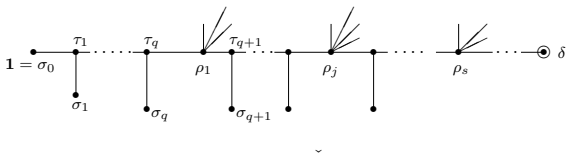
We compute the semigroup Poincaré series and the classical Poincaré series of a valuation... P^S_C(t) = ∏(1−t^{M_τi})/∏(1−t^{M_σi})
What do these tags mean?
- matches
- The paper's claim is directly supported by a theorem in the formal canon.
- supports
- The theorem supports part of the paper's argument, but the paper may add assumptions or extra steps.
- extends
- The paper goes beyond the formal theorem; the theorem is a base layer rather than the whole result.
- uses
- The paper appears to rely on the theorem as machinery.
- contradicts
- The paper's claim conflicts with a theorem or certificate in the canon.
- unclear
- Pith found a possible connection, but the passage is too broad, indirect, or ambiguous to say the theorem truly supports the claim.
Forward citations
Cited by 1 Pith paper
-
On a generalized Poincar\'e series of plane valuations
Equations are given for the generalized Poincaré series of plane valuations on E_{K^2,0} using the generalized Euler characteristic integral over the projectivized extended semigroup.
Reference graph
Works this paper leans on
-
[1]
Semigroups corresponding to algebroid branches in the plane
Bresinsky H. Semigroups corresponding to algebroid branches in the plane. Proc. of the A.M.S., v.32, no.2, 381–384 (1972)
work page 1972
-
[2]
Casas-Alvero E. Singularities of plane curves. London Mathematical So- ciety Lecture Note Series, 276. Cambridge University Press, Cambridge, 2000. 21
work page 2000
-
[3]
Gorenstein property and symmetry for one-dimensional local Cohen-Macaulay rings
Campillo A., Delgado F., Kiyek, K. Gorenstein property and symmetry for one-dimensional local Cohen-Macaulay rings. Manuscripta Math., v.83 (1994), no.3-4, 405–423
work page 1994
-
[4]
Guse˘ ın-Zade S. M.; Delgado F.; Campillo A. On the monodromy of a plane curve singularity and the Poincar´ e series of its ring of functions. Funkt- sional. Anal. i Prilozhen. v.33, no.1, 66–68 (1999; in Russian); translation in Funct. Anal. Appl. v.33, no.1, 56–57 (1999)
work page 1999
-
[5]
The Alexander polynomial of a plane curve singularity via the ring of functions on it
Campillo A., Delgado F., Gusein-Zade S.M. The Alexander polynomial of a plane curve singularity via the ring of functions on it. Duke Math. J. v.117, no.1, 125–156 (2003)
work page 2003
-
[6]
On the topological type of a set of plane valuations with symmetries
Campillo A., Delgado F., Gusein-Zade S.M. On the topological type of a set of plane valuations with symmetries. Math. Nachr., v.290, no.13, 1925–1938 (2017)
work page 1925
-
[7]
On real analogues of the Poincar´ e series
Campillo A., Delgado F., Gusein-Zade S.M. On real analogues of the Poincar´ e series. Bull. Lond. Math. Soc. v.56, no.1, 449–459 (2024)
work page 2024
-
[8]
Real Poincar´ e series of a plane divisorial valuation
Campillo A., Delgado F., Gusein-Zade S.M. Real Poincar´ e series of a plane divisorial valuation. Mosc. Math. J. v.25, no.2, 153–161 (2025)
work page 2025
-
[9]
On the Poincar´ e series for a plane divisorial valuation
Galindo C. On the Poincar´ e series for a plane divisorial valuation. Bull. Belg. Math. Soc. Simon Stevin v.2, no.1, 65–74 (1995)
work page 1995
-
[10]
The theory of classical valuations
Ribenboim P. The theory of classical valuations. Springer Monographs in Mathematics. Springer – Verlag, NewYork, 1999
work page 1999
-
[11]
Valuations in function fields of surfaces, Amer
Spivakosky M. Valuations in function fields of surfaces, Amer. J. Math. v.112, no.1, 107–156 (1990)
work page 1990
-
[12]
Wall C. T. C. Singular points of plane curves. London Mathematical So- ciety Student Texts, 63. Cambridge University Press, Cambridge, 2004. Addresses: A. Campillo and F. Delgado: IMUVA (Instituto de Investigaci´ on en Matem´ aticas), Universidad de Valladolid, Paseo de Bel´ en, 7, 47011 Valladolid, Spain. E-mail: campillo@agt.uva.es, fdelgado@uva.es S.M....
work page 2004
discussion (0)
Sign in with ORCID, Apple, or X to comment. Anyone can read and Pith papers without signing in.