REVIEW 2 major objections 5 minor 24 references
Construction of the smallest Ree-Tits unital from the special linear group of degree two over the field with eight elements
T0 review · 2 major / 5 minor · reviewed 2026-08-07 · deepseek-v4-flash
Pith's one-line read The paper constructs the smallest Ree-Tits unital from SL(2,8), proves it is a flag-transitive unital of order 3, and makes embeddings into larger Ree-Tits unitals explicit.
desk verdict A solid explicit matrix model of the smallest Ree-Tits unital, with a real but fixable support gap in the identification and an overstated embedding claim. read the letter →
The pith
A machine-rendered reading of the paper's core claim, the machinery that carries it, and where it could break.
The reading
What carries the argument
The central object is the incidence geometry $\mathcal{S}$ whose points are the 28 normalizers of Sylow 3-subgroups of $\Sigma\mathrm{L}(2,8)$ and whose 63 blocks are the involutions in that group, with incidence given by containment. The proof machinery consists of the trace-based order classification of elements in $\mathrm{SL}(2,8)$ (Lemma 1.2), the semi-regular action of a Sylow 3-subgroup on the remaining ones (Remark 1.3), and the reduction of every joining-block computation to solving two involution equations $IB = B^{-1}I$ and $IC = C^{-1}I$. The identification with the Ree-Tits unital rests on the isomorphism $\gamma$ from [23], [24], which is used to translate normalizers and involutions into the fixed-point geometry of involutions in $\mathrm{Ree}(3)$.
What would settle it
Compute, for each of the 63 involutions of $\Sigma\mathrm{L}(2,8)$, the image under the cited isomorphism $\gamma$ and verify that the joining-block and intersection data of Section 2.7 match the fixed-point sets of the corresponding involutions in $\mathrm{Ree}(3)$; a mismatch at any listed block or point would refute the identification with $\mathrm{RT}(3)$.
Extended reading notes
Core claim
The central claim is that the incidence geometry $\mathcal{S} = (\mathcal{N}, \mathcal{J}, \ni)$, with $\mathcal{N}$ the set of normalizers of Sylow 3-subgroups of $\Sigma\mathrm{L}(2,8)$ and $\mathcal{J}$ the set of its involutions, is a unital of order 3, meaning a 2-(28,4,1) design. The proof is self-contained: counting $|\mathcal{N}| = 28$, $|\mathcal{J}| = 63$, and $|\mathcal{N} \cap \mathcal{J}| = 9$ gives four points per block, and a short argument using the fact that two different Sylow 3-subgroups intersect trivially shows that any two points lie on exactly one block. The group $\mathrm{SL}(2,8)$ acts transitively on flags. The unital is not Hermitian, because $\mathrm{SL}(2,8)$ contains elements of order 9 while the automorphism group of the Hermitian unital of order 3 has exponent 3 on its Sylow 3-subgroups. Finally, through the exceptional isomorphism $\gamma : \Sigma\mathrm{L}(2,8) \to \mathrm{Ree}(3)$, the geometry is identified with the smallest Ree-Tits unital $\mathrm{RT}(3)$, and the explicit super O'Nan configuration is carried over to all Ree-Tits unitals of order $3^{2\ell+1}$.
Load-bearing premise
The identification of the constructed geometry $\mathcal{S}$ with the smallest Ree-Tits unital $\mathrm{RT}(3)$ rests on the existence of an isomorphism from $\Sigma\mathrm{L}(2,8)$ onto $\mathrm{Ree}(3)$ and on the normalization steps in Section 5, which are cited from the literature rather than proved here.
Editorial extensions
If this is right
- The matrix model makes every block of the smallest Ree-Tits unital explicit: joining two points reduces to solving a pair of linear equations over $\mathbb{F}_8$.
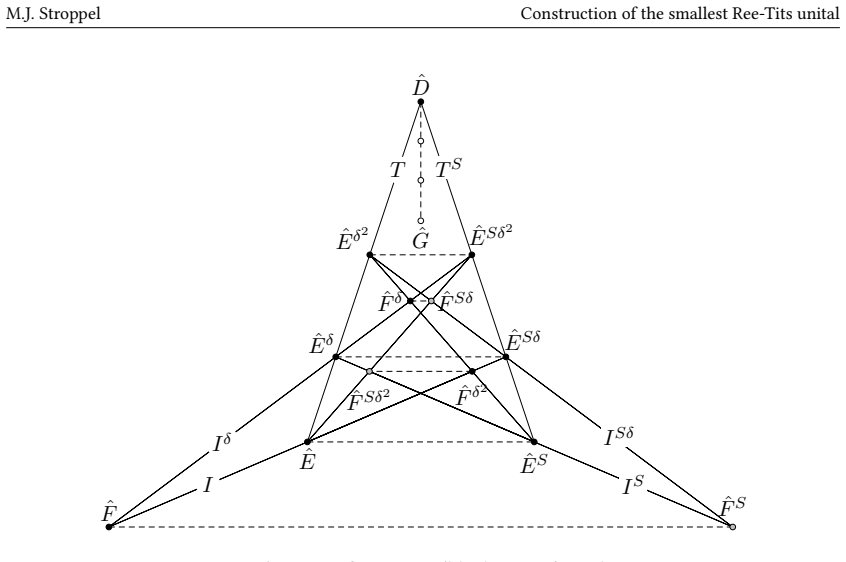
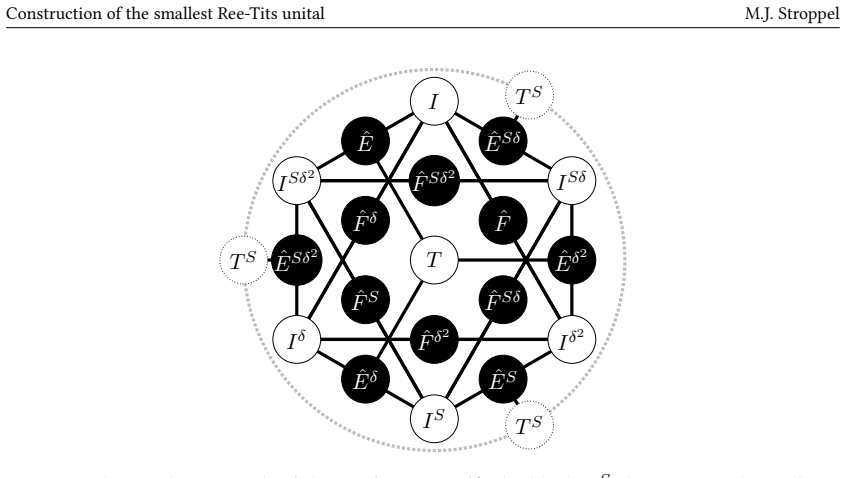
- The super O'Nan configuration of Section 2.7(l) — the dual of the complete graph $K_5$ — persists in every Ree-Tits unital $\mathrm{RT}(3^{2\ell+1})$, where the construction of Section 4.7 produces $q/3$ such configurations sharing the two blocks $\mathrm{Fix}(\tau)$ and $\mathrm{Fix}(\tau\sigma)$.
- $\mathrm{SL}(2,8)$ acts flag-transitively on $\mathcal{S}$, giving a concrete group action on a unital distinct from the Hermitian unital of order 3.
- The configuration $\mathcal{K}$ of 13 points and 8 blocks, with stabilizer of order 6 in $\Sigma\mathrm{L}(2,8)$, provides a finite test object for comparing embeddings of unitals of order 3 into projective planes of order 9.
- The explicit construction makes the open question in 2.8 well-posed: one can now search among the finitely many unitals of order 3 for those containing the dual of $K_5$.
Reading between the lines
- A constructive version of the isomorphism to the Ree group would make the identification with $\mathrm{RT}(3)$ fully self-contained, removing the dependence on an external existence result.
- The explicit super O'Nan configuration gives a combinatorial fingerprint that could be used to search the finitely many isomorphism classes of unitals of order 3 for other members containing the dual of $K_5$.
- The matrix model may offer a computational route to decide whether the smallest Ree-Tits unital embeds in a projective plane of order 9; the paper does not pursue that embedding question.
Editorial analysis
A structured set of objections, weighed in public.
Referee Report
Summary. The paper constructs an incidence geometry S whose points are normalizers of Sylow 3-subgroups of ΣL(2,8) and whose blocks are involutions in ΣL(2,8). It proves that S is a unital of order 3 acted on flag-transitively by SL(2,8) (Theorem 2.2), that S is not isomorphic to a Hermitian unital (Theorem 2.4), and it exhibits, by explicit matrix computations, a super O'Nan configuration (the dual of the complete graph on 5 vertices). The paper then reviews Ree groups and Ree-Tits unitals, uses an external isomorphism ΣL(2,8)≅Ree(3) to identify S with the smallest Ree-Tits unital RT(3), and translates the super O'Nan configuration to larger Ree-Tits unitals via a Λ-action.
Significance. The self-contained part of the paper is a clear strength: Theorem 2.2 is an elementary, checkable proof that S is a unital of order 3, and the matrix computations in Section 2.7 are explicit and reproducible. If the identification with RT(3) is accepted, the paper provides a useful small matrix model for the smallest Ree-Tits unital and makes the super O'Nan configuration visible in a concrete group-theoretic setting. The main weakness is that the central attribution to the Ree-Tits unital, as opposed to merely a non-Hermitian unital of order 3, depends on an external isomorphism and on asserted normalization steps that are not demonstrated. This is a support gap rather than an internal inconsistency, and it can be closed by a direct computational verification.
major comments (2)
- [Section 5; Remark 2.5] The central attribution that S is the Ree-Tits unital RT(3) is conditional. Remark 2.5 states that the identification proceeds 'assuming the mere existence of an isomorphism from ΣL(2,8) onto Ree(3)', and Section 5 supplies the bridge by citing Wilson [23,24]. That citation is admissible, but the three normalization steps in Section 5—Δ^γ=Ξ, S^γ=σ, and T^γ=τ—are asserted 'without loss of generality' without proof. In particular, the step 'This implies T^γ ∈ σZ' depends on the centralizer of δ^γ=λ_v in Ree(3)∞, which is not computed; and the simultaneous normalization of S^γ after fixing Δ^γ=Ξ requires an action of N_{Ree(3)}(Ξ) on the relevant conjugates that is not demonstrated. If any of these normalizations fails, the incidence isomorphism at the end of Section 5 does not follow. A direct check, for example by computing the image of each point and block of S under an explicit γ, would close this load-bearing gap.
- [Abstract; Section 4.7] The abstract's claim that 'embeddings into larger Ree-Tits unitals are made explicit' overstates what is proved. Section 4.7 shows that the super O'Nan configuration found in RT(3) gives |K|/3 such configurations in RT(q) sharing the blocks τ and τσ; it does not construct an embedding of the 28-point unital S into RT(q), nor does it map the points and blocks of S into the larger unital. The abstract should be rephrased to say that configurations are translated into all larger Ree-Tits unitals, or the embedding must actually be supplied.
minor comments (5)
- [Section 4.8] The GAP computation in Section 4.8 verifies the absence of additional intersections for |K| < 3^11, and the text is careful to say 'in these small cases'. This is fine as a computational observation, but it does not prove the general claim for all finite Ree groups; the finite-range status should be restated wherever the result is invoked.
- [Section 1.2] In the proof of Lemma 1.2, the sentence 'The center of SL(2,8) is trivial because s^2=1 implies s=1 since the ground field has characteristic 2' is slightly compressed; scalar matrices in SL(2,8) satisfy λ^2=1, hence λ=1, which is the argument intended.
- [Section 2.2] The notation N′ in the proof of Theorem 2.2 is used for the derived subgroup ⟨A⟩ of the dihedral group N, but N′ conventionally denotes the derived subgroup; the text should make this explicit to avoid confusion with the set of points N.
- [Section 5] The displayed set labelled E^γ⟨σ,λ_v⟩ is the orbit of the point E^γ under the group ⟨σ,λ_v⟩; the notation could be clarified by writing ⟨σ,λ_v⟩·E^γ or 'the orbit of E^γ under ...'.
- [Figures 1 and 2] The captions describe the configurations, but the figures are not included in the text provided; if the figures are essential to the exposition, they should be included in the final version.
Circularity Check
No circular derivation: S is built self-containedly from SL(2,8); the Ree-Tits identification uses an external isomorphism, not the paper's own outputs.
full rationale
The core construction in Section 2 is self-contained: Theorem 2.2 proves directly from Sylow and centralizer computations in Sigma L(2,8) that S is a 2-(28,4,1) design with a flag-transitive SL(2,8) action. Theorem 2.4 proves non-isomorphism to the Hermitian unital by a Sylow-exponent argument, with the O'Nan-configuration alternative only a secondary remark. The attribution of S as the smallest Ree-Tits unital is not derived from the unital property; it is bridged by the cited isomorphism gamma : Sigma L(2,8) -> Ree(3) (Wilson [23,24]), explicitly flagged in Remark 2.5 as an assumed external fact, and by the normalization chain in Section 5. Those normalizations are conjugacy reductions using proved facts (Sylow subgroups of Sigma L(2,8) and Lemma 4.1 on involutions in Ree(3)_infty); the assertion that T^gamma lies in sigma Z is a centralizer computation rather than a reuse of the target conclusion. The author's self-citations ([9], [18], [19], [20]) appear as background or as an alternative argument and are not load-bearing. No parameter is fitted and renamed a prediction, and no incidence object is defined in terms of the target Ree-Tits unital. The main weakness is a support gap: the external isomorphism and the WLOG normalizations are not computationally checked in the paper, so the identification's correctness depends on Wilson's result, but this is not a circularity.
Assumptions & free parameters
assumptions (3)
- domain assumption Existence of an isomorphism gamma from SL(2,8) onto Ree(3), with the conjectured correspondence of Sylow subgroups and involutions.
- standard math The Ree-Tits unital construction and the doubly transitive action of Ree(theta,K) on P, taken from Tits [21] and De Medts-Weiss [4].
- standard math Sylow theorems and trace-based conjugacy classification in SL(2,8), as stated in Lemma 1.2.
Cite this review
Pith. "Pith review of Construction of the smallest Ree-Tits unital from the special linear group of degree two over the field with eight elements." pith.science (2026). https://pith.science/paper/BN3NNOJO
@misc{pith2026250602732,
  author       = {Pith},
  title        = {Pith review of: Construction of the smallest Ree-Tits unital from the special linear group of degree two over the field with eight elements},
  year         = {2026},
  howpublished = {\url{https://pith.science/paper/BN3NNOJO}},
  note         = {Machine review of arXiv:2506.02732}
}
read the original abstract
We construct the smallest Ree-Tits unital from a group of matrices that is isomorphic to the commutator group of the corresponding Ree group. The matrix description is used to determine configurations in the unital via explicit computations. Embeddings into larger Ree-Tits unitals are made explicit.
Figures
Reference graph
Works this paper leans on
- [1]
- [2]
- [3]
-
[4]
T. De Medts and R. M. Weiss, The norm of a Ree group , Nagoya Math. J. 199 (2010), 15–41, http://projecteuclid.org/getRecord?id=euclid.nmj/ 1284471569. MR 2730410. Zbl 05813562
work page 2010
-
[5]
P. Dembowski, Finite geometries, Ergebnisse der Mathematik und ihrer Grenzgebiete 44, Springer-Verlag, Berlin, 1968, doi:10.1007/978-3-642-62012-6. MR 0233275. Zbl 0865.51004
-
[6]
Freudenthal, Oktaven, Ausnahmegruppen und Oktavengeometrie , Geom
H. Freudenthal, Oktaven, Ausnahmegruppen und Oktavengeometrie , Geom. Dedicata 19 (1985), no. 1, 7–63, doi:10.1007/BF00233101. MR 797151. Zbl 0573.51004
-
[7]
The GAP Group, GAP – Groups, Algorithms, and Programming, Version 4.12.0 , 2022. https://www.gap-system.org
work page 2022
-
[8]
L. C. Grove, Classical groups and geometric algebra , Graduate Studies in Mathemat- ics 39, American Mathematical Society, Providence, RI, 2002, doi:10.1090/gsm/039. MR 1859189. Zbl 0990.20001. © by M.J. Stroppel version of August 16, 2025 15 M.J. Stroppel Construction of the smallest Ree-Tits unital
Show all 24 references
-
[9]
Grundh ¨ofer, B
T. Grundh ¨ofer, B. Krinn, and M. J. Stroppel, Non-existence of isomorphisms between certain unitals , Des. Codes Cryptogr. 60 (2011), no. 2, 197–201, doi:10.1007/s10623-010-9428-2. MR 2795696. Zbl 05909195
2011 doi
-
[10]
Grundh ¨ofer and M
T. Grundh ¨ofer and M. J. Stroppel, Automorphisms of Verardi groups: small upper triangular matrices over rings, Beitr. Algebra Geom. 49 (2008), no. 1, 1–31, https://eudml.org/ doc/116938. MR 2410562. Zbl 05241751
2008
-
[11]
Gr ¨uning, Das kleinste Ree-Unital , Arch
K. Gr ¨uning, Das kleinste Ree-Unital , Arch. Math. (Basel) 46 (1986), no. 5, 473–480, doi:10.1007/BF01210788. MR 847092 (87g:51016). Zbl 0593.51012
1986
-
[12]
D. G. Higman and J. E. McLaughlin, Geometric ABA-groups, Illinois J. Math. 5 (1961), 382–397, http://projecteuclid.org/getRecord?id=euclid.ijm/ 1255630883. MR 0131216. Zbl 0104.14702
1961
-
[13]
W. M. Kantor, Homogeneous designs and geometric lattices , J. Combin. Theory Ser. A 38 (1985), no. 1, 66–74, doi:10.1016/0097-3165(85)90022-6. MR 773556. Zbl 0559.05015
1985
-
[14]
L ¨uneburg, Some remarks concerning the Ree groups of type (G2), J
H. L ¨uneburg, Some remarks concerning the Ree groups of type (G2), J. Algebra 3 (1966), 256–259, doi:10.1016/0021-8693(66)90014-7. MR 0193136. Zbl 0135.39401
1966
-
[15]
G. P. Nagy, Embeddings of Ree unitals in a projective plane over a field , Finite Fields Appl. 74 (2021), Paper No. 101875, 11, doi:10.1016/j.ffa.2021.101875. MR 4264172. Zbl 1481.51007
2021
-
[16]
M. E. O’Nan, Automorphisms of unitary block designs , J. Algebra 20 (1972), 495–511, doi:10.1016/0021-8693(72)90070-1. MR 0295934. Zbl 0241.05013
1972
-
[17]
Ree, A family of simple groups associated with the simple Lie algebra of type(G2), Amer
R. Ree, A family of simple groups associated with the simple Lie algebra of type(G2), Amer. J. Math. 83 (1961), 432–462, doi:10.2307/2372888. MR 0138680. Zbl 0104.24705
1961
-
[18]
M. J. Stroppel, Reconstruction of incidence geometries from groups of automorphisms, Arch. Math. (Basel) 58 (1992), no. 6, 621–624, doi:10.1007/BF01193534, http://dx.doi. org/10.18419/opus-7507. MR 1161931. Zbl 0781.51002
1992
-
[19]
M. J. Stroppel, A categorical glimpse at the reconstruction of geometries, Geom. Dedicata 46 (1993), no. 1, 47–60, doi:10.1007/BF01264093, http://dx.doi.org/10.18419/ opus-7512. MR 1214465. Zbl 0783.51002
1993
-
[20]
M. J. Stroppel and H. Van Maldeghem, Automorphisms of unitals, Bull. Belg. Math. Soc. Simon Stevin 12 (2005), no. 5, 895–908, http://projecteuclid.org/euclid.bbms/ 1136902624. MR 2241352. Zbl 1139.51002. 16 version of August 16, 2025 © by M.J. Stroppel Construction of the smal...
2005
-
[21]
Tits, Les groupes simples de Suzuki et de Ree, in: S´eminaire Bourbaki, 6, Exp
J. Tits, Les groupes simples de Suzuki et de Ree, in: S´eminaire Bourbaki, 6, Exp. No. 210, pp. 65–82, Soc. Math. France, Paris, 1995. https://eudml.org/doc/109620. MR 1611778. Zbl 0267.20041
1995
-
[22]
Van Maldeghem, Generalized polygons, Monographs in Mathematics 93, Birkh ¨auser Verlag, Basel, 1998, doi:10.1007/978-3-0348-0271-0
H. Van Maldeghem, Generalized polygons, Monographs in Mathematics 93, Birkh ¨auser Verlag, Basel, 1998, doi:10.1007/978-3-0348-0271-0. MR 1725957. Zbl 0914.51005
1998
-
[23]
R. A. Wilson, The finite simple groups , Graduate Texts in Mathematics 251, Springer- Verlag London Ltd., London, 2009, doi:10.1007/978-1-84800-988-2. MR 2562037. Zbl 1203.20012
2009
-
[24]
R. A. Wilson, Another new approach to the small Ree groups, Arch. Math. (Basel) 94 (2010), no. 6, 501–510, doi:10.1007/s00013-010-0130-4. MR 2653666. Zbl 1206.20016. Markus J. Stroppel LExMath Fakult¨at 8 Universit¨at Stuttgart 70550 Stuttgart stroppel@mathematik.uni-stuttgart...
2010
Reviewed August 7, 2026 · model on record in the stance chip above.
Discussion (0). Sign in to comment.