REVIEW 4 major objections 4 minor 50 references
Diagnosing the impact of relativistically intense prepulse on few-picosecond timeframes for short scale length laser-matter interactions
T0 review · 4 major / 4 minor · reviewed 2026-08-07 · deepseek-v4-flash
Pith's one-line read Picosecond-scale prepulse degradation, not nanosecond contrast, controls thin-foil harmonic emission and demands a $10^{10}$ few-ps contrast benchmark for multi-petawatt lasers.
desk verdict Few-ps contrast clearly degrades CSE harmonics, but the 10^10 benchmark and 'new diagnostic' claims are stretched on five uncalibrated FROG shots. read the letter →
The pith
A machine-rendered reading of the paper's core claim, the machinery that carries it, and where it could break.
The reading
What carries the argument
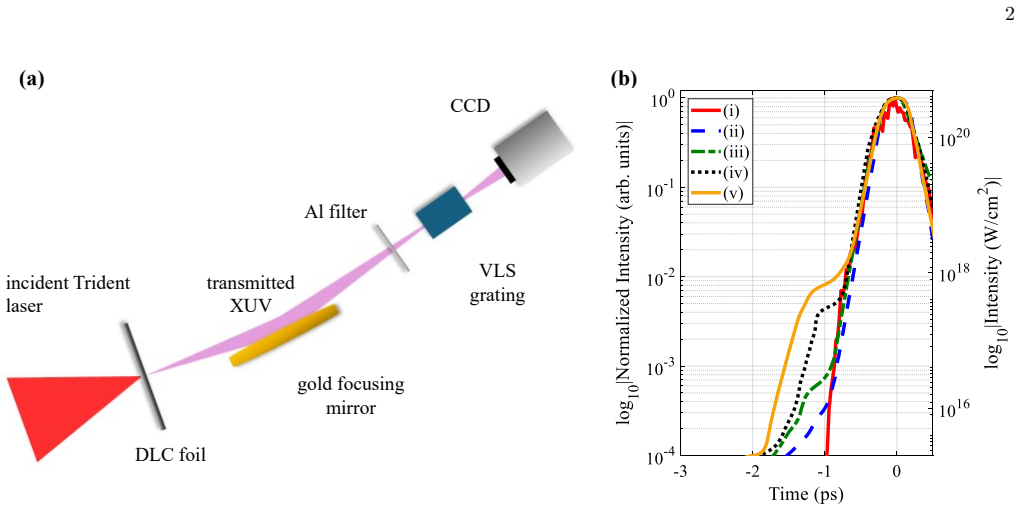
The diagnostic chain is the key machinery. A single-shot frequency resolved optical gating (FROG) autocorrelation device records the on-shot temporal profile around the main pulse, while coherent synchrotron emission (CSE), radiation emitted coherently by dense nanometre-scale electron bunches following synchrotron-like trajectories, provides the transmitted XUV harmonic spectrum as a sensitive readout of the preplasma density scale length. Two-dimensional particle-in-cell simulations, including collisional and collisionless absorption mechanisms, connect the measured pedestal shape to the evolving target density profile and to the loss of the reflecting critical surface.
What would settle it
Cross-calibrate the single-shot FROG against an independent third-order cross-correlator on identical shots; if the contrast values at $-1$ ps disagree, the quantitative correlation loses its foundation. Alternatively, a shot with contrast near $10^{-2}$ at $-1$ ps that still produced a narrow-band harmonic comb would directly contradict the claimed sensitivity.
Extended reading notes
Core claim
The central claim is that the few-picosecond pedestal, not the nanosecond pedestal, controls the outcome of relativistic interactions with ultra-thin foils. Measuring each shot's pulse shape with a single-shot FROG device and recording the transmitted harmonic spectrum on the same shot, the authors find that as the contrast at $-1$ ps drops from $10^{-6}$ to $10^{-2}$, the harmonic signal first brightens and broadens, then collapses from a narrow-band comb to featureless hot-plasma line emission. Two-dimensional particle-in-cell simulations with collisional absorption reproduce the preplasma expansion and show that for the worst contrast the main pulse breaks through the target before the interaction begins. The paper concludes that few-ps contrast on the order of $10^{10}$ will be required for multi-petawatt laser facilities, because a pedestal that is merely relativistic at MPW focal intensities can destroy the critical surface on the picosecond timescale.
Load-bearing premise
The load-bearing premise is that the single-shot FROG device accurately measures the absolute intensity of the few-picosecond pedestal on the interacting shot, and that this pedestal is the only significant variable that changes between the five shots.
Editorial extensions
If this is right
- A few-picosecond contrast near $10^{10}$ becomes a design requirement for multi-petawatt systems aiming to drive short scale-length solid-target interactions.
- The transmitted CSE harmonic spectrum can operate as an on-shot, non-invasive diagnostic of few-ps contrast on high-power laser facilities.
- The same few-ps sensitivity applies to other ultra-thin target applications such as radiation pressure acceleration, where optimal target thickness is tens of nanometres.
- Contrast-enhancement methods must address the few-ps pedestal rather than only the nanosecond-scale amplified spontaneous emission pedestal.
Reading between the lines
- If the harmonic spectrum is this sensitive, it could be calibrated as a quantitative contrast monitor on future multi-petawatt shots without adding a separate diagnostic beamline.
- The sudden spectral transition between the intermediate shots suggests a narrow pedestal-intensity window; mapping that window against pedestal duration would give front-end designers a concrete specification.
- The results imply that shot-to-shot reproducibility of harmonic yield may be dominated by contrast jitter, so single-shot contrast diagnostics should become standard in these experiments.
Editorial analysis
A structured set of objections, weighed in public.
Referee Report
Summary. The manuscript reports an experimental study at the Trident laser facility in which five single-shot measurements of the few-picosecond temporal contrast of the laser pulse are paired with five corresponding XUV harmonic spectra from ultra-thin diamond-like-carbon foils. The authors show that as a pedestal grows on the rising edge of the pulse, the transmitted harmonic spectra evolve from a narrow harmonic comb to broad, weak, line-dominated emission, and they attribute this to preplasma expansion driven by the pedestal. Two-dimensional EPOCH PIC simulations using the measured pulse shapes as input produce electron-density snapshots that qualitatively reproduce the progressive target expansion. The paper concludes with a benchmark claim that multi-petawatt laser systems will require few-picosecond contrast as high as 10^10 to preserve short-scale-length interactions.
Significance. If the central correlation is correct, the work offers a new on-shot diagnostic for few-picosecond contrast and a quantitative design target for future multi-petawatt facilities. The experimental design is genuinely useful: combining a single-shot FROG with a CSE-harmonic probe is a natural and minimally invasive way to link contrast to interaction quality, and the use of measured pulse shapes as input to the PIC simulations is appropriate validation rather than a circular step. No fitted parameters are introduced, and the qualitative PIC density snapshots support the proposed mechanism of pedestal-driven preplasma expansion. However, the quantitative strength of the paper currently rests on a small number of absolute contrast values whose calibration is not established, and the benchmark claim is not derived from the data with any explicit scaling. The paper therefore has a sound central idea but needs additional calibration, error analysis, and quantitative spectral analysis before its quantitative conclusions can be accepted.
major comments (4)
- [Fig. 1(b) and Fig. 2(b)] The absolute values of the few-picosecond pedestal contrast (10^-6 to 10^-2 at -1 ps) are obtained from a single-shot FROG device, but the manuscript reports no dynamic-range calibration, no error bars, no repeated measurements, and no independent cross-check against a third-order cross-correlator or similar diagnostic. A FROG retrieval is typically normalized to the main-pulse energy, and its ability to constrain the intensity at the 10^-6 level on the rising edge is not demonstrated. Since the x-axis of Fig. 2(b), the ordering of shots, and the subsequent 10^10 benchmark all depend on these absolute values, this calibration issue is load-bearing. The authors should either provide an explicit calibration of the FROG dynamic range at the relevant contrast levels or clearly state the uncertainty and show that the conclusion is robust within that uncertainty.
- [Fig. 2(a) and Fig. 2(b)] The correlation between integrated harmonic counts and contrast at -1 ps is based on only five shots with no estimate of shot-to-shot variability of the XUV signal at fixed contrast, no error bars on either axis, and no quantitative spectral analysis such as line-width, spectral scaling exponent, or harmonic-order cutoff as a function of contrast. The apparent rapid decay from shot (iii) to shot (v) is presented as a key observation, but with no measure of uncertainty it is not possible to determine whether the trend is robust or dominated by uncontrolled target, pointing, or CCD variations. The authors should add error analysis, repeat shots at similar contrast, or otherwise demonstrate statistical significance.
- [PIC simulations (Section with Fig. 3)] The PIC simulations are used only to provide qualitative electron-density snapshots; no synthetic harmonic spectra are computed, no quantitative comparison to the measured spectra is made, and no convergence study or sensitivity scan over numerical parameters (resolution, particle number, box size) is reported. Because the simulations use the same FROG-derived pulse shapes as the experimental x-axis, any systematic error in the FROG calibration propagates directly into the simulated pedestals. The simulations therefore support the proposed mechanism but do not currently validate the quantitative contrast thresholds or the 10^10 benchmark. Synthetic spectra or at least a quantitative scale-length characterization at the relevant times would materially strengthen the claim.
- [Discussion of 10^10 benchmark] The statement that few-picosecond contrast 'will be required to be up to 10^10' for multi-petawatt systems is presented as a conclusion of this work, but no explicit quantitative derivation connects the measured contrast values at Trident intensities (about 4x10^20 W/cm^2) to the required contrast at multi-petawatt focal intensities. The argument that a pedestal of 10^-6 at a few picoseconds becomes relativistic when scaled to MPW intensities is plausible, but the threshold should be derived from the scaling of the relevant absorption mechanisms (collisional absorption, J x B heating, stochastic heating) and the target-response timescales. Without this derivation, the benchmark is an extrapolation rather than a quantitative result of the presented data.
minor comments (4)
- [Abstract and Introduction] There are several typographical errors: 'pondermotive' should be 'ponderomotive', 'single-shot a single-shot frequency resolved optical gating' in Section II contains a duplicated phrase, and 'stochastic heating scale will scale with intensity' in the Discussion repeats 'scale'.
- [Fig. 2] The y-axis of Fig. 2(b) is labeled 'Integrated Counts (normalized)' but the normalization is only described in the caption as normalized to shot (ii); the text should also state the normalization more explicitly in the body. Error bars are absent on both axes, which is particularly important for the contrast axis as noted in the major comments.
- [Conclusion] The sentence 'These results acts as a benchmark for the contrast level required for MPW facilities' has a subject-verb agreement error; it should be 'These results act as a benchmark.'
- [References and text] The text says 'the CSE mechanism can be isolated using a novel geometry [31, 32]' and cites work by Dromey et al. from 2012 and 2013; the reader would benefit from a sentence clarifying the specific geometric feature that suppresses the ROM contribution, since the distinction is central to the interpretation of the spectra.
Circularity Check
No significant circularity: FROG contrast data are independent inputs, PIC simulations are forward models, and the MPW 10^10 benchmark is an explicit extrapolation rather than a fitted prediction.
full rationale
The derivation chain is not circular. The single-shot FROG traces are independent measurements used as the x-axis of Fig. 2(b) and as drive inputs to the EPOCH PIC simulations; the simulations then forward-model preplasma expansion and are compared qualitatively to the observed harmonic spectra. No parameter is fitted to the harmonic output and then renamed a prediction. The identification of the transmitted harmonics as CSE does rely on the authors' prior publications (Dromey et al., Refs 31 and 32), but these are externally published experimental results with stated spectral scaling and are not derived from the present dataset, so this is ordinary self-citation rather than a load-bearing circular loop. The few-picosecond contrast benchmark of ~10^10 for MPW systems is an explicit order-of-magnitude extrapolation of the measured pedestal intensities to higher peak powers, not a quantity fitted to the same data it is used to predict. Concerns about FROG dynamic-range calibration, absence of error bars, and the absence of an independent contrast diagnostic are measurement-reliability issues, not evidence that the paper's claims reduce by construction to its inputs.
Assumptions & free parameters
assumptions (4)
- domain assumption Transmitted harmonic spectra from normal-incidence interaction with ultra-thin foils are generated by coherent synchrotron emission, with scaling I(n) ~ n^-4/3 to n^-6/5.
- domain assumption The single-shot FROG device provides an accurate absolute measurement of the few-ps pulse pedestal on the interacting shot.
- domain assumption Preplasma expansion over the few-ps window is dominated by collisional (inverse bremsstrahlung) and collisionless (JxB and stochastic) heating as modeled by EPOCH with binary collision modules.
- domain assumption Extrapolation from Trident (0.4 PW) to multi-petawatt systems assumes the pedestal intensity scales with peak intensity at fixed contrast ratio.
Cite this review
Pith. "Pith review of Diagnosing the impact of relativistically intense prepulse on few-picosecond timeframes for short scale length laser-matter interactions." pith.science (2026). https://pith.science/paper/4BYHVG7D
@misc{pith2026250602798,
  author       = {Pith},
  title        = {Pith review of: Diagnosing the impact of relativistically intense prepulse on few-picosecond timeframes for short scale length laser-matter interactions},
  year         = {2026},
  howpublished = {\url{https://pith.science/paper/4BYHVG7D}},
  note         = {Machine review of arXiv:2506.02798}
}
abstract
With the rapid proliferation of multi-petawatt (MPW) lasers globally, a new era of high-energy density science promises to emerge within the next decade. However, precise control over how light at these ultra-relativistic intensities interacts with matter (especially with solid-density targets) will be crucial to fully realize the cutting-edge scientific advancements and technological breakthroughs that the MPW regime promises to unlock. In this manuscript, we present experimental results, supported by numerical simulations, which show how intense prepulse activity on few-ps ($10^{-12}$ s) timescales leads to rapid shifts in the steepness of the preplasma generated on the surface of ultra-thin nanofoil targets. By combining a single-shot frequency resolved optical gating (FROG) autocorrelation device to diagnose on-shot incident laser pulse contrast, with coherent synchrotron emission (CSE) from relativistic laser plasmas as a probe for evolving plasma-scale length conditions, we provide an experimental benchmark for laser contrast on forthcoming MPW facilities, where high contrast on few-ps timescales will be essential for the next generation of laser-solid interactions.
Figures


Reference graph
Works this paper leans on
-
[1]
Petawatt and exawatt class lasers worldwide.High Power Laser Sci- ence and Engineering, 7:e54, 2019
Colin N Danson, Constantin Haefner, Jake Bro- mage, Thomas Butcher, Jean-Christophe F Chanteloup, Enam A Chowdhury, Almantas Galvanauskas, Leonida A Gizzi, Joachim Hein, David I Hillier, et al. Petawatt and exawatt class lasers worldwide.High Power Laser Sci- ence and Engineering, 7:e54, 2019
work page 2019
-
[2]
High-order optical harmonic generation from solid surfaces.Applied Physics B, 63:499–506, 1996
D Von der Linde and K Rzazewski. High-order optical harmonic generation from solid surfaces.Applied Physics B, 63:499–506, 1996
work page 1996
-
[3]
Matthew Zepf, GD Tsakiris, G Pretzler, I Watts, DM Chambers, PA Norreys, U Andiel, AE Dangor, K Ei- dmann, C Gahn, et al. Role of the plasma scale length in the harmonic generation from solid targets.Physical Review E, 58(5):R5253, 1998
work page 1998
-
[4]
S Gordienko, A Pukhov, O Shorokhov, and T Baeva. Relativistic doppler effect: Universal spectra and zep- tosecond pulses.Physical review letters, 93(11):115002, 2004
work page 2004
-
[5]
High harmonics and sub-attosecond pulses in the relativistic regime
Teodora Baeva, Sergey Gordienko, and Alexander Pukhov. High harmonics and sub-attosecond pulses in the relativistic regime. InAPS Division of Atomic, Molecular and Optical Physics Meeting Abstracts, vol- ume 38, pages Q2–009, 2007
work page 2007
-
[6]
Plasma mirrors for ultrahigh-intensity optics.Nature Physics, 3(6):424–429, 2007
C´ edric Thaury, Fabien Quere, J-P Geindre, Anna Levy, Tiberio Ceccotti, P Monot, Michel Bougeard, F R´ eau, P d’Oliveira, Patrick Audebert, et al. Plasma mirrors for ultrahigh-intensity optics.Nature Physics, 3(6):424–429, 2007
work page 2007
-
[7]
SX Hu and LA Collins. Attosecond pump probe: explor- ing ultrafast electron motion inside an atom.Physical review letters, 96(7):073004, 2006
work page 2006
-
[8]
Route to intense single at- tosecond pulses.New Journal of Physics, 8(1):19, 2006
George D Tsakiris, Klaus Eidmann, J¨ urgen Meyer-ter Vehn, and Ferenc Krausz. Route to intense single at- tosecond pulses.New Journal of Physics, 8(1):19, 2006
work page 2006
Show all 50 references
-
[9]
Coherent focusing of high harmonics: A new way to- wards the extreme intensities.Physical review letters, 94(10):103903, 2005
S Gordienko, A Pukhov, O Shorokhov, and T Baeva. Coherent focusing of high harmonics: A new way to- wards the extreme intensities.Physical review letters, 94(10):103903, 2005
2005
-
[10]
Diffraction-limited per- formance and focusing of high harmonics from relativistic plasmas.Nature Physics, 5(2):146–152, 2009
Brendan Dromey, Daryl Adams, R H¨ orlein, Y Nomura, SG Rykovanov, DC Carroll, PS Foster, Satyabrata Kar, Keith Markey, P McKenna, et al. Diffraction-limited per- formance and focusing of high harmonics from relativistic plasmas.Nature Physics, 5(2):146–152, 2009
2009
-
[11]
Controlling the divergence of high harmonics from solid targets: a route toward coherent harmonic focusing.The European Phys- ical Journal D, 55:475–481, 2009
Rainer H¨ orlein, Sergey G Rykovanov, Brendan Dromey, Yutaka Nomura, D Adams, M Geissler, Matthew Zepf, Ferenc Krausz, and George D Tsakiris. Controlling the divergence of high harmonics from solid targets: a route toward coherent harmonic focusing.The European Phys- ical Jour...
2009
-
[12]
Achieving extreme light intensities us- ing optically curved relativistic plasma mirrors.Physical review letters, 123(10):105001, 2019
Henri Vincenti. Achieving extreme light intensities us- ing optically curved relativistic plasma mirrors.Physical review letters, 123(10):105001, 2019
2019
-
[13]
On gauge invariance and vacuum po- larization.Physical Review, 82(5):664, 1951
Julian Schwinger. On gauge invariance and vacuum po- larization.Physical Review, 82(5):664, 1951
1951
-
[14]
Quantum vacuum pro- cesses in the extremely intense light of relativistic plasma mirror sources.New Journal of Physics, 24(6):065005, 2022
Antonin Sainte-Marie, Luca Fedeli, Ne ¨ ıl Za ¨ ım, Felix Karbstein, and Henri Vincenti. Quantum vacuum pro- cesses in the extremely intense light of relativistic plasma mirror sources.New Journal of Physics, 24(6):065005, 2022
2022
-
[15]
Light-matter interaction near the schwinger limit using tightly focused doppler-boosted lasers.Physical Review Letters, 132(17):175002, 2024
Ne ¨ ıl Za ¨ ım, Antonin Sainte-Marie, Luca Fedeli, Pierre Bartoli, Axel Huebl, Adrien Leblanc, Jean-Luc Vay, and Henri Vincenti. Light-matter interaction near the schwinger limit using tightly focused doppler-boosted lasers.Physical Review Letters, 132(17):175002, 2024
2024
-
[16]
Realization of laser intensity over 1023 w/cm2
Jin Woo Yoon, Yeong Gyu Kim, Il Woo Choi, Jae Hee Sung, Hwang Woon Lee, Seong Ku Lee, and Chang Hee Nam. Realization of laser intensity over 1023 w/cm2. Optica, 8(5):630–635, May 2021
2021
-
[17]
Highly efficient double plasma mirror producing ultrahigh-contrast multi-petawatt laser pulses
Il Woo Choi, Cheonha Jeon, Seong Geun Lee, Seung Yeon Kim, Tae Yun Kim, I Jong Kim, Hwang Woon Lee, Jin Woo Yoon, Jae Hee Sung, Seong Ku Lee, and Chang Hee Nam. Highly efficient double plasma mirror producing ultrahigh-contrast multi-petawatt laser pulses. Opt. Lett., 45(23):6...
2020
-
[18]
Contrast degradation in a chirped-pulse amplifier due to generation of prepulses by postpulses
NV Didenko, A V Konyashchenko, AP Lutsenko, and S Yu Tenyakov. Contrast degradation in a chirped-pulse amplifier due to generation of prepulses by postpulses. Optics Express, 16(5):3178–3190, 2008
2008
-
[19]
Degrada- tion of picosecond temporal contrast of ti: sapphire lasers with coherent pedestals.Optics Letters, 41(19):4441– 4444, 2016
Nikita Khodakovskiy, Mikhail Kalashnikov, Emilien Gontier, Franck Falcoz, and Pierre-Mary Paul. Degrada- tion of picosecond temporal contrast of ti: sapphire lasers with coherent pedestals.Optics Letters, 41(19):4441– 4444, 2016
2016
-
[20]
High- density plasmas produced by ultrafast laser pulses.Phys- ical review letters, 62(2):155, 1989
MM Murnane, HC Kapteyn, and R W Falcone. High- density plasmas produced by ultrafast laser pulses.Phys- ical review letters, 62(2):155, 1989
1989
-
[21]
Effects of nonionizing prepulses in high-intensity laser- solid interactions.Physical Review E, 64(2):025401, 2001
KB Wharton, CD Boley, AM Komashko, AM Rubenchik, J Zweiback, J Crane, G Hays, TE Cowan, and T Ditmire. Effects of nonionizing prepulses in high-intensity laser- solid interactions.Physical Review E, 64(2):025401, 2001
2001
-
[22]
Conceptual design of sub-exa- watt system by using optical parametric chirped pulse amplification
J Kawanaka, K Tsubakimoto, H Yoshida, K Fujioka, Y Fujimoto, S Tokita, T Jitsuno, N Miyanaga, and Gekko-EXA Design Team. Conceptual design of sub-exa- watt system by using optical parametric chirped pulse amplification. InJournal of Physics: Conference Series, volume 688, page...
2016
-
[23]
Overview and sta- tus of station of extreme light toward 100 pw.The Review of Laser Engineering, 49(2):93, 2021
Yujie Peng, Yi Xu, Lianghong Yu, Xinliang W ANG, Yanyan LI, Xiaoming LU, Cheng W ANG, Jun LIU, Chengqiang ZHAO, Yanqi LIU, et al. Overview and sta- tus of station of extreme light toward 100 pw.The Review of Laser Engineering, 49(2):93, 2021
2021
-
[24]
International exawatt center for extreme light studies (xcels): Laser system and experi- 7 ment program.Bulletin of the Lebedev Physics Institute, 50(Suppl 6):S635–S640, 2023
I Yu Kostyukov, EA Khazanov, AA Shaikin, AG Lit- vak, and AM Sergeev. International exawatt center for extreme light studies (xcels): Laser system and experi- 7 ment program.Bulletin of the Lebedev Physics Institute, 50(Suppl 6):S635–S640, 2023
2023
-
[25]
Direct observation of density-gradient effects in harmonic gen- eration from plasma mirrors.Physical review letters, 110(17):175001, 2013
S Kahaly, S Monchoc´ e, H Vincenti, T Dzelzainis, B Dromey, M Zepf, Ph Martin, and F Qu´ er´ e. Direct observation of density-gradient effects in harmonic gen- eration from plasma mirrors.Physical review letters, 110(17):175001, 2013
2013
-
[26]
Influence of the laser prepulse on proton acceleration in thin-foil experiments.Physical review letters, 93(4):045003, 2004
Malte Kaluza, J¨ org Schreiber, Marko IK Santala, George D Tsakiris, Klaus Eidmann, J¨ urgen Meyer-ter Vehn, and Klaus J Witte. Influence of the laser prepulse on proton acceleration in thin-foil experiments.Physical review letters, 93(4):045003, 2004
2004
-
[27]
Effects of front surface plasma expansion on proton acceleration in ultraintense laser irradiation of foil targets.Laser and Particle Beams, 26(4):591–596, 2008
P McKenna, DC Carroll, Olle Lundh, F N¨ urnberg, Keith Markey, S Bandyopadhyay, D Batani, RG Evans, R Jafer, Saty Kar, et al. Effects of front surface plasma expansion on proton acceleration in ultraintense laser irradiation of foil targets.Laser and Particle Beams, 26(4):591–...
2008
-
[28]
Interaction of an ultrashort, relativistically strong laser pulse with an overdense plasma.Physics of Plasmas, 1(3):745–757, 1994
So V Bulanov, NM Naumova, and Francesco Pegoraro. Interaction of an ultrashort, relativistically strong laser pulse with an overdense plasma.Physics of Plasmas, 1(3):745–757, 1994
1994
-
[29]
Enhanced relativistic harmonics by elec- tron nanobunching.Physics of Plasmas, 17(3), 2010
A Pukhov et al. Enhanced relativistic harmonics by elec- tron nanobunching.Physics of Plasmas, 17(3), 2010
2010
-
[30]
Elec- tron trajectories associated with laser-driven coherent synchrotron emission at the front surface of overdense plasmas.Physical Review E, 101(5):053210, 2020
S Cousens, M Yeung, M Zepf, and B Dromey. Elec- tron trajectories associated with laser-driven coherent synchrotron emission at the front surface of overdense plasmas.Physical Review E, 101(5):053210, 2020
2020
-
[31]
Coherent syn- chrotron emission from electron nanobunches formed in relativistic laser–plasma interactions.Nature Physics, 8(11):804–808, 2012
B Dromey, S Rykovanov, M Yeung, Rainer H¨ orlein, Daniel Jung, Donald Cort Gautier, T Dzelzainis, Daniel Kiefer, S Palaniyppan, R Shah, et al. Coherent syn- chrotron emission from electron nanobunches formed in relativistic laser–plasma interactions.Nature Physics, 8(11):804–808, 2012
2012
-
[32]
Coherent synchrotron emission in transmission from ultrathin relativistic laser plasmas.New Journal of Physics, 15(1):015025, 2013
B Dromey, S Cousens, S Rykovanov, M Yeung, Daniel Jung, DC Gautier, T Dzelzainis, Daniel Kiefer, S Palaniyppan, R Shah, et al. Coherent synchrotron emission in transmission from ultrathin relativistic laser plasmas.New Journal of Physics, 15(1):015025, 2013
2013
-
[33]
Trident high-energy-density facility experimental capabilities and diagnostics.Review of Scientific Instruments, 79(10), 2008
Steven H Batha, R Aragonez, FL Archuleta, TN Archuleta, JF Benage, JA Cobble, JS Cowan, VE Fatherley, KA Flippo, DC Gautier, et al. Trident high-energy-density facility experimental capabilities and diagnostics.Review of Scientific Instruments, 79(10), 2008
2008
-
[34]
Mechanically ruled aberration-corrected con- cave gratings for a flat-field grazing-incidence spectro- graph.Applied optics, 22(4):512–513, 1983
Toshiaki Kita, Tatsuo Harada, N Nakano, and Hiroto Kuroda. Mechanically ruled aberration-corrected con- cave gratings for a flat-field grazing-incidence spectro- graph.Applied optics, 22(4):512–513, 1983
1983
-
[35]
High-temporal contrast using low-gain optical parametric amplification.Optics letters, 34(15):2273–2275, 2009
Rahul C Shah, Randall P Johnson, Tsutomu Shimada, Kirk A Flippo, Juan C Fernandez, and Bjorn M Hegelich. High-temporal contrast using low-gain optical parametric amplification.Optics letters, 34(15):2273–2275, 2009
2009
-
[36]
Dynamics of relativistic transparency and optical shuttering in expanding overdense plasmas
Sasi Palaniyappan, B Manuel Hegelich, Hui-Chun Wu, Daniel Jung, Donald C Gautier, Lin Yin, Brian J Al- bright, Randall P Johnson, Tsutomu Shimada, Samuel Letzring, et al. Dynamics of relativistic transparency and optical shuttering in expanding overdense plasmas. Nature Physic...
2012
-
[37]
Contemporary particle-in-cell approach to laser-plasma modelling.Plasma Physics and Controlled Fusion, 57(11):113001, 2015
TD Arber, Keith Bennett, CS Brady, A Lawrence- Douglas, MG Ramsay, Nathan John Sircombe, Paddy Gillies, RG Evans, Holger Schmitz, AR Bell, et al. Contemporary particle-in-cell approach to laser-plasma modelling.Plasma Physics and Controlled Fusion, 57(11):113001, 2015
2015
-
[38]
Simulations of ultraintense laser–plasma inter- actions.Physics of Fluids B: Plasma Physics, 5(7):2603– 2608, 1993
SC Wilks. Simulations of ultraintense laser–plasma inter- actions.Physics of Fluids B: Plasma Physics, 5(7):2603– 2608, 1993
1993
-
[39]
A binary collision model for plasma simulation with a particle code.Journal of computational physics, 25(3):205–219, 1977
Tomonor Takizuka and Hirotada Abe. A binary collision model for plasma simulation with a particle code.Journal of computational physics, 25(3):205–219, 1977
1977
-
[40]
Yasuhiko Sentoku and Andreas J Kemp. Numerical methods for particle simulations at extreme densities and temperatures: Weighted particles, relativistic collisions and reduced currents.Journal of computational Physics, 227(14):6846–6861, 2008
2008
-
[41]
Absorption of ultrashort, ultra-intense laser light by solids and over- dense plasmas.IEEE Journal of Quantum Electronics, 33(11):1954–1968, 1997
Scott C Wilks and William L Kruer. Absorption of ultrashort, ultra-intense laser light by solids and over- dense plasmas.IEEE Journal of Quantum Electronics, 33(11):1954–1968, 1997
1954
-
[42]
J×b heating by very intense laser light.The Physics of fluids, 28(1):430– 432, 1985
William L Kruer and Kent Estabrook. J×b heating by very intense laser light.The Physics of fluids, 28(1):430– 432, 1985
1985
-
[43]
Identification of coupling mechanisms between ultraintense laser light and dense plasmas
Ludovic Chopineau, Adrien Leblanc, Guillaume Blaclard, Adrien Denoeud, Maxence Th´ evenet, Jean-Luc Vay, Guy Bonnaud, Ph Martin, Henri Vincenti, and Fabien Qu´ er´ e. Identification of coupling mechanisms between ultraintense laser light and dense plasmas. Physical Review X, 9...
2019
-
[44]
Threshold for electron heating by two electromagnetic waves.Physical Review A, 28(6):3592, 1983
JT Mendon¸ ca. Threshold for electron heating by two electromagnetic waves.Physical Review A, 28(6):3592, 1983
1983
-
[45]
High-energy ion generation in interaction
Y Sentoku, V Yu Bychenkov, K Flippo, Anatoly Mak- simchuk, K Mima, G Mourou, ZM Sheng, and Donald Umstadter. High-energy ion generation in interaction. of short laser pulse with high-density plasma.Applied Physics B, 74:207–215, 2002
2002
-
[46]
Coupling of laser energy into hot- electrons in high-contrast relativistic laser-plasma inter- actions.Physics of Plasmas, 20(3), 2013
GE Kemp, A Link, Y Ping, DW Schumacher, RR Free- man, and PK Patel. Coupling of laser energy into hot- electrons in high-contrast relativistic laser-plasma inter- actions.Physics of Plasmas, 20(3), 2013
2013
-
[47]
The plasma mirror—a subpicosecond optical switch for ul- trahigh power lasers.Review of Scientific Instruments, 75(3):645–649, 2004
B Dromey, S Kar, M Zepf, and PJROSI Foster. The plasma mirror—a subpicosecond optical switch for ul- trahigh power lasers.Review of Scientific Instruments, 75(3):645–649, 2004
2004
-
[48]
Experi- ment and simulation of novel liquid crystal plasma mir- rors for high contrast, intense laser pulses.Scientific re- ports, 6(1):32041, 2016
Patrick L Poole, Andrew Krygier, Ginevra E Cochran, PS Foster, GG Scott, LA Wilson, J Bailey, N Bourgeois, Cristina Hernandez-Gomez, David Neely, et al. Experi- ment and simulation of novel liquid crystal plasma mir- rors for high contrast, intense laser pulses.Scientific re- ...
2016
-
[49]
Emittance preserving thin film plasma mir- rors for gev scale laser plasma accelerators.Physical Re- view Accelerators and Beams, 24(12):121301, 2021
A Zingale, N Czapla, DM Nasir, SK Barber, JH Bin, AJ Gonsalves, F Isono, J van Tilborg, S Steinke, K Naka- mura, et al. Emittance preserving thin film plasma mir- rors for gev scale laser plasma accelerators.Physical Re- view Accelerators and Beams, 24(12):121301, 2021
2021
-
[50]
Greater than five-order-of-magnitude postcompression temporal con- trast improvement with an ionization plasma grating
Matthew R Edwards, Nicholas M Fasano, Andreas M Giakas, Michelle M Wang, Jesse Griff-McMahon, Ana- toli Morozov, Victor M Perez-Ramirez, Nuno Lemos, Pierre Michel, and Julia M Mikhailova. Greater than five-order-of-magnitude postcompression temporal con- trast improvement with...
2024
Reviewed August 7, 2026 · model on record in the stance chip above.
Discussion (0). Sign in to comment.