REVIEW 5 major objections 6 minor 46 references
Combining social relations and interaction data in Recommender System with Graph Convolution Collaborative Filtering
T0 review · 5 major / 6 minor · reviewed 2026-08-07 · deepseek-v4-flash
Pith's one-line read This paper claims that propagating user embeddings through interaction, Jaccard-similarity, and friendship graphs matches or beats nine baselines on recall, precision, and NDCG@20 in four datasets.
desk verdict The central user-correlation matrix C is undefined as written (union/intersection, not Jaccard), so the paper's core signal is unreproducible; the rest is a modest, interesting ablation study that would need code, data, and variance reporting before I'd trust the gains. read the letter →
The pith
A machine-rendered reading of the paper's core claim, the machinery that carries it, and where it could break.
The reading
What carries the argument
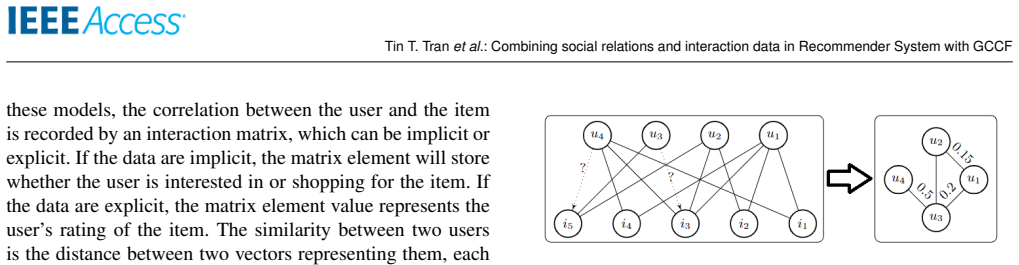
The central mechanism is multi-graph linear embedding propagation. Every layer, the user embedding aggregates three symmetrically normalized neighborhood sums—from the interaction matrix A, the social matrix S, and the correlation matrix C—and the item embedding aggregates only from A (Equation 9); the three user signals are combined by weighted sum and, in matrix form (Equation 14), by simple addition. The new object is C: the paper computes the user-correlation signal from the Jaccard overlap of users' item sets and then applies a fixed quantization function f (Table 2) that maps overlap values into five levels, so that strong overlaps strongly influence propagation while weak overlaps are zeroed out. The final embedding is the mean over K layers, and the trainable parameters are only the initial embeddings, with the BPR loss trained by Adam.
What would settle it
Recompute the Table 4 numbers with the correlation matrix C removed from propagation (its normalized adjacency set to zero); if recall, precision, or NDCG@20 on any dataset stays at or above the variant that uses only interaction and social signals, then C contributes nothing and the central claim fails. A second check: the formula printed as equation (6), with WU the union size and WI the intersection size, yields values of one or larger rather than Jaccard similarities in [0,1], so the quantization in Table 2 is not directly reproducible from the text alone and requires the authors' implementation.
Extended reading notes
Core claim
The central claim is that user embeddings should be built by linearly propagating through three symmetrically normalized adjacency matrices at the same time: the user–item interaction matrix A, the social friendship matrix S, and a user-correlation matrix C derived from the Jaccard overlap of users' item sets, with overlap values quantized into five influence levels (0, 0.005, 0.05, 0.5, 1) according to Table 2. At each layer the three user-signal embeddings are simply summed and the item embedding propagates only through A (Equations 9 and 14), and the final user and item embeddings are the mean of all layer embeddings, scored by inner product and trained with Bayesian personalized ranking. With these design choices—no feature-transformation matrices and no nonlinear activations—the model reports the best or tied-best recall, precision, and NDCG@20 among MF, SocialMF, TrustSVD, GCMC, NGCF, WiGCN, LightGCN, SocialLGN, and SEPT on Gowalla, Librarything, Ciao, and Epinions. The authors interpret this as evidence that the correlation graph contributes influence signals beyond what high-order connectivity in the interaction graph and raw friendship edges already provide, and that quantizing overlaps prevents the model from overfitting to noisy small co-occurrences.
Load-bearing premise
The load-bearing premise is that the degree of overlap between two users' purchased or rated items carries influence information that is not already present in the purchase graph or the friendship graph, and that adding the three propagation signals by simple summation is enough to turn that influence into better recommendations.
Editorial extensions
If this is right
- On Gowalla, Librarything, Ciao, and Epinions, the full model reports the best or tied-best recall, precision, and NDCG@20 among the nine baselines in Table 4; the recall gains over the best baseline are roughly 0.08 to 0.68 percentage points.
- Adding the correlation matrix shortens training: on Gowalla the full model converges in 440 epochs versus 1,140 for LightGCN and 1,090 for SEPT, with similar reductions on the other datasets.
- The ablations show the two extra signals play different roles: on Gowalla social friendship contributes the larger share of the improvement, while on Librarything the interaction-correlation signal matters more and social data alone slightly lowers NDCG; combining both always gives the best result.
- Removing both feature-transformation matrices and nonlinear activations is again confirmed as the right simplification: SocialLGN variants that drop only one of the two perform worse, and the proposed model uses neither.
Reading between the lines
- Because C is computed once from the interaction matrix with simple matrix operations, the observed convergence speedup suggests a preprocessing-only enhancement that could be bolted onto other LightGCN-style recommenders; the paper does not test that transfer.
- The quantization into five fixed levels is one regularization choice; a continuous Jaccard weight or a learned mapping from overlap to influence would separate the benefit of the similarity signal itself from the benefit of threshold smoothing.
- Since the social matrix is optional, the same architecture could accept other user–user relations, such as trust scores or co-purchase at category level, in place of friendship edges; the paper leaves that substitution untested.
Editorial analysis
A structured set of objections, weighed in public.
Referee Report
Summary. This manuscript presents GCCF, a graph convolution collaborative filtering model that augments a LightGCN-style user-item propagation with two additional user-user signals: a quantized Jaccard overlap matrix C computed from purchase/rating histories and a social friendship matrix S. The authors propose a preprocessing pipeline (10-core filtering and user retention by Jaccard overlap), a propagation layer that averages normalized signals from A, C, and S, and a BPR loss. They compare against nine baselines on Gowalla, Librarything, Ciao, and Epinions and report that the full model achieves the highest recall, precision, and NDCG@20, while also converging faster than LightGCN-based baselines.
Significance. If the empirical claims are correct, the contribution is modest but useful: it shows that a lightweight, transformation-free GCN can incorporate social and behavioral user-user correlation signals, and it provides an ablation separating the two signals. The paper compares against a broad set of baselines and reports per-dataset results, which is a strength. However, the central new signal C is not well defined as written, the reported gains are small and without variance estimates, and the preprocessing makes the evaluation non-standard. Because of these issues, the significance of the claims cannot be assessed from the manuscript in its current form.
major comments (5)
- [III-A-2, Eqs. (4)-(6), Table 2] Equations (4) and (5) define WU = |Ii ∪ Ij| and WI = |Ii ∩ Ij|. Equation (6) then sets C = f(WU ⊙ WI^{-1}), whose element is |union| / |intersection|, which is ≥ 1 whenever the intersection is nonempty and undefined when it is empty. Table 2, however, partitions only values in [0,1] as Jaccard indices, and the sentence after (6) calls WI 'the matrix that represents the union.' The literal reading cannot produce the C used in the experiments; if the intended formula is WI ⊙ WU^{-1}, the paper must state this, handle the zero-intersection case, and re-run the experiments, because every reported improvement over LightGCN/WiGCN is attributed to this matrix.
- [III-A-2 and IV-A] The manuscript does not state whether the correlation matrix C is constructed from the full preprocessed interaction matrix or only from the 80% training split used for learning. If C is built from all interactions before the 20% latest-interaction test split, then test labels are visible in the user-user overlap signal during training, which would invalidate the evaluation. The authors should specify that C, S, and the propagation graph are computed from training data only, and recompute all tables if necessary.
- [IV-B, Table 4] The text in Section IV-B states that 'our model with interaction embedding (Our w/ interaction) still gives the highest results' among the non-social models MF, GCMC, NGCF, LightGCN, and WiGCN. Table 4 contradicts this on Epinions: for recall, LightGCN achieves 0.0150 versus 0.0139 for 'Our w/ interact', and for NDCG@20, 0.0085 versus 0.0073. This claim needs to be corrected or the table corrected.
- [III-A-2, Table 2] The quantization function f in Table 2 uses hand-selected bin boundaries and typical values (0.0, 0.005, 0.05, 0.5, 1.0) with no stated selection procedure and no sensitivity analysis. Because the reported improvements of the full model over LightGCN are small (e.g., +7.3% recall on Gowalla, +4.7% on Librarything; interaction-only gains of +2.1% and +0.3%), it is not possible to tell whether the gains come from the proposed propagation or from threshold choices tuned to the datasets. The authors should justify the thresholds via validation and report sensitivity or ablation results.
- [III-A, Algorithm 1 and Section IV-A] The preprocessing is not reproducible as specified: the text says 10-core drops users with fewer than 10 interactions, but Algorithm 1 filters out items with fewer than 10 interactions; the user-retention step keeps users with the highest Jaccard distance to the full item set using a 'selected_ratio' taken from the original dataset, which substantially changes the evaluation population. The authors should release the exact processed datasets and code, and clarify whether all baseline results are produced on the same processed data; otherwise the comparison in Table 4 cannot be verified.
minor comments (6)
- [III-A, Algorithm 1] The 10-core description is inconsistent: the text says users with fewer than 10 interactions are dropped, while Algorithm 1 filters out items with fewer than 10 interactions; these are different operations and the discrepancy should be resolved.
- [III-B-5, Eq. (14)] Equation (14) uses notation eS, eC, and eR that is not defined consistently with (15), and the superscripts on E^{(k-1)} versus E^{(k)} appear to be off by one relative to the propagation equations in (9).
- [IV-A, Eq. (16)] The definitions of false positive and false negative in (16) are incorrect; false negative is an actual interaction not retrieved, not 'predicted interactions not being exist on the test set.' The ranking metrics (recall@20, NDCG@20) should be defined precisely.
- [IV-C-1] The text mentions 'SocialGCN' in item 3, but this model is not among the baselines and is not defined; the intended reference may be SEPT.
- [V-A] The conclusion contains a placeholder citation '[?]' that should be removed or replaced.
- [General] There are numerous typos and inconsistencies, including 'analyst' for 'analyze' in the introduction, 'Epinion' in the Table 4 header, and 'N DGC' in equation (17).
Circularity Check
No circular derivation: held-out evaluation and external baselines make the central comparison self-contained; the only circularity-adjacent concern is a non-load-bearing self-citation, plus an internal inconsistency in the definition of C that is a reproducibility defect, not a circularity.
full rationale
The paper's claim is empirical: GCCF combines interaction matrix A, quantized user-correlation matrix C, and social matrix S, and reports higher recall/precision/NDCG@20 than listed baselines (Table 4). The evaluation protocol splits interactions by timestamp into 80% training and 20% test (Section IV-A), so metrics are computed against interactions not used in the BPR loss. The propagation equations (9) and (14) are standard LightGCN-style aggregation, and no parameter is fitted to the test labels. No uniqueness theorem or external mathematical result is invoked to force the architecture. The cited prior work [34] is by the same first author and is used to motivate adding a weighted user influence matrix, but the contribution of that matrix is tested directly via ablations (Tables 7 and 8), so the self-citation is not load-bearing. Two non-circular concerns should be weighed. First, Section III-A-2/Equation (6) is internally inconsistent: with WU = |Ii ∪ Ij| and WI = |Ii ∩ Ij|, the expression WU ⊙ WI^{-1} equals |Ii ∪ Ij| / |Ii ∩ Ij|, which is ≥ 1 and undefined for disjoint sets, while Table 2 bins values in [0,1). The text at (6) also reverses the roles by calling WI the union matrix. Thus the actual C used in experiments is not specified as written, which is a reproducibility defect but not a circular reduction. Second, the 10-core and user-selection preprocessing is dataset-dependent, but it is applied uniformly to all models and does not by construction determine the ranking in Table 4. Overall, the derivation is self-contained; the score of 2 reflects only the minor non-load-bearing self-citation and the flagged specification defect, not a by-construction equivalence.
Assumptions & free parameters
free parameters (4)
- Jaccard quantization thresholds =
0.0, 0.005, 0.05, 0.5, 1.0
- 10-core threshold =
10
- selected_ratio (item/user ratio for user retention) =
datasets dependent: 1.44, 1.60, 18.78, 11.95
- embedding size d and layer count K =
d=64, K unspecified
assumptions (4)
- domain assumption High-order connectivity in the user-item graph encodes collaborative filtering signals usable by linear propagation
- domain assumption Social friendship edges S are undirected and binary even when the source data (e.g., Epinions trust, Ciao friend lists) may be directed or weighted
- ad hoc to paper The user-correlation matrix C, derived from Jaccard item overlaps quantized by Table 2, captures user influence complementary to friendship S
- ad hoc to paper Keeping only the most active users (highest Jaccard overlap with the item catalog) preserves a representative evaluation population
Cite this review
Pith. "Pith review of Combining social relations and interaction data in Recommender System with Graph Convolution Collaborative Filtering." pith.science (2026). https://pith.science/paper/ERM2CWPP
@misc{pith2026250602834,
  author       = {Pith},
  title        = {Pith review of: Combining social relations and interaction data in Recommender System with Graph Convolution Collaborative Filtering},
  year         = {2026},
  howpublished = {\url{https://pith.science/paper/ERM2CWPP}},
  note         = {Machine review of arXiv:2506.02834}
}
read the original abstract
A recommender system is an important subject in the field of data mining, where the item rating information from users is exploited and processed to make suitable recommendations with all other users. The recommender system creates convenience for e-commerce users and stimulates the consumption of items that are suitable for users. In addition to e-commerce, a recommender system is also used to provide recommendations on books to read, movies to watch, courses to take or websites to visit. Similarity between users is an important impact for recommendation, which could be calculated from the data of past user ratings of the item by methods of collaborative filtering, matrix factorization or singular vector decomposition. In the development of graph data mining techniques, the relationships between users and items can be represented by matrices from which collaborative filtering could be done with the larger database, more accurate and faster in calculation. All these data can be represented graphically and mined by today's highly developed graph neural network models. On the other hand, users' social friendship data also influence consumption habits because recommendations from friends will be considered more carefully than information sources. However, combining a user's friend influence and the similarity between users whose similar shopping habits is challenging. Because the information is noisy and it affects each particular data set in different ways. In this study, we present the input data processing method to remove outliers which are single reviews or users with little interaction with the items; the next proposed model will combine the social relationship data and the similarity in the rating history of users to improve the accuracy and recall of the recommender system.
Figures


Figures from the paper (4 more)


Reference graph
Works this paper leans on
-
[1]
Zhang, J., Lin, Z., Xiao, B. & Zhang, C. An optimized item-based col- laborative filtering recommendation algorithm. 2009 IEEE International Conference On Network Infrastructure And Digital Content. pp. 414-418 (2009)
work page 2009
-
[2]
Tewari, A., Kumar, A. & Barman, A. Book recommendation system based on combine features of content based filtering, collaborative filtering and association rule mining. 2014 IEEE International Advance Computing Conference (IACC). pp. 500-503 (2014)
work page 2014
-
[3]
Grattarola, D. & Alippi, C. Graph Neural Networks in TensorFlow and Keras with Spektral [Application Notes]. IEEE Computational Intelligence Magazine. 16, 99-106 (2021)
work page 2021
- [4]
- [5]
-
[6]
Dossena, M., Irwin, C. & Portinale, L. Graph-based Recommendation using Graph Neural Networks. 2022 21st IEEE International Conference On Machine Learning And Applications (ICMLA). pp. 1769-1774 (2022)
work page 2022
-
[7]
Neural Graph Collaborative Filtering
Wang, X., He, X., Wang, M., Feng, F. & Chua, T. Neural Graph Collaborative Filtering. CoRR. abs/1905.08108 (2019), http://arxiv.org/abs/1905.08108
work page Pith review arXiv 2019
-
[8]
Candillier, L., Meyer, F. & Boullé, M. Comparing State-of-the-Art Collab- orative Filtering Systems. MLDM. (2007)
work page 2007
Show all 46 references
-
[9]
& Salehi, M
Jalili, M., Ahmadian, S., Izadi, M., Moradi, P. & Salehi, M. Evaluating Collaborative Filtering Recommender Algorithms: A Survey. IEEE Ac- cess. 6 pp. 74003-74024 (2018)
2018
-
[10]
A Framework for Collaborative, Content-Based and Demo- graphic Filtering
Pazzani, M. A Framework for Collaborative, Content-Based and Demo- graphic Filtering. ARTIFICIAL INTELLIGENCE REVIEW. 13 pp. 393- 408 (1999)
1999
-
[11]
& Tuzhilin, A
Adomavicius, G., Sankaranarayanan, R., Sen, S. & Tuzhilin, A. Incorpo- rating contextual information in recommender systems using a multidi- mensional approach. ACM Transactions On Information Systems (TOIS). 23, 103-145 (2005)
2005
-
[12]
& Moradi, P
Bojnordi, E. & Moradi, P. A novel collaborative filtering model based on combination of correlation method with matrix completion technique. The 16th CSI International Symposium On Artificial Intelligence And Signal Processing (AISP 2012). pp. 191-194 (2012)
2012
-
[13]
& Terry, D
Goldberg, D., Nichols, D., Oki, B. & Terry, D. Using Collaborative Filtering to Weave an Information Tapestry. Commun. ACM. 35, 61-70 (1992,12), https://doi.org/10.1145/138859.138867
1992
-
[14]
& Kriegel, H
Yu, K., Xu, X., Tao, J., Ester, M. & Kriegel, H. Instance Selection Techniques for Memory-Based Collaborative Filtering. Proceedings Of The 2002 SIAM International Conference On Data Mining (SDM). pp. 59-74, https://epubs.siam.org/doi/abs/10.1137/1.9781611972726.4
2002 doi
-
[15]
& V olinsky, C
Koren, Y ., Bell, R. & V olinsky, C. Matrix Factorization Techniques for Recommender Systems. Computer. 42, 30-37 (2009)
2009
-
[16]
& Welling, M
Berg, R., Kipf, T. & Welling, M. Graph Convolutional Matrix Completion. (2017)
2017
-
[17]
Guo, Q., Zhuang, F., Qin, C., Zhu, H., Xie, X., Xiong, H. & He, Q. A Survey on Knowledge Graph-Based Recommender Systems. IEEE Transactions On Knowledge; Data Engineering. 34, 3549-3568 (2022,8) VOLUME 4, 2016 11 Tin T. Tranet al.: Combining social relations and interaction da...
2022
-
[18]
& Khan, L
Gao, Y ., Li, Y ., Lin, Y ., Gao, H. & Khan, L. Deep Learning on Knowledge Graph for Recommender System: A Survey. (2020)
2020
-
[19]
& Cui, B
Wu, S., Sun, F., Zhang, W. & Cui, B. Graph Neural Networks in Recom- mender Systems: A Survey. (2021)
2021
-
[20]
Wu, Z., Pan, S., Chen, F., Long, G., Zhang, C. & Yu, P. A Comprehensive Survey on Graph Neural Networks. IEEE Transac- tions On Neural Networks And Learning Systems. 32, 4-24 (2021,1), http://dx.doi.org/10.1109/TNNLS.2020.2978386
2021
-
[21]
Wang, X., Ji, H., Shi, C., Wang, B., Cui, P., Yu, P. & Ye, Y . Het- erogeneous Graph Attention Network. CoRR. abs/1903.07293 (2019), http://arxiv.org/abs/1903.07293
2019 arXiv
-
[22]
& Leskovec, J
Ying, R., He, R., Chen, K., Eksombatchai, P., Hamilton, W. & Leskovec, J. Graph Convolutional Neural Networks for Web-Scale Recommender Systems. Proceedings Of The 24th ACM SIGKDD International Con- ference On Knowledge Discovery &; Data Mining. pp. 974-983 (2018), https://doi...
2018
-
[23]
& Leskovec, J
Hamilton, W., Ying, R. & Leskovec, J. Inductive Representa- tion Learning on Large Graphs. CoRR. abs/1706.02216 (2017), http://arxiv.org/abs/1706.02216
2017 arXiv
-
[24]
& Wang, M
He, X., Deng, K., Wang, X., Li, Y ., Zhang, Y . & Wang, M. LightGCN: Simplifying and Powering Graph Convolution Network for Recommenda- tion. (2020)
2020
-
[25]
& Yorke-Smith, N
Guo, G., Zhang, J. & Yorke-Smith, N. A Novel Recommendation Model Regularized with User Trust and Item Ratings. IEEE Transactions On Knowledge And Data Engineering. 28, 1607-1620 (2016)
2016
-
[26]
& Yang, S
Jiang, M., Cui, P., Wang, F., Zhu, W. & Yang, S. Scalable Recommendation with Social Contextual Information. IEEE Transactions On Knowledge And Data Engineering. 26, 2789-2802 (2014)
2014
-
[27]
& Fowler, J
Bond, R., Fariss, C., Jones, J., Kramer, A., Marlow, C., Set- tle, J. & Fowler, J. A 61-million-person experiment in social in- fluence and political mobilization. Nature. 489, 295-298 (2012,9,1), https://doi.org/10.1038/nature11421
2012 doi
-
[28]
& Tang, J
Qiu, J., Tang, J., Ma, H., Dong, Y ., Wang, K. & Tang, J. Deep- Inf : Modeling Influence Locality in Large Social Networks. (2018), https://api.semanticscholar.org/CorpusID:49239721
2018
-
[29]
& Srihari, S
Wang, J., Bagul, D. & Srihari, S. ContextMF : A Fast and Context-aware Embedding Learning Method for Recommendation Systems. (2018), https://api.semanticscholar.org/CorpusID:198186939
2018
-
[30]
Factorization Meets the Neighborhood: A Multifaceted Col- laborative Filtering Model
Koren, Y . Factorization Meets the Neighborhood: A Multifaceted Col- laborative Filtering Model. Proceedings Of The 14th ACM SIGKDD International Conference On Knowledge Discovery And Data Mining. pp. 426-434 (2008), https://doi.org/10.1145/1401890.1401944
2008
-
[31]
& Yin, D
Fan, W., Ma, Y ., Li, Q., He, Y ., Zhao, E., Tang, J. & Yin, D. Graph Neural Networks for Social Recommendation. (2019)
2019
-
[32]
& Zeng, J
Liao, J., Zhou, W., Luo, F., Wen, J., Gao, M., Li, X. & Zeng, J. SocialLGN: Light graph convolution network for social recommendation. Information Sciences. 589 pp. 595-607 (2022), https://www.sciencedirect.com/science/article/pii/S0020025522000019
2022
-
[33]
& Hung, N
Yu, J., Yin, H., Gao, M., Xia, X., Zhang, X. & Hung, N. Socially- Aware Self-Supervised Tri-Training for Recommendation. CoRR. abs/2106.03569 (2021), https://arxiv.org/abs/2106.03569
2021 arXiv
-
[34]
& Snasel, V
Tran, T. & Snasel, V . Improvement Graph Convolution Collaborative Filtering with Weighted Addition Input. Intelligent Information And Database Systems. pp. 635-647 (2022)
2022
-
[35]
& McSherry, F
Najork, M. & McSherry, F. Computing Information Retrieval Performance Measures Efficiently in the Presence of Tied Scores. 30th European Conference On IR Research (ECIR). (2008,4), https://www.microsoft.com/en-us/research/publication/computing- information-retrieval-performanc...
2008
-
[36]
& Chua, T
He, X., Liao, L., Zhang, H., Nie, L., Hu, X. & Chua, T. Neural Collabora- tive Filtering. (2017)
2017
-
[37]
& Schmidt-Thieme, L
Rendle, S., Freudenthaler, C., Gantner, Z. & Schmidt-Thieme, L. BPR: Bayesian Personalized Ranking from Implicit Feedback. (2012)
2012
-
[38]
Kingma, D. & Ba, J. Adam: A Method for Stochastic Optimization. (2017)
2017
-
[39]
& Leskovec, J
Cho, E., Myers, S. & Leskovec, J. Friendship and Mobility: User Move- ment in Location-Based Social Networks. Proceedings Of The 17th ACM SIGKDD International Conference On Knowledge Discovery And Data Mining. pp. 1082-1090 (2011), https://doi.org/10.1145/2020408.2020579
2011
-
[40]
& King, I
Zhao, T., McAuley, J. & King, I. Improving Latent Factor Mod- els via Personalized Feature Projection for One Class Recommen- dation. Proceedings Of The 24th ACM International On Conference On Information And Knowledge Management. pp. 821-830 (2015), https://doi.org/10.1145/28...
2015
-
[41]
& Liu, H
Tang, J., Gao, H. & Liu, H. MTrust: Discerning Multi-Faceted Trust in a Connected World. Proceedings Of The Fifth ACM International Conference On Web Search And Data Mining. pp. 93-102 (2012), https://doi.org/10.1145/2124295.2124309
2012
-
[42]
& Kim, S
Reyhani Hamedani, M., Ali, I., Hong, J. & Kim, S. TrustRec: An ef- fective approach to exploit implicit trust and distrust relationships along with explicit ones for accurate recommendations. Computer Science And Information Systems. 18 pp. 93-114 (2021,1)
2021
-
[43]
& Riedl, J
Herlocker, J., Konstan, J., Terveen, L. & Riedl, J. Evaluating Collabo- rative Filtering Recommender Systems. ACM Trans. Inf. Syst.. 22, 5-53 (2004,1), https://doi.org/10.1145/963770.963772
2004
-
[44]
& Riedl, J
Sarwar, B., Karypis, G., Konstan, J. & Riedl, J. Application of Dimension- ality Reduction in Recommender System – A Case Study. (2000,8)
2000
-
[45]
& Riedl, J
Sarwar, B., Karypis, G., Konstan, J. & Riedl, J. Analysis of Rec- ommendation Algorithms for E-Commerce. Proceedings Of The 2nd ACM Conference On Electronic Commerce. pp. 158-167 (2000), https://doi.org/10.1145/352871.352887
2000
-
[46]
& Ester, M
Jamali, M. & Ester, M. A Matrix Factorization Technique with Trust Propagation for Recommendation in Social Networks. Proceedings Of The Fourth ACM Conference On Recommender Systems. pp. 135-142 (2010), https://doi.org/10.1145/1864708.1864736 TIN T. TRAN received the M.S. degr...
2010
Reviewed August 7, 2026 · model on record in the stance chip above.
Discussion (0). Sign in to comment.