REVIEW 4 major objections 3 minor 1 cited by
Active galactic nuclei through the prism of galaxy clusters: bounds on axion-like particles
T0 review · 4 major / 3 minor · reviewed 2026-08-07 · deepseek-v4-flash
Pith's one-line read Stacking 29 AGN spectra behind galaxy clusters tightens axion-like particle bounds by up to a factor of four.
desk verdict A genuinely new stacking approach to ALP searches, carefully analyzed, but the headline bound rests on a partially untested assumption about the step's energy location. read the letter →
The pith
A machine-rendered reading of the paper's core claim, the machinery that carries it, and where it could break.
The reading
What carries the argument
The carrying object is the averaged photon survival probability template, $P_{\gamma\gamma}(E) = 1 - p_0/(1 + (E_c/E)^k)$, which is the realization-averaged form of the domain conversion probability $\langle P_{\gamma a}\rangle \approx (1/3)(1 - \exp(-(3/2) N P_{\gamma a}))$. For each ALP parameter pair ($m_a$, $g_{a\gamma}$), the authors generate a thousand random realizations of a Coma-like cluster magnetic field with radial profile $B(r) = B_0 [n_e(r)/n_0]^\eta$, with $B_0 = 5.2\,\mu$G, $\eta = 0.67$, $\beta = 0.75$, $r_c = 291$ kpc, and randomly oriented domains sized between 2 and 34 kpc, then average the conversion probability and map it to template parameters ($p_0$, $E_c$, $k$). Stacking 29 AGN spectra multiplies each EBL-corrected log-parabola spectrum by this same $P_{\gamma\gamma}$ and compares the global $\chi^2$ with the baseline; exclusions are drawn where the joint fit worsens by $\Delta\chi^2 = 6.2$.
What would settle it
Measure the actual magnetic-field strengths of the 29 sample clusters via Faraday rotation measures or synchrotron radio emission; if the sample-averaged central field is about 1.6 times lower than Coma's 5.2 microG, the claimed factor-of-4 improvement in the coupling limits shrinks to roughly factor 2.5. Alternatively, a stacked analysis with a larger, independent sample of AGN-cluster pairs should reproduce the step-like suppression with characteristic energy near 600 MeV if the reported 2 sigma hint is genuine.
Extended reading notes
Core claim
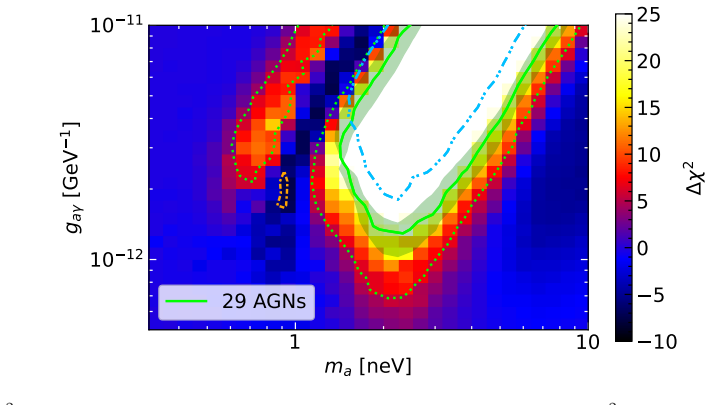
In the standard picture, a photon traversing a magnetized region converts to an ALP with a probability that oscillates with energy, and in a single object the observed pattern depends chaotically on the unknown magnetic configuration. The paper's central claim is that after averaging over many objects the conversion probability becomes a universal, smooth step function, $P_{\gamma\gamma}(E) = 1 - p_0/(1 + (E_c/E)^k)$, with $p_0$, $E_c$ and $k$ determined by the ALP mass and coupling. Stacking the GeV spectra of 29 AGNs located behind galaxy clusters and fitting this common step yields the most competitive current astrophysical exclusion for ALP masses in the 1-10 neV range, with the nominal bound improving on previous limits by up to a factor of 4 (7.5 if only statistical errors are considered). The same fit produces a roughly $2\sigma$ region of improved fit around $m_a \approx 1$ neV and $g_{a\gamma} \approx 2 \times 10^{-12}$ GeV$^{-1}$, which the authors interpret as a marginal hint that disappears once Fermi/LAT systematic uncertainties are included.
Load-bearing premise
The load-bearing premise is that every cluster in the sample has a magnetic field statistically similar to the Coma cluster's, with the same radial profile and central strength, even though the sample's average mass is about four times lower than Coma's; if the true average field is weaker, the bounds weaken by up to a factor of 1.6.
Editorial extensions
If this is right
- The 1-10 neV mass window is now probed with up to 4 times stronger coupling limits than before, reaching parameter space where ALPs could constitute dark matter.
- The method is transferable: the same stacking procedure applied to X-ray, MeV, or TeV data would extend the bounds toward lower and higher ALP masses.
- With CTAO and a similar set of 29 AGN-cluster pairs, the expected exclusion improves by roughly an order of magnitude in $g_{a\gamma}$ at larger masses.
- If the marginal $2\sigma$ improvement is real, it predicts a coherent step-like suppression at about 600 MeV across many independent AGN spectra, which future data can confirm or refute.
- Larger cluster samples from upcoming all-sky surveys will reduce the finite-sample scatter in $p_0$ and sharpen the exclusions.
Reading between the lines
- If the Coma-like magnetic-field assumption holds, the same stacking idea could be applied to other source populations behind magnetized foreground structures, such as quasars behind the Galactic plane, without modelling individual fields in detail.
- The approximately 600 MeV characteristic energy of the $2\sigma$ hint sits where extragalactic background-light absorption is modest, so a residual EBL systematic could mimic or mask the step; re-fitting with alternative EBL models would test this directly.
- Because the coupling limits scale roughly with the assumed magnetic-field strength, direct Faraday-rotation measurements of the specific 29 clusters would convert the current uncertainty band in the exclusion plot into a measured quantity rather than an assumed one.
- The paper's template approach suggests a broader principle: for any oscillatory particle-physics process in a disordered environment, ensemble averaging can turn unpredictable per-object wiggles into a predictable spectral feature, lowering the bar for astrophysical discovery.
Editorial analysis
A structured set of objections, weighed in public.
Referee Report
Summary. The paper introduces a stacked-analysis method for axion-like-particle (ALP) searches: 29 AGN spectra from the Fermi/LAT 4FGL-DR4 catalog that lie behind or within galaxy clusters are fitted jointly with smooth log-parabola EBL models, optionally multiplied by a common step-like photon survival probability Pγγ = 1 − p0/(1 + (Ec/E)^k). The shape parameters (p0, Ec, k) are mapped to ALP parameters (ma, gaγ) through numerical ALPro solutions for a Coma-like magnetic field profile. The main result is a 95% exclusion contour that improves previous bounds by up to a factor of 4 for ALP masses between 1 neV and 10 neV, with a factor-of-1.6 weakening in a pessimistic B0–M500 scaling scenario. With statistical-only uncertainties, a marginal ~2σ improvement region appears near ma ≈ 1 neV and gaγ ≈ 2×10^−12 GeV^−1, but it disappears when nominal Fermi/LAT systematics are included. The paper also presents a CTAO sensitivity forecast.
Significance. The stacking idea is a genuine methodological contribution: instead of marginalizing over random magnetic-field realizations in a single source, the analysis exploits ensemble averaging over many AGN-cluster pairs and demonstrates that the averaged survival probability takes a regular step-like form. The paper is careful in several respects: the conversion probabilities are computed with the independent public ALPro code, the finite-sample scatter of p0 is addressed, injection tests are performed, and the impact of Fermi/LAT systematics is shown explicitly. The pessimistic B0–M500 scaling scenario is a useful robustness check. However, the absolute bound is conditional on the assumption that every cluster in the sample has a magnetic field statistically similar to Coma, and the paper's own test of B0 variation does not fully propagate the scatter into the energy-scale parameter Ec, which determines the ALP mass range. If this propagation is addressed, the method could deliver a meaningful improvement; in its current form the factor-of-4 claim is not fully established.
major comments (4)
- [Methods, 'Average magnetic field strength across the sample of clusters', Fig. 4, Table 1] The test that varies B0 by two orders of magnitude reports only that p0 changes by about 20% and that the shape of Eq. (2) is maintained; it does not report how Ec changes. According to Eq. (9), Ec ∝ ma^2/(gaγ B), so cluster-to-cluster variation in B directly shifts the step location for each cluster. The average of many steps with different Ec is a convolution, not a single step at the mean field, and it can broaden and shift the effective Ec inferred from the stacked fit. Because Ec sets the ALP mass scale in Fig. 7, this omission is load-bearing for the claimed factor-of-4 improvement in the 1–10 neV range. Please quantify how Ec and k vary in Fig. 6, and either propagate a realistic distribution of B0 across the 29 clusters into the (p0, Ec, k)-to-(ma, gaγ) mapping or demonstrate that the effective Ec is insensitive to that distribution.
- [Methods, 'Consistency checks' and Fig. 9] The log-average M500 of the selected sample is about 1.6×10^14 Msun, roughly four times lower than Coma's mass, yet every cluster is assigned the Coma profile with B0 = 5.2 μG, η = 0.67, β = 0.75, and rc = 291 kpc. The paper's Fig. 4 shows no clear B0–M500 correlation, but the number of clusters with measured B0 is small and the sample is heterogeneous; the quoted 'pessimistic' scenario only reduces the mean B0 by a factor of 1.6. Since the bound scales approximately as gaγ ∝ 1/B for fixed ma, a downward bias in the true average field directly weakens the headline result. Please provide a quantitative statement of how low the true average B0 can be before the improvement over the previous bounds disappears, and report the statistical power of Fig. 4 for ruling out a mass-dependent field normalization.
- [Methods, 'Correction for the finite sample size' and Fig. 8] The injection tests generate random conversion curves from the same Coma-like field model that is used to define the template and the mapping in Fig. 7. They therefore validate the internal consistency of the pipeline under the assumed model, but they do not test the external validity of the assumption that all 29 clusters share the Coma magnetic-field profile. This should be stated explicitly where the injection results are interpreted as evidence of robustness, and ideally supplemented with injection tests that draw cluster field strengths from a distribution motivated by the sample's mass distribution.
- [Results and Table 2] The finite-sample correction allows p0 to vary within ±20% of its central value, and the quoted Δχ² plot appears to use the best fit over this allowed range. If p0 is effectively profiled as a constrained nuisance parameter, the use of a fixed Δχ² = 6.2 threshold for 2 d.o.f. needs justification; the effective number of degrees of freedom is no longer exactly 2. The injection tests calibrate the threshold at a few trial points, but not over the full scanned grid. Please clarify the profiling procedure and either recalibrate the threshold with Monte Carlo simulations over the full grid or state explicitly that the contours are local 2σ contours.
minor comments (3)
- [Methods, Eq. (10) and Fig. 5] The total Δχ² improvement of −7.36 for the marginal detection region is dominated by NGC 1275, which contributes −4.79, i.e., about 65% of the total. Please show a leave-one-out analysis or explicitly quantify the contribution of NGC 1275 before describing the improvement as consistent across 'most AGN spectra'.
- [Methods, 'Dispersion of magnetic field strength'] The notation in the main text and Methods is sometimes inconsistent: Eq. (2) defines Pγγ = 1 − ⟨Pγa⟩, while Eq. (10) defines ⟨Pγa⟩ as a function of N and Pγa; please unify the averaging notation and define Pγa(E) in Eq. (10) explicitly as the single-domain conversion probability.
- [Introduction] The sentence 'The values of B0 and η are strongly correlated' should specify that this is a phenomenological correlation in the derived parameters from Faraday-rotation fits, not a physical correlation, to avoid confusion.
Circularity Check
No significant circularity: the ALP bound is produced by an independent ALPro-generated conversion template applied to external Fermi/LAT spectra, and the sole self-citation is not load-bearing.
full rationale
The claimed derivation chain is self-contained. The survival-probability template Pγγ(E) = 1 − p0/[1 + (Ec/E)^k] is not fitted to the AGN spectra; it is generated by numerically integrating the standard photon–ALP mixing equations (Eq. 4) with the ALPro code, using an external Coma-cluster magnetic-field profile (Eq. 11, parameters from Bonafede et al. 2010). The mapping between (p0, Ec, k) and (ma, gaγ) in Figure 7 is the output of that same independent simulation, not a fit to the Fermi/LAT data. The stacked-spectra fit then uses this fixed template and compares Δχ² with the EBL-corrected log-parabola baseline; no fitted parameter is renamed as a prediction. The ±20% allowance on p0 is an explicitly conservative finite-sample correction, applied in the direction that weakens exclusions. The only self-citation (Ref. 29, Malyshev et al. 2018) appears in a list of individual-object ALP search references and is not used to justify the stacked method, the field model, or the step template, so it is not load-bearing. The Coma-representative field assumption is a model uncertainty, quantified via the mass-scaling pessimistic line and the B0 variation tests, rather than a circular step: changing the assumption changes the bound by an externally computed factor instead of reproducing the input. The potential Ec shift under inter-cluster B0 scatter is an unpropagated systematic, not a circularity. No equation in the paper reduces to its own input by construction.
Assumptions & free parameters
free parameters (3)
- Average cluster magnetic field B0 =
5.2 microG (Coma), with systematic variations 3.1-6.5 microG
- Plateau height p0 of the survival probability template =
central value from ALPro averaging, marginalized within +/-20%
- Radial slope eta of the magnetic field profile =
0.67, varied 0.4-0.7 in the uncertainty band
assumptions (5)
- standard math The photon-ALP mixing equations (Eqs. 4-9) from Raffelt-Stodolsky accurately describe conversion in cluster magnetic fields.
- domain assumption All clusters in the sample have magnetic fields statistically similar to Coma, with B(r)=B0[ne/n0]^eta using Coma parameters.
- ad hoc to paper Averaging over many random magnetic field realizations yields Eq. (10), and the result is well approximated by the step-like template Eq. (2) with parameters mapped via Fig. 7.
- domain assumption AGN spectra in the GeV band are well described by EBL-corrected log-parabolas, so residual common step-like suppression is attributed to ALPs rather than to intrinsic source physics.
- domain assumption Plasma frequency and resonant conversion effects are negligible for the Fermi-LAT energy range used.
Cite this review
Pith. "Pith review of Active galactic nuclei through the prism of galaxy clusters: bounds on axion-like particles." pith.science (2026). https://pith.science/paper/ZRCT5FHZ
@misc{pith2026250602848,
  author       = {Pith},
  title        = {Pith review of: Active galactic nuclei through the prism of galaxy clusters: bounds on axion-like particles},
  year         = {2026},
  howpublished = {\url{https://pith.science/paper/ZRCT5FHZ}},
  note         = {Machine review of arXiv:2506.02848}
}
read the original abstract
Hypothetical axion-like particles (ALPs) are of interest because of their potential to act as dark matter or to reveal information about yet undiscovered fundamental constituents of matter. Such particles can be created when photons traverse regions of magnetic fields. The conversion probability depends on both the magnetic field parameters and photon energy, leading to multiple spectral absorption features as light passes through magnetized regions. Traditionally, astrophysical searches have focused on detecting such features in individual objects. However, the limited understanding of properties of cosmic magnetic fields have hindered the progress. Here we introduce a new approach by analyzing stacked (rather than individual) spectra of active galactic nuclei (AGNs) positioned behind galaxy clusters -- gigantic magnetic field reservoirs. Stacking efficiently averages over the uncertainties in magnetic fields, revealing a unique step-like spectral signature of photon-to-ALP conversion. With this approach we advance into previously inaccessible regions of the ALP parameter space for nano-electronvolt masses. Adopting this method will significantly improve existing bounds across a wide range of masses by using different telescopes and increasing the size of the stacked datasets. The Cherenkov Telescope Array Observatory, in particular, will extensively probe the parameter space where ALPs could serve as dark matter.
Figures


Figures from the paper (6 more)



Forward citations
Cited by 1 Pith paper
-
Circular polarization effects induced by photon-axion mixing in astrophysical environments
The paper derives analytic circular-polarization signals from photon-axion mixing and uses the blazar S4 0954+65 optical circular-polarization limit to bound g_aγγ around 10^-12 to 10^-11 GeV^-1 for ultralight axion masses.
Reference graph
Works this paper leans on
-
[1]
ALP components; see the text for more details. The mass and coupling constant of the ALP were selected to match the parameters of the marginal2σdetection (m a = 9.1×10 −10 eV ,gaγ = 2.1×10 −12 GeV−1). The negative∆χ 2 =χ 2 ALP −χ 2 0 indicates an improvement of the ALP-invoking model compared to the baseline fit model. The “Average significance” column in...
-
[2]
Raffelt, G. G.Stars as laboratories for fundamental physics : the astrophysics of neutrinos, axions, and other weakly interacting particles(1996)
work page 1996
- [3]
-
[4]
Rosenberg, L. J. & van Bibber, K. A. Searches for invisible axions.Phys. Rept.325, 1–39 (2000)
work page 2000
-
[5]
Chadha-Day, F., Ellis, J. & Marsh, D. J. E. Axion dark matter: What is it and why now? Science Advances8, eabj3618 (2022).2105.01406
arXiv 2022
-
[6]
Peccei, R. D. & Quinn, H. R. Constraints Imposed by CP Conservation in the Presence of Instantons.Phys. Rev. D16, 1791–1797 (1977)
work page 1977
-
[7]
Peccei, R. D. & Quinn, H. R. CP Conservation in the Presence of Instantons.Phys. Rev. Lett. 38, 1440–1443 (1977)
work page 1977
-
[8]
Problem of StrongPandTInvariance in the Presence of Instantons.Phys
Wilczek, F. Problem of StrongPandTInvariance in the Presence of Instantons.Phys. Rev. Lett.40, 279–282 (1978). 18
work page 1978
Show all 79 references
-
[9]
A New Light Boson?Phys
Weinberg, S. A New Light Boson?Phys. Rev. Lett.40, 223–226 (1978)
1978
-
[10]
Axion cooling of neutron stars.Phys
Sedrakian, A. Axion cooling of neutron stars.Phys. Rev. D93, 065044 (2016).1512. 07828
2016
-
[11]
Fiorillo, D. F. G. & Iocco, F. Axions from Neutron Star Mergers.Phys. Rev. D105, 123007 (2022).2109.10364
2022 arXiv
-
[12]
& Stodolsky, L
Raffelt, G. & Stodolsky, L. Mixing of the photon with low-mass particles.Phys. Rev. D37, 1237–1249 (1988)
1988
-
[13]
Dessert, C., Long, A. J. & Safdi, B. R. X-Ray Signatures of Axion Conversion in Magnetic White Dwarf Stars.Phys. Rev. Lett.123, 061104 (2019).1903.05088
2019 arXiv
-
[14]
& Galanti, G
Tavecchio, F., Roncadelli, M. & Galanti, G. Photons to axion-like particles conversion in Active Galactic Nuclei.Physics Letters B744, 375–379 (2015).1406.2303
2015 arXiv
-
[15]
& Cotter, G
Davies, J., Meyer, M. & Cotter, G. Constraints on axionlike particles from a combined analysis of three flaring Fermi flat-spectrum radio quasars.Phys. Rev. D107, 083027 (2023).2211. 03414
2023
-
[16]
W., Carlson, E
Brockway, J. W., Carlson, E. D. & Raffelt, G. G. SN 1987A gamma-ray limits on the conver- sion of pseudoscalars.Physics Letters B383, 439–443 (1996).astro-ph/9605197
1996 arXiv
-
[17]
& Terning, J
Cs ´aki, C., Kaloper, N. & Terning, J. Dimming Supernovae without Cosmic Acceleration. Phys. Rev. Lett.88, 161302 (2002).hep-ph/0111311
2002 arXiv
-
[18]
& Zupan, J
Grossman, Y ., Roy, S. & Zupan, J. Effects of initial axion production and photon-axion oscillation on type Ia supernova dimming [rapid communication].Physics Letters B543, 23– 28 (2002).hep-ph/0204216
2002 arXiv
-
[19]
& Gustafsson, M
Crnogor ˇcevi´c, M., Caputo, R., Meyer, M., Omodei, N. & Gustafsson, M. Searching for axion- like particles from core-collapse supernovae with Fermi LAT’s low-energy technique.Phys. Rev. D104, 103001 (2021).2109.05790
2021 arXiv
-
[20]
P., Powell, A
Conlon, J. P., Powell, A. J. & Marsh, M. C. D. Galaxy cluster thermal x-ray spectra constrain axionlike particles.Phys. Rev. D93, 123526 (2016).1509.06748
2016 arXiv
-
[21]
Ajello, M.et al.Search for spectral irregularities due to photon–axionlike-particle oscillations with the fermi large area telescope.Phys. Rev. Lett.116, 161101 (2016). URLhttps: //link.aps.org/doi/10.1103/PhysRevLett.116.161101
2016 doi
-
[22]
Marsh, M. C. D.et al.A New Bound on Axion-Like Particles.JCAP12, 036 (2017).1703. 07354
2017
-
[23]
S.et al.Astrophysical Limits on Very Light Axion-like Particles from Chandra Grating Spectroscopy of NGC 1275.Astrophys
Reynolds, C. S.et al.Astrophysical Limits on Very Light Axion-like Particles from Chandra Grating Spectroscopy of NGC 1275.Astrophys. J.890, 59 (2020).1907.05475. 19
2020 arXiv
-
[24]
& ZuHone, J
Donnert, J., Vazza, F., Br ¨uggen, M. & ZuHone, J. Magnetic Field Amplification in Galaxy Clusters and Its Simulation.ssr214, 122 (2018).1810.09783
2018 arXiv
-
[25]
& Tjemsland, J
Kachelriess, M. & Tjemsland, J. On the origin and the detection of characteristic axion wiggles in photon spectra.JCAP01, 025 (2022).2111.08303
2022 arXiv
-
[26]
& Meyer, M
Cecil, R. & Meyer, M. Modeling the Magnetic Field of the Virgo Cluster For Axion Like Particle Search in Gamma Ray Energies.PoSGamma2022, 182 (2023)
2023
-
[27]
Hochmuth, K. A. & Sigl, G. Effects of axion-photon mixing on gamma-ray spectra from magnetized astrophysical sources.Phys. Rev. D76, 123011 (2007).0708.1144
2007 arXiv
-
[28]
& Brun, P
Wouters, D. & Brun, P. Constraints on axion-like particles from X-ray observations of the hydra galaxy cluster.The Astrophysical Journal772, 44 (2013). URLhttps://doi. org/10.1088/0004-637x/772/1/44
2013 doi
-
[29]
P., Day, F., Jennings, N., Krippendorf, S
Conlon, J. P., Day, F., Jennings, N., Krippendorf, S. & Rummel, M. Constraints on Axion-Like Particles from Non-Observation of Spectral Modulations for X-ray Point Sources.JCAP07, 005 (2017).1704.05256
2017 arXiv
-
[30]
& Jochum, J
Malyshev, D., Neronov, A., Semikoz, D., Santangelo, A. & Jochum, J. Improved limit on axion-like particles from gamma-ray data on Perseus cluster.arXiv e-printsarXiv:1805.04388 (2018).1805.04388
2018 arXiv
-
[31]
Sisk-Reyn ´es, J.et al.New constraints on light axion-like particles using Chandra transmission grating spectroscopy of the powerful cluster-hosted quasar H1821+643.MNRAS510, 1264– 1277 (2022).2109.03261
2022 arXiv
-
[32]
H., Reynolds, C
Matthews, J. H., Reynolds, C. S., Marsh, M. C. D., Sisk-Reyn ´es, J. & Rodman, P. E. How do Magnetic Field Models Affect Astrophysical Limits on Light Axion-like Particles? An X-ray Case Study with NGC 1275.arXiv e-printsarXiv:2202.08875 (2022).2202.08875
2022 arXiv
-
[33]
& Cotter, G
Davies, J., Meyer, M. & Cotter, G. Constraints on axionlike particles from a combined analysis of three flaring F e r m i flat-spectrum radio quasars.Phys. Rev. D107, 083027 (2023). 2211.03414
2023 arXiv
-
[34]
cajohare/axionlimits: Axionlimits (2020)
O’Hare, C. cajohare/axionlimits: Axionlimits (2020). URLhttps://doi.org/10. 5281/zenodo.3932430
2020
-
[35]
Abdollahi, S.et al.Incremental Fermi Large Area Telescope Fourth Source Catalog.Astro- phys. J. Supp.260, 53 (2022).2201.11184
2022 arXiv
-
[36]
H., Lott, B
Ballet, J., Bruel, P., Burnett, T. H., Lott, B. & The Fermi-LAT collaboration. Fermi Large Area Telescope Fourth Source Catalog Data Release 4 (4FGL-DR4).arXiv e-prints arXiv:2307.12546 (2023).2307.12546. 20
2023 arXiv
-
[37]
L., Han, J
Wen, Z. L., Han, J. L. & Yang, F. A catalogue of clusters of galaxies identified from all sky surveys of 2MASS, WISE, and SuperCOSMOS.Monthly Notices of the Royal Astronomical Society475, 343–352 (2018).1712.02491
2018 arXiv
-
[38]
& Zargaryan, D
Sahakyan, N., Baghmanyan, V . & Zargaryan, D. Fermi-LAT observation of nonblazar AGNs. Astron. Astrophys.614, A6 (2018).1801.09381
2018 arXiv
-
[39]
Astrophys.686, A157 (2024)
Nelson, D.et al.Introducing the TNG-Cluster simulation: Overview and the physical proper- ties of the gaseous intracluster medium.Astron. Astrophys.686, A157 (2024)
2024
-
[40]
& Feretti, L
Dolag, K., Schindler, S., Govoni, F. & Feretti, L. Correlation of the magnetic field and the intra-cluster gas density in galaxy clusters.Astron. Astrophys.378, 777–786 (2001). astro-ph/0108485
2001 arXiv
-
[41]
The intra-cluster mag- netic field power spectrum.Astron
Govoni, F.et al.Sardinia Radio Telescope observations of Abell 194. The intra-cluster mag- netic field power spectrum.Astron. Astrophys.603, A122 (2017).1703.08688
2017 arXiv
-
[42]
& Murgia, M
Feretti, L., Giovannini, G., Govoni, F. & Murgia, M. Clusters of galaxies: observational properties of the diffuse radio emission.Astronomy and Astrophysics Review20, 54 (2012). 1205.1919
2012 arXiv
-
[43]
Fermi-LAT website URLhttps://fermi.gsfc.nasa.gov/ssc/data/ analysis/scitools/Aeff_Systematics.html
-
[44]
Steffen, F. D. Dark-matter candidates. Axions, neutralinos, gravitinos, and axinos.European Physical Journal C59, 557–588 (2009).0811.3347
2009 arXiv
-
[45]
& Raue, M
Meyer, M., Horns, D. & Raue, M. First lower limits on the photon-axion-like particle coupling from very high energy gamma-ray observations.Phys. Rev. D87, 035027 (2013).1302. 1208
2013
-
[46]
& Ringwald, A
Giannotti, M., Irastorza, I., Redondo, J. & Ringwald, A. Cool WISPs for stellar cooling excesses.J. Cosmol. Astropart. Phys.2016, 057 (2016).1512.08108
2016 arXiv
-
[47]
Cherenkov Telescope Array: The Next Generation Gamma-ray Obser- vatory.arXiv e-printsarXiv:1709.05434 (2017).1709.05434
CTA Consortium, T. Cherenkov Telescope Array: The Next Generation Gamma-ray Obser- vatory.arXiv e-printsarXiv:1709.05434 (2017).1709.05434
2017 arXiv
-
[48]
The Cherenkov Telescope Array: layout, design and performance
Gueta, O. The Cherenkov Telescope Array: layout, design and performance. In37th Interna- tional Cosmic Ray Conference, 885 (2022).2108.04512
2022 arXiv
-
[49]
First X-ray catalogues and data release of the western Galactic hemisphere.Astron
Merloni, A.et al.The SRG/eROSITA all-sky survey. First X-ray catalogues and data release of the western Galactic hemisphere.Astron. Astrophys.682, A34 (2024).2401.17274
2024 arXiv
-
[50]
Invisible axion search methods.Reviews of Modern Physics93, 015004 (2021)
Sikivie, P. Invisible axion search methods.Reviews of Modern Physics93, 015004 (2021). 2003.02206. 21
2021 arXiv
-
[51]
& Montanino, D
Mirizzi, A. & Montanino, D. Stochastic conversions of TeV photons into axion-like particles in extragalactic magnetic fields.Journal of Cosmology and Astroparticle Physics2009, 004 (2009).0911.0015
2009 arXiv
-
[52]
Mirizzi, A., Raffelt1, G. G. & Serpico, P. D. Photon-Axion Conversion in Intergalactic Mag- netic Fields and Cosmological Consequences. In Kuster, M., Raffelt, G. & Beltr ´an, B. (eds.) Axions, vol. 741, 115 (2008)
2008
-
[53]
Marsh, M. C. D., Matthews, J. H., Reynolds, C. & Carenza, P. Fourier formalism for relativistic axion-photon conversion with astrophysical applications.Phys. Rev. D105, 016013 (2022). 2107.08040
2022 arXiv
-
[54]
& Roncadelli, M
de Angelis, A., Mansutti, O. & Roncadelli, M. Axion-like particles, cosmic magnetic fields and gamma-ray astrophysics.Physics Letters B659, 847–855 (2008).0707.2695
2008 arXiv
-
[55]
Romano, P.et al.Prospects for gamma-ray observations of narrow-line Seyfert 1 galaxies with the Cherenkov Telescope Array.Mon. Not. Roy. Astron. Soc.481, 5046–5061 (2018). 1809.03426
2018 arXiv
-
[56]
Astrophys.513, A30 (2010).1002.0594
Bonafede, A.et al.The Coma cluster magnetic field from Faraday rotation measures.Astron. Astrophys.513, A30 (2010).1002.0594
2010 arXiv
-
[57]
Łokas, E. L. & Mamon, G. A. Dark matter distribution in the Coma cluster from galaxy kinematics: breaking the mass-anisotropy degeneracy.Mon. Not. Roy. Astron. Soc.343, 401– 412 (2003).astro-ph/0302461
2003 arXiv
-
[58]
& Conlon, J
Kraljic, D., Rummel, M. & Conlon, J. P. ALP conversion and the soft X-ray excess in the outskirts of the Coma cluster.J. Cosmol. Astropart. Phys.2015, 011–011 (2015).1406. 5188
2015
-
[59]
T., Kronberg, P
Kim, K. T., Kronberg, P. P., Giovannini, G. & Venturi, T. Discovery of intergalactic radio emission in the Coma-A1367 supercluster.Nature341, 720–723 (1989)
1989
-
[60]
& Tagliani, A
Feretti, L., Dallacasa, D., Giovannini, G. & Tagliani, A. The magnetic field in the Coma cluster.Astron. Astrophys.302, 680 (1995).astro-ph/9504058
1995 arXiv
-
[61]
B.et al.Magnetic fields in the centre of the Perseus cluster.Mon
Taylor, G. B.et al.Magnetic fields in the centre of the Perseus cluster.Mon. Not. Roy. Astron. Soc.368, 1500–1506 (2006).astro-ph/0602622
2006 arXiv
-
[62]
& Reiprich, T
Lovisari, L. & Reiprich, T. H. The non-uniformity of galaxy cluster metallicity profiles. Monthly Notices of the Royal Astronomical Society483, 540–557 (2019).1811.05987
2019 arXiv
-
[63]
Planck Collaborationet al.Planck 2015 results. XXVII. The second Planck catalogue of Sunyaev-Zeldovich sources.Astron. Astrophys.594, A27 (2016).1502.01598
2016 arXiv
-
[64]
Lidman, C.et al.Evidence for significant growth in the stellar mass of brightest cluster galaxies over the past 10 billion years.Mon. Not. Roy. Astron. Soc.427, 550–568 (2012). 1208.5143. 22
2012 arXiv
-
[65]
Astrophys.483, 699–713 (2008).0709.2652
Guidetti, D.et al.The intracluster magnetic field power spectrum in Abell 2382.Astron. Astrophys.483, 699–713 (2008).0709.2652
2008 arXiv
-
[66]
Leahy, D. A. & Yin, D. X-ray analysis of the cluster 3C 129.Mon. Not. Roy. Astron. Soc. 313, 617–626 (2000)
2000
-
[67]
B., Govoni, F., Allen, S
Taylor, G. B., Govoni, F., Allen, S. W. & Fabian, A. C. Magnetic fields in the 3C 129 cluster. Mon. Not. Roy. Astron. Soc.326, 2–10 (2001).astro-ph/0104223
2001 arXiv
-
[69]
Astrophys.659, A146 (2022).2111.06940
de Gasperin, F.et al.MeerKAT view of the diffuse radio sources in Abell 3667 and their interactions with the thermal plasma.Astron. Astrophys.659, A146 (2022).2111.06940
2022 arXiv
-
[70]
Planck Collaborationet al.Planck intermediate results. X. Physics of the hot gas in the Coma cluster.Astron. Astrophys.554, A140 (2013).1208.3611
2013 arXiv
-
[71]
& Johnston-Hollitt, M
Feretti, L. & Johnston-Hollitt, M. Magnetic fields in clusters of galaxies.New Astron. Rev.48, 1145–1150 (2004).astro-ph/0409462
2004 arXiv
-
[72]
Astrophys
Govoni, F.et al.Rotation measures of radio sources in hot galaxy clusters.Astron. Astrophys. 522, A105 (2010).1007.5207
2010 arXiv
-
[73]
Finoguenov, A., Reiprich, T. H. & Boehringer, H. Details of the mass-temperature relation for clusters of galaxies.Astron. Astrophys.368, 749–759 (2001).astro-ph/0010190
2001 arXiv
-
[74]
Osinga, E.et al.The detection of cluster magnetic fields via radio source depolarisation. Astron. Astrophys.665, A71 (2022).2207.09717
2022 arXiv
-
[75]
Ajello, M.et al.The Fourth Catalog of Active Galactic Nuclei Detected by the Fermi Large Area Telescope: Data Release 3.Astrophys. J. Supp.263, 24 (2022).2209.12070
2022 arXiv
-
[76]
W., Arnaud, M
Pratt, G. W., Arnaud, M. & Pointecouteau, E. Structure and scaling of the entropy in nearby galaxy clusters.Astron. Astrophys.446, 429–438 (2006).astro-ph/0508234
2006 arXiv
-
[77]
Naima: a Python package for inference of particle distribution properties from nonthermal spectra
Zabalza, V . Naima: a Python package for inference of particle distribution properties from nonthermal spectra. In34th International Cosmic Ray Conference (ICRC2015), vol. 34 of International Cosmic Ray Conference, 922 (2015).1509.03319
2015 arXiv
-
[78]
Dom ´ınguez, A.et al.Extragalactic background light inferred from AEGIS galaxy-SED-type fractions.Mon. Not. Roy. Astron. Soc.410, 2556–2578 (2011).1007.1459
2011 arXiv
-
[79]
J.880, 70 (2019).1906.07087
Giacintucci, S.et al.Expanding the Sample of Radio Minihalos in Galaxy Clusters.Astrophys. J.880, 70 (2019).1906.07087
2019 arXiv
-
[80]
G., Aghanim, N., Hern ´andez-Mart´ınez, E
Lebeau, T., Sorce, J. G., Aghanim, N., Hern ´andez-Mart´ınez, E. & Dolag, K. Mass bias in clusters of galaxies: Projection effects on the case study of Virgo replica.Astron. Astrophys. 682, A157 (2024).2310.02326. 23
2024 arXiv
Reviewed August 7, 2026 · model on record in the stance chip above.
Discussion (0). Sign in to comment.