REVIEW 2 major objections 5 minor 101 references
The chemical and spatial variations of the bulge's velocity ellipsoids
T0 review · 2 major / 5 minor · reviewed 2026-08-07 · deepseek-v4-flash
Pith's one-line read A purely secularly evolved bar simulation reproduces the Milky Way bulge's velocity-ellipse trends, so a significant accreted classical bulge is not required.
desk verdict A careful, useful follow-up on bulge velocity ellipses with a genuinely handy new diagnostic (rho_rl), but the central claim rests on an untested metallicity-as-age proxy. read the letter →
The pith
A machine-rendered reading of the paper's core claim, the machinery that carries it, and where it could break.
The reading
What carries the argument
The machinery is the velocity-dispersion tensor of a stellar population, compressed into three dimensionless quantities: in-plane anisotropy $\beta_{ij} = 1-\sigma_{jj}^2/\sigma_{ii}^2$, correlation $\rho_{ij} = \sigma_{ij}^2/(\sigma_i\sigma_j)$, and vertex deviation $l_{\rm v}$, with $\tan(2l_{\rm v}) = 2\rho_{ij}\sqrt{1-\beta_{ij}}/|\beta_{ij}|$ (Eqn. A10). The load-bearing mechanism is kinematic fractionation: the bar forms with a strength set by each age cohort's initial velocity dispersion, so younger, cooler stars become strongly barred and X-shaped while older, hotter stars remain weakly barred and boxy, and the same orbit families imprint age-dependent quadrupoles in $\beta$, $\rho$, and $l_{\rm v}$ that project into observable minor-axis trends along $l=0^\circ$.
What would settle it
Measure $\rho_{rl}$ along the minor axis for bulge stars split into narrow bins of individual asteroseismic age; if the correlation amplitude does not increase monotonically with decreasing age at $3.5^\circ<|b|<6.6^\circ$, the kinematic-fractionation explanation of the metallicity trend would be falsified.
Extended reading notes
Core claim
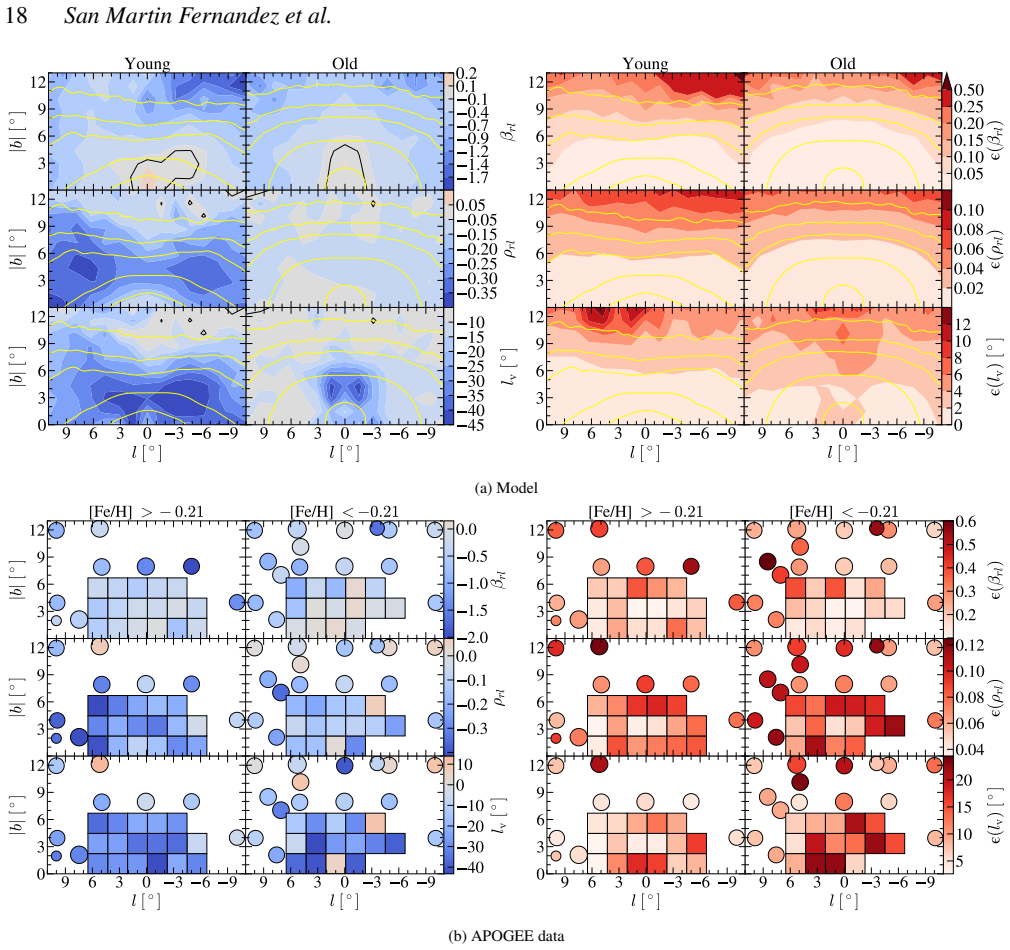
The paper's central claim is that $\rho_{rl}$ between the heliocentric radial and longitudinal velocities is a clean, continuous tracer of bar strength, while the vertex deviation $l_{\rm v}$ is a blunt one. In the isolated $N$-body$+$SPH simulation, young (4-7 Gyr) stars form a strong bar with a prominent X-shape and show much stronger negative $\rho_{rl}$ than old (9.5-10 Gyr) boxy stars; APOGEE stars split at the median $[{\rm Fe/H}] = -0.21$ dex follow the same separation. At fixed latitude, $\rho_{rl}$ rises in amplitude with decreasing age in the model and with increasing $[{\rm Fe/H}]$ in the data, which the paper reads as the first indication that the Milky Way bar's amplitude varies smoothly with metallicity, as kinematic fractionation predicts, rather than being constant above some metallicity. Along the way the paper shows that $l_{\rm v}$ peaks near $-45^\circ$ for both young and old populations whenever the velocity ellipse is nearly isotropic, so equal vertex-deviation peaks do not imply equal bar strengths, and that $\rho_{rl}$ changes little under distance uncertainties up to 35%, making it the recommended statistic for future bulge surveys.
Load-bearing premise
The comparison rests on treating metallicity as a proxy for age in the observed bulge and on assuming an isolated, merger-free simulation captures the Milky Way's bulge assembly; if $[{\rm Fe/H}]$ and age are scrambled in the real bulge, the agreement could be coincidental.
Editorial extensions
If this is right
- Along the bulge minor axis, $l_{\rm v}$ reaches nearly $-45^\circ$ for both young and old populations at $|b|<6^\circ$, so vertex deviation alone cannot be used to argue that metal-poor bulge stars belong to a separate, unbarred accreted component.
- $\rho_{rl}$ is the recommended bar-strength tracer: it grows monotonically with decreasing age and increasing $[{\rm Fe/H}]$, is robust to radial cuts and to distance uncertainties as large as 35%, and remains unbiased at small sample sizes.
- Distance errors up to about 20% for the young population leave the anisotropy, correlation, and vertex deviation essentially unchanged, so current APOGEE plus Gaia DR3 data are adequate for the qualitative comparison.
- The latitude band $3^\circ<|b|<6^\circ$ along the minor axis is the most promising window for future surveys to test whether the Milky Way bar amplitude is a continuous function of stellar population.
- The model predicts that bar signatures such as the X-shape, strong streaming motions, and forbidden velocities weaken smoothly with age, so bulge samples with reliable individual ages should show a continuum of bar strength rather than two discrete components.
Reading between the lines
- If the continuous $\rho_{rl}$ trend survives larger samples, the Milky Way bulge would be a single age-stratified bar-disc system whose bimodal metallicity distribution can arise from kinematic fractionation plus a thick disc, pushing any classical bulge below roughly 2% of the stellar mass.
- A sharper test would replace the $[{\rm Fe/H}]$-age proxy with asteroseismic or Cepheid ages for bulge stars; the model predicts that $\rho_{rl}$ amplitude orders populations by age alone, independent of metallicity.
- The appendix result that bootstrap errors for $l_{\rm v}$ are biased below a few hundred stars suggests that some small-sample historical vertex-deviation measurements in the bulge should be treated as upper limits on non-axisymmetry rather than detections of distinct components.
- The same $\rho_{rl}$ diagnostic could be applied to external barred galaxies with integral-field kinematics, where the model's $(l,b)$ maps give a concrete template for how projection mixes near- and far-side bar streaming.
Editorial analysis
A structured set of objections, weighed in public.
Referee Report
Summary. This paper presents a kinematic analysis of velocity ellipsoids in an N-body+SPH galaxy simulation from Debattista et al. (2017), comparing model predictions for two age-selected bulge populations (young, 4-7 Gyr; old, 9.5-10 Gyr) with APOGEE DR16+Gaia DR3 bulge stars split at the median [Fe/H]. The authors compute the anisotropy beta_ij, correlation rho_ij, and vertex deviation l_v in galactocentric and heliocentric frames, and compare vertical profiles along the bulge minor axis and full (l,b) maps. They find that rho_rl increases in amplitude with decreasing age in the model and with increasing [Fe/H] in the data, and interpret this as evidence that the Milky Way bar's amplitude varies continuously with [Fe/H] through kinematic fractionation, making a significant accreted classical bulge unnecessary. The paper also argues that vertex deviation is a blunt tracer of bar strength whereas the correlation is robust and promising.
Significance. If the central inference holds, the paper would strengthen the secular-origin scenario for the Milky Way bulge by connecting a specific observable (the v_r-v_l correlation) to a continuously varying bar strength across stellar populations. The paper's strengths include careful bootstrap error estimation with B=500, an explicit test of bootstrap validity in Appendix C showing that vertex deviation is biased for small samples while correlation is well-behaved, a Monte Carlo study of distance-error effects in Section 7, and a comparison with weaker-bar and oval models in Appendix B that supports the proposed interpretation of rho_rl as a bar-strength tracer. These methodological checks make the descriptive kinematic results trustworthy. However, the decisive model-data link depends on an untested metallicity-as-age proxy and on an unquantified trend, so the interpretative conclusion is not yet established.
major comments (2)
- [Section 5; Section 9.3(iv), Fig. 13] The central claim that the APOGEE [Fe/H] trend in rho_rl is evidence for kinematic fractionation depends on [Fe/H] being a monotonic proxy for age, but the paper neither validates this proxy nor can its simulation validate it. Section 5 states only the expectation that older stars are more metal-poor, while Section 3 reports that the simulation lacks metal diffusion, producing an excess of low-metallicity stars forming at all ages and a weakened age-metallicity relation, which is why the model populations are defined by age rather than metallicity. A broad or non-monotonic bulge age-metallicity relation could produce the observed [Fe/H] trend from mixed populations unrelated to the kinematic-fractionation sequence. Please test the proxy directly (e.g., with known APOGEE ages or chemical clocks), and/or compare model metallicity-sorted populations (acknowledging the weakened relation) to see whether the predicted trend survives. If this cannot be done, the inference should be framed as a prediction conditional on a monotonic relation.
- [Section 9.1 and Fig. 13] The paper describes the observed trend as a rise in |rho_rl| with [Fe/H] that "appears to be" present and may "plateau or even decline" within errors, but no statistical significance is quantified. With only three or four metallicity bins and bootstrap errors that appear comparable to the bin-to-bin variation, a constant rho_rl within the quoted uncertainties may be consistent with the data. Please provide a quantitative test of monotonicity (e.g., rank correlation with bootstrap significance, or a linear fit with uncertainty), and report the significance of the trend in the 3.5<|b|<6.6 degree bin where the claim is strongest.
minor comments (5)
- [Equation (5)] Equation (5) appears to have a typographical issue in the summation notation, with an extra symbol inside the sum; please check and correct the displayed formula.
- [Fig. 13 caption] The histogram in Fig. 13 is labeled only with 'N', and the inset values such as '[248 248 117]' are not defined in the caption; please state explicitly what these numbers represent.
- [Section 9.2] The acronym 'VRT-LSST' is used without being defined; please expand it or provide a reference at first use.
- [Appendix B] The central-oval model has not been presented before, but the appendix gives no description of how it was constructed or how its parameters compare to the fiducial model; a brief description would help the reader assess the comparison.
- [Section 5.2] The statement that the APOGEE sample 'may be biased in distance for different metallicities' is noted but not investigated beyond a radial-cut test; please state explicitly whether the quoted rho_rl robustness checks included metallicity-dependent selection functions or whether this remains an open issue.
Circularity Check
No significant circularity: the simulation is prior work and the APOGEE/Gaia comparison is independent, though the metallicity-as-age proxy is an untested assumption that limits the inference.
full rationale
The paper's central comparison is not circular: the model is a pre-existing N-body+SPH simulation from Debattista et al. (2017), and the observed data are an independent APOGEE DR16 + Gaia DR3 sample from Rojas-Arriagada et al. (2020). The model is not fitted to the observed rho_rl versus [Fe/H] trend. Instead, the paper compares an age-split model prediction with a metallicity-split observed trend. The paper explicitly acknowledges that the simulation lacks metal diffusion, which weakens the model's own age-metallicity relation, and therefore defines model populations by age rather than metallicity. The observational comparison then relies on the stated assumption that older stars are more metal-poor, which is an external validity concern rather than a circular derivation. Self-citations to Debattista et al. (2017) and Gough-Kelly et al. (2022) are legitimate because they describe the same simulation and prior predictions, and the present work adds new observable comparisons. Appendix B independently tests the claim that rho_rl traces bar strength by comparing strong-bar, weak-bar, and oval models, so the interpretation is not forced solely by self-citation. No equation or fitted parameter reduces to the paper's conclusions by construction. The score of 1 reflects only the presence of numerous self-citations and the unvalidated age-metallicity proxy, neither of which constitutes formal circularity.
Assumptions & free parameters
free parameters (4)
- Spatial scaling factor =
1.7
- Velocity scaling factor =
0.48
- Sun's distance to Galactic Centre R0 =
8.1 kpc
- Bar orientation angle =
27 degrees
assumptions (4)
- domain assumption The N-body+SPH simulation evolves in isolation and forms a realistic barred galaxy with a box/peanut bulge.
- domain assumption Metallicity is a reliable proxy for age in the observed APOGEE bulge sample.
- domain assumption The Milky Way bulge is symmetric with respect to the mid-plane.
- domain assumption Bootstrapping with B=500 iterations provides valid uncertainty estimates for the velocity ellipse statistics.
Cite this review
Pith. "Pith review of The chemical and spatial variations of the bulge's velocity ellipsoids." pith.science (2026). https://pith.science/paper/FZ5E4HC7
@misc{pith2026250602876,
  author       = {Pith},
  title        = {Pith review of: The chemical and spatial variations of the bulge's velocity ellipsoids},
  year         = {2026},
  howpublished = {\url{https://pith.science/paper/FZ5E4HC7}},
  note         = {Machine review of arXiv:2506.02876}
}
abstract
We study the velocity ellipsoids in an $N$-body$+$SPH simulation of a barred galaxy which forms a bar with a BP bulge. We focus on the 2D kinematics, and quantify the velocity ellipses by the anisotropy, $\beta_{ij}$, the correlation, $\rho_{ij}$, and the vertex deviation, $l_{\rm v}$. We explore the variations in these quantities based on stellar age within the bulge and compare these results with the Milky Way's bulge using data from APOGEE DR16 and {\it Gaia} DR3. We first explore the variation of the model's velocity ellipses in galactocentric velocities, $v_R$ and $v_\phi$, for two bulge populations, a (relatively) young one and an old one. The bar imprints quadrupoles on the distribution of ellipse properties, which are stronger in the young population, as expected from their stronger bar. The quadrupoles are distorted if we use heliocentric velocities $v_r$ and $v_l$. We then project these kinematics along the line of sight onto the $(l,b)$-plane. Along the minor axis $\beta_{rl}$ changes from positive at low $|b|$ to negative at large $|b|$, crossing over at lower $|b|$ in the young stars. Consequently the vertex deviation peaks at lower $|b|$ in the young population, but reaches similar peak values in the old. The $\rho_{rl}$ is much stronger in the young stars, and traces the bar strength. The APOGEE stars split by the median [Fe/H] follow the same trends. Lastly we explore the velocity ellipses across the entire bulge region in $(l,b)$ space, finding good qualitative agreement between the model and observations.
Figures


Figures from the paper (14 more)


Reference graph
Works this paper leans on
-
[1]
Babusiaux C., 2016, @doi [Publ. Astron. Soc. Aust. https://doi.org/10.1017/pasa.2016.1] 10.1017/pasa.2016.1 , 33, e026
-
[2]
Babusiaux C., et al., 2010, @doi [A&A https://doi.org/10.1051/0004-6361/201014353] 10.1051/0004-6361/201014353 , 519, A77
-
[3]
Bailer-Jones C. A. L., Rybizki J., Fouesneau M., Demleitner M., Andrae R., 2021, @doi [ ] 10.3847/1538-3881/abd806 , https://ui.adsabs.harvard.edu/abs/2021AJ....161..147B 161, 147
-
[4]
Bekki K., Tsujimoto T., 2011, @doi [MNRAS Letters https://doi.org/10.1111/j.1745-3933.2011.01097.x] 10.1111/j.1745-3933.2011.01097.x , 416, L60
arXiv 2011
-
[5]
Bensby T., et al., 2019, @doi [The Messenger] 10.18727/0722-6691/5123 , https://ui.adsabs.harvard.edu/abs/2019Msngr.175...35B 175, 35
-
[6]
Princeton University Press
Binney J., Merrifield M., 1998, Galactic Astronomy . Princeton University Press
1998
-
[7]
Blanton M. R., et al., 2017, @doi [ https://ui.adsabs.harvard.edu/abs/2017AJ....154...28B] 10.3847/1538-3881/aa7567 , 154, 28
-
[8]
Bobylev V. V., Bajkova A. T., 2021, @doi [Astron. Rep. https://doi.org/10.1134/S1063772921070015] 10.1134/S1063772921070015 , 65, 498
Show all 101 references
-
[9]
Bovy J., 2015, @doi [ApJS http://dx.doi.org/10.1088/0067-0049/216/2/29] 10.1088/0067-0049/216/2/29 , 216, 29
2015 doi
-
[10]
W., Hunt J
Bovy J., Leung H. W., Hunt J. A. S., Mackereth J. T., García-Hernández D. A., Roman-Lopes A., 2019, @doi [MNRAS https://doi.org/10.1093/mnras/stz2891] 10.1093/mnras/stz2891 , 490, 4740
2019 doi
-
[11]
R., Anderson J., Gnedin O
Brown W. R., Anderson J., Gnedin O. Y., Bond H. E., Geller M. J., Kenyon S. J., Livio M., 2010, @doi [ApJL https://dx.doi.org/10.1088/2041-8205/719/1/L23] 10.1088/2041-8205/719/1/L23 , 719, L23
2010 doi
-
[12]
L., 2015, @doi [MNRAS https://doi.org/10.1093/mnras/stv1314] 10.1093/mnras/stv1314 , 452, 956
Büdenbender A., van de Ven G., Watkins L. L., 2015, @doi [MNRAS https://doi.org/10.1093/mnras/stv1314] 10.1093/mnras/stv1314 , 452, 956
2015 doi
-
[13]
Calamida A., et al., 2014, @doi [ApJ http://dx.doi.org/10.1088/0004-637X/790/2/164] 10.1088/0004-637X/790/2/164 , 790, 7
2014 doi
-
[14]
Cirasuolo M., et al., 2020, @doi [The Messenger] 10.18727/0722-6691/5195 , https://ui.adsabs.harvard.edu/abs/2020Msngr.180...10C 180, 10
2020 doi
-
[15]
Clarkson W., et al., 2008, @doi [ApJ https://doi.org/10.1086/590378] 10.1086/590378 , 684, 1110
2008 doi
-
[16]
I., et al., 2011, @doi [ApJ https://dx.doi.org/10.1088/0004-637X/735/1/37] 10.1088/0004-637X/735/1/37 , 735, 37
Clarkson W. I., et al., 2011, @doi [ApJ https://dx.doi.org/10.1088/0004-637X/735/1/37] 10.1088/0004-637X/735/1/37 , 735, 37
2011 doi
-
[17]
R., Debattista V
Cole D. R., Debattista V. P., Erwin P., Earp S. W. F., Roskar R., 2014, @doi [MNRAS http://dx.doi.org/10.1093/mnras/stu1985] 10.1093/mnras/stu1985 , 445, 3352
2014 doi
-
[18]
P., Ness M., Earp S
Debattista V. P., Ness M., Earp S. W. F., Cole D. R., 2015, @doi [ApJL] 10.1088/2041-8205/812/1/L16 , 812, L16
2015 doi
-
[19]
P., Ness M., Gonzalez O
Debattista V. P., Ness M., Gonzalez O. A., Freeman K., Zoccali M., Minniti D., 2017, @doi [MNRAS http://dx.doi.org/10.1093/mnras/stx947] 10.1093/mnras/stx947
2017 doi
-
[20]
P., Gonzalez O
Debattista V. P., Gonzalez O. A., Sanderson R. E., El-Badry K., Garrison-Kimmel S., Wetzel A., Faucher-Gigu \` e re C.-A., Hopkins P. F., 2019, @doi [MNRAS https://doi.org/10.1093/mnras/stz746] 10.1093/mnras/stz746 , 485, 5073
2019 doi
-
[21]
P., et al., 2023, @doi [ApJ https://dx.doi.org/10.3847/1538-4357/acbb00] 10.3847/1538-4357/acbb00 , 946, 118
Debattista V. P., et al., 2023, @doi [ApJ https://dx.doi.org/10.3847/1538-4357/acbb00] 10.3847/1538-4357/acbb00 , 946, 118
2023 doi
-
[22]
Dehnen W., Binney J., 1998, @doi [MNRAS https://doi.org/10.1046/j.1365-8711.1998.01282.x] https://doi.org/10.1046/j.1365-8711.1998.01282.x , 294, 429
1998
-
[23]
K., Hempel M., Gonzalez O
D \'e k \'a ny I., Minniti D., Catelan M., Zoccali M., Saito R. K., Hempel M., Gonzalez O. A., 2013, @doi [ApJL https://iopscience.iop.org/article/10.1088/2041-8205/776/2/L19] 10.1088/2041-8205/776/2/L19 , http://adsabs.harvard.edu/abs/2013ApJ...776L..19D 776, L19
2013 doi
-
[24]
Di Matteo P., et al., 2015, @doi [ https://doi.org/10.1051/0004-6361/201424457] 10.1051/0004-6361/201424457 , 577, A1
2015 doi
-
[25]
Khoperskov, S
Di Matteo P., Fragkoudi, F. Khoperskov, S. Ciambur, B. Haywood, M. Combes, F. Gómez, A. 2019, @doi [ https://doi.org/10.1051/0004-6361/201832606] 10.1051/0004-6361/201832606 , 628, A11
2019 doi
-
[26]
Drimmel R., Poggio E., 2018, @doi [RNAAS https://dx.doi.org/10.3847/2515-5172/aaef8b] 10.3847/2515-5172/aaef8b , 2, 210
2018 doi
-
[27]
J., et al., 2011, @doi [ http://adsabs.harvard.edu/abs/2011AJ....142...72E] 10.1088/0004-6256/142/3/72 , 142, 72
Eisenstein D. J., et al., 2011, @doi [ http://adsabs.harvard.edu/abs/2011AJ....142...72E] 10.1088/0004-6256/142/3/72 , 142, 72
2011 doi
-
[28]
Ferreras I., Wyse R. F. G., Silk J., 2003, @doi [MNRAS https://doi.org/10.1046/j.1365-2966.2003.07056.x] 10.1046/j.1365-2966.2003.07056.x , 345, 1381
2003
-
[29]
Haywood, M
Fragkoudi F., Di Matteo, P. Haywood, M. Gómez, A. Combes, F. Katz, D. Semelin, B. 2017a, @doi [A&A https://doi.org/10.1051/0004-6361/201630244] 10.1051/0004-6361/201630244 , 606, A47
-
[30]
Haywood, M
Fragkoudi F., Di Matteo, P. Haywood, M. Khoperskov, S. Gomez, A. Schultheis, M. Combes, F. Semelin, B. 2017b, @doi [A&A https://doi.org/10.1051/0004-6361/201731597] 10.1051/0004-6361/201731597 , 607, L4
-
[31]
Haywood, M
Fragkoudi F., Di Matteo, P. Haywood, M. Schultheis, M. Khoperskov, S. Gómez, A. Combes, F. 2018, @doi [A&A https://doi.org/10.1051/0004-6361/201732509] 10.1051/0004-6361/201732509 , 616, A180
2018 doi
-
[32]
Fragkoudi F., et al., 2020, @doi [MNRAS https://doi.org/10.1093/mnras/staa1104] 10.1093/mnras/staa1104 , 494, 5936
2020 doi
-
[33]
GRAVITY Collaboration et al., 2018, @doi [A&A https://doi.org/10.1051/0004-6361/201833718] 10.1051/0004-6361/201833718 , 615, L15
2018 doi
-
[34]
Gaia Collaboration et al., 2018, @doi [A&A https://doi.org/10.1051/0004-6361/201833051] 10.1051/0004-6361/201833051 , 616, A1
2018 doi
-
[35]
Gaia Collaboration et al., 2023, @doi [A&A https://doi.org/10.1051/0004-6361/202243940] 10.1051/0004-6361/202243940 , 674, A1
2023 doi
-
[36]
E., et al., 2016, @doi [ https://dx.doi.org/10.3847/0004-6256/151/6/144] 10.3847/0004-6256/151/6/144 , 151, 144
García Pérez A. E., et al., 2016, @doi [ https://dx.doi.org/10.3847/0004-6256/151/6/144] 10.3847/0004-6256/151/6/144 , 151, 144
2016 doi
-
[37]
P., Robin A
Gardner E., Debattista V. P., Robin A. C., Vásquez S., Zoccali M., 2014, @doi [MNRAS https://doi.org/10.1093/mnras/stt2430] 10.1093/mnras/stt2430 , 438, 3275
2014 doi
-
[38]
https://doi.org/10.1525/collabra.87615] 10.1525/collabra.87615 , 9, 87615
Gnambs T., 2023, @doi [Collabra Psychol. https://doi.org/10.1525/collabra.87615] 10.1525/collabra.87615 , 9, 87615
2023 doi
-
[39]
A., Rejkuba M., Minniti D., Zoccali M., Valenti E., Saito R
Gonzalez O. A., Rejkuba M., Minniti D., Zoccali M., Valenti E., Saito R. K., 2011, @doi [ http://dx.doi.org/10.1051/0004-6361/201117959 A & A ] 10.1051/0004-6361/201117959 , 534
2011 doi
-
[40]
A., et al., 2016, @doi [A&A https://doi.org/10.1051/0004-6361/201527806] 10.1051/0004-6361/201527806 , 591, A7
Gonzalez O. A., et al., 2016, @doi [A&A https://doi.org/10.1051/0004-6361/201527806] 10.1051/0004-6361/201527806 , 591, A7
2016 doi
-
[41]
A., et al., 2020, @doi [The Messenger] 10.18727/0722-6691/5196 , https://ui.adsabs.harvard.edu/abs/2020Msngr.180...18G 180, 18
Gonzalez O. A., et al., 2020, @doi [The Messenger] 10.18727/0722-6691/5196 , https://ui.adsabs.harvard.edu/abs/2020Msngr.180...18G 180, 18
2020 doi
-
[42]
P., Clarkson W
Gough-Kelly S., Debattista V. P., Clarkson W. I., Gonzalez O. A., Anderson S. R., Gennaro M., Calamida A., Sahu K. C., 2022, @doi [MNRAS https://doi.org/10.1093/mnras/stab3192] 10.1093/mnras/stab3192 , 509, 4829
2022 doi
-
[43]
Governato F., et al., 2010, @doi [ ] 10.1038/nature08640 , http://adsabs.harvard.edu/abs/2010Natur.463..203G 463, 203
2010 doi
-
[44]
E., 1996, @doi [ ] 10.1086/118116 , https://ui.adsabs.harvard.edu/abs/1996AJ....112.1487H 112, 1487
Harris W. E., 1996, @doi [ ] 10.1086/118116 , https://ui.adsabs.harvard.edu/abs/1996AJ....112.1487H 112, 1487
1996 doi
-
[45]
C., 2015, Am Stat https://doi.org/10.1080/00031305.2015.1089789, 69, 371
Hesterberg T. C., 2015, Am Stat https://doi.org/10.1080/00031305.2015.1089789, 69, 371
2015 arXiv
-
[46]
F., 2015, @doi [MNRAS https://doi.org/10.1093/mnras/stv195] 10.1093/mnras/stv195 , 450, 53
Hopkins P. F., 2015, @doi [MNRAS https://doi.org/10.1093/mnras/stv195] 10.1093/mnras/stv195 , 450, 53
2015 doi
-
[47]
F., et al., 2018, @doi [MNRAS https://doi.org/10.1093/mnras/sty1690] 10.1093/mnras/sty1690 , 480, 800
Hopkins P. F., et al., 2018, @doi [MNRAS https://doi.org/10.1093/mnras/sty1690] 10.1093/mnras/sty1690 , 480, 800
2018 doi
-
[48]
I., Rich R
Johnson C. I., Rich R. M., Fulbright J. P., Valenti E., McWilliam A., 2011, @doi [ApJ https://doi.org/10.1088/0004-637x/732/2/108] 10.1088/0004-637x/732/2/108 , 732, 108
2011 doi
-
[49]
I., Rich R
Johnson C. I., Rich R. M., Kobayashi C., Kunder A., Pilachowski C. A., Koch A., de Propris R., 2013, @doi [ApJ https://dx.doi.org/10.1088/0004-637X/765/2/157] 10.1088/0004-637X/765/2/157 , 765, 157
2013 doi
-
[50]
I., et al., 2022, @doi [MNRAS https://doi.org/10.1093/mnras/stac1840] 10.1093/mnras/stac1840 , 515, 1469
Johnson C. I., et al., 2022, @doi [MNRAS https://doi.org/10.1093/mnras/stac1840] 10.1093/mnras/stac1840 , 515, 1469
2022 doi
-
[51]
M., 2002, @doi [AJ http://dx.doi.org/10.1086/342540] 10.1086/342540 , 124, 2054
Kuijken K., Rich R. M., 2002, @doi [AJ http://dx.doi.org/10.1086/342540] 10.1086/342540 , 124, 2054
2002 doi
-
[52]
Lucey M., et al., 2021, @doi [MNRAS https://doi.org/10.1093/mnras/stab003] 10.1093/mnras/stab003 , 501, 5981
2021 doi
-
[53]
R., et al., 2013, @doi [ https://dx.doi.org/10.1088/2041-8205/777/1/L13] 10.1088/2041-8205/777/1/L13 , 777, L13
Majewski S. R., et al., 2013, @doi [ https://dx.doi.org/10.1088/2041-8205/777/1/L13] 10.1088/2041-8205/777/1/L13 , 777, L13
2013 doi
-
[54]
R., et al., 2017, @doi [AJ https://doi.org/10.3847/1538-3881/aa784d] 10.3847/1538-3881/aa784d , 154, 94
Majewski S. R., et al., 2017, @doi [AJ https://doi.org/10.3847/1538-3881/aa784d] 10.3847/1538-3881/aa784d , 154, 94
2017 doi
-
[55]
McWilliam A., Zoccali M., 2010, @doi [ApJ https://doi.org/10.1088/0004-637x/724/2/1491] 10.1088/0004-637x/724/2/1491 , 724, 1491
2010 doi
-
[56]
Ness M., et al., 2012, @doi [ApJ https://doi.org/10.1088/0004-637x/756/1/22] 10.1088/0004-637x/756/1/22 , 756, 22
2012 doi
-
[57]
Ness M., et al., 2013, @doi [MNRAS https://doi.org/10.1093/mnras/sts629] 10.1093/mnras/sts629 , 430, 836
2013 doi
-
[58]
P., Bensby T., Feltzing S., Ro s kar R., Cole D
Ness M., Debattista V. P., Bensby T., Feltzing S., Ro s kar R., Cole D. R., Johnson J. A., Freeman K., 2014, @doi [ApJ https://doi.org/10.1088/2041-8205/787/2/L19] 10.1088/2041-8205/787/2/L19 , 787, L19
2014 doi
-
[59]
L., et al., 2015, @doi [AJ https://dx.doi.org/10.1088/0004-6256/150/6/173] 10.1088/0004-6256/150/6/173 , 150, 173
Nidever D. L., et al., 2015, @doi [AJ https://dx.doi.org/10.1088/0004-6256/150/6/173] 10.1088/0004-6256/150/6/173 , 150, 173
2015 doi
-
[60]
M., 1995, @doi [ https://doi.org/10.1038/377701a0] 10.1038/377701a0 , 377, 701
Ortolani S., Renzini A., Gilmozzi R., Marconi G., Barbuy B., Bica E., Rich R. M., 1995, @doi [ https://doi.org/10.1038/377701a0] 10.1038/377701a0 , 377, 701
1995 doi
-
[61]
M., Zakamska N., Wood P
Qin W., Nataf D. M., Zakamska N., Wood P. R., Casagrande L., 2018, @doi [ApJ https://dx.doi.org/10.3847/1538-4357/aad7fb] 10.3847/1538-4357/aad7fb , 865, 47
2018 doi
-
[62]
Queiroz A. B. A., et al., 2021, @doi [A&A https://doi.org/10.1051/0004-6361/202039030] 10.1051/0004-6361/202039030 , 656, A156
2021 doi
-
[63]
M., Villata M., Navarro J
Raiteri C. M., Villata M., Navarro J. F., 1996, https://ui.adsabs.harvard.edu/abs/1996A 315, 105
1996
-
[64]
J., Brunthaler A., 2004, @doi [ApJ https://dx.doi.org/10.1086/424960] 10.1086/424960 , 616, 872
Reid M. J., Brunthaler A., 2004, @doi [ApJ https://dx.doi.org/10.1086/424960] 10.1086/424960 , 616, 872
2004 doi
-
[65]
Renzini A., et al., 2018, @doi [ApJ https://doi.org/10.3847/1538-4357/aad09b] 10.3847/1538-4357/aad09b , 863, 16
2018 doi
-
[66]
Roca-Fàbrega S., Antoja T., Figueras F., Valenzuela O., Romero-Gómez M., Pichardo B., 2014, @doi [MNRAS https://doi.org/10.1093/mnras/stu437] 10.1093/mnras/stu437 , 440, 1950
2014 doi
-
[67]
Rojas-Arriagada A., et al., 2014, @doi [A&A https://doi.org/10.1051/0004-6361/201424121] 10.1051/0004-6361/201424121 , 569, A103
2014 doi
-
[68]
Rojas-Arriagada A., et al., 2017, @doi [A&A ttps://doi.org/10.1051/0004-6361/201629160] 10.1051/0004-6361/201629160 , 601, A140
2017 doi
-
[69]
Recio-Blanco, A
Rojas-Arriagada A., Zoccali M., Schultheis, M. Recio-Blanco, A. Zasowski, G. Minniti, D. Jönsson, H. Cohen, R. E. 2019, @doi [A&A https://doi.org/10.1051/0004-6361/201834126] 10.1051/0004-6361/201834126 , 626, A16
2019 doi
-
[70]
Rojas-Arriagada A., et al., 2020, @doi [MNRAS https://doi.org/10.1093/mnras/staa2807] 10.1093/mnras/staa2807 , 499, 1037
2020 doi
-
[71]
C., et al., 2006, @doi [ https://doi.org/10.1038/nature05158] 10.1038/nature05158 , 443, 534
Sahu K. C., et al., 2006, @doi [ https://doi.org/10.1038/nature05158] 10.1038/nature05158 , 443, 534
2006 doi
-
[72]
K., Zoccali M., McWilliam A., Minniti D., Gonzalez O
Saito R. K., Zoccali M., McWilliam A., Minniti D., Gonzalez O. A., Hill V., 2011, @doi [AJ https://doi.org/10.1088/0004-6256/142/3/76] 10.1088/0004-6256/142/3/76 , 142, 76
2011 doi
-
[73]
K., et al., 2012, @doi [ ] 10.1051/0004-6361/201118407 , http://adsabs.harvard.edu/abs/2012A
Saito R. K., et al., 2012, @doi [ ] 10.1051/0004-6361/201118407 , http://adsabs.harvard.edu/abs/2012A
2012 doi
-
[74]
Schultheis M., et al., 2017, @doi [ https://doi.org/10.1051/0004-6361/201630154] 10.1051/0004-6361/201630154 , 600, A14
2017 doi
-
[75]
A., Gerhard O., 2020, @doi [MNRAS https://doi.org/10.1093/mnras/staa1336] 10.1093/mnras/staa1336 , 495, 3175
Sellwood J. A., Gerhard O., 2020, @doi [MNRAS https://doi.org/10.1093/mnras/staa1336] 10.1093/mnras/staa1336 , 495, 3175
2020 doi
-
[76]
M., Kormendy J., Howard C
Shen J., Rich R. M., Kormendy J., Howard C. D., Propris R. D., Kunder A., 2010, @doi [ApJ https://doi.org/10.1088/2041-8205/720/1/l72] 10.1088/2041-8205/720/1/l72 , 720, L72
2010 doi
-
[77]
T., Shen J., Koposov S
Simion I. T., Shen J., Koposov S. E., Ness M., Freeman K., Bland-Hawthorn J., Lewis G. F., 2021, @doi [MNRAS https://doi.org/10.1093/mnras/stab073] 10.1093/mnras/stab073 , 502, 1740
2021 doi
-
[78]
K., 2020, @doi [ApJ https://dx.doi.org/10.3847/1538-4357/ab9ff6] 10.3847/1538-4357/ab9ff6 , 900, 4
Sit T., Ness M. K., 2020, @doi [ApJ https://dx.doi.org/10.3847/1538-4357/ab9ff6] 10.3847/1538-4357/ab9ff6 , 900, 4
2020 doi
-
[79]
F., et al., 2006, @doi [AJ https://dx.doi.org/10.1086/498708] 10.1086/498708 , 131, 1163
Skrutskie M. F., et al., 2006, @doi [AJ https://dx.doi.org/10.1086/498708] 10.1086/498708 , 131, 1163
2006 doi
-
[80]
C., Evans N
Smith M. C., Evans N. W., An J. H., 2009, @doi [ApJ https://dx.doi.org/10.1088/0004-637X/698/2/1110] 10.1088/0004-637X/698/2/1110 , 698, 1110
2009 doi
-
[81]
C., et al., 2022, @doi [MNRAS https://doi.org/10.1093/mnras/stac639] 10.1093/mnras/stac639 , 512, 1857
Sormani M. C., et al., 2022, @doi [MNRAS https://doi.org/10.1093/mnras/stac639] 10.1093/mnras/stac639 , 512, 1857
2022 doi
-
[82]
M., Kuijken K., 2007, @doi [ApJ https://doi.org/10.1086/521098] 10.1086/521098 , 665, L31
Soto M., Rich R. M., Kuijken K., 2007, @doi [ApJ https://doi.org/10.1086/521098] 10.1086/521098 , 665, L31
2007 doi
-
[83]
Soto M., Kuijken, K. Rich, R. M. 2012, @doi [A&A https://doi.org/10.1051/0004-6361/201116522] 10.1051/0004-6361/201116522 , 540, A48
2012 doi
-
[84]
Stinson G., Seth A., Katz N., Wadsley J., Governato F., Quinn T., 2006, @doi [MNRAS] 10.1111/j.1365-2966.2006.11097.x , 373, 1074
2006
-
[85]
Surot F., et al., 2019, @doi [ https://doi.org/10.1051/0004-6361/201935730] 10.1051/0004-6361/201935730 , 629, A1
2019 doi
-
[86]
Tacchella S., et al., 2015, @doi [Science https://doi.org/10.1126/science.1261094] 10.1126/science.1261094 , 348, 314
2015 doi
-
[87]
Thielemann F.-K., Nomoto K., Yokoi K., 1986, http://adsabs.harvard.edu/abs/1986A\
1986
-
[88]
Nataf, D
Uttenthaler S., Schultheis, M. Nataf, D. M. Robin, A. C. Lebzelter, T. Chen, B. 2012, @doi [ https://doi.org/10.1051/0004-6361/201219055] 10.1051/0004-6361/201219055 , 546, A57
2012 doi
-
[90]
Renzini, A
Valenti E., Zoccali, M. Renzini, A. Brown, T. M. Gonzalez, O. A. Minniti, D. Debattista, V. P. Mayer, L. 2013a, @doi [ https://doi.org/10.1051/0004-6361/201321962] 10.1051/0004-6361/201321962 , 559, A98
-
[91]
Vásquez S., et al., 2013, @doi [A&A https://doi.org/10.1051/0004-6361/201220222] 10.1051/0004-6361/201220222 , 555, A91
2013 doi
-
[92]
W., Stadel J., Quinn T., 2004, @doi [New Astron
Wadsley J. W., Stadel J., Quinn T., 2004, @doi [New Astron. https://ui.adsabs.harvard.edu/abs/2004NewA....9..137W] 10.1016/j.newast.2003.08.004 , 9, 137
2004 doi
-
[93]
Wegg C., Gerhard O., 2013, @doi [MNRAS http://dx.doi.org/10.1093/mnras/stt1376] 10.1093/mnras/stt1376 , 435, 1874
2013 doi
-
[94]
Wegg C., Gerhard O., Portail M., 2015, @doi [MNRAS http://dx.doi.org/10.1093/mnras/stv745] 10.1093/mnras/stv745 , 450, 4050
2015 doi
-
[95]
Weidemann V., 1987, http://adsabs.harvard.edu/abs/1987A\
1987
-
[96]
A., et al., 2016, @doi [ApJL https://dx.doi.org/10.3847/2041-8205/824/2/L29] 10.3847/2041-8205/824/2/L29 , 824, L29
Williams A. A., et al., 2016, @doi [ApJL https://dx.doi.org/10.3847/2041-8205/824/2/L29] 10.3847/2041-8205/824/2/L29 , 824, L29
2016 doi
-
[97]
Zasowski G., et al., 2017, @doi [AJ https://doi.org/10.3847/1538-3881/aa8df9] 10.3847/1538-3881/aa8df9 , 154, 198
2017 doi
-
[98]
N., Rich R
Zhao H., Spergel D. N., Rich R. M., 1994, @doi [AJ https://ui.adsabs.harvard.edu/abs/1994AJ....108.2154Z] 10.1086/117227 , 108, 2154
1994 doi
-
[99]
Zoccali M., et al., 2003, @doi [ https://doi.org/10.1051/0004-6361:20021604] 10.1051/0004-6361:20021604 , 399, 931
2003 doi
-
[100]
Barbuy, B
Zoccali M., Hill V., Lecureur, A. Barbuy, B. Renzini, A. Minniti, D. G\'omez, A. Ortolani, S. 2008, @doi [A&A https://doi.org/10.1051/0004-6361:200809394] 10.1051/0004-6361:200809394 , 486, 177
2008 doi
-
[101]
ichi Tadaki K., et al., 2017, @doi [ApJ https://dx.doi.org/10.3847/1538-4357/834/2/135] 10.3847/1538-4357/834/2/135 , 834, 135
2017 doi
-
[102]
write newline
" write newline "" before.all 'output.state := FUNCTION fin.entry write newline FUNCTION new.block output.state before.all = 'skip after.block 'output.state := if FUNCTION new.sentence output.state after.block = 'skip output.state before.all = 'skip after.sentence 'output.stat...
Reviewed August 7, 2026 · model on record in the stance chip above.
Discussion (0). Sign in to comment.