REVIEW 3 major objections 6 minor 131 references
Vintage NPOI: New and Updated Angular Diameters for 145 Stars
T0 review · 3 major / 6 minor · reviewed 2026-08-07 · deepseek-v4-flash
Pith's one-line read Twenty-five years of NPOI archive data yield 145 new or updated angular diameters, with most of the 241-star NPOI sample reaching 2% or better precision.
desk verdict A genuinely useful NPOI diameter catalog that needs quality-control fixes before publication, especially the unflagged gamma Cas disk measurement. read the letter →
The pith
A machine-rendered reading of the paper's core claim, the machinery that carries it, and where it could break.
The reading
What carries the argument
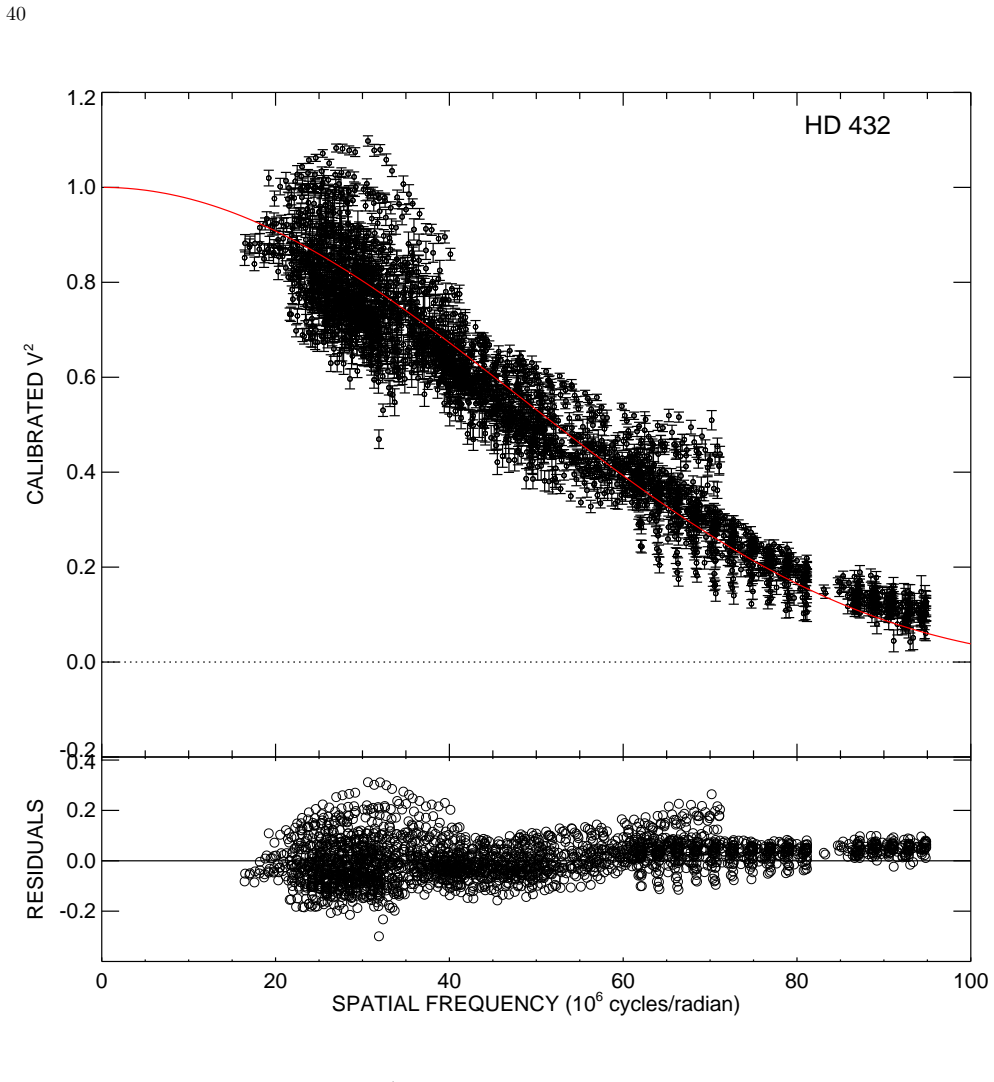
The central object is the interferometric visibility curve: the squared visibility $V^2$ is fitted first with a uniform-disk model, $V^2 = [2J_1(x)/x]^2$ with $x = \pi B\theta_\mathrm{UD}\lambda^{-1}$, then with a limb-darkened disk using coefficients from ATLAS models. The effective temperature and the limb-darkening coefficient are iterated to convergence because $T_\mathrm{eff}$ selects $\mu_\mathrm{LD}$, and the final $T_\mathrm{eff}$ comes from inverting the Stefan-Boltzmann relation with the bolometric flux. The 1996–2002 data are reduced with the original Classic beam-combiner pipeline, and post-2002 data with the updated pipeline, and both are combined in a single $\chi^2$ fit per star.
What would settle it
Re-observe a subset of the 145 stars with an independent long-baseline interferometer and compare the limb-darkened diameters; a systematic offset beyond the quoted ~2% would falsify the claimed precision. A faster check is gamma Cassiopeiae: resolving its photosphere separately from its disk should raise the 9998 K effective temperature toward the ~35,000 K spectral-type value, confirming that the single-star assumption is violated for that star.
Extended reading notes
Core claim
The paper claims that reprocessing the full NPOI archive, including data taken before the 2002 beam-combiner upgrade, yields limb-darkened angular diameters for 145 stars with uncertainties as low as 0.1% and an average of 1.8%. Combining these diameters with parallaxes and bolometric fluxes gives physical radii and effective temperatures: the sample includes 13 stars on the Habitable World Observatory target list, 14 asteroseismic targets for which masses are derived from the frequency of maximum oscillation power, and 69 stars whose visibility curves reach the first null and beyond, opening the way to direct limb-darkening measurements. Aggregated with earlier NPOI work, these measurements form a 241-star catalog in which 192 stars (75%) have angular-diameter uncertainties of 2% or less.
Load-bearing premise
The measurements assume every target is a single star that is not rotating fast enough to be oblate or gravity-darkened, and that no surrounding disk or companion contributes light within the interferometer's field of view.
Editorial extensions
If this is right
- 142 of the 145 stars have angular-diameter uncertainties below 10%, giving a benchmark set of directly measured radii and effective temperatures that can calibrate model-dependent values from large spectroscopic surveys.
- The 13 Habitable World Observatory targets include five stars whose new interferometric radii disagree with SED-based estimates by more than 5% and one by 27%, showing which target radii need revision.
- The 14 asteroseismic targets, combined with literature frequencies of maximum oscillation power, yield single-star masses from 0.9 to 2.4 solar masses with a median uncertainty of 12%.
- The 69 zero-crossing stars in this sample provide the high-spatial-frequency visibility data needed to measure limb darkening and gravity darkening directly rather than assuming them from models.
- If the 75% majority of the full 241-star sample holds at 2% precision, the NPOI archive can serve as a fiducial resource for precision stellar astrophysics, including exoplanet host star characterization.
Reading between the lines
- The paper's success at recovering science from 1996–2002 data suggests other interferometric archives predating modern beam combiners may hold similarly recoverable measurements that are currently unused.
- The gamma Cassiopeiae case shows the single-star assumption is not merely theoretical: its derived effective temperature of 9998 K versus a spectral-type value near 35,000 K implies the measured diameter traces a disk, and the star is not flagged in Table 6 despite the bias.
- Discrepancies of up to 27% with SED-based radii for Habitable World Observatory targets imply that some exoplanet target lists may be using radii that are over- or under-estimated, which could propagate into planetary radius and habitability calculations.
- The 69 zero-crossing stars could be re-observed at higher spatial frequency to measure second-lobe structure, providing a direct test of limb-darkening models across spectral types.
Editorial analysis
A structured set of objections, weighed in public.
Referee Report
Summary. The paper presents new or updated angular diameters, physical radii, and effective temperatures for 145 stars observed with the Navy Precision Optical Interferometer between 1996 and 2021. The analysis combines early and late NPOI data, fits uniform-disk and limb-darkened visibility models, and applies an iterative limb-darkening correction based on literature Teff, log g, and [Fe/H]. From the final limb-darkened diameters, the authors derive radii using literature parallaxes and effective temperatures using literature bolometric fluxes and the Stefan-Boltzmann relation. The sample is placed in context with previous NPOI measurements (241 stars total), and subsets are highlighted as promising HWO targets, asteroseismic targets with masses from νmax, and stars with visibility data reaching the first null or beyond.
Significance. If reliable, this catalog would provide a large, homogeneous set of directly measured angular diameters and derived fundamental parameters for bright stars, useful for calibrating spectroscopic surveys, characterizing HWO target stars, and constraining stellar evolution models. The paper's strengths include the use of substantial archival data spanning 25 years, a transparent description of the limb-darkening iteration, and the explicit identification of zero-crossing stars for future limb-darkening studies. The comparison with SED-based radii in Section 6.1 is also valuable. However, the reliability of the catalog is compromised by unmodeled or unflagged departures from the spherical single-star assumptions, most seriously for HD 5394 (gamma Cas) and for known rapid rotators such as Altair, Regulus, and eta UMa.
major comments (3)
- [Section 4, Table 7, HD 5394] The derived effective temperature for HD 5394 (gamma Cas) is 9998 ± 142 K, while the literature input Teff used for the initial limb-darkening coefficient is 35,210 K. This difference of roughly 25,200 K directly contradicts the Section 4 claim that the largest Teff change from the iterative process was 145 K. The sentence in Section 4 appears to describe only the change in Teff caused by updating the limb-darkening coefficient, not the difference between the initial literature Teff and the final Stefan-Boltzmann Teff, but as written it is misleading. More importantly, the enormous Teff discrepancy is the signature of fitting the Be circumstellar disk rather than the stellar photosphere. The paper discusses gamma Cas as a complex Be system in Section 5 but does not flag the measured angular diameter as contaminated in Table 6 or Table 7. This is a load-bearing issue because a non-stellar measurement is presented as a stellar diameter with 0.9% formal uncertainty. I recommend the authors either remove HD 5394 or flag it prominently, and add a criterion that flags targets whose final Teff deviates from the spectral-type/literature value by more than some threshold.
- [Section 6.3 and Table 6, HD 187642, HD 87901, HD 120315] The paper itself states that Altair is gravity-darkened and oblate (Section 6.3), yet Table 6 lists a circular limb-darkened diameter θLD = 3.211 ± 0.003 mas with σLD = 0.1%. For a non-circular source, the circular visibility model is misspecified; the χ²+1 uncertainty is a formal parameter error under a wrong model, not a true uncertainty on any physical diameter. The resulting θLD is an ill-defined average over position angles, and the derived radius and Teff inherit this bias. The same concern applies to HD 87901 (Regulus, v sin i = 329 km/s) and HD 120315 (eta UMa, v sin i = 205 km/s), which are fitted with the same spherical model without any caveat in Table 6. The catalog should flag such stars and either exclude them from the precision statistics or assign a systematic uncertainty that accounts for the oblateness/gravity-darkening bias.
- [Section 3.1 and Table 6] The two basic assumptions stated in Section 3.1 (effectively single, no significant oblateness) are violated by several targets that are not flagged in Table 6. For example, HD 32068/ζ Aur is an eclipsing binary with ΔmV = 2.22 (Table 8) and is nonetheless fitted as a single star; HD 29095/58 Per is a red supergiant with a B-star companion at ΔmV ≈ 2.9–3.9, near the NPOI detection window; and HD 5394 is a Be star with a bright disk. Section 5 notes some of these systems, but the asterisk convention in Table 6 is applied only to a subset. I recommend extending the flagging convention to all targets with known companions, disks, or rapid rotation that could bias the visibility fit, and adding a sentence in Section 6 stating how many of the 145 measurements are affected by such contamination.
minor comments (6)
- [Section 4] The sentence about σR contributions is confusingly worded: "The minimum and maximum σR were 0.03% and 21% for σpar, respectively, and 0.1% and 46% for σLD" seems to refer to the parallax and angular-diameter contributions separately, not the total radius uncertainty; please rephrase.
- [Section 6.2 and Table 10] The text says "Table 10 shows the results of these calculations for nine of our targets," but Table 10 contains 14 rows; also the abstract promises "14 more are asteroseismic targets," so the count should be made consistent.
- [Table 6] For HD 95418 the final θLD uncertainty is listed as 0.001 mas with σLD = 0.1%, but the ratio 0.001/1.560 is 0.06%, not 0.1%; please check the rounding and ensure the computed percentages are consistent with the quoted uncertainties.
- [References] The reference list contains two identical entries for Baines et al. 2023; please remove the duplicate.
- [Figure 4 caption] The caption says "see Section 6.1 for details," but the relevant discussion is in Section 6; update the cross-reference.
- [Section 6.3] The sentence describing the possible detection of binaries cites Hutter et al. (2016) for the detection window, but the numbers for magnitude difference and separation are quoted in Section 3.1; consider moving this citation there for clarity.
Circularity Check
No significant circularity: angular diameters are direct visibility fits with independent SED-based calibrators and literature bolometric fluxes.
full rationale
The measured angular diameters come from fitting the visibility model V^2 = [2J1(x)/x]^2 to calibrated NPOI visibilities, with a limb-darkening correction taken from Claret & Bloemen (2011) using literature Teff, log g, and [Fe/H]. The limb-darkening coefficient is an externally tabulated model quantity, not a free parameter fitted to the target data. The target theta_LD is the chi-squared minimum of that fixed model against the calibrated visibilities, so it is not defined in terms of the output Teff. The derived Teff comes from Eq. (1), combining theta_LD with a bolometric flux obtained from literature luminosities and parallaxes; the subsequent iteration updates mu_LD using the new Teff, but the effect is small (average theta_LD change 0.3%, Teff change 0.2%) and the output is not equal to the input by construction. Calibrator angular diameters are SED fits to photometry, so the calibration reference is independent of the target parameters. No uniqueness theorem or load-bearing self-citation forces the results. The concerns in Section 3.1 about binarity and rapid rotation, and the HD 5394 (gamma Cas) discrepancy, are model-assumption and accuracy issues, not circularity, because the pipeline does not fit a parameter that is then renamed as a prediction. Therefore no circular step is exhibited.
Assumptions & free parameters
free parameters (1)
- Calibrator angular diameter estimates theta_est =
0.2 to 1.5 mas, per-star values in Table 5
assumptions (4)
- domain assumption Targets are effectively single and not oblate due to rapid rotation (Section 3.1)
- domain assumption Limb-darkening coefficients from Claret & Bloemen (2011) ATLAS models in the R-band approximate the NPOI bandpass
- domain assumption Calibrator stars are small and symmetric, and their SED-fitted diameters are accurate to 5 percent
- domain assumption Bolometric luminosities L from the literature are accurate
Cite this review
Pith. "Pith review of Vintage NPOI: New and Updated Angular Diameters for 145 Stars." pith.science (2026). https://pith.science/paper/2KEYUO3E
@misc{pith2026250602912,
  author       = {Pith},
  title        = {Pith review of: Vintage NPOI: New and Updated Angular Diameters for 145 Stars},
  year         = {2026},
  howpublished = {\url{https://pith.science/paper/2KEYUO3E}},
  note         = {Machine review of arXiv:2506.02912}
}
read the original abstract
We present new or updated angular diameters, physical radii, and effective temperatures for 145 stars from the Navy Precision Optical Interferometer data archive. We used data from 1996 to late-2021, and we describe the differences between early and late data, which hinge upon an update of the beam combiner in 2002. We came across several sub-categories of stars of interest: 13 of our stars are promising targets for the Habitable World Observatory and therefore require as much study as possible, and 14 more are asteroseismic targets and have stellar masses after we combined our radii and effective temperatures with frequencies of maximum oscillation power values from the literature. In addition to this, many of the stars here show measurements to the first null in the visibility curve and beyond, which is the gateway to determining second-order effects such as direct measurements of limb-darkening. Finally, we consider the stars in the larger context of previous NPOI measurements and find the majority 75% of the angular diameters in the overall NPOI sample have uncertainties of 2% or less.
Figures


Figures from the paper (2 more)


Reference graph
Works this paper leans on
-
[1]
- [1] #1 = = ^ ^ ^ .\!\!^ d .\!\!^ h .\!\!^ m .\!\!^ s .\!\!^ @mss
thebibliography [1] 20pt to REFERENCES 6pt =0pt 10pt plus 3pt =0pt =0pt =1pt plus 1pt =0pt =0pt -12pt =13pt plus 1pt =20pt =13pt plus 1pt \@M =10000 =-1.0em =0pt =0pt 0pt =0pt =1.0em @enumiv\@empty 10000 10000 `\.\@m \@noitemerr \@latex@warning Empty `thebibliography' environment \@ifnextchar \@reference \@latexerr Missing key on reference command Each re...
2019
-
[2]
Allende Prieto, C. & Lambert, D. L.\ 1999, , 352, 555. doi:10.48550/arXiv.astro-ph/9911002
-
[3]
R., Schiavon, R., et al.\ 2008, Astronomische Nachrichten, 329, 1018
Allende Prieto, C., Majewski, S. R., Schiavon, R., et al.\ 2008, Astronomische Nachrichten, 329, 1018. doi:10.1002/asna.200811080
-
[4]
Alonso, A., Arribas, S., & Martinez-Roger, C.\ 1996, , 117, 227
1996
-
[5]
& Francis, C.\ 2012, Astronomy Letters, 38, 331
Anderson, E. & Francis, C.\ 2012, Astronomy Letters, 38, 331. doi:10.1134/S1063773712050015
-
[6]
T., Mozurkewich, D., Rickard, L
Armstrong, J. T., Mozurkewich, D., Rickard, L. J, et al.\ 1998, , 496, 550. doi:10.1086/305365
doi:10.1086/305365 1998
-
[7]
P., M \'e rand, A., Coud \'e du Foresto, V., et al.\ 2006, , 645, 664
Aufdenberg, J. P., M \'e rand, A., Coud \'e du Foresto, V., et al.\ 2006, , 645, 664. doi:10.1086/504149
doi:10.1086/504149 2006
-
[8]
Ayres, T.\ 2023, , 266, 6. doi:10.3847/1538-4365/acb535
Show all 131 references
-
[9]
K., Armstrong, J
Baines, E. K., Armstrong, J. T., Schmitt, H. R., et al.\ 2018, , 155, 30. doi:10.3847/1538-3881/aa9d8b
2018 doi
-
[10]
K., Thomas Armstrong, J., Clark, J
Baines, E. K., Thomas Armstrong, J., Clark, J. H., et al.\ 2021, , 162, 198. doi:10.3847/1538-3881/ac2431
2021 doi
-
[11]
K., Clark, J
Baines, E. K., Clark, J. H., Schmitt, H. R., et al.\ 2023, , 166, 268. doi:10.3847/1538-3881/ad08be
2023 doi
-
[12]
K., Schmitt, H
Baines, E. K., Schmitt, H. R., Stone, J. M., et al.\ 2024, , 13135, 131350K, doi:10.1117/12.3027444
2024 doi
-
[13]
D., Harper, G
Bennett, P. D., Harper, G. M., Brown, A., et al.\ 1996, , 471, 454. doi:10.1086/177981
1996 doi
-
[14]
T., Lane, B
van Belle, G. T., Lane, B. F., Thompson, R. R., et al.\ 1999, , 117, 521
1999
-
[15]
W., Schmitt, J
Berghoefer, T. W., Schmitt, J. H. M. M., & Cassinelli, J. P.\ 1996, , 118, 481
1996
-
[16]
J.\ 1997, IAU Symposium, 189, 147
Booth, A. J.\ 1997, IAU Symposium, 189, 147
1997
-
[17]
doi:10.1051/0004-6361:20021020
Bord \'e , P., Coud \'e du Foresto, V., Chagnon, G., et al.\ 2002, , 393, 183. doi:10.1051/0004-6361:20021020
2002 doi
-
[18]
Bourg \'e s, L., Lafrasse, S., Mella, G., et al.\ 2014, Astronomical Data Analysis Software and Systems XXIII, 485, 223
2014
-
[19]
doi:10.1093/mnras/stab997
Cardiel, N., Zamorano, J., Bar \'a , S., et al.\ 2021, , 504, 3730. doi:10.1093/mnras/stab997
2021 doi
- [20]
-
[21]
D., et al.\ 2013, , 549, A129
Cesetti, M., Pizzella, A., Ivanov, V. D., et al.\ 2013, , 549, A129. doi:10.1051/0004-6361/201219078
2013 doi
-
[22]
doi:10.1051/0004-6361/201936360
Charbonnel, C., Lagarde, N., Jasniewicz, G., et al.\ 2020, , 633, A34. doi:10.1051/0004-6361/201936360
2020 doi
-
[23]
doi:10.3847/1538-4357/ab66c7
Chen, X., Ge, Z., Chen, Y., et al.\ 2020, , 889, 157. doi:10.3847/1538-4357/ab66c7
2020 doi
-
[24]
doi:10.3847/1538-4357/ac2507
Chen, X., Guo, W., Sun, L., et al.\ 2021, , 922, 183. doi:10.3847/1538-4357/ac2507
2021 doi
-
[25]
Chen, P. S. & Kwok, S.\ 1993, , 416, 769. doi:10.1086/173276
1993 doi
-
[26]
& Malkov, O.\ 2022, , 517, 2925
Chulkov, D. & Malkov, O.\ 2022, , 517, 2925. doi:10.1093/mnras/stac2827
2022 doi
-
[27]
Claret, A., & Bloemen, S.\ 2011, , 529, A75
2011
-
[28]
L., VandenBerg, D
Clem, J. L., VandenBerg, D. A., Grundahl, F., et al.\ 2004, , 127, 1227. doi:10.1086/381295
2004 doi
-
[29]
A., & Megeath, S
Cohen, M., Wheaton, W. A., & Megeath, S. T.\ 2003, , 126, 1090. doi:10.1086/376474
2003 doi
-
[30]
C., & Castelli, F.\ 1996, , 112, 307
Colina, L., Bohlin, R. C., & Castelli, F.\ 1996, , 112, 307. doi:10.1086/118016
1996 doi
-
[31]
doi:10.1051/0004-6361/202348403
Corsaro, E., Bonanno, A., Kayhan, C., et al.\ 2024, , 683, A161. doi:10.1051/0004-6361/202348403
2024 doi
-
[32]
M., Skrutskie, M
Cutri, R. M., Skrutskie, M. F., van Dyk, S., et al.\ 2003, VizieR Online Data Catalog, 2246. II/246
2003
-
[33]
M., Freeman, K
De Silva, G. M., Freeman, K. C., Bland-Hawthorn, J., et al.\ 2015, , 449, 2604. doi:10.1093/mnras/stv327
2015 doi
-
[34]
Eggleton, P. P. & Tokovinin, A. A.\ 2008, , 389, 869. doi:10.1111/j.1365-2966.2008.13596.x
2008
-
[35]
M., Caputo, M., Lai, T
Eiermann, J. M., Caputo, M., Lai, T. S.-Y., et al.\ 2024, , 529, 1680. doi:10.1093/mnras/stae102
2024 doi
-
[36]
doi:10.1051/0004-6361/202245796
Escorza, A., Karinkuzhi, D., Jorissen, A., et al.\ 2023, , 670, L14. doi:10.1051/0004-6361/202245796
2023 doi
-
[37]
R., Karovska, M., Bond, H
Evans, N. R., Karovska, M., Bond, H. E., et al.\ 2018, , 863, 187. doi:10.3847/1538-4357/aad410
2018 doi
-
[38]
R., Schaefer, G
Evans, N. R., Schaefer, G. H., Bond, H. E., et al.\ 2008, , 136, 1137. doi:10.1088/0004-6256/136/3/1137
2008 doi
-
[39]
R., Schaefer, G
Evans, N. R., Schaefer, G. H., Gallenne, A., et al.\ 2024, , 971, 190. doi:10.3847/1538-4357/ad5e7a
2024 doi
-
[40]
doi:10.1051/0004-6361:20042229
Fr \'e mat, Y., Zorec, J., Hubert, A.-M., et al.\ 2005, , 440, 305. doi:10.1051/0004-6361:20042229
2005 doi
-
[41]
Friedemann, C.\ 1992, Bulletin d'Information du Centre de Donnees Stellaires, 40, 31
1992
-
[42]
Gaia Collaboration, Prusti, T., de Bruijne, J. H. J., et al.\ 2016, , 595, A1. doi:10.1051/0004-6361/201629272
2016 doi
-
[43]
Gaia Collaboration, Brown, A. G. A., Vallenari, A., et al.\ 2018, , 616, A1. doi:10.1051/00sec:obsvis04-6361/201833051
2018 doi
-
[44]
Gaia Collaboration\ 2022, VizieR Online Data Catalog, 1355
2022
-
[45]
H., & Ballering, N.\ 2016, , 826, 171
G \'a sp \'a r, A., Rieke, G. H., & Ballering, N.\ 2016, , 826, 171. doi:10.3847/0004-637X/826/2/171
2016 doi
-
[46]
doi:10.1051/0004-6361/201528052
Gebran, M., Farah, W., Paletou, F., et al.\ 2016, , 589, A83. doi:10.1051/0004-6361/201528052
2016 doi
-
[47]
Gontcharov, G. A. & Mosenkov, A. V.\ 2018, VizieR Online Data Catalog, 2354. II/354
2018
-
[48]
O., Corbally, C
Gray, R. O., Corbally, C. J., Garrison, R. F., et al.\ 2003, , 126, 2048. doi:10.1086/378365
2003 doi
-
[49]
F.\ 2005, The Observatory, 125, 1
Griffin, R. F.\ 2005, The Observatory, 125, 1
2005
-
[50]
F.\ 2008, The Observatory, 128, 21
Griffin, R. F.\ 2008, The Observatory, 128, 21
2008
-
[51]
F.\ 2010, The Observatory, 130, 299
Griffin, R. F.\ 2010, The Observatory, 130, 299
2010
-
[52]
doi:10.1086/130927
Gruber, R., Koo, D., & Middleditch, J.\ 1981, , 93, 777. doi:10.1086/130927
1981 doi
-
[53]
B., Bubbly, S
Gudennavar, S. B., Bubbly, S. G., Preethi, K., et al.\ 2012, , 199, 8. doi:10.1088/0067-0049/199/1/8
2012 doi
-
[54]
J., Koch, A., et al.\ 2018, , 619, A134
Hanke, M., Hansen, C. J., Koch, A., et al.\ 2018, , 619, A134. doi:10.1051/0004-6361/201833351
2018 doi
-
[55]
K., Dressing, C
Harada, C. K., Dressing, C. D., Kane, S. R., et al.\ 2024, , 272, 30. doi:10.3847/1538-4365/ad3e81
2024 doi
-
[56]
L., Stickland, D
Harmer, D. L., Stickland, D. J., Lloyd, C., et al.\ 1983, , 204, 927. doi:10.1093/mnras/204.3.927
1983 doi
-
[57]
doi:10.1051/0004-6361/200912927
Haubois, X., Perrin, G., Lacour, S., et al.\ 2009, , 508, 923. doi:10.1051/0004-6361/200912927
2009 doi
-
[58]
& Mel \'e ndez, J.\ 2007, , 475, 1003
Hekker, S. & Mel \'e ndez, J.\ 2007, , 475, 1003. doi:10.1051/0004-6361:20078233
2007 doi
-
[59]
Hoffleit, D.\ 1964, New Haven, Conn.: Yale University Observatory, 1964, 3rd rev.ed., edited by Hoffleit, Dorrit
1964
-
[60]
S., et al.\ 2021, , 919, 131
Hon, M., Huber, D., Kuszlewicz, J. S., et al.\ 2021, , 919, 131. doi:10.3847/1538-4357/ac14b1
2021 doi
-
[61]
P., van Belle, G
Horch, E. P., van Belle, G. T., Davidson, J. W., et al.\ 2015, , 150, 151. doi:10.1088/0004-6256/150/5/151
2015 doi
-
[62]
R., & McSwain, M
Huang, W., Gies, D. R., & McSwain, M. V.\ 2010, , 722, 605. doi:10.1088/0004-637X/722/1/605
2010 doi
-
[63]
R., Stello, D., et al.\ 2011, , 743, 143
Huber, D., Bedding, T. R., Stello, D., et al.\ 2011, , 743, 143. doi:10.1088/0004-637X/743/2/143
2011 doi
-
[64]
A., Benson, J
Hummel, C. A., Benson, J. A., Hutter, D. J., et al.\ 2003, , 125, 2630. doi:10.1086/374572
2003 doi
-
[65]
A., Mozurkewich, D., Armstrong, J
Hummel, C. A., Mozurkewich, D., Armstrong, J. T., et al.\ 1998, , 116, 2536. doi:10.1086/300602
1998 doi
-
[67]
J., Tycner, C., Zavala, R
Hutter, D. J., Tycner, C., Zavala, R. T., et al.\ 2019, , 243, 32. doi:10.3847/1538-4365/ab32e1
2019 doi
-
[68]
J., Tycner, C., Zavala, R
Hutter, D. J., Tycner, C., Zavala, R. T., et al.\ 2021, , 257, 69. doi:10.3847/1538-4365/ac23cb
2021 doi
-
[69]
J., Zavala, R
Hutter, D. J., Zavala, R. T., Tycner, C., et al.\ 2016, , 227, 4. doi:10.3847/0067-0049/227/1/4
2016 doi
-
[70]
S., Shane, W
Jackson, E. S., Shane, W. W., & Lynds, B. T.\ 1957, , 125, 712. doi:10.1086/146345
1957 doi
-
[71]
Jamar, C., Macau-Hercot, D., Monfils, A., et al.\ 1995, VizieR Online Data Catalog, 3039. III/39A
1995
- [72]
-
[74]
R., Nordlander, T., et al.\ 2022, , 658, A48
Karovicova, I., White, T. R., Nordlander, T., et al.\ 2022, , 658, A48. doi:10.1051/0004-6361/202142100
2022 doi
-
[75]
doi:10.1051/0004-6361/201014840
Katz, D., Soubiran, C., Cayrel, R., et al.\ 2011, , 525, A90. doi:10.1051/0004-6361/201014840
2011 doi
-
[76]
doi:10.1051/0004-6361/201834371
Kervella, P., Arenou, F., Mignard, F., et al.\ 2019, , 623, A72. doi:10.1051/0004-6361/201834371
2019 doi
-
[77]
doi:10.1051/0004-6361/202142146
Kervella, P., Arenou, F., & Th \'e venin, F.\ 2022, , 657, A7. doi:10.1051/0004-6361/202142146
2022 doi
-
[78]
R.\ 1995, , 293, 87
Kjeldsen, H., & Bedding, T. R.\ 1995, , 293, 87
1995
-
[79]
R., et al.\ 2024, , 962, 70
Klement, R., Rivinius, T., Gies, D. R., et al.\ 2024, , 962, 70. doi:10.3847/1538-4357/ad13ec
2024 doi
-
[80]
doi:10.1051/0004-6361:20030243
Le Borgne, J.-F., Bruzual, G., Pell \'o , R., et al.\ 2003, , 402, 433. doi:10.1051/0004-6361:20030243
2003 doi
-
[81]
J., Tan, K
Liu, Y. J., Tan, K. F., Wang, L., et al.\ 2014, , 785, 94. doi:10.1088/0004-637X/785/2/94
2014 doi
-
[82]
& Stapelfeldt, K.\ 2023, , 241, 116.07
Mamajek, E. & Stapelfeldt, K.\ 2023, , 241, 116.07
2023
-
[83]
D., Hartkopf, W
Mason, B. D., Hartkopf, W. I., Raghavan, D., et al.\ 2011, , 142, 176. doi:10.1088/0004-6256/142/5/176
2011 doi
-
[84]
D., Wycoff, G
Mason, B. D., Wycoff, G. L., Hartkopf, W. I., et al.\ 2001, , 122, 3466. doi:10.1086/323920
2001 doi
-
[85]
doi:10.3847/1538-3881/acb142
Matthews, N., Rivet, J.-P., Vernet, D., et al.\ 2023, , 165, 117. doi:10.3847/1538-3881/acb142
2023 doi
-
[86]
A., & Watson, R
McDonald, I., Zijlstra, A. A., & Watson, R. A.\ 2017, , 471, 770. doi:10.1093/mnras/stx1433
2017 doi
-
[87]
Mermilliod, J.-C.\ 1991, Catalogue of Homogeneous Means in the UBV System, Institut d'Astronomie, Universite de Lausanne
1991
-
[89]
G., Levine, S
Monet, D. G., Levine, S. E., Canzian, B., et al.\ 2003, , 125, 984. doi:10.1086/345888
2003 doi
-
[90]
D., Zhao, M., Pedretti, E., et al.\ 2007, Science, 317, 342
Monnier, J. D., Zhao, M., Pedretti, E., et al.\ 2007, Science, 317, 342. doi:10.1126/science.1143205
2007 doi
-
[91]
Neckel, T., Klare, G., & Sarcander, M.\ 1980, Bulletin d'Information du Centre de Donnees Stellaires, 19, 61
1980
-
[92]
R., McNeil, J
Neilson, H. R., McNeil, J. T., Ignace, R., et al.\ 2017, , 845, 65. doi:10.3847/1538-4357/aa7edf
2017 doi
- [93]
-
[94]
H., et al.\ 2020, Research Notes of the American Astronomical Society, 4, 12
Pantaleoni Gonz \'a lez, M., Ma \' z Apell \'a niz, J., Barb \'a , R. H., et al.\ 2020, Research Notes of the American Astronomical Society, 4, 12. doi:10.3847/2515-5172/ab712b
2020 doi
-
[95]
doi:10.1051/0004-6361/202347768
Paunzen, E., Netopil, M., Pri s egen, M., et al.\ 2024, , 689, A270. doi:10.1051/0004-6361/202347768
2024 doi
-
[96]
Porter, J. M. & Rivinius, T.\ 2003, , 115, 1153. doi:10.1086/378307
2003 doi
-
[97]
doi:10.3847/1538-4357/ad372f
Prasow- \'E mond, M., Hlavacek-Larrondo, J., Fogarty, K., et al.\ 2024, , 967, 8. doi:10.3847/1538-4357/ad372f
2024 doi
-
[98]
H., Teukolsky, S
Press, W. H., Teukolsky, S. A., Vetterling, W. T., & Flannery, B. P.\ 1992, Numerical recipes in C. The art of scientific computing (Cambridge: University Press, c1992, 2nd ed.)
1992
- [99]
-
[100]
doi:10.1051/0004-6361/201116769
Prugniel, P., Vauglin, I., & Koleva, M.\ 2011, , 531, A165. doi:10.1051/0004-6361/201116769
2011 doi
-
[101]
doi:10.3847/0004-6256/152/2/41
Pr s a, A., Harmanec, P., Torres, G., et al.\ 2016, , 152, 41. doi:10.3847/0004-6256/152/2/41
2016 doi
-
[102]
& Mel \'e ndez, J.\ 2005, , 626, 446
Ram \' rez, I. & Mel \'e ndez, J.\ 2005, , 626, 446. doi:10.1086/430101
2005 doi
-
[103]
M., Carlberg, J
Rebull, L. M., Carlberg, J. K., Gibbs, J. C., et al.\ 2015, , 150, 123. doi:10.1088/0004-6256/150/4/123
2015 doi
-
[104]
C.\ 2011, , 413, 1200
Roberts, L. C.\ 2011, , 413, 1200. doi:10.1111/j.1365-2966.2011.18205.x
2011
-
[105]
F., Jim \'e nez-Vicente, J., et al.\ 2006, , 371, 703
S \'a nchez-Bl \'a zquez, P., Peletier, R. F., Jim \'e nez-Vicente, J., et al.\ 2006, , 371, 703. doi:10.1111/j.1365-2966.2006.10699.x
2006
-
[106]
D., Massa, D., Meade, M., et al.\ 1985, , 59, 397
Savage, B. D., Massa, D., Meade, M., et al.\ 1985, , 59, 397. doi:10.1086/191078
1985 doi
-
[107]
L., et al.\ 2016, , 459, 1170
Scowcroft, V., Seibert, M., Freedman, W. L., et al.\ 2016, , 459, 1170. doi:10.1093/mnras/stw628
2016 doi
-
[108]
doi:10.3931/e-rara-527
Secchi, A.\ 1867, Sugli spettri prismatici delle stelle fisse : memoria del A[ngelo] Secchi, by Secchi, Angelo, 1867.. doi:10.3931/e-rara-527
-
[109]
M.\ 1992, , 30, 457
Shao, M., & Colavita, M. M.\ 1992, , 30, 457. doi:10.1146/annurev.aa.30.090192.002325
1992
-
[110]
Smith, M. A. & Henry, G. W.\ 2021, , 915, 13. doi:10.3847/1538-4357/abfe6e
2021 doi
-
[111]
L., Lagarde, N., et al.\ 2024, , 682, A145
Soubiran, C., Creevey, O. L., Lagarde, N., et al.\ 2024, , 682, A145. doi:10.1051/0004-6361/202347136
2024 doi
-
[112]
doi:10.1051/0004-6361/201628497
Soubiran, C., Le Campion, J.-F., Brouillet, N., et al.\ 2016, , 591, A118. doi:10.1051/0004-6361/201628497
2016 doi
-
[113]
G., Oelkers, R
Stassun, K. G., Oelkers, R. J., Paegert, M., et al.\ 2019, , 158, 138. doi:10.3847/1538-3881/ab3467
2019 doi
-
[114]
G., Oelkers, R
Stassun, K. G., Oelkers, R. J., Pepper, J., et al.\ 2018, , 156, 102. doi:10.3847/1538-3881/aad050
2018 doi
-
[115]
doi:10.1051/0004-6361/202347793
Tkachenko, A., Pavlovski, K., Serebriakova, N., et al.\ 2024, , 683, A252. doi:10.1051/0004-6361/202347793
2024 doi
- [116]
-
[117]
E., Horch, E
Tokovinin, A., Everett, M. E., Horch, E. P., et al.\ 2019, , 158, 167. doi:10.3847/1538-3881/ab4137
2019 doi
- [118]
-
[119]
R., Schaefer, G
Touhami, Y., Gies, D. R., Schaefer, G. H., et al.\ 2013, , 768, 128. doi:10.1088/0004-637X/768/2/128
2013 doi
-
[120]
A., Z i z n ovsk \'y , J., et al.\ 2010, Contributions of the Astronomical Observatory Skalnate Pleso, 40, 83
Tremko, J., Bakos, G. A., Z i z n ovsk \'y , J., et al.\ 2010, Contributions of the Astronomical Observatory Skalnate Pleso, 40, 83
2010
-
[121]
A., et al.\ 2004, , 152, 251
Valdes, F., Gupta, R., Rose, J. A., et al.\ 2004, , 152, 251. doi:10.1086/386343
2004 doi
-
[122]
& Munari, U.\ 2010, , 522, A79
Valentini, M. & Munari, U.\ 2010, , 522, A79. doi:10.1051/0004-6361/201014870
2010 doi
- [123]
-
[124]
T., van Belle, G., Creech-Eakman, M
van Belle, G. T., van Belle, G., Creech-Eakman, M. J., et al.\ 2008, , 176, 276. doi:10.1086/526548
2008 doi
-
[125]
doi:10.1051/0004-6361:20078357
van Leeuwen, F.\ 2007, , 474, 653. doi:10.1051/0004-6361:20078357
2007 doi
-
[126]
S., van Belle, G
von Braun, K., Boyajian, T. S., van Belle, G. T., et al.\ 2014, , 438, 2413. doi:10.1093/mnras/stt2360
2014 doi
-
[127]
V., & Jenkins, C
Wall, J. V., & Jenkins, C. R.\ 2003, Practical Statistics for Astronomers (Princeton Series in Astrophysics)
2003
-
[128]
doi:10.1051/aas:2000332
Wenger, M., Ochsenbein, F., Egret, D., et al.\ 2000, , 143, 9. doi:10.1051/aas:2000332
2000 doi
- [129]
-
[130]
A., Johnston, K
Wittkowski, M., Hummel, C. A., Johnston, K. J., et al.\ 2001, , 377, 981. doi:10.1051/0004-6361:20011124
2001 doi
-
[131]
P., Prugniel, P., et al.\ 2011, , 525, A71
Wu, Y., Singh, H. P., Prugniel, P., et al.\ 2011, , 525, A71. doi:10.1051/0004-6361/201015014
2011 doi
-
[132]
jie ., Shao, Y., & Li, X.-D.\ 2024, , 962, 126
Xu, X.-. jie ., Shao, Y., & Li, X.-D.\ 2024, , 962, 126. doi:10.3847/1538-4357/ad20ec
2024 doi
-
[133]
L., et al.\ 2009, , 501, 297
Zorec, J., Cidale, L., Arias, M. L., et al.\ 2009, , 501, 297. doi:10.1051/0004-6361/200811147
2009 doi
-
[134]
doi:10.1051/0004-6361/201628760
Zorec, J., Fr \'e mat, Y., Domiciano de Souza, A., et al.\ 2016, , 595, A132. doi:10.1051/0004-6361/201628760
2016 doi
Reviewed August 7, 2026 · model on record in the stance chip above.
Discussion (0). Sign in to comment.