REVIEW 1 major objections 7 minor 20 references
Domination and Total Domination Numbers in Zero-divisor Graphs of Commutative Rings
T0 review · 1 major / 7 minor · reviewed 2026-08-07 · deepseek-v4-flash
Pith's one-line read For every commutative ring, the domination number of its zero-divisor graph equals the total domination number, except for rings of the form Z2 × D with D a domain, where the two numbers are 1 and 2.
desk verdict Settles the domination vs total domination comparison for zero-divisor graphs with one clean exception, but the infinite case as written has a repairable gap. read the letter →
The pith
A machine-rendered reading of the paper's core claim, the machinery that carries it, and where it could break.
The reading
What carries the argument
The central object is the zero-divisor graph Γ(R): vertices are nonzero zero-divisors of R, and distinct vertices r and s are adjacent exactly when rs = 0, with self-adjacency allowed for vertices with square zero. The load-bearing structural fact is Lemma 3.4: every minimum total dominating set {a1, ..., an} satisfies aiaj = 0 for i ≠ j, so it induces a complete subgraph (a clique of pairwise-annihilating elements). This forces girth 3 whenever γ_t ≥ 3, reduces the girth-4 and infinite-girth cases to small values of γ_t, and underpins the replacement argument in Theorem 4.2, which selects a minimum dominating set D maximizing the number of elements that have another element of D in their annihilator and then produces a new minimum dominating set of the same size with even more such elements, contradicting maximality unless γ = γ_t. For the infinite case, Lemma 5.1 adjoins one neighbor of each element of an infinite minimum dominating set to obtain a total dominating set of the same cardinality.
What would settle it
Exhibit a commutative ring R, not isomorphic to Z2 × D for any domain D, for which γ_t(Γ(R)) > γ(Γ(R)); the paper's own results exclude all finite cases, so any counterexample must have infinite domination number and would refute Theorem 1.1. A concrete target is a zero-divisor graph with a countable minimum dominating set but no countable total dominating set; the paper provides no such ring, and constructing one would settle the question negatively.
Extended reading notes
Core claim
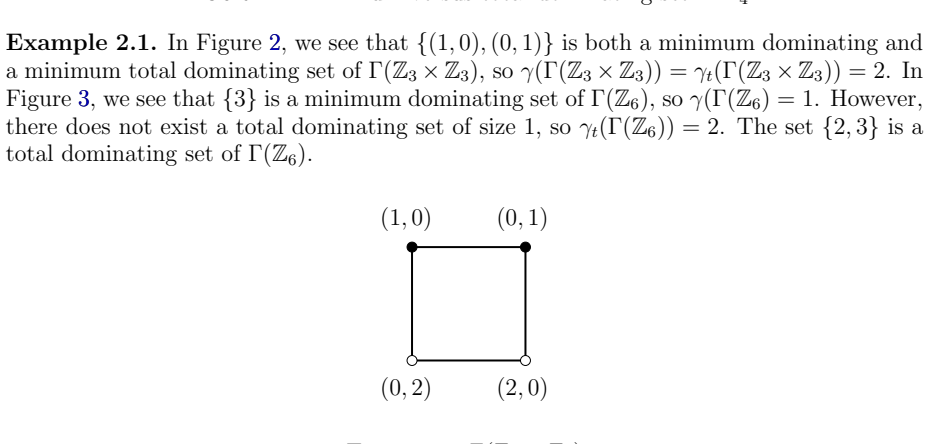
The paper's central claim is Theorem 1.1: if R is a commutative ring not isomorphic to Z2 × D for a domain D, then γ_t(Γ(R)) = γ(Γ(R)). Equivalently, the only zero-divisor graphs in which domination and total domination differ are the stars Γ(Z2 × D), whose universal vertex (1,0) alone dominates the graph yet, having nonzero square, must be joined by a leaf to form a total dominating set. The proof divides by girth: when girth is 4 or infinite, γ_t is at most 2 and equality holds except in the star case; when γ_t is finite and at least 3, the girth is 3 and a maximality argument on minimum dominating sets of Γ(R) forces equality; and when γ_t is infinite, a cardinality argument yields equality. The paper also shows that γ_t = 1 happens exactly when the zero-divisors of R form an annihilator ideal Z(R) = ann(a), in which case both parameters equal 1.
Load-bearing premise
The infinite-case proof assumes that an infinite minimum dominating set can always be enlarged to a total dominating set of equal cardinality by adding one neighbor per element; the paper spells out this step only for countable sets, and the uncountable case rests on an unstated cardinal arithmetic comparison.
Editorial extensions
If this is right
- For every finite commutative ring except Z2 × D (D a domain), the domination and total domination numbers of Γ(R) are equal.
- A zero-divisor graph has total domination number 1 exactly when the zero-divisors of R form an annihilator ideal, and then both numbers are 1.
- Whenever the total domination number is at least 3, the zero-divisor graph contains a triangle, so the only possible discrepancy between γ and γ_t occurs in the star case with γ_t = 2.
- The exceptional rings Z2 × D are fully classified: their zero-divisor graphs are stars with γ = 1 and γ_t = 2.
Reading between the lines
- A standard graph-theoretic bound covers the infinite case more directly than the paper's lemma: any graph without isolated vertices has γ_t ≤ 2γ, and every vertex of a zero-divisor graph has a neighbor, so for infinite γ the two parameters must be equal; this observation would dispatch all uncountable rings in one stroke.
- The theorem can be read as a sharper algebraic classification than its statement: γ ≠ γ_t holds exactly when Γ(R) has a universal vertex with nonzero square, which is precisely the situation of the star Z2 × D; this reformulation is directly testable on any ring.
- Without the axiom of choice, the unstated cardinal arithmetic in Lemma 5.1 could fail, potentially admitting rings where γ is countable yet γ_t is strictly larger; exploring this would require working in a choiceless set-theoretic setting.
Editorial analysis
A structured set of objections, weighed in public.
Referee Report
Summary. The paper studies domination and total domination numbers of zero-divisor graphs of commutative rings. Its main theorem (Theorem 1.1) asserts that for every commutative ring R, γ_t(Γ(R)) = γ(Γ(R)) unless R is isomorphic to Z_2 × D for a domain D, in which case γ = 1 and γ_t = 2. The proof splits the problem according to the girth trichotomy for zero-divisor graphs (3, 4, or ∞). For girth 4 or ∞, the total domination number is shown to be at most 2 and the equality follows by direct case analysis. For girth 3, the finite case is handled in Section 4 through a lengthy case analysis (Theorem 4.2), and the infinite case is delegated to Lemma 5.1 in Section 5. The paper is self-contained at the level of graph theory, relying on standard external results for girth classification and classification of rings with girth 4 or ∞.
Significance. If the proof is completed, the result is a clean and definitive classification: among all zero-divisor graphs of commutative rings, the only one with unequal domination and total domination numbers is the star graph arising from Z_2 × D. The theorem is parameter-free and covers both finite and infinite rings. The authors make good use of the known girth trichotomy and of Lemma 3.4, which shows that a minimum total dominating set induces a complete subgraph; this structural insight reduces much of the problem to girth-3 graphs. The finite case is a substantial and largely coherent case analysis. The main obstruction to accepting the theorem as proved is a gap in Lemma 5.1 that affects the infinite-ring half of the main theorem; the gap is localized and repairable by a standard cardinality argument.
major comments (1)
- [Section 5, Lemma 5.1] The proof of Lemma 5.1 does not cover the uncountable case of Theorem 1.1, and the sentence 'the only case we need to consider is when γ(Γ(R)) is countable, but γ_t(Γ(R)) is uncountable' is not justified. The first paragraph only proves that γ_t infinite implies γ infinite, by contrapositive from the fact that a finite dominating set yields a finite total dominating set. It does not rule out the possibility that γ is uncountable and γ_t is a strictly larger uncountable cardinal. The subsequent construction with a countable dominating set D cannot be applied when γ is uncountable. The missing step is straightforward: for any infinite minimum dominating set D, choose for each x ∈ D a neighbor n_x (allowing n_x = x when x^2 = 0, and otherwise using the fact that a nonzero zero-divisor has a distinct zero-divisor neighbor), and set T = D ∪ {n_x : x ∈ D}. Then T is a total dominating set and |T| = |D| for infinite D, so γ_t(Γ(R)) ≤ γ(Γ(R)); the reverse inequality is automatic. This argument should be added, or the claim that only the countable case needs consideration should be removed.
minor comments (7)
- [Section 2] The sentence 'the girth of of a zero-divisor graph' contains a duplicated 'of'.
- [Section 3, Proposition 3.8] The phrase 'where D a domain' should read 'where D is a domain'.
- [Section 4, Theorem 4.2] In the proof, 'it must the case' should be 'it must be the case', and 'contadiction' should be 'contradiction'.
- [Section 4, Theorem 4.2, Case 1] In the paragraph beginning 'If for every z ∈ ann(x − d)*', the sentence 'Thus, there must exist s ∈ ann(x)* ...' appears to be a copy-paste error; it should refer to an element w ∈ ann(x − d)*, matching the immediately following sentence.
- [Section 4, Proposition 4.1] The proof does not explicitly address subcases in which a proposed replacement element such as ab equals an existing element of the total dominating set (for example, ab = x1). Such cases can be handled by using a different two-element total dominating set, but the text should say so.
- [Theorem 1.1] The statement quantifies over all commutative rings, but when R is an integral domain, Γ(R) has no vertices and γ and γ_t are not defined. The paper should either state the standing assumption that Z(R)* is nonempty or explain how the empty graph is treated.
- [Example 2.1] The expression 'γ(Γ(Z6) = 1' is missing a closing parenthesis; it should be 'γ(Γ(Z6)) = 1'.
Circularity Check
Derivation is self-contained; the only overlapping-author citation is a standard non-target fact, and the infinite-ring lemma's gap is a correctness issue, not circularity.
full rationale
I find no circular dependence. The paper's main theorem is assembled from Proposition 3.3/3.5/3.7/3.8/3.9 (small total domination values), Theorem 4.2 (finite total domination case, self-contained maximality argument), and Lemma 5.1 (infinite total domination case). None of these steps fits a parameter to the conclusion or defines a quantity in terms of the target. Lemma 3.4's replacement argument and Theorem 4.2's case analysis are internal ring-theoretic/graph-theoretic proofs that do not assume gamma_t = gamma. The only citation with overlapping authorship is [AAS], used for the standard fact that the girth of a zero-divisor graph is 3, 4, or infinity; that fact is external, parameter-free, and concerns girth rather than domination, so it is not a self-citation chain forcing the target result. Per the reviewing rule, I flag Lemma 5.1 as a separate non-circular gap: its first paragraph proves only that a finite dominating set yields a finite total dominating set, and the proof then says 'the only case we need to consider is when gamma(Γ(R)) is countable, but gamma_t(Γ(R)) is uncountable,' omitting the case where both are uncountable with gamma_t larger. That is an incompleteness/correctness risk, not a circular step, because the missing argument (add one neighbor of each element of an arbitrary infinite minimum dominating set) would not presuppose gamma_t = gamma. Score 0.
Assumptions & free parameters
assumptions (6)
- domain assumption Zero-divisor graph convention includes self-adjacency for square-zero elements.
- domain assumption The girth of any zero-divisor graph is 3, 4, or infinity.
- domain assumption Rings with girth 4 have the form given in [MUL, Theorem 2.3].
- domain assumption Rings with infinite girth are exactly the list in [DS, Theorems 1.7 and 1.12].
- standard math Every nonzero zero-divisor has a nonzero annihilator.
- standard math Choice principle for selecting one neighbor from each element of a dominating set.
Cite this review
Pith. "Pith review of Domination and Total Domination Numbers in Zero-divisor Graphs of Commutative Rings." pith.science (2026). https://pith.science/paper/4BLD6CAY
@misc{pith2026250602953,
  author       = {Pith},
  title        = {Pith review of: Domination and Total Domination Numbers in Zero-divisor Graphs of Commutative Rings},
  year         = {2026},
  howpublished = {\url{https://pith.science/paper/4BLD6CAY}},
  note         = {Machine review of arXiv:2506.02953}
}
abstract
Zero-divisor graphs of commutative rings are well-represented in the literature. In this paper, we consider dominating sets, total dominating sets, domination numbers and total domination numbers of zero-divisor graphs. We determine the domination and total domination numbers of zero-divisor graphs are equal for all zero-divisor graphs of commutative rings except for $\mathbb{Z}_2 \times D$ in which $D$ is a domain. In this case, $\gamma(\Gamma(\mathbb{Z}_2 \times D)) = 1$ and $\gamma_t(\Gamma(\mathbb{Z}_2 \times D)) = 2$.
Figures


Reference graph
Works this paper leans on
-
[1]
Anderson, D.F., Axtell, M., and Stickles, J., Zero-divisor graphs in commutative rings, in Commutative Algebra, Noetherian and Non-Noetherian Perspectives , Springer-Verlag, New York (2011), 23-45
work page 2011
-
[2]
and Livingston, P.S., The zero-divisor graph of a commutative ring, J
Anderson, D.F. and Livingston, P.S., The zero-divisor graph of a commutative ring, J. Algebra 217 (1999), 434--447
work page 1999
-
[3]
and Stickles, J., Cut structures in zero-divisor graphs of commutative rings, J
Axtell, M., Baeth, N. and Stickles, J., Cut structures in zero-divisor graphs of commutative rings, J. Comm. Alg. 8 (2016), no. 2 143--171
work page 2016
-
[4]
and Trampbachls, W., Zero-divisor ideals and realizable zero-divisor graphs, Involve 2 (2009), no
Axtell, M., Stickles, J. and Trampbachls, W., Zero-divisor ideals and realizable zero-divisor graphs, Involve 2 (2009), no. 1
work page 2009
-
[5]
Beck, I., Coloring of commutative rings, J. Algebra 116 (1988), 208-226
work page 1988
-
[6]
Chartland, G., Introductory Graph Theory, Dover Publications, Inc., New York, 1977
work page 1977
-
[7]
Cote, B., Ewing, C., Huhn, M., Plaut, C.M., Weber, D.,
-
[8]
Coykendall, J., Sather-Wagstaff, S., Sheppardson, L., and Spiroff, S., On zero-divisor graphs, in Progress in Commutative Algebra 2 , De Gruyter, Berlin (2012), 241-299
work page 2012
Show all 20 references
-
[9]
DeMeyer, F., Schneider, K., Automorphisms and zero-divisor graphs of commutative rings, Internat. J. Commutative Rings 1 (3) (2001), 93-105
2001
-
[10]
Fink, J., Jacobson, L., Kinch, L., and Roberts, J., On graphs having domination number half their order, Periodica Mathematica Hungarica 16 (1985), 287--293
1985
-
[11]
Hungerford, T., Algebra, Springer, New York, 1974
1974
-
[12]
and Rahimi, A.M., Dominating sets of some graphs associated to commutative rings, Comm
Mojdeh, D.A. and Rahimi, A.M., Dominating sets of some graphs associated to commutative rings, Comm. Alg. 40 (2012), no. 9, 3389--3396
2012
-
[13]
Mulay, S.B., Rings having zero-divisor graphs of small diameter or large girth, Bull. Austral. Math. Soc. 72 (2005), 481--490
2005
-
[14]
and Rehman, N., On domination in zero-divisor graphs of rings with involution, Bull
Nazim, M., Nisar, J. and Rehman, N., On domination in zero-divisor graphs of rings with involution, Bull. Korean Math. Soc. 58 (2021), no. 6, 1409--1418
2021
-
[15]
Ore, O., Theory of Graphs, American Mathematical Society, Providence RI, 1962
1962
-
[16]
and Xuong, N.H., Domination-balanced graphs, J
Payan, C. and Xuong, N.H., Domination-balanced graphs, J. of Graph Theory 6 (1982), 23--32
1982
-
[17]
and Mojdeh, D.A., On domination in zero-divisor graphs, Canadian Math
Rad, N.J., Jafari, S.H. and Mojdeh, D.A., On domination in zero-divisor graphs, Canadian Math. Bull. 56 (2013), no. 2, 407--411
2013
-
[18]
9-10, 1155--1166
Redmond S.P., On zero-divisor graphs of small finite commutative rings, Discrete Mathematics 207 (2007), no. 9-10, 1155--1166
2007
-
[19]
and Ramezani, F., On the domination and signed domination numbers of zero-divisor graph, Electronic J
Vatandoost, E. and Ramezani, F., On the domination and signed domination numbers of zero-divisor graph, Electronic J. of Graph Theory and Applications 4 (2016), no. 2, 148--156
2016
-
[20]
164 (1965), 729 - 741
Vizing, V.G., A bound on the external stability number of a graph, Doklady A.N. 164 (1965), 729 - 741
1965
Reviewed August 7, 2026 · model on record in the stance chip above.
Discussion (0). Sign in to comment.