REVIEW 2 major objections 5 minor 18 references
Controllable Text-to-Speech Synthesis with Masked-Autoencoded Style-Rich Representation
T0 review · 2 major / 5 minor · reviewed 2026-08-07 · deepseek-v4-flash
Pith's one-line read A two-stage text-to-speech pipeline with discrete style-rich tokens as its intermediate representation delivers fine-grained, stable control over emotion, pitch, and timbre.
desk verdict A clean two-stage TTS architecture with an honest limitations section, but the control-accuracy benchmarks are self-referential and the scaling comparison mixes architecture with data. read the letter →
The pith
A machine-rendered reading of the paper's core claim, the machinery that carries it, and where it could break.
The reading
What carries the argument
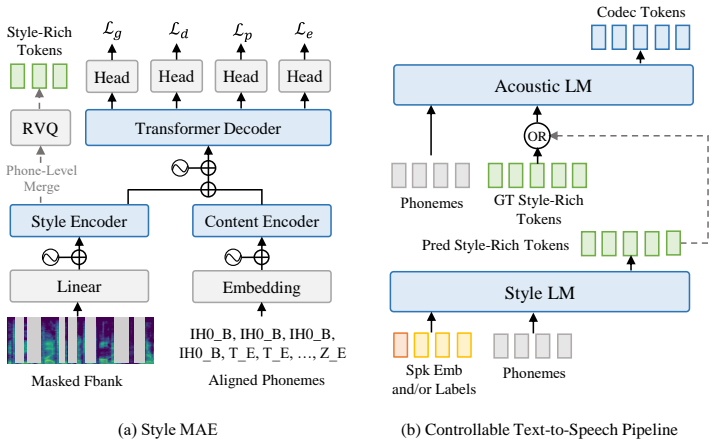
The load-bearing object is the quantized masked-autoencoder style-rich representation: a pretrained MAE whose style encoder maps masked mel filterbanks plus aligned phonemes to frame-level features, trained with reconstruction, contrastive, pitch-classification, and energy-classification losses, then averaged per phone and discretized by a three-codebook residual vector quantizer. This token sequence is the intermediate variable that decouples the two transformer language models: the style LM models the distribution of style-rich tokens given phonemes and control signals, while the acoustic LM models codec tokens given phonemes and style-rich tokens. A second mechanism is classifier-free guidance on the discrete control labels, where labels are randomly replaced by an empty control token during training and the logits are extrapolated at inference; this is what sharpens control over fine-grained attributes such as arousal and pitch mean.
What would settle it
Take a fixed set of utterances and create label extremes (e.g., high versus low arousal, high versus low pitch mean) using the paper's own binning, generate speech with the two-stage model, then have independent human listeners or a different, converged attribute estimator rate the outputs. If the model's output attributes do not separate by label above chance, or if human-annotated labels disagree with the tool-based accuracy by more than the tool's own test-retest reliability, the central control claim fails. An even simpler check: hold the speaker embedding fixed, generate the same text with conflicting label combinations (e.g., 'male' plus high pitch-mean), and compare predicted versus actual acoustic distributions; if the model simply copies the most frequent label in the training set, the correlations in the data rather than the control pathway would explain the accuracy.
Extended reading notes
Core claim
The central discovery is that a masked-autoencoder style encoder, after phone-level merging and residual vector quantization, produces a discrete style-rich token sequence that carries speaker timbre, prosody, and acoustic environment well enough to serve as the sole style interface between two autoregressive language models. Given text phonemes and control signals (discrete labels for age, gender, pitch mean, pitch std, arousal, dominance, valence, SNR, and C50, optionally combined with a speaker embedding), the first LM predicts these style-rich tokens; the second LM, trained on a small high-quality corpus, reconstructs codec tokens from the phonemes and the predicted tokens. The paper demonstrates that applying classifier-free guidance in the first stage, with the empty control token dropped in 15% of training steps, increases control accuracy for fine-grained attributes that have ambiguous boundaries, while the two-stage design keeps content accuracy and naturalness stable as the guidance scale grows, unlike a one-stage baseline trained on the same small corpus. It also shows that swapping timbre labels for a speaker embedding preserves emotion-control accuracy and speaker similarity, enabling attribute adjustment on top of a chosen reference voice.
Load-bearing premise
The automatic labeling tools that assign age, gender, emotion, pitch, SNR, and C50 values to the training data are accurate enough to serve as both supervision and ground truth; if they carry systematic bias, the reported fine-grained control accuracy would reflect that bias rather than true acoustic control.
Editorial extensions
If this is right
- The two-stage architecture lets style learning scale to large, automatically labeled corpora while keeping the high-quality acoustic modeling stage small, lowering the data cost of controllable TTS.
- Discrete labels give users a control interface that is more precise than natural-language prompts for attributes like pitch mean, pitch variation, emotion dimensions, SNR, and reverberation.
- Classifier-free guidance at the style-token level improves control accuracy for fine-grained attributes without degrading content accuracy, provided the first stage is trained on enough data.
- Using a speaker embedding in place of timbre labels supports emotion and pitch control for a specified reference speaker while retaining speaker similarity.
Reading between the lines
- A likely but untested extension is to reuse the same style-rich token interface for voice conversion or style transfer between speakers, since the acoustic LM already decouples timbre from style tokens.
- Because control accuracy is measured with the same automatic tools that produced the labels, the reported percentages may partly measure label-consistency rather than perceptual control; a human-rating study of attribute strength would clarify this.
- The style LM could serve as a sampling prior to generate diverse stylistic renderings of the same text and labels, but the paper does not report diversity or sample-variation metrics.
Editorial analysis
A structured set of objections, weighed in public.
Referee Report
Summary. The manuscript proposes a two-stage LM-based controllable TTS system. A masked autoencoder is trained to produce a quantized 'style-rich token' sequence from speech and aligned phonemes; an autoregressive style LM generates these tokens from text and discrete attribute labels (age, gender, pitch mean/std, arousal/dominance/valence, SNR, C50) and/or speaker embeddings; an acoustic LM then generates EnCodec tokens from text and style tokens. Experiments compare this two-stage system with a one-stage baseline on WER, UTMOS, control accuracy, speaker similarity, and subjective MOS, and examine classifier-free guidance in the style LM. The paper claims that training the style LM on large corpora improves content robustness and control, and that label/speaker-embedding combinations enable timbre and emotion control.
Significance. The proposed decoupling of style-token generation from codec-token generation is a sensible way to exploit large, lower-quality corpora for control while keeping high-quality data demand modest. The style MAE with auxiliary losses and RVQ tokenization is clearly described, and the use of CFG in the style-token LM is a reasonable mechanism that the experiments show can help fine-grained attributes. The authors are candid about limitations. However, the two load-bearing pieces of evidence—the superiority of the two-stage design and the fine-grained control accuracy—are not yet established because the main comparison is confounded by training data scale, and the control metric reuses the automatic annotators that produced the training labels. These are fixable with additional ablations and independent evaluation, so the contribution could become solid.
major comments (2)
- [Section III-D2, Figs. 2 and 4, Table IV] The central evidence for the two-stage design is confounded by training data composition. The one-stage baseline is trained only on LibriTTS, while the two-stage style LM is trained on GigaSpeech-xl and only the acoustic LM uses LibriTTS. The improved WER/UTMOS stability and the control-accuracy advantages of the two-stage model over the one-stage model could therefore reflect exposure to 10,000 hours of diverse speech rather than the benefit of the two-stage architecture. Please add ablations that vary data scale independently of architecture, e.g., train the style LM on LibriTTS alone, or train a one-stage model on GigaSpeech-xl (or a comparable subset), and report Figures 2 and 4 for those configurations.
- [Section III-B, Table I, Sections IV-V] The fine-grained control-accuracy metric is circular with respect to the training supervision. Table I shows that all training labels are produced by w2v2-age-gender, w2v2-emotion, and DataSpeech, and Section III-B states that control accuracy is computed by re-running those same tools on synthesized speech and comparing against the tool-derived 'ground truth' labels. If these annotators have systematic bias, the model can achieve high reported accuracy by reproducing the annotator's biased mapping rather than by controlling the underlying perceptual or acoustic attributes. Section IV provides direct evidence of such bias: arousal and dominance from w2v2-emotion are strongly linearly correlated despite being theoretically orthogonal, and Section V limitation 1 concedes that tool bias causes sub-optimal control. The MOS-A results in Table V are only a partial remedy: they cover emotion only, use 8 samples per setting, and convert labels from the same VAD system used in training. Please provide independent evaluation for age, pitch, SNR, and C50 (e.g., human perceptual ratings, manual acoustic measurements, or held-out labels from different tools), or explicitly restate the claim as control over the annotator-derived labels.
minor comments (5)
- [Abstract / Index Terms] There is a typo in the Index Terms: 'genertaion' should be 'generation'.
- [Fig. 2] The legend entries such as '1-stage libritts' and '2-stage gigaspeech' refer to test sets, but this is easy to misread as training data; please relabel them as 'test set' or use a clearer notation.
- [Table I] The row for Gender is missing an explicit lower-bound value in the table body; the reader has to infer the intended interval from the listed boundaries.
- [Section III-B] The 'soft accuracy' rule—counting a one-bin error as correct for age/SNR/C50 and as 0.5 for emotion/pitch—makes reported percentages hard to interpret, especially for attributes with skewed distributions; please report per-bin accuracy or confusion matrices and add confidence intervals or significance tests for the model differences.
- [Section IV] The MLPs for predicting pitch mean and pitch std from high-level labels are described, but their downstream effect on control accuracy or content quality is not evaluated; adding such an evaluation would make this proposal more concrete.
Circularity Check
Control-accuracy evidence is partially circular: the same annotation tools that create the training labels also grade the synthesized outputs, so the reported fine-grained control may reflect reproducing tool bias; the pipeline's content and quality results rest on independent metrics.
-
fitted input called prediction
[Section III-B (Metrics), with Table I and Section II-C]
"Section III-B: "For control accuracy, we use the annotation tools to extract attribute labels and compute percentage accuracy with ground truth labels." Section II-C: "These labels are denoted by extracting attribute values with some tools and binning them to different levels." Table I lists the same tools: w2v2-age-gender, w2v2-emotion, and DataSpeech."
The style LM is trained on discrete labels produced by the automatic tools in Table I, and the same tools are then re-run on synthesized speech to compute control accuracy against 'ground truth labels' that are also tool outputs. A model can score high accuracy by learning the tools' systematic input-to-label mapping, including any bias, without controlling the underlying acoustic or perceptual attribute. The paper itself acknowledges this risk in Section V, limitation 1: 'the attribute annotations of the training data may have a bias against real-world values, causing sub-optimal control capabilities.' Thus the control-accuracy metric mainly measures agreement with the labeling functions used for supervision, making the fine-grained control claim partially self-referential.
-
self definitional
[Section III-B, subjective evaluation paragraph]
""For MOS-A, considering that the original VAD labels are difficult to understand, we converted the VAD label combinations into emotional intensity levels (such as flat, neutral, or highly expressive) or typical emotional categories (such as happy, angry, or sad) corresponding to those combinations.""
The emotion labels used to train the style LM come from the w2v2-emotion VAD system, as shown in Table I ('Arousal, Dominance, Valence — w2v2-emotion'). The subjective MOS-A evaluation converts the same VAD label combinations into emotion categories and asks raters to judge alignment with those categories, so the human emotion-control evaluation is anchored to the same tool-derived discretization used as supervision. This is not fully independent evidence of controlling natural emotion; it is partly a check that the output matches the same VAD mapping, though human listening does provide some external judgment.
full rationale
The paper's two-stage architecture and training recipe are not circular: the style MAE, RVQ, style LM, acoustic LM, and CFG are trained with ordinary next-token and reconstruction losses, and the content-accuracy, naturalness, and speaker-similarity evidence (WER via Whisper, UTMOS, WavLM-SV cosine similarity, MCD, and MOS-Q/MOS-S) uses external tools or human ratings that are independent of the training labels. The use of prior work [6] by overlapping authors is a building block, not a load-bearing uniqueness argument, so it does not constitute circularity. However, the headline quantitative support for fine-grained control is partly circular: the same automatic annotation tools that produced the training labels (Table I) are reused in Section III-B to score control accuracy, and the subjective MOS-A emotion evaluation converts labels from the same VAD system used in training. This does not invalidate the whole paper, because the two-stage design's content robustness and naturalness advantages are externally grounded, but it means the fine-grained control-accuracy numbers are substantially a self-consistency check with the labeler rather than independent validation of controlling the underlying attributes. Score 4 reflects partial circularity concentrated in the control-accuracy and emotion-alignment evidence.
Assumptions & free parameters
free parameters (6)
- Style MAE loss weights (lambda_r, lambda_c, lambda_p, lambda_e) =
10, 1, 1, 1
- Classifier-free guidance scale gamma =
1.0 to 4.0 searched; 2.0 to 3.0 reported as best
- Attribute binning boundaries =
Table I: gender thresholds [0.35, 0.5, 0.65]; age 0-100 in 10 bins; other attributes equidistant within hand-set ranges
- Soft accuracy tolerance for control metrics =
+/-1 bin for age, SNR, C50; 0.5 credit for emotion and pitch labels
- Mask probability for style MAE =
0.75
- Number of RVQ codebooks and EnCodec levels =
3 RVQ codebooks for style tokens; first 3 of 8 EnCodec levels
assumptions (4)
- domain assumption Aligned phoneme sequences with duplicated durations are a sufficient content representation for both language models.
- domain assumption The automatic attribute extractors (w2v2-age-gender, w2v2-emotion, DataSpeech) produce labels reliable enough to supervise and evaluate fine-grained control.
- domain assumption Style encoder output without a dedicated bottleneck is acceptable despite content leakage into style-rich tokens.
- standard math Autoregressive next-token factorization and classifier-free guidance logit interpolation are valid generative modeling choices.
invented entities (1)
-
Style-rich token (ST)
Cite this review
Pith. "Pith review of Controllable Text-to-Speech Synthesis with Masked-Autoencoded Style-Rich Representation." pith.science (2026). https://pith.science/paper/76LS5QBD
@misc{pith2026250602997,
  author       = {Pith},
  title        = {Pith review of: Controllable Text-to-Speech Synthesis with Masked-Autoencoded Style-Rich Representation},
  year         = {2026},
  howpublished = {\url{https://pith.science/paper/76LS5QBD}},
  note         = {Machine review of arXiv:2506.02997}
}
read the original abstract
Controllable TTS models with natural language prompts often lack the ability for fine-grained control and face a scarcity of high-quality data. We propose a two-stage style-controllable TTS system with language models, utilizing a quantized masked-autoencoded style-rich representation as an intermediary. In the first stage, an autoregressive transformer is used for the conditional generation of these style-rich tokens from text and control signals. The second stage generates codec tokens from both text and sampled style-rich tokens. Experiments show that training the first-stage model on extensive datasets enhances the content robustness of the two-stage model as well as control capabilities over multiple attributes. By selectively combining discrete labels and speaker embeddings, we explore fully controlling the speaker's timbre and other stylistic information, and adjusting attributes like emotion for a specified speaker. Audio samples are available at https://style-ar-tts.github.io.
Figures


Figures from the paper (1 more)

Reference graph
Works this paper leans on
-
[1]
Prompttts: Controllable text-to-speech with text descriptions,
Z. Guo, Y . Leng, Y . Wu, S. Zhao, and X. Tan, “Prompttts: Controllable text-to-speech with text descriptions,” inICASSP 2023-2023 IEEE International Conference on Acoustics, Speech and Signal Processing (ICASSP). IEEE, 2023, pp. 1–5
work page 2023
-
[2]
Prompttts 2: Describing and generating voices with text prompt,
Y . Leng, Z. Guo, K. Shen, X. Tan, Z. Ju, Y . Liu, Y . Liu, D. Yang, L. Zhang, K. Songet al., “Prompttts 2: Describing and generating voices with text prompt,”arXiv preprint arXiv:2309.02285, 2023
arXiv 2023
-
[3]
Textrolspeech: A text style control speech corpus with codec language text-to-speech models,
S. Ji, J. Zuo, M. Fang, Z. Jiang, F. Chen, X. Duan, B. Huai, and Z. Zhao, “Textrolspeech: A text style control speech corpus with codec language text-to-speech models,” inICASSP 2024-2024 IEEE International Conference on Acoustics, Speech and Signal Processing (ICASSP). IEEE, 2024, pp. 10 301–10 305
work page 2024
-
[4]
Instructtts: Modelling expressive tts in discrete latent space with natural language style prompt,
D. Yang, S. Liu, R. Huang, C. Weng, and H. Meng, “Instructtts: Modelling expressive tts in discrete latent space with natural language style prompt,”IEEE/ACM Transactions on Audio, Speech, and Language Processing, 2024
work page 2024
-
[5]
Y . Zhou, X. Qin, Z. Jin, S. Zhou, S. Lei, S. Zhou, Z. Wu, and J. Jia, “V oxinstruct: Expressive human instruction-to-speech generation with unified multilingual codec language modelling,”arXiv preprint arXiv:2408.15676, 2024
work page Pith review arXiv 2024
-
[6]
R. Huang, C. Zhang, Y . Ren, Z. Zhao, and D. Yu, “Prosody-tts: Improving prosody with masked autoencoder and conditional diffusion model for expressive text-to-speech,” inFindings of the Association for Computational Linguistics: ACL 2023, 2023, pp. 8018–8034
work page 2023
-
[7]
Uniaudio: Towards universal audio generation with large language models,
D. Yang, J. Tian, X. Tan, R. Huang, S. Liu, H. Guo, X. Chang, J. Shi, J. Bian, Z. Zhaoet al., “Uniaudio: Towards universal audio generation with large language models,” inForty-first International Conference on Machine Learning
-
[8]
Classifier-free diffusion guidance,
J. Ho and T. Salimans, “Classifier-free diffusion guidance,” inNeurIPS 2021 Workshop on Deep Generative Models and Downstream Applica- tions, 2021
2021
Show all 18 references
-
[9]
Gigaspeech: An evolving, multi- domain asr corpus with 10,000 hours of transcribed audio,
G. Chen, S. Chai, G. Wang, J. Du, W.-Q. Zhang, C. Weng, D. Su, D. Povey, J. Trmal, J. Zhanget al., “Gigaspeech: An evolving, multi- domain asr corpus with 10,000 hours of transcribed audio,”arXiv preprint arXiv:2106.06909, 2021
2021 arXiv
-
[10]
Librispeech: an asr corpus based on public domain audio books,
V . Panayotov, G. Chen, D. Povey, and S. Khudanpur, “Librispeech: an asr corpus based on public domain audio books,” in2015 IEEE international conference on acoustics, speech and signal processing (ICASSP). IEEE, 2015, pp. 5206–5210
2015
-
[11]
Libritts: A corpus derived from librispeech for text-to-speech,
H. Zen, V . Dang, R. Clark, Y . Zhang, R. J. Weiss, Y . Jia, Z. Chen, and Y . Wu, “Libritts: A corpus derived from librispeech for text-to-speech,” arXiv preprint arXiv:1904.02882, 2019
1904 arXiv
-
[12]
Dailytalk: Spoken dialogue dataset for conversational text-to-speech,
K. Lee, K. Park, and D. Kim, “Dailytalk: Spoken dialogue dataset for conversational text-to-speech,” inICASSP 2023-2023 IEEE International Conference on Acoustics, Speech and Signal Processing (ICASSP). IEEE, 2023, pp. 1–5
2023
-
[13]
Utmos: Utokyo-sarulab system for voicemos challenge 2022,
T. Saeki, D. Xin, W. Nakata, T. Koriyama, S. Takamichi, and H. Saruwatari, “Utmos: Utokyo-sarulab system for voicemos challenge 2022,”arXiv preprint arXiv:2204.02152, 2022
2022 arXiv
-
[14]
Robust speech recognition via large-scale weak super- vision. arxiv 2022,
A. Radford, J. W. Kim, T. Xu, G. Brockman, C. McLeavey, and I. Sutskever, “Robust speech recognition via large-scale weak super- vision. arxiv 2022,”arXiv preprint arXiv:2212.04356, vol. 10, 2022
2022 arXiv
-
[15]
High fidelity neural audio compression,
A. D ´efossez, J. Copet, G. Synnaeve, and Y . Adi, “High fidelity neural audio compression,”arXiv preprint arXiv:2210.13438, 2022
2022 arXiv
-
[16]
Yourtts: Towards zero-shot multi-speaker tts and zero-shot voice conversion for everyone,
E. Casanova, J. Weber, C. D. Shulby, A. C. Junior, E. G ¨olge, and M. A. Ponti, “Yourtts: Towards zero-shot multi-speaker tts and zero-shot voice conversion for everyone,” inInternational Conference on Machine Learning. PMLR, 2022, pp. 2709–2720
2022
-
[17]
Xtts: a massively multilin- gual zero-shot text-to-speech model,
E. Casanova, K. Davis, E. G ¨olge, G. G ¨oknar, I. Gulea, L. Hart, A. Alja- fari, J. Meyer, R. Morais, S. Olayemiet al., “Xtts: a massively multilin- gual zero-shot text-to-speech model,”arXiv preprint arXiv:2406.04904, 2024
2024 arXiv
-
[18]
Wespeaker: A research and production oriented speaker embedding learning toolkit,
H. Wang, C. Liang, S. Wang, Z. Chen, B. Zhang, X. Xiang, Y . Deng, and Y . Qian, “Wespeaker: A research and production oriented speaker embedding learning toolkit,” inICASSP 2023-2023 IEEE International Conference on Acoustics, Speech and Signal Processing (ICASSP). IEEE, 2023...
2023
Reviewed August 7, 2026 · model on record in the stance chip above.
Discussion (0). Sign in to comment.