REVIEW 4 major objections 5 minor 35 references
An isometry theorem for persistent homology of circle-valued functions
T0 review · 4 major / 5 minor · reviewed 2026-08-07 · deepseek-v4-flash
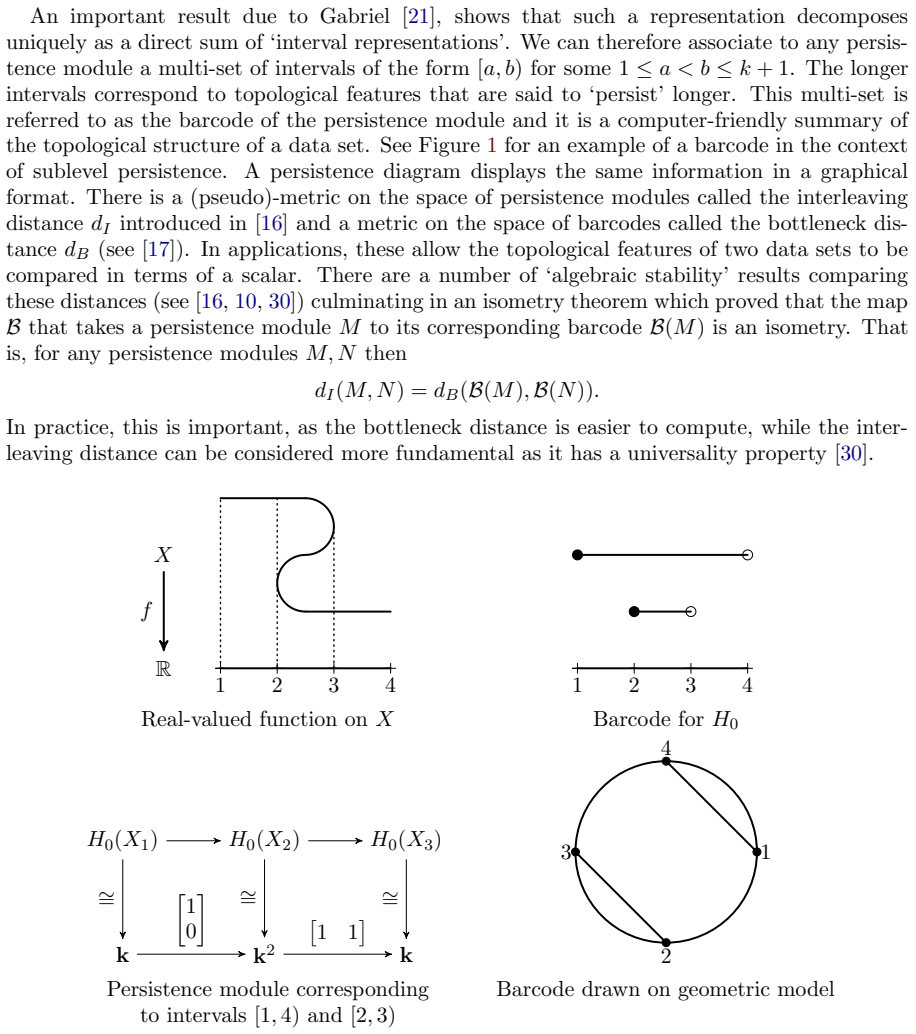
Pith's one-line read This paper proves that the interleaving distance equals the bottleneck distance for persistence modules of circle-valued functions, with barcodes drawn as graded arcs and closed curves on an annulus.
desk verdict A serious isometry theorem for circle-valued persistence, but the interleaving distance is not well-defined as written because the Φ maps are only defined up to scalar. read the letter →
The pith
A machine-rendered reading of the paper's core claim, the machinery that carries it, and where it could break.
The reading
What carries the argument
The load-bearing object is the Auslander-Reiten translate $\tau$ on the bounded derived category of the gentle algebra $kQ$, together with the maps $\Phi_M: M \to \tau^{-1}M$ formed by composing the two arrows of an Auslander-Reiten mesh. These maps replace the classical shift and transition morphisms: Definition 3.9 declares $M,N$ $\delta$-interleaved when morphisms $f: M \to \tau^{-\delta}N$ and $g: N \to \tau^{-\delta}M$ satisfy $\tau^{-\delta}g \circ f = \Phi_M^{2\delta}$ and $\tau^{-\delta}f \circ g = \Phi_N^{2\delta}$. The matching geometric machinery is the annulus model of $\tilde A$: indecomposable objects correspond to graded arcs (between marked boundary points, or between the two boundary components) and to graded primitive closed curves, and the operations $s$ and $t$ move an arc's start or end to the next marked point, exactly tracking the meshes of the Auslander-Reiten quiver. The bottleneck distance is then defined by $\delta$-shortness and $\delta$-equivalence under these endpoint movements, and the proof shows the two distances agree component-by-component.
What would settle it
Fix any normalization of $\Phi_M$ in a homogeneous tube, for example set $\Phi_M = c\,\varphi$ with $c=1$ and $c=2$ on the same quasi-simple $M$, and compute the minimal $\delta$ for which $M$ is $\delta$-interleaved with itself under Definition 3.9; the metric axioms require this distance to be zero independent of the scaling, and if the two scalings yield different interleaving predicates or different distances to a fixed module $N$, the isometry theorem fails as stated, with Example 9.1 (the winding-number comparison) as a concrete case to recompute under each scaling.
Extended reading notes
Core claim
The central discovery is Theorem 7.6: for persistence modules $M,N$ of type $\tilde A$ (representations of a non-cyclically oriented cycle quiver, the algebraic form of circle-valued persistence), the interleaving distance defined through Auslander-Reiten translates satisfies $d_I(M,N) = d_B(B(M),B(N))$, where $B(-)$ sends a module to the multiset of graded arcs and closed curves representing its indecomposable summands in the geometric model. The paper proves the equality in two parts: for preprojective and preinjective summands, interleavings give matchings in a bipartite graph whose edges are defined by the partial order $M \leq \tau^{-\delta}N \leq \tau^{-2\delta}M$, and conversely such matchings give interleavings; for regular summands inside tubes, the argument uses canonical injections and induced matchings, comparing lengths in uniserial tubes with the $\delta$-short and $\delta$-equivalent conditions on arcs. The barcode formalism thereby absorbs the Jordan-block data of circle-valued persistence into closed curves with an eigenvalue parameter, and the bottleneck distance compares these objects by moving their endpoints along the boundary components.
Load-bearing premise
Definition 2.1 defines the morphism $\Phi_M$ only up to multiplication by a nonzero scalar of the field, and Definition 3.9 uses $\Phi_M^{2\delta}$ and $\Phi_N^{2\delta}$ in the interleaving equations without fixing those scalars, so the predicate 'M and N are $\delta$-interleaved' is not precisely defined as written; the isometry theorem inherits this dependence unless a normalization is supplied.
Editorial extensions
If this is right
- For any two circle-valued persistence modules of type $\tilde A$, the interleaving distance can be computed as a bottleneck distance on finite multisets of arcs and closed curves, making the algebraic distance accessible to the same matching algorithms used for classical barcodes.
- The classical isometry theorem for equioriented type A quivers is a special case: on the disc model, arcs between marked points are exactly the intervals $[a,b)$, and the endpoint operations reproduce the usual $\delta$-matching condition.
- The barcode of a circle-valued module encodes not only interval-like summands but also band objects $(\gamma,\lambda,l)$, so the Jordan-block invariants of level-set persistence are naturally part of the same distance framework.
- The equality $d_I = d_B$ gives algebraic stability in the circle-valued setting: if two modules are $\delta$-interleaved, their barcodes are $\delta$-matched, and vice versa, so persistent features cannot move more than $\delta$ under an interleaving of size $\delta$.
- Because both distances are metrics on their respective spaces, the isometry identifies the two metric spaces, so either notion can be used for comparison, with the bottleneck side supplying the finite combinatorial computation.
Reading between the lines
- The proof's reliance on the geometric model of gentle algebras suggests the same two-distance formalism could be pushed to other gentle algebras whose geometric models admit endpoint operations with the same mesh-tracking property; the annulus and disc are the cases where those operations are already explicit.
- The scaling ambiguity in Definition 2.1 leaves open the possibility that different normalizations of $\Phi_M$ produce different interleaving distances, so a natural test is to fix a normalization and check whether the isometry statement survives; if it does not, the theorem needs a canonical choice before it is fully well-posed.
- A consequence the authors leave implicit is that any two circle-valued maps whose level-set modules are $\delta$-interleaved have $\delta$-matched annulus barcodes, giving an algebraic stability statement in the spirit of the geometric stability results discussed in Section 8.
Editorial analysis
A structured set of objections, weighed in public.
Referee Report
Summary. The paper proposes a generalization of the interleaving and bottleneck distances to persistence modules associated with circle-valued functions, modeled as representations of non-cyclically oriented quivers of type \tilde A. The interleaving distance is defined using the Auslander-Reiten translate on the derived category, and the barcode is defined as a multiset of graded arcs and closed curves on the geometric model of the derived category. The centerpiece is an isometry theorem (Theorem 7.6) asserting that the interleaving distance between two \tilde A persistence modules equals the bottleneck distance between their geometric barcodes. The paper also contains a dictionary relating its barcodes to the barcodes and Jordan blocks of Burghelea-Dey and Burghelea-Haller, and several worked examples.
Significance. If the main theorem is correct, the paper would provide a genuinely intrinsic isometry theorem for circle-valued persistence, avoiding the usual detour through multidimensional persistence or derived equivalences with equioriented quivers. The use of the geometric model to encode barcodes as arcs and closed curves is conceptually appealing and could be a useful bridge between representation theory and topological data analysis. The paper is ambitious and includes many useful structural observations, but the central object of the paper, the interleaving distance of Definition 3.9, is not rigorously well-posed as written, and several load-bearing proof steps appear incomplete. The result is therefore not yet established to the standard required for publication.
major comments (4)
- [Definition 3.9, with Definition 2.1 and Definition 3.7] The predicate "M and N are δ-interleaved" is not well-defined. Definition 2.1 states that Φ_M : M → τ^{-1}M is well defined only up to scaling by an element of k^*. Definition 3.7 then constructs Φ^δ_N by composing such morphisms, so each Φ^{2δ}_M and Φ^{2δ}_N is determined only up to an arbitrary nonzero scalar. The equalities τ^{-δ}g∘f = Φ^{2δ}_M and τ^{-δ}f∘g = Φ^{2δ}_N in Definition 3.9 therefore are not precise mathematical statements unless a normalization is fixed. Since d_I in Definition 3.12 is defined as the infimum over such ill-defined predicates, the left-hand side of Theorem 7.6 is ambiguous. The problem propagates: Lemma 3.15, Proposition 3.16, and the stability proofs in Sections 6 and 7 all rely on equalities involving these unnormalized Φ maps. The paper needs to either choose a canonical normalization for each Φ_M (for example by fixing specific mesh morphisms) or reformulate the interleaving condition projectively, and then prove that the resulting distance is independent of any remaining choices.
- [Lemma 5.13] The triangle inequality proof for the bottleneck distance applies Lemma 5.7 to arcs that may have infinite length. Lemma 5.7 is stated only for graded arcs or closed curves of finite length, but the barcode B can contain arcs with endpoints on different boundary components, which have infinite length. In the proof, when γ ∈ B_{2(d1+d2)} is such an infinite-length arc, the displayed equalities involving ℓ(γ) are not covered by Lemma 5.7. This is not merely a cosmetic gap: the contradiction argument used to prove B_{2(d1+d2)} ⊆ Coim(η2∘η1) depends on the length formula for the very element γ. The proof should either extend Lemma 5.7 to infinite lengths with a separate argument, or handle infinite-length arcs directly (for instance, by observing that finite endpoint-sliding operations preserve infinite length and that an infinite-length arc cannot be δ-equivalent to a finite-length arc).
- [Lemma 6.2] The functor F from the full subcategory S to finite-dimensional vector spaces is not well-defined as stated. The definition F(f) = F(Σ α_m f_m) = Σ α_m depends on the chosen basis {f_m} of each Hom-space, and no argument is given that different bases yield the same scalar or that composition of morphisms is preserved. The claim that the basis morphisms are "compatible with composition" is asserted but not proved, and in general a linear combination of morphisms can be represented in multiple ways. This matters because the Hall's theorem argument uses the fact that F(Φ^{2δ}_{M_I}) is a rank |I| diagonal matrix; if F is not a genuine linear functor, the rank conclusion has no basis. The proof should either construct F explicitly from a compatible family of bases, or replace this step by a direct rank argument using actual matrices with respect to fixed bases of the relevant Hom-spaces.
- [Theorem 7.4] The composition θδ ∘ η_f is not well-defined as stated. In the theorem statement, η_f is described as a matching B(M) → B(Im f), while θδ is defined immediately before as a perfect matching B(N) → B(τ^δ N). These do not compose. The proof later refers to B(τ^{-δ}N) and to inclusions of Im f into τ^{-δ}N, suggesting that the intended construction involves an additional matching induced by the inclusion Im f ↪ τ^{-δ}N and a bijection B(N) → B(τ^{-δ}N) induced by τ^{-δ}. The statement and proof need to be corrected so that the domain and codomain of the composed matching are explicit and consistent.
minor comments (5)
- [Corollary 3.8] There is a typo: "resrticted" should be "restricted".
- [Section 9.3] The word "trivalised" should be "trivialized".
- [Section 1.2.1] The phrase "Ausander-Reiten" should be "Auslander-Reiten".
- [Definition 5.6] Definition 5.6 refers to a "graded arc or closed curve" but the notion of length for a closed curve is only implicit through Definition 4.6; it would help to state explicitly that the length of (γ, λ, l) is l, including the trivial case l = 0.
- [Section 8] The dictionary in Section 8 is useful, but the table entry for closed and open intervals both mapping to arcs between different boundary components could be confusing; a sentence clarifying that the grading distinguishes preprojective from preinjective objects would improve readability.
Circularity Check
No significant circularity: the isometry theorem is proved by independent inequalities; no fitted parameter, renamed input, or load-bearing self-citation.
full rationale
The claimed derivation chain is deductive. The interleaving distance (Definition 3.12) is defined algebraically via AR-translates and Φ-morphisms (Definitions 3.7, 3.9), while the bottleneck distance (Definitions 5.10, 5.12) is defined independently through geometric s/t-operations and δ-equivalence of arcs and closed curves. Theorem 7.6 is obtained by proving two inequalities: d_I ≥ d_B (Theorem 7.4 and Proposition 6.3 via Hall's theorem and induced matchings) and d_I ≤ d_B (Propositions 6.4 and 7.5, constructing interleavings from matchings). Neither inequality substitutes the target equality into a definition; each side retains independent content. The barcode operations s,t are motivated by the AR-mesh, but the bottleneck matching condition is not the interleaving condition verbatim: it requires endpoint moves bounded by δ and length thresholds, and the proofs translate between the two languages. There are no fitted parameters and no self-citations; the external results cited (Gabriel, AR theory, geometric models [33], induced matchings [5]) are established mathematical facts, not author-specific assertions. The only flagged concern is Definition 2.1, which states Φ_M is 'well defined up to a scaling by an element in k∗'; consequently Definition 3.9's equalities may not define a precise predicate unless normalizations are fixed. This is a well-posedness gap in the left-hand side of Theorem 7.6, not a case of the theorem reducing to its inputs, so it does not affect the circularity score.
Assumptions & free parameters
assumptions (4)
- standard math Structure theorem for indecomposable representations of type A and \tilde A quivers (Gabriel's theorem and tame hereditary classification).
- domain assumption Geometric model theorem for gentle algebras (Opper-Plamondon-Schroll), including the bijection between indecomposable objects in Db and graded arcs/closed curves, and the description of morphisms via intersections.
- domain assumption Standard component property of the AR quiver for tame hereditary algebras (Liu-Paquette), including existence of a basis of morphisms compatible with the AR mesh.
- standard math Serre duality for the derived category of a hereditary algebra.
Cite this review
Pith. "Pith review of An isometry theorem for persistent homology of circle-valued functions." pith.science (2026). https://pith.science/paper/E7VJPC23
@misc{pith2026250602999,
  author       = {Pith},
  title        = {Pith review of: An isometry theorem for persistent homology of circle-valued functions},
  year         = {2026},
  howpublished = {\url{https://pith.science/paper/E7VJPC23}},
  note         = {Machine review of arXiv:2506.02999}
}
read the original abstract
This paper explores persistence modules for circle-valued functions, presenting a new extension of the interleaving and bottleneck distances in this setting. We propose a natural generalisation of barcodes in terms of arcs on a geometric model associated to the derived category of quiver representations. The main result is an isometry theorem that establishes an equivalence between the interleaving distance and the bottleneck distance for circle-valued persistence modules.
Figures


Figures from the paper (2 more)


Reference graph
Works this paper leans on
-
[1]
Morphisms between indecomposable complexes in the bounded derived category of a gentle algebra
K.K. Arnesen, R. Laking, D. Pauksztello: Morphisms between indecomposable complexes in the bounded derived category of a gentle algebra , J. Algebra 467 (2016), 1–46, also arXiv:1411.7644
work page Pith review arXiv 2016
- [2]
-
[3]
M. Auslander, I. Reiten: Representation theory of artin algebras iii almost split sequences , Communications in Algebra, 3(3), 239–294. https://doi.org/10.1080/00927877508822046
-
[4]
M. Auslander, I. Reiten, S.O. Smalø: Representation theory of Artin algebras, , Cambridge Studies in Advanced Mathematics, vol. 36, Cambridge University Press. ISBN 978-0-521-59923-8
-
[5]
U. Bauer, M. Lesnick: Induced Matchings and the Algebraic Stability of Persistence Barcodes , Journal of Computational Geometry 6:2 (2015), 162-191https://doi.org/10.20382/jocg.v6i2a9
-
[6]
K. Baur, R. Coelho Sim˜ oes:A Geometric Model for the Module Category of a Gentle Algebra , International Mathematics Research Notices, 2021 (15), 11357–11392, (2021)https://doi.org/10.1093/imrn/rnz150
-
[7]
V. Bekkert, H.A. Merklen: Indecomposables in derived categories of gentle algebras , Algebr. Represent. Theory 6(3) (2003), 285–302
work page 2003
-
[8]
H.B. Bjerkevik: Stability of higher-dimensional interval decomposable persistence modules , https://doi.org/10.48550/arXiv.1609.02086
Show all 35 references
-
[9]
Bobi´ nski:The almost split triangles for perfect complexes over gentle algebras , J
G. Bobi´ nski:The almost split triangles for perfect complexes over gentle algebras , J. Pure Appl. Algebra 215(4) (2011), 642–654, also arXiv:0903.5140
2011 arXiv
-
[10]
Botnan, M
M.B. Botnan, M. Lesnick: Algebraic stability of zigzag persistence modules , Algebraic & Geometric Topology 18 (2018) 3133–3204https://msp.org/agt/2018/18-6/p01.xhtml
2018
-
[11]
Bubenik, V
P. Bubenik, V. de Silva, J. Scott: Metrics for Generalized Persistence Modules , Found Comput Math 15, 1501–1531 (2015)https://doi.org/10.1007/s10208-014-9229-5
2015 doi
-
[12]
Burghelea, T
D. Burghelea, T. K. Dey: Topological Persistence for Circle-Valued Maps, Discrete & Computational Geometry 50 (2013), 69–98, also arXiv:1104.5646. 32
2013 arXiv
-
[13]
Burghelea, S
D. Burghelea, S. Haller: Topology of angle valued maps, bar codes and Jordan blocks , Journal of Applied and Computational Topology, 1 (2017), 121–197
2017
-
[14]
C ¸ anak¸ ci, D
I. C ¸ anak¸ ci, D. Pauksztello, S. Schroll:On extensions for gentle algebras , arXiv:1707.06934
-
[15]
Carlsson, V
G. Carlsson, V. de Silva: Zigzag Persistence, Found Comput Math 10, 367–405 (2010)https://doi.org/10.1007/s10208-010-9066-0
2010 doi
-
[16]
Chazal, D
F. Chazal, D. Cohen-Steiner, M. Glisse, L. J. Guibas, and S. Y. Oudot: Proximity of persistence modules and their diagrams , Proceedings of the twenty-fifth annual symposium on Computational geometry, Association for Computing Machinery, NY, USA, 237–246https://doi.org/10.1145...
-
[17]
Cohen-Steiner, H
D. Cohen-Steiner, H. Edelsbrunner, J. Harer: Stability of persistence diagrams , Discrete & Computational Geometry 37 (2007), 103—120
2007
-
[18]
Crawley-Boevey: Decomposition of pointwise finite-dimensional persistence modules , Journal of Algebra and its Applications, 14(05):1550066, 2015
W. Crawley-Boevey: Decomposition of pointwise finite-dimensional persistence modules , Journal of Algebra and its Applications, 14(05):1550066, 2015
2015
-
[19]
Edelsbrunner, Letscher & Zomorodian: Topological Persistence and Simplification, Discrete Comput Geom 28, 511–533 (2002)https://doi.org/10.1007/s00454-002-2885-2
2002 doi
-
[20]
Escolar, Y
E.G. Escolar, Y. Hiraoka: Persistence Modules on Commutative Ladders of Finite Type , Discrete Comput Geom 55, 100–157 (2016)https://doi.org/10.1007/s00454-015-9746-2
2016 doi
-
[21]
Gabriel: Unzerlegbare Darstellungen I
P. Gabriel: Unzerlegbare Darstellungen I. , Manuscripta Math 6, 71–103 (1972)https://doi.org/10.1007/BF01298413
1972 doi
-
[22]
X. Gao, M. Zhao: Isometry Theorem for Continuous Quiver of Type ˜A, arXiv:2412.12462
-
[23]
The GAP Group: GAP – Groups, Algorithms, and Programming , Version 4.14.0; 2024https://www.gap-system.org
-
[24]
Haiden, L
F. Haiden, L. Katzarkov, M. Kontsevich: Flat surfaces and stability structures. , Publ. Math. Inst. Hautes ´ Etudes Sci., 126:247–318, 2017
2017
-
[25]
E. J. Hanson, J. D. Rock: Decomposition of pointwise finite-dimensional S1 persistence modules, Journal of Algebra and Its Applications, 23(03):2450054, 2024
2024
-
[26]
Hiraoka, Y
Y. Hiraoka, Y. Ike, M. Yoshiwaki: Algebraic stability theorem for derived categories of zigzag persistence modules, Journal of Topology and Analysis, (2022)
2022
-
[27]
Igusa, J
K. Igusa, J. D. Rock, and G. Todorov: Continuous quivers of type A(I) foundations, Rendiconti del Circolo Matematico di Palermo Series 2, 72(2):833–868, 2023
2023
-
[28]
Keller: Derived categories and their uses , in: Handbook of Algebra, vol
B. Keller: Derived categories and their uses , in: Handbook of Algebra, vol. 1, North-Holland, Amsterdam, 1996, pp. 671–701https://doi.org/10.1016/S1570-7954(96)80023-4
1996 doi
-
[29]
Lekili, A
Y. Lekili, A. Polishchuk: Auslander orders over nodal stacky curves and partially wrapped Fukaya categories., Journal of Topology, 11, 3, 1753-8416, 2018https://doi.org/10.1112/topo.12064
-
[30]
Lesnick: The Theory of the Interleaving Distance on Multidimensional Persistence Modules , Found Comput Math 15, 613–650 (2015) https://doi.org/10.1007/s10208-015-9255-y
M. Lesnick: The Theory of the Interleaving Distance on Multidimensional Persistence Modules , Found Comput Math 15, 613–650 (2015) https://doi.org/10.1007/s10208-015-9255-y
2015 doi
-
[31]
S. Liu, C. Paquette: Standard Components of a Krull-Schmidt Category , Proceedings of the American Mathematical Society, 143(1), 45–59 (2015)
2015
-
[32]
Meehan and D
K. Meehan and D. Meyer: An Isometry Theorem for Generalized Persistence Modules , arXiv:1710.02858
- [33]
-
[34]
S. Y. Oudot: Persistence theory: from quiver representations to data analysis , volume 209. American Mathematical Society, 2017
2017
-
[35]
de Silva, D
V. de Silva, D. Morozov, M. Vejdemo-Johansson: Persistent Cohomology and Circular Coordinates , Discrete & Comput Geom 45 (2011), 737–759https://doi.org/10.1007/s00454-011-9344-x. Nathan Broomhead, Mathematical Sciences, University of Plymouth, Drake Circus, Plymouth, PL4 8AA,...
2011 doi
Reviewed August 7, 2026 · model on record in the stance chip above.
Discussion (0). Sign in to comment.