REVIEW 3 major objections 5 minor 55 references
Should we care about the spatial heterogeneity in coral reefs under unidirectional turbulent flows?
T0 review · 3 major / 5 minor · reviewed 2026-08-07 · deepseek-v4-flash
Pith's one-line read Randomly placed corals produce consistently different in-canopy flow than the staggered arrays that models usually assume.
desk verdict A well-executed DNS study showing that a realistic stochastic coral bed behaves differently from periodic idealized arrays, but the design conflates random arrangement with species mixing and a single realization, so the strong 'spatial heterogeneity' conclusion is not fully secured. read the letter →
The pith
A machine-rendered reading of the paper's core claim, the machinery that carries it, and where it could break.
The reading
What carries the argument
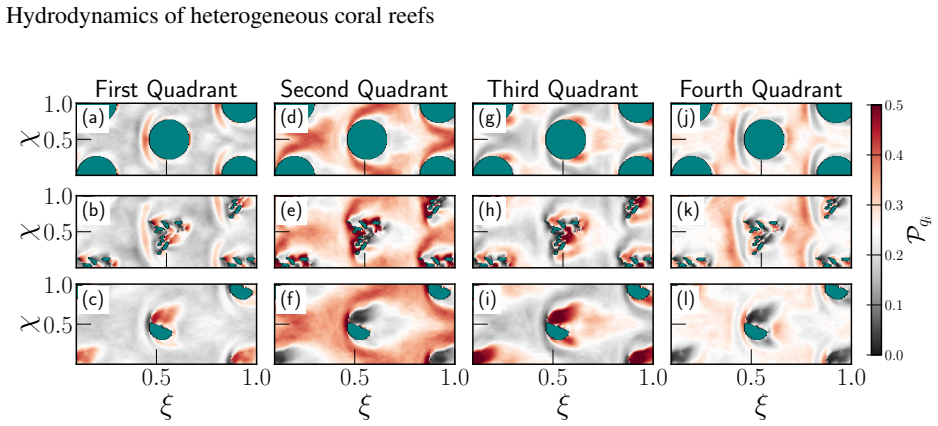
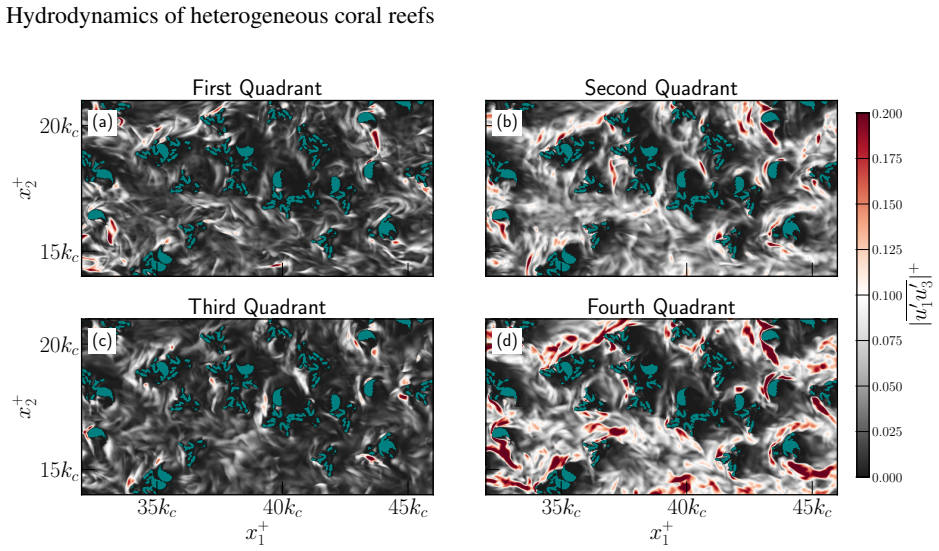
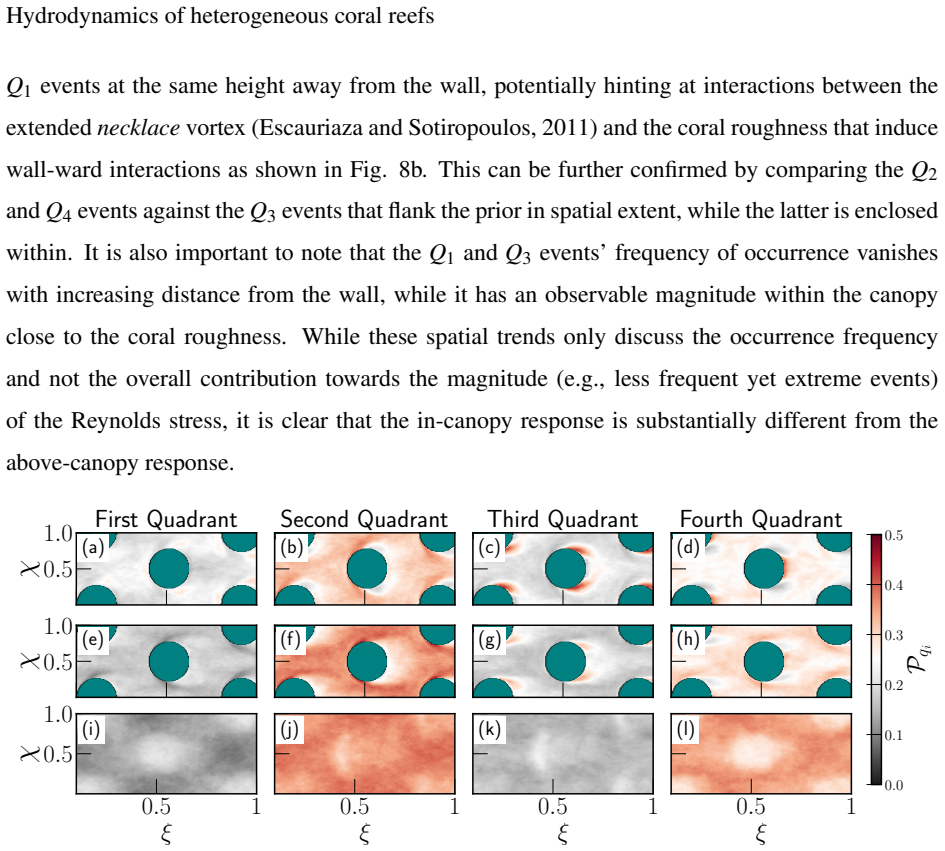
The argument is carried by the triple decomposition of velocity $U_i = \langle \overline{U}_i\rangle + \widetilde{U}_i + u'_i$, where $\langle\cdot\rangle$ denotes the spatial plane average and the overbar a time average; expanding the quadratic nonlinearity $U_iU_j$ yields the dispersive stress $\langle \widetilde{U}_i\widetilde{U}_j\rangle$ alongside the Reynolds stress $\langle u'_iu'_j\rangle$. The paper reads the signature of spatial heterogeneity in the dispersive stress and in quadrant-resolved Reynolds-stress events (ejections and sweeps versus wall-ward and outward interactions), compared between periodic staggered tiles and the non-periodic stochastic bed. The stochastic bed is generated by translating and rotating two triangulated coral models to uniformly sampled positions, which is the device that isolates spatial arrangement as the variable.
What would settle it
Run the same protocol on several independent stochastic beds, for example ten realizations with the same coral models and count; if their double-averaged velocity and TKE profiles bracket or overlap the staggered cases instead of lying consistently outside them, the reported substantial difference is an artifact of a single draw. A second check is to randomize the positions of identical cylinders: reproducing the stochastic signal there would confirm arrangement as the cause, while a null result would implicate species mixing.
Extended reading notes
Core claim
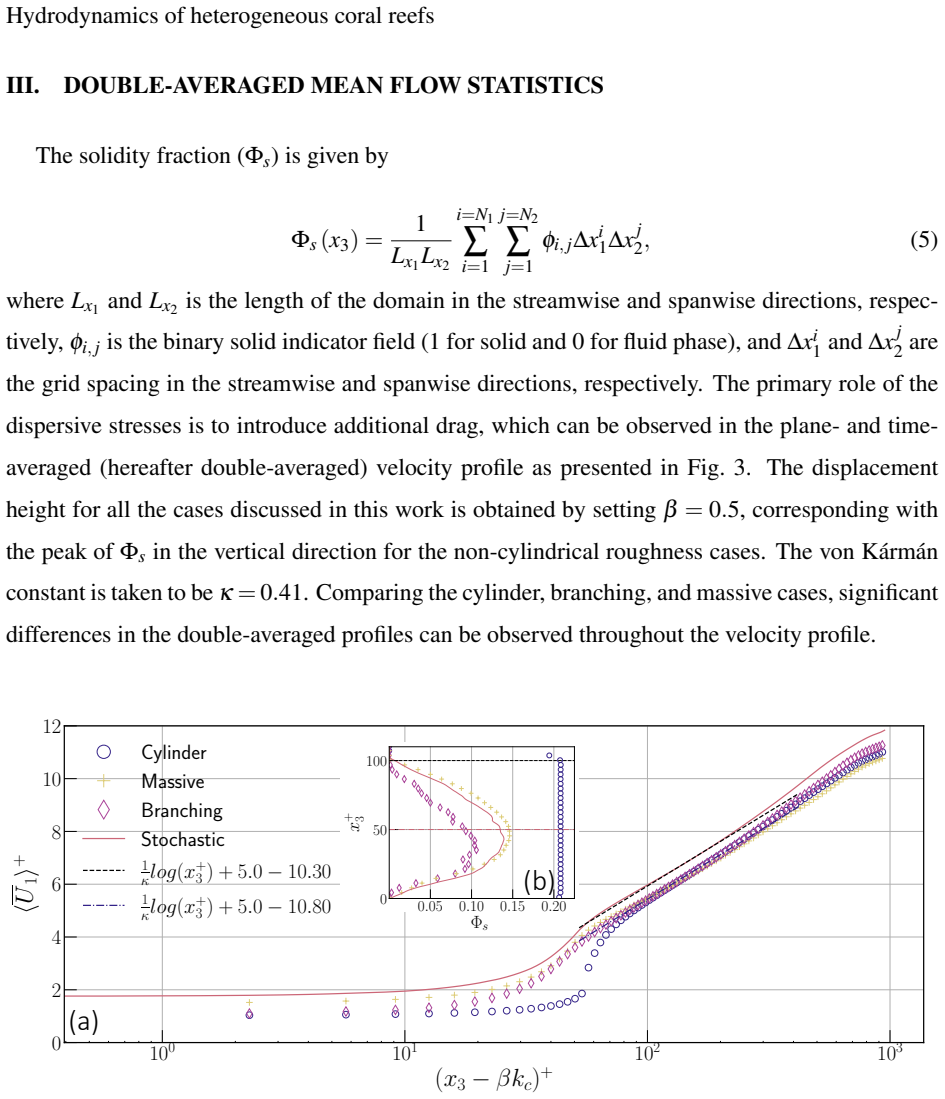
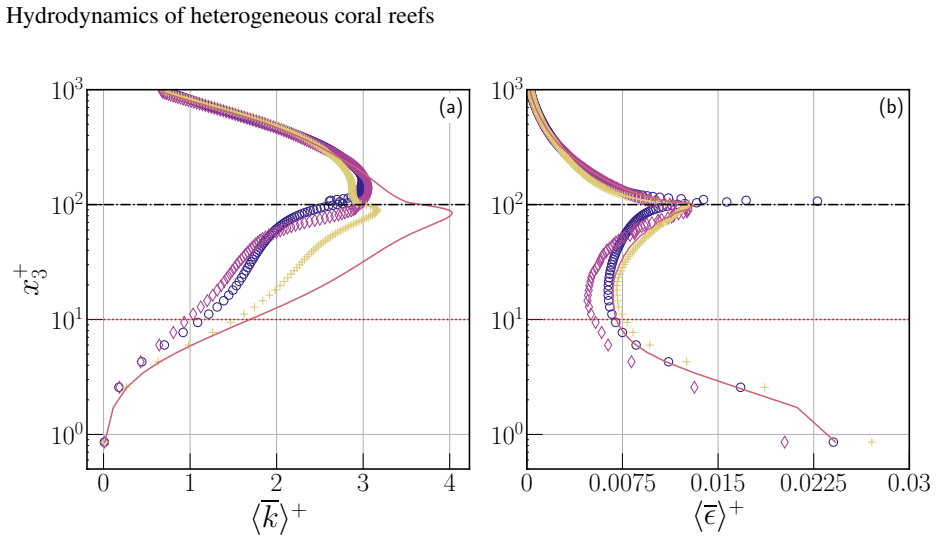
The central claim is that a stochastically generated coral bed is hydrodynamically distinct from regularly staggered coral arrays, even when the same coral species models are used and the number of corals is kept the same. In the stochastic case the double-averaged streamwise velocity is higher (lower mean-flow drag), the streamwise turbulence peak is stronger and sits near the canopy crest rather than at individual roughness crests, time-averaged vorticity spreads through the canopy instead of concentrating at crests, and the spatial frequency of Reynolds-stress quadrant events no longer coincides with the locations where those events contribute most to momentum transport. The stochastic bed also shows a higher double-averaged velocity than a regular bed with a similar solidity fraction, which points to arrangement rather than solidity as the control. Between the three regular cases the paper finds broadly similar in-canopy behaviour with modest differences, so its headline contrast is order versus randomness rather than species identity alone. Above roughly three hundred wall units beyond the crest, all profiles collapse, which the authors read as a universal response set by the common roughness height.
Load-bearing premise
The load-bearing premise is that one stochastically generated bed, drawn from a uniform random placement of branching and massive corals with no minimum spacing and no replication, can stand in for spatial heterogeneity generally, so that its differences from the staggered arrays are due to randomness of arrangement rather than to species mixing or a particular draw.
Editorial extensions
If this is right
- Two-equation coastal closure models that calibrate drag and turbulent kinetic energy against periodic arrays will misestimate in-canopy momentum transport over patchy reefs, since the stochastic bed shows lower mean-flow drag and stronger in-canopy turbulence.
- Flow above the canopy is insensitive to heterogeneity: beyond roughly $x_3^+ \sim 300$ above the crest, mean flow and turbulence profiles from all four beds collapse, so outer-layer prediction only needs the mean roughness height.
- The stochastic bed's peak streamwise turbulence sits just below the canopy crest with vorticity distributed through the canopy, implying that bulk drag parameterisations based on crest shear layers miss the dominant turbulent production mechanism in heterogeneous arrangements.
- Locations where Reynolds-stress-producing events occur most often are not the locations where their magnitude is largest in the stochastic case; spatially averaged models cannot represent this decoupling, so local sediment-transport and nutrient-exchange predictions need explicit heterogeneity.
Reading between the lines
- Because only one stochastic realization is simulated, the paper's strongest conclusion would be hardened or weakened by an ensemble of independent random beds; that test is the natural next step and is absent from the paper.
- The stochastic case mixes branching and massive corals while each staggered case is single-species, so part of the observed difference could in principle be species mixing; randomizing identical cylinders would separate arrangement from composition.
- The paper does not include waves, scalar transport, or sediment, but its quadrant-analysis results suggest that rare, localized ejection and sweep events carry the heterogeneity signal, which is exactly the part of the flow that eddy-viscosity closures in ocean models are known to represent poorly.
- If the lower-drag finding survives replication, existing reef friction parameterisations derived from regular canopies would systematically overestimate drag and underestimate mean flow on heterogeneous reef flats, with consequences for wave-setup and lagoon circulation.
Editorial analysis
A structured set of objections, weighed in public.
Referee Report
Summary. This paper reports scale-resolving simulations of turbulent channel flow at Re_tau = 1000 over four roughness configurations: staggered cylinders, staggered branching corals, staggered massive corals, and a stochastically generated bed made of randomly placed and randomly rotated branching and massive coral geometries. The study compares double-averaged velocity profiles, Reynolds and dispersive stresses, quadrant contributions to the Reynolds stress, in-canopy streamlines, vorticity, TKE, and dissipation, and concludes that the stochastic coral bed produces substantially different hydrodynamics from the three regular staggered arrangements. The authors argue this has consequences for how coral reef roughness should be represented in coastal ocean models.
Significance. If the central claim were firmly established, the paper would provide a useful cautionary result: idealized periodic, monospecific coral representations may miss important in-canopy heterogeneity. The strengths of the work include the use of realistic coral geometries, a relatively high Reynolds number for scale-resolving simulations, careful quadrant-analysis diagnostics, and the authors' own open tools GenSDF and GenIC for geometry and initial conditions. However, the experimental design does not currently isolate 'spatial heterogeneity' as the cause of the observed differences, and the use of a single stochastic realization leaves the result without a measure of sampling variability. The paper is therefore a promising descriptive study whose main interpretive claim needs additional support.
major comments (3)
- [Section II and Section VI B] The comparison does not isolate spatial heterogeneity. The stochastic bed is generated by uniformly sampling coordinates and rotation angles and then placing both branching (Acropora formosa) and massive (Pseudodiploria strigosa) corals, whereas each staggered case contains a single species on a fixed lattice. The stochastic case therefore differs from every staggered comparator simultaneously in random arrangement, mixed-species composition, and local spacing (no minimum separation is enforced, so clusters or near-overlaps can occur). The statement in Section VI B that 'introducing a stochastic spatial distribution using the same coral types ... results in a vastly different time-averaged flow response' attributes the difference to the spatial distribution, but the data cannot separate that factor from species mixing and local blockage. Adding controls such as a staggered mixed-species bed, stochastic single-species beds, or at least an explicit reframing of the conclusion to 'a mixed-species stochastic bed' would be needed to support the title's claim.
- [Section II and results throughout] Only a single stochastic realization is simulated. All double-averaged profiles and quadrant statistics for the stochastic case come from one random draw, and no error bars, confidence intervals, or ensemble statistics are provided. Without multiple stochastic realizations, the large differences reported for the stochastic case cannot be distinguished from realization-specific fluctuations. This is load-bearing because the paper's central message is that stochastic spatial heterogeneity, rather than one particular random pattern, changes the hydrodynamics.
- [Section III and Fig. 3] The comparison across cases conflates solidity with arrangement. The stochastic case is said to have a solid fraction similar to the massive case, but the four cases differ in both solidity profile and geometry, and the stochastic case also mixes two species with different shapes. To support the claim that arrangement drives the observed differences, the paper should report quantitative solidity and frontal-area metrics for all cases and, ideally, match solidity and frontal area when comparing staggered and stochastic arrangements. As written, the differences between the stochastic bed and the regular beds could be due to differences in solidity or species composition rather than to spatial heterogeneity.
minor comments (5)
- [Data Availability Statement] The data availability statement ends with the placeholder 'ADD 4TU DATA REPOSITORY BEFORE PUBLISHING'; this must be completed before publication.
- [Section III] The displacement height is defined by setting beta = 0.5 'corresponding with the peak of Phi_s in the vertical direction for the non-cylindrical roughness cases.' This is unclear for the cylinder case, which has no vertical peak in Phi_s; the definition of beta for each case should be stated explicitly.
- [Figure 2 caption] The caption labels the cases as 'Increasing Geometric/Spatial Complexity' without defining a quantitative measure of complexity; either provide such a metric or soften the wording.
- [Section VI B] The phrase 'using the same coral types (i.e., branching and massive)' is confusing because the staggered branching and massive cases each use only one species, while the stochastic case uses both; rephrase to make clear that the stochastic case combines the two species already introduced in the staggered cases.
- [Throughout] There are several typographical and grammatical issues, including 'there after' in Section IV, 'which are important for relevant for modelling' in the Conclusions, and '0.8 flight from New York to Melbourne' in the Carbon Footprint Statement; these should be corrected.
Circularity Check
No significant circularity: the paper reports DNS results whose conclusions are emergent from the simulation, and the only self-citations are to the authors' geometry and initialization tools, which are not load-bearing.
full rationale
This paper is a computational simulation study rather than a derivation chain, and no reported quantity reduces to a fitted input by construction. The four geometries are generated by explicitly stated, independent rules: the staggered cases use fixed streamwise/spanwise spacing sx1 = sx2 = 2kc, and the stochastic bed is produced by uniform random sampling of centroid coordinates and rotation angles (Section II), with the same total coral count as the staggered cases. All quantities used to support the central claim — double-averaged velocity, dispersive and Reynolds stresses, rms profiles, quadrant statistics, TKE, and dissipation — are computed from the DNS solution of the non-dimensional Navier-Stokes equations (Eq. 3), so the observed differences between the stochastic and regular beds are emergent rather than imposed. The displacement height (β = 0.5 at the peak of Φs) and κ = 0.41 are standard prior values, not fitted to the results. The only self-citations are to the authors' own tools: GenSDF (signed-distance-field geometry masking, published in SoftwareX 2025) and GenIC (synthetic initial conditions, SSRN 2025). Neither determines the scientific conclusions: GenSDF only supplies the solid mask used by the immersed-boundary method, and GenIC only shortens the spin-up transient (statistically stationary flow within 5 Tε). The GenIC input profiles themselves are taken from the external Castro, Cheng, and Reynolds (2006) simulations and rescaled to Reτ = 1000 using inner scaling, so the initialization is not self-referential. No uniqueness theorem, ansatz, or empirical scaling is imported from the authors' prior work to force the findings. The comparison between the stochastic bed and the staggered arrays is imperfectly controlled — it conflates random arrangement with species mixing (branching plus massive vs. single species) and rests on a single random realization, which weakens the attribution of the observed differences to spatial arrangement. That is an external-validity or experimental-design limitation, not circularity: the flow statistics are not defined in terms of, and never assume, the conclusion that spatial heterogeneity matters. The score of 1 reflects only the presence of minor, non-load-bearing self-citations to the authors' own software tools.
Assumptions & free parameters
free parameters (4)
- Staggered spacing sx1 = sx2 = 2kc =
2kc
- Displacement height beta =
0.5
- Friction Reynolds number Re_tau =
1000
- Stochastic realization seed =
single random draw
assumptions (5)
- standard math Incompressible Navier-Stokes equations with constant pressure gradient
- domain assumption Domain simplification: periodic lateral boundaries, free-slip top, no-slip bottom
- domain assumption Quasi-static flow without wind waves
- ad hoc to paper Single stochastic realization is representative
- domain assumption Volume-penalization IBM resolves the coral geometry at the chosen mesh
Cite this review
Pith. "Pith review of Should we care about the spatial heterogeneity in coral reefs under unidirectional turbulent flows?." pith.science (2026). https://pith.science/paper/EK5QIPIJ
@misc{pith2026250603021,
  author       = {Pith},
  title        = {Pith review of: Should we care about the spatial heterogeneity in coral reefs under unidirectional turbulent flows?},
  year         = {2026},
  howpublished = {\url{https://pith.science/paper/EK5QIPIJ}},
  note         = {Machine review of arXiv:2506.03021}
}
read the original abstract
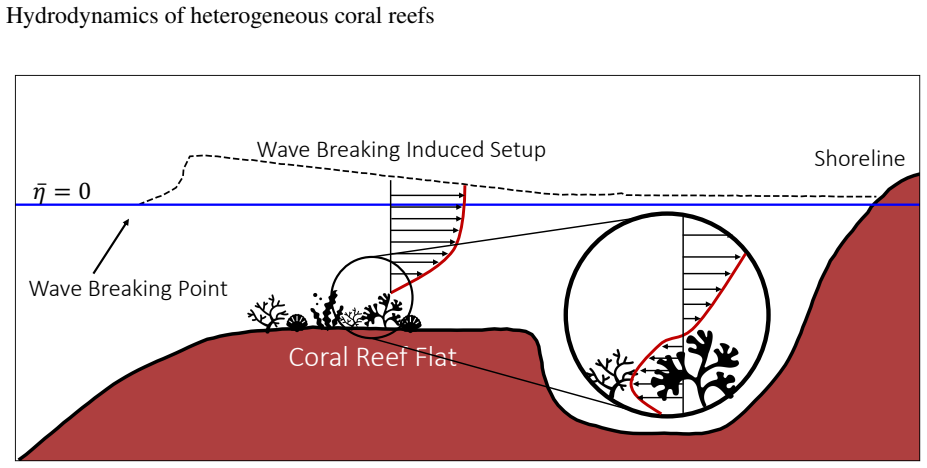
In this work, we systematically investigate the similarities and differences observed between a hydraulically rough wall comprised of an array of cylinders, massive corals, and branching corals arranged in a staggered manner, along with a stochastically generated coral bed using a scale-resolving computational framework. Our data suggests that for all the flow parameters of interest, there is a substantial difference observed between the stochastic coral bed and the regularly arranged coral bed. By analysing the double-averaged statistics and time-averaged spatial heterogeneity in the hydrodynamic response, we explain the differences observed between the four cases that bring out significant local effects. These observations have important consequences for modelling coral-like roughness in numerical and experimental settings to better understand the mean flow statistics and the spatial heterogeneity induced as a consequence of the underlying coral geometry. Our results can help inform the coastal ocean modelling efforts to further improve the inclusion of coral heterogeneity within two-equation closure models by further investigating the impact of spatially stochastic, rough bottom boundary layers.
Figures

Figures from the paper (15 more)








Reference graph
Works this paper leans on
-
[1]
author author Anderson , W. \ and\ author Meneveau , C. ,\ title title Dynamic roughness model for large-eddy simulation of turbulent flow over multiscale, fractal-like rough surfaces , \ @noop journal journal Journal of fluid mechanics \ volume 679 ,\ pages 288--314 ( year 2011 ) NoStop
work page 2011
-
[2]
author author Blanco , J. F. , author Bejarano , A. C. , author Lasso , J. , \ and\ author Cantera , J. R. ,\ title title A new look at computation of the complexity index in mangroves: Do disturbed forests have clues to analyze canopy height patchiness? \ 10.1023/A:1011115220126/METRICS journal journal Wetlands Ecology and Management \ volume 9 ,\ pages ...
-
[3]
author author Brereton , G. , author Jouybari , M. A. , \ and\ author Yuan , J. ,\ title title Toward modeling of turbulent flow over surfaces of arbitrary roughness , \ @noop journal journal Physics of Fluids \ volume 33 ( year 2021 ) NoStop
work page 2021
-
[4]
author author Brouwer , G. D. ,\ title Automated Data-Driven Generation of 3D Coral Reef Models: Assessing and Integrating Empirical Data Sources ,\ https://repository.tudelft.nl/record/uuid:4893ca9e-5cce-42ba-8ded-7cff98258cce type Master's thesis ,\ school Delft University of Technology ( year 2024 ) NoStop
work page 2024
-
[5]
author author Castro , I. P. , author Cheng , H. , \ and\ author Reynolds , R. ,\ title title Turbulence over urban-type roughness: deductions from wind-tunnel measurements , \ @noop journal journal Boundary-Layer Meteorology \ volume 118 ,\ pages 109--131 ( year 2006 ) NoStop
work page 2006
-
[6]
author author Crocker , R. , author Robson , B. J. , author Ani , C. , author Anthony , K. , \ and\ author Iwanaga , T. ,\ title title Synthetic data for reef modelling , \ @noop journal journal Ecological Informatics \ volume 82 ,\ pages 102698 ( year 2024 ) NoStop
work page 2024
-
[7]
\ and\ author Sotiropoulos , F
author author Escauriaza , C. \ and\ author Sotiropoulos , F. ,\ title title Reynolds number effects on the coherent dynamics of the turbulent horseshoe vortex system , \ @noop journal journal Flow, turbulence and combustion \ volume 86 ,\ pages 231--262 ( year 2011 ) NoStop
work page 2011
-
[8]
author author Etminan , V. , author Lowe , R. J. , \ and\ author Ghisalberti , M. ,\ title title A new model for predicting the drag exerted by vegetation canopies , \ 10.1002/2016WR020090 journal journal Water Resources Research \ volume 53 ,\ pages 3179--3196 ( year 2017 ) NoStop
Show all 55 references
-
[9]
author author Ferziger , J. H. , author Peri \'c , M. , \ and\ author Street , R. L. ,\ @noop title Computational Methods for Fluid Dynamics \ ( publisher Springer ,\ year 2019 ) NoStop
2019
-
[10]
author author Finnigan , J. J. , author Shaw , R. H. , \ and\ author Patton , E. G. ,\ title title Turbulence structure above a vegetation canopy , \ @noop journal journal Journal of Fluid Mechanics \ volume 637 ,\ pages 387--424 ( year 2009 ) NoStop
2009
-
[11]
author author Flack , K. A. \ and\ author Schultz , M. P. ,\ title title Review of hydraulic roughness scales in the fully rough regime , \ @noop journal journal Journal of Fluid Engineering \ ( year 2010 ) NoStop
2010
-
[12]
, author Gerritsen , M
author author Fringer , O. , author Gerritsen , M. , \ and\ author Street , R. ,\ title title An unstructured-grid, finite-volume, nonhydrostatic, parallel coastal ocean simulator , \ @noop journal journal Ocean modelling \ volume 14 ,\ pages 139--173 ( year 2006 ) NoStop
2006
-
[13]
, author Fagg , G
author author Gabriel , E. , author Fagg , G. E. , author Bosilca , G. , author Angskun , T. , author Dongarra , J. J. , author Squyres , J. M. , author Sahay , V. , author Kambadur , P. , author Barrett , B. , author Lumsdaine , A. , et al. ,\ title title Open MPI : Goals, co...
2004
-
[14]
\ and\ author Schumann , U
author author Gerz , T. \ and\ author Schumann , U. ,\ title title A possible explanation of countergradient fluxes in homogeneous turbulence , \ @noop journal journal Theoretical and Computational Fluid Dynamics \ volume 8 ,\ pages 169--181 ( year 1996 ) NoStop
1996
-
[15]
\ and\ author Nepf , H
author author Ghisalberti , M. \ and\ author Nepf , H. M. ,\ title title Mixing layers and coherent structures in vegetated aquatic flows , \ @noop journal journal Journal of Geophysical Research: Oceans \ volume 107 ,\ pages 3--1 ( year 2002 ) NoStop
2002
-
[16]
author author Gourlay , M. R. ,\ title title Wave set-up on coral reefs. 1. set-up and wave-generated flow on an idealised two dimensional horizontal reef , \ @noop journal journal Coastal Engineering \ volume 27 ,\ pages 161--193 ( year 1996 ) NoStop
1996
-
[17]
, author Kelley , B
author author Hamilton , J. , author Kelley , B. , author Monismith , S. , \ and\ author Koseff , J. ,\ title title On the use of simplified geometries to represent turbulent flow over coral reefs. \ @noop journal journal Journal of Fluid Mechanics \ ( year 2024 ) NoStop
2024
-
[18]
author author Hench , J. L. , author Leichter , J. J. , \ and\ author Monismith , S. G. ,\ title title Episodic circulation and exchange in a wave-driven coral reef and lagoon system , \ @noop journal journal Limnology and Oceanography \ volume 53 ,\ pages 2681--2694 ( year 20...
2008
-
[19]
author author Hunt , J. C. , author Wray , A. A. , \ and\ author Moin , P. ,\ title title Eddies, streams, and convergence zones in turbulent flows , \ @noop journal journal Studying turbulence using numerical simulation databases, 2. Proceedings of the 1988 summer program \ (...
1988
-
[20]
author author Huston , M. A. ,\ title title Patterns of species diversity on coral reefs , \ http://www.jstor.org/stable/2097046 journal journal Annual Review of Ecology and Systematics \ volume 16 ,\ pages 149--177 ( year 1985 ) NoStop
1985
-
[21]
author author Jelly , T. O. \ and\ author Busse , A. ,\ title title Reynolds and dispersive shear stress contributions above highly skewed roughness , \ @noop journal journal Journal of Fluid Mechanics \ volume 852 ,\ pages 710--724 ( year 2018 ) NoStop
2018
-
[22]
,\ title title Turbulent flows over rough walls , \ @noop journal journal Annu
author author Jim \'e nez , J. ,\ title title Turbulent flows over rough walls , \ @noop journal journal Annu. Rev. Fluid Mech. \ volume 36 ,\ pages 173--196 ( year 2004 ) NoStop
2004
-
[23]
\ and\ author Vidakovic , B
author author Katul , G. \ and\ author Vidakovic , B. ,\ title title Identification of low-dimensional energy containing/flux transporting eddy motion in the atmospheric surface layer using wavelet thresholding methods , \ @noop journal journal Journal of the atmospheric scien...
1998
-
[24]
\ and\ author Cavar , D
author author Kelly , M. \ and\ author Cavar , D. ,\ title title Effective roughness and displaced mean flow over complex terrain , \ 10.1007/s10546-022-00748-z journal journal Boundary-Layer Meteorology \ volume 186 ,\ pages 93--123 ( year 2023 ) NoStop
-
[25]
\ and\ author Moin , P
author author Kim , J. \ and\ author Moin , P. ,\ title title Application of a fractional-step method to incompressible navier-stokes equations , \ @noop journal journal Journal of Computational Physics \ volume 59 ,\ pages 308--323 ( year 1985 ) NoStop
1985
-
[26]
\ and\ author Constantinescu , G
author author Kirkil , G. \ and\ author Constantinescu , G. ,\ title title Effects of cylinder reynolds number on the turbulent horseshoe vortex system and near wake of a surface-mounted circular cylinder , \ @noop journal journal Physics of Fluids \ volume 27 ( year 2015 ) NoStop
2015
-
[27]
author author Launder , B. E. \ and\ author Sharma , B. I. ,\ title title Application of the energy-dissipation model of turbulence to the calculation of flow near a spinning disc , \ @noop journal journal Letters in heat and mass transfer \ volume 1 ,\ pages 131--137 ( year 1...
1974
-
[28]
\ and\ author Laizet , S
author author Li , N. \ and\ author Laizet , S. ,\ title title 2decomp & FFT -a highly scalable 2D decomposition library and FFT interface , \ \ ( year 2010 ) NoStop
2010
-
[29]
, author Rogers , J
author author Lindhart , M. , author Rogers , J. , author Maticka , S. , author Woodson , C. , \ and\ author Monismith , S. ,\ title title Wave modulation of flows on open and closed reefs , \ @noop journal journal Journal of Geophysical Research: Oceans \ volume 126 ,\ pages ...
2021
-
[30]
author author Lowe , R. J. , author Shavit , U. , author Falter , J. L. , author Koseff , J. R. , \ and\ author Monismith , S. G. ,\ title title Modeling flow in coral communities with and without waves: A synthesis of porous media and canopy flow approaches , \ @noop journal ...
2008
-
[31]
, author Alam \'e , K
author author Ma , R. , author Alam \'e , K. , \ and\ author Mahesh , K. ,\ title title Direct numerical simulation of turbulent channel flow over random rough surfaces , \ @noop journal journal Journal of Fluid Mechanics \ volume 908 ,\ pages A40 ( year 2021 ) NoStop
2021
-
[32]
author author Mellor , G. L. \ and\ author Yamada , T. ,\ title title Development of a turbulence closure model for geophysical fluid problems , \ @noop journal journal Reviews of Geophysics \ volume 20 ,\ pages 851--875 ( year 1982 ) NoStop
1982
-
[33]
author author Moody , L. F. ,\ title title Friction factors for pipe flow , \ @noop journal journal Transactions of the American Society of mechanical engineers \ volume 66 ,\ pages 671--678 ( year 1944 ) NoStop
1944
-
[34]
author author Mullarney , J. C. , author Henderson , S. M. , author Norris , B. K. , author Bryan , K. R. , author Fricke , A. T. , author Sandwell , D. R. , \ and\ author Culling , D. P. ,\ title title A question of scale: How turbulence around aerial roots shapes the seabed ...
2017
-
[35]
\ and\ author Nezu , I
author author Nakagawa , H. \ and\ author Nezu , I. ,\ title title Prediction of the contributions to the reynolds stress from bursting events in open-channel flows , \ @noop journal journal Journal of fluid mechanics \ volume 80 ,\ pages 99--128 ( year 1977 ) NoStop
1977
-
[36]
author author Nepf , H. M. ,\ title title Hydrodynamics of vegetated channels , \ 10.1080/00221686.2012.696559 journal journal Journal of Hydraulic Research \ volume 50 ,\ pages 262--279 ( year 2012 ) NoStop
2012
-
[37]
\ and\ author Garc \'i a-S \'a nchez , C
author author Patil , A. \ and\ author Garc \'i a-S \'a nchez , C. ,\ title title Fake it till you make it: Synthetic turbulence to achieve swift converged turbulence statistics in a pressure-driven channel flow. \ @noop journal journal Available at SSRN: https://ssrn.com/abst...
2025
-
[38]
, author Krishnan Paranjothi , U
author author Patil , A. , author Krishnan Paranjothi , U. C. , \ and\ author García-Sánchez , C. ,\ title title GenSDF : An MPI -fortran based signed-distance-field generator for computational fluid dynamics applications , \ https://doi.org/10.1016/j.softx.2025.102117 journal...
-
[39]
author author Perry , A. E. , author Schofield , W. H. , \ and\ author Joubert , P. N. ,\ title title Rough wall turbulent boundary layers , \ @noop journal journal Journal of Fluid Mechanics \ volume 37 ,\ pages 383--413 ( year 1969 ) NoStop
1969
-
[40]
\ and\ author Katul , G
author author Poggi , D. \ and\ author Katul , G. G. ,\ title title The effect of canopy roughness density on the constitutive components of the dispersive stresses , \ @noop journal journal Experiments in Fluids \ volume 45 ,\ pages 111--121 ( year 2008 ) NoStop
2008
-
[41]
author author Pomeroy , A. W. , author Ghisalberti , M. , author Peterson , M. , \ and\ author Farooji , V. E. ,\ title title A framework to quantify flow through coral reefs of varying coral cover and morphology , \ @noop journal journal Plos one \ volume 18 ,\ pages e0279623...
2023
-
[42]
author author Pope , S. B. ,\ @noop title Turbulent Flows \ ( publisher Cambridge University Press ,\ year 2000 ) NoStop
2000
-
[43]
author author Rogers , J. S. , author Maticka , S. A. , author Chirayath , V. , author Woodson , C. B. , author Alonso , J. J. , \ and\ author Monismith , S. G. ,\ title title Connecting flow over complex terrain to hydrodynamic roughness on a coral reef , \ @noop journal jour...
2018
-
[44]
author author Sadeh , W. Z. \ and\ author Brauer , H. J. ,\ title title A visual investigation of turbulence in stagnation flow about a circular cylinder , \ @noop journal journal Journal of Fluid Mechanics \ volume 99 ,\ pages 53--64 ( year 1980 ) NoStop
1980
-
[45]
author author Scotti , A. ,\ title title Direct numerical simulation of turbulent channel flows with boundary roughened with virtual sandpaper , \ 10.1063/1.2183806 journal journal Physics of Fluids \ volume 18 ( year 2006 ),\ 10.1063/1.2183806 NoStop
2006 doi
-
[46]
,\ https://3d.si.edu/object/3d/pseudodiploria-strigosa:73f73a61-1b87-4dfd-a031-619778b826c0 title Acropora formosa - 3D model , \ ( year 2017 a ) NoStop
author author Smithsonian , I. ,\ https://3d.si.edu/object/3d/pseudodiploria-strigosa:73f73a61-1b87-4dfd-a031-619778b826c0 title Acropora formosa - 3D model , \ ( year 2017 a ) NoStop
2017
-
[47]
,\ https://3d.si.edu/object/3d/pseudodiploria-strigosa:73f73a61-1b87-4dfd-a031-619778b826c0 title Pseudodiploria strigosa - 3D model , \ ( year 2017 b ) NoStop
author author Smithsonian , I. ,\ https://3d.si.edu/object/3d/pseudodiploria-strigosa:73f73a61-1b87-4dfd-a031-619778b826c0 title Pseudodiploria strigosa - 3D model , \ ( year 2017 b ) NoStop
2017
-
[48]
author author Sumer , B. M. , author Christiansen , N. , \ and\ author Freds e , J. ,\ title title The horseshoe vortex and vortex shedding around a vertical wall-mounted cylinder exposed to waves , \ @noop journal journal Journal of Fluid Mechanics \ volume 332 ,\ pages 41--7...
1997
-
[49]
, author Lowe , R
author author Taebi , S. , author Lowe , R. J. , author Pattiaratchi , C. B. , author Ivey , G. N. , author Symonds , G. , \ and\ author Brinkman , R. ,\ title title Nearshore circulation in a tropical fringing reef system , \ @noop journal journal Journal of Geophysical Resea...
2011
-
[50]
, author Busse , A
author author Thakkar , M. , author Busse , A. , \ and\ author Sandham , N. ,\ title title Surface correlations of hydrodynamic drag for transitionally rough engineering surfaces , \ @noop journal journal Journal of turbulence \ volume 18 ,\ pages 138--169 ( year 2017 ) NoStop
2017
-
[51]
author author Wallace , J. M. ,\ title title Quadrant analysis in turbulence research: History and evolution , \ https://www.annualreviews.org/content/journals/10.1146/annurev-fluid-122414-034550 journal journal Annual Review of Fluid Mechanics \ volume 48 ,\ pages 131--158 ( ...
-
[52]
author author Wangsawijaya , D. D. , author Baidya , R. , author Chung , D. , author Marusic , I. , \ and\ author Hutchins , N. ,\ title title The effect of spanwise wavelength of surface heterogeneity on turbulent secondary flows , \ @noop journal journal Journal of Fluid Mec...
2020
-
[53]
author author Yang , J. Q. , author Kerger , F. , \ and\ author Nepf , H. M. ,\ title title Estimation of the bed shear stress in vegetated and bare channels with smooth beds , \ @noop journal journal Water Resources Research \ volume 51 ,\ pages 3647--3663 ( year 2015 ) NoStop
2015
-
[54]
\ and\ author Piomelli , U
author author Yuan , J. \ and\ author Piomelli , U. ,\ title title Estimation and prediction of the roughness function on realistic surfaces , \ @noop journal journal Journal of Turbulence \ volume 15 ,\ pages 350--365 ( year 2014 ) NoStop
2014
-
[55]
, author Stelling , G
author author Zijlema , M. , author Stelling , G. , \ and\ author Smit , P. ,\ title title SWASH: An operational public domain code for simulating wave fields and rapidly varied flows in coastal waters , \ https://doi.org/10.1016/j.coastaleng.2011.05.015 journal journal Coasta...
Reviewed August 7, 2026 · model on record in the stance chip above.
Discussion (0). Sign in to comment.