REVIEW 3 major objections 4 minor 26 references
Prefix-free parsing for merging big BWTs
T0 review · 3 major / 4 minor · reviewed 2026-08-07 · deepseek-v4-flash
Pith's one-line read This paper claims that building and merging BWTs of small, mutually dissimilar subdatasets lets prefix-free parsing index huge collections in a fraction of the memory, with a 9.39 GB bacterial collection handled in under a gigabyte.
desk verdict The merge algorithm in §3 is incorrect as written: the BWT interleaves characters from different phrases that share a suffix, so per-phrase block copies don't produce the right order. read the letter →
The pith
A machine-rendered reading of the paper's core claim, the machinery that carries it, and where it could break.
The reading
What carries the argument
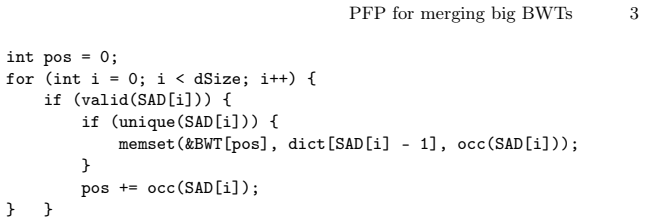
The load-bearing object is the valid phrase suffix: in a prefix-free parse, phrases start and end with trigger strings of length w, and any proper phrase suffix of length at least w is valid. PFP's correctness rests on the fact that no valid phrase suffix is a proper prefix of another, so the lexicographic order of valid phrase suffixes determines the BWT order of the characters that precede them. The merging algorithm scans these suffixes, looks up the phrase ending at each suffix, its total occurrence count, and the small dataset that owns it, then copies that many characters from the corresponding small BWT into the output. Supporting tables and streaming of the small dictionaries' suffix arrays keep the memory footprint down.
What would settle it
Run pfp-merge on a dataset whose pieces share many w-length substrings, such as genomes of the same species split across pieces: if a substantial fraction of valid phrase suffixes appear in more than one small dictionary, the output BWT will be wrong or peak memory will approach plain PFP. A direct check is to count, for a proposed split with w=20, how many valid phrase suffixes occur in more than one small dataset; if that count is not near zero, the central claim fails for that split.
Extended reading notes
Core claim
The central discovery is that the piecewise BWTs can be merged by scanning valid phrase suffixes in lexicographic order, rather than by aligning the pieces. After removing trigger strings that appear in more than one small dataset, every valid phrase suffix appears in exactly one small dataset, so the characters preceding that suffix in the whole BWT are all in one small BWT and keep their relative order. A single pass over the suffix array of the concatenated dictionaries, copying blocks of characters equal to each phrase's occurrence count from the appropriate small BWT, therefore produces the BWT of the whole dataset. This bypasses the large parse and dictionary that plain PFP would need for the entire collection.
Load-bearing premise
The dataset can be split into small pieces that are almost mutually dissimilar, so that nearly every w-length substring occurs in only one piece; otherwise the merge cannot assign each valid phrase suffix to exactly one small BWT and the memory benefit collapses.
Editorial extensions
If this is right
- Collections of genomes grouped by species or chromosome can be indexed with PFP in memory close to the size of one group's dictionary rather than the whole collection's parse.
- The memory during the final merge is dominated by the suffix array of the concatenated dictionaries, which can be streamed from disk, so datasets beyond the reach of plain PFP become tractable.
- The algorithm can be parallelized by starting each small suffix array at an interior position, sharing the static dictionaries and tables across threads without proportionally increasing memory.
- When queries only involve {A,C,G,T}, storing dictionaries in 3 bits per character keeps phrase-suffix comparisons fast, making the approach practical at scale.
Reading between the lines
- The reported 0.77 GB used by the merging phase itself suggests the memory advantage will grow with the number of groups: adding pieces adds tables, not another full-size parse.
- The merge could be combined with other BWT construction algorithms for the small pieces, potentially inheriting their speed while keeping the lower memory of this approach.
- The same unique-phrase-suffix idea could extend to other parse-based indexes, such as r-index-style structures or Wheeler graphs, making piecewise construction a general pattern for repetitive pangenomes.
- A practical deployment would need an automatic way to find a valid decomposition and to verify that w=20 is sufficient; without that, the approach remains heuristic.
Editorial analysis
A structured set of objections, weighed in public.
Referee Report
Summary. The paper proposes a memory-reduction strategy for building the BWT of very large repetitive datasets with prefix-free parsing (PFP). The idea is to split the dataset into smaller, mutually dissimilar datasets, build a BWT for each small dataset with PFP, and then merge these BWTs into the BWT of the whole dataset. The merge is described in Section 3 through a code fragment (Figure 2) that copies, for each valid phrase suffix, a block of characters from the appropriate small dataset's BWT. The paper reports a single experiment on 9.39 GB of bacterial pangenomes, where pfp-merge peaks at 0.91 GB, far below plain PFP (bigbwt, 13.84 GB) and competitive with grlBWT (1.71 GB). The central correctness claim is that, under a heuristic condition that most w-mers appear in only one small dataset, each valid phrase suffix appears in exactly one small dataset, so copying the corresponding BWT characters yields the whole BWT.
Significance. If the merge procedure were correct, the paper would describe a practically attractive way to extend PFP's low-memory construction to datasets that are not repetitive enough for recursive PFP. The experimental result is striking: a 15x reduction in peak memory compared with plain PFP on a real 9.39 GB collection. The paper is also clearly written and makes its code and data available. These strengths are real, and the proposed direction of building small BWTs and merging them is worth pursuing. However, the correctness of the central algorithm is not established, and there is a concrete failure mode even under the paper's own 'not very similar' assumption. Because the contribution is the merge algorithm itself, this flaw is load-bearing.
major comments (3)
- [§3, Figure 2] The proof of correctness for the merge loop counts characters but never proves that the occ(SAD[i]) characters belonging to a given phrase are contiguous in oldBWT[DS(SAD[i])]. In a BWT/eBWT, the characters preceding the same valid phrase suffix α are ordered by the suffix following α; for occurrences at the end of a phrase, that suffix includes the following phrase, not the phrase identity. Two phrases ending with the same α can therefore interleave their occurrences in oldBWT, and the fread of occ(SAD[i]) characters copies the wrong context. A concrete failure occurs on text CACBCAC with w=1 and trigger string C: the phrases CAC and CBC share the valid suffix C, yet Figure 2, applied to the BWT of that single dataset, produces a string of length 6 instead of the true BWT of length 8. Thus the central claim of Section 3 is not established even under the ideal assumption that every valid phrase suffix appears in exactly one small dataset.
- [§3, 'not very similar' condition] The decomposition condition is informal: no algorithm or validation test is given for checking that most w-mers appear in only one small dataset, and the statement that w=20 is 'usually enough' is anecdotal. More importantly, the condition as stated is insufficient: the counterexample above satisfies the condition (the only valid suffix C appears in exactly one small dataset), yet the merge loop is still incorrect. A revised paper would need to either prove a formal condition under which the per-phrase blocks in oldBWT are contiguous, or replace the extraction step with a correct procedure that uses, for example, suffix-array intervals and rank/select operations.
- [§4, Table 1] The experimental section reports peak memory and time on a single 9.39 GB collection, but does not report any verification that the BWT produced by pfp-merge is identical to the BWT of the whole dataset. Given the flaw in Figure 2, the experiment cannot currently be interpreted as evidence for correctness of the merging procedure. At minimum, the paper would need a differential test against bigbwt on the same input, and ideally on multiple datasets with varying degrees of similarity, together with a precise description of what the implementation actually does if it differs from Figure 2.
minor comments (4)
- [§4] The text refers to 'Masillo's CMT-BWT' in the experiments, while Section 1 calls it 'CMS-BWT'; the tool name should be reconciled.
- [Table 1] The table uses 'glrbwt' while the text and repository name use 'grlbwt' (or 'grlBWT'); the spelling should be unified.
- [Abstract] The abstract has formatting issues in the PDF text, including missing spaces such as 'Whenbuilding'; this should be corrected in the camera-ready version.
- [§3, streaming SAD] The claim that storing dictionaries instead of SAD reduces space 'by about 4 or 8' depends on the suffix-array entry size and the dictionary encoding; the statement should be qualified more precisely.
Circularity Check
No significant circularity: pfp-merge builds on prior PFP machinery and is evaluated against external tools, with no fitted quantity relabeled as a prediction.
full rationale
The claimed contribution is a construction: if a dataset splits into small datasets whose w-mers are mostly disjoint, the paper builds each small dataset's BWT independently and merges them using the dictionary suffix array (Section 3, Fig. 2). The target whole-dataset BWT is never an input to the construction; the merge reads only the small datasets' BWTs, phrase occurrence counts, and dictionary order. Correctness is argued from PFP invariants about valid phrase suffixes being prefix-free and confined to one small dataset, not by assuming the output. No parameter is fitted to the target BWT and then reported as a prediction: Table 1 compares measured peak memory against external implementations bigbwt, grlBWT, ropebwt3 and lg. The citations to Boucher et al. [5,6] and the 2018 arXiv note [11] are ordinary references to the prior PFP method the paper extends, not a self-citation chain that forces the conclusion; the merge step is a new combination of known pieces. The \u201cw=20 is usually enough\u201d heuristic and the \u201cnot very similar\u201d assumption are unvalidated modeling assumptions, hence correctness risks, not circularity. The derivation chain is self-contained modulo the cited PFP foundation, so no circular step is present.
Assumptions & free parameters
free parameters (2)
- PFP window length w =
20 in experiments
- PFP modulus p =
default program setting, not stated
assumptions (4)
- standard math PFP phrase properties: every phrase starts and ends with a trigger string, and every valid phrase suffix begins with the phrase-ending trigger.
- domain assumption The dataset can be partitioned into small datasets that are not very similar, i.e., most w-mers appear in only one small dataset.
- domain assumption For a fixed valid phrase suffix, the order of preceding characters in the whole eBWT is the same as in the containing small dataset's eBWT.
- standard math Replacing non-ACGT characters by X preserves the multiset of ACGT substrings.
Cite this review
Pith. "Pith review of Prefix-free parsing for merging big BWTs." pith.science (2026). https://pith.science/paper/WLQWGTK6
@misc{pith2026250603294,
  author       = {Pith},
  title        = {Pith review of: Prefix-free parsing for merging big BWTs},
  year         = {2026},
  howpublished = {\url{https://pith.science/paper/WLQWGTK6}},
  note         = {Machine review of arXiv:2506.03294}
}
read the original abstract
When building Burrows-Wheeler Transforms (BWTs) of truly huge datasets, prefix-free parsing (PFP) can use an unreasonable amount of memory. In this paper we show how if a dataset can be broken down into small datasets that are not very similar to each other -- such as collections of many copies of genomes of each of several species, or collections of many copies of each of the human chromosomes -- then we can drastically reduce PFP's memory footprint by building the BWTs of the small datasets and then merging them into the BWT of the whole dataset.
Figures

Reference graph
Works this paper leans on
-
[1]
Ahmed,O.,Rossi,M.,Kovaka,S.,Schatz,M.C.,Gagie,T.,Boucher,C.,Langmead, B.: Pan-genomic matching statistics for targeted nanopore sequencing. iScience 24(6) (2021)
work page 2021
-
[2]
Genome Biology24(1), 122 (2023)
Ahmed, O.Y., Rossi, M., Gagie, T., Boucher, C., Langmead, B.: SPUMONI 2: improved classification using a pangenome index of minimizer digests. Genome Biology24(1), 122 (2023)
work page 2023
- [3]
- [4]
-
[5]
Algorithms for Molecular Biology14, 1–15 (2019)
Boucher, C., Gagie, T., Kuhnle, A., Langmead, B., Manzini, G., Mun, T.: Prefix- free parsing for building big BWTs. Algorithms for Molecular Biology14, 1–15 (2019)
work page 2019
- [6]
-
[7]
Information and Computation294, 105088 (2023)
Díaz-Domínguez, D., Navarro, G.: Efficient construction of the BWT for repetitive text using string compression. Information and Computation294, 105088 (2023)
work page 2023
-
[8]
Algorithmica63(3), 707–730 (2012)
Ferragina, P., Gagie, T., Manzini, G.: Lightweight data indexing and compression in external memory. Algorithmica63(3), 707–730 (2012)
work page 2012
Show all 26 references
-
[9]
iScience27(10) (2024)
Ferro, E., Oliva, M., Gagie, T., Boucher, C.: Building a pangenome alignment index via recursive prefix-free parsing. iScience27(10) (2024)
2024
-
[10]
In: Proc
Gagie, T., I, T., Manzini, G., Navarro, G., Sakamoto, H., Takabatake, Y.: Rpair: rescaling RePair with rsync. In: Proc. 26th Symposium on String Processing and Information Retrieval (SPIRE). pp. 35–44. Springer (2019)
2019
-
[11]
arxiv (2018)
Gagie, T., Manzini, G.: Prefix-free parsing for building big BWTs. arxiv (2018)
2018
-
[12]
In: Proc
Gagie, T., Navarro, G., Prezza, N.: Optimal-time text indexing in BWT-runs bounded space. In: Proc. 29th Symposium on Discrete Algorithms (SODA). pp. 1459–1477 (2018)
2018
-
[13]
Journal of the ACM67(1), 1–54 (2020)
Gagie, T., Navarro, G., Prezza, N.: Fully functional suffix trees and optimal text searching in BWT-runs bounded space. Journal of the ACM67(1), 1–54 (2020)
2020
-
[14]
In: Proc
Goga,A.,Baláž,A.:Prefix-freeparsingforbuildinglargetunnelledWheelergraphs. In: Proc. 22nd Workshop on Algorithms in Bioinformatics (WABI 2022). pp. 18–1 (2022)
2022
-
[15]
In: Proc
Hong, A., Rossi, M., Boucher, C.: LZ77 via prefix-free parsing. In: Proc. 25th Symposium on Algorithm Engineering and Experiments (ALENEX). pp. 123–134 (2023) 8 D. Díaz-Domínguez et al
2023
-
[16]
Hunt, M., Lima, L., Anderson, D., Hawkey, J., Shen, W., Lees, J., Iqbal, Z.: AllThe- Bacteria-allbacterialgenomesassembled,availableandsearchable.bioRxiv(2024)
2024
-
[17]
In: Proc
Kim, J., Varki, R., Oliva, M., Boucher, C.: Re2pair: Increasing the scalability of RePair by decreasing memory usage. In: Proc. 32nd European Symposium on Algorithms (ESA). pp. 78–1 (2024)
2024
-
[18]
Bioinformatics40(12), btae717 (2024)
Li, H.: BWT construction and search at the terabase scale. Bioinformatics40(12), btae717 (2024)
2024
-
[19]
Lipták,Z.,Lucà,S.,Masillo,F.:MeasuringgenomicdatawithPFP.bioRxiv(2025)
2025
-
[20]
Cambridge Uni- versity Press, 2nd edn
Mäkinen, V., Belazzougui, D., Cunial, F., Tomescu, A.I.: Genome-scale algorithm design: bioinformatics in the era of high-throughput sequencing. Cambridge Uni- versity Press, 2nd edn. (2023)
2023
-
[21]
Theoretical Computer Science387(3), 298–312 (2007)
Mantaci, S., Restivo, A., Rosone, G., Sciortino, M.: An extension of the Burrows– Wheeler transform. Theoretical Computer Science387(3), 298–312 (2007)
2007
-
[22]
In: Proc
Masillo, F.: Matching statistics speed up BWT construction. In: Proc. 31st Euro- pean Symposium on Algorithms (ESA). pp. 83–1 (2023)
2023
-
[23]
arXiv (2025)
Olbrich, J.: Fast and memory-efficient BWT construction of repetitive texts using lyndon grammars. arXiv (2025)
2025
-
[24]
Bioinformatics41(3), btaf104 (2025)
Olbrich,J.,Büchler,T.,Ohlebusch,E.:Generatingmultiplealignmentsonapange- nomic scale. Bioinformatics41(3), btaf104 (2025)
2025
-
[25]
Journal of Computational Biology29(2), 169–187 (2022)
Rossi, M., Oliva, M., Langmead, B., Gagie, T., Boucher, C.: MONI: a pangenomic index for finding maximal exact matches. Journal of Computational Biology29(2), 169–187 (2022)
2022
-
[26]
Tridgell, A., Mackerras, P.: The rsync algorithm. Tech. Rep. TR-CS-96-05, The Australian National University (1996)
1996
Reviewed August 7, 2026 · model on record in the stance chip above.
Discussion (0). Sign in to comment.