REVIEW 2 major objections 5 minor 159 references
Negligible effects of environmental fluctuations on the maintenance of coral biodiversity: A test of five storage effects
T0 review · 2 major / 5 minor · reviewed 2026-08-07 · deepseek-v4-flash
Pith's one-line read A simulation-based test on 11 Great Barrier Reef coral species finds that the storage effect—coexistence through temporal niche partitioning—operates but is too weak to maintain coral biodiversity.
desk verdict A serious empirical test of the storage effect in corals, but the five-year window makes me wary of the covariance structure that drives the central conclusion. read the letter →
The pith
A machine-rendered reading of the paper's core claim, the machinery that carries it, and where it could break.
The reading
What carries the argument
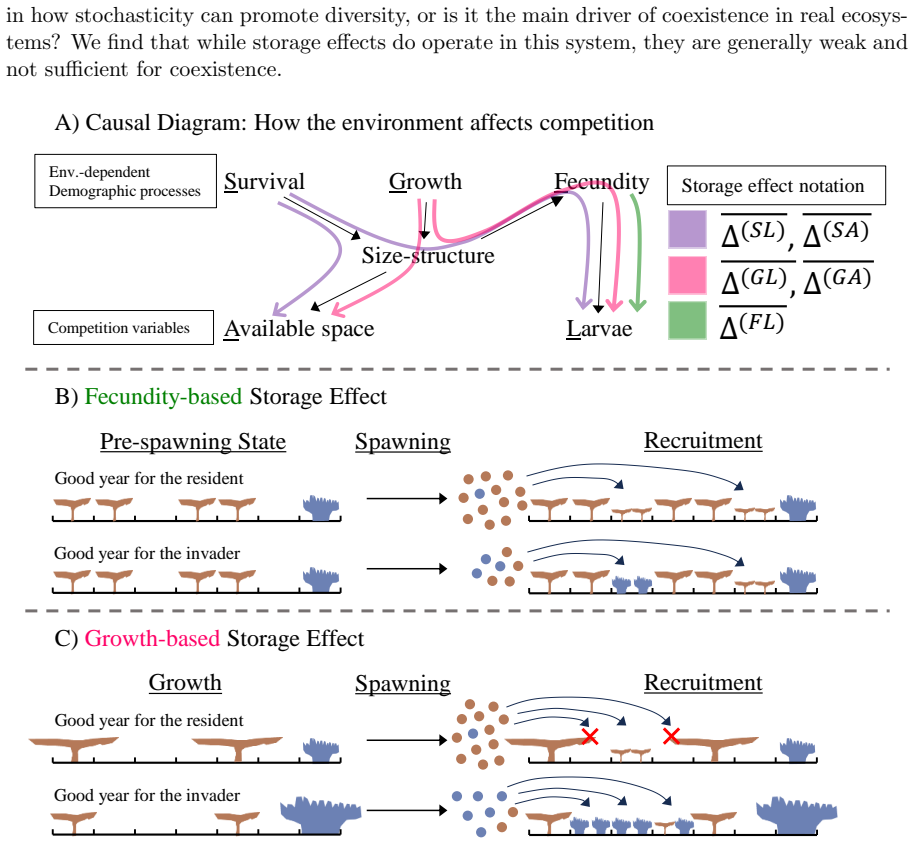
The argument is carried by three coupled tools. An Integral Projection Model (IPM)—a size-structured population model that tracks colony planar area through annual survival, growth, spawning, and density-dependent recruitment—generates simulated coral communities, with environmental fluctuations entering as species-specific year effects on growth and fecundity plus a wave-disturbance mortality sub-model. Bayesian hierarchical fitting propagates parameter uncertainty into every coexistence outcome. Simulation-based Modern Coexistence Theory (MCT) decomposes each species' per-capita growth rate when rare into components for mean conditions, environmental variation, competition variation, and the environment–competition interaction, and then compares invaders to residents; a fine-grained partition splits the storage effect into five sub-effects ($\Delta_{(SL)}$, $\Delta_{(SA)}$, $\Delta_{(GL)}$, $\Delta_{(GA)}$, $\Delta_{(FL)}$) indexed by which demographic process covaries with which competition axis. The load-bearing diagnostic is a two-parameter map of coexistence probability against the between-species fecundity-year-effect correlation and the scale of environmental variability, which places the fitted species in a high-correlation, low-variability region far from where the storage effect can stabilize coexistence.
What would settle it
A multi-decadal demographic time series from the same reef that reveals strongly negative correlations among species' fecundity year effects together with high interannual variance would place the community inside the coexistence regime identified in the paper's Figure 6 and undermine its central conclusion; the same measurement showing persistently high positive correlations with modest variance would corroborate the finding.
Extended reading notes
Core claim
The central discovery is that the storage effect is real but negligible: it promotes coexistence yet is nowhere near sufficient for it in this coral community. In simulations, the posterior probability that two or more of the 11 species coexist is 38%, and for three or more species only about 12%; in the exclusion cases, Goniastrea pectinata typically monopolizes the community. The Modern Coexistence Theory partition shows that fluctuation-free effects $\Delta_0$ are typically five times larger than the storage effect $\Delta_{(EC)}$, and coexistence arises when $\Delta_0$ is near zero rather than when the storage effect is unusually strong. Of the five process-based storage effects, only the fecundity-to-larvae effect $\Delta_{(FL)}$—the classic lottery-model mechanism—makes a substantive contribution; growth-based and survival-based storage effects are weak because growth fluctuations lack a positive environment–competition covariance and survival fluctuations barely move equilibrium growth rates. The decisive sensitivity result is that high-probability coexistence via the storage effect requires roughly tenfold-greater environmental variability, or roughly fivefold variability combined with strongly negative between-species correlations in fecundity year effects—conditions far outside the posterior estimates for the studied species.
Load-bearing premise
The load-bearing premise is that the between-species correlations in year-to-year vital rates computed from five years of data represent true long-term environmental responses; the study window included a cyclone and thermal stress, and if those events inflated the correlations, the storage effect's strength could be substantially underestimated.
Editorial extensions
If this is right
- If the storage effect is this weak in a coral community possessing all its theoretical prerequisites, fluctuation-driven coexistence mechanisms are likely minor in most ecosystems, and fluctuating environments should not be treated as a default explanation for biodiversity.
- Coral coexistence research should shift toward spatial mechanisms—microhabitat settlement preferences, spatial fitness-density covariance, and asymmetric larval dispersal—which the paper identifies as the most plausible alternative supports.
- Among storage-effect pathways, fecundity fluctuations coupled to larval competition dominate, so empirical effort on temporal coexistence should concentrate on propagule production and settlement rather than on growth- or survival-driven mechanisms.
- Coexistence in this system, when it happens, reflects near-equal mean fitnesses rather than strong stabilization, so demographic equalizing processes deserve as much attention as stabilizing mechanisms.
Reading between the lines
- If the cyclone- and heat-stress years inflated the estimated between-species correlations, a multi-decadal demographic record could shift the fitted community toward the negative-correlation, high-variability regime where the storage effect stabilizes coexistence—my inference, not a claim the paper makes.
- Because the model is deliberately aspatial, it does not rule out a spatial storage effect; a spatially explicit version with microhabitat patches and larval dispersal could test whether space substitutes for time in maintaining the same coral diversity.
- The simulated dominance of Goniastrea pectinata, which contradicts its field abundance, implies an omitted process such as species-specific thermal sensitivity or microhabitat segregation; quantifying that omission would show how much real-world coexistence the single-habitat, fluctuation-only model misses.
- Recruitment-density parameters were tuned to produce realistic coral cover rather than estimated from data, so direct species-level recruit measurements would sharpen the fluctuation-free fitness differences and could confirm or revise the reported fivefold gap.
Editorial analysis
A structured set of objections, weighed in public.
Referee Report
Summary. The paper parameterizes integral projection models for 11 coral species at Lizard Island using five years of demographic data, simulates community dynamics, and applies simulation-based Modern Coexistence Theory to quantify five storage effects arising from survival, growth, and fecundity fluctuations interacting with larval and space competition. The central claim is that storage effects operate but are weak: they are generally smaller than fluctuation-free fitness differences, coexistence is uncommon in simulations, and coexistence becomes probable only under greatly exaggerated environmental variability or strongly negative interspecific correlations. The authors support this with extensive robustness checks, posterior uncertainty propagation, and comparisons of fecundity fluctuations to literature values.
Significance. If the central claim holds, this is a valuable empirical test of a prominent coexistence mechanism in a system thought to favor strong storage effects, and it would reinforce a growing literature suggesting that temporal storage effects are generally weak. The study's strengths include explicit propagation of parameter uncertainty into coexistence outcomes, quantification of five distinct storage-effect pathways, and a broad set of alternative-model and parameter-sensitivity analyses. The concern raised below about the low-rank covariance structure of simulated year effects is load-bearing for the weak-storage-effect conclusion, because the simulated environmental responses are generated from covariance matrices that cannot represent the full dimensionality of species-specific environmental responses and may thereby bias the storage-effect estimates downward.
major comments (2)
- [Section 2.3 and Appendix A.3/A.4, Eqs. (A.15)-(A.16) and (A.22)-(A.25)] The 11x11 empirical correlation matrices RG, RF1, and RF2 are computed from only 5-6 annual species-specific year-effect estimates, so for any posterior draw each matrix has rank at most 4 (growth) or 5 (fecundity). The covariance matrices constructed in Eqs. (A.15), (A.22), and (A.23) are therefore singular, and the MVN draws in Eqs. (A.16), (A.24), and (A.25) confine all 11 species' environmental responses to a 4-5 dimensional linear subspace. This rank constraint mechanically limits the diversity of species-specific responses, which is the first ingredient of the storage effect, and it imposes a lower bound on average squared pairwise correlations among the 11 simulated response vectors; this is a distinct pathway by which the five-year window can bias Delta(EC) and coexistence probabilities downward, independent of whether the mean correlations are themselves biased. The diffuse-correlation robustness check in Appendix B.5 uses a full-rank compound-symmetry matrix with a single shared rho and therefore does not test the low-rank constraint. Please add a robustness analysis that breaks the low-rank constraint, for example by using an LKJ or factor-model prior on the full covariance matrix, or by adding species-specific independent noise to the simulated year effects, and report the resulting coexistence probabilities and Delta(EC) values. If the weak-storage-effect conclusion persists under that alternative, it would substantially strengthen the paper.
- [Section 3 and Fig. 4] The model predicts that Goniastrea pectinata dominates in 88-91% of no-coexistence simulations, yet this species is neither the most abundant nor the most abundant within its morphological group in the observed community. The text offers two plausible explanations, but the possibility that the five-year demographic rates are unrepresentative is also directly relevant to the storage-effect estimates: the study period ended with Tropical Cyclone Nathan and included thermal stress that disproportionately affected Acropora, so the estimated year effects and their between-species correlations may be dominated by a common disturbance response. Because the central claim concerns the strength of environmental covariance, please test how the estimated year-effect covariance structure and the MCT storage-effect estimates change when the cyclone-affected year is excluded or when year effects are estimated under a longer-term disturbance regime, and report whether the qualitative conclusion remains.
minor comments (5)
- [Results, Section 3] The phrase 'the probability of three or more species coexisting was only than 12%' appears to contain a typo; it should likely read 'only 12%'.
- [Appendix A.2] The phrase 'Combining this with wave-disturbance morality (sub-model A.1)' should read 'mortality' rather than 'morality'.
- [Appendix C] The paragraph beginning 'The early life history of corals involves two critical transitions...' is duplicated verbatim; one copy should be removed.
- [Appendix B.5 and Table B.1] The diffuse-correlation robustness model is described qualitatively but its quantitative results are not reported in Table B.1 or elsewhere; please add the coexistence probabilities for this scenario so that readers can compare it with the baseline and other alternatives.
- [Section 5 / References] The reference list contains entries cited in the text that appear with inconsistent formatting (e.g., some entries have missing journal names or incomplete page ranges); a careful copyedit of the reference list is recommended.
Circularity Check
No significant circularity: storage-effect magnitudes are emergent simulation outputs, not fitted values; the fitted environmental covariance does not force them by construction, and the self-cited MCT tools have independent anchors.
full rationale
The paper's central claim—that five storage effects are weak contributors to coral coexistence—is a measured simulation output, not a fitted parameter or a self-referential prediction. The inputs fitted to data (year-effect means, variances, and empirical between-species correlations for growth and fecundity; survival and wave-disturbance parameters) do not by construction determine the MCT storage-effect terms Delta(EC) or the sub-storage effects Delta(SL), Delta(SA), Delta(GL), Delta(GA), Delta(FL): those quantities emerge from full size-structured simulations with density-dependent recruitment and invader-resident comparisons (Eqs. D.1-D.5), including competition feedbacks not imposed by the fitted covariance. The only tuned parameter, beta_j,R, is matched to observed coral-cover ranges (Section 2.2, Appendix A.5) rather than to storage-effect magnitude, and Appendix B shows coexistence probabilities are insensitive or less favorable under alternative recruitment, growth, survival, and correlation structures. Figure 6 and G.1 further show that the fitted (rho, sigma) location does not force weak storage effects by definition: coexistence becomes probable only under roughly 10x larger fluctuations or strongly negative correlations, far from the posterior—an empirical mapping, not an identity. The paper self-cites Johnson and Hastings (2022a,b,c; 2023) for the ingredient-list definition, the simple-comparison method, and the storage-effect approximation (Eq. E.1); these are methodological or explanatory citations with independent anchors (Chesson 1994; Ellner et al. 2016b, 2019), and the main result does not rest on any single self-cited theorem—the simple-versus-scaled comparison is checked directly in Fig. D.1. The acknowledged five-year window (Section 2.3) may bias estimated correlation matrices, and those covariance matrices can be low-rank; this is a genuine data-limitation and bias risk (a correctness concern), not a circularity, because the storage effect is not defined as the fitted covariance and the diffuse-correlation robustness check (Appendix B.5) tests an alternative full-rank correlation structure with qualitatively identical outcomes. Accordingly, no circular step satisfies the evidence standard, and the score of 2 reflects only the presence of minor, non-load-bearing self-citations.
Assumptions & free parameters
free parameters (1)
- beta_j,R (maximum recruit density per species) =
Species-specific values, chosen by simulation to produce single-species coral cover between 0.1 and 0.5; interquartile…
assumptions (4)
- domain assumption An aspatial integral projection model adequately approximates coral community dynamics despite local colony interactions (overgrowth, digestion, competition for light).
- ad hoc to paper Recruitment is density-dependent in all years, at the asymptotic maximum of the settlement-recruitment curve, so the quotient L_j / sum(L_k) fully determines species recruit shares.
- domain assumption The empirical correlation matrix of species-specific year effects, computed from 5 years of data, is representative of long-term interspecific environmental covariance.
- standard math Simulation-based Modern Coexistence Theory, with the shuffling approach to remove environment-competition covariance, correctly separates the storage effect from higher-order interactions.
Cite this review
Pith. "Pith review of Negligible effects of environmental fluctuations on the maintenance of coral biodiversity: A test of five storage effects." pith.science (2026). https://pith.science/paper/EZRI6XEL
@misc{pith2026250603346,
  author       = {Pith},
  title        = {Pith review of: Negligible effects of environmental fluctuations on the maintenance of coral biodiversity: A test of five storage effects},
  year         = {2026},
  howpublished = {\url{https://pith.science/paper/EZRI6XEL}},
  note         = {Machine review of arXiv:2506.03346}
}
read the original abstract
The storage effect is a general explanation for ecological coexistence, wherein different species specialize on different states of a fluctuating environment, e.g., hot vs. cold years. Despite the storage effect's prominence in theoretical ecology, we lack evidence on whether it maintains biodiversity in nature. Here, we examine five storage effects in a community of 11 coral species from the Great Barrier Reef, using detailed size-structured demographic data collected over five years. We parameterize integral projection models, simulate coral communities, and quantify coexistence mechanisms through Modern Coexistence Theory. Results show that storage effects promote coexistence but are weak compared to fitness differences. Despite coral communities exhibiting theoretical prerequisites for strong temporal niche partitioning, the storage effect plays only a minor role in maintaining coral biodiversity. This aligns with growing evidence that storage effects are weak across ecosystems. Coral coexistence likely depends more on spatial processes, including microhabitat partitioning and asymmetric dispersal.
Figures


Figures from the paper (3 more)


Reference graph
Works this paper leans on
-
[1]
Adler, P. B. and Drake, J. M. (2008). Environmental variation, stochastic extinction, and competitive coexistence. The American Naturalist , 172(5):E186--E195
2008
-
[2]
B., Fajardo, A., Kleinhesselink, A
Adler, P. B., Fajardo, A., Kleinhesselink, A. R., and Kraft, N. J. (2013). Trait-based tests of coexistence mechanisms. Ecology letters , 16(10):1294--1306
2013
-
[3]
B., HilleRisLambers, J., Kyriakidis, P
Adler, P. B., HilleRisLambers, J., Kyriakidis, P. C., Guan, Q., and Levine, J. M. (2006). Climate variability has a stabilizing effect on the coexistence of prairie grasses. Proceedings of the National Academy of Sciences , 103(34):12793--12798
2006
-
[4]
J., Dumas, M., Lemonnier, H., and Rodolfo-Metalpa, R
Alessi, C., Randall, C. J., Dumas, M., Lemonnier, H., and Rodolfo-Metalpa, R. (2024). Spawning window and fecundity in three acroporid corals from the environmentally variable semi-enclosed lagoon of bourak \'e . Coral Reefs , 43(5):1469--1482
2024
-
[5]
H., Dornelas, M., Madin, J
\'A lvarez-Noriega, M., Baird, A. H., Dornelas, M., Madin, J. S., and Connolly, S. R. (2018). Negligible effect of competition on coral colony growth. Ecology , 99(6):1347--1356
2018
-
[6]
S., Baird, A
\'A lvarez-Noriega, M., Madin, J. S., Baird, A. H., Dornelas, M., and Connolly, S. R. (2023). Disturbance-induced changes in population size structure promote coral biodiversity. The American Naturalist , 202(5):604--615
2023
-
[7]
Anderson, G. D. (2025). Recovery of coral cover at lizard island australia 6 years post-disturbance. Frontiers in Marine Science , 11:1509455
2025
-
[8]
P., Kingsford, M
Andutta, F. P., Kingsford, M. J., and Wolanski, E. (2012). ‘sticky water’enables the retention of larvae in a reef mosaic. Estuarine, Coastal and Shelf Science , 101:54--63
2012
Show all 159 references
-
[9]
L., Huxman, T
Angert, A. L., Huxman, T. E., Chesson, P., and Venable, D. L. (2009). Functional tradeoffs determine species coexistence via the storage effect. Proceedings of the National Academy of Sciences , 106(28):11641--11645
2009
-
[10]
Anthony, K. R. and Connolly, S. R. (2004). Environmental limits to growth: physiological niche boundaries of corals along turbidity--light gradients. Oecologia , 141:373--384
2004
-
[11]
E., Legendre, P., and Rodr \' guez-Zaragoza, F
Arias-Gonz \'a lez, J. E., Legendre, P., and Rodr \' guez-Zaragoza, F. A. (2008). Scaling up beta diversity on caribbean coral reefs. Journal of Experimental Marine Biology and Ecology , 366(1-2):28--36
2008
-
[12]
Armitage, D. W. and Jones, S. E. (2019). Negative frequency-dependent growth underlies the stable coexistence of two cosmopolitan aquatic plants. Ecology , 100(5):e02657
2019
-
[13]
Armitage, D. W. and Jones, S. E. (2020). Coexistence barriers confine the poleward range of a globally distributed plant. Ecology Letters , 23(12):1838--1848
2020
-
[14]
and Mundy, C
Babcock, R. and Mundy, C. (1996). Coral recruitment: consequences of settlement choice for early growth and survivorship in two scleractinians. Journal of Experimental Marine Biology and Ecology , 206(1-2):179--201
1996
-
[15]
C., Baird, A
Babcock, R. C., Baird, A. H., Piromvaragorn, S., Thomson, D. P., and Willis, B. L. (2003). Identification of scleractinian coral recruits from indo-pacific reefs. ZOOLOGICAL STUDIES-TAIPEI- , 42(1):211--226
2003
-
[16]
Bairos-Novak , K. R. (2023). Demographic and evolutionary responses of reef-building corals to climate change . Phd thesis, James Cook University. Available online at James Cook University's ResearchOnline repository
2023
-
[17]
and Engel, M
Bak, R. and Engel, M. (1979). Distribution, abundance and survival of juvenile hermatypic corals (scleractinia) and the importance of life history strategies in the parent coral community. Marine Biology , 54(4):341--352
1979
-
[18]
Barab \'a s, G., D'Andrea, R., and Stump, S. M. (2018). Chesson's coexistence theory. Ecological Monographs , 88(3):277--303
2018
-
[19]
A., Kendall, B
Berkley, H. A., Kendall, B. E., Mitarai, S., and Siegel, D. A. (2010). Turbulent dispersal promotes species coexistence. Ecology Letters , 13(3):360--371
2010
-
[20]
and Dekker, R
Beukema, J. and Dekker, R. (2007). Variability in annual recruitment success as a determinant of long-term and large-scale variation in annual production of intertidal wadden sea mussels (mytilus edulis). Helgoland Marine Research , 61:71--86
2007
-
[21]
Black, K. P. and Gay, S. L. (1990). Reef-scale numerical hydrodynamic modelling developed to instigate crown-of-thorns starfish outbreaks. In Bradbury, R., editor, Acanthaster and the coral reef: a theoretical approach , pages 120--150. Springer-Verlag, Berlin
1990
-
[22]
Black, K. P. and Rosenberg, M. A. (1992). Natural stability of beaches around a large bay. Journal of Coastal Research , 8:385--397
1992
-
[23]
Borger, J. L. and Colley, S. (2010). The effects of a coral disease on the reproductive output of montastraea faveolata (scleractinia: Faviidae). Revista de Biologia Tropical , 58:99--110
2010
-
[24]
E., Kristensen, K., van Benthem , K
Brooks, M. E., Kristensen, K., van Benthem , K. J., Magnusson, A., Berg, C. W., Nielsen, A., Skaug, H. J., Maechler, M., and Bolker, B. M. (2017). glmmTMB balances speed and flexibility among packages for zero-inflated generalized linear mixed modeling. The R Journal , 9(2):378--400
2017
-
[25]
C \'a ceres, C. E. (1997). Temporal variation, dormancy, and coexistence: a field test of the storage effect. Proceedings of the National Academy of Sciences , 94(17):9171--9175
1997
-
[26]
Cameron, K. A. and Harrison, P. L. (2020). Density of coral larvae can influence settlement, post-settlement colony abundance and coral cover in larval restoration. Scientific reports , 10(1):5488
2020
-
[27]
D., Lee, D., Goodrich, B., Betancourt, M., Brubaker, M
Carpenter, B., Gelman, A., Hoffman, M. D., Lee, D., Goodrich, B., Betancourt, M., Brubaker, M. A., Guo, J., Li, P., and Riddell, A. (2017). Stan: A probabilistic programming language. Journal of statistical software , 76
2017
-
[28]
E., Chequer, A
Carpenter, G. E., Chequer, A. D., Weber, S., Mass, T., and Goodbody-Gringley, G. (2022). Light and photoacclimatization drive distinct differences between shallow and mesophotic coral communities. Ecosphere , 13(8):e4200
2022
-
[29]
Chesson, P. (1994). Multispecies competition in variable environments. Theoretical population biology , 45(3):227--276
1994
-
[30]
Chesson, P. (2000a). General theory of competitive coexistence in spatially-varying environments. Theoretical Population Biology , 58(3):211--237
2000
-
[31]
Chesson, P. (2000b). Mechanisms of maintenance of species diversity. Annual review of Ecology and Systematics , 31(1):343--366
2000
-
[32]
and Huntly, N
Chesson, P. and Huntly, N. (1997). The roles of harsh and fluctuating conditions in the dynamics of ecological communities. The American Naturalist , 150(5):519--553
1997
-
[33]
J., Roxburgh, S
Chesson, P., Huntly, N. J., Roxburgh, S. H., Pantastico-Caldas, M., and Facelli, J. M. (2012). The storage effect: definition and tests in two plant communities. In Temporal dynamics and ecological process , pages 11--40. Cambridge University Press
2012
-
[34]
Chesson, P. L. (1985). Coexistence of competitors in spatially and temporally varying environments: a look at the combined effects of different sorts of variability. Theoretical Population Biology , 28(3):263--287
1985
-
[35]
Chesson, P. L. and Ellner, S. (1989). Invasibility and stochastic boundedness in monotonic competition models. Journal of Mathematical Biology , 27:117--138
1989
-
[36]
Chesson, P. L. and Warner, R. R. (1981). Environmental variability promotes coexistence in lottery competitive systems. The American Naturalist , 117(6):923--943
1981
-
[37]
Chornesky, E. (1991). The ties that bind: inter-clonal cooperation may help a fragile coral dominate shallow high-energy reefs. Marine Biology , 109(1):41--51
1991
-
[38]
B., Mason, L
Choukroun, S., Stewart, O. B., Mason, L. B., and Bode, M. (2024). Larval dispersal predictions are highly sensitive to hydrodynamic modelling choices. Coral Reefs , pages 1--13
2024
-
[39]
P., Lafrankie, J
Condit, R., Hubbell, S. P., Lafrankie, J. V., Sukumar, R., Manokaran, N., Foster, R. B., and Ashton, P. S. (1996). Species-area and species-individual relationships for tropical trees: a comparison of three 50-ha plots. Journal of ecology , pages 549--562
1996
-
[40]
H., Hughes, T
Connell, J. H., Hughes, T. P., Wallace, C. C., Tanner, J. E., Harms, K. E., and Kerr, A. M. (2004). A long-term study of competition and diversity of corals. Ecological Monographs , 74(2):179--210
2004
-
[41]
Connolly, S. R. and Baird, A. H. (2010). Estimating dispersal potential for marine larvae: dynamic models applied to scleractinian corals. Ecology , 91(12):3572--3583
2010
-
[42]
S., Oliver, T
Couch, C. S., Oliver, T. A., Dettloff, K., Huntington, B., Tanaka, K. R., and Vargas- \'A ngel, B. (2023). Ecological and environmental predictors of juvenile coral density across the central and western pacific. Frontiers in Marine Science , 10:1192102
2023
-
[43]
M., Rundel, P
Cowling, R. M., Rundel, P. W., Lamont, B. B., Arroyo, M. K., and Arianoutsou, M. (1996). Plant diversity in mediterranean-climate regions. Trends in Ecology & Evolution , 11(9):362--366
1996
-
[44]
Cruz, D. W. d. and Harrison, P. L. (2017). Enhanced larval supply and recruitment can replenish reef corals on degraded reefs. Scientific reports , 7(1):13985
2017
-
[45]
and Gonzalez, A
Descamps-Julien, B. and Gonzalez, A. (2005). Stable coexistence in a fluctuating environment: an experimental demonstration. Ecology , 86(10):2815--2824
2005
-
[46]
and Connolly, S
Dornelas, M. and Connolly, S. R. (2008). Multiple modes in a coral species abundance distribution. Ecology Letters , 11(10):1008--1016
2008
-
[47]
R., G \'o mez-Lemos, L
Doropoulos, C., Evensen, N. R., G \'o mez-Lemos, L. A., and Babcock, R. C. (2017). Density-dependent coral recruitment displays divergent responses during distinct early life-history stages. Royal Society Open Science , 4(5):170082
2017
-
[48]
Doropoulos, C., Ward, S., Roff, G., Gonz \'a lez-Rivero, M., and Mumby, P. J. (2015). Linking demographic processes of juvenile corals to benthic recovery trajectories in two common reef habitats. PLoS One , 10(5):e0128535
2015
-
[49]
and Johnson, C
Dunstan, P. and Johnson, C. (1998). Spatio-temporal variation in coral recruitment at different scales on heron reef, southern great barrier reef. Coral Reefs , 17:71--81
1998
-
[50]
Edmunds, P. J. (2018). Implications of high rates of sexual recruitment in driving rapid reef recovery in mo’orea, french polynesia. Scientific reports , 8(1):16615
2018
-
[51]
Edmunds, P. J. (2021). Spatiotemporal variation in coral recruitment and its association with seawater temperature. Limnology and Oceanography , 66(4):1394--1408
2021
-
[52]
Edmunds, P. J. (2023). Coral recruitment: patterns and processes determining the dynamics of coral populations. Biological Reviews , 98(6):1862--1886
2023
-
[53]
J., Bruno, J
Edmunds, P. J., Bruno, J. F., and Carlon, D. B. (2004). Effects of depth and microhabitat on growth and survivorship of juvenile corals in the florida keys. Marine Ecology Progress Series , 278:115--124
2004
-
[54]
J., Guest, J
Edwards, A. J., Guest, J. R., Heyward, A. J., Villanueva, R. D., Baria, M. V., Bollozos, I. S., and Golbuu, Y. (2015). Direct seeding of mass-cultured coral larvae is not an effective option for reef rehabilitation. Marine Ecology Progress Series , 525:105--116
2015
-
[55]
P., Childs, D
Ellner, S. P., Childs, D. Z., and Rees, M. (2016a). Data-driven modelling of structured populations . Springer
2016
-
[56]
P., Snyder, R
Ellner, S. P., Snyder, R. E., and Adler, P. B. (2016b). How to quantify the temporal storage effect using simulations instead of math. Ecology letters , 19(11):1333--1342
2016
-
[57]
P., Snyder, R
Ellner, S. P., Snyder, R. E., Adler, P. B., Hern \'a ndez, C. M., and Hooker, G. (2024). It's about (taking up) space: Discreteness of individuals and the strength of spatial coexistence mechanisms. Ecology , 105(11):e4404
2024
-
[58]
P., Snyder, R
Ellner, S. P., Snyder, R. E., Adler, P. B., and Hooker, G. (2019). An expanded modern coexistence theory for empirical applications. Ecology letters , 22(1):3--18
2019
-
[59]
M., Chesson, P., and Barnes, N
Facelli, J. M., Chesson, P., and Barnes, N. (2005). Differences in seed biology of annual plants in arid lands: a key ingredient of the storage effect. Ecology , 86(11):2998--3006
2005
-
[60]
and Connolly, S
Figueiredo, J. and Connolly, S. R. (2012). Dispersal-mediated coexistence under recruitment limitation and displacement competition. Ecological Modelling , 243:133--142
2012
-
[61]
and Meischner, D
Fricke, H. and Meischner, D. (1985). Depth limits of bermudan scleractinian corals: a submersible survey. Marine Biology , 88:175--187
1985
-
[62]
Gause, G. F. (1934). The struggle for existence. Williams & Wilkins, Baltimore
1934
-
[63]
B., Stern, H
Gelman, A., Carlin, J. B., Stern, H. S., Dunson, D. B., Vehtari, A., and Rubin, D. B. (2014). Bayesian data analysis . Chapman and Hall/CRC, 3rd ed. edition
2014
-
[64]
Gibbs, D. A. and Hay, M. E. (2015). Spatial patterns of coral survivorship: impacts of adult proximity versus other drivers of localized mortality. PeerJ , 3:e1440
2015
-
[65]
Glassom, D., Zakai, D., and Chadwick-Furman, N. (2004). Coral recruitment: a spatio-temporal analysis along the coastline of eilat, northern red sea. Marine Biology , 144:641--651
2004
-
[66]
Graham, E., Baird, A., Connolly, S., Sewell, M., and Willis, B. (2013). Rapid declines in metabolism explain extended coral larval longevity. Coral Reefs , 32:539--549
2013
-
[67]
M., Lowe, R
Grimaldi, C. M., Lowe, R. J., Benthuysen, J. A., Cuttler, M. V., Green, R. H., Radford, B., Ryan, N., and Gilmour, J. (2022). Hydrodynamic drivers of fine-scale connectivity within a coral reef atoll. Limnology and Oceanography , 67(10):2204--2217
2022
-
[68]
M., Shoemaker, L
Hallett, L. M., Shoemaker, L. G., White, C. T., and Suding, K. N. (2019). Rainfall variability maintains grass-forb species coexistence. Ecology Letters , 22(10):1658--1667
2019
-
[69]
Harper, J. L. (1977). Population biology of plants. Academic Press
1977
-
[70]
Harrington, L., Fabricius, K., De'Ath, G., and Negri, A. (2004). Recognition and selection of settlement substrata determine post-settlement survival in corals. Ecology , 85(12):3428--3437
2004
-
[71]
Hartig, F. (2024). DHARMa: Residual Diagnostics for Hierarchical (Multi-Level / Mixed) Regression Models . R package version 0.4.7
2024
-
[72]
and Chesson, P
Holt, G. and Chesson, P. (2014). Variation in moisture duration as a driver of coexistence by the storage effect in desert annual plants. Theoretical Population Biology , 92:36--50
2014
-
[73]
Houde, E. D. (2016). Recruitment variability. Fish reproductive biology: implications for assessment and management , pages 98--187
2016
-
[74]
Hughes, T., Baird, A., Dinsdale, E., Moltschaniwskyj, N., Pratchett, M., Tanner, J., and Willis, B. (2000). Supply-side ecology works both ways: The link between benthic adults, fecundity, and larval recruits. Ecology , 81(8):2241--2249
2000
-
[75]
Ingram, T., Giery, S., and Losos, J. (2022). Hierarchical partitioning of multiple niche dimensions among ecomorphs, species and sexes in puerto rican anoles. Journal of Zoology , 318(2):127--134
2022
-
[76]
Janzen, D. H. (1970). Herbivores and the number of tree species in tropical forests. The American Naturalist , 104(940):501--528
1970
-
[77]
and Morin, P
Jiang, L. and Morin, P. J. (2007). Temperature fluctuation facilitates coexistence of competing species in experimental microbial communities. Journal of animal ecology , 76(4):660--668
2007
-
[78]
Johnson, E. C. and Hastings, A. (2022a). Methods for calculating coexistence mechanisms: beyond scaling factors. Oikos , 2022(12):e09266
2022
-
[79]
Johnson, E. C. and Hastings, A. (2022b). The storage effect is not about bet-hedging or population stage-structure. arXiv preprint arXiv:2201.06687
2022 arXiv
-
[80]
Johnson, E. C. and Hastings, A. (2022c). Towards a heuristic understanding of the storage effect. Ecology Letters , 25(11):2347--2358
2022
-
[81]
Johnson, E. C. and Hastings, A. (2023). Coexistence in spatiotemporally fluctuating environments. Theoretical Ecology , 16(2):59--92
2023
-
[82]
C., Wyatt, A
Johnston, E. C., Wyatt, A. S., Leichter, J. J., and Burgess, S. C. (2022). Niche differences in co-occurring cryptic coral species (pocillopora spp.). Coral Reefs , 41(3):767--778
2022
-
[83]
E., Bonnard, I., Meiling, S., Raviglione, D., Meistertzheim, A.-L., H \'e douin, L., Banaigs, B., Payri, C
Jorissen, H., Galand, P. E., Bonnard, I., Meiling, S., Raviglione, D., Meistertzheim, A.-L., H \'e douin, L., Banaigs, B., Payri, C. E., and Nugues, M. M. (2021). Coral larval settlement preferences linked to crustose coralline algae with distinct chemical and microbial signat...
2021
-
[84]
K., Wright, S
Kalyuzhny, M., Lake, J. K., Wright, S. J., and Ostling, A. M. (2023). Pervasive within-species spatial repulsion among adult tropical trees. Science , 381(6657):563--568
2023
-
[85]
Kelly, C. K. and Bowler, M. G. (2002). Coexistence and relative abundance in forest trees. Nature , 417(6887):437--440
2002
-
[86]
Kelly, C. K. and Bowler, M. G. (2005). A new application of storage dynamics: differential sensitivity, diffuse competition, and temporal niches. Ecology , 86(4):1012--1022
2005
-
[87]
and Poorter, L
Kitajima, K. and Poorter, L. (2008). Functional basis for resource niche partitioning by tropical trees. In Carson, W. P. and Schnitzer, S. A., editors, Tropical Forest Community Ecology . Blackwell Science
2008
-
[88]
Koenker, R. (2024). quantreg: Quantile Regression . R package version 5.99
2024
-
[89]
Lamare, M. D. and Barker, M. F. (1999). In situ estimates of larval development and mortality in the new zealand sea urchin evechinus chloroticus (echinodermata: Echinoidea). Marine Ecology Progress Series , 180:197--211
1999
-
[90]
Lang, J. C. and Chornesky, E. A. (1990). Competition between scleractinian reef corals -- a review of mechanisms and effects. In Ecosystems of the World , volume 25, pages 209--252. Elsevier, Amsterdam, New York, Oxford. 44 pages; references: 6 pages
1990
-
[91]
Lapid, E. D. and Chadwick, N. E. (2006). Long-term effects of competition on coral growth and sweeper tentacle development. Marine Ecology Progress Series , 313:115--123
2006
-
[92]
Letten, A. D. and Stouffer, D. B. (2019). The mechanistic basis for higher-order interactions and non-additivity in competitive communities. Ecology letters , 22(3):423--436
2019
-
[93]
Levin, S. A. (1970). Community equilibria and stability, and an extension of the competitive exclusion principle. The American Naturalist , 104(939):413--423
1970
-
[94]
Loya, Y., Sakai, K., Yamazato, K., Nakano, Y., Sambali, H., and Van Woesik, R. (2001). Coral bleaching: the winners and the losers. Ecology letters , 4(2):122--131
2001
-
[95]
and Levins, R
MacArthur, R. and Levins, R. (1967). The limiting similarity, convergence, and divergence of coexisting species. The american naturalist , 101(921):377--385
1967
-
[96]
Madin, J. S. (2005). Mechanical limitations of reef corals during hydrodynamic disturbances. Coral Reefs , 24(4):630--635
2005
-
[97]
S., Baird, A
Madin, J. S., Baird, A. H., Baskett, M. L., Connolly, S. R., and Dornelas, M. A. (2020). Partitioning colony size variation into growth and partial mortality. Biology Letters , 16(1):20190727
2020
-
[98]
S., Baird, A
Madin, J. S., Baird, A. H., Bridge, T. C., Connolly, S. R., Zawada, K. J., and Dornelas, M. (2018). Cumulative effects of cyclones and bleaching on coral cover and species richness at lizard island. Marine Ecology Progress Series , 604:263--268
2018
-
[99]
S., Baird, A
Madin, J. S., Baird, A. H., Connolly, S. R., Dornelas, M. A., \'A lvarez-Noriega, M., McWilliam, M. J., Barbosa, M., Blowes, S. A., Cetina-Heredia, P., Christie, A. P., et al. (2023). Six years of demography data for 11 reef coral species
2023
-
[100]
S., Baird, A
Madin, J. S., Baird, A. H., Dornelas, M., and Connolly, S. R. (2014). Mechanical vulnerability explains size-dependent mortality of reef corals. Ecology letters , 17(8):1008--1015
2014
-
[101]
S., Black, K
Madin, J. S., Black, K. P., and Connolly, S. R. (2006). Scaling water motion on coral reefs: from regional to organismal scales. Coral Reefs , 25:635--644
2006
-
[102]
Madin, J. S. and Connolly, S. R. (2006). Ecological consequences of major hydrodynamic disturbances on coral reefs. Nature , 444(7118):477--480
2006
-
[103]
S., Hughes, T
Madin, J. S., Hughes, T. P., and Connolly, S. R. (2012). Calcification, storm damage and population resilience of tabular corals under climate change. PLoS ONE , 7(10)
2012
-
[104]
Marhaver, K., Vermeij, M., Rohwer, F., and Sandin, S. (2013). Janzen-connell effects in a broadcast-spawning caribbean coral: distance-dependent survival of larvae and settlers. Ecology , 94(1):146--160
2013
-
[105]
R., and Wilson, A
Mart \' nez-Quintana, \'A ., Lasker, H. R., and Wilson, A. M. (2023). Three-dimensional species distribution modelling reveals the realized spatial niche for coral recruitment on contemporary caribbean reefs. Ecology Letters , 26(9):1497--1509
2023
-
[106]
Mason, B., Beard, M., and Miller, M. (2011). Coral larvae settle at a higher frequency on red surfaces. Coral Reefs , 30:667--676
2011
-
[107]
M., Metcalf, C
McMahon, S. M., Metcalf, C. J., and Woodall, C. W. (2011). High-dimensional coexistence of temperate tree species: functional traits, demographic rates, life-history stages, and their physical context. Plos one , 6(1):e16253
2011
-
[108]
H., Connolly, S
McWilliam, M., Dornelas, M., \'A lvarez-Noriega, M., Baird, A. H., Connolly, S. R., and Madin, J. S. (2023). Net effects of life-history traits explain persistent differences in abundance among similar species. Ecology , 104(1):e3863
2023
-
[109]
Mellin, C., Peterson, E., Puotinen, M., and Schaffelke, B. (2020). Representation and complementarity of the long-term coral monitoring on the great barrier reef. Ecological Applications , 30(6):e02122
2020
-
[110]
and Loreau, M
Mouquet, N. and Loreau, M. (2003). Community patterns in source-sink metacommunities. The american naturalist , 162(5):544--557
2003
-
[111]
and Iwasa, Y
Muko, S. and Iwasa, Y. (2000). Species coexistence by permanent spatial heterogeneity in a lottery model. Theoretical Population Biology , 57(3):273--284
2000
-
[112]
Munday, P. L. (2004). Competitive coexistence of coral-dwelling fishes: the lottery hypothesis revisited. Ecology , 85(3):623--628
2004
-
[113]
L., Harold, A
Munday, P. L., Harold, A. S., and Winterbottom, R. (1999). Guide to coral-dwelling gobies (genus gobiodon) of papua new guinea and the great barrier reef. Revue Francaise d’Aquariologie , 26:53--58
1999
-
[114]
and Sakai, K
Nakamura, M. and Sakai, K. (2010). Spatiotemporal variability in recruitment around iriomote island, ryukyu archipelago, japan: implications for dispersal of spawning corals. Marine Biology , 157:801--810
2010
-
[115]
M., Burgess, S
Osborne, K., Dolman, A. M., Burgess, S. C., and Johns, K. A. (2011). Disturbance and the dynamics of coral cover on the great barrier reef (1995--2009). PloS one , 6(3):e17516
2011
-
[116]
Pake, C. E. and Venable, D. L. (1995). Is coexistence of sonoran desert annuals mediated by temporal variability reproductive success. Ecology , 76(1):246--261
1995
-
[117]
Pake, C. E. and Venable, D. L. (1996). Seed banks in desert annuals: implications for persistence and coexistence in variable environments. Ecology , 77(5):1427--1435
1996
-
[118]
Pande, J., Fung, T., Chisholm, R., and Shnerb, N. M. (2020). Mean growth rate when rare is not a reliable metric for persistence of species. Ecology letters , 23(2):274--282
2020
-
[119]
C., Anderson, T
Pansu, J., Hutchinson, M. C., Anderson, T. M., Te Beest, M., Begg, C. M., Begg, K. S., Bonin, A., Chama, L., Chamaill \'e -Jammes, S., Coissac, E., et al. (2022). The generality of cryptic dietary niche differences in diverse large-herbivore assemblages. Proceedings of the Nat...
2022
-
[120]
Peach, M. B. and Hoegh-Guldberg, O. (1999). Sweeper polyps of the coral goniopora tenuidens (scleractinia: Poritidae). Invertebrate Biology , pages 1--7
1999
-
[121]
S., Hoey, A
Pratchett, M. S., Hoey, A. S., Tan, C.-H., Kuo, C.-Y., Bauman, A. G., Kumaraswamy, R., and Baird, A. H. (2019). Spatial and temporal variation in fecundity of acropora spp. in the northern great barrier reef. Diversity , 11(4):60
2019
-
[122]
F., Jones, R
Ricardo, G. F., Jones, R. J., Nordborg, M., and Negri, A. P. (2017). Settlement patterns of the coral acropora millepora on sediment-laden surfaces. Science of the Total Environment , 609:277--288
2017
-
[123]
N., and Paul, V
Ritson-Williams, R., Arnold, S. N., and Paul, V. J. (2016). Patterns of larval settlement preferences and post-settlement survival for seven caribbean corals. Marine Ecology Progress Series , 548:127--138
2016
-
[124]
Robles, C. D. (1997). Changing recruitment in constant species assemblages: implications for predation theory in intertidal communities. Ecology , 78(5):1400--1414
1997
-
[125]
Romano, S. L. (1990). Long-term effects of interspecific aggression on growth of the reef-building corals cyphastrea ocellina (dana) and pocillopora damicomis (linnaeus). Journal of Experimental Marine Biology and Ecology , 140(1-2):135--146
1990
-
[126]
J., and Connolly, S
Ruiz-Moreno, A., Emslie, M. J., and Connolly, S. R. (2024). High response diversity and conspecific density-dependence, not species interactions, drive dynamics of coral reef fish communities. Ecology Letters , 27(4):e14424
2024
-
[127]
Rumrill, S. S. (1990). Natural mortality of marine invertebrate larvae. Ophelia , 32(1-2):163--198
1990
-
[128]
R., and Bode, L
Salomon, Y., Connolly, S. R., and Bode, L. (2010). Effects of asymmetric dispersal on the coexistence of competing species. Ecology Letters , 13(4):432--441
2010
-
[129]
J., Betancourt, M., and Vasishth, S
Schad, D. J., Betancourt, M., and Vasishth, S. (2021). Toward a principled Bayesian workflow in cognitive science. Psychological methods , 26(1):103
2021
-
[130]
Schreiber, S. J. (2021). Positively and negatively autocorrelated environmental fluctuations have opposing effects on species coexistence. The American Naturalist , 197(4):000--000
2021
-
[131]
S., Yoshiyama, K., de Tezanos Pinto, P., Swenson, N
Schwaderer, A. S., Yoshiyama, K., de Tezanos Pinto, P., Swenson, N. G., Klausmeier, C. A., and Litchman, E. (2011). Eco-evolutionary differences in light utilization traits and distributions of freshwater phytoplankton. Limnology and Oceanography , 56(2):589--598
2011
-
[132]
Schyra, J., Scheu, S., and Korb, J. (2019). Cryptic niche differentiation in west african savannah termites as indicated by stable isotopes. Ecological Entomology , 44(2):190--196
2019
-
[133]
A., Sampayo, E
Sims, C. A., Sampayo, E. M., Mayfield, M. M., Staples, T. L., Dalton, S. J., Gutierrez-Isaza, N., and Pandolfi, J. M. (2021). Janzen--connell effects partially supported in reef-building corals: adult presence interacts with settler density to limit establishment. Oikos , 130(...
2021
-
[134]
and Hughes, T
Smith, L. and Hughes, T. (1999). An experimental assessment of survival, re-attachment and fecundity of coral fragments. Journal of Experimental Marine Biology and Ecology , 235(1):147--164
1999
-
[135]
Snyder, R. E. (2008). When does environmental variation most influence species coexistence? Theoretical Ecology , 1(3):129--139
2008
-
[136]
Snyder, R. E. and Chesson, P. (2003). Local dispersal can facilitate coexistence in the presence of permanent spatial heterogeneity. Ecology letters , 6(4):301--309
2003
-
[137]
Snyder, R. E. and Chesson, P. (2004). How the spatial scales of dispersal, competition, and environmental heterogeneity interact to affect coexistence. The American Naturalist , 164(5):633--650
2004
-
[138]
Song, C., Barab \'a s, G., and Saavedra, S. (2019). On the consequences of the interdependence of stabilizing and equalizing mechanisms. The American Naturalist , 194(5):627--639
2019
-
[139]
Spaak, J. W. and Schreiber, S. J. (2023). Building modern coexistence theory from the ground up: the role of community assembly. Ecology Letters , 26(11):1840--1861
2023
-
[140]
Spear, E. R. and Broders, K. D. (2021). Host-generalist fungal pathogens of seedlings may maintain forest diversity via host-specific impacts and differential susceptibility among tree species. New Phytologist , 231(1):460--474
2021
-
[141]
Gelais, A
St. Gelais, A. T., Chaves-Fonnegra, A., Brownlee, A. S., Kosmynin, V. N., Moulding, A. L., and Gilliam, D. S. (2016). Fecundity and sexual maturity of the coral siderastrea siderea at high latitude along the florida reef tract, usa. Invertebrate Biology , 135(1):46--57
2016
-
[142]
RStan : the R interface to Stan
Stan Development Team (2024). RStan : the R interface to Stan . R package version 2.32.6
2024
-
[143]
Stimson, J. (1985). The effect of shading by the table coral acropora hyacinthus on understory corals. Ecology , 66(1):40--53
1985
-
[144]
E., Davies, S
Strader, M. E., Davies, S. W., and Matz, M. V. (2015). Differential responses of coral larvae to the colour of ambient light guide them to suitable settlement microhabitat. Royal Society open science , 2(10):150358
2015
-
[145]
Stump, S. M. and Chesson, P. (2015). Distance-responsive predation is not necessary for the janzen--connell hypothesis. Theoretical Population Biology , 106:60--70
2015
-
[146]
Stump, S. M. and Vasseur, D. A. (2023). Reexamining the storage effect: Why temporal variation in abiotic factors seems unlikely to cause coexistence. Ecological Monographs , 93(4):e1585
2023
-
[147]
Suzuki, G., Arakaki, S., Suzuki, K., Iehisa, Y., and Hayashibara, T. (2012). What is the optimal density of larval seeding in acropora corals? Fisheries science , 78(4):801--808
2012
-
[148]
Suzuki, G., Okada, W., Yasutake, Y., Kai, S., Fujikura, Y., Tanita, I., Yamashita, H., Hayashibara, T., Ando, W., Nogami, K., et al. (2018). Interspecific differences in the post-settlement survival of acropora corals under a common garden experiment. Fisheries science , 84:849--856
2018
-
[149]
Tan, C., Pratchett, M., Bay, L., Graham, E., and Baird, A. (2016). Spatial and temporal variation in fecundity among populations of acropora millepora on the great barrier reef. Marine Ecology Progress Series , 561:147--153
2016
-
[150]
Turelli, M. (1978). Does environmental variability limit niche overlap? Proceedings of the National Academy of Sciences , 75(10):5085--5089
1978
-
[151]
S., Fletcher, C., Garwood, N
Usinowicz, J., Chang-Yang, C.-H., Chen, Y.-Y., Clark, J. S., Fletcher, C., Garwood, N. C., Hao, Z., Johnstone, J., Lin, Y., Metz, M. R., Masaki, T., Nakashizuka, T., Sun, I.-F., Valencia, R., Wang, Y., Zimmerman, J. K., Ives, A. R., and Wright, S. J. (2017). Temporal coexisten...
2017
-
[152]
J., and Ives, A
Usinowicz, J., Wright, S. J., and Ives, A. R. (2012). Coexistence in tropical forests through asynchronous variation in annual seed production. Ecology , 93(9):2073--2084
2012
-
[153]
L., Pake, C
Venable, D. L., Pake, C. E., and Caprio, A. C. (1993). Diversity and coexistence of sonoran desert winter annuals. Plant Species Biology , 8(2-3):207--216
1993
-
[154]
Vermeij, M. J. and Sandin, S. A. (2008). Density-dependent settlement and mortality structure the earliest life phases of a coral population. Ecology , 89(7):1994--2004
2008
-
[155]
Veron, J. C. E. N., DeVantier, L. M., Turak, E., Green, A. L., Kininmonth, S., Stafford-Smith, M., and Peterson, N. (2011). The coral triangle. In Dubinsky, Z. and Stambler, N., editors, Coral Reefs: An Ecosystem in Transition , pages 47--55. Springer
2011
-
[156]
Volterra, V. (1926). Variations and fluctuations of the number of individuals in animal species living together. Animal Ecology , pages 409--448
1926
-
[157]
Warner, R. R. and Chesson, P. L. (1985). Coexistence mediated by recruitment fluctuations: a field guide to the storage effect. The American Naturalist , 125(6):769--787
1985
-
[158]
L., Miller, T
Williams, J. L., Miller, T. E., and Ellner, S. P. (2012). Avoiding unintentional eviction from integral projection models. Ecology , 93(9):2008--2014
2012
-
[159]
and Martorell, C
Zepeda, V. and Martorell, C. (2019). Fluctuation-independent niche differentiation and relative non-linearity drive coexistence in a species-rich grassland. Ecology , 100(8):e02726
2019
Reviewed August 7, 2026 · model on record in the stance chip above.
Discussion (0). Sign in to comment.