REVIEW 4 major objections 4 minor 47 references
Optimizing Software Defined Battery Systems for Transformer Protection
T0 review · 4 major / 4 minor · reviewed 2026-08-07 · deepseek-v4-flash
Pith's one-line read Pooling residential batteries into one virtual battery cuts consumer bills by 56% and transformer aging by 48% versus individual control in simulated EV-charging neighborhoods.
desk verdict Good case study with a real confound: the headline 56% cost saving mixes battery sharing with a change from per-home to aggregate net metering, so the central number is not as clean as billed. read the letter →
The pith
A machine-rendered reading of the paper's core claim, the machinery that carries it, and where it could break.
The reading
What carries the argument
The central object is the virtual battery partition: virtualization software splits each physical battery into a retained partition the homeowner controls and a shared partition pooled with neighbors, allowing the controller to treat many batteries as one aggregate while changing the split over time. The optimization uses model predictive control with a convex objective that sums time-of-use electricity cost, a quadratic penalty for exceeding the transformer's 25 kW limit, and small penalties for simultaneous charge/discharge and battery degradation. Transformer aging is evaluated with the standard heated-oil transformer model, which converts load profiles into hottest-spot temperature and percent loss of life.
What would settle it
Re-run the four-week January and July simulations while capping neighborhood size so that maximum base load stays below 25 kW, or use a real feeder where base load is below nameplate; if the cost and aging advantages of joint over individual optimization fall well short of 56% and 48%, the headline result depends on the sampling heuristic rather than on battery sharing itself.
Extended reading notes
Core claim
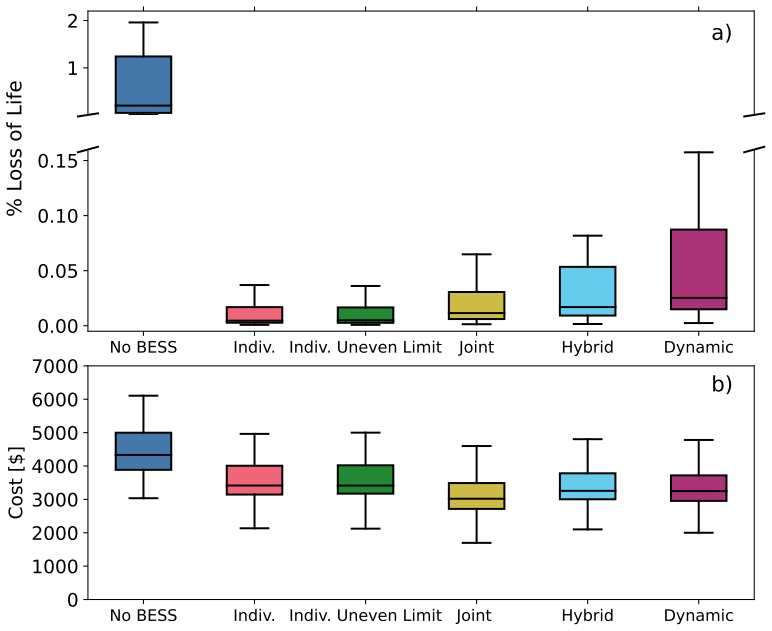
The paper's central claim is that virtualization turns a set of private home batteries into a flexibly shared resource that is strictly better for the neighborhood than letting each homeowner optimize alone. In the July 2018 case study, joint (fully shared) optimization cuts total consumer electricity bills by 56% and transformer loss of life by 48% relative to individual optimization. The hybrid scheme, which pools a fixed 50% share of each battery, and the dynamic scheme, which repartitions batteries every two hours, give transformer aging close to the joint case with median costs only slightly above it. The paper further claims that sharing 75% of each battery captures most of the benefit, within 14% of full-sharing cost, so homeowner autonomy does not require giving up the economic gains.
Load-bearing premise
The simulations build every neighborhood by adding homes until the biggest monthly base load (before EV charging) already exceeds the transformer's 25 kW limit, so the transformer starts each trial overloaded; if real transformers are sized to carry ordinary base load comfortably, the reported savings from battery sharing could shrink substantially.
Editorial extensions
If this is right
- Joining all neighborhood batteries into one virtual battery reduces total consumer electricity bills by 56% and transformer aging by 48% relative to individual battery control in the July 2018 simulation.
- Sharing 75% of each battery captures most of the benefit: median cost is within 14% of full sharing while each homeowner keeps a 25% retained partition.
- Hybrid and dynamic schemes deliver transformer protection close to joint optimization while preserving homeowner control, at slightly higher cost.
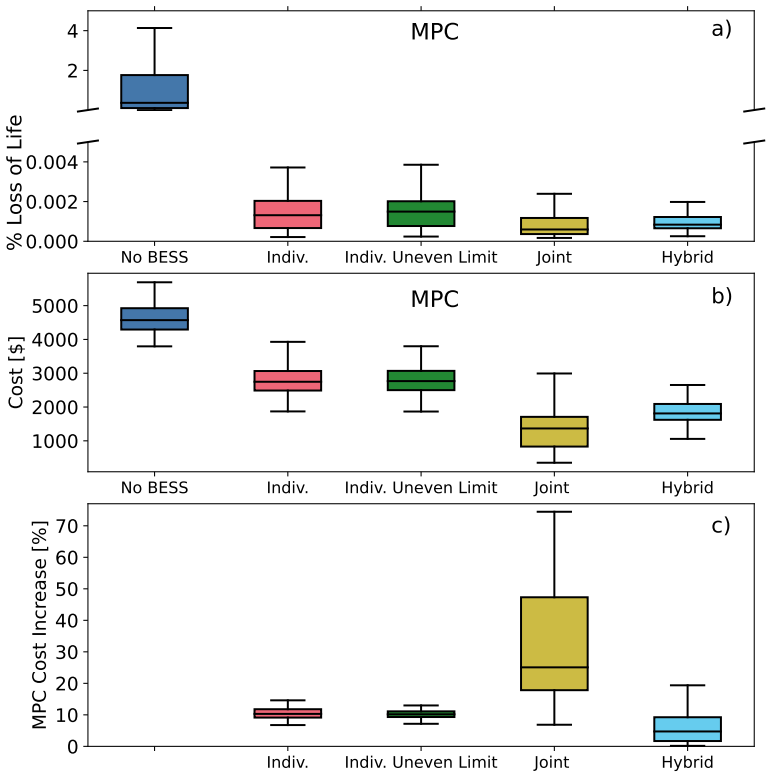
- Model predictive control with naive one-day forecasts raises monthly costs by less than 25% (median) relative to perfect foresight, roughly $5.75 to $18.50 per home, so real-time deployment remains economical.
- The schemes remain cost-effective at 50% EV penetration and when a per-cycle battery degradation cost is included, with sharing schemes affected less by aging costs.
Reading between the lines
- The 75% sharing result implies that an aggregator may not need full control of every home battery to capture near-joint savings, which lowers the autonomy barrier to adoption; the paper does not flesh out this governance implication.
- The dynamic scheme's partition weights track the timing of each home's tariff peaks in mixed-rate neighborhoods, suggesting the same mechanism could double as a price-responsive demand-management tool, a use the paper mentions only in passing.
- Because MPC cost increases are larger and more spread out for shared batteries than for individual control, forecast errors propagate across homes; investing in better load and solar forecasts may matter more for joint schemes than for individual schemes.
- The paper reports only total system cost, not per-home cost allocation; real deployment will need a fairness rule for splitting savings, and the ranking of schemes could change under such a rule.
Editorial analysis
A structured set of objections, weighed in public.
Referee Report
Summary. This paper proposes optimization schemes for residential battery energy storage systems (BESSs) that protect neighborhood distribution transformers while minimizing electricity costs, comparing individual control, individual control with uneven transformer allocation, and joint, hybrid, and dynamic sharing schemes enabled by battery virtualization. The authors simulate a 25 kVA transformer serving sampled San Jose homes with NREL load and solar data, OCHRE EV charging profiles, PG&E EV2-A TOU tariffs, and an IEEE C57.91 thermal aging model, using convex optimization with perfect foresight and with MPC. The headline findings are that joint/shared optimization reduces consumer bills by 56% and transformer aging by 48% relative to individual optimization, while hybrid and dynamic schemes retain homeowner autonomy at slightly higher cost. The paper also reports sensitivity analyses for seasons, EV penetration, battery aging costs, imperfect forecasts, and a small DC hardware testbed.
Significance. If the quantitative claims survive scrutiny, the paper makes a useful practical contribution: it shows that battery virtualization can approximate the cost benefits of full aggregation while retaining homeowner control, and it quantifies transformer aging benefits using an accepted thermal model. The work is strong in its transparency about the optimization formulations, its use of 50 Monte Carlo trials per season, its MPC implementation with a naive forecaster, its sensitivity analyses, and its small-scale physical demonstration. However, the central 56% cost-saving claim is not yet credible because the individual and joint schemes are optimized under different billing treatments, and the neighborhood sampling rule starts every trial with a transformer already overloaded by base load. Both issues directly affect the headline numbers and must be addressed before the results can be accepted as stated.
major comments (4)
- [§2.1, §2.3, and §6.1] The cost comparison underlying the headline 56% saving is not apples-to-apples. In individual optimization, Eq. (1) bills each home as C^T max(M_i, 0), so exported solar is uncompensated and one home's export cannot offset another home's import. In joint optimization, Eq. (11) bills the aggregate as C^T max(M1, 0), where M1 is the sum of the home meters; the max is taken after summation, thereby allowing cross-home netting. Moving from individual to joint therefore changes both battery control and billing structure simultaneously. Section 6.1 acknowledges that the joint/hybrid/dynamic schemes require a new electricity cost structure, but the paper never quantifies how much of the reported 56% cost reduction arises from aggregate netting alone rather than from battery sharing. Please rerun the individual scheme under the same aggregate billing rule, or otherwise decompose the saving into a control-sharing component and a billing-structure component, and restate the abstract and conclusions accordingly if the sharing-only benefit is smaller.
- [§2.7] The neighborhood sampling heuristic selects homes until the maximum monthly sum of loads excluding EV charging exceeds the nominal 25 kW transformer limit. Consequently, every trial starts with a transformer that is already overloaded by base residential load before any EV charging is added. This makes the no-BESS baseline artificially stressed and likely inflates the measured transformer-aging benefits of all BESS schemes, including the reported 48% aging reduction for joint optimization relative to individual optimization. Since transformer protection is one of the paper's two central claims, please also report results for neighborhoods whose base load is below the transformer rating, or at least characterize the distribution of base-load overload severity and show that the qualitative conclusions are unchanged.
- [§2.4, Eq. (17)] The second objective term in the hybrid optimization problem is printed as C^T max((M1+BS1)_t, 0)^2 · Δt, i.e., the max term appears to be squared while the joint benchmark in Eq. (11) is linear in the aggregate import. As printed, this term has inconsistent units and is not 'similar to the objective for joint optimization' as claimed in the text. If this is a typographical error, please correct it; otherwise the hybrid and dynamic results do not correspond to the stated cost-minimization objective and their reported costs cannot be interpreted as electricity bills.
- [§5.5 and Fig. 8] The MPC sensitivity results contain an internal inconsistency that needs correction. The text states that cost increases for the individual schemes are around 10% and that median differences for all schemes are less than 25%, while the caption to Figure 8 says 'all schemes yielding less than 1% cost increases monthly' and the panel itself shows values above 60%. Please reconcile the numbers and ensure the reported MPC cost increases match Figure 8c, because the robustness-to-forecast-error claim depends on these values.
minor comments (4)
- [§3] The text refers to the 'IEEE C57.96 standard' for transformer aging, but reference [44] and the equations used correspond to IEEE C57.91-2011, 'IEEE Guide for Loading Mineral-Oil-Immersed Transformers and Step-Voltage Regulators.' Please correct the standard number.
- [Table 3, §3] The ambient temperature is fixed at 25°C for both January and July simulations. Since the hottest-spot temperature and loss-of-life calculations depend strongly on ambient temperature, the seasonal comparison would be more informative if Θ_A were varied by season or if the sensitivity of the aging results to Θ_A were reported.
- [§2.1, Eq. (1)] The sums in Eqs. (1) and (2) are written as nX i=0, but there are n homes; the indexing should presumably be i=1 to n. Similar off-by-one conventions for T and T+1 appear throughout and should be harmonized for clarity.
- [§6, first paragraph] The discussion states that 'with only 50% sharing, the hybrid scheme reduces the total community cost incurred during the month of July 2018 by 57%,' whereas Section 5.2 reports joint/hybrid/dynamic savings of 53–56% and Figure 5 shows the 50% sharing case with a median cost that is still above the joint case. Please clarify whether the 57% figure refers to a different baseline or is a typo.
Circularity Check
Headline 56% bill saving is partially an accounting artifact: the joint scheme's aggregate-meter billing (Eq. 11) is structurally no more expensive than the individual scheme's per-home billing (Eq. 1) even for identical battery trajectories, and the paper attributes the entire saving to battery sharing without isolating the billing change.
-
other
[Sections 2.1–2.3, Equations (1) and (11); abstract headline claim]
"There is no net metering, so the positive values of the meter are multiplied by the timestep length and the cost at each timestep in units of $/kWh. ... The utility bills the aggregate system as a whole: the first term in the objective, Equation (11), multiplies the sum of all the home meters and the aggregate battery output by the TOU cost vector. ... joint, or shared, optimization reduces consumer bills by 56% ... compared to individual optimization."
In individual optimization, Equation (1) bills each home as C^T max(M_i, 0), so exported solar is uncompensated. In joint optimization, Equation (11) bills the aggregate as C^T max(M1, 0), with M1 the sum of the home meters. Because max(⋅, 0) is convex, C^T max(Σ M_i, 0) ≤ Σ_i C^T max(M_i, 0) for nonnegative C: the joint billing term is automatically no larger than the sum of the individual billing terms for any identical battery trajectory, and one home's export offsets another's import only in the joint computation. A portion of the reported 56% joint-vs-individual bill reduction is therefore guaranteed by the objective definitions rather than produced by the shared battery control.
full rationale
The paper's core simulations compare schemes on external data (NREL ResStock, NREL OCHRE, PG&E EV2-A tariffs) through an external physics model (IEEE C57.91 transformer aging with datasheet parameters), and no parameter is fitted to reproduce the headline numbers; the reported costs exclude the hand-chosen penalty weights (lambda=100, alpha=0.01). The transformer-aging reduction (48%) is a computed consequence of the meter trajectories through the IEEE model and is independent of the billing asymmetry, so it does not reduce to its own inputs. The only self-citation, reference [32], supports a latency remark in Section 6.1 and is not load-bearing for the central claims. The one by-construction element is the cost comparison between Equation (1) and Equation (11): joint aggregate netting is structurally cheaper than per-home no-net-metering even with identical battery action, and although Section 6.1 discloses that a new cost structure is required, the abstract attributes the full 56% saving to battery sharing without quantifying the billing-only share. This is a partial confound rather than a full circular derivation: the hybrid and dynamic results, the MPC sensitivity analysis, and the aging computations stand on independent computation. Non-circular concerns, such as the Section 2.7 sizing heuristic that guarantees each trial's transformer is already overloaded by base load and the hand-chosen objective weights, are modeling and benchmarking risks rather than circularity. Overall, one partial by-construction element affects the headline cost metric while the rest of the derivation chain is self-contained, so the circularity score is 4.
Assumptions & free parameters
free parameters (5)
- Transformer violation penalty weight lambda =
100
- Simultaneous charge/discharge penalty alpha =
0.01
- Dynamic partition change interval h =
2 hours
- Ambient temperature Theta_A =
25 C
- Naive forecast averaging window =
4 days
assumptions (6)
- domain assumption IEEE C57.91 transformer thermal model equations (Eqs. 32-39)
- domain assumption Power factor equals 1
- domain assumption No net metering
- domain assumption EV charging schedules are known one day ahead
- domain assumption Batteries execute commands exactly in the main simulations
- ad hoc to paper Neighborhoods are constructed so base load alone exceeds the transformer limit
Cite this review
Pith. "Pith review of Optimizing Software Defined Battery Systems for Transformer Protection." pith.science (2026). https://pith.science/paper/LELJSOHU
@misc{pith2026250603439,
  author       = {Pith},
  title        = {Pith review of: Optimizing Software Defined Battery Systems for Transformer Protection},
  year         = {2026},
  howpublished = {\url{https://pith.science/paper/LELJSOHU}},
  note         = {Machine review of arXiv:2506.03439}
}
read the original abstract
Residential electric vehicle charging causes large spikes in electricity demand that risk violating neighborhood transformer power limits. Battery energy storage systems reduce these transformer limit violations, but operating them individually is not cost-optimal. Instead of individual optimization, aggregating, or sharing, these batteries leads to cost-optimal performance, but homeowners must relinquish battery control. This paper leverages virtualization to propose battery sharing optimization schemes to reduce electricity costs, extend the lifetime of a residential transformer, and maintain homeowner control over the battery. A case study with simulated home loads, solar generation, and electric vehicle charging profiles demonstrates that joint, or shared, optimization reduces consumer bills by 56% and transformer aging by 48% compared to individual optimization. Hybrid and dynamic optimization schemes that provide owners with autonomy have similar transformer aging reduction but are slightly less cost-effective. These results suggest that controlling shared batteries with virtualization is an effective way to delay transformer upgrades in the face of growing residential electric vehicle charging penetration.
Figures


Figures from the paper (8 more)




Reference graph
Works this paper leans on
- [1]
-
[2]
M. Muratori, Impact of uncoordinated plug-in electric vehicle charg- ing on residential power demand, Nature Energy 3 (3) (2018) 193–201. doi:10.1038/s41560-017-0074-z
- [3]
-
[4]
M. Soleimani, M. Kezunovic, Economic Analysis of Transformer Loss of Life Mitigation Using Energy Storage and PV Generation, in: 2020 IEEE/PES Transmission and Distribution Conference and Exposition (T&D), 2020, pp. 1–5. doi:10.1109/TD39804.2020.9299895
-
[5]
M. R. Sarker, D. J. Olsen, M. A. Ortega-Vazquez, Co-Optimization of Distribution Transformer Aging and Energy Arbitrage Using Electric Vehicles, IEEE Transactions on Smart Grid 8 (6) (2017) 2712–2722. doi:10.1109/TSG.2016.2535354
arXiv 2017
-
[6]
A. Kaufman, The U.S. Is Running Low On The Machines Needed To Avoid Blackouts, https://www.huffpost.com/entry/transformer- shortage_n_64645004e4b0005c6055c541 (May 2023)
work page 2023
-
[7]
Y. Li, A. Jenn, Impact of electric vehicle charging demand on power distribution grid congestion, Proceedings of the National Academy of Sciences 121 (18) (2024) e2317599121. doi:10.1073/pnas.2317599121
- [8]
Show all 47 references
-
[9]
S. Li, W. Hu, D. Cao, Z. Zhang, Q. Huang, Z. Chen, F. Blaab- jerg, EV Charging Strategy Considering Transformer Lifetime via Evo- lutionary Curriculum Learning-Based Multiagent Deep Reinforcement Learning, IEEE Transactions on Smart Grid 13 (4) (2022) 2774–2787. doi:10.1109/TS...
2022
-
[10]
C. d. M. Affonso, M. Kezunovic, Technical and Economic Im- pact of PV-BESS Charging Station on Transformer Life: A Case Study, IEEE Transactions on Smart Grid 10 (4) (2019) 4683–4692. doi:10.1109/TSG.2018.2866938
2019
-
[11]
Visakh, B
A. Visakh, B. Thomas, M. P. Selvan, Controlled Charging of Electric Vehicles to Reduce the Aging of Distribution Transformers, in: 2022 22nd National Power Systems Conference (NPSC), 2022, pp. 24–29. doi:10.1109/NPSC57038.2022.10069054
2022
-
[12]
Rossi, C
F. Rossi, C. Diaz-Londono, Y. Li, C. Zou, G. Gruosso, Smart Electric Vehicle Charging Algorithm to Reduce the Impact on 39 Power Grids: A Reinforcement Learning Based Methodology, IEEE Open Journal of Vehicular Technology 6 (2025) 1072–1084. doi:10.1109/OJVT.2025.3559237
2025
-
[13]
Sarmokadam, M
S. Sarmokadam, M. Suresh, R. Mathew, Power flow control strategy for prosumer based EV charging scheme to minimize charging im- pact on distribution network, Energy Reports 13 (2025) 3794–3809. doi:10.1016/j.egyr.2025.03.032
2025 doi
-
[14]
Latinopoulos, A
C. Latinopoulos, A. Sivakumar, J. Polak, Response of electric vehicle driverstodynamicpricingofparkingandchargingservices: Riskychoice in early reservations, Transportation Research Part C: Emerging Tech- nologies 80 (2017) 175–189. doi:10.1016/j.trc.2017.04.008
2017 doi
-
[15]
Navidi, A
T. Navidi, A. El Gamal, R. Rajagopal, Coordinating distributed en- ergy resources for reliability can significantly reduce future distribu- tion grid upgrades and peak load, Joule 7 (8) (2023) 1769–1792. doi:10.1016/j.joule.2023.06.015
2023 doi
-
[16]
I. D. Endara, D. M. Macas, M. P. Valverde, J. M. García, Design of Load Management Methods Using Distributed Storage and Their Im- pactonTheAgingLevelofDistributionTransformers, in: Z.Peng(Ed.), Technological Advancements and Future Directions in Green Energy : Selected Papers...
2024
-
[17]
Datta, A
U. Datta, A. Kalam, J. Shi, Smart control of BESS in PV integrated EV charging station for reducing transformer overloading and providing battery-to-grid service, Journal of Energy Storage 28 (2020) 101224. doi:10.1016/j.est.2020.101224
2020
-
[18]
S.-K. Hong, S. G. Lee, M. Kim, Assessment and Mitigation of Electric Vehicle Charging Demand Impact to Transformer Aging for an Apart- ment Complex, Energies 13 (10) (2020) 2571. doi:10.3390/en13102571
2020 doi
-
[19]
J. Li, Z. Wu, S. Zhou, H. Fu, X.-P. Zhang, Aggregator service for PV and battery energy storage systems of residential building, CSEE Journal of Power and Energy Systems 1 (4) (2015) 3–11. doi:10.17775/CSEEJPES.2015.00042. 40
2015
-
[20]
Moradi Amani, S
A. Moradi Amani, S. S. Sajjadi, W. A. Somaweera, M. Jalili, X. Yu, Data-driven model predictive control of community batteries for voltage regulation in power grids subject to EV charging, Energy Reports 9 (2023) 236–244. doi:10.1016/j.egyr.2022.12.089
2023 doi
-
[21]
Rayaprolu. M. Raghuveer, B. R. Bhalja, P. Agarwal, Real-Time Energy Management System for an Active Distribution Network with Multiple EV Charging Stations Considering Transformer’s Aging and Reactive Power Dispatch, IEEE Transactions on Industry Applications (2025) 1–13doi:10...
2025
-
[22]
Ntube, H
N. Ntube, H. Li, Stochastic multi-objective optimal sizing of battery energy storage system for a residential home, Journal of Energy Storage 59 (2023) 106403. doi:10.1016/j.est.2022.106403
2023
-
[23]
Hafiz, A
F. Hafiz, A. Rodrigo de Queiroz, P. Fajri, I. Husain, Energy manage- ment and optimal storage sizing for a shared community: A multi-stage stochastic programming approach, Applied Energy 236 (2019) 42–54. doi:10.1016/j.apenergy.2018.11.080
2019 doi
-
[24]
Henni, P
S. Henni, P. Staudt, C. Weinhardt, A sharing economy for residen- tial communities with PV-coupled battery storage: Benefits, pric- ing and participant matching, Applied Energy 301 (2021) 117351. doi:10.1016/j.apenergy.2021.117351
2021
-
[25]
S. Lee, P. Shenoy, K. Ramamritham, D. Irwin, AutoShare: Virtual com- munity solar and storage for energy sharing, Energy Informatics 4 (1) (2021) 10. doi:10.1186/s42162-021-00144-w
2021 doi
-
[26]
Khanal, R
S. Khanal, R. Khezri, A. Mahmoudi, S. Kahourzadeh, Optimal capacity of solar photovoltaic and battery storage for grid-tied houses based on energy sharing, IET Generation, Transmission & Distribution 17 (8) (2023) 1707–1722. doi:10.1049/gtd2.12824
2023 doi
-
[27]
Merrington, R
S. Merrington, R. Khezri, A. Mahmoudi, Optimal sizing of grid- connected rooftop photovoltaic and battery energy storage for houses with electric vehicle, IET Smart Grid 6 (3) (2023) 297–311. doi:10.1049/stg2.12099. 41
2023 doi
-
[28]
Walker, S
A. Walker, S. Kwon, Analysis on impact of shared energy storage in residential community: Individual versus shared energy storage, Applied Energy 282 (2021) 116172. doi:10.1016/j.apenergy.2020.116172
2021
-
[29]
H. Kang, S. Jung, H. Kim, J. Hong, J. Jeoung, T. Hong, Multi- objective sizing and real-time scheduling of battery energy stor- age in energy-sharing community based on reinforcement learn- ing, Renewable and Sustainable Energy Reviews 185 (2023) 113655. doi:10.1016/j.rser.2023.113655
2023
-
[30]
Barbour, D
E. Barbour, D. Parra, Z. Awwad, M. C. González, Community energy storage: A smart choice for the smart grid?, Applied Energy 212 (2018) 489–497. doi:10.1016/j.apenergy.2017.12.056
2018 doi
-
[31]
M. B. Roberts, A. Bruce, I. MacGill, Impact of shared battery en- ergy storage systems on photovoltaic self-consumption and electric- ity bills in apartment buildings, Applied Energy 245 (2019) 78–95. doi:10.1016/j.apenergy.2019.04.001
2019 doi
-
[32]
Martin, N
S. Martin, N. Mosier, O. Nnorom, Y. Ou, L. Patel, O. Triebe, G. Cezar, P. Levis, R. Rajagopal, Software defined grid energy storage, in: Pro- ceedings of the 9th ACM International Conference on Systems for Energy-Efficient Buildings, Cities, and Transportation, BuildSys ’22, A...
2022
-
[33]
Bashir, T
N. Bashir, T. Guo, M. Hajiesmaili, D. Irwin, P. Shenoy, R. Sitaraman, A. Souza, A. Wierman, Enabling Sustainable Clouds: The Case for Virtualizing the Energy System, in: Proceedings of the ACM Sympo- sium on Cloud Computing, ACM, Seattle WA USA, 2021, pp. 350–358. doi:10.1145/...
2021
-
[34]
Souza, N
A. Souza, N. Bashir, J. Murillo, W. Hanafy, Q. Liang, D. Irwin, P. Shenoy, Ecovisor: A Virtual Energy System for Carbon-Efficient Ap- plications, in: Proceedings of the 28th ACM International Conference on Architectural Support for Programming Languages and Operating Systems, ...
2023
-
[35]
Kumar, M
R. Kumar, M. J. Wenzel, M. J. Ellis, M. N. ElBsat, K. H. Drees, V. M. Zavala, A Stochastic Model Predictive Control Framework for Station- aryBatterySystems, IEEETransactionsonPowerSystems33(4)(2018) 4397–4406. doi:10.1109/TPWRS.2017.2789118
2018
-
[36]
W. C. Clarke, C. Manzie, M. J. Brear, An economic MPC approach to microgrid control, in: 2016 Australian Control Conference (AuCC), 2016, pp. 276–281. doi:10.1109/AUCC.2016.7868202
2016
-
[37]
Zamani, A
V. Zamani, A. Cortés, J. Kleissl, S. Martínez, Integration of PV gen- eration and storage on power distribution systems using MPC, in: 2015 IEEE Power & Energy Society General Meeting, 2015, pp. 1–5. doi:10.1109/PESGM.2015.7286588
2015
-
[38]
U. R. Nair, M. Sandelic, A. Sangwongwanich, T. Dragičević, R. Costa-Castelló, F. Blaabjerg, An Analysis of Multi Objective En- ergy Scheduling in PV-BESS System Under Prediction Uncertainty, IEEE Transactions on Energy Conversion 36 (3) (2021) 2276–2286. doi:10.1109/TEC.2021.3055453
2021
-
[39]
Pezeshki, P
H. Pezeshki, P. J. Wolfs, G. Ledwich, Impact of High PV Penetration on Distribution Transformer Insulation Life, IEEE Transactions on Power Delivery 29 (3) (2014) 1212–1220. doi:10.1109/TPWRD.2013.2287002
2014
-
[40]
Tesla, Tesla Powerwall 2 Datasheet, Tech. rep. (Jun. 2019)
2019
-
[41]
Tesla’s Powerwall 2 and Solar Roof Tiles: Our Review, https://unboundsolar.com/solar-information/tesla-powerwall-for-solar
-
[42]
Tesla, TESLA POWERWALL LIMITED WARRANTY (USA) (Jan. 2025). URL https://energylibrary.tesla.com/docs/Public/ EnergyStorage/Powerwall/General/Warranty/en-us/ Powerwall-Warranty-EN.pdf
2025
-
[43]
PG&E, Electric rates: Current and historic electric rates, https://www.pge.com/tariffs/en/rate-information/electric- rates.html#accordion-a84c67dc1e-item-e10eec0cc5 (Apr. 2024). 43
2024
-
[44]
IEEE Guide for Loading Mineral-Oil-Immersed Transformers and Step- Voltage Regulators, IEEE Std C57.91-2011 (Revision of IEEE Std C57.91-1995) (2012) 1–123doi:10.1109/IEEESTD.2012.6166928
2012
-
[45]
Larson Electronics - 25 KVA Pad Mount Transformer - 12470Y/7200 Grounded Wye Primary, 240/120V Secondary - Mineral Oil Fluid / ONAN, https://www.larsonelectronics.com/product/292915/25-kva- pad-mount-transformer-12470y-7200-grounded-wye-primary-240-120v- secondary-mineral-oil-...
-
[46]
Wilson, A
E. Wilson, A. Parker, A. Fontanini, E. Present, J. Reyna, R. Adhikari, C. Bianchi, C. CaraDonna, M. Dahlhausen, J. Kim, A. LeBar, L. Liu, M. Praprost, L. Zhang, P. DeWitt, N. Merket, A. Speake, T. Hong, H. Li, N. Frick, Z. Wang, A. Blair, H. Horsey, D. Roberts, K. Trenbath, O....
2022
-
[47]
Blonsky, J
M. Blonsky, J. Maguire, K. McKenna, D. Cutler, S. P. Balamurugan, X. Jin, OCHRE: The Object-oriented, Controllable, High-resolution Residential Energy Model for Dynamic Integration Studies, Applied En- ergy 290 (2021) 116732. doi:10.1016/j.apenergy.2021.116732. 44
2021
Reviewed August 7, 2026 · model on record in the stance chip above.
Discussion (0). Sign in to comment.