REVIEW 3 major objections 5 minor 46 references
StARS DCM: A Sleep Stage-Decoding Forehead EEG Patch for Real-time Modulation of Sleep Physiology
T0 review · 3 major / 5 minor · reviewed 2026-08-07 · deepseek-v4-flash
Pith's one-line read The paper builds a modular forehead EEG patch and claims it can decode sleep stages in real time and use them to trigger closed-loop auditory and thermal interventions.
desk verdict A concrete, well-written system description that overclaims because the closed-loop decoding and timing rest entirely on self-cited preprints. read the letter →
The pith
A machine-rendered reading of the paper's core claim, the machinery that carries it, and where it could break.
The reading
What carries the argument
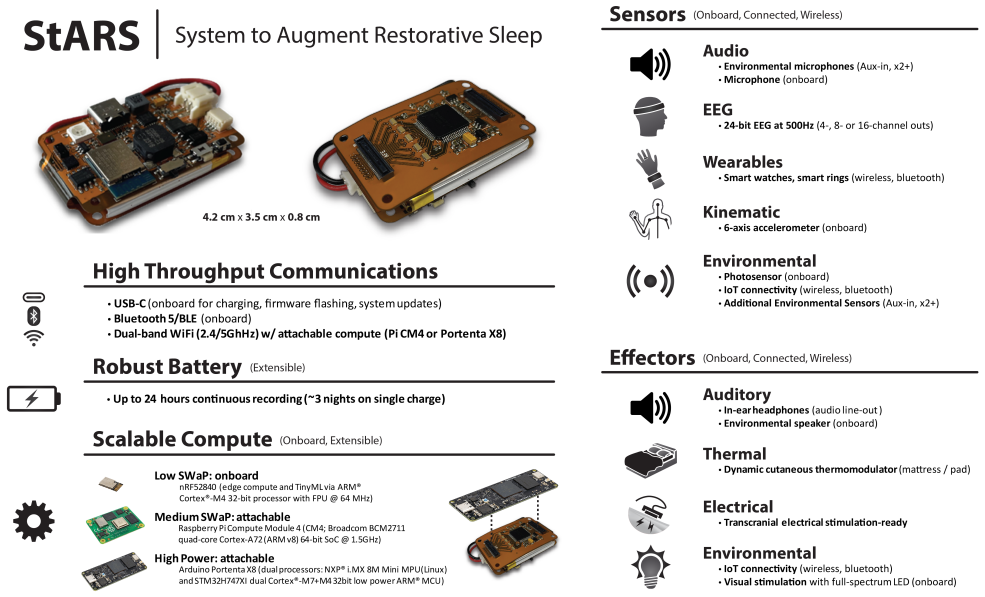
The load-bearing machinery is the real-time sleep-stage decoder combined with the DCM's synchronized sensing. The DCM is a forehead patch built around a precision biopotential amplifier and an ultra-low-power wireless microcontroller on a flexible PCB, with an IMU, microphone, ambient light sensor, haptic driver, NFC pairing, and microSD logging. ezmsg is a publisher-subscriber messaging framework that coordinates sensors, compute, and effectors at low latency. The decoder itself is a neural-network sleep-stage classifier trained with self-supervised and transfer learning, claimed in companion works to be accurate for both forehead EEG and peripheral signals such as heart rate and motion. The effector chain is closed-loop: a decoded slow-wave-timed trigger delivers a 50 ms pink-noise burst, and the decoded sleep stage commands the water-filled mattress pad to cool at appropriate times.
What would settle it
Compare the patch's real-time stage calls, epoch by epoch, against expert polysomnography scoring in a cohort of sleepers, and measure the delay between true slow-wave or NREM onset and the decoder's output. If agreement is too low or latency too long, the claim that cooling and sounds arrive at the physiologically right moment collapses.
Extended reading notes
Core claim
StARS is claimed to be a complete closed-loop sleep-modulation platform: the DCM forehead patch records EEG, EMG, EOG, motion, audio, and light; the ezmsg framework synchronizes and streams the data in real time; neural-network decoders improved by transfer learning output a sleep stage; and effectors, including an audio transducer and a water-filled mattress pad, act on that output. The paper asserts that yoking thermal modulation to real-time decoded sleep-stage dynamics provides a guarantee that cooling is initiated and modulated at physiologically appropriate times, regardless of variability in sleep onset latency. It also claims, to the authors' knowledge, that StARS is the first system to bridge active body cooling with a noninvasive forehead EEG brain-computer interface. The paper further reports that the DCM is inexpensive, with a bill of materials near 180 USD, configurable in form factor, and soon to be released as open hardware, which would let other groups build and customize their own sleep-decoding EEG devices.
Load-bearing premise
The one assumption everything else rests on is that the software can correctly identify sleep stages from forehead EEG as it streams, and the paper gives no measurements showing it can.
Editorial extensions
If this is right
- Users could receive pink-noise acoustic stimulation timed to the rising phase of individual slow waves without sleeping in a laboratory, since the forehead patch performs staging and triggering locally.
- Bedding temperature could be cooled when decoded sleep stage indicates slow-wave sleep rather than after a fixed bedtime delay, reducing sensitivity to how long the user takes to fall asleep.
- The same platform, configured with a smart ring instead of EEG electrodes, could run a minimal sleep-modulation setup of ring, phone, and thermoregulating bedding if the peripheral decoders are accurate enough.
- As open hardware, other labs could reproduce the roughly 180 USD patch and build their own electrode or effector boards, making synchronized multimodal biosignal recording more accessible.
- Stimulation protocols could be standardized across research groups by swapping modular decoders and effectors within the same software backbone.
Reading between the lines
- Beyond the paper, the decisive scientific question is not whether the hardware streams data but whether stage-yoked cooling increases slow-wave activity more than fixed-delay cooling; no such comparison is reported here.
- Beyond the paper, if the transfer-learned decoders really reach useful accuracy on heart-rate and motion inputs, the same self-supervised recipe could be applied to other low-channel physiological monitoring tasks, such as drowsiness or seizure detection, which the paper does not discuss.
- Beyond the paper, because the decoder's accuracy rests on two same-group preprints, an independent replication of forehead-EEG staging accuracy is the natural next step, and the open-hardware release makes that replication possible.
Editorial analysis
A structured set of objections, weighed in public.
Referee Report
Summary. The paper presents StARS, a modular hardware/software platform for real-time sleep monitoring and closed-loop intervention, centered on the DCM forehead EEG patch. The DCM is an open-source, flexible biosignal acquisition device (up to 16 EEG channels, 24-bit ADC) paired with the ezmsg real-time messaging framework. The authors claim that StARS can accurately decode sleep stages in real time from forehead EEG or peripheral wearable signals, and use these decodes to control auditory slow-wave stimulation and dynamic bedding-temperature modulation. The manuscript also describes the DCM's hardware design, battery life, cost, and planned open-source release, and cites two companion preprints for the sleep-stage-decoder validation.
Significance. If the platform performs as claimed, it would be a useful open-source contribution to sleep research and closed-loop neuromodulation: low-cost forehead EEG hardware, modular sensor/effector integration, and the first reported integration of active body cooling with real-time forehead-EEG-based sleep-stage decoding. The authors are also making the hardware design freely available, which is a concrete strength. However, the central functional claims — real-time accurate sleep-stage decoding and reliable closed-loop stimulation — are not supported by any measurements or validation in this manuscript; they rest entirely on self-cited preprints. The paper's value therefore depends on evidence that is not presented here.
major comments (3)
- [§I (Overview), §III.B, §IV] The central claim that StARS can 'accurately decode sleep in real time' is load-bearing but unsupported in this manuscript. No classification accuracy, confusion matrix, Cohen's kappa, epoch-level latency, or polysomnography comparison is reported for the forehead-EEG or peripheral-wearable decoder. The only evidence is the citation to the same authors' preprints [24] and [46], which are not peer-reviewed and whose performance is not summarized here. Since the auditory and thermal interventions are timed by this decoder, the manuscript must include at least a summary of the decoder's accuracy and real-time latency, or explicitly reposition the accuracy claim as a design goal pending validation.
- [§II] The hardware specifications are stated as established facts without measurement context: 'approximately 5 days of continuous multi-sensor logging,' '8-10+ hours of continuous EEG recording per charge,' '20 minutes' charging, a $180 bill-of-materials cost, and '16 channels ... at 24-bit resolution.' For a hardware platform paper, these figures are central and should be accompanied by measurement conditions (e.g., sampling rate, number of active channels, streaming versus logging mode, battery test protocol) and preferably by measured data or a clear reference to a specification document.
- [§III.B] The text states that yoking cooling to the real-time sleep-stage decoder 'provides a guarantee that cooling is initiated and dynamically modulated at the appropriate times.' This guarantee is logically unsupported because it presumes that the decoder is accurate and fast enough in real-world use, which is not shown. The same subsection's novelty claim — 'to our knowledge, StARS is the first system to bridge this gap' — is not substantiated by a literature search; the authors should either provide a brief comparison with prior temperature-based closed-loop systems or soften the claim.
minor comments (5)
- [Abstract and §I] The description 'advanced neural network models and transfer learning' is vague; please provide at least the model family and a summary of the transfer-learning approach, or remove the adjective 'advanced.'
- [Fig. 2A] The text refers to 'NEC' in the figure caption; this appears to be a typo for 'NFC.'
- [§III.A] The statement 'StARS uses a similar protocol' for acoustic stimulation would be clearer if the exact detection algorithm and stimulation trigger were specified (e.g., slow-wave phase-locking criteria and stimulus amplitude).
- [References [24], [46]] Please update the reference statuses if these preprints have been accepted or published, and consider summarizing their key validation metrics in the text so the reader can assess the decoder claim without retrieving the preprints.
- [Title and §I] The title emphasizes a 'forehead EEG patch,' but the described system also supports smart rings and other peripheral wearables; consider clarifying the scope in the title or abstract.
Circularity Check
No significant circularity; the paper's decoder claims are deferred to companion works, which is a validation gap rather than a circular derivation.
full rationale
The manuscript is an engineering and platform description rather than a quantitative derivation. It states that StARS 'can accurately decode sleep in real time' and uses that capability to time auditory and thermal interventions, but it does not fit parameters, derive predictions, or present equations that identify an output with an input. The supporting evidence for the sleep-stage decoder is explicitly assigned to two companion works, references [24] and [46], both by overlapping authors. Under the standing rules, a citation to an externally falsifiable companion study constitutes real evidence even when self-authored; the present paper makes no reduction to those citations beyond normal pointer-style reliance, and there is no indication in the text that the companion works depend on the present paper. The absence of in-paper accuracy, latency, and field-validation data is a genuine completeness or validation concern, but it is not circularity: the claims would stand or fall on the companion validations, not on an assumption equivalent to the conclusion. The 'guarantee' that cooling is initiated at appropriate times is conditional on decoder correctness, and therefore does not smuggle in the conclusion. No self-definitional steps, fitted-input-as-prediction steps, imported uniqueness theorems, or ansatz-by-citation steps are present.
Assumptions & free parameters
assumptions (3)
- domain assumption Acoustic slow-wave stimulation (aSTIM) with 50 ms pink noise during the UP phase of a slow wave reliably boosts slow-wave activity and memory consolidation.
- domain assumption Dynamic bedding temperature modulation timed to decoded sleep stages increases slow-wave sleep and is more effective than fixed-delay cooling.
- domain assumption The hardware specifications of the DCM (16 channels, 24-bit ADC, nRF52840 MCU, ~5 days logging, ~$180 BOM) are accurate design facts.
Cite this review
Pith. "Pith review of StARS DCM: A Sleep Stage-Decoding Forehead EEG Patch for Real-time Modulation of Sleep Physiology." pith.science (2026). https://pith.science/paper/CQAFOIVK
@misc{pith2026250603442,
  author       = {Pith},
  title        = {Pith review of: StARS DCM: A Sleep Stage-Decoding Forehead EEG Patch for Real-time Modulation of Sleep Physiology},
  year         = {2026},
  howpublished = {\url{https://pith.science/paper/CQAFOIVK}},
  note         = {Machine review of arXiv:2506.03442}
}
read the original abstract
The System to Augment Restorative Sleep (StARS) is a modular hardware/software platform designed for real-time sleep monitoring and intervention. Utilizing the compact DCM biosignal device, StARS captures electrophysiological signals (EEG, EMG, EOG) and synchronizes sensor data using the ezmsg real-time software framework. StARS supports interventions such as closed-loop auditory stimulation and dynamic thermal modulation guided by sleep-stage decoding via advanced neural network models and transfer learning. Configurable with a lightweight EEG forehead patch or wearable sensors like smart rings, StARS offers flexible, low-burden solutions for EEG, BCI, and sleep-enhancement research and applications. The open-source DCM patch further enables customizable EEG device development.
Figures


Reference graph
Works this paper leans on
-
[24]
W. G. Coon, D. Luna, A. Panagrahi, M. Reid, and M. Ogg, “Getting more from less: Transfer learning improves sleep stage decoding accuracy in peripheral wearable devices,” arXiv preprint , 2025. [Online]. Available: https://arxiv.org/abs/2506.00730
arXiv 2025
-
[46]
ezscore-f: A Set of Freely Available, Validated Sleep Stage Classifiers for Forehead EEG,
W. G. Coon, P. Zerr, G. Milsap, N. Sikder, M. Smith, M. Dresler, and M. Reid, “ezscore-f: A Set of Freely Available, Validated Sleep Stage Classifiers for Forehead EEG,” bioRxiv, p. 2025.06.02.657451, Jan. 2025. [Online]. Available: http://biorxiv.org/content/early/2025/ 06/06/2025.06.02.657451.abstract
work page 2025
-
[1]
Sleep duration in the United States: a cross-sectional population-based study,
P. M. Krueger and E. M. Friedman, “Sleep duration in the United States: a cross-sectional population-based study,” American Journal of Epidemiology , vol. 169, no. 9, pp. 1052–1063, 2009
work page 2009
-
[2]
Sleep disorders and associated medical comorbidities in active duty military personnel,
V . Mysliwiec, L. McGraw, R. Pierce, P. Smith, B. Trapp, and B. J. Roth, “Sleep disorders and associated medical comorbidities in active duty military personnel,” Sleep, vol. 36, no. 2, pp. 167–174, 2013
work page 2013
-
[3]
Prevalence and impact of short sleep duration in redeployed OIF soldiers,
D. D. Luxton, D. Greenburg, J. Ryan, A. Niven, G. Wheeler, and V . Mysliwiec, “Prevalence and impact of short sleep duration in redeployed OIF soldiers,” Sleep, vol. 34, no. 9, pp. 1189–1195, 2011
work page 2011
-
[4]
Effects of sleep deprivation on cognition,
W. D. Killgore, “Effects of sleep deprivation on cognition,” Progress in Brain Research , vol. 185, pp. 105–129, 2010
work page 2010
-
[5]
Sleep loss, learning capacity and academic performance,
G. Curcio, M. Ferrara, and L. De Gennaro, “Sleep loss, learning capacity and academic performance,” Sleep Medicine Reviews, vol. 10, no. 5, pp. 323–337, 2006
work page 2006
-
[6]
C. R. Newbury, R. Crowley, K. Rastle, and J. Tamminen, “Sleep deprivation and memory: Meta-analytic reviews of studies on sleep deprivation before and after learning.”Psychological Bulletin, vol. 147, no. 11, p. 1215, 2021
work page 2021
Show all 46 references
-
[7]
The memory function of sleep,
S. Diekelmann and J. Born, “The memory function of sleep,” Nature Reviews Neuroscience, vol. 11, no. 2, pp. 114–126, 2010
2010
-
[8]
Sick and tired: does sleep have a vital role in the immune system?
P. A. Bryant, J. Trinder, and N. Curtis, “Sick and tired: does sleep have a vital role in the immune system?” Nature Reviews Immunology, vol. 4, no. 6, pp. 457–467, 2004
2004
-
[9]
Sleep drives metabolite clearance from the adult brain,
L. Xie, H. Kang, Q. Xu, M. J. Chen, Y . Liao, M. Thiyagarajan, J. O’Donnell, D. J. Christensen, C. Nicholson, J. J. Iliff et al. , “Sleep drives metabolite clearance from the adult brain,” Science, vol. 342, no. 6156, pp. 373–377, 2013
2013
-
[10]
One night of partial sleep deprivation impairs recovery from a single exercise training session,
D. E. Rae, T. Chin, K. Dikgomo, L. Hill, A. J. McKune, T. A. Kohn, and L. C. Roden, “One night of partial sleep deprivation impairs recovery from a single exercise training session,” European Journal of Applied Physiology , vol. 117, pp. 699–712, 2017
2017
-
[11]
Cardiovascular, inflammatory, and metabolic consequences of sleep deprivation,
J. M. Mullington, M. Haack, M. Toth, J. M. Serrador, and H. K. Meier- Ewert, “Cardiovascular, inflammatory, and metabolic consequences of sleep deprivation,” Progress in Cardiovascular Diseases, vol. 51, no. 4, pp. 294–302, 2009
2009
-
[12]
The metabolic consequences of sleep deprivation,
K. L. Knutson, K. Spiegel, P. Penev, and E. Van Cauter, “The metabolic consequences of sleep deprivation,” Sleep Medicine Reviews , vol. 11, no. 3, pp. 163–178, 2007
2007
-
[13]
Sleep, cognition, and normal aging: integrating a half century of multidisciplinary research,
M. K. Scullin and D. L. Bliwise, “Sleep, cognition, and normal aging: integrating a half century of multidisciplinary research,” Perspectives on Psychological Science , vol. 10, no. 1, pp. 97–137, 2015
2015
-
[14]
Impact of sleep on the risk of cognitive decline and dementia,
A. P. Spira, L. P. Chen-Edinboro, M. N. Wu, and K. Yaffe, “Impact of sleep on the risk of cognitive decline and dementia,” Current Opinion in Psychiatry , vol. 27, no. 6, p. 478, 2014
2014
-
[15]
The bidirectional link between sleep disturbances and traumatic brain injury symptoms: A role for glymphatic dysfunction?
J. A. Piantino, J. J. Iliff, and M. M. Lim, “The bidirectional link between sleep disturbances and traumatic brain injury symptoms: A role for glymphatic dysfunction?” Biological Psychiatry, vol. 91, no. 5, pp. 478–487, 2022
2022
-
[16]
The glymphatic system’s role in traumatic brain injury-related neurodegeneration,
M. E. Peters and C. G. Lyketsos, “The glymphatic system’s role in traumatic brain injury-related neurodegeneration,” Molecular Psychi- atry, pp. 1–9, 2023
2023
-
[17]
The glymphatic system: a novel component of fundamental neurobiology,
L. M. Hablitz and M. Nedergaard, “The glymphatic system: a novel component of fundamental neurobiology,” Journal of Neuroscience , vol. 41, no. 37, pp. 7698–7711, 2021
2021
-
[18]
Sleep and emotional memory processing,
E. Van der Helm and M. P. Walker, “Sleep and emotional memory processing,” Sleep Medicine Clinics , vol. 6, no. 1, pp. 31–43, 2011
2011
-
[19]
Restless REM sleep impedes overnight amygdala adaptation,
R. Wassing, O. Lakbila-Kamal, J. R. Ramautar, D. Stoffers, F. Schalk- wijk, and E. J. Van Someren, “Restless REM sleep impedes overnight amygdala adaptation,” Current Biology , vol. 29, no. 14, pp. 2351– 2358, 2019
2019
-
[20]
Emotional memory processing during REM sleep with implications for post-traumatic stress disorder,
Y .-A. Rho, J. Sherfey, and S. Vijayan, “Emotional memory processing during REM sleep with implications for post-traumatic stress disorder,” Journal of Neuroscience , vol. 43, no. 3, pp. 433–446, 2023
2023
-
[21]
REM sleep and the early development of posttraumatic stress disorder,
T. A. Mellman, V . Bustamante, A. I. Fins, W. R. Pigeon, and B. Nolan, “REM sleep and the early development of posttraumatic stress disorder,” American Journal of Psychiatry , vol. 159, no. 10, pp. 1696–1701, 2002
2002
-
[22]
The recuperative effects of REM sleep and stage 4 sleep on human performance after complete sleep loss: experiment 1,
A. Lubin, J. Moses, L. Johnson, and P. Naitoh, “The recuperative effects of REM sleep and stage 4 sleep on human performance after complete sleep loss: experiment 1,” Psychophysiology, vol. 11, no. 2, pp. 133–146, 1974
1974
-
[23]
Targeting arousal and sleep through noninvasive brain stimulation to improve mental health,
T. Geiser, E. Hertenstein, K. Fehér, J. G. Maier, C. L. Schneider, M. A. Züst, M. Wunderlin, C. Mikutta, S. Klöppel, and C. Nissen, “Targeting arousal and sleep through noninvasive brain stimulation to improve mental health,” Neuropsychobiology, vol. 79, no. 4-5, pp. 284–292, 2020
2020
-
[25]
Rapid decline in body temper- ature before sleep: fluffing the physiological pillow?
S. S. Campbell and R. J. Broughton, “Rapid decline in body temper- ature before sleep: fluffing the physiological pillow?” Chronobiology international, vol. 11, no. 2, pp. 126–131, 1994
1994
-
[26]
Skin deep: enhanced sleep depth by cutaneous temperature manipulation,
R. J. Raymann, D. F. Swaab, and E. J. Van Someren, “Skin deep: enhanced sleep depth by cutaneous temperature manipulation,” Brain, vol. 131, no. 2, pp. 500–513, 2008
2008
-
[27]
The significance of sleep onset and slow wave sleep for nocturnal release of growth hormone (gh) and cortisol,
J. Born, S. Muth, and H. Fehm, “The significance of sleep onset and slow wave sleep for nocturnal release of growth hormone (gh) and cortisol,” Psychoneuroendocrinology, vol. 13, no. 3, pp. 233–243, 1988
1988
-
[28]
Elec- troencephalogram power density and slow wave sleep as a function of prior waking and circadian phase,
D.-J. Dijk, D. P. Brunner, D. G. Beersma, and A. A. Borbély, “Elec- troencephalogram power density and slow wave sleep as a function of prior waking and circadian phase,” Sleep, vol. 13, no. 5, pp. 430–440, 1990
1990
-
[29]
Slow-wave sleep and waking cognitive performance among older adults with and without insomnia complaints,
M. C. Crenshaw and J. D. Edinger, “Slow-wave sleep and waking cognitive performance among older adults with and without insomnia complaints,” Physiology & behavior, vol. 66, no. 3, pp. 485–492, 1999
1999
-
[30]
Implications of sleep disturbance and inflammation for alzheimer’s disease dementia,
M. R. Irwin and M. V . Vitiello, “Implications of sleep disturbance and inflammation for alzheimer’s disease dementia,” The Lancet Neurology, vol. 18, no. 3, pp. 296–306, 2019
2019
-
[31]
Association between slow-wave sleep loss and incident dementia,
J. J. Himali, A.-A. Baril, M. G. Cavuoto, S. Yiallourou, C. D. Wiedner, D. Himali, C. DeCarli, S. Redline, A. S. Beiser, S. Seshadri et al. , “Association between slow-wave sleep loss and incident dementia,” JAMA neurology, vol. 80, no. 12, pp. 1326–1333, 2023
2023
-
[32]
Brain neural patterns and the memory function of sleep,
G. Girardeau and V . Lopes-Dos-Santos, “Brain neural patterns and the memory function of sleep,” Science, vol. 374, no. 6567, pp. 560–564, 2021
2021
-
[33]
Glymphatic failure as a final common pathway to dementia,
M. Nedergaard and S. A. Goldman, “Glymphatic failure as a final common pathway to dementia,” Science, vol. 370, no. 6512, pp. 50– 56, 2020
2020
-
[34]
Sleep, cerebrospinal fluid, and the glymphatic system: A systematic review,
P. L. Chong, D. Garic, M. D. Shen, I. Lundgaard, and A. J. Schwicht- enberg, “Sleep, cerebrospinal fluid, and the glymphatic system: A systematic review,” Sleep medicine reviews , vol. 61, p. 101572, 2022
2022
-
[35]
Auditory closed- loop stimulation of the sleep slow oscillation enhances memory,
H.-V . V . Ngo, T. Martinetz, J. Born, and M. Mölle, “Auditory closed- loop stimulation of the sleep slow oscillation enhances memory,” Neuron, vol. 78, no. 3, pp. 545–553, 2013
2013
-
[36]
The impact of acoustic stimulation during sleep on memory and sleep architecture: A meta-analysis,
E. C. Stanyer, P. D. E. Baniqued, M. Awais, L. Kouara, A. G. Davies, E. C. Killan, and F. Mushtaq, “The impact of acoustic stimulation during sleep on memory and sleep architecture: A meta-analysis,” Journal of Sleep Research , vol. 31, no. 3, p. e13385, 2022
2022
-
[37]
Modulating overnight memory consolidation by acoustic stimulation during slow-wave sleep: a sys- tematic review and meta-analysis,
M. Wunderlin, M. A. Züst, E. Hertenstein, K. D. Fehér, C. L. Schneider, S. Klöppel, and C. Nissen, “Modulating overnight memory consolidation by acoustic stimulation during slow-wave sleep: a sys- tematic review and meta-analysis,” Sleep, vol. 44, no. 7, p. zsaa296, 2021
2021
-
[38]
Strengthening sleep–autonomic interaction via acoustic enhancement of slow oscillations,
D. Grimaldi, N. A. Papalambros, K. J. Reid, S. M. Abbott, R. G. Malkani, M. Gendy, M. Iwanaszko, R. I. Braun, D. J. Sanchez, K. A. Paller et al. , “Strengthening sleep–autonomic interaction via acoustic enhancement of slow oscillations,” Sleep, vol. 42, no. 5, p. zsz036, 2019
2019
-
[39]
The thermophysiological cascade leading to sleep ini- tiation in relation to phase of entrainment,
K. Kräuchi, “The thermophysiological cascade leading to sleep ini- tiation in relation to phase of entrainment,” Sleep medicine reviews , vol. 11, no. 6, pp. 439–451, 2007
2007
-
[40]
Daily social and physical activity increases slow-wave sleep and daytime neuropsychological performance in the elderly,
E. Naylor, P. D. Penev, L. Orbeta, I. Janssen, R. Ortiz, E. F. Colecchia, M. Keng, S. Finkel, and P. C. Zee, “Daily social and physical activity increases slow-wave sleep and daytime neuropsychological performance in the elderly,” Sleep, vol. 23, no. 1, pp. 1–9, 2000
2000
-
[41]
Exercise benefits for the aging brain depend on the accom- panying cognitive load: insights from sleep electroencephalogram,
J. Horne, “Exercise benefits for the aging brain depend on the accom- panying cognitive load: insights from sleep electroencephalogram,” Sleep Medicine , vol. 14, no. 11, pp. 1208–1213, 2013
2013
-
[42]
Hot-water bathing before bedtime and shorter sleep onset latency are accompanied by a higher distal- proximal skin temperature gradient in older adults,
Y . Tai, K. Obayashi, Y . Yamagami, K. Yoshimoto, N. Kurumatani, K. Nishio, and K. Saeki, “Hot-water bathing before bedtime and shorter sleep onset latency are accompanied by a higher distal- proximal skin temperature gradient in older adults,” Journal of Clinical Sleep Medici...
2021
-
[43]
Effects of passive body heating on the sleep of older female insomniacs,
C. M. Dorsey, S. E. Lukas, M. H. Teicher, D. Harper, J. W. Winkelman, S. L. Cunningham, and A. Satlin, “Effects of passive body heating on the sleep of older female insomniacs,” Journal of geriatric psychiatry and neurology, vol. 9, no. 2, pp. 83–90, 1996
1996
-
[44]
Passive body heating and sleep: influence of proximity to sleep,
D. E. Bunnell, J. A. Agnew, S. M. Horvath, L. Jopson, and M. Wills, “Passive body heating and sleep: influence of proximity to sleep,” Sleep, vol. 11, no. 2, pp. 210–219, 1988
1988
-
[45]
Sleep on a high heat capacity mattress increases conductive body heat loss and slow wave sleep,
K. Kräuchi, E. Fattori, A. Giordano, M. Falbo, A. Iadarola, F. Aglì, A. Tribolo, R. Mutani, and A. Cicolin, “Sleep on a high heat capacity mattress increases conductive body heat loss and slow wave sleep,” Physiology & behavior , vol. 185, pp. 23–30, 2018
2018
Reviewed August 7, 2026 · model on record in the stance chip above.
Discussion (0). Sign in to comment.