REVIEW 3 major objections 6 minor 50 references
VChatter: Exploring Generative Conversational Agents for Simulating Exposure Therapy to Reduce Social Anxiety
T0 review · 3 major / 6 minor · reviewed 2026-08-07 · deepseek-v4-flash
Pith's one-line read This paper claims that VChatter, a multi-agent conversational system, can simulate exposure therapy and significantly reduce social anxiety and loneliness in university students over six days.
desk verdict A novel LLM multi-agent exposure-therapy simulator worth a serious look as a feasibility pilot, but the pre/post results cannot support the efficacy claims as written. read the letter →
The pith
A machine-rendered reading of the paper's core claim, the machinery that carries it, and where it could break.
The reading
What carries the argument
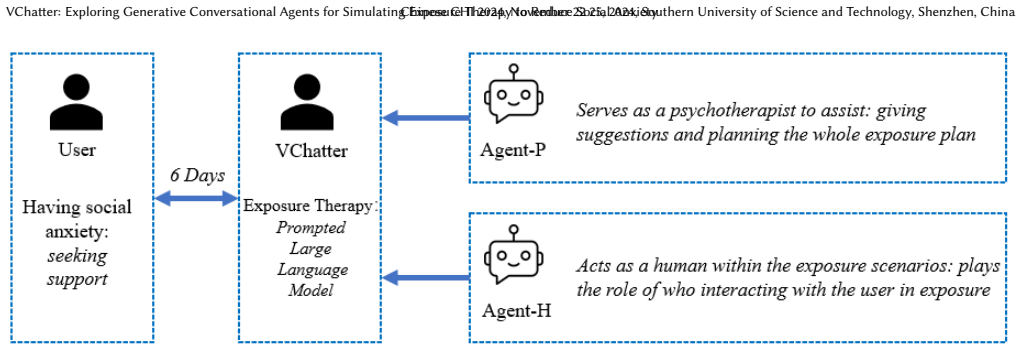
The central mechanism is the two-agent prompt architecture powered by a large language model: Agent-P follows a five-step exposure therapy protocol (assessment, hierarchy construction, graded exposure with repetition, skill teaching, and summary) and generates personalized character and scenario descriptions, which the user pastes into Agent-H's editable placeholders. Agent-H then role-plays low, medium, and high exposure interactions, sustained by prompts that keep the persona friendly and able to keep the conversation going. Text output is converted to speech and paired with animated 3D avatars whose facial expressions track sentiment, which the authors use to preserve immersion while giving users a safer, less pressured environment than face-to-face exposure.
What would settle it
A randomized controlled trial with clinically diagnosed social anxiety disorder patients, comparing VChatter against a no-treatment or text-only chatbot control and measuring SAS-A at the end and at one-month follow-up: the central claim fails if the anxiety reduction does not beat the control or does not persist.
Extended reading notes
Core claim
VChatter demonstrates that a multi-agent LLM system can walk a socially anxious user through the standard exposure therapy sequence: assessment, hierarchy construction, graded exposure repeated at each level, skill teaching, and summary. Agent-P, prompted as a psychotherapist, identifies the specific source of fear, designs scenarios from mild to severe, and debriefs the user after each task; Agent-H, prompted with character and scene placeholders, plays the interaction roles. The six-day study reports significant pre-post reductions in adolescents' social anxiety, loneliness, avoidance, fear, and social isolation, and users rated the system as useful and immersive.
Load-bearing premise
The load-bearing premise is that university students who self-report high social anxiety scores respond to a six-day chatbot exposure like the clinically diagnosed population the therapy is meant to serve.
Editorial extensions
If this is right
- If correct, chatbot-based exposure therapy could make a core clinical technique available to people who cannot afford, or are too anxious to seek, human therapy.
- Users' significant pre-post drops in avoidance, fear, and isolation suggest that repeated graded chatbot interactions may help people re-enter real social situations.
- Personalized exposure plans, generated by the therapist agent and editable by the user, appear to be a workable way to tailor scenarios to individual fear sources.
- The combination of voice output and expressive animated avatars was experienced as safe and immersive, supporting multimodal conversational agents as a therapeutic format.
- The reported gains are strongest for mild to moderate cases, since the study itself did not include clinically diagnosed or severe patients.
Reading between the lines
- The paper's reported gains are consistent with feasibility, but the absence of a clinically diagnosed sample and a control group means the result most strongly supports 'can work in a six-day self-selected sample' rather than 'works as a treatment'; a waitlist or text-only control arm would sharpen the claim.
- User feedback that high-exposure agents were too gentle points to a tunable 'agent assertiveness' parameter that could act as a graded exposure-intensity dial, letting future systems calibrate difficulty continuously instead of in three tiers.
- The same two-agent structure could generalize to other fear hierarchies, such as public speaking, job interviews, or conflict conversations, and to group settings if the system scales beyond two simultaneous role-players.
- A delayed post-test weeks after the six-day session would separate lasting exposure learning from short-term demand effects; the paper itself does not report follow-up.
Editorial analysis
A structured set of objections, weighed in public.
Referee Report
Summary. The paper presents VChatter, a multi-agent system that uses GPT-4-based agents (an Agent-P therapist and two Agent-H social partners) to simulate exposure therapy for social anxiety. The design is grounded in a survey (N=36) and an expert interview, and the system is evaluated in a six-day study with 10 self-selected university students. The authors report significant within-subjects reductions in social anxiety (SAS-A), loneliness (UCLA), and self-reported avoidance/fear/isolation, concluding that LLM-based conversational agents can effectively simulate exposure therapy. The paper's main contribution is the system design and exploratory feasibility evidence, but the efficacy claims rest on an uncontrolled pre/post design.
Significance. If the efficacy claim were supported, VChatter would represent a low-cost, accessible intervention for social anxiety. The system design is thoughtfully motivated, the multi-agent architecture is clearly described, and the authors include full prompts in the appendix. However, the current evidence does not establish that VChatter caused the observed improvements. The feasibility contribution is genuine and may be useful to the HCI community, but the clinical-scale claims in the abstract and conclusion are disproportionate to the strength of the study design.
major comments (3)
- [Section 5.4, 6.2] The central claim that VChatter 'significantly reduced social anxiety' is based entirely on a within-subjects pre/post comparison with N=10 and no control, waitlist, or alternative-intervention condition. Because participants were recruited for high LSAS scores (Section 5.1), the observed improvements are vulnerable to regression to the mean, repeated questionnaire exposure, natural time effects, and demand characteristics. Section 6.2 acknowledges that no baseline group was included, but the abstract and conclusion still assert causal efficacy. Please either reframe the contribution as a feasibility and user-experience study with the pre/post results described as suggestive, or provide a controlled comparison.
- [Section 5.1] The power analysis is mis-specified: the text says 'T-test, ρ = 0.7 (large effect size)', which confuses the correlation between repeated measures with the effect size. For a paired t-test, the required input is the standardized mean difference (e.g., Cohen's dz) together with the correlation. With no documented a priori effect size, the claim that N=10 is 'satisfied' is not quantitatively justified. Please report the actual effect size and correlation, or characterize the G*Power calculation as a heuristic rather than a formal justification.
- [Section 3 and 5.1] The paper repeatedly labels participants with LSAS ≥ 60 as 'clinically diagnosable as having social anxiety disorder'. LSAS is a screening instrument, not a diagnostic tool; a high symptom score does not constitute a clinical diagnosis. This overstatement affects how the target population is described throughout the manuscript. Please replace 'clinically diagnosable' with 'high social anxiety symptoms' and explicitly note that participants were not clinically assessed, which is already partially acknowledged in Section 6.2.
minor comments (6)
- [Section 6.1] The text states that 'our agent underwent fine-tuning', but Section 4.2 describes only prompt engineering with GPT-4. Please clarify whether any model weights were actually tuned or whether the adaptation was purely through prompts.
- [Section 5.4.3 / Table 2] The UCLA loneliness Z-value is reported as -2.401 in the text but -2.410 in Table 2; the after-UCLA SD is 13.53 in the text and 13.11 in Table 2. Please reconcile these inconsistencies.
- [Section 5.4.2] The subsection heading 'Release Social Anxiety' should likely read 'Relieve Social Anxiety'.
- [Section 5.4.4] The dimension 'Contravene' is a nonstandard term; the text itself defines it as 'the extent of social avoidance'. Consider using 'Avoidance' consistently for clarity.
- [Section 5.3] The sentence 'AN additional experiments (e.g., a conversation agent with only a text-to-voice model or only a virtual human representation) are not been designed' is grammatically incorrect and unclear. Please rephrase to state that no ablation experiments were conducted.
- [Section 5.4.1] The quotation attributed to User 2 ends with '(user 8, male, age 24, LSAS 96)', which suggests a misplacement of the participant identifier. Please verify that the quote attribution is correct.
Circularity Check
No significant circularity: VChatter's claims are empirical pre-post comparisons with externally validated scales, not derivations from fitted inputs or self-cited results.
full rationale
The paper makes no mathematical derivation whose output is equivalent to its input. VChatter's design is informed by a survey (N=36) and an expert interview, and its evaluation is a six-day within-subjects study (N=10) comparing SAS-A, UCLA, and Likert-scale measures before and after the intervention. These outcome instruments are externally validated scales, not quantities fitted from the same data. The only author self-citation, Peng et al. [30], is used to justify the choice of usability metrics ('Similar to previous CA designs[30], we selected Usefulness...'), which is a methodological convention rather than a load-bearing premise for the anxiety-reduction claim. The paper explicitly concedes the absence of a baseline or control group ('it is important to clarify that we did not select a group of socially anxious patients to undergo traditional exposure therapy as a baseline for our study'), and the lack of a control condition is a threat to internal validity and causal attribution, not a form of circularity. No fitted parameter is renamed as a prediction, no uniqueness theorem is imported from the authors' prior work, and no ansatz is smuggled in via self-citation. The central claim that users showed pre-post reductions in social anxiety is an empirical observation whose interpretation may be confounded, but it does not reduce by definition to the system's inputs. Therefore the appropriate circularity score is 0.
Assumptions & free parameters
assumptions (5)
- domain assumption LSAS, SAS-A, and UCLA are valid and reliable measures of social anxiety and loneliness in this population.
- domain assumption Self-reported LSAS >= 60 indicates clinically diagnosable SAD.
- ad hoc to paper A six-day, two-repetition-per-level exposure schedule is sufficient to produce therapeutic desensitization.
- domain assumption GPT-4 will follow the engineered prompts reliably and produce safe, clinically reasonable guidance.
- domain assumption The interviewed expert's advice is sufficiently representative to ground the design requirements.
Cite this review
Pith. "Pith review of VChatter: Exploring Generative Conversational Agents for Simulating Exposure Therapy to Reduce Social Anxiety." pith.science (2026). https://pith.science/paper/25XNN4G4
@misc{pith2026250603520,
  author       = {Pith},
  title        = {Pith review of: VChatter: Exploring Generative Conversational Agents for Simulating Exposure Therapy to Reduce Social Anxiety},
  year         = {2026},
  howpublished = {\url{https://pith.science/paper/25XNN4G4}},
  note         = {Machine review of arXiv:2506.03520}
}
read the original abstract
Many people struggle with social anxiety, feeling fear, or even physically uncomfortable in social situations like talking to strangers. Exposure therapy, a clinical method that gradually and repeatedly exposes individuals to the source of their fear and helps them build coping mechanisms, can reduce social anxiety but traditionally requires human therapists' guidance and constructions of situations. In this paper, we developed a multi-agent system VChatter to explore large language models(LLMs)-based conversational agents for simulating exposure therapy with users. Based on a survey study (N=36) and an expert interview, VChatter includes an Agent-P, which acts as a psychotherapist to design the exposure therapy plans for users, and two Agent-Hs, which can take on different interactive roles in low, medium, and high exposure scenarios. A six-day qualitative study (N=10) showcases VChatter's usefulness in reducing users' social anxiety, feelings of isolation, and avoidance of social interactions. We demonstrated the feasibility of using LLMs-based conversational agents to simulate exposure therapy for addressing social anxiety and discussed future concerns for designing agents tailored to social anxiety.
Figures


Figures from the paper (1 more)

Reference graph
Works this paper leans on
-
[1]
American Psychiatric Association et al. 2000. Diagnostic and statistical manual of mental disorders. Text revision (2000)
work page 2000
-
[2]
John T Cacioppo and Louise C Hawkley. 2009. Perceived social isolation and cognition. Trends in cognitive sciences 13, 10 (2009), 447–454
work page 2009
-
[3]
Orla Cooney, Kevin Doherty, Marguerite Barry, David Coyle, Gavin Doherty, and Benjamin R. Cowan. 2024. Using Speech Agents for Mood Logging within Blended Mental Healthcare: Mental Healthcare Practitioners’ Perspectives. In Proceedings of the 6th ACM Conference on Conversational User Interfaces (Luxem- bourg, Luxembourg) (CUI ’24). Association for Computi...
arXiv 2024
-
[4]
I don’t know what you mean by ‘I am anxious’
Tessa Eagle, Conrad Blau, Sophie Bales, Noopur Desai, Victor Li, and Steve Whittaker. 2022. “I don’t know what you mean by ‘I am anxious’”: A New Method for Evaluating Conversational Agent Responses to Standardized Mental Health Inputs for Anxiety and Depression. ACM Trans. Interact. Intell. Syst. 12, 2, Article 12 (July 2022), 23 pages. https://doi.org/1...
-
[5]
Thomas A Field, Eric T Beeson, and Laura K Jones. 2015. The new ABCs: A prac- titioner’s guide to neuroscience-informed cognitive-behavior therapy. Journal of Mental Health Counseling 37, 3 (2015), 206–220
work page 2015
-
[6]
National Collaborating Centre for Mental Health (UK et al. 2013. Social anxiety disorder: recognition, assessment and treatment. (2013)
work page 2013
-
[7]
Richard G Heimberg. 1995. Social phobia: Diagnosis, assessment, and treatment . Guilford Press
work page 1995
-
[8]
Richard G Heimberg and Robert E Becker. 2002. Cognitive-behavioral group therapy for social phobia: Basic mechanisms and clinical strategies . Guilford Press. Chinese CHI 2024, November 22 25, 2024, Southern University of Science and Technology, Shenzhen, China Zhang et al
work page 2002
Show all 50 references
-
[9]
Richard G Heimberg, Robert E Becker, Karen Goldfinger, and James A Vermilyea
-
[10]
Yew Ken Heng. 2021. ReWIND: psychoeducation game leveraging cognitive behavioral therapy (CBT) to enhance emotion control for generalized anxiety disorder. In Extended Abstracts of the 2021 CHI Conference on Human Factors in Computing Systems. 1–5
2021
-
[11]
Debra A Hope, Richard G Heimberg, and Cynthia L Turk. 2010. Managing social anxiety: A cognitive-behavioral therapy approach: Therapist guide . Oxford University Press, USA
2010
-
[12]
Heidi M Inderbitzen-Nolan and Kenneth S Walters. 2000. Social Anxiety Scale for Adolescents: Normative data and further evidence of construct validity. Journal of clinical child psychology 29, 3 (2000), 360–371
2000
-
[13]
Maurice Jakesch, Advait Bhat, Daniel Buschek, Lior Zalmanson, and Mor Naaman
-
[14]
Isabel L Kampmann, Paul MG Emmelkamp, and Nexhmedin Morina. 2016. Meta- analysis of technology-assisted interventions for social anxiety disorder. Journal of anxiety disorders 42 (2016), 71–84
2016
-
[15]
Philip C Kendall and Jeremy S Peterman. 2015. CBT for adolescents with anxiety: mature yet still developing.American Journal of Psychiatry 172, 6 (2015), 519–530
2015
-
[16]
Pradeep Raj Krishnappa Babu and Uttama Lahiri. 2022. Gaze-based anxiety sensitive virtual social communication platform for individuals with autism. In CHI Conference on Human Factors in Computing Systems Extended Abstracts . 1–7
2022
-
[17]
SeoYoung Lee and Junho Choi. 2017. Enhancing user experience with conversa- tional agent for movie recommendation: Effects of self-disclosure and reciprocity. International Journal of Human-Computer Studies 103 (2017), 95–105
2017
-
[18]
Yi-Chieh Lee, Yichao Cui, Jack Jamieson, Wayne Fu, and Naomi Yamashita. 2023. Exploring Effects of Chatbot-based Social Contact on Reducing Mental Illness Stigma. In Proceedings of the 2023 CHI Conference on Human Factors in Computing Systems (Hamburg, Germany) (CHI ’23). Asso...
2023 doi
-
[19]
Yi-Chieh Lee, Naomi Yamashita, and Yun Huang. 2020. Designing a Chatbot as a Mediator for Promoting Deep Self-Disclosure to a Real Mental Health Professional. Proc. ACM Hum.-Comput. Interact. 4, CSCW1, Article 31 (May 2020), 27 pages. https://doi.org/10.1145/3392836
2020 doi
-
[20]
I Hear You, I Feel You
Yi-Chieh Lee, Naomi Yamashita, Yun Huang, and Wai Fu. 2020. "I Hear You, I Feel You": Encouraging Deep Self-disclosure through a Chatbot. In Proceedings of the 2020 CHI Conference on Human Factors in Computing Systems (Honolulu, HI, USA) (CHI ’20). Association for Computing Ma...
2020
-
[21]
Carlos Miguel Legaspi Jr., Tristan Raphael Pacana, Kyle Loja, Christina Sing, and Ethel Ong. 2023. User Perception of Wysa as a Mental Well-being Support Tool during the COVID-19 Pandemic. In Proceedings of the Asian HCI Symposium 2022 (New Orleans, LA, USA) (Asian HCI ’22). A...
2023
-
[22]
Truong, and Alex Mariakakis
Brenna Li, Ofek Gross, Noah Crampton, Mamta Kapoor, Saba Tauseef, Mohit Jain, Khai N. Truong, and Alex Mariakakis. 2024. Beyond the Waiting Room: Patient’s Perspectives on the Conversational Nuances of Pre-Consultation Chatbots (CHI ’24). Association for Computing Machinery, N...
2024
-
[23]
Maria Elizabeth Loades, Eleanor Chatburn, Nina Higson-Sweeney, Shirley Reynolds, Roz Shafran, Amberly Brigden, Catherine Linney, Megan Niamh Mc- Manus, Catherine Borwick, and Esther Crawley. 2020. Rapid systematic review: the impact of social isolation and loneliness on the me...
2020
-
[24]
David Mal, Erik Wolf, Nina Döllinger, Mario Botsch, Carolin Wienrich, and Marc Erich Latoschik. 2024. From 2D-Screens to VR: Exploring the Effect of Immersion on the Plausibility of Virtual Humans. InExtended Abstracts of the 2024 CHI Conference on Human Factors in Computing S...
2024
-
[25]
Douglas S Mennin, David M Fresco, Richard G Heimberg, Franklin R Schneier, Sharon O Davies, and Michael R Liebowitz. 2002. Screening for social anxiety disorder in the clinical setting: using the Liebowitz Social Anxiety Scale. Journal of anxiety disorders 16, 6 (2002), 661–673
2002
-
[26]
Masahiro Mori, Karl F MacDorman, and Norri Kageki. 2012. The uncanny valley [from the field]. IEEE Robotics & automation magazine 19, 2 (2012), 98–100
2012
-
[27]
Amanda S Morrison and Richard G Heimberg. 2013. Social anxiety and social anxiety disorder. Annual review of clinical psychology 9, 1 (2013), 249–274
2013
-
[28]
Shi Hui Ng, Lay-Ki Soon, and Tin Tin Su. 2023. Emotion-Aware Chatbot with Cultural Adaptation for Mitigating Work-Related Stress. In Proceedings of the Asian HCI Symposium 2023 . 41–50
2023
-
[29]
O’Brien, Carrie J
Joon Sung Park, Joseph C. O’Brien, Carrie J. Cai, Meredith Ringel Morris, Percy Liang, and Michael S. Bernstein. 2023. Generative Agents: Interactive Simulacra of Human Behavior. arXiv:2304.03442 [cs.HC] https://arxiv.org/abs/2304.03442
2023 arXiv
-
[30]
Zhenhui Peng, Qingyu Guo, Ka Wing Tsang, and Xiaojuan Ma. 2020. Exploring the Effects of Technological Writing Assistance for Support Providers in Online Mental Health Community. In Proceedings of the 2020 CHI Conference on Human Factors in Computing Systems (Honolulu, HI, USA...
2020
-
[31]
KATHRYN Ponniah and SD Hollon. 2008. Empirically supported psychological interventions for social phobia in adults: a qualitative review of randomized controlled trials. Psychological medicine 38, 1 (2008), 3–14
2008
-
[32]
Daniel W Russell. 1996. UCLA Loneliness Scale (Version 3): Reliability, validity, and factor structure. Journal of personality assessment 66, 1 (1996), 20–40
1996
-
[33]
Richard M Ryan and Edward L Deci. 2000. Self-determination theory and the facilitation of intrinsic motivation, social development, and well-being. American psychologist 55, 1 (2000), 68
2000
-
[34]
Jitender Sareen and Murray Stein. 2000. A review of the epidemiology and approaches to the treatment of social anxiety disorder. Drugs 59 (2000), 497–509
2000
-
[35]
Jessica Schroeder, Chelsey Wilkes, Kael Rowan, Arturo Toledo, Ann Paradiso, Mary Czerwinski, Gloria Mark, and Marsha M. Linehan. 2018. Pocket Skills: A Conversational Mobile Web App To Support Dialectical Behavioral Therapy. In Proceedings of the 2018 CHI Conference on Human F...
2018
-
[36]
Murray B Stein and Jack M Gorman. 2001. Unmasking social anxiety disorder. Journal of Psychiatry and Neuroscience 26, 3 (2001), 185
2001
-
[37]
Robert J Taormina and Jennifer H Gao. 2013. Maslow and the motivation hier- archy: Measuring satisfaction of the needs. The American journal of psychology 126, 2 (2013), 155–177
2013
-
[38]
Alan R Teo, Robert Lerrigo, and Mary AM Rogers. 2013. The role of social isolation in social anxiety disorder: A systematic review and meta-analysis. Journal of anxiety disorders 27, 4 (2013), 353–364
2013
-
[39]
Joseph Weizenbaum. 1966. ELIZA—a computer program for the study of natural language communication between man and machine. Commun. ACM 9, 1 (1966), 36–45
1966
-
[40]
Sufei Xin, Haiyun Peng, and Liang Sheng. 2022. Changes of social anxiety in Chinese adolescents during 2002 2020: An increasing trend and its relationship with social change. Children and Youth Services Review 142 (2022), 106614
2022
-
[41]
Samaneh Zamanifard and Andrew Robb. 2023. Social virtual reality is my thera- pist: overcoming social anxiety disorder through using social virtual reality. In Extended Abstracts of the 2023 CHI Conference on Human Factors in Computing Systems. 1–6
2023
-
[42]
Zhenjie Zhao and Xiaojuan Ma. 2020. Situated Learning of Soft Skills with an Interactive Agent in Virtual Reality via Multimodal Feedback. In Adjunct Proceedings of the 33rd Annual ACM Symposium on User Interface Software and Technology (Virtual Event, USA) (UIST ’20 Adjunct)....
2020
-
[45]
You also need to clarify the reasons for their fear of specific scenarios
During this therapy session, you need to: Gradually explore and identify which specific scenarios the patient is especially fearful of through conversation. You also need to clarify the reasons for their fear of specific scenarios. For example, the patient might be afraid of p...
-
[46]
The exposure scenarios are divided into mild, moderate, and severe
Based on the patient’s fearful scenarios, you need to design an exposure therapy plan, starting from mild exposure scenarios. The exposure scenarios are divided into mild, moderate, and severe. VChatter: Exploring Generative Conversational Agents for Simulating Exposure Therap...
2024
-
[47]
In Your Task, you clearly outline what the patient needs to accomplish in this exposure scenario
Note that in the Interaction Role, you provide the profile of the character the patient will interact with, while the Exposure Scenario explains the situation. In Your Task, you clearly outline what the patient needs to accomplish in this exposure scenario
-
[48]
The patient also needs to complete two severe exposure scenarios
For severe exposure scenarios, you need to provide both a male and female character, with a scenario requiring interaction with both at the same time. The patient also needs to complete two severe exposure scenarios
-
[49]
You should work with the patient to solve these difficulties, offering advice based on their interaction performance
After the patient reports completing the exposure scenario you suggested, you need to ask them about how they completed it and what difficulties they encountered during the process. You should work with the patient to solve these difficulties, offering advice based on their in...
-
[50]
Finally, you should express anticipa- tion for your next meeting with them
Once the patient completes all exposure tasks, you should sum- marize their performance throughout the entire process, pointing out any shortcomings and offering suggestions, while also praising the areas where they did well. Finally, you should express anticipa- tion for your...
-
[1985]
The Journal of Nervous and Mental Disease 173, 4 (1985), 236–245
Treatment of social phobia by exposure, cognitive restructuring, and homework assignments. The Journal of Nervous and Mental Disease 173, 4 (1985), 236–245
1985
-
[2023]
In Proceedings of the 2023 CHI Conference on Human Factors in Computing Systems (Hamburg, Germany) (CHI ’23)
Co-Writing with Opinionated Language Models Affects Users’ Views. In Proceedings of the 2023 CHI Conference on Human Factors in Computing Systems (Hamburg, Germany) (CHI ’23). Association for Computing Machinery, New York, NY, USA, Article 111, 15 pages. https://doi.org/10.114...
2023
Reviewed August 7, 2026 · model on record in the stance chip above.
Discussion (0). Sign in to comment.