REVIEW 2 major objections 4 minor 82 references
Changing Look AGN: A study of Optical/UV and the Highly Ionized Fe K$\alpha$ X-ray Line Flux Variations Using Photo-Ionization Simulations
T0 review · 2 major / 4 minor · reviewed 2026-08-07 · deepseek-v4-flash
Pith's one-line read This paper claims that changing-look AGN transitions are driven by intrinsic accretion-rate changes, and that the highly ionized Fe Kα line is a coronal diagnostic that tracks them.
desk verdict A workmanlike Cloudy study with a solid BLR-insensitivity result and an over-interpreted Fe K coronal-origin claim; worth refereeing, but the coronal location needs to be treated as model input, not output. read the letter →
The pith
A machine-rendered reading of the paper's core claim, the machinery that carries it, and where it could break.
The reading
What carries the argument
The load-bearing tool is the Cloudy photoionization code (C23.01) applied to plane-parallel slabs of solar-composition gas with column density $10^{23}\ \mathrm{cm}^{-2}$. The input SED is a big blue bump plus an X-ray power law whose normalization is set by the X-ray-to-optical index $\alpha_{\rm ox}$; the ionization parameter $U = Q(H)/(4\pi r_0^2 n_H c)$ sets the radiation strength. For the realistic Mrk 1018 case, the BLR radius is fixed by a radius-luminosity relation based on the 5100 Å luminosity, gas density is fixed at $n_H = 10^{12}\ \mathrm{cm}^{-3}$, and the Fe K emitting radius is scaled as $R_{\rm FeK} = 10^{-1}$ to $10^{-3} R_{\rm BLR}$, with $10^{-2.5} R_{\rm BLR}$ giving the H-like and He-like dominance. The output quantities that carry the argument are the four broad-line luminosities and the decomposition of the Fe Kα flux into H-like, He-like, hot fluorescent (Fe XVIII–XXIII), and cold fluorescent ($\le$Fe XVII) components.
What would settle it
Take a changing-look AGN such as Mrk 1018 through its bright and faint states with simultaneous optical monitoring and a high-resolution X-ray spectrum, measuring the 6.7 keV He-like Fe Kα line. The model predicts the ionized Fe Kα luminosity falls by about an order of magnitude as $\log(L/L_{\rm Edd})$ drops from $-1.14$ to $-2.27$; if the line flux instead stays constant or rises while the continuum dims, the coronal-origin and accretion-rate-driven picture is wrong. A second check: find a changing-look source with a large Hα disappearance but a constant 5100 Å continuum, which the paper's X-ray-only models say should not happen.
Extended reading notes
Core claim
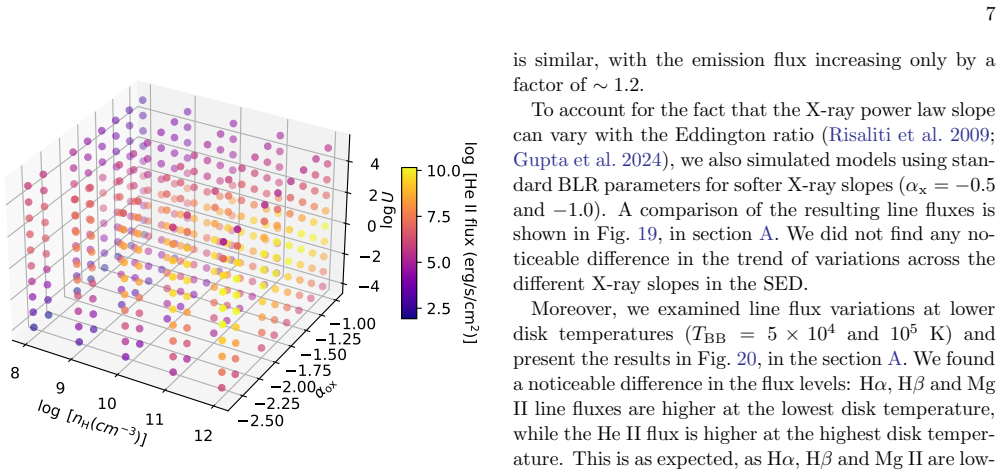
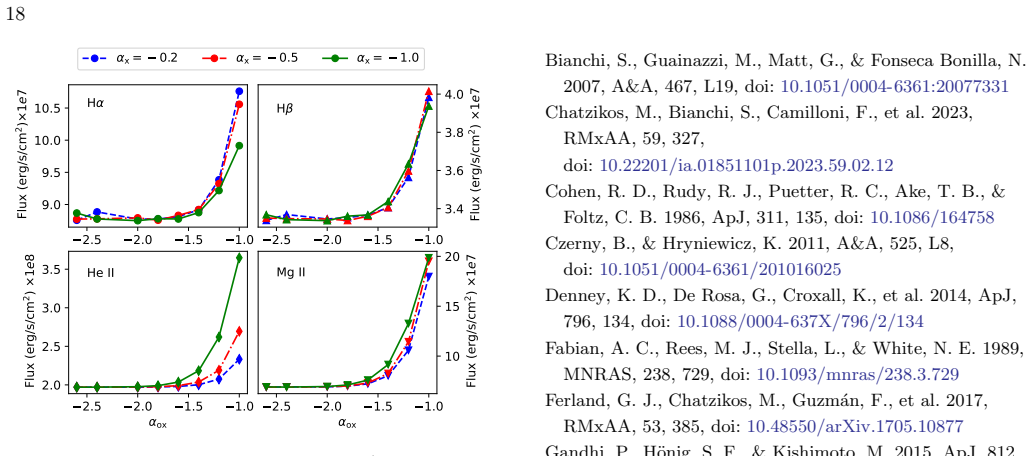
On the paper's own terms, the central discovery is a clear separation of drivers in AGN line variability. In a grid of photoionization models with the disk emission held fixed and only the X-ray power-law steepening (larger $\alpha_{\rm ox}$), the Hα, Hβ, Mg II, and He II fluxes change by factors of only about 1.2–2.4, far too little to make broad lines appear or disappear. When instead the full spectral energy distribution changes as in Mrk 1018's 2008–2016 transition—bolometric luminosity falling by a factor of 16, with the X-ray luminosity falling about two orders of magnitude—the same lines drop by factors of about 21 (Hα), 26 (Hβ), 24 (Mg II), and 10 (He II) from the highest to the lowest Eddington-ratio state, reproducing the observed dimming from Seyfert 1 to 1.9. For the Fe K region, the simulations show the H-like and He-like Fe components only become dominant when the emitting gas sits at radii near $10^{-2.5}\,R_{\rm BLR}$ with a high ionization parameter; at that location the ionized Fe Kα flux tracks the X-ray strength and falls by about an order of magnitude in the faint state. The paper therefore concludes that highly ionized Fe Kα is produced in the coronal region of the accretion disk, and that a change in the mass accretion rate is the likely trigger of the changing-look phenomenon.
Load-bearing premise
The load-bearing premise is that the broad-line region can be represented by a single gas slab of fixed density $n_H = 10^{12}\ \mathrm{cm}^{-3}$ whose radius is set by the 5100 Å luminosity through a radius-luminosity relation, so that one ionization parameter describes all lines and the Fe K region; if the real BLR spans a range of densities and radii, or is not in photoionization equilibrium during a fast transition, the computed line drops and the inferred coronal radius would change.
Editorial extensions
If this is right
- If broad-line disappearance in changing-look AGN requires broadband continuum change, then X-ray-only variability campaigns should not be expected to correlate one-to-one with Hα/Hβ type flips; a strong line transition without any 5100 Å change would point to an additional mechanism.
- The ionized Fe Kα line becomes a practical coronal tracer: its 6.7–6.97 keV flux should rise and fall with the Eddington ratio, giving X-ray spectrometers a way to watch the corona evolve across a changing-look event.
- The ordering of line responses found here—Hβ dropping most (about 26×) and He II least (about 10×)—gives a quantitative prediction for multi-line monitoring samples of changing-look AGN.
- If changing-look phenomena are driven by mass accretion changes, Type 1 and Type 2 are not fixed orientation classes but states a single source can cycle through, so AGN demography needs to be treated as a time-dependent process.
Reading between the lines
- Beyond the paper, the single-zone assumption is the place to look first if future data disagree: a BLR with a spread in densities and radii would dilute the predicted factor-of-20 line drops and could reconcile the simulations with changing-look sources that show milder line changes.
- Beyond the paper, the result implies that a changing-look source caught in its faint state should still show a weak but detectable 6.7 keV Fe Kα component if the accretion flow has not fully shut off; searching for this residual emission is a direct test of the coronal-origin claim.
- Beyond the paper, the proposed driver could be tested statistically: in a sample of changing-look AGN, the amplitude of the Hβ change should correlate with the amplitude of the 5100 Å continuum change, not with the X-ray change alone.
- Beyond the paper, if the BLR radius lags the luminosity by a dynamical or recombination time, using a radius-luminosity relation at each epoch could misplace the clouds; time-resolved reverberation mapping during a changing-look event would separate this lag effect from intrinsic accretion change.
Editorial analysis
A structured set of objections, weighed in public.
Referee Report
Summary. The paper presents Cloudy photoionization simulations of the response of broad-line region (BLR) optical/UV lines (Hα, Hβ, Mg II, He II) and the Fe Kα X-ray line complex to changes in the AGN continuum. Two scenarios are considered: (i) variation of the X-ray power-law only, with fixed disk emission, and (ii) broadband continuum variations as observed in the changing-look AGN Mrk 1018 (using SEDs from Noda & Done 2018). The main findings are that BLR line fluxes are largely insensitive to X-ray-only changes; for Mrk 1018 the simulations reproduce the observed brightening/dimming trends of the BLR lines, although with predicted flux drops that are considerably larger than observed; and that the highly ionized Fe Kα emission from H-like and He-like Fe ions responds strongly to the X-ray strength of the SED, which the authors interpret as evidence that this emission originates in the coronal region of the accretion disk. The paper also concludes that changing-look behavior in AGN is likely driven by intrinsic changes in the accretion rate.
Significance. If the main conclusions hold, the paper supports the view that changing-look AGN transitions reflect genuine changes in the accretion state rather than purely geometrical effects, and it identifies the highly ionized Fe Kα line as a potentially useful coronal diagnostic. The BLR insensitivity to X-ray-only continuum changes is convincingly demonstrated across a wide parameter grid (Figs. 3-7) and is a useful, robust result. The Fe K part, however, is more model-dependent: the conclusion that the emitting region is coronal rests on a chosen radius and density rather than on an independent constraint, and the predicted Fe K luminosities are never compared to observed X-ray line measurements. With appropriate qualification and a comparison to observed Fe K data, the paper would make a solid contribution to the changing-look AGN literature.
major comments (2)
- [Section 4.2, Eq. (3), Fig. 21] The conclusion that the highly ionized Fe Kα line originates in the coronal region is not uniquely determined by the modeling because the ionization parameter U = Q(H)/(4πr² n_H c) is degenerate in radius and density. The paper's own Fig. 21 shows that at n_H = 10^9 cm^-3, comparable H-like and He-like Fe K emission already appears at R_FeK = 10^-1 R_BLR, which is about 30 times farther out than the adopted R_FeK = 10^-2.5 R_BLR. Thus the adopted combination (n_H = 10^12 cm^-3, R_FeK = 10^-2.5 R_BLR) is not forced by the data; a lower-density medium at larger radius produces the same qualitative result. Without an independent density constraint, the model does not demonstrate that the emitting region is actually at a coronal distance. I recommend either adding such a constraint or explicitly softening the abstract and conclusion claims from 'origin is in the coronal part' to 'consistent with a coronal origin under the adopted parameters.'
- [Section 4.2 and Section 5] The predicted Fe Kα luminosities, equivalent widths, and line ratios are never compared to observed X-ray spectra of Mrk 1018 or any other changing-look AGN. This is a load-bearing gap because the paper's main novelty for the Fe K line is the claim that its variability traces coronal changes. The simulations currently show that a region with the chosen parameters would respond to X-ray flux variations, but they do not demonstrate that such a region exists or that its predicted line strength is consistent with X-ray observations. I recommend adding a quantitative comparison to available X-ray data (e.g., XMM-Newton or Suzaku spectra of Mrk 1018 or similar CL AGN) or, if that is not possible, clearly labeling the Fe K results as a parameter study rather than an empirical reproduction.
minor comments (4)
- [Section 4.1] The text states 'we assumed that the BLR gas density is nH = 12 cm^-3', which appears to be a typo for n_H = 10^12 cm^-3. Please correct this.
- [Figure 17 and Appendix Figures 21-23] The legend labels contain 'Fluorscent' instead of 'Fluorescent' in Figures 17, 21, 22, and 23. Please correct the spelling.
- [Section 3.2 (discussion of Iwasawa et al.)] The text mentions 'Fe XXV and Fe XVI' as high-ionization lines; this is likely a typo, as Fe XVI is not a high-ionization line in this context and the intended reference is probably Fe XXV and Fe XXVI. Please verify and correct.
- [Section 4.1, Eq. (4)] The radius-luminosity relation of Bentz et al. (2009) has a reported scatter; including this uncertainty in the propagated Mrk 1018 ionization parameters (Table 1) would make the BLR line predictions more robust and would help assess the significance of the predicted line flux changes.
Circularity Check
Fe K coronal-origin conclusion is the adopted radius–density choice read out via Eq. (3); the Mrk 1018 BLR dimming is a self-contained consistency check, not a fitted prediction.
-
self definitional
[Section 4.2 (Fe Kα emission models), Eqs. (3)–(4), Figs. 17 and 21.]
"In the next step, and in line with these findings, we consider a model of highly ionized gas that predominantly produces H-like and He-like Fe K emission. ... To estimate the Fe K flux, we adopt a model with a gas density of log[nH] = 12 and log[U] = 3.0. ... If RFeK further decreases to 2.5 orders of magnitude less than RBLR, the total Fe K emission is fully dominated by the emission from He-like and H-like Fe ions. This clearly indicates that the highly ionized Fe Kα emission is produced in the coronal region of the accretion disk in AGNs."
Eq. (3), U = Q(H)/(4π r0^2 n_H c), makes radius a function of U once n_H and Q(H) are fixed. The paper fixes n_H = 10^12 cm^-3 and adopts log U = 3.0, which is equivalent to placing the gas at R_FeK ≈ 10^-2.5 R_BLR; the H-like/He-like dominance at that radius is then presented as evidence that the line is produced closer to the source, in the corona. That is a restatement of the chosen radius, not a measurement. Fig. 21 shows the degeneracy: at n_H = 10^9 cm^-3, significant H-like/He-like Fe K flux appears at R_FeK = 10^-1 R_BLR. No observed Fe K flux or ratio is compared to break this r–n_H degeneracy, so the coronal-origin claim reduces to the input assumption.
full rationale
The paper's BLR analysis is largely self-contained: Cloudy C23.01 is a public photoionization code, the Mrk 1018 broadband SEDs are taken from Noda & Done (2018), and the BLR radius is set by the external Bentz et al. (2009) R–L relation. The resulting line dimming is a consistency check rather than an independent prediction, because R_BLR^2 scales with L_5100 and the adopted photoionization keeps the line luminosity roughly proportional to the continuum; however, no parameter was fitted to the Mrk 1018 line data, so this is not a circular fit. The Fe K coronal-origin conclusion is circular in the specific sense detailed above: the small emitting radius is an input (via Eq. 3 with n_H = 10^12 cm^-3 and log U = 3), and the H-like/He-like dominance follows from that choice, with the r–n_H degeneracy acknowledged in Fig. 21. The choice of n_H is anchored to the self-cited Adhikari et al. (2016) disk-atmosphere profile, which is load-bearing for the coronal claim. The paper's honesty about the degeneracy and about overestimated BLR line drops (Section 5) keeps the circularity partial rather than total; the independent content (X-ray-only changes do not drive BLR lines, Fe K flux responds to X-ray strength, all lines dim with Eddington ratio) supports a score of 6.
Assumptions & free parameters
free parameters (8)
- Big Blue Bump temperature T_BB =
5.5e5 K (standard)
- X-ray power-law slope alpha_x =
-0.2 (standard); -0.5, -1.0 tested
- Low-energy UV slope alpha_uv =
-0.5
- Gas density n_H for BLR and Fe K region =
1e12 cm^-3
- BLR ionization parameter log U =
-2.0 (standard model)
- Fe K region ionization parameter log U =
3.0
- Fe K emitting radius R_FeK =
10^-2.5 R_BLR (Mrk 1018 models)
- Column density N_H =
1e23 cm^-2
assumptions (6)
- domain assumption Solar chemical composition (Grevesse and Sauval 1998) in Cloudy
- domain assumption Two-component SED parameterization of Eq. 1 (Big Blue Bump plus X-ray power law)
- domain assumption Constant-density, plane-parallel, open-geometry gas slabs
- domain assumption Bentz et al. (2009) radius-luminosity relation (Eq. 4) applies to Mrk 1018 at all CL states
- domain assumption Photoionization equilibrium is instantaneous (no time lags)
- domain assumption Cloudy's Fe K emission treatment (stationary gas, no general relativistic effects) is adequate
Cite this review
Pith. "Pith review of Changing Look AGN: A study of Optical/UV and the Highly Ionized Fe K$\alpha$ X-ray Line Flux Variations Using Photo-Ionization Simulations." pith.science (2026). https://pith.science/paper/JNDIDYW5
@misc{pith2026250603540,
  author       = {Pith},
  title        = {Pith review of: Changing Look AGN: A study of Optical/UV and the Highly Ionized Fe K$\alpha$ X-ray Line Flux Variations Using Photo-Ionization Simulations},
  year         = {2026},
  howpublished = {\url{https://pith.science/paper/JNDIDYW5}},
  note         = {Machine review of arXiv:2506.03540}
}
abstract
Significant variability in broad emission line strengths of active galactic nuclei (AGN) over months to years has been observed, often accompanied by intrinsic continuum changes. Such spectral variability challenges the traditional AGN classification scheme, which attributes differences between Type 1 and Type 2 to geometrical effects, as transitions between these types occur on timescales shorter than viscous ones. In this work, using the {\sc cloudy} photo-ionization simulations, we investigated the response of the major emission line fluxes, in the optical/UV and hard X-ray bands, to changes in the intensity and shape of the continuum emission of the AGN under two scenarios: (i) changes in the X-ray power-law while keeping disc emission fixed, and (ii) broadband continuum variations. We demonstrate that BLR line fluxes are insensitive to X-ray power-law changes alone. Considering a well-studied case of the changing-look (CL) AGN Mrk 1018, which exhibits variations in the intrinsic disc emission, as well as the X-ray power-law, our simulations reproduce observed brightening and dimming trends of the BLR emission. Moreover, we show that the highly ionized Fe K$\alpha$ X-ray flux, primarily produced by the H-like and He-like ions of Fe, strongly depends on the X-ray strength of the intrinsic SED. These findings suggest that the origin of highly ionized Fe K$\alpha$ emission is in the coronal part of the accretion disk and that the CL phenomenon can be triggered by intrinsic changes in the accretion properties of AGN.
Figures


Figures from the paper (16 more)




Reference graph
Works this paper leans on
-
[1]
, " * write output.state after.block = add.period write newline
ENTRY address archivePrefix author booktitle chapter doi edition editor eprint howpublished institution journal key month number organization pages publisher school series title misctitle type volume year version url label extra.label sort.label short.list INTEGERS output.state before.all mid.sentence after.sentence after.block FUNCTION init.state.consts ...
-
[2]
write newline
" write newline "" before.all 'output.state := FUNCTION format.url url empty "" new.block "" url * "" * if FUNCTION format.eprint eprint empty "" archivePrefix empty "" archivePrefix "arXiv" = new.block " " eprint * " " * new.block " " eprint * " " * if if if FUNCTION format.doi doi empty "" " " doi * " " * if FUNCTION format.pid doi empty eprint empty ur...
-
[3]
gxWػl v^sܮ
thebibliography [1] 20pt to REFERENCES 6pt =0pt -12pt 10pt plus 3pt =0pt =0pt =1pt plus 1pt =0pt =0pt -12pt =13pt plus 1pt =20pt =13pt plus 1pt \@M =10000 =-1.0em =0pt =0pt 0pt =0pt =1.0em @enumiv\@empty 10000 10000 `\.\@m \@noitemerr \@latex@warning Empty `thebibliography' environment \@ifnextchar \@reference \@latexerr Missing key on reference command E...
2021
-
[4]
Adhikari , T. P. 2019, Photoionization Modelling as a Density Diagnostic of Line Emitting/Absorbing Regions in Active Galactic Nuclei , 10.1007/978-3-030-22737-1
-
[5]
P., Hryniewicz , K., R \'o \.z a \'n ska , A., Czerny , B., & Ferland , G
Adhikari , T. P., Hryniewicz , K., R \'o \.z a \'n ska , A., Czerny , B., & Ferland , G. J. 2018, , 856, 78, 10.3847/1538-4357/aab350
-
[6]
P., R \'o \.z a \'n ska , A., Czerny , B., Hryniewicz , K., & Ferland , G
Adhikari , T. P., R \'o \.z a \'n ska , A., Czerny , B., Hryniewicz , K., & Ferland , G. J. 2016, , 831, 68, 10.3847/0004-637X/831/1/68
-
[7]
P., R \'o \.z a \'n ska , A., Hryniewicz , K., Czerny , B., & Behar , E
Adhikari , T. P., R \'o \.z a \'n ska , A., Hryniewicz , K., Czerny , B., & Behar , E. 2019, , 881, 78, 10.3847/1538-4357/ab2dfc
-
[8]
Andonie , C., Bauer , F. E., Carraro , R., et al. 2022, , 664, A46, 10.1051/0004-6361/202142473
Show all 82 references
-
[9]
1993, , 31, 473, 10.1146/annurev.aa.31.090193.002353
Antonucci , R. 1993, , 31, 473, 10.1146/annurev.aa.31.090193.002353
1993
-
[10]
R., Korista , K
Arav , N., Gabel , J. R., Korista , K. T., et al. 2007, , 658, 829, 10.1086/511666
2007 doi
-
[11]
P., Tollerud , E
Astropy Collaboration , Robitaille , T. P., Tollerud , E. J., et al. 2013, , 558, A33, 10.1051/0004-6361/201322068
2013 doi
-
[12]
M., Sip o cz , B
Astropy Collaboration , Price-Whelan , A. M., Sip o cz , B. M., et al. 2018, , 156, 123, 10.3847/1538-3881/aabc4f
2018 doi
-
[13]
R., & Ross , R
Ballantyne , D. R., & Ross , R. R. 2002, , 332, 777, 10.1046/j.1365-8711.2002.05359.x
2002
-
[14]
Beckmann , V., & Shrader , C. R. 2012, Active Galactic Nuclei
2012
-
[15]
C., Walsh , J
Bentz , M. C., Walsh , J. L., Barth , A. J., et al. 2009, , 705, 199, 10.1088/0004-637X/705/1/199
2009 doi
-
[16]
2007, , 467, L19, 10.1051/0004-6361:20077331
Bianchi , S., Guainazzi , M., Matt , G., & Fonseca Bonilla , N. 2007, , 467, L19, 10.1051/0004-6361:20077331
2007 doi
-
[17]
2023, , 59, 327, 10.22201/ia.01851101p.2023.59.02.12
Chatzikos , M., Bianchi , S., Camilloni , F., et al. 2023, , 59, 327, 10.22201/ia.01851101p.2023.59.02.12
2023 doi
-
[18]
D., Rudy , R
Cohen , R. D., Rudy , R. J., Puetter , R. C., Ake , T. B., & Foltz , C. B. 1986, , 311, 135, 10.1086/164758
1986 doi
-
[19]
2011, , 525, L8, 10.1051/0004-6361/201016025
Czerny , B., & Hryniewicz , K. 2011, , 525, L8, 10.1051/0004-6361/201016025
2011 doi
-
[20]
D., De Rosa , G., Croxall , K., et al
Denney , K. D., De Rosa , G., Croxall , K., et al. 2014, , 796, 134, 10.1088/0004-637X/796/2/134
2014 doi
-
[21]
C., Rees , M
Fabian , A. C., Rees , M. J., Stella , L., & White , N. E. 1989, , 238, 729, 10.1093/mnras/238.3.729
1989 doi
- [22]
-
[23]
F., & Kishimoto , M
Gandhi , P., H \"o nig , S. F., & Kishimoto , M. 2015, , 812, 113, 10.1088/0004-637X/812/2/113
2015 doi
-
[24]
Gaskell , C. M. 2009, , 53, 140, 10.1016/j.newar.2009.09.006
2009 doi
-
[25]
Gohil , R., & Ballantyne , D. R. 2015, , 449, 1449, 10.1093/mnras/stv326
2015 doi
-
[26]
Grevesse , N., & Sauval , A. J. 1998, , 85, 161, 10.1023/A:1005161325181
1998 doi
-
[27]
M., van Hoof , P
Gunasekera , C. M., van Hoof , P. A. M., Chatzikos , M., & Ferland , G. J. 2023, Research Notes of the American Astronomical Society, 7, 246, 10.3847/2515-5172/ad0e75
2023 doi
-
[28]
2019, , 883, L44, 10.3847/2041-8213/ab4138
Guo , H., Sun , M., Liu , X., et al. 2019, , 883, L44, 10.3847/2041-8213/ab4138
2019 doi
-
[29]
A., et al
Guo , W.-J., Zou , H., Fawcett , V. A., et al. 2024, , 270, 26, 10.3847/1538-4365/ad118a
2024 doi
-
[30]
2021, , 508, 144, 10.1093/mnras/stab2550
Guolo , M., Ruschel-Dutra , D., Grupe , D., et al. 2021, , 508, 144, 10.1093/mnras/stab2550
2021 doi
-
[31]
K., Ricci , C., Temple , M
Gupta , K. K., Ricci , C., Temple , M. J., et al. 2024, , 691, A203, 10.1051/0004-6361/202450567
2024 doi
-
[32]
2024, , 530, 4850, 10.1093/mnras/stae1177
Hagen , S., Done , C., & Edelson , R. 2024, , 530, 4850, 10.1093/mnras/stae1177
2024 doi
-
[33]
2012, in Journal of Physics Conference Series, Vol
Hryniewicz , K., Niko ajuk , M., & Czerny , B. 2012, in Journal of Physics Conference Series, Vol. 372, Journal of Physics Conference Series (IOP), 012060, 10.1088/1742-6596/372/1/012060
2012 doi
-
[34]
2012, , 537, A86, 10.1051/0004-6361/201118203
Iwasawa , K., Mainieri , V., Brusa , M., et al. 2012, , 537, A86, 10.1051/0004-6361/201118203
2012 doi
-
[35]
J., et al
Jana , A., Ricci , C., Temple , M. J., et al. 2024, arXiv e-prints, arXiv:2411.08676. 2411.08676
2024 arXiv
-
[36]
S., Netzer , H., et al
Kaspi , S., Smith , P. S., Netzer , H., et al. 2000, , 533, 631, 10.1086/308704
2000 doi
-
[37]
L., et al
Kollatschny , W., Grupe , D., Parker , M. L., et al. 2020, , 638, A91, 10.1051/0004-6361/202037897
2020 doi
-
[38]
S., Reeves , J., et al
Laha , S., Reynolds , C. S., Reeves , J., et al. 2021, Nature Astronomy, 5, 13, 10.1038/s41550-020-01255-2
2021 doi
-
[39]
M., Yaqoob , T., & Kilgard , R
LaMassa , S. M., Yaqoob , T., & Kilgard , R. 2017, , 840, 11, 10.3847/1538-4357/aa68df
2017 doi
-
[40]
C., Shu , X
Liang , W. C., Shu , X. W., Wang , J. X., et al. 2022, Journal of High Energy Astrophysics, 33, 20, 10.1016/j.jheap.2022.01.002
2022 doi
-
[41]
L., Ivezi \'c , Z ., Kochanek , C
MacLeod , C. L., Ivezi \'c , Z ., Kochanek , C. S., et al. 2010, , 721, 1014, 10.1088/0004-637X/721/2/1014
2010 doi
-
[42]
L., Ross , N
MacLeod , C. L., Ross , N. P., Lawrence , A., et al. 2016, , 457, 389, 10.1093/mnras/stv2997
2016 doi
-
[43]
2020, , 496, 3412, 10.1093/mnras/staa1683
Marinucci , A., Bianchi , S., Braito , V., et al. 2020, , 496, 3412, 10.1093/mnras/staa1683
2020 doi
- [44]
-
[45]
D., Gupta , A., et al
Mathur , S., Denney , K. D., Gupta , A., et al. 2018, , 866, 123, 10.3847/1538-4357/aadd91
2018 doi
-
[46]
E., Husemann , B., Croom , S
McElroy , R. E., Husemann , B., Croom , S. M., et al. 2016, , 593, L8, 10.1051/0004-6361/201629102
2016 doi
-
[47]
P., Hryniewicz , K., Stalin , C
Mondal , S., Adhikari , T. P., Hryniewicz , K., Stalin , C. S., & Pandey , A. 2022, , 662, A77, 10.1051/0004-6361/202243084
2022 doi
-
[48]
P., & Singh , C
Mondal , S., Adhikari , T. P., & Singh , C. B. 2021, , 505, 1071, 10.1093/mnras/stab1194
2021 doi
-
[49]
D., Yaqoob , T., & Terashima , Y
Murphy , K. D., Yaqoob , T., & Terashima , Y. 2007, , 666, 96, 10.1086/520039
2007 doi
-
[50]
A., et al
Nandra , K., Clavel , J., Edelson , R. A., et al. 1998, , 505, 594, 10.1086/306181
1998 doi
- [51]
-
[52]
N., Yi , W., et al
Ni , Q., Brandt , W. N., Yi , W., et al. 2020, , 889, L37, 10.3847/2041-8213/ab6d78
2020 doi
-
[53]
2018, , 480, 3898, 10.1093/mnras/sty2032
Noda , H., & Done , C. 2018, , 480, 3898, 10.1093/mnras/sty2032
2018 doi
-
[54]
2023, , 943, 63, 10.3847/1538-4357/aca963
Noda , H., Mineta , T., Minezaki , T., et al. 2023, , 943, 63, 10.3847/1538-4357/aca963
2023 doi
-
[55]
L., Winkler , H., Tsygankov , S
Oknyansky , V. L., Winkler , H., Tsygankov , S. S., et al. 2019, , 483, 558, 10.1093/mnras/sty3133
2019 doi
-
[56]
A., & V \' lchez , J
P \'e rez-D \' az , B., P \'e rez-Montero , E., Fern \'a ndez-Ontiveros , J. A., & V \' lchez , J. M. 2022, , 666, A115, 10.1051/0004-6361/202243602
2022 doi
-
[57]
N., et al
Pu , X., Luo , B., Brandt , W. N., et al. 2020, , 900, 141, 10.3847/1538-4357/abacc5
2020 doi
-
[58]
N., Turner , M
Reeves , J. N., Turner , M. J. L., Pounds , K. A., et al. 2001, , 365, L134, 10.1051/0004-6361:20000424
2001 doi
-
[59]
2023, Nature Astronomy, 7, 1282, 10.1038/s41550-023-02108-4
Ricci , C., & Trakhtenbrot , B. 2023, Nature Astronomy, 7, 1282, 10.1038/s41550-023-02108-4
2023 doi
-
[60]
2014, , 441, 3622, 10.1093/mnras/stu735
Ricci , C., Ueda , Y., Paltani , S., et al. 2014, , 441, 3622, 10.1093/mnras/stu735
2014 doi
-
[61]
2020, , 898, L1, 10.3847/2041-8213/ab91a1
Ricci , C., Kara , E., Loewenstein , M., et al. 2020, , 898, L1, 10.3847/2041-8213/ab91a1
2020 doi
-
[62]
2009, , 700, L6, 10.1088/0004-637X/700/1/L6
Risaliti , G., Young , M., & Elvis , M. 2009, , 700, L6, 10.1088/0004-637X/700/1/L6
2009 doi
-
[63]
T., & Pojma \'n ski , G
R \'o \.z a \'n ska , A., Czerny , B., \.Z ycki , P. T., & Pojma \'n ski , G. 1999, , 305, 481, 10.1046/j.1365-8711.1999.02425.x
1999
-
[64]
I., & Sunyaev , R
Shakura , N. I., & Sunyaev , R. A. 1973, , 24, 337
1973
-
[65]
W., Yaqoob , T., & Wang , J
Shu , X. W., Yaqoob , T., & Wang , J. X. 2010, , 187, 581, 10.1088/0067-0049/187/2/581
2010 doi
-
[66]
2020, , 641, A167, 10.1051/0004-6361/202038575
Sniegowska , M., Czerny , B., Bon , E., & Bon , N. 2020, , 641, A167, 10.1051/0004-6361/202038575
2020 doi
-
[67]
A., Gierli \'n ski , M., & Siemiginowska , A
Sobolewska , M. A., Gierli \'n ski , M., & Siemiginowska , A. 2009, , 394, 1640, 10.1111/j.1365-2966.2009.14436.x
2009
-
[68]
W., Marziani , P., Zwitter , T., Calvani , M., & Dultzin-Hacyan , D
Sulentic , J. W., Marziani , P., Zwitter , T., Calvani , M., & Dultzin-Hacyan , D. 1998, , 501, 54, 10.1086/305795
1998 doi
-
[69]
1979, , 234, L9, 10.1086/183100
Tananbaum , H., Avni , Y., Branduardi , G., et al. 1979, , 234, L9, 10.1086/183100
1979 doi
- [70]
-
[71]
2013, , 550, A71, 10.1051/0004-6361/201220443
Vagnetti , F., Antonucci , M., & Trevese , D. 2013, , 550, A71, 10.1051/0004-6361/201220443
2013 doi
-
[72]
2010, , 519, A17, 10.1051/0004-6361/201014320
Vagnetti , F., Turriziani , S., Trevese , D., & Antonucci , M. 2010, , 519, A17, 10.1051/0004-6361/201014320
2010 doi
-
[73]
A., & Cignoni , M
Veronese , S., Vignali , C., Severgnini , P., Matzeu , G. A., & Cignoni , M. 2024, , 683, A131, 10.1051/0004-6361/202348098
2024 doi
- [74]
-
[75]
2024, , 973, L25, 10.3847/2041-8213/ad7397
Xrism Collaboration , Audard , M., Awaki , H., et al. 2024, , 973, L25, 10.3847/2041-8213/ad7397
2024 doi
-
[76]
J., MacLeod , C
Yang , Q., Green , P. J., MacLeod , C. L., et al. 2023, , 953, 61, 10.3847/1538-4357/acdedd
2023 doi
-
[77]
M., Kallman , T
Yaqoob , T., George , I. M., Kallman , T. R., et al. 2003, , 596, 85, 10.1086/377687
2003 doi
-
[78]
2004, , 604, 63, 10.1086/381731
Yaqoob , T., & Padmanabhan , U. 2004, , 604, 63, 10.1086/381731
2004 doi
-
[79]
P., Maccacaro , T., et al
Zamorani , G., Henry , J. P., Maccacaro , T., et al. 1981, , 245, 357, 10.1086/158815
1981 doi
-
[80]
2024, , 966, 85, 10.3847/1538-4357/ad2f30
Zeltyn , G., Trakhtenbrot , B., Eracleous , M., et al. 2024, , 966, 85, 10.3847/1538-4357/ad2f30
2024 doi
-
[81]
W., et al
Zetzl , M., Kollatschny , W., Ochmann , M. W., et al. 2018, , 618, A83, 10.1051/0004-6361/201732506
2018 doi
-
[82]
N., et al
Zhang , Z., Luo , B., Brandt , W. N., et al. 2023, , 954, 159, 10.3847/1538-4357/ace7c2
2023 doi
Reviewed August 7, 2026 · model on record in the stance chip above.
Discussion (0). Sign in to comment.