REVIEW 2 major objections 6 minor 66 references
Coupling models of resistive valves to muscle mechanics in cardiac fluid-structure interaction simulations
T0 review · 2 major / 6 minor · reviewed 2026-08-07 · deepseek-v4-flash
Pith's one-line read Conventional resistive valve models leave the wall reaction force out of the momentum balance, so heart FSI simulations drift and oscillate; this paper adds a distributed attachment force with matching resultant and shows the artifacts…
desk verdict A clean fix for a real linear-momentum imbalance in resistive valve FSI, but the 'Newton's laws' claim overreaches because only the resultant of the attachment force is balanced. read the letter →
The pith
A machine-rendered reading of the paper's core claim, the machinery that carries it, and where it could break.
The reading
What carries the argument
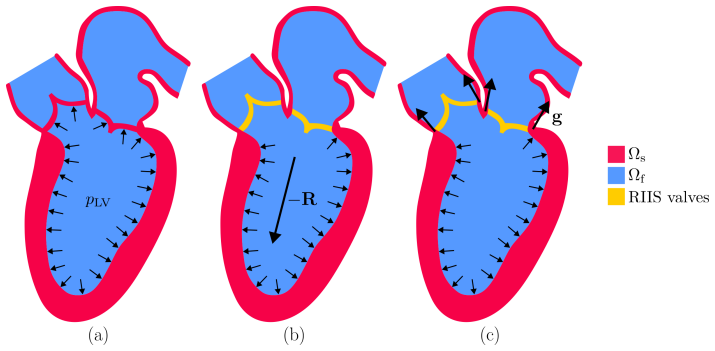
The load-bearing object is the distributed attachment force $\hat{\mathbf g}_k=(F_k/V_k)\,\delta_k(\varphi_k(\hat x+\hat d))$ added to the solid elastodynamics equation. The smoothed Dirac delta $\delta_k$ of the signed distance function $\varphi_k$ is the same RIIS kernel used in the fluid, so the force is spread over the valve-wall overlap region; $F_k$ is the integrated resistive force from the fluid momentum equation, and $V_k$ normalizes the distribution so its resultant equals $F_k$. Computing $\hat{\mathbf g}_k$ explicitly from the previous time step's velocity, pressure, and displacement keeps the added term almost free computationally while introducing a first-order error in time.
What would settle it
Run the spherical benchmark with the resistive plane tilted or displaced so its fluid force has nonzero torque about the system's center of mass; if the total angular momentum changes while no external torque acts, the model is not fully Newtonian. Equivalently, compute $\int_{\Omega_f} (x-x_0)\times R_k\,dx$ and the torque of $\hat{\mathbf g}_k$ about the same point at peak systole in the realistic heart: a nonzero difference directly contradicts the paper's Newton-law claim.
Extended reading notes
Core claim
The central claim is that the resistive immersed implicit surface (RIIS) valve model becomes consistent with Newton's laws in fluid-structure interaction only if the force the fluid exerts on each valve is transferred back onto the cardiac wall. The transfer is made explicit: with $R_k$ the resistive force density in the Navier-Stokes equation, the fluid force on valve $k$ is $F_k=\int_{\Omega_f} R_k\,dx$, and the wall receives $\hat{\mathbf g}_k=(F_k/V_k)\,\delta_k(\varphi_k)$, where $V_k$ is the integral of the same smoothed delta kernel over the solid domain. Matching the resultant of $\hat{\mathbf g}_k$ to $F_k$ restores linear momentum of the coupled fluid-solid system, and the numerical experiments confirm the consequence: no center-of-mass drift in the spherical benchmark and no unphysiological ventricular displacement, pulmonary-vein jets, or pressure-volume-loop oscillations in the realistic left heart.
Load-bearing premise
The repair assumes that transferring only the total push of the fluid on each valve to the wall is enough to restore Newton's laws; the fluid's twisting effect on the valve is never passed to the wall, so the system as a whole can still start to spin.
Editorial extensions
If this is right
- Without the attachment force, the spherical benchmark shows a clear downward acceleration of the system's center of mass; with it, the center of mass remains stationary and only a small drift remains, shrinking like $\Delta t$ as the time step is refined.
- In the realistic left heart, neglecting the force produces fast large longitudinal ventricular displacement, high atrial strains, strong pulmonary-vein jets, and sharp oscillations in pressure-volume loops, all absent when the force is included.
- The pressure-volume loop of the left atrium becomes much more physiological when valve forces are included, matching the expected morphology.
- The correction is not tied to RIIS specifically: the same force-balance principle extends to other resistive valve models used in FSI simulations.
- The added computational cost is minor, with the linear solve dominating and the assembly of $\hat{\mathbf g}_k$ contributing only a small fraction of wall time.
Reading between the lines
- The paper balances only the resultant of the fluid force on each valve, not its torque; a tilted or asymmetric valve would transmit a spurious twisting force to the wall, so angular momentum of the FSI system is not conserved in general.
- A benchmark with an off-center resistive surface would expose this: if total angular momentum changes with no external torque, the model is not fully Newtonian even though it fixes the linear drift.
- The near-linear relation between pressure jump and force density for closed valves could be used as a cheap surrogate for valve state in patient-specific models, since its slope encodes valve geometry.
- Extending the explicit evaluation of $\hat{\mathbf g}_k$ to second-order extrapolation is a natural next step that should remove the residual first-order drift at essentially the same cost.
Editorial analysis
A structured set of objections, weighed in public.
Referee Report
Summary. This paper proposes an extension of the resistive immersed implicit surface (RIIS) valve model for use in cardiac fluid-structure interaction (FSI) simulations. The authors add a distributed body force to the solid momentum equation, chosen so that its resultant equals the integral of the resistive force over the fluid domain for each valve, thereby restoring linear momentum balance to the coupled system. The modification is discretized explicitly, and numerical tests include a spherical benchmark (where center-of-mass drift is removed and the residual drift converges with the time step) and a realistic left-heart model (where valve attachment forces suppress unphysical ventricular displacements and pressure-volume loop oscillations).
Significance. The proposed modification addresses a real and practically important deficiency: standard RIIS, when embedded in FSI, violates linear momentum balance and can produce unphysical global motion of the heart. The spherical benchmark is well designed, and the observed first-order convergence of the residual drift with the explicit treatment is a strong consistency check. The implementation is based on the open-source lifex/deal.II stack, all parameters are reported, and no calibration is performed to obtain the physiological-looking PV loops. The main caveat is that the construction enforces only the resultant of the valve force, not the moment, so the paper's stronger claims about Newton's laws and physical consistency are not fully supported.
major comments (2)
- [Section 2.2 (definition of C_k(t) and g_k; Eq. (3) for R_k)] The proposed construction enforces only the resultant of the fluid-valve force, not its moment. With g_k = (F_k/V_k) δ_k(φ_k(x̂+d̂)) and R_k = (R_k/ε_k)(u-u_ALE) δ_k(φ_k(x)), the torque on the solid is τ_g = (F_k/V_k) ∫_{Ω_s} x × δ_k dx, whereas the torque exerted by the fluid on the valve is τ_R = ∫_{Ω_f} x × (R_k/ε_k)(u-u_ALE) δ_k dx. These coincide only if u-u_ALE is constant on the support of δ_k, which is generally not the case. Hence the total angular momentum of the coupled system is not conserved in general. The spherical benchmark of Section 3.1 cannot reveal this because its azimuthal symmetry makes both torques zero, and the realistic test of Section 3.2 does not monitor angular momentum. Since the abstract and the conclusions claim that the model 'satisfies Newton's laws' and is 'physically consistent', the claim is stronger than what is established: only linear momentum balance is demonstrated. The authors should either modify the attachment force distribution so that it also matches the torque (e.g., by taking g_k = δ_k (C_k + D_k × (x-x̄)) and fixing D_k through the torque balance) or explicitly limit the claims to linear momentum conservation.
- [Section 2.2, Assumption 3] Assumption 3 states that the spatial distribution of bg_k is the same as in the fluid, but the implemented formula bg_k = C_k(t) δ_k(φ_k(x̂+d̂)) is not the same vector distribution as R_k ∝ (u-u_ALE) δ_k(φ_k(x)); the direction of R_k varies with the local relative velocity, while bg_k has the constant direction of C_k. The assumption is therefore a new modeling ansatz for the shape of the attachment force, not a statement of equality of distributions. Because this choice determines the torque mismatch discussed in the previous comment, it is load-bearing and should be presented and justified as such, with a discussion of its consequences.
minor comments (6)
- [Section 3.1, paragraph before Figure 3] The phrase 'both with and withouth the newly introduced term' contains a typo: 'withouth' should be 'without'.
- [Table 1 caption] The word 'techinques' should be 'techniques'.
- [Table 2] The row label 'computeg' should read 'compute g'.
- [Section 3.2, first paragraph] The sentence 'we valves open and close according to...' is missing a verb; it should read 'we let the valves open and close according to...'.
- [Appendix A] The activation time φ in the eikonal-diffusion model uses the same symbol as the valve signed-distance functions φ_k in Section 2.1; renaming one of them (e.g., τ_act) would avoid confusion.
- [Table A.7] The Q0 entries are labeled with units 'mmHg' for initial flow rates; flow rates should have units of volume per time (e.g., mL/s) or the quantities should be defined differently.
Circularity Check
No significant circularity: the attachment force is constructed, not fitted (C_k(t)=F_k(t)/V_k(t) is forced by the balance condition itself), so the stationary center of mass in the spherical benchmark is a consistency check of the implementation rather than an independent prediction; the without-g failure case and the realistic-heart comparison give the work independent content.
-
self definitional
[Section 2.2 (derivation of C_k(t) and bg_k) and Section 3.1 (spherical benchmark); Conclusions, Section 4.]
"By Assumption 2, we choose Ck(t) such that, at every time t, the resultant of bgk equals the force that the fluid exerts on the k-th valve, denoted by Fk: ... Ck(t) = Fk(t)/Vk(t), bgk(bx, t) = Fk(t)/Vk(t) delta_k(phi_k(bx + bd)). ... These forces are computed in such a way to balance the forces exchanged by the fluid and the valves, thus making sure that the model satisfies Newton's laws."
The property showcased as the headline outcome -- that the FSI system is momentum-balanced (spherical benchmark: the center of mass remains stationary with bg and drifts without it) -- is exactly the property imposed when C_k(t) was defined so that the resultant of bg_k equals F_k, the fluid force on the valve. No parameter is fitted to data and no independent balance law is invoked: the stationarity check verifies that the construction and its explicit discretization were implemented correctly, not that the model predicts a new behavior.
full rationale
The derivation chain for the new term is self-contained: given the resistive force density R_k acting on the fluid (Eq. 3), the paper postulates bg_k = C_k(t) delta_k(phi_k) on the structure (Assumption 3), then fixes C_k(t) = F_k(t)/V_k(t) so that the resultant transmitted to the wall equals the fluid force on the valve (Section 2.2). Linear-momentum balance of the combined fluid-solid system therefore follows by construction, and the spherical-benchmark result (stationary center of mass with bg) is a consistency check of the implementation and discretization, not a fitted prediction. The comparison case without bg, which exhibits the unphysical drift, and the realistic left-heart test (PV loops, force-density traces) provide independent content, and no parameter is tuned to make the results look physiological. Self-citation is heavy (RIIS [24], the FSI model [13], eikonal-mechanics and active-stress models [44, 45, 52], and the discretization [12] are all from the authors' group), but the new construction is derived in-paper from stated assumptions, so the self-citations are substrate rather than load-bearing justification; nothing central reduces to an unverified self-citation. The appended skeptic note about torque is weighed here and classified as a correctness risk, not circularity: Assumption 2 (valve equilibrium) is used only for the force resultant, while bg_k is constrained only by its resultant, so a torque mismatch between R_k and bg_k is generally present, angular momentum is not conserved in general, and the spherical benchmark's symmetry hides this. That makes the abstract/conclusion statement that the model 'satisfies Newton's laws' overstated, but overclaiming is not a circular-derivation defect and does not raise the circularity score.
Assumptions & free parameters
assumptions (4)
- domain assumption Assumption 1: In the deformed configuration, each surface Γ_k is in contact with the structure domain, so Γ_k ∩ Ω_s ≠ ∅.
- domain assumption Assumption 2: Each valve remains in equilibrium at all times, i.e., the net force acting on it is zero.
- ad hoc to paper Assumption 3: The spatial distribution of the attachment force on the wall matches the resistive force profile: g_k = C_k(t) δ_k(φ_k(x̂ + d̂)).
- domain assumption Valve opening/closing velocity is neglected: ∂d_k/∂t ≈ 0, so the valve velocity equals u_ALE.
Cite this review
Pith. "Pith review of Coupling models of resistive valves to muscle mechanics in cardiac fluid-structure interaction simulations." pith.science (2026). https://pith.science/paper/SZR7BQLG
@misc{pith2026250603869,
  author       = {Pith},
  title        = {Pith review of: Coupling models of resistive valves to muscle mechanics in cardiac fluid-structure interaction simulations},
  year         = {2026},
  howpublished = {\url{https://pith.science/paper/SZR7BQLG}},
  note         = {Machine review of arXiv:2506.03869}
}
read the original abstract
To accurately simulate all phases of the cardiac cycle, computational models of hemodynamics in heart chambers need to include a sufficiently faithful model of cardiac valves. This can be achieved efficiently through resistive methods, and the resistive immersed implicit surface (RIIS) model in particular [Fedele et al., BMMB, 2017]. However, the conventional RIIS model is not suited to fluid-structure interaction (FSI) simulations, since it neglects the reaction forces by which valves are attached to the cardiac walls, leading to models that are not consistent with Newton's laws. In this paper, we propose an improvement to RIIS to overcome this limitation, by adding distributed forces acting on the structure to model the attachment of valves to the cardiac walls. The modification has a minimal computational overhead thanks to an explicit numerical discretization scheme. Numerical experiments in both idealized and realistic settings demonstrate the effectiveness of the proposed modification in ensuring the physical consistency of the model, thus allowing to apply RIIS and other resistive valve models in the context of FSI simulations.
Figures


Figures from the paper (5 more)


Reference graph
Works this paper leans on
-
[1]
P. C. Africa. lifex: A flexible, high performance library for the numerical solution of complex finite element problems.SoftwareX, 20:101252, 2022
work page 2022
-
[2]
P. C. Africa, I. Fumagalli, M. Bucelli, A. Zingaro, M. Fedele, L. Dede’, and A. Quarteroni. lifex-cfd: An open-source computational fluid dynamics solver for cardiovascular applications.Computer Physics Communications, 296:109039, 2024
work page 2024
- [3]
- [4]
-
[5]
M. Astorino, J. Hamers, S. C. Shadden, and J.-F. Gerbeau. A robust and efficient valve model based on resistive immersed surfaces.International Journal for Numerical Methods in Biomedical Engineering, 28(9):937–959, 2012
work page 2012
-
[6]
C. M. Augustin, M. A. Gsell, E. Karabelas, E. Willemen, F. W. Prinzen, J. Lumens, E. J. Vigmond, and G. Plank. A computationally efficient physiologically comprehensive 3D–0D closed-loop model of the heart and circulation.Computer methods in applied mechanics and engineering, 386:114092, 2021
work page 2021
-
[7]
Y. Bazilevs, K. Takizawa, and T. E. Tezduyar.Computational fluid-structure interaction: methods and applications. John Wiley & Sons, 2013
work page 2013
-
[8]
L.Bennati, V.Giambruno, F.Renzi, V.DiNicola, C.Maffeis, G.Puppini, G.B.Luciani, andC.Vergara. Turbulentblooddynamicsintheleftheartinthepresenceofmitralregurgitation: acomputationalstudy based on multi-series cine-MRI.Biomechanics and Modeling in Mechanobiology, 22(6):1829–1846, 2023. 16 Subdomain Parameter Description Value Unit left ventricle SL0 sarcome...
work page 2023
Show all 66 references
-
[9]
Bennati, C
L. Bennati, C. Vergara, V. Giambruno, I. Fumagalli, A. F. Corno, A. Quarteroni, G. Puppini, and G. B. Luciani. An image-based computational fluid dynamics study of mitral regurgitation in presence of prolapse.Cardiovascular Engineering and Technology, 14(3):457–475, 2023
2023
-
[10]
G. G. Blume, C. J. Mcleod, M. E. Barnes, J. B. Seward, P. A. Pellikka, P. M. Bastiansen, and T. S. Tsang. Left atrial function: physiology, assessment, and clinical implications.European Journal of Echocardiography, 12(6):421–430, 2011
2011
-
[11]
M. Bucelli. The lifex library version 2.0.arXiv preprint arXiv:2411.19624, 2024
2024 arXiv
-
[12]
Bucelli, L
M. Bucelli, L. Dede’, A. Quarteroni, and C. Vergara. Partitioned and monolithic FSI schemes for the numerical simulation of the heart.Communications in Computational Physics, 32(5):1217–1256, 2022
2022
-
[13]
Bucelli, A
M. Bucelli, A. Zingaro, P. C. Africa, I. Fumagalli, L. Dede’, and A. Quarteroni. A mathematical model that integrates cardiac electrophysiology, mechanics, and fluid dynamics: Application to the human left heart.International Journal for Numerical Methods in Biomedical Enginee...
2023
-
[14]
Caballero, W
A. Caballero, W. Mao, R. McKay, C. Primiano, S. Hashim, and W. Sun. New insights into mitral heart valve prolapse after chordae rupture through fluid–structure interaction computational modeling. Scientific Reports, 8(1):1–14, 2018. 18 Compartment Parameter Description Value U...
2018
-
[15]
Chnafa, S
C. Chnafa, S. Mendez, and F. Nicoud. Image-based large-eddy simulation in a realistic left heart. Computers & Fluids, 94:173–187, 2014
2014
-
[16]
Corti, L
M. Corti, L. Zingaro, Alberto Dede’, and A. Quarteroni. Impact of atrial fibrillation on left atrium haemodynamics: A computational fluid dynamics study.Computers in Biology and Medicine, 150:106143, 2022
2022
-
[17]
Courtemanche, R
M. Courtemanche, R. J. Ramirez, and S. Nattel. Ionic mechanisms underlying human atrial action potential properties: insights from a mathematical model.American Journal of Physiology-Heart and Circulatory Physiology, 275(1):H301–H321, 1998. 19
1998
-
[18]
Crispino, L
A. Crispino, L. Bennati, and C. Vergara. Cardiac hemodynamics computational modeling including chordae tendineae, papillaries, and valves dynamics.bioRxiv, pages 2024–05, 2024
2024
-
[19]
Crugnola, C
L. Crugnola, C. Vergara, L. Fusini, I. Fumagalli, G. Luraghi, A. Redaelli, and G. Pontone. Computa- tional hemodynamic indices to identify transcatheter aortic valve implantation degeneration.Computer Methods and Programs in Biomedicine, 259:108517, 2025
2025
-
[20]
A. Daub, J. Kriegseis, and B. Frohnapfel. Replication of left ventricular haemodynamics with a simple planar mitral valve model.Biomedical Engineering/Biomedizinische Technik, 65(5):595–603, 2020
2020
-
[21]
Davey, C
M. Davey, C. Puelz, S. Rossi, M. A. Smith, D. R. Wells, G. M. Sturgeon, W. P. Segars, J. P. Vavalle, C. S. Peskin, and B. E. Griffith. Simulating cardiac fluid dynamics in the human heart.PNAS nexus, 3(10):pgae392, 2024
2024
-
[22]
Donea, S
J. Donea, S. Giuliani, and J.-P. Halleux. An arbitrary Lagrangian-Eulerian finite element method for transient dynamic fluid-structure interactions.Computer Methods in Applied Mechanics and Engineer- ing, 33(1-3):689–723, 1982
1982
-
[23]
Computational analysis to assess hemodynamic forces in descending thoracic aortic aneurysms.The Journal of Physiology, 2025
F.Duca, D.Bissacco, L.Crugnola, C.Faitini, M.Domanin, F.Migliavacca, S.Trimarchi, andC.Vergara. Computational analysis to assess hemodynamic forces in descending thoracic aortic aneurysms.The Journal of Physiology, 2025
2025
-
[24]
Fedele, E
M. Fedele, E. Faggiano, L. Dede’, and A. Quarteroni. A patient-specific aortic valve model based on movingresistiveimmersedimplicitsurfaces.Biomechanics and Modeling in Mechanobiology, 16(5):1779– 1803, 2017
2017
-
[25]
Fedele, R
M. Fedele, R. Piersanti, F. Regazzoni, M. Salvador, P. C. Africa, M. Bucelli, A. Zingaro, L. Dede’, and A. Quarteroni. A comprehensive and biophysically detailed computational model of the whole human heart electromechanics.Computer Methods in Applied Mechanics and Engineering...
2023
-
[26]
Fedele and A
M. Fedele and A. Quarteroni. Polygonal surface processing and mesh generation tools for the numer- ical simulation of the cardiac function.International Journal for Numerical Methods in Biomedical Engineering, 37(4):e3435, 2021
2021
-
[27]
L. Feng, H. Gao, and X. Luo. Whole-heart modelling with valves in a fluid–structure interaction framework.Computer Methods in Applied Mechanics and Engineering, 420:116724, 2024
2024
-
[28]
Forti and L
D. Forti and L. Dede’. Semi-implicit bdf time discretization of the navier–stokes equations with vms-les modeling in a high performance computing framework.Computers & Fluids, 117:168–182, 2015
2015
-
[29]
Fumagalli, L
I. Fumagalli, L. Dede’, and A. Quarteroni. A reduced 3D-0D fluid–structure interaction model of the aortic valve that includes leaflet curvature.Biomechanics and Modeling in Mechanobiology, 2025
2025
-
[30]
Fumagalli, M
I. Fumagalli, M. Fedele, C. Vergara, L. Dede’, S. Ippolito, F. Nicolò, C. Antona, R. Scrofani, and A. Quarteroni. An image-based computational hemodynamics study of the systolic anterior motion of the mitral valve.Computers in Biology and Medicine, 123:103922, 2020
2020
-
[31]
Gerach, S
T. Gerach, S. Schuler, J. Fröhlich, L. Lindner, E. Kovacheva, R. Moss, E. M. Wülfers, G. Seemann, C. Wieners, and A. Loewe. Electro-mechanical whole-heart digital twins: a fully coupled multi-physics approach.Mathematics, 9(11):1247, 2021
2021
-
[32]
Geuzaine, J.-F
C. Geuzaine, J.-F. Remacle, and P. Dular. Gmsh: a three-dimensional finite element mesh generator. International Journal for Numerical Methods in Engineering, 79(11):1309–1331, 2009
2009
-
[33]
T. J. R. Hughes, W. K. Liu, and T. K. Zimmermann. Lagrangian-Eulerian finite element formulation for incompressible viscous flows.Computer Methods in Applied Mechanics and Engineering, 29(3):329–349, 1981. 20
1981
-
[34]
R. Izzo, D. Steinman, S. Manini, and L. Antiga. The vascular modeling toolkit: a Python library for the analysis of tubular structures in medical images.Journal of Open Source Software, 3(25):745, 2018
2018
-
[35]
E. L. Johnson, D. W. Laurence, F. Xu, C. E. Crisp, A. Mir, H. M. Burkhart, C.-H. Lee, and M.-C. Hsu. Parameterization, geometric modeling, and isogeometric analysis of tricuspid valves.Computer methods in applied mechanics and engineering, 384:113960, 2021
2021
-
[36]
Karabelas, S
E. Karabelas, S. Longobardi, J. Fuchsberger, O. Razeghi, C. Rodero, M. Strocchi, R. Rajani, G. Haase, G. Plank, and S. Niederer. Global sensitivity analysis of four chamber heart hemodynamics using surrogate models.IEEE Transactions on Biomedical Engineering, 2022
2022
-
[37]
Kronborg and J
J. Kronborg and J. Hoffman. Fluid-structure interaction simulation of mitral valve structures in a left ventricle model.International Journal for Numerical Methods in Engineering, 126(8):e70031, Apr. 2025
2025
-
[38]
Meschini, M
V. Meschini, M. De Tullio, G. Querzoli, and R. Verzicco. Flow structure in healthy and pathological left ventricles with natural and prosthetic mitral valves.Journal of Fluid Mechanics, 834:271–307, 2018
2018
-
[39]
D. Oks, C. Samaniego, G. Houzeaux, C. Butakoff, and M. Vázquez. Fluid–structure interaction analysis of eccentricity and leaflet rigidity on thrombosis biomarkers in bioprosthetic aortic valve replacements. International Journal for Numerical Methods in Biomedical Engineering,...
2022
-
[40]
P. S. Pagel, F. Kehl, M. Gare, D. A. Hettrick, J. R. Kersten, and D. C. Warltier. Mechanical function of the left atrium: new insights based on analysis of pressure-volume relations and doppler echocardio- graphy.Anesthesiology, 98(4):975–994, 2003
2003
-
[41]
G. Pase, E. Brinkhuis, T. De Vries, J. Kosinka, T. Willems, and C. Bertoglio. A parametric geom- etry model of the aortic valve for subject-specific blood flow simulations using a resistive approach. Biomechanics and Modeling in Mechanobiology, 22(3):987–1002, 2023
2023
-
[42]
Piersanti, P
R. Piersanti, P. C. Africa, M. Fedele, C. Vergara, L. Dede’, A. F. Corno, and A. Quarteroni. Modeling cardiac muscle fibers in ventricular and atrial electrophysiology simulations.Computer Methods in Applied Mechanics and Engineering, 373:113468, 2021
2021
-
[43]
Piersanti, F
R. Piersanti, F. Regazzoni, M. Salvador, A. F. Corno, C. Vergara, and A. Quarteroni. 3D–0D closed- loop model for the simulation of cardiac biventricular electromechanics.Computer Methods in Applied Mechanics and Engineering, 391:114607, 2022
2022
-
[44]
Regazzoni, L
F. Regazzoni, L. Dede’, and A. Quarteroni. Biophysically detailed mathematical models of multiscale cardiac active mechanics.PLoS Computational Biology, 16(10):e1008294, 2020
2020
-
[45]
Regazzoni, M
F. Regazzoni, M. Salvador, P. C. Africa, M. Fedele, L. Dede’, and A. Quarteroni. A cardiac electrome- chanical model coupled with a lumped-parameter model for closed-loop blood circulation.Journal of Computational Physics, 457:111083, 2022
2022
-
[46]
Renzi, C
F. Renzi, C. Vergara, M. Fedele, V. Giambruno, A. Quarteroni, G. Puppini, and G. B. Luciani. Ac- curate reconstruction of right heart shape and motion from Cine-MRI for image-driven computational hemodynamics.International Journal for Numerical Methods in Biomedical Engineerin...
2025
-
[47]
O. Ruz, J. Diaz, M. Vidrascu, P. Moireau, D. Chapelle, and M. A. Fernández. Left heart hemodynamics simulations with fluid-structure interaction and reduced valve modeling.HAL preprint hal-04733426, 2024
2024
-
[48]
Salvador, F
M. Salvador, F. Regazzoni, S. Pagani, L. Dede’, N. Trayanova, and A. Quarteroni. The role of mechano- electric feedbacks and hemodynamic coupling in scar-related ventricular tachycardia.Computers in Biology and Medicine, 142:105203, 2022. 21
2022
-
[49]
J. H. Seo, V. Vedula, T. Abraham, A. C. Lardo, F. Dawoud, H. Luo, and R. Mittal. Effect of the mitral valve on diastolic flow patterns.Physics of Fluids, 26(12), 2014
2014
-
[50]
J. H. Spühler, J. Jansson, N. Jansson, and J. Hoffman. 3D fluid-structure interaction simulation of aortic valves using a unified continuum ALE FEM model.Frontiers in Physiology, 9:363, 2018
2018
-
[51]
Stein, T
K. Stein, T. Tezduyar, and R. Benney. Mesh moving techniques for fluid-structure interactions with large displacements.Journal of Applied Mechanics, 70(1):58–63, 2003
2003
-
[52]
Stella, F
S. Stella, F. Regazzoni, C. Vergara, L. Dede’, and A. Quarteroni. A fast cardiac electromechanics model coupling the eikonal and the nonlinear mechanics equations.Mathematical Models and Methods in Applied Sciences, 32(08):1531–1556, 2022
2022
-
[53]
Strocchi, M
M. Strocchi, M. A. Gsell, C. M. Augustin, O. Razeghi, C. H. Roney, A. J. Prassl, E. J. Vigmond, J. M. Behar, J. S. Gould, C. A. Rinaldi, et al. Simulating ventricular systolic motion in a four-chamber heart model with spatially varying robin boundary conditions to model the ef...
2020
-
[54]
Strocchi, S
M. Strocchi, S. Longobardi, C. M. Augustin, M. A. Gsell, A. Petras, C. A. Rinaldi, E. J. Vigmond, G. Plank, C. J. Oates, R. D. Wilkinson, et al. Cell to whole organ global sensitivity analysis on a four-chamber heart electromechanics model using gaussian processes emulators.PL...
2023
-
[55]
K. H. Ten Tusscher and A. V. Panfilov. Alternans and spiral breakup in a human ventricular tissue model.American Journal of Physiology-Heart and Circulatory Physiology, 291(3):H1088–H1100, 2006
2006
-
[56]
Terahara, T
T. Terahara, T. Kuraishi, K. Takizawa, and T. E. Tezduyar. Computational flow analysis with boundary layer and contact representation: II. heart valve flow with leaflet contact.Journal of Mechanics, 38:185– 194, 2022
2022
-
[57]
A. This, L. Boilevin-Kayl, M. A. Fernández, and J.-F. Gerbeau. Augmented resistive immersed surfaces valvemodelforthesimulationofcardiachemodynamicswithisovolumetricphases.International Journal for Numerical Methods in Biomedical Engineering, 36(3):e3223, 2020
2020
-
[58]
M. Toma, D. R. Einstein, C. H. Bloodworth IV, R. P. Cochran, A. P. Yoganathan, and K. S. Kunzelman. Fluid–structure interaction and structural analyses using a comprehensive mitral valve model with 3D chordal structure.International Journal for Numerical Methods in Biomedical ...
2017
-
[59]
T. P. Usyk, I. J. LeGrice, and A. D. McCulloch. Computational model of three-dimensional cardiac electromechanics.Computing and Visualization in Science, 4(4):249–257, 2002
2002
-
[60]
Vedula, J.-H
V. Vedula, J.-H. Seo, A. C. Lardo, and R. Mittal. Effect of trabeculae and papillary muscles on the hemodynamics of the left ventricle.Theoretical and Computational Fluid Dynamics, 30(1):3–21, 2016
2016
-
[61]
Vellguth, J
K. Vellguth, J. Brüning, L. Goubergrits, L. Tautz, A. Hennemuth, U. Kertzscher, F. Degener, M. Kelm, S. Sündermann, and T. Kuehne. Development of a modeling pipeline for the prediction of hemodynamic outcome after virtual mitral valve repair using image-based CFD.International...
2018
-
[62]
Zingaro, Z
A. Zingaro, Z. Ahmad, E. Kholmovski, K. Sakata, L. Dede’, A. K. Morris, A. Quarteroni, and N. A. Trayanova. A comprehensive stroke risk assessment by combining atrial computational fluid dynamics simulations and functional patient data.Scientific Reports, 14(1):9515, 2024
2024
-
[63]
Zingaro, M
A. Zingaro, M. Bucelli, R. Piersanti, F. Regazzoni, L. Dede’, and A. Quarteroni. An electromechanics- driven fluid dynamics model for the simulation of the whole human heart.Journal of Computational Physics, 454:112885, 2024. 22
2024
-
[64]
Zingaro, I
A. Zingaro, I. Burba, D. Oks, M. Fontana, C. Samaniego, M. Bischofberger, B. de Boeck, A. Douverny, Ö. Karakas, S. Toggweiler, D. Arzamendi-Aizpurua, U. Gülan, and M. Vázquez. Advancing aortic stenosis assessment: validation of fluid-structure interaction models against 4D flo...
2024 arXiv
-
[65]
Zingaro, I
A. Zingaro, I. Fumagalli, L. Dede’, M. Fedele, P. C. Africa, A. F. Corno, and A. Quarteroni. A geometric multiscale model for the numerical simulation of blood flow in the human left heart.Discrete and Continuous Dynamical Systems, 15(8):2391–2427, 2022
2022
-
[66]
Zygote solid 3D heart generation II developement report
Zygote Media Group Inc. Zygote solid 3D heart generation II developement report. Technical report. 2014. 23
2014
Reviewed August 7, 2026 · model on record in the stance chip above.
Discussion (0). Sign in to comment.