Block Alpha-Circulant Preconditioners for All-at-Once Diffusion-Based Covariance Operators
Pith reviewed 2026-05-19 11:20 UTC · model grok-4.3
The pith
Approximate block alpha-circulant preconditioners enable robust and efficient solves for all-at-once diffusion-based covariance operators using inner Chebyshev or saddle-point iterations.
A machine-rendered reading of the paper's core claim, the machinery that carries it, and where it could break.
Core claim
We provide practical methods to apply block alpha-circulant preconditioners to the all-at-once system for the case where the main diffusion operation matrix cannot be readily diagonalized using a discrete Fourier transform. Our new framework applies the block alpha-circulant preconditioner approximately by solving an inner block diagonal problem via a choice of inner iterative approaches. Our first method applies Chebyshev semi-iteration to a symmetric positive definite matrix, shifted by a complex scaling of the identity, and we extend theoretical results to obtain computable bounds on the asymptotic convergence factor for each of the complex sub-problems. The second approach transforms the
What carries the argument
Approximate application of the block alpha-circulant preconditioner through inner iterative solution of complex-shifted block diagonal or saddle-point subproblems.
If this is right
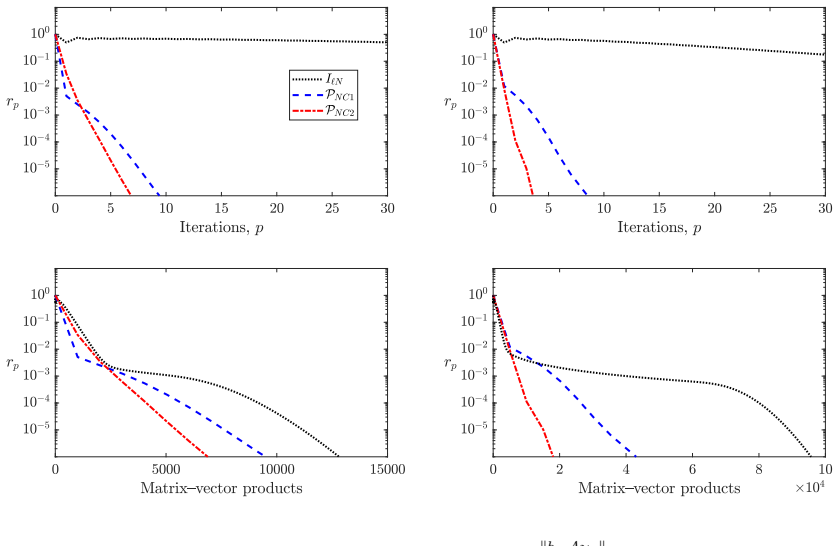
- With unlimited computational resources both inner methods achieve outer iteration counts matching those of the exact best-case block alpha-circulant preconditioner.
- A nested adaptation of the Chebyshev approach reduces work under a limited computational budget while retaining robustness.
- Suitable choices of the parameter alpha make the overall scheme robust when measured by outer iterations and total matrix-vector products.
- The framework extends all-at-once diffusion representations to matrices that lack Fourier diagonalizability.
Where Pith is reading between the lines
- The same inner-solver strategy for approximate circulant preconditioners could transfer to other all-at-once or time-parallel formulations of evolution equations.
- Convergence bounds for the complex subproblems may guide parameter tuning in related iterative methods for statistical estimation beyond the diffusion case.
- Hybrid combinations of these alpha-circulant approximations with other parallel preconditioners might further improve scalability in large data-assimilation pipelines.
Load-bearing premise
The inner block diagonal problems arising from the approximate block alpha-circulant preconditioner can be solved to sufficient accuracy by Chebyshev semi-iteration or saddle-point methods without degrading outer iteration convergence in practice.
What would settle it
A marked increase in outer iteration count or total matrix-vector products when the inner Chebyshev or saddle-point solves are used instead of exact preconditioner application would show that the approximations fail to preserve efficiency.
Figures




read the original abstract
Covariance matrices are central to data assimilation and inverse methods derived from statistical estimation theory. Previous work has considered the application of an all-at-once diffusion-based representation of a covariance matrix operator in order to exploit inherent parallelism in the underlying problem. In this paper, we provide practical methods to apply block $\alpha$-circulant preconditioners to the all-at-once system for the case where the main diffusion operation matrix cannot be readily diagonalized using a discrete Fourier transform. Our new framework applies the block $\alpha$-circulant preconditioner approximately by solving an inner block diagonal problem via a choice of inner iterative approaches. Our first method applies Chebyshev semi-iteration to a symmetric positive definite matrix, shifted by a complex scaling of the identity. We extend theoretical results for Chebyshev semi-iteration in the symmetric positive definite setting, to obtain computable bounds on the asymptotic convergence factor for each of the complex sub-problems. The second approach transforms the complex sub-problem into a (generalized) saddle point system with real coefficients. Numerical experiments reveal that in the case of unlimited computational resources, both methods can match the iteration counts of the `best-case' block $\alpha$-circulant preconditioner. We also provide a practical adaptation to the nested Chebyshev approach, which improves performance in the case of a limited computational budget. Using an appropriate choice of $\alpha$ our new approaches are robust and efficient in terms of outer iterations and matrix--vector products.
Editorial analysis
A structured set of objections, weighed in public.
Referee Report
Summary. The paper develops practical approximate application methods for block α-circulant preconditioners applied to all-at-once linear systems arising from diffusion-based covariance operators, specifically when the underlying diffusion matrix cannot be diagonalized via the discrete Fourier transform. The preconditioner is applied by solving inner block-diagonal complex-shifted problems either via an extension of Chebyshev semi-iteration (with new bounds on the asymptotic convergence factor) or via a real-coefficient generalized saddle-point reformulation. Numerical experiments are presented claiming that, for suitable choices of α, both inner approaches can match the outer GMRES iteration counts of the exact best-case block α-circulant preconditioner under unlimited resources, together with a practical nested-Chebyshev adaptation for limited budgets.
Significance. If the central claims hold, the work supplies usable techniques for deploying α-circulant preconditioners in settings where exact block-diagonal solves are unavailable, which is relevant to parallel-in-time data assimilation and inverse problems. The extension of Chebyshev convergence theory to complex shifts and the saddle-point reformulation constitute concrete technical contributions. The reported numerical matching of outer iteration counts and matvec efficiency for chosen α, if reproducible with explicit inner tolerances, would strengthen the case for these preconditioners in practice.
major comments (2)
- [§3] §3 (theoretical extension): the new bounds on the asymptotic convergence factor for Chebyshev semi-iteration applied to the complex-shifted SPD blocks are derived, but the manuscript does not provide a quantitative link showing how these inner factors control the spectrum of the overall preconditioned operator or the outer GMRES convergence rate; without this transfer result the claim that inner solves preserve best-case outer iteration counts remains unproven.
- [Numerical experiments] Numerical experiments section, Tables 1–3: the reported outer iteration counts and total matvecs for the approximate inner methods are stated to match the exact block α-circulant case, yet the inner iteration tolerances, maximum inner iterations, and resulting effective preconditioner quality are not tabulated or analyzed; this omission makes it impossible to verify that the inner solves do not degrade the outer convergence enough to offset the claimed robustness.
minor comments (2)
- [Abstract] Abstract: the phrase 'matrix--vector products' uses a double hyphen; replace with a single hyphen or en-dash for consistency with journal style.
- [§2] Notation: the parameter α is introduced as a free choice, but its admissible range and any constraints arising from the complex shift in the Chebyshev analysis should be stated explicitly in the first section where the preconditioner is defined.
Simulated Author's Rebuttal
We thank the referee for the careful reading of our manuscript and the constructive comments provided. Below we respond to each major comment in turn, indicating the changes we intend to make to the paper.
read point-by-point responses
-
Referee: [§3] §3 (theoretical extension): the new bounds on the asymptotic convergence factor for Chebyshev semi-iteration applied to the complex-shifted SPD blocks are derived, but the manuscript does not provide a quantitative link showing how these inner factors control the spectrum of the overall preconditioned operator or the outer GMRES convergence rate; without this transfer result the claim that inner solves preserve best-case outer iteration counts remains unproven.
Authors: We appreciate this observation. The bounds we derive control the rate at which the inner Chebyshev iterations converge to the exact solution of the complex-shifted systems. When computational resources are unlimited, one can perform a sufficient number of inner iterations to achieve machine precision accuracy, rendering the approximate preconditioner application identical to the exact block α-circulant preconditioner. Consequently, the outer GMRES iteration counts match those of the best-case scenario by construction, without requiring an additional transfer theorem for this limiting case. For the practical nested-Chebyshev variant with limited budgets, the matching is demonstrated numerically. In the revision, we will clarify this distinction in §3 and the numerical experiments section to make the claims more precise. revision: partial
-
Referee: [Numerical experiments] Numerical experiments section, Tables 1–3: the reported outer iteration counts and total matvecs for the approximate inner methods are stated to match the exact block α-circulant case, yet the inner iteration tolerances, maximum inner iterations, and resulting effective preconditioner quality are not tabulated or analyzed; this omission makes it impossible to verify that the inner solves do not degrade the outer convergence enough to offset the claimed robustness.
Authors: We agree that providing details on the inner solver parameters would enhance reproducibility and allow better assessment of the preconditioner quality. In the revised manuscript, we will include additional information, such as a new table or expanded discussion in the numerical experiments section, specifying the inner iteration tolerances, maximum number of inner iterations employed for each method, and any analysis of the resulting effective preconditioner accuracy relative to the exact case. This will substantiate that the inner solves maintain sufficient quality to preserve the reported outer iteration robustness. revision: yes
Circularity Check
No significant circularity; derivation is self-contained via standard theory and explicit extensions.
full rationale
The paper extends known Chebyshev semi-iteration bounds to complex-shifted SPD matrices and reformulates subproblems as real saddle-point systems using standard algebraic manipulations. These steps are derived directly from the block α-circulant structure and inner solver theory without reducing any central claim (robustness for chosen α, outer iteration counts) to a fitted parameter or self-citation chain. Numerical experiments compare against the exact best-case preconditioner, providing external falsifiability. No load-bearing uniqueness theorem or ansatz is imported from the authors' prior work; the framework remains independent of its own outputs.
Axiom & Free-Parameter Ledger
free parameters (1)
- alpha
axioms (1)
- domain assumption The shifted matrix remains suitable for Chebyshev semi-iteration bounds after complex scaling.
Reference graph
Works this paper leans on
-
[1]
Owe Axelsson. Iterative Solution Methods . Cambridge University Press, Cambridge, UK, 1996
work page 1996
-
[2]
Joseph Bak and Donald J. Newman. Complex Analysis . Springer New York, NY, 2010
work page 2010
-
[3]
Daniele Bertaccini and Michael K. Ng. Block {ω }-circulant preconditioners for the systems of differential equations. Calcolo, 40(2):71–90, 2003
work page 2003
-
[4]
HSL MI20: an efficient AMG precon- ditioner for finite element problems in 3D
Jonathan Boyle, Milan Mihajlovi´ c, and Jennifer Scott. HSL MI20: an efficient AMG precon- ditioner for finite element problems in 3D. International Journal for Numerical Methods in Engineering, 82(1):64–98, 2010
work page 2010
-
[5]
A computational framework for infinite-dimensional Bayesian inverse problems
Tan Bui-Thanh, Omar Ghattas, James Martin, and Georg Stadler . A computational framework for infinite-dimensional Bayesian inverse problems. Part I: The linea rized case, with application to global seismic inversion. SIAM Journal on Scientific Computing , 35(6):A2494–A2523, 2013
work page 2013
-
[6]
Weaver, Philip Browne, Hao Zuo, and M agdalena A
Marcin Chrust, Anthony T. Weaver, Philip Browne, Hao Zuo, and M agdalena A. Balmaseda. Impact of ensemble-based hybrid background-error covariance s in ECMWF’s next generation ocean reanalysis system. Quarterly Journal of the Royal Meteorological Society , 151(767):e4914, 2025
work page 2025
-
[7]
Roland Freund and Stephan Ruscheweyh. On a class of Chebyshe v approximation problems which arise in connection with a conjugate gradient type method. Numerische Mathematik , 48(5):525–542, 1986
work page 1986
-
[8]
Martin J. Gander and Davide Palitta. A new ParaDiag time-parallel t ime integration method. SIAM Journal on Scientific Computing , 46(2):A697–A718, 2024
work page 2024
-
[9]
Tom´ aˇ s Gergelits and Zdenˇ ek Strakoˇ s. Composite convergence bounds based on Chebyshev polyno- mials and finite precision conjugate gradient computations. Numerical Algorithms, 65(4):759–782, 2014
work page 2014
-
[10]
Weaver, Youssef Diouane , and Oliver Guillet
Olivier Goux, Selime G¨ urol, Anthony T. Weaver, Youssef Diouane , and Oliver Guillet. Impact of correlated observation errors on the conditioning of variationa l data assimilation problems. Numerical Linear Algebra with Applications , 31(1):e2529, 2024. 25
work page 2024
-
[11]
Weaver, Xavier Vasseur, Yann Michel, S erge Gratton, and Selime G¨ urol
Oliver Guillet, Anthony T. Weaver, Xavier Vasseur, Yann Michel, S erge Gratton, and Selime G¨ urol. Modelling spatially correlated observation errors in variation al data assimilation using a diffusion operator on an unstructured mesh. Quarterly Journal of the Royal Meteorological Society, 145(722):1947–1967, 2019
work page 1947
-
[12]
Martin H. Gutknecht and Stefan R¨ ollin. The Chebyshev iteratio n revisited. Parallel Computing , 28(2):263–283, 2002
work page 2002
-
[13]
Studies in the history of pro bability and statistics XLIX: On the Mat´ ern correlation family
Peter Guttorp and Tilmann Gneiting. Studies in the history of pro bability and statistics XLIX: On the Mat´ ern correlation family. Biometrika, 93(4):989–995, 2006
work page 2006
-
[14]
Magnus R. Hestenes and Eduard Stiefel. Methods of conjugat e gradients for solving linear sys- tems. Journal of Research of the National Bureau of Standards , 49(6):409–436, 1952
work page 1952
-
[15]
Sean Hon, Po Yin Fun, Jiamei Dong, and Stefano Serra-Capizza no. A sine transform based preconditioned MINRES method for all-at-once systems from cons tant and variable-coefficient evolutionary partial differential equations. Numerical Algorithms, 95(4):1769–1799, 2024
work page 2024
-
[16]
A First Course in the Numerical Analysis of Differential Equa tions
Arieh Iserles. A First Course in the Numerical Analysis of Differential Equa tions. Cambridge University Press, Cambridge, UK, 2008
work page 2008
-
[17]
A preconditio ned MINRES method for block lower triangular Toeplitz systems
Congcong Li, Xuelei Lin, Sean Hon, and Shu-Lin Wu. A preconditio ned MINRES method for block lower triangular Toeplitz systems. Journal of Scientific Computing , 100(3):Art. 63, 2024
work page 2024
-
[18]
An all-at-once preconditioner for ev olutionary partial differential equations
Xue-lei Lin and Michael Ng. An all-at-once preconditioner for ev olutionary partial differential equations. SIAM Journal on Scientific Computing , 43(4):A2766–A2784, 2021
work page 2021
-
[19]
Finn Lindgren, H ˚ avard Rue, and Johan Lindstr¨ om. An explicit link between Gaussian fields and Gaussian Markov random fields: the stochastic partial differential equation approach. Journal of the Royal Statistical Society, Series B (Statistical Metho dology), 73(4):423–498, 2011
work page 2011
-
[20]
A fast block α -circulant preconditioner for all-at-once systems from wave equations
Jun Liu and Shu-Lin Wu. A fast block α -circulant preconditioner for all-at-once systems from wave equations. SIAM Journal on Matrix Analysis and Applications , 41(4):1912–1943, 2020
work page 1912
- [21]
- [22]
-
[23]
Eleanor McDonald, Jennifer Pestana, and Andy Wathen. Preco nditioning and iterative solution of all-at-once systems for evolutionary partial differential equat ions. SIAM Journal on Scientific Computing, 40(2):A1012–A1033, 2018
work page 2018
-
[24]
Richardson’s iteration for n onsymmetric matrices
Gerhard Opfer and Glenn Schober. Richardson’s iteration for n onsymmetric matrices. Linear Algebra and its Applications , 58:343–361, 1984
work page 1984
-
[25]
Christopher C. Paige and Michael A. Saunders. Solution of spar se indefinite systems of linear squations. SIAM Journal on Numerical Analysis , 12(4):617–629, 1975
work page 1975
-
[26]
John W. Pearson and Andrew J. Wathen. A new approximation of the Schur complement in preconditioners for PDE-constrained optimization. Numerical Linear Algebra with Applications , 19(5):816–829, 2012
work page 2012
-
[27]
John W. Ruge and Klaus St¨ uben. Algebraic multigrid. In Stephen F. McCormick, editor, Multi- grid Methods, pages 73–130. SIAM, 1987. 26
work page 1987
-
[28]
Daniel Simpson, Finn Lindgren, and H ˚ avard Rue. In order to ma ke spatial statistics computa- tionally feasible, we need to forget about the covariance function. Environmetrics, 23(1):65–74, 2012
work page 2012
-
[29]
One-shot solution of a time-dependent time-period ic PDE-constrained optimization problem
Martin Stoll. One-shot solution of a time-dependent time-period ic PDE-constrained optimization problem. IMA Journal of Numerical Analysis , 34(4):1554–1577, 2014
work page 2014
-
[30]
Inverse Problem Theory and Methods for Model Parameter Esti mation
Albert Tarantola. Inverse Problem Theory and Methods for Model Parameter Esti mation. SIAM, Philadelphia, PA, 2005
work page 2005
-
[31]
Weaver, Selime G¨ urol, Jean Tshimanga, Marcin Chru st, and Andrea Piacentini
Anthony T. Weaver, Selime G¨ urol, Jean Tshimanga, Marcin Chru st, and Andrea Piacentini. “Time”-Parallel diffusion-based correlation operators. Quarterly Journal of the Royal Meteoro- logical Society, 144(716):2067–2088, 2018
work page 2067
-
[32]
Anthony T. Weaver and Isabelle Mirouze. On the diffusion equatio n and its application to isotropic and anisotropic correlation modelling in variational assimilatio n. Quarterly Journal of the Royal Meteorological Society , 139(670):242–260, 2013
work page 2013
-
[33]
Weaver, Jean Tshimanga, and Andrea Piacentini
Anthony T. Weaver, Jean Tshimanga, and Andrea Piacentini. Co rrelation operators based on an implicitly formulated diffusion equation solved with the Chebyshev itera tion. Quarterly Journal of the Royal Meteorological Society , 142(694):455–471, 2016
work page 2016
-
[34]
Nonstandard norms and robust estimates fo r saddle point problems
Walter Zulehner. Nonstandard norms and robust estimates fo r saddle point problems. SIAM Journal on Matrix Analysis and Applications , 32(2):536–560, 2011. 27
work page 2011
discussion (0)
Sign in with ORCID, Apple, or X to comment. Anyone can read and Pith papers without signing in.