REVIEW 3 major objections 4 minor 138 references
Europium, we have a problem. Modelling r-process enrichment across Local Group galaxies
T0 review · 3 major / 4 minor · reviewed 2026-08-07 · deepseek-v4-flash
Pith's one-line read This paper argues that the same europium-enrichment recipe that fits the Milky Way underproduces europium in Local Group dwarf spheroidal galaxies by about 0.5 dex, and that a strong low-metallicity boost of neutron-star-merger sources…
desk verdict Robust missing-Eu tension in dSphs, but the proposed 40x MNS boost needs a present-day merger-rate check before it can be believed. read the letter →
The pith
A machine-rendered reading of the paper's core claim, the machinery that carries it, and where it could break.
The reading
What carries the argument
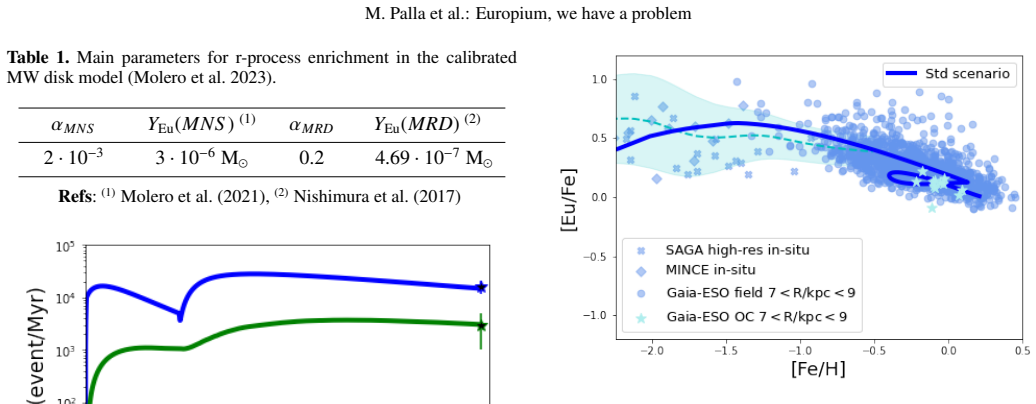
The central object is the chemical-evolution machinery for r-process elements: a two-channel enrichment scheme in which prompt sources (magneto-rotationally driven supernovae, with Eu yield $4.69\times10^{-7}\,M_\odot$ per event) track the star-formation rate, and delayed sources (merging neutron stars, with Eu yield $3\times10^{-6}\,M_\odot$ per event) follow a delay-time distribution. The Milky-Way-calibrated event fractions are $\alpha_{\rm MNS}=2\times10^{-3}$ and $\alpha_{\rm MRD}=0.2$. The argument is carried by step-function modifications to those rates below a metallicity threshold: first a generic "missing Eu" rate $x$ active below [Fe/H]$_{\rm thresh}$, then a multiplicative boost $\alpha_{\rm incr}\approx40$ applied to $\alpha_{\rm MNS}$ below a threshold that must be read as global $Z\simeq0.1\,Z_\odot$ to fit the Milky Way. Maximum-likelihood grids over ($x$, [Fe/H]$_{\rm thresh}$) and ($\alpha_{\rm incr}$, [Fe/H]$_{\rm thresh}$) are what turn the abundance deficits into quantitative parameter estimates.
What would settle it
Measure [Eu/Fe] in Magellanic Clouds stars over [Fe/H] from about -1.5 to -0.5 and locate where the europium excess switches on: the paper's scenario predicts the boost activates at a fixed global metallicity $Z\simeq0.1\,Z_\odot$, which in the Clouds, with their different star-formation history, appears at a different [Fe/H] than in Sculptor or Fornax; if the discontinuity tracks [Fe/H] instead of $Z$, the proposed reconciliation fails.
Extended reading notes
Core claim
The paper's central claim is that the two-source r-process enrichment recipe calibrated to the Milky Way—prompt magneto-rotational supernovae plus delayed neutron-star mergers—systematically underproduces europium in the three most massive Local Group dwarf spheroidals. In Sagittarius, Fornax, and Sculptor the predicted [Eu/Fe] trails the observed trends by roughly 0.5 dex, a deficit that survives even a factor-of-five increase in the merger yield. By fitting a step-like "missing Eu" source, the authors find that dwarfs require an extra europium production rate of about $5\times10^{-10}$ per unit star-formation rate up to [Fe/H] $\simeq -0.5$ dex, roughly four times the combined Milky Way-calibrated production. The only modification that also keeps the Milky Way consistent is to multiply the fraction of massive-star binaries that produce neutron-star mergers by about 40 for stars born below a global metallicity of roughly $0.1\,Z_\odot$, with the threshold expressed in $Z$ rather than [Fe/H]; a comparable boost of prompt supernova-like sources overproduces europium in the Galaxy. The paper therefore concludes that delayed, low-metallicity neutron-star-merger enrichment is a viable unified explanation, while stopping short of a definitive identification.
Load-bearing premise
All four galaxy models assume the same stellar initial mass function and the same europium yields per neutron-star merger and per magneto-rotational supernova, allowing only the event-rate parameters to vary; if yields or the IMF change with metallicity or from galaxy to galaxy, the inferred missing-europium budget and the factor-of-40 boost would be artifacts.
Editorial extensions
If this is right
- The same r-process enrichment framework cannot be transferred unchanged from the Milky Way to dwarf galaxies: matching the dwarf [Eu/Fe] trends requires roughly a factor-of-four increase in the europium production rate normalized to star formation.
- A delayed-source boost—about 40 times more neutron-star-merger progenitors among stars born at $Z\lesssim0.1\,Z_\odot$—reproduces Sagittarius, Fornax, and Sculptor and keeps the Milky Way within about 0.1 dex, provided the threshold is set by global metallicity rather than [Fe/H].
- A comparable prompt-source boost (magneto-rotational supernovae or collapsars) can explain the dwarfs but overproduces europium in the Milky Way by up to 0.4 dex, so it is excluded as a unified solution.
- Metallicity thresholds controlling stellar-binary properties should be phrased in global $Z$, not [Fe/H], because different star-formation histories shift the relation between the two.
- Larger, more homogeneous samples of neutron-capture elements in Local Group dwarfs and the Magellanic Clouds are required to turn the proposed boost from a viable scenario into a firmly measured one.
Reading between the lines
- I infer that the same factor-of-40 boost should leave a visible signature in other pure r-process elements, for example dysprosium or erbium, in these dwarfs, so the scenario could be checked with existing spectra before new surveys arrive.
- I infer that a metallicity-dependent merger fraction as steep as this step function implies a strong enhancement of the binary-neutron-star merger rate at high redshift, which upcoming gravitational-wave detectors could test against the local rate.
- I infer that the step-function threshold is a placeholder for a smooth, metallicity-dependent decline of the merger fraction; fitting a continuous function would refine the $\alpha_{\rm incr}$ estimate and might reduce the required factor.
- I infer that extending this analysis to ultra-faint dwarfs would predict that stochastic europium enrichment there is driven by more low-metallicity mergers than the Milky Way-calibrated rate suggests, changing the predicted scatter and event counts.
Editorial analysis
A structured set of objections, weighed in public.
Referee Report
Summary. The paper applies an r-process enrichment framework calibrated to the Milky Way (MW) to three Local Group dwarf spheroidal galaxies (Sagittarius, Fornax, Sculptor). The framework combines prompt sources (MRD-SNe) and delayed sources (MNS mergers) with yields and event fractions that reproduce MW [Eu/Fe] trends and compact-binary merger rates. The authors find that this MW-calibrated scenario systematically underestimates [Eu/Fe] in the dwarf galaxies by roughly 0.5 dex, even when the MNS yield is increased by a factor of five. They quantify a 'missing Eu' production rate of about 5e-10 per unit SFR up to [Fe/H] approximately -0.5 dex, and then test two remedies: an increased prompt-source contribution at low metallicity and an increased delayed-source (MNS) contribution at low metallicity. The prompt-source scenario is rejected because it overproduces Eu in the MW. The delayed-source scenario, with an MNS fraction boosted by a factor of about 40 below a global-metallicity threshold Z about 2e-3 (mapped to [Fe/H] about -1.33 in the MW model), is presented as the only tested scenario that can approximately reconcile the MW and dwarf trends, with residual discrepancies around 0.1 dex.
Significance. The negative result is significant and well demonstrated: it shows that a state-of-the-art r-process framework tuned to the MW does not extrapolate to other Local Group galaxies, a finding with direct implications for chemical tagging and for identifying the dominant r-process sites. The paper is careful to separate the independent MW calibration from the dwarf predictions, so the 0.5 dex deficit is not a circular artifact. The proposed delayed-source reconciliation, if confirmed, would be an important and falsifiable step. The manuscript also has clear strengths: it tests a factor-of-five yield variation, uses multiple independent datasets for the dwarfs, provides explicit likelihood grids, and acknowledges its simplifications. The main weakness is that the proposed MW-compatible delayed-source model is not checked against the present-day MNS merger rate, which was one of the key constraints that fixed the baseline alpha_MNS in the standard model. Without this check, the central positive claim remains incomplete.
major comments (3)
- The proposed MW model with alpha_incr=40 and a low-metallicity threshold Z approximately 2e-3 is never tested against the present-day MNS merger rate. The standard model's alpha_MNS=2e-3 was explicitly calibrated to reproduce the Abbott et al. (2021) rate (Sec. 4.1, Fig. 4), and Sec. 4.1 rejects an unthresholded increase of alpha_MNS because it would overestimate that rate. The boosted model still raises alpha_MNS by a factor of 40 for all progenitors below the threshold, and with the adopted t^-1 DTD in Eq. (4), low-metallicity stars from the first infall episode can contribute to the present-day merger rate. The paper asserts, without a supporting calculation, that 'minor adjustments' in r-process parameters would preserve observables such as the present-day MNS rate. This missing check is load-bearing for the paper's conclusion that the delayed-source scenario can simultaneously reproduce the MW and dwarf data; the authors should recompute the predicted present-day MNS rate for the dashed model in Fig. 12 and compare it with the Abbott et al. constraint.
- The quantitative parameters of the proposed remedy (the 'missing Eu' rate x~5e-10, [Fe/H]_thresh~-0.55 dex, and alpha_incr~40) are derived from a step-function parameterization combined with a likelihood that assigns all scatter to observational errors and does not include model covariance. The step function is an admitted simplification, but the paper does not demonstrate that the inferred parameters are robust to a smooth metallicity dependence of the enhancement or to the use of [Eu/Mg] as an additional constraint in a joint fit. Since these parameters are directly transferred to the Milky Way model to produce the dashed curves in Fig. 12, the reconciliation claim depends on their robustness. At minimum, sensitivity tests with a smoother threshold or an alternative DTD would establish whether the factor-40 boost is an artifact of the chosen functional form rather than a robust requirement.
- The 'missing Eu' budget is computed under the assumption that the IMF and the r-process yields (Y_Eu(MNS)=3e-6 Msun and Y_Eu(MRD)=4.69e-7 Msun) are identical across all galaxies and independent of metallicity; only the event-fraction parameters alpha_MNS and alpha_MRD are allowed to vary. The paper mentions that alternative IMF formulations were explored but does not report the quantitative outcome, and it does not test metallicity-dependent yields for the prompt source, which dominates the Eu budget in the MW (Sec. 4). If the low-metallicity MRD-SN yield is higher than the adopted value, the inferred missing-Eu rate and the required alpha_incr could shrink substantially. A sensitivity test that varies Y_Eu(MRD) by a factor comparable to the factor-of-five range already explored for MNS would materially strengthen the claim that the deficit is due to missing enrichment rather than to the adopted yield scale.
minor comments (4)
- The sentence 'It is it worth mentioning that in Fig. 1 and throughout this work' contains a duplicated pronoun and should read 'It is worth mentioning...'.
- The phrase 'heavyside step function' should be written as 'Heaviside step function'.
- The word 'likelihhod' in 'does not allow to perform a meaningful likelihhod analysis' is a typo and should be 'likelihood'.
- The phrase 'not considered in our main analysis as due to the disadvantages' is awkward and should be rephrased, for example as 'not considered in our main analysis because of the disadvantages'.
Circularity Check
No significant circularity: the dwarf [Eu/Fe] deficit is an independent benchmark; the delayed-MNS scenario is fitted to dwarfs but checked on Sculptor and the Milky Way, and the unverified merger-rate remark is a correctness gap, not a circular reduction.
full rationale
The negative result (Sec. 4.1, Fig. 6) is not circular: the standard r-process parameters (Table 1) come from the MW-calibrated model of Molero et al. (2023), and the paper recomputes the MW rate and [Eu/Fe] matches (Figs. 4-5) against external data, including the Abbott et al. (2021) merger rate, before applying the same setup to Sgr, For, and Scl. The 0.5 dex deficit is therefore an out-of-sample comparison. The missing-Eu estimate (Sec. 5) is a maximum-likelihood fit of an added production rate and [Fe/H] threshold to the dwarf Eu data; the paper labels it an estimate and does not present the resulting agreement as a prediction. The delayed scenario (Sec. 6.1) fits alpha_incr and [Fe/H]_thresh to Sgr and For; the agreement shown in Fig. 10 is the fit, not independent evidence. The independent content comes from the Scl check (Fig. 11, Scl excluded from the fit) and the MW check (Fig. 12), where the dwarf-fitted alpha_incr = 40 is applied to the MW with the threshold transferred via global Z (about 2e-3) rather than re-fit to MW [Eu/Fe]. That is a genuine consistency test, though not a strong one, because the threshold mapping uses the models' own Z-[Fe/H] relation. The statement in Sec. 6.3 that minor parameter adjustments could recover the small [Eu/Fe] discrepancy 'without compromising the reproduction of observables (e.g. the present-day MNS rate)' is not backed by a recomputation of the boosted model's present-day MW merger rate; this is an omitted check or possible correctness problem, but it is not a circular reduction because no equation forces the MW Eu match to preserve the rate. Self-citations to Molero et al. (2021, 2023) are not load-bearing in a circular sense: the parameters are re-derived or reproduced against external rate and abundance data in this paper. Overall score 0.
Assumptions & free parameters
free parameters (7)
- alpha_MNS (fraction of neutron-star progenitors forming MNS) =
2e-3 (reference; boosted by alpha_incr up to ~40 in the scenario)
- alpha_MRD (fraction of massive stars exploding as MRD-SNe) =
0.2
- Missing Eu rate x (per unit SFR) =
5e-10
- [Fe/H]thresh for the missing Eu source =
-0.55 dex
- alpha_incr (MNS boost factor) =
40 (total weighted); 36 for Fornax, 42 for Sagittarius
- [Fe/H]thresh for the MNS boost =
-0.95 dex (total weighted)
- MW [Fe/H]thresh (Z-mapped) =
-1.33 dex
assumptions (7)
- standard math Chemical evolution equation (1) with instantaneous mixing and the adopted stellar yields (Karakas 2010, Nomoto 2013, Iwamoto 1999).
- domain assumption Same IMF (Kroupa 1993) and same r-process yields in all galaxies.
- domain assumption MNS rate follows the Simonetti et al. (2019) DTD with a 40 Myr plateau and t^-1 decay.
- domain assumption Eu is produced about 97% by the r-process, and yields are scaled from the solar pattern and the AT2017gfo kilonova measurement.
- ad hoc to paper The extra Eu production switches on and off with a step function in metallicity (Eq. 5 and Eq. 6).
- ad hoc to paper The low-metallicity MNS boost threshold is set by global metallicity Z and transfers between galaxies via Z, not [Fe/H].
- domain assumption The conversion of the Abbott et al. (2021) cosmic MNS rate to a Galactic rate of 32+49-24 Myr^-1 and its use to fix alpha_MNS.
invented entities (1)
-
Fictitious 'missing Eu' source with rate x per unit SFR active below [Fe/H]thresh
Cite this review
Pith. "Pith review of Europium, we have a problem. Modelling r-process enrichment across Local Group galaxies." pith.science (2026). https://pith.science/paper/SEHEZ2SD
@misc{pith2026250604066,
  author       = {Pith},
  title        = {Pith review of: Europium, we have a problem. Modelling r-process enrichment across Local Group galaxies},
  year         = {2026},
  howpublished = {\url{https://pith.science/paper/SEHEZ2SD}},
  note         = {Machine review of arXiv:2506.04066}
}
read the original abstract
Context: Europium (Eu) serves as a crucial tracer to understand the origin of rapid neutron-capture process (r-process) elements. An extensive effort was made in the last decade to model the chemical evolution of this element in the Galaxy. However, less attention was reserved to Eu in different galaxies of the Local Group (LG). Aims: By employing detailed and well-tested chemical evolution models, we investigate Eu enrichment across LG dwarf spheroidal galaxies, allowing for a direct comparison between model predictions for dwarf galaxies and the Milky Way (MW). Methods: Building upon an r-process enrichment framework that successfully reproduces the observed Eu abundance patterns as well as the supernova and compact binary merger rates in the MW, we build chemical evolution models for the Sagittarius, Fornax, and Sculptor dwarf spheroidal galaxies and test the enrichment scenario against the abundance patterns observed in these galaxies. Results: Models reproducing the Galactic Eu patterns significantly underestimate the [Eu/Fe] ratios observed in LG dwarfs. To address this "missing Eu" problem, we estimate the Eu production rate needed to match the observations and explore potential contributions either from prompt or delayed sources, assessing their compatibility with the MW observables. Conclusions: The same r-process enrichment frameworks cannot reproduce simultaneously the Eu patterns both in the MW and in dwarf galaxies. However, a scenario where additional Eu is provided by an increased production from delayed sources at low metallicity can theoretically reconcile the trends observed in the MW and in LG dwarfs, because of the small discrepancies (0.1 dex) between model predictions and observations found in this case. Further targeting and modelling of neutron-capture elements in LG galaxies are however needed to fill the gaps in our current understanding of the problem.
Figures


Figures from the paper (8 more)


Reference graph
Works this paper leans on
-
[1]
, " * write output.state after.block = add.period write newline
ENTRY address archiveprefix author booktitle chapter edition editor howpublished institution eprint journal key month note number organization pages publisher school series title type volume year label extra.label sort.label short.list INTEGERS output.state before.all mid.sentence after.sentence after.block FUNCTION init.state.consts #0 'before.all := #1 ...
-
[2]
write newline
" write newline "" before.all 'output.state := FUNCTION n.dashify 't := "" t empty not t #1 #1 substring "-" = t #1 #2 substring "--" = not "--" * t #2 global.max substring 't := t #1 #1 substring "-" = "-" * t #2 global.max substring 't := while if t #1 #1 substring * t #2 global.max substring 't := if while FUNCTION word.in bbl.in " " * FUNCTION format....
-
[3]
P., Abbott , R., Abbott , T
Abbott , B. P., Abbott , R., Abbott , T. D., et al. 2017, , 119, 161101
2017
-
[4]
D., Abraham , S., et al
Abbott , R., Abbott , T. D., Abraham , S., et al. 2021, , 913, L7
2021
-
[5]
J., et al
Alencastro Puls , A., Kuske , J., Hansen , C. J., et al. 2025, , 693, A294
2025
-
[6]
K., Vincenzo , F., Ji , A
Alexander , R. K., Vincenzo , F., Ji , A. P., et al. 2023, , 522, 5415
2023
-
[7]
& Thielemann , F.-K
Arcones , A. & Thielemann , F.-K. 2023, , 31, 1
2023
-
[8]
K., & Qian , Y
Argast , D., Samland , M., Thielemann , F. K., & Qian , Y. Z. 2004, , 416, 997
2004
Show all 138 references
-
[9]
2007, , 450, 97
Arnould , M., Goriely , S., & Takahashi , K. 2007, , 450, 97
2007
-
[10]
J., & Scott , P
Asplund , M., Grevesse , N., Sauval , A. J., & Scott , P. 2009, , 47, 481
2009
-
[11]
L., Cassisi , S., et al
Bettinelli , M., Hidalgo , S. L., Cassisi , S., et al. 2019, , 487, 5862
2019
-
[12]
2011, , 418, 284
Bisterzo , S., Gallino , R., Straniero , O., Cristallo , S., & K \"a ppeler , F. 2011, , 418, 284
2011
-
[13]
I., Lipunov , V
Bogomazov , A. I., Lipunov , V. M., & Tutukov , A. V. 2007, Astronomy Reports, 51, 308
2007
-
[14]
L., Pilachowski , C
Burris , D. L., Pilachowski , C. A., Armandroff , T. E., et al. 2000, , 544, 302
2000
-
[15]
Y., et al
Cappellaro , E., Turatto , M., Tsvetkov , D. Y., et al. 1997, , 322, 431
1997
-
[16]
2021, , 503, 1
Cavallo , L., Cescutti , G., & Matteucci , F. 2021, , 503, 1
2021
-
[17]
2023, , 674, A130
Cavallo , L., Cescutti , G., & Matteucci , F. 2023, , 674, A130
2023
-
[18]
2022, , 668, A168
Cescutti , G., Bonifacio , P., Caffau , E., et al. 2022, , 668, A168
2022
-
[19]
2015, , 577, A139
Cescutti , G., Romano , D., Matteucci , F., Chiappini , C., & Hirschi , R. 2015, , 577, A139
2015
-
[20]
1997, , 477, 765
Chiappini , C., Matteucci , F., & Gratton , R. 1997, , 477, 765
1997
-
[21]
2001, , 554, 1044
Chiappini , C., Matteucci , F., & Romano , D. 2001, , 554, 1044
2001
-
[22]
L., et al
C \^o t \'e , B., Belczynski , K., Fryer , C. L., et al. 2017, , 836, 230
2017
-
[23]
2019, , 875, 106
C \^o t \'e , B., Eichler , M., Arcones , A., et al. 2019, , 875, 106
2019
-
[24]
J., Sneden , C., Lawler , J
Cowan , J. J., Sneden , C., Lawler , J. E., et al. 2021, Reviews of Modern Physics, 93, 015002
2021
-
[25]
de Boer , T. J. L., Belokurov , V., & Koposov , S. 2015, , 451, 3489
2015
-
[26]
de Boer , T. J. L., Tolstoy , E., Hill , V., et al. 2012, , 544, A73
2012
-
[27]
S., Bellido-Tirado , O., Chiappini , C., et al
de Jong , R. S., Bellido-Tirado , O., Chiappini , C., et al. 2012, in Society of Photo-Optical Instrumentation Engineers (SPIE) Conference Series, Vol. 8446, Ground-based and Airborne Instrumentation for Astronomy IV, ed. I. S. McLean , S. K. Ramsay , & H. Takami , 84460T
2012
-
[28]
Dolphin , A. E. 2002, , 332, 91
2002
-
[29]
2024, , 691, A333
Ernandes , H., Feuillet , D., Feltzing , S., & Sk \'u lad \'o ttir , \'A . 2024, , 691, A333
2024
-
[30]
C., Horta , D., et al
Fernandes , L., Mason , A. C., Horta , D., et al. 2023, , 519, 3611
2023
-
[31]
2024, , 686, A295
Fran c ois , P., Cescutti , G., Bonifacio , P., et al. 2024, , 686, A295
2024
-
[32]
& Salvaterra , R
Ghirlanda , G. & Salvaterra , R. 2022, , 932, 10
2022
-
[33]
& Mapelli , M
Giacobbo , N. & Mapelli , M. 2018, , 480, 2011
2018
-
[34]
C., et al
Gilmore , G., Randich , S., Worley , C. C., et al. 2022, , 666, A120
2022
-
[35]
2021, , 500, 1755
Greggio , L., Simonetti , P., & Matteucci , F. 2021, , 500, 1755
2021
-
[36]
& Sauval , A
Grevesse , N. & Sauval , A. J. 1998, , 85, 161
1998
-
[37]
2020, , 492, 2828
Grisoni , V., Cescutti , G., Matteucci , F., et al. 2020, , 492, 2828
2020
-
[38]
2025, , 693, A211
Guo , Y., Storm , N., Bergemann , M., et al. 2025, , 693, A211
2025
-
[39]
J., El-Souri , M., Monaco , L., et al
Hansen , C. J., El-Souri , M., Monaco , L., et al. 2018, , 855, 83
2018
-
[40]
J., Montes , F., & Arcones , A
Hansen , C. J., Montes , F., & Arcones , A. 2014, , 797, 123
2014
-
[41]
J., Primas , F., Hartman , H., et al
Hansen , C. J., Primas , F., Hartman , H., et al. 2012, , 545, A31
2012
-
[42]
N., Klessen , R
Hartwig , T., Ishigaki , M. N., Klessen , R. S., & Yoshida , N. 2019, , 482, 1204
2019
-
[43]
2019, , 626, A15
Hill , V., Sk \'u lad \'o ttir , \'A ., Tolstoy , E., et al. 2019, , 626, A15
2019
-
[44]
R., et al
Hirai , Y., Ishimaru , Y., Saitoh , T. R., et al. 2015, , 814, 41
2015
-
[45]
F., Gurvich , A
Hopkins , P. F., Gurvich , A. B., Shen , X., et al. 2023, , 525, 2241
2023
-
[46]
P., Mackereth , J
Horta , D., Schiavon , R. P., Mackereth , J. T., et al. 2021, , 500, 1385
2021
-
[47]
2018, International Journal of Modern Physics D, 27, 1842005
Hotokezaka , K., Beniamini , P., & Piran , T. 2018, International Journal of Modern Physics D, 27, 1842005
2018
-
[48]
N., Aoki , W., & Chiba , M
Ishigaki , M. N., Aoki , W., & Chiba , M. 2013, , 771, 67
2013
-
[49]
1999, , 125, 439
Iwamoto , K., Brachwitz , F., Nomoto , K., et al. 1999, , 125, 439
1999
-
[50]
2018, , 620, A39
Je r \'a bkov \'a , T., Hasani Zonoozi , A., Kroupa , P., et al. 2018, , 620, A39
2018
-
[51]
P., Frebel , A., Chiti , A., & Simon , J
Ji , A. P., Frebel , A., Chiti , A., & Simon , J. D. 2016 a , , 531, 610
2016
-
[52]
P., Frebel , A., Simon , J
Ji , A. P., Frebel , A., Simon , J. D., & Chiti , A. 2016 b , , 830, 93
2016
-
[53]
R., et al
Kalogera , V., Kim , C., Lorimer , D. R., et al. 2004, , 601, L179
2004
-
[54]
Karakas , A. I. 2010, , 403, 1413
2010
-
[55]
2023, , 678, A87
Karamehmetoglu , E., Sollerman , J., Taddia , F., et al. 2023, , 678, A87
2023
-
[56]
1998, , 498, 541
Kennicutt , Robert C., J. 1998, , 498, 541
1998
-
[57]
2020 a , , 895, 138
Kobayashi , C., Leung , S.-C., & Nomoto , K. 2020 a , , 895, 138
2020
-
[58]
2020 b , , 895, 138
Kobayashi , C., Leung , S.-C., & Nomoto , K. 2020 b , , 895, 138
2020
-
[59]
2012, , 426, 1940
Korobkin , O., Rosswog , S., Arcones , A., & Winteler , C. 2012, , 426, 1940
2012
-
[60]
A., & Gilmore , G
Kroupa , P., Tout , C. A., & Gilmore , G. 1993, , 262, 545
1993
-
[61]
Lanfranchi , G. A. & Matteucci , F. 2004, , 351, 1338
2004
-
[62]
A., Matteucci , F., & Cescutti , G
Lanfranchi , G. A., Matteucci , F., & Cescutti , G. 2008, , 481, 635
2008
-
[63]
Law , D. R. & Majewski , S. R. 2016, in Astrophysics and Space Science Library, Vol. 420, Tidal Streams in the Local Group and Beyond, ed. H. J. Newberg & J. L. Carlin , 31
2016
-
[64]
Lemasle , B., de Boer , T. J. L., Hill , V., et al. 2014, , 572, A88
2014
-
[65]
2010, , 523, A17
Letarte , B., Hill , V., Tolstoy , E., et al. 2010, , 523, A17
2010
-
[66]
2018, , 613, C1
Letarte , B., Hill , V., Tolstoy , E., et al. 2018, , 613, C1
2018
-
[67]
2022, , 931, 147
Li , H., Aoki , W., Matsuno , T., et al. 2022, , 931, 147
2022
-
[68]
A., Palla , M., et al
Liberatori , A., Alvarez Garay , D. A., Palla , M., et al. 2025, arXiv e-prints, arXiv:2506.02476
2025 arXiv
-
[69]
J., Rizzuti , F., et al
Lombardo , L., Hansen , C. J., Rizzuti , F., et al. 2025, , 693, A293
2025
-
[70]
MacFadyen , A. I. & Woosley , S. E. 1999, , 524, 262
1999
-
[71]
2023, , 669, A119
Magrini , L., Viscasillas V \'a zquez , C., Spina , L., et al. 2023, , 669, A119
2023
-
[72]
M., Matteucci , F., & Costa , R
Marcon-Uchida , M. M., Matteucci , F., & Costa , R. D. D. 2010, , 520, A35
2010
-
[73]
2017, , 604, A129
Mashonkina , L., Jablonka , P., Pakhomov , Y., Sitnova , T., & North , P. 2017, , 604, A129
2017
-
[74]
2021, , 650, A110
Matsuno , T., Hirai , Y., Tarumi , Y., et al. 2021, , 650, A110
2021
-
[75]
2012, Chemical Evolution of Galaxies
Matteucci , F. 2012, Chemical Evolution of Galaxies
2012
-
[76]
2021, , 29, 5
Matteucci , F. 2021, , 29, 5
2021
-
[77]
& Brocato , E
Matteucci , F. & Brocato , E. 1990, , 365, 539
1990
-
[78]
& Recchi , S
Matteucci , F. & Recchi , S. 2001, , 558, 351
2001
-
[79]
2014, , 438, 2177
Matteucci , F., Romano , D., Arcones , A., Korobkin , O., & Rosswog , S. 2014, , 438, 2177
2014
-
[80]
2009, , 501, 531
Matteucci , F., Spitoni , E., Recchi , S., & Valiante , R. 2009, , 501, 531
2009
-
[81]
F., et al
McKenzie , M., Yong , D., Marino , A. F., et al. 2022, , 516, 3515
2022
-
[82]
McMillan , P. J. 2017, , 465, 76
2017
-
[83]
2013, , 778, 149
McWilliam , A., Wallerstein , G., & Mottini , M. 2013, , 778, 149
2013
-
[84]
Melioli , C., Brighenti , F., D'Ercole , A., & de Gouveia Dal Pino , E. M. 2009, , 399, 1089
2009
-
[85]
& Vanbeveren , D
Mennekens , N. & Vanbeveren , D. 2014, , 564, A134
2014
-
[86]
2023, , 669, A54
Minelli , A., Bellazzini , M., Mucciarelli , A., et al. 2023, , 669, A54
2023
-
[87]
Mishenina , T. V. & Kovtyukh , V. V. 2001, , 370, 951
2001
-
[88]
2023, , 523, 2974
Molero , M., Magrini , L., Matteucci , F., et al. 2023, , 523, 2974
2023
-
[89]
2025, , 694, A274
Molero , M., Magrini , L., Palla , M., et al. 2025, , 694, A274
2025
-
[90]
2021, , 505, 2913
Molero , M., Romano , D., Reichert , M., et al. 2021, , 505, 2913
2021
-
[91]
2007, , 464, 201
Monaco , L., Bellazzini , M., Bonifacio , P., et al. 2007, , 464, 201
2007
-
[92]
L., et al
Monty , S., Belokurov , V., Sanders , J. L., et al. 2024, , 533, 2420
2024
-
[93]
2017, , 605, A46
Mucciarelli , A., Bellazzini , M., Ibata , R., et al. 2017, , 605, A46
2017
-
[94]
Nishimura , N., Sawai , H., Takiwaki , T., Yamada , S., & Thielemann , F. K. 2017, , 836, L21
2017
-
[95]
2015, , 810, 109
Nishimura , N., Takiwaki , T., & Thielemann , F.-K. 2015, , 810, 109
2015
-
[96]
2013, , 51, 457
Nomoto , K., Kobayashi , C., & Tominaga , N. 2013, , 51, 457
2013
-
[97]
2021, , 503, 3216
Palla , M. 2021, , 503, 3216
2021
-
[98]
2024 a , , 528, 2407
Palla , M., De Looze , I., Rela \ n o , M., et al. 2024 a , , 528, 2407
2024
-
[99]
2024 b , , 690, A334
Palla , M., Magrini , L., Spitoni , E., et al. 2024 b , , 690, A334
2024
-
[100]
2020 a , , 889, 4
Palla , M., Matteucci , F., Calura , F., & Longo , F. 2020 a , , 889, 4
2020
-
[101]
2020 b , , 498, 1710
Palla , M., Matteucci , F., Spitoni , E., Vincenzo , F., & Grisoni , V. 2020 b , , 498, 1710
2020
-
[102]
2022, , 663, A125
Palla , M., Santos-Peral , P., Recio-Blanco , A., & Matteucci , F. 2022, , 663, A125
2022
-
[103]
D., Cehula , J., et al
Patel , A., Metzger , B. D., Cehula , J., et al. 2025, , 984, L29
2025
-
[104]
2020, , 491, 1832
Prantzos , N., Abia , C., Cristallo , S., Limongi , M., & Chieffi , A. 2020, , 491, 1832
2020
-
[105]
2022, , 666, A121
Randich , S., Gilmore , G., Magrini , L., et al. 2022, , 666, A121
2022
-
[106]
J., Hanke , M., et al
Reichert , M., Hansen , C. J., Hanke , M., et al. 2020, , 641, A127
2020
-
[107]
\'A ., et al
Reichert , M., Obergaulinger , M., Aloy , M. \'A ., et al. 2023, , 518, 1557
2023
-
[108]
\'A ., & Arcones , A
Reichert , M., Obergaulinger , M., Eichler , M., Aloy , M. \'A ., & Arcones , A. 2021, , 501, 5733
2021
-
[109]
Roederer , I. U. 2011, , 732, L17
2011
-
[110]
U., Preston , G
Roederer , I. U., Preston , G. W., Thompson , I. B., et al. 2014, , 147, 136
2014
-
[111]
2015, , 446, 4220
Romano , D., Bellazzini , M., Starkenburg , E., & Leaman , R. 2015, , 446, 4220
2015
-
[112]
I., Tosi , M., & Matteucci , F
Romano , D., Karakas , A. I., Tosi , M., & Matteucci , F. 2010, , 522, A32
2010
-
[113]
2021, , 653, A72
Romano , D., Magrini , L., Randich , S., et al. 2021, , 653, A72
2021
-
[114]
2021, , 83, 101498
Rozwadowska , K., Vissani , F., & Cappellaro , E. 2021, , 83, 101498
2021
-
[115]
Sch \"o nrich , R. A. & Weinberg , D. H. 2019, , 487, 580
2019
-
[116]
M., Barnes , J., & Metzger , B
Siegel , D. M., Barnes , J., & Metzger , B. D. 2019, , 569, 241
2019
-
[117]
H., Dotter , A., Majewski , S
Siegel , M. H., Dotter , A., Majewski , S. R., et al. 2007, , 667, L57
2007
-
[118]
D., Brown , T
Simon , J. D., Brown , T. M., Mutlu-Pakdil , B., et al. 2023, , 944, 43
2023
-
[119]
2019, , 486, 2896
Simonetti , P., Matteucci , F., Greggio , L., & Cescutti , G. 2019, , 486, 2896
2019
-
[120]
A., Amarsi , A
Sk \'u lad \'o ttir , \'A ., Puls , A. A., Amarsi , A. M., et al. 2023, The Messenger, 190, 19
2023
-
[121]
& Salvadori , S
Sk \'u lad \'o ttir , \'A . & Salvadori , S. 2020, , 634, L2
2020
-
[122]
2022, Universe, 8, 87
Spina , L., Magrini , L., & Cunha , K. 2022, Universe, 8, 87
2022
-
[123]
2009, , 504, 87
Spitoni , E., Matteucci , F., Recchi , S., Cescutti , G., & Pipino , A. 2009, , 504, 87
2009
-
[124]
2019, , 623, A60
Spitoni , E., Silva Aguirre , V., Matteucci , F., Calura , F., & Grisoni , V. 2019, , 623, A60
2019
-
[125]
2020, , 635, A58
Spitoni , E., Verma , K., Silva Aguirre , V., & Calura , F. 2020, , 635, A58
2020
-
[126]
2021, , 647, A73
Spitoni , E., Verma , K., Silva Aguirre , V., et al. 2021, , 647, A73
2021
-
[127]
2008, , 60, 1159
Suda , T., Katsuta , Y., Yamada , S., et al. 2008, , 60, 1159
2008
-
[128]
K., Eichler , M., Panov , I
Thielemann , F. K., Eichler , M., Panov , I. V., & Wehmeyer , B. 2017, Annual Review of Nuclear and Particle Science, 67, 253
2017
-
[129]
2021, , 920, L32
Tsujimoto , T. 2021, , 920, L32
2021
-
[130]
2023, , 670, A129
Van der Swaelmen , M., Viscasillas V \'a zquez , C., Cescutti , G., et al. 2023, , 670, A129
2023
-
[131]
2024, , 683, A121
Vasini , A., Spitoni , E., & Matteucci , F. 2024, , 683, A121
2024
-
[132]
2015, , 449, 1327
Vincenzo , F., Matteucci , F., Recchi , S., et al. 2015, , 449, 1327
2015
-
[133]
Vincenzo , F., Matteucci , F., Vattakunnel , S., & Lanfranchi , G. A. 2014, , 441, 2815
2014
-
[134]
2022, , 660, A135
Viscasillas V \'a zquez , C., Magrini , L., Casali , G., et al. 2022, , 660, A135
2022
-
[135]
2021, , 505, 5862
Wanajo , S., Hirai , Y., & Prantzos , N. 2021, , 505, 5862
2021
-
[136]
J., Selsing , J., et al
Watson , D., Hansen , C. J., Selsing , J., et al. 2019, , 574, 497
2019
-
[137]
2012, , 750, L22
Winteler , C., K \"a ppeli , R., Perego , A., et al. 2012, , 750, L22
2012
-
[138]
Woosley , S. E. & Heger , A. 2006, , 637, 914
2006
Reviewed August 7, 2026 · model on record in the stance chip above.
Discussion (0). Sign in to comment.