REVIEW 3 major objections 5 minor 83 references
Investigating the HI distribution and kinematics of ESO444-G084 and [KKS2000]23: New insights from the MHONGOOSE survey
T0 review · 3 major / 5 minor · reviewed 2026-08-07 · deepseek-v4-flash
Pith's one-line read The paper claims that two isolated dwarf galaxies with similar rotation speeds conceal opposite dark matter structures: one compact and dense, the other diffuse and cored.
desk verdict A useful two-galaxy MeerKAT study whose headline halo-density contrast rests on an under-tested inner rotation-curve fit, not the M/L assumption. read the letter →
The pith
A machine-rendered reading of the paper's core claim, the machinery that carries it, and where it could break.
The reading
What carries the argument
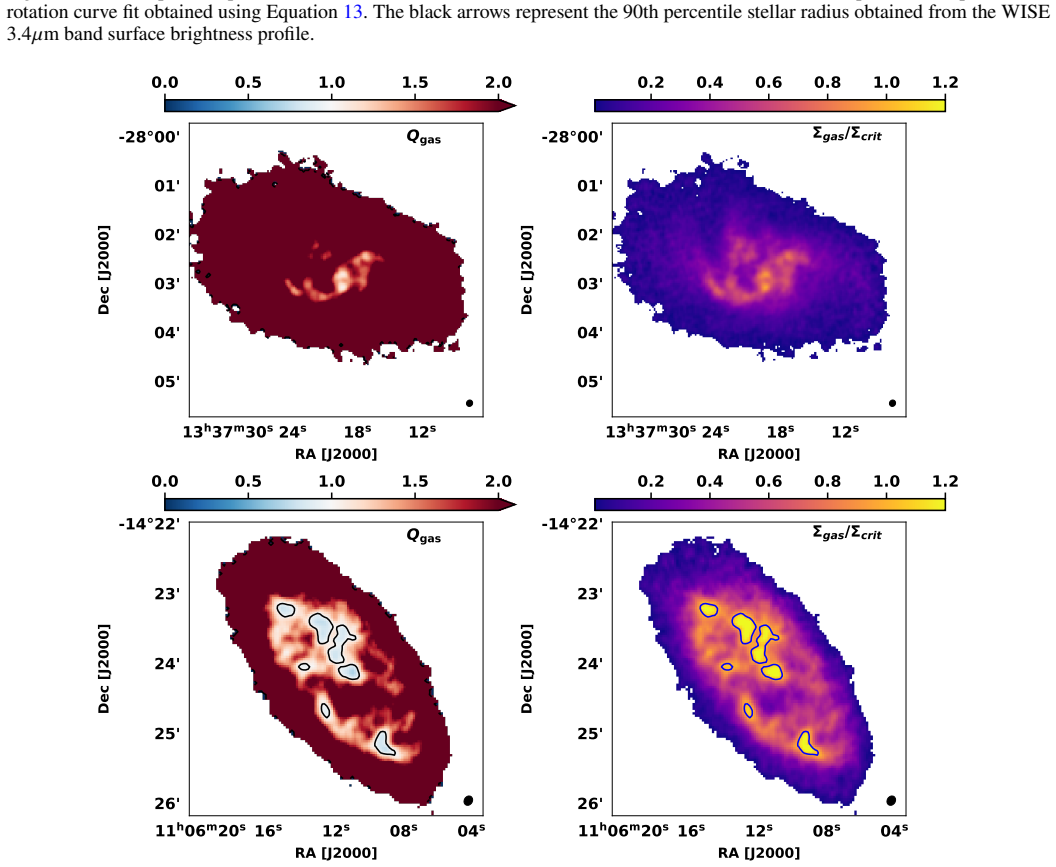
The argument is carried by 3D tilted-ring kinematic fitting (the TiRiFiC and PyFAT codes) applied directly to the HI data cubes, which corrects for beam smearing and allows separate approaching- and receding-side rotation curves. The rotation curves are corrected for asymmetric drift using the pressure-gradient formula of Meurer et al. (1996), and then decomposed with the pseudo-isothermal (ISO) halo profile $\rho(r) = \rho_0/[1+(r/r_c)^2]$ inside a rotation-curve fitting routine that fixes the stellar disk via WISE 3.4-micron surface brightness and a mass-to-light ratio, and the gas disk via HI surface density scaled by 1.4 for helium. The two fitted halo parameters, central density $\rho_0$ and core radius $r_c$, are what the paper compares between the two galaxies. Disk stability is assessed through pixel-by-pixel Toomre $Q_{\rm gas}$ and $\Sigma_{\rm gas}/\Sigma_{\rm crit}$ maps, with uncertainties propagated from the rotation curve, velocity dispersion, and gas surface density.
What would settle it
A direct test would measure the stellar mass-to-light ratios independently, for example by fitting the full optical-to-infrared spectral energy distribution or using resolved stellar populations, and then re-fitting the isothermal halo parameters. If the true $M/L$ for ESO444-G084 is close to 0.5, its fitted core radius expands from 3.48 to 5.84 kpc and becomes unconstrained, erasing the factor-of-four central-density contrast; alternatively, a high-resolution inner rotation curve using CO or H-alpha integral-field data inside 1 kpc would show whether the fast rise is real or smoothed by the beam.
Extended reading notes
Core claim
On its own terms, the paper's central claim is that high-sensitivity, high-resolution HI observations resolve two contrasting dwarf galaxy states. ESO444-G084 shows smooth, centrally concentrated neutral hydrogen with a kinematic warp beyond roughly 1.8 kpc and a fast-rising rotation curve, which the authors interpret as a centrally concentrated dark matter halo; [KKS2000]23 shows clumpy, asymmetric HI and a gently rising rotation curve that continues to climb past 6 kpc, indicating a more extended, cored dark matter halo. Using a pseudo-isothermal halo and WISE-based stellar mass-to-light ratios of 0.20 and 0.18 respectively, the fitted core radii are $3.48\pm0.57$ kpc and $5.49\pm0.60$ kpc, and the central dark matter densities differ by nearly a factor of four. The rotation curves, after asymmetric-drift correction, imply disk-like kinematics in both galaxies, with no significant radial inflows or outflows detected. The paper further claims that spatially resolved Toomre $Q$ maps and $\Sigma_{\rm gas}/\Sigma_{\rm crit}$ maps show ESO444-G084 remains globally stable while its H$\alpha$ and FUV emission indicate localized star formation, whereas [KKS2000]23 has unstable regions yet weak H$\alpha$, suggesting that turbulence, gas depletion, or past feedback suppresses star formation.
Load-bearing premise
The load-bearing premise is that the adopted stellar mass-to-light ratios ($0.20$ for ESO444-G084 and $0.18$ for [KKS2000]23, from the WISE color relation) correctly fix the stellar disk's contribution; if the true values are higher, the fitted halo densities and core radii change substantially, and the paper's own $M/L = 0.5$ test shows the concentrated-halo reading of ESO444-G084 would lose its constraint.
Editorial extensions
If this is right
- Dwarf galaxy dark matter halos are not uniform: two isolated galaxies of similar rotation speed can differ by a factor of about four in central dark-matter density, so mass models of individual dwarfs matter more than averaged scaling relations.
- A fast-rising HI rotation curve does not require a cuspy NFW halo; the pseudo-isothermal cored profile fits ESO444-G084, so conclusions about cusps versus cores must come from full fits rather than curve steepness alone.
- Gravitational instability is neither necessary nor sufficient for star formation in dwarfs: ESO444-G084 forms stars while globally stable, and [KKS2000]23 is unstable yet has little recent H-alpha emission.
- The FUV-to-H-alpha ratio difference implies that recent star formation has declined in [KKS2000]23 relative to the past 100 million years, pointing to episodic, internally regulated star-formation cycles.
- With no detectable inflows or outflows at the survey's sensitivity, internal gas dynamics and feedback, not gas accretion, set the current star-formation behavior in these dwarfs.
Reading between the lines
- Beyond the paper, if the adopted stellar mass-to-light ratios are even moderately underestimated, the claimed halo contrast weakens: the paper itself finds that raising both $M/L$ values to 0.5 moves ESO444-G084's core radius from 3.48 to 5.84 kpc and leaves it unconstrained, so an independent stellar-mass estimate from full spectral energy distribution fitting would directly test the concentrated
- Beyond the paper, the beam-size interpretation of the HI diameter growth at low column density could be checked by observing a few dwarfs with the same integration time at even lower angular resolution or with longer baselines; if genuinely faint extended gas exists below the current surface-brightness limit, it would alter total HI masses and outer rotation curves.
- Beyond the paper, comparing the spatially resolved $Q$ maps with molecular gas tracers would sharpen the stability-versus-star-formation puzzle: if [KKS2000]23 has no molecular clouds despite its instability, that would support the turbulence-suppression picture, whereas finding dense gas would shift the explanation toward feedback or depletion history.
- Beyond the paper, the two galaxies may bracket an evolutionary sequence, with the compact-halo dwarf in a stable, star-forming state and the cored-halo dwarf in a post-burst, quiescent state; resolved stellar-population ages or color maps would test whether halo structure and star-formation phase are causally linked or merely correlated.
Editorial analysis
A structured set of objections, weighed in public.
Referee Report
Summary. This paper presents MeerKAT/MHONGOOSE 21-cm HI observations of two nearby isolated dwarf irregular galaxies, ESO444-G084 and [KKS2000]23. The authors measure total HI fluxes and masses, derive rotation curves with the 3D tilted-ring codes PyFAT and TiRiFiC, apply an asymmetric-drift correction, fit pseudo-isothermal dark matter halo models to the circular velocities, and construct spatially resolved Toomre Q and Sigma_gas/Sigma_crit maps to connect disk stability with H-alpha and FUV star-formation tracers. The central physical claim is that the two dwarfs have contrasting dark matter distributions: ESO444-G084 has a high central halo density (rho0 = 16.05 +/- 1.45 x 10^-3 Msun pc^-3 at adopted M/L=0.2) and a relatively fast-rising rotation curve, whereas [KKS2000]23 has a lower central density (4.29 +/- 0.43 x 10^-3) and a more gradual rise, implying a more extended, cored halo. The paper also reports a kinematic warp in ESO444-G084, the absence of detectable inflows/outflows, and contrasting star-formation states: localized star formation in ESO444-G084 despite global stability, and gravitational instability in [KKS2000]23 despite weak H-alpha emission.
Significance. If the central density contrast is robust, the paper provides a useful addition to the small set of low-mass galaxies with well-resolved HI rotation curves and dark matter decompositions, and it sharpens the observational picture of dwarf-galaxy halo diversity. The strengths of the manuscript are the high-quality 50-hour MeerKAT data, the use of established 3D kinematic modeling pipelines, the detailed channel-map and position-velocity comparisons, and the explicit uncertainty maps for the stability diagnostics. The mass-modeling and stability analysis are presented transparently, with both WISE-based and alternative mass-to-light ratios explored. The principal significance rests on a single comparison of two galaxies, so the result is suggestive rather than statistical, but it is a legitimate case study.
major comments (3)
- [Section 5.2.1, Eq. (8), Table 8] The central claim of a factor ~3.7 difference in central isothermal halo density rho0 is set primarily by the inner slope of the rotation curve, because V_iso^2 ~ (4*pi*G*rho0/3) r^2 for r << r_c (Eq. 8). For ESO444-G084 that slope is measured in a region where the paper reports radial velocities of up to ~20 km/s (Section 5.2.1, Fig. 6) while V_rot is only ~10-35 km/s over the same radii (Table 5), and the TiRiFiC model explicitly includes a fitted radial-velocity term with a manually guided iterative fit. The paper does not report a control fit with V_rad fixed to zero, nor does it give confidence contours in the (rho0, r_c) plane that include the V_rot-V_rad covariance. Without such a test, the reader cannot assess whether the fast-rise/concentrated-halo interpretation is robust or is partly an artifact of the non-circular-motion degeneracy. Please add a control fit or otherwise quantify how much rho0 and r_c shift when V_rad is forced to zero or varied over its plausible range.
- [Section 6.4, Table 8] The adopted stellar mass-to-light ratio is a load-bearing input for the absolute halo parameters. The paper's own Table 8 shows that for ESO444-G084, changing (M/L)_3.4 from 0.2 to 0.5 changes rho0 from 16.05 to 11.47 x 10^-3 Msun pc^-3 and makes the core radius poorly constrained (5.84 +/- 2.64 kpc, similar to or larger than the outermost data point). The qualitative ESO-versus-KKS contrast survives this change, but the magnitude of the central concentration and the 'centrally concentrated halo' wording depend on the adopted M/L. Please either present the halo parameter constraints as a function of M/L over a plausible range (e.g., 0.1-0.6) or marginalize over M/L with a prior, rather than quoting a single WISE-based value as the headline result.
- [Section 5.2.1 versus Abstract and Conclusions] There is a direct internal tension in the description of ESO444-G084's rotation curve. Section 5.2.1 states that the curve exhibits a gradual rise in the inner region (R < 2 kpc) 'rather than the steep, abrupt increase expected for an NFW-like halo,' while the abstract and conclusions call it 'fast-rising' and use it to support a centrally concentrated dark matter distribution. Please reconcile these statements by defining a quantitative measure of 'fast' versus 'gradual' (e.g., V(2 kpc)/V_max, logarithmic slope, or rise time) and apply the same measure to both galaxies.
minor comments (5)
- [Table 6] The table caption reads '[KKS2000]2' but should read '[KKS2000]23'.
- [Eq. (2)] The quantity b in the asymmetric-drift equation is used but never defined; please state explicitly that it is the one-dimensional velocity dispersion and clarify the relation between b and sigma_D.
- [Section 4.2] The sentence 'The velocity and dispersion maps included in Fig. 2 will be analyzed in detail in Section 5' appears to refer to the [KKS2000]23 maps, which are shown in Fig. 3 rather than Fig. 2; please correct the cross-reference.
- [Section 8.3] The reference to 'Girelli et al. 2020' is preceded by a stray '?' in the text; please fix the citation formatting.
- [Section 7, Eq. (14)-(16)] The uncertainty propagation for Q_gas and Sigma_gas/Sigma_crit uses only absolute values of first-order partial derivatives and ignores covariance terms between kappa, Sigma, and sigma_HI; since kappa itself comes from a fitted rotation curve, please state this simplification or include the leading covariance terms.
Circularity Check
No significant circularity: the rotation curves are observed inputs, halo parameters are fit to them, and no claim reduces to its own input by construction.
full rationale
The paper's derivation chain is self-contained against external data. Rotation curves are measured from the MeerKAT cubes via 3D tilted-ring modeling (Section 5), and the dark matter halo parameters in Table 8 are obtained by fitting the pseudo-isothermal circular-velocity profile (Eq. 8) to those curves, with baryonic contributions fixed by an externally calibrated WISE-based M/L. The central-density comparison (rho0 = 16.05 vs 4.29 x 10^-3 M_sun pc^-3) is therefore a fitted result, not a prediction that reduces to its input. The Toomre-Q / stability analysis uses the same rotation information through Eq. (13) as a smooth parameterization of the observed kinematics, and the stability criterion is not fed back into the mass-model fit, so this is a diagnostic applied after fitting rather than a circular derivation. Citations to de Blok et al. (2024), TiRiFiC, and PyFAT are data and software provenance, not load-bearing self-citations; the ISO halo is adopted as an explicit empirical model with stated alternatives, not smuggled in via a self-citation. The paper's own caveats, such as the M/L = 0.5 case leaving the core radius only weakly constrained and radial motions up to ~20 km/s in the inner region of ESO444-G084, are robustness and systematic-uncertainty issues, not circularity. The broken citation '?Girellietal.2020' in Section 8.3 is a completeness/formatting artefact and does not affect the circularity verdict. No equation or conclusion is equivalent to its own input by construction.
Assumptions & free parameters
free parameters (7)
- (M/L)*3.4um for ESO444-G084 =
0.20
- (M/L)*3.4um for [KKS2000]23 =
0.18
- ISO halo core radius r_c for ESO444-G084 =
3.48 +/- 0.57 kpc
- ISO halo central density rho0 for ESO444-G084 =
(16.05 +/- 1.45) x 10^-3 M_sun pc^-3
- ISO halo core radius r_c for [KKS2000]23 =
5.49 +/- 0.60 kpc
- ISO halo central density rho0 for [KKS2000]23 =
(4.29 +/- 0.43) x 10^-3 M_sun pc^-3
- V_flat and l_flat in Eq. 13 for both galaxies =
not reported in text
assumptions (6)
- domain assumption Galaxies are axisymmetric and in dynamical equilibrium so that circular velocity traces total gravitational potential (Eq. 3)
- domain assumption Molecular gas contribution is negligible
- domain assumption Helium correction factor of 1.4
- domain assumption Stellar disk is infinitely thin in ROTMOD
- domain assumption Scale height gradient is negligible in pressure gradient correction (d ln h_z/dR = 0)
- domain assumption Pseudo-isothermal (ISO) halo model describes the dark matter density profile
Cite this review
Pith. "Pith review of Investigating the HI distribution and kinematics of ESO444-G084 and [KKS2000]23: New insights from the MHONGOOSE survey." pith.science (2026). https://pith.science/paper/MP3FFLOZ
@misc{pith2026250604101,
  author       = {Pith},
  title        = {Pith review of: Investigating the HI distribution and kinematics of ESO444-G084 and [KKS2000]23: New insights from the MHONGOOSE survey},
  year         = {2026},
  howpublished = {\url{https://pith.science/paper/MP3FFLOZ}},
  note         = {Machine review of arXiv:2506.04101}
}
read the original abstract
We present the HI distribution, kinematics, mass modeling, and disk stability of the dwarf irregular galaxies ESO444-G084 and [KKS2000]23 using high-resolution, high-sensitivity MHONGOOSE survey data from MeerKAT. ESO444-G084 shows centrally concentrated HI emission, while [KKS2000]23 exhibits irregular high-density clumps. Total HI fluxes measured down to 10^19 and 10^18 cm^-2 are nearly identical, indicating that the increased HI diameter at lower column densities results mainly from the larger beam, with no significant extra emission detected. We derive total HI masses of (1.1 +/- 0.1) x 10^8 and (6.1 +/- 0.3) x 10^8 solar masses for ESO444-G084 and [KKS2000]23, respectively. Using PyFAT and TiRiFiC, we extract 3D rotation curves that reveal disk-like kinematics in both galaxies. ESO444-G084 shows a warp beyond ~1.8 kpc and a fast-rising curve consistent with a centrally concentrated dark matter distribution, while [KKS2000]23's more gradual rise suggests a more extended halo. Mass modeling with an isothermal halo and stellar mass-to-light ratios of 0.20 for ESO444-G084 and 0.18 for [KKS2000]23 yields consistent results. We analyze disk stability using spatially resolved Toomre Q and gas-to-critical surface density ratios, linking these with H-alpha and FUV-based star formation. ESO444-G084 supports localized star formation despite global stability, while [KKS2000]23 appears gravitationally unstable yet lacks H-alpha, suggesting that turbulence, gas depletion, or past feedback suppresses star formation. No inflows or outflows are detected, indicating internal processes regulate star formation. This study highlights the interplay between HI morphology, kinematics, dark matter distribution, and disk stability, showing how internal processes shape dwarf galaxy evolution.
Figures


Figures from the paper (14 more)




Reference graph
Works this paper leans on
-
[1]
& Bureau, M
Athanassoula, E. & Bureau, M. 1999, ApJ, 522, 699
1999
-
[2]
G., Staveley-Smith, L., de Blok, W
Barnes, D. G., Staveley-Smith, L., de Blok, W. J. G., et al. 2001, MNRAS, 322, 486
2001
-
[3]
Begeman, K. G. 1989, A&A, 223, 47
1989
-
[4]
Begeman, K. G., Broeils, A. H., & Sanders, R. H. 1991, MNRAS, 249, 523 Begum,A.,Chengalur,J.N.,Karachentsev,I.D.,Sharina,M.E.,&Kaisin,S.S. 2008, MNRAS, 386, 1667
work page 1991
-
[5]
2008, AJ, 136, 2846
Bigiel, F., Leroy, A., Walter, F., et al. 2008, AJ, 136, 2846
2008
-
[6]
Blais-Ouellette, S., Amram, P., Carignan, C., & Swaters, R. 2004, A&A, 420, 147
work page 2004
-
[7]
1978, PhD thesis, University of Groningen, Netherlands
Bosma, A. 1978, PhD thesis, University of Groningen, Netherlands
1978
-
[8]
Bullock, J. S. & Boylan-Kolchin, M. 2017, ARA&A, 55, 343
2017
Show all 83 references
-
[9]
2018, ApJ, 856, 180
Camilo, F., Scholz, P., Serylak, M., et al. 2018, ApJ, 856, 180
2018
-
[10]
& Freeman, K
Carignan, C. & Freeman, K. C. 1985, ApJ, 294, 494
1985
-
[11]
& Freeman, K
Carignan, C. & Freeman, K. C. 1988, ApJ, 332, L33
1988
-
[12]
& Purton, C
Carignan, C. & Purton, C. 1998, ApJ, 506, 125
1998
-
[13]
D., Machacek, M
Carlson, E. D., Machacek, M. E., & Hall, L. J. 1992, ApJ, 398, 43
1992
-
[14]
M., Saintonge, A., et al
Chamba, N., Marcum, P. M., Saintonge, A., et al. 2024, ApJ, 974, 247
2024
-
[15]
E., Jarrett, T
Cluver, M. E., Jarrett, T. H., Hopkins, A. M., et al. 2014, ApJ, 782, 90 Côté, S., Carignan, C., & Freeman, K. C. 2000, AJ, 120, 3027
2014
-
[16]
A., Cohen, S
Dale, D. A., Cohen, S. A., Johnson, L. C., et al. 2009, ApJ, 703, 517 de Blok, W. J. G. 2010, Advances in Astronomy, 2010, 789293 de Blok, W. J. G., Athanassoula, E., Bosma, A., et al. 2020, A&A, 643, A147 de Blok, W. J. G., Healy, J., Maccagni, F. M., et al. 2024, A&A, 688, A...
2009
-
[17]
J., Lang, D., et al
Dey, A., Schlegel, D. J., Lang, D., et al. 2019, AJ, 157, 168 Di Cintio, A., Brook, C. B., Dutton, A. A., et al. 2014, MNRAS, 441, 2986 Di Teodoro, E. M. & Fraternali, F. 2015, MNRAS, 451, 3021
2019
-
[18]
Downing, E. R. & Oman, K. A. 2023, MNRAS, 522, 3318
2023
-
[19]
A., Obreja, A., & Macciò, A
Dutton, A. A., Obreja, A., & Macciò, A. V. 2019, MNRAS, 482, 5606
2019
-
[20]
Elmegreen, B. G. 2002, ApJ, 577, 206
2002
-
[21]
Elmegreen, B. G. & Hunter, D. A. 2015, ApJ, 805, 145
2015
-
[22]
C., de Blok, W
Elson, E. C., de Blok, W. J. G., & Kraan-Korteweg, R. C. 2012, AJ, 143, 1
2012
-
[23]
Flores, R. A. & Primack, J. R. 1994, ApJ, 427, L1 Article number, page 21 of 22 A&A proofs: manuscript no. b
1994
-
[24]
2017, A&A, 606, A47
Fragkoudi, F., Di Matteo, P., Haywood, M., et al. 2017, A&A, 606, A47
2017
-
[25]
& Jog, C
Ghosh, S. & Jog, C. J. 2018, New A, 63, 38
2018
-
[26]
2020, A&A, 634, A135
Girelli, G., Pozzetti, L., Bolzonella, M., et al. 2020, A&A, 634, A135
2020
-
[27]
Gnedin, O. Y. & Zhao, H. 2002, MNRAS, 333, 299
2002
-
[28]
2012, MNRAS, 422, 1231
Governato, F., Zolotov, A., Pontzen, A., et al. 2012, MNRAS, 422, 1231
2012
-
[29]
Healy, J., de Blok, W. J. G., Maccagni, F. M., et al. 2024, A&A, 687, A254
2024
-
[30]
F., Quataert, E., & Murray, N
Hopkins, P. F., Quataert, E., & Murray, N. 2012, MNRAS, 421, 3488
2012
-
[31]
2000, Phys
Hu, W., Barkana, R., & Gruzinov, A. 2000, Phys. Rev. Lett., 85, 1158
2000
-
[32]
A., Elmegreen, B
Hunter, D. A., Elmegreen, B. G., Goldberger, E., et al. 2021, AJ, 161, 71
2021
-
[33]
A., Elmegreen, B
Hunter, D. A., Elmegreen, B. G., Oh, S.-H., et al. 2011, AJ, 142, 121
2011
-
[34]
A., Ficut-Vicas, D., Ashley, T., et al
Hunter, D. A., Ficut-Vicas, D., Ashley, T., et al. 2012, AJ, 144, 134
2012
-
[35]
& MeerKAT Team
Jonas, J. & MeerKAT Team. 2016, in MeerKAT Science: On the Pathway to the SKA, 1 Józsa, G. I. G., Kenn, F., Klein, U., & Oosterloo, T. A. 2007, A&A, 468, 731 Józsa, G. I. G., Kenn, F., Oosterloo, T. A., & Klein, U. 2012, TiRiFiC: Tilted Ring Fitting Code, Astrophysics Source C...
2016
-
[36]
Kaldare, R., Colless, M., Raychaudhury, S., & Peterson, B. A. 2003, MNRAS, 339, 652
2003
-
[37]
2024, pyFAT: Python Fully Automated TiRiFiC, Astrophysics Source Code Library, record ascl:2407.002
Kamphuis, P. 2024, pyFAT: Python Fully Automated TiRiFiC, Astrophysics Source Code Library, record ascl:2407.002
2024
-
[38]
Kamphuis, P., Józsa, G. I. G., Oh, S. . H., et al. 2015, MNRAS, 452, 3139 Karachentsev,I.D.,Karachentseva,V.E.,Suchkov,A.A.,&Grebel,E.K.2000, A&AS, 145, 415
2015
-
[39]
D., Sharina, M
Karachentsev, I. D., Sharina, M. E., Dolphin, A. E., et al. 2002, A&A, 385, 21
2002
-
[40]
1989, ApJ, 344, 685
Kennicutt, Robert C., J. 1989, ApJ, 344, 685
1989
-
[41]
Kennicutt, R. C. & Evans, N. J. 2012, ARA&A, 50, 531 Kereš, D., Katz, N., Weinberg, D. H., & Davé, R. 2005, Monthly Notices of the Royal Astronomical Society, 363, 2, provided by SAO/NASA Astrophysics Data System
2012
-
[42]
2021, A&A, 654, A7
Khademi, M., Yang, Y., Hammer, F., & Nasiri, S. 2021, A&A, 654, A7
2021
-
[43]
S., Staveley-Smith, L., Kilborn, V
Koribalski, B. S., Staveley-Smith, L., Kilborn, V. A., et al. 2004, AJ, 128, 16
2004
-
[44]
S., Staveley-Smith, L., Westmeier, T., et al
Koribalski, B. S., Staveley-Smith, L., Westmeier, T., et al. 2020, Ap&SS, 365, 118
2020
-
[45]
S., Wang, J., Kamphuis, P., et al
Koribalski, B. S., Wang, J., Kamphuis, P., et al. 2018, MNRAS, 478, 1611
2018
-
[46]
S., Boylan-Kolchin, M., et al
Lazar, A., Bullock, J. S., Boylan-Kolchin, M., et al. 2020, MNRAS, 497, 2393
2020
-
[47]
S., & Schombert, J
Lelli, F., McGaugh, S. S., & Schombert, J. M. 2016, AJ, 152, 157
2016
-
[48]
K., Walter, F., Brinks, E., et al
Leroy, A. K., Walter, F., Brinks, E., et al. 2008, AJ, 136, 2782 López-Sánchez, Á. R., Koribalski, B. S., van Eymeren, J., et al. 2012, MNRAS, 419, 1051 Mac Low, M.-M. & Ferrara, A. 1999, ApJ, 513, 142
2008
-
[49]
A., Navarro, J
Marasco, A., Oman, K. A., Navarro, J. F., Frenk, C. S., & Oosterloo, T. 2018, MNRAS, 476, 2168
2018
-
[50]
C., Fanson, J., Schiminovich, D., et al
Martin, D. C., Fanson, J., Schiminovich, D., et al. 2005, ApJ, 619, L1
2005
-
[51]
Martinsson, T. P. K., Verheijen, M. A. W., Westfall, K. B., et al. 2013, A&A, 557, A131
2013
-
[52]
R., Carignan, C., Beaulieu, S
Meurer, G. R., Carignan, C., Beaulieu, S. F., & Freeman, K. C. 1996, AJ, 111, 1551
1996
-
[53]
R., Hanish, D
Meurer, G. R., Hanish, D. J., Ferguson, H. C., et al. 2006, ApJS, 165, 307
2006
-
[54]
F., Eke, V
Navarro, J. F., Eke, V. R., & Frenk, C. S. 1996, MNRAS, 283, L72
1996
-
[55]
Niemeyer, J. C. 2020, Progress in Particle and Nuclear Physics, 113, 103787
2020
-
[56]
Oh, S.-H., de Blok, W. J. G., Brinks, E., Walter, F., & Kennicutt, Jr., R. C. 2011, AJ, 141, 193
2011
-
[57]
Oh, S.-H., de Blok, W. J. G., Walter, F., Brinks, E., & Kennicutt, Robert C., J. 2008, AJ, 136, 2761
2008
-
[58]
A., Brinks, E., et al
Oh, S.-H., Hunter, D. A., Brinks, E., et al. 2015, AJ, 149, 180
2015
-
[59]
A., Navarro, J
Oman, K. A., Navarro, J. F., Fattahi, A., et al. 2015, MNRAS, 452, 3650
2015
-
[60]
Pence, W. D. & Blackman, C. P. 1984, MNRAS, 210, 547
1984
-
[61]
& Governato, F
Pontzen, A. & Governato, F. 2012, MNRAS, 421, 3464
2012
-
[62]
Read, J. I. & Gilmore, G. 2005, MNRAS, 356, 107
2005
-
[63]
I., Walker, M
Read, J. I., Walker, M. G., & Steger, P. 2019, MNRAS, 484, 1401
2019
-
[64]
Rocha, M., Peter, A. H. G., Bullock, J. S., et al. 2013, MNRAS, 430, 81
2013
-
[65]
2023, A&A, 677, A44
Romano, M., Nanni, A., Donevski, D., et al. 2023, A&A, 677, A44
2023
-
[66]
Romeo, A. B. & Falstad, N. 2013, MNRAS, 433, 1389
2013
-
[67]
S., Staveley-Smith, L., et al
Ryan-Weber, E., Koribalski, B. S., Staveley-Smith, L., et al. 2002, AJ, 124, 1954
2002
-
[68]
V., Wetzel, A., & Fattahi, A
Sales, L. V., Wetzel, A., & Fattahi, A. 2022, Nature Astronomy, 6, 897 Sánchez-Salcedo, F. J. 2006, MNRAS, 365, 555 Santos-Santos,I.M.E.,Navarro,J.F.,Robertson,A.,etal.2020,MNRAS,495, 58
2022
-
[69]
J., Pingel, N
Sardone, A., Pisano, D. J., Pingel, N. M., et al. 2021, ApJ, 910, 69
2021
-
[70]
K., Walter, F., et al
Schruba, A., Leroy, A. K., Walter, F., et al. 2012, AJ, 143, 138
2012
-
[71]
J., et al
Sorgho, A., Carignan, C., Pisano, D. J., et al. 2019, MNRAS, 482, 1248
2019
-
[72]
Spergel, D. N. & Steinhardt, P. J. 2000, Phys. Rev. Lett., 84, 3760
2000
-
[73]
A., Madore, B
Swaters, R. A., Madore, B. F., van den Bosch, F. C., & Balcells, M. 2003, ApJ, 583, 732
2003
-
[74]
A., Sancisi, R., van Albada, T
Swaters, R. A., Sancisi, R., van Albada, T. S., & van der Hulst, J. M. 2009, Astronomy & Astrophysics, 493, 871
2009
-
[75]
V., Dutton, A
Tollet, E., Macciò, A. V., Dutton, A. A., et al. 2016, MNRAS, 456, 3542
2016
-
[76]
1964, ApJ, 139, 1217
Toomre, A. 1964, ApJ, 139, 1217
1964
-
[77]
& Yu, H.-B
Tulin, S. & Yu, H.-B. 2018, Phys. Rep., 730, 1
2018
-
[78]
B., Courtois, H
Tully, R. B., Courtois, H. M., & Sorce, J. G. 2016, AJ, 152, 50
2016
-
[79]
Veronese, S., de Blok, W. J. G., Healy, J., et al. 2025, A&A, 693, A97
2025
-
[80]
Walter, F., Brinks, E., de Blok, W. J. G., et al. 2008, AJ, 136, 2563
2008
-
[81]
B., Hau, G
Whiting, A. B., Hau, G. K. T., & Irwin, M. 2002, ApJS, 141, 123
2002
-
[82]
B., Hau, G
Whiting, A. B., Hau, G. K. T., Irwin, M., & Verdugo, M. 2007, AJ, 133, 715
2007
-
[83]
L., Eisenhardt, P
Wright, E. L., Eisenhardt, P. R. M., Mainzer, A. K., et al. 2010, AJ, 140, 1868 1 InstitutodeAstrofísicadeAndalucía(CSIC),GlorietadelaAstronomías/n,18008Granada, Spain 2 Wits Centre for Astrophysics, School of Physics, University of the Witwatersrand, 1 Jan Smuts Avenue, 2000,...
2010
Reviewed August 7, 2026 · model on record in the stance chip above.
Discussion (0). Sign in to comment.