REVIEW 3 major objections 7 minor 86 references
A robust matrix-free approach for large-scale non-isothermal high-contrast viscosity Stokes flow on blended domains with applications to geophysics
T0 review · 3 major / 7 minor · reviewed 2026-08-07 · deepseek-v4-flash
Pith's one-line read The paper proposes a matrix-free iterative solver for compressible Stokes flow with extreme viscosity contrasts and demonstrates its robustness on a 2.11-billion-unknown mantle convection simulation.
desk verdict Solid engineering paper with a genuinely new Schur complement variant and an honest large-scale demonstration; the main caveat is that the V-cycle BFBT approximation ignores the compressibility term C, and robustness beyond the single tested density profile is not established. read the letter →
The pith
A machine-rendered reading of the paper's core claim, the machinery that carries it, and where it could break.
The reading
What carries the argument
The load-bearing object is the V-cycle BFBT Schur complement approximation of Eq. (21): $\hat S_V^{-1} = (B \hat A_C^{-1} B^T)^{-1} (B \hat A_C^{-1} A \hat A_C^{-1} B^T) (B \hat A_C^{-1} B^T)^{-1}$, where $\hat A_C$ is one geometric multigrid V-cycle with Chebyshev smoothing, using one pre- and post-smoothing step, in place of the diagonal diag($A$). It approximates the inverse Schur complement inside an FGMRES-accelerated symmetric Uzawa block preconditioner; the outer application also solves $B \hat A_C^{-1} B^T$ by a CG solver preconditioned by the inverse-viscosity mass matrix to a relative tolerance of 0.1. The idea is that the V-cycle captures the action of $A^{-1}$ more faithfully than the diagonal, at a cost low enough for a matrix-free, massively parallel setting.
What would settle it
Compute the eigenvalues of $\hat S_V^{-1} S$ or, equivalently, run the FGMRES method on a spherical-shell Stokes problem with a thin, stiff slab of viscosity contrast $10^6$ and with the compressibility term strengthened by increasing the dissipation number or density gradient. If the iteration count per time step grows linearly with the contrast or with mesh refinement, or if the V-cycle BFBT approximation degrades relative to the diag($A$) version, the central robustness claim is refuted.
Extended reading notes
Core claim
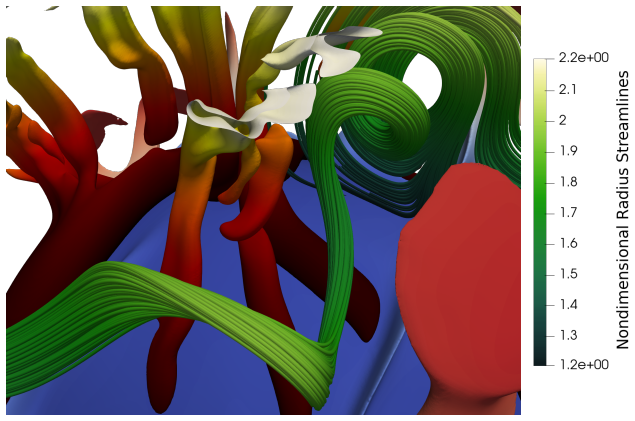
The central claim is that Eq. (21), called the V-cycle BFBT approximation, provides a sufficiently accurate inverse Schur complement for the generalized saddle point system $(A \quad B^T; \, B+C \quad 0)$ of compressible TALA mantle flow, even when viscosity varies over several orders of magnitude. In this approximation, the diagonal of $A$ used in the classical diag($A$)-BFBT formula is replaced by $\hat A_C$, a single Chebyshev-smoothed geometric multigrid V-cycle with one pre- and post-smoothing step. Wrapped in an FGMRES outer iteration preconditioned by a symmetric Uzawa block preconditioner, the resulting solver is matrix-free and is demonstrated to be robust for the temperature- and space-dependent Frank-Kamenetskii viscosity model considered, reaching a Stokes solve with 2.11e9 unknowns in a 400-myr mantle convection simulation.
Load-bearing premise
The load-bearing premise is that replacing diag($A$) in the BFBT formula with one cheap Chebyshev-smoothed multigrid V-cycle still gives a Schur complement approximation accurate enough for the non-symmetric compressible saddle point system; no spectral or convergence proof is provided, and the numerical evidence covers a single viscosity model and parameter set.
Editorial extensions
If this is right
- The Stokes subproblem with 2.11e9 unknowns can be solved inside a 400-myr mantle simulation in 10.52 days on 15,360 cores, with 7.27 days spent on the saddle point FGMRES solve.
- When only a small residual reduction is required per time step, all considered Schur complement approximations perform comparably; the V-cycle BFBT is clearly fastest when a larger reduction is needed.
- Strong and weak scaling tests show that both the saddle point solver and the advection-diffusion solver scale nearly ideally to 15,360 cores, with some super-ideal behaviour attributed to smoother viscosity on finer grids.
- The BDF2 plus particle-advection operator splitting retains second-order temporal convergence with a bounded error constant even for small diffusion coefficients, so advection-dominated regimes do not spoil the time accuracy.
- Because the whole method is matrix-free, the limiting resource becomes memory rather than operator assembly, which is the property that makes higher-resolution simulations with 2.7e9 spatial degrees of freedom feasible.
Reading between the lines
- The robustness claim is algorithmic rather than proven: Eq. (21) is not backed by a spectral analysis of $\hat S_V^{-1} S$, so a natural next test is to compute the eigenvalue distribution of $\hat S_V^{-1} S$ for the given viscosity model and for stiffer ones.
- The same 'replace diag(A) by one V-cycle' trick could plausibly transfer to other saddle point problems with heterogeneous coefficients, such as ice-sheet flow or magma dynamics, where mass-based Schur complements are known to degrade.
- The comparison data suggest a practical plateau: for loose tolerances of $10^{-3}$ to $10^{-1}$, cheaper Schur approximations are competitive, so production codes that only need modest accuracy per time step may not need the extra machinery.
- A concrete stress test would be to push the compressibility parameter, for example by increasing the dissipation number or the density gradient, and check whether the iteration count per FGMRES step stays bounded; the paper only demonstrates one parameter set.
Editorial analysis
A structured set of objections, weighed in public.
Referee Report
Summary. The paper develops a matrix-free iterative solver for a compressible (TALA) Stokes system coupled to a temperature advection-diffusion equation. Spatial discretisation uses P2-P1 Taylor-Hood elements on blended annulus and spherical-shell meshes; temporal discretisation combines BDF2 for diffusion with a particle-based modified method of characteristics for advection. The Stokes subproblem is solved by FGMRES with Uzawa-type block preconditioners, Chebyshev-smoothed geometric multigrid for the velocity block, and a proposed 'V-cycle BFBT' Schur approximation in which the diagonal of A is replaced by a single GMG V-cycle. The paper reports second-order temporal convergence, a comparison of Schur approximations and Uzawa variants, strong and weak scaling studies, and a 400 Myr mantle simulation with 2.11e9 velocity-pressure unknowns on 15,360 cores.
Significance. If the solver behaviour is as robust as claimed, the paper is a useful contribution to geodynamic modelling: matrix-free, scalable Stokes solvers that tolerate high viscosity contrast and a compressible mass balance are of genuine practical importance. The manuscript is careful in its internal solver comparisons, and the source code is made available with a DOI, which is a concrete reproducibility strength. The central robustness claim, however, is supported only by a single viscosity and density configuration, and the proposed V-cycle BFBT approximation for the non-symmetric compressible system is not backed by spectral analysis or an ablation isolating the compressibility term. The scalability evidence is reported per FGMRES iteration rather than as total time to solution, with no iteration counts for the weak scaling runs. These gaps limit confidence in the general robustness and scalability claims as currently stated.
major comments (3)
- [5.2.3, Eq. (21)] Eq. (21) defines the inverse Schur operator using B \hat A_C^{-1} B^T and B \hat A_C^{-1} A \hat A_C^{-1} B^T, i.e., it targets the incompressible Schur complement B A^{-1} B^T. For the generalised saddle point system (15) with off-diagonal block \bar B = B + C, the exact Schur complement is \bar B A^{-1} B^T. No bound or numerical experiment is given showing that the C A^{-1} B^T correction is negligible, and the note in Sec. 5.2.1 that B can be replaced by B + C in the Uzawa updates does not repair Eq. (21), because the inner products in the BFBT formula still use B only. The Sec. 8 claim that the solver is 'robust with respect to this term' is therefore not established outside the tested parameter point.
- [5.2.3 and Sec. 7.2] The V-cycle BFBT approximation rests on two unproved algorithmic assumptions: that a single Chebyshev-smoothed GMG V-cycle with mV = degV = 1 is an accurate enough surrogate for A^{-1} inside the BFBT identity, and that the resulting \hat S_V is a sufficiently accurate Schur complement for the non-symmetric compressible system. No spectral analysis or convergence theorem is given, and the numerical support is limited to the Frank-Kamenetskii viscosity (24) with the radial base profile of Fig. 6 and one density profile with Di/Gamma_0 approximately 0.378. If either assumption degrades under other high-contrast viscosity profiles or stronger compressibility, the central robustness claim fails; a parameter study varying Di/Gamma_0 and viscosity contrast, or an ablation isolating the C-block contribution, is needed.
- [7.5] The weak scaling efficiency in Fig. 15a is computed from the average FGMRES time per iteration, not from the total saddle point solve time, and the paper does not report iteration counts for the weak scaling runs. If the number of FGMRES iterations grows with the number of unknowns, the per-iteration metric overstates the true time-to-solution scalability. The strong scaling plot (Fig. 13) likewise reports time per FGMRES iteration for the saddle point part. Total solve times and iteration counts should be reported for both scaling studies to support the scalability claim.
minor comments (7)
- [7.2 and 7.5] The text contains the typo 'FMGRES' where the method is FGMRES; please correct both occurrences.
- [Fig. 13] The left subcaption 'This is to make the scaling of the text similar.' appears to be a leftover sentence and should be removed or rewritten.
- [7.2] The unknown count is given as '2 .106· 10^9' in Sec. 7.2, while the abstract and Sec. 8 state 2.11e9; please harmonise the notation.
- [Fig. 12] The legend abbreviations SM, SV and S_w are not defined in the caption; please add a sentence identifying them with Eqs. (19), (21) and (20).
- [7.4] The statement that omega = 0.0125 'worked best' for the weighted BFBT suggests parameter tuning for that variant; please state explicitly which parameters were used for each variant in Fig. 12 and whether the tuned value was used only for weighted BFBT.
- [7.1] The manufactured-solution test sets rho = 1 and uses a prescribed velocity, so it validates the temporal splitting of the temperature equation but not the coupled compressible Stokes solver; this limitation should be stated explicitly.
- [5.2.2] The claim that the degree-6 polynomial approximation of the exponential 'does not negatively impact the convergence rate' is not backed by a comparison; please add an iteration-count or residual-history comparison.
Circularity Check
No significant circularity: the solver claim rests on the paper's own numerical benchmarks and on standard algebraic approximations, not on a fitted parameter or a self-citation chain.
full rationale
The paper's central claim is that a matrix-free FGMRES/Uzawa/Chebyshev solver with a V-cycle BFBT Schur approximation is robust and scalable for the compressible TALA Stokes system. This claim is supported by the paper's own convergence, scaling, and large-scale timing experiments. No physical constant or solver parameter is fitted to a target output and then renamed as a prediction; the tolerances and smoother settings in Table B1 are tuning choices, not fitted inputs that force the reported outcome. The V-cycle BFBT approximation in Eq. (21) is an algebraic replacement of diag(A) by a GMG V-cycle, and it is explicitly presented as an approximation, not as a quantity derived from the compressible Schur complement. The paper also notes in Sec. 5.2.1 that B can be replaced by B+C in the Uzawa updates, showing awareness of the nonsymmetric off-diagonal block. The lack of a spectral bound for the C term and the use of a single viscosity profile are validation limitations and correctness risks, but they do not make the derivation circular: no equation defines its output in terms of its input, and no load-bearing inference depends on an unverified self-citation. Citations to HyTeG and to prior Uzawa/BFBT work are standard background references for the software framework and for established preconditioning techniques; they do not by themselves establish the central robustness claim. Therefore, there is no significant circularity.
Assumptions & free parameters
free parameters (8)
- Uzawa relaxation parameter ω =
0.3 default; 0.0125 for weighted BFBT test in Sec 7.4
- Uzawa velocity scaling σ =
1
- A-block solver parameters (tolA, tolcoarse, mA, degA) =
tolA=1e-2, tolcoarse=1e-2, mA=3, degA=2
- V-cycle BFBT parameters (mV, degV, tolV-BFBT) =
mV=1, degV=1, tolV-BFBT=1e-1
- Viscosity interpolation level lη and coarse level lmin =
lη=3,lmin=2 for 240 macro elements; lη=2,lmin=1 for 1920; lη=1,lmin=0 for 15360
- w-BFBT asymmetric scaling ar, al =
ar=al=1 default; ar=10, al=1 in one test
- CFL constant CCFL =
not reported; 'chosen experimentally'
- Additional solver tolerances (tolinvMass, tolwBFBT, tolVectorMass, tol(u,p), tolT) =
1e-10, 1e-10, 1e-4, 1e-5, 1e-10
assumptions (7)
- domain assumption P2-P1 Taylor-Hood is inf-sup stable on the blended, non-planar spherical-shell meshes with the projected free-slip boundary condition.
- domain assumption The blending map B is a C0-diffeomorphism, locally C1 on macroelements, and quadrature on pulled-back blended elements remains sufficiently accurate.
- ad hoc to paper The singular projected saddle-point system (13) with the non-symmetric C-block is solvable by FGMRES from a consistent initial guess with the described projections inside the preconditioner.
- ad hoc to paper The V-cycle BFBT Schur approximation (21), with a single Chebyshev-smoothed GMG V-cycle replacing diag(A), is an accurate enough Schur complement for high-contrast compressible Stokes systems.
- ad hoc to paper Representing viscosity as a P1 interpolant on levels above lη does not materially degrade solver robustness.
- domain assumption The MMOC/BDF2 operator splitting with extrapolated velocity and temperature remains stable and second-order for the coupled nonlinear problem.
- domain assumption The TALA geophysical approximations, including the hydrostatic reference state and omitted density derivative in mass conservation, adequately model mantle convection.
Cite this review
Pith. "Pith review of A robust matrix-free approach for large-scale non-isothermal high-contrast viscosity Stokes flow on blended domains with applications to geophysics." pith.science (2026). https://pith.science/paper/TNT3ZLH7
@misc{pith2026250604157,
  author       = {Pith},
  title        = {Pith review of: A robust matrix-free approach for large-scale non-isothermal high-contrast viscosity Stokes flow on blended domains with applications to geophysics},
  year         = {2026},
  howpublished = {\url{https://pith.science/paper/TNT3ZLH7}},
  note         = {Machine review of arXiv:2506.04157}
}
read the original abstract
We consider a compressible Stokes problem in the quasi-stationary case coupled with a time dependent advection-diffusion equation with special emphasis on high viscosity contrast geophysical mantle convection applications. In space, we use a P2-P1 Taylor--Hood element which is generated by a blending approach to account for the non-planar domain boundary without compromising the stencil data structure of uniformly refined elements. In time, we apply an operator splitting approach for the temperature equation combining the BDF2 method for diffusion and a particle method for advection, resulting in an overall second order scheme. Within each time step, a stationary Stokes problem with a high viscosity contrast has to be solved for which we propose a matrix-free, robust and scalable iterative solver based on Uzawa type block preconditioners, polynomial Chebyshev smoothers and a BFBT type Schur complement approximation. Our implementation is using a hybrid hierarchical grid approach allowing for massively parallel, high resolution Earth convection simulations.
Figures


Figures from the paper (12 more)




Reference graph
Works this paper leans on
-
[1]
Geophysical Journal International 221(2), 1264–1280 (2020) https://doi.org/10.1093/gji/ggaa078
Gassm¨ oller, R., Dannberg, J., Bangerth, W., Heister, T., Myhill, R.: On for- mulations of compressible mantle convection. Geophysical Journal International 221(2), 1264–1280 (2020) https://doi.org/10.1093/gji/ggaa078
-
[2]
Boussinesq, J.: Th´ eorie analytique de la chaleur mise en harmonie avec la thermo- dynamique et avec la th´ eorie m´ ecanique de la lumi` ere. Tome II: Refroidissement et ´ echauffement par rayonnement, conductibilit´ e des tiges, lames et masses cristallines, courants de convection, th´ eorie m´ ecanique de la lumi´ ere vol. 2. Gauthier-Villars, Paris (1903)
1903
-
[3]
Journal of Fluid Mechanics 96(3), 515–583 (1980) https://doi
Jarvis, G.T., Mckenzie, D.P.: Convection in a compressible fluid with infinite Prandtl number. Journal of Fluid Mechanics 96(3), 515–583 (1980) https://doi. org/10.1017/S002211208000225X
-
[4]
Cambridge University Press, Cambridge (2001)
Schubert, G., Turcotte, D.L., Olson, P.: Mantle Convection in the Earth and Plan- ets. Cambridge University Press, Cambridge (2001). https://doi.org/10.1017/ CBO9780511612879
2001
-
[5]
Geophysical Journal International 210(2), 833–851 (2017) https: //doi.org/10.1093/gji/ggx195
Heister, T., Dannberg, J., Gassm¨ oller, R., Bangerth, W.: High accuracy mantle convection simulation through modern numerical methods – II: realistic models and problems. Geophysical Journal International 210(2), 833–851 (2017) https: //doi.org/10.1093/gji/ggx195
-
[6]
Kronbichler, M., Heister, T., Bangerth, W.: High accuracy mantle convection sim- ulation through modern numerical methods. Geophysical Journal International 191(1), 12–29 (2012) https://doi.org/10.1111/j.1365-246X.2012.05609.x 34
arXiv 2012
-
[7]
Geophysical Journal International 217(1), 650– 667 (2019) https://doi.org/10.1093/gji/ggz036
Liu, S., King, S.D.: A benchmark study of incompressible Stokes flow in a 3-D spherical shell using ASPECT. Geophysical Journal International 217(1), 650– 667 (2019) https://doi.org/10.1093/gji/ggz036
-
[8]
Cambridge University Press, Cambridge (2004)
Fowler, C.M.R.: The Solid Earth: An Introduction to Global Geophysics, 2nd edn. Cambridge University Press, Cambridge (2004). https://doi.org/10.1017/ CBO9780511819643
2004
Show all 86 references
-
[9]
Annual Review of Earth and Planetary Sciences 14, 377–415 (1986) https: //doi.org/10.1146/annurev.ea.14.050186.002113
Jeanloz, R., Morris, S.: Temperature Distribution in the Crust and Mantle. Annual Review of Earth and Planetary Sciences 14, 377–415 (1986) https: //doi.org/10.1146/annurev.ea.14.050186.002113
1986
-
[10]
Physics of the Earth and Planetary Interiors 118(1-2), 103–109 (2000) https://doi.org/10.1016/S0031-9201(99)00133-8
da Silva, C.R.S., Wentzcovitch, R.M., Patel, A., Price, G.D., Karato, S.I.: The composition and geotherm of the lower mantle: constraints from the elasticity of silicate perovskite. Physics of the Earth and Planetary Interiors 118(1-2), 103–109 (2000) https://doi.org/10.1016/S...
2000 doi
-
[11]
Annual Review of Earth and Plane- tary Sciences 18, 357–386 (1990) https://doi.org/10.1146/annurev.ea.18.050190
Jeanloz, R.: The Nature of the Earth’s Core. Annual Review of Earth and Plane- tary Sciences 18, 357–386 (1990) https://doi.org/10.1146/annurev.ea.18.050190. 002041
1990 doi
-
[12]
Nature 401, 462–464 (1999) https: //doi.org/10.1038/46758
Alf` e, D., Gillan, M.J., Price, G.D.: The melting curve of iron at the pressures of the Earth’s core from ab initio calculations. Nature 401, 462–464 (1999) https: //doi.org/10.1038/46758
1999 doi
-
[13]
Gondwana Research 53, 1–8 (2018) https://doi.org/10.1016/j.gr.2017.07.005
Bunge, H.-P., Glasmacher, U.A.: Models and observations of vertical motion (MoveOn) associated with rifting to passive margins: Preface. Gondwana Research 53, 1–8 (2018) https://doi.org/10.1016/j.gr.2017.07.005
2018 doi
-
[14]
Geophysical Journal International 238(2), 992–1012 (2024) https://doi.org/10.1093/gji/ggae178
Freissler, R., Schuberth, B.S.A., Zaroli, C.: A concept for the global assessment of tomographic resolution and uncertainty. Geophysical Journal International 238(2), 992–1012 (2024) https://doi.org/10.1093/gji/ggae178
2024 doi
-
[15]
Geophysical Journal International 221(1), 617–639 (2020) https://doi.org/10.1093/gji/ggaa023
Colli, L., Bunge, H.-P., Oeser, J.: Impact of model inconsistencies on reconstruc- tions of past mantle flow obtained using the adjoint method. Geophysical Journal International 221(1), 617–639 (2020) https://doi.org/10.1093/gji/ggaa023
2020 doi
-
[16]
Geophysical Journal International 231(3), 1833–1849 (2022) https://doi.org/10.1093/gji/ggac293
Dannberg, J., Gassm¨ oller, R., Li, R., Lithgow-Bertelloni, C., Stixrude, L.: An entropy method for geodynamic modelling of phase transitions: capturing sharp and broad transitions in a multiphase assemblage. Geophysical Journal International 231(3), 1833–1849 (2022) https://d...
2022 doi
-
[17]
SIAM Journal on Matrix Analysis and Applications 39(2), 932–960 (2018) https://doi.org/10.1137/16M1106304
Drzisga, D., John, L., R¨ ude, U., Wohlmuth, B., Zulehner, W.: On the Analysis of Block Smoothers for Saddle Point Problems. SIAM Journal on Matrix Analysis and Applications 39(2), 932–960 (2018) https://doi.org/10.1137/16M1106304
2018 doi
-
[18]
SIAM Jour- nal on Scientific Computing 46(3), 1599–1627 (2024) https://doi.org/10.1137/ 22M1504184
Jodlbauer, D., Langer, U., Wick, T., Zulehner, W.: Matrix-Free Monolithic 35 Multigrid Methods for Stokes and Generalized Stokes Problems. SIAM Jour- nal on Scientific Computing 46(3), 1599–1627 (2024) https://doi.org/10.1137/ 22M1504184
2024
-
[19]
Journal of Compu- tational Science 63, 101804 (2022) https://doi.org/10.1016/j.jocs.2022.101804
Wichrowski, M., Krzy˙ zanowski, P.: A matrix-free multilevel preconditioner for the generalized Stokes problem with discontinuous viscosity. Journal of Compu- tational Science 63, 101804 (2022) https://doi.org/10.1016/j.jocs.2022.101804
2022
-
[20]
SIAM Journal on Scientific Computing 14(2), 461–469 (1993) https://doi.org/10.1137/ 0914028
Saad, Y.: A Flexible Inner-Outer Preconditioned GMRES Algorithm. SIAM Journal on Scientific Computing 14(2), 461–469 (1993) https://doi.org/10.1137/ 0914028
1993
-
[21]
International Journal of Parallel, Emergent and Distributed Systems 34(5), 477–496 (2019) https:// doi.org/10.1080/17445760.2018.1506453
Kohl, N., T¨ onnes, D., Drzisga, D., Bartuschat, D., R¨ ude, U.: The HyTeG finite- element software framework for scalable multigrid solvers. International Journal of Parallel, Emergent and Distributed Systems 34(5), 477–496 (2019) https:// doi.org/10.1080/17445760.2018.1506453
2019
-
[22]
In: Bungartz, H.-J., Reiz, S., Uekermann, B., Neumann, P., Nagel, W.E
Bauer, S., Bunge, H.-P., Drzisga, D., Ghelichkhan, S., Huber, M., Kohl, N., Mohr, M., R¨ ude, U., Th¨ onnes, D., Wohlmuth, B.: TerraNeo—Mantle Convection Beyond a Trillion Degrees of Freedom. In: Bungartz, H.-J., Reiz, S., Uekermann, B., Neumann, P., Nagel, W.E. (eds.) Softwar...
2020 doi
-
[23]
Geophysical Journal International 173(2), 693–702 (2008) https://doi.org/10.1111/j.1365-246X.2008.03745.x
Leng, W., Zhong, S.: Viscous heating, adiabatic heating and energetic consistency in compressible mantle convection. Geophysical Journal International 173(2), 693–702 (2008) https://doi.org/10.1111/j.1365-246X.2008.03745.x
2008 arXiv
-
[24]
Geophysical Journal International 180(1), 73–87 (2010) https://doi.org/10.1111/j.1365-246X.2009.04413.x
King, S.D., Lee, C., Van Keken, P.E., Leng, W., Zhong, S., Tan, E., Tosi, N., Kameyama, M.C.: A community benchmark for 2-D Cartesian compressible con- vection in the Earth’s mantle. Geophysical Journal International 180(1), 73–87 (2010) https://doi.org/10.1111/j.1365-246X.200...
2010
-
[25]
Solid Earth 13(7), 1127–1159 (2022) https://doi.org/ 10.5194/se-13-1127-2022
M¨ uller, R.D., Flament, N., Cannon, J., Tetley, M.G., Williams, S.E., Cao, X., Bodur, O.F., Zahirovic, S., Merdith, A.: A tectonic-rules-based mantle reference frame since 1 billion years ago – implications for supercontinent cycles and plate– mantle system evolution. Solid E...
2022 doi
-
[26]
SIAM Jour- nal on Scientific Computing 44(3), 260–285 (2022) https://doi.org/10.1137/ 21M1402510
Kohl, N., Mohr, M., Eibl, S., R¨ ude, U.: A Massively Parallel Eulerian-Lagrangian Method for Advection-Dominated Transport in Viscous Fluids. SIAM Jour- nal on Scientific Computing 44(3), 260–285 (2022) https://doi.org/10.1137/ 21M1402510
2022
-
[27]
Stiff and Differential-Algebraic Problems
Hairer, E., Wanner, G.: Solving Ordinary Differential Equations II. Stiff and Differential-Algebraic Problems. Springer Series in Computational Mathematics, vol. 14. Springer, Berlin, Heidelberg, New York (1996). https://doi.org/10.1007/ 36 978-3-642-05221-7
1996
-
[28]
Journal of Applied Mathematics and Computing 19(1), 33– 55 (2005) https://doi.org/10.1007/BF02935787
Emmrich, E.: Stability and error of the variable two-step BDF for semilinear parabolic problems. Journal of Applied Mathematics and Computing 19(1), 33– 55 (2005) https://doi.org/10.1007/BF02935787
2005 doi
-
[29]
BIT Numerical Mathematics 38(4), 644–662 (1998) https: //doi.org/10.1007/BF02510406
Becker, J.: A second order backward difference method with variable steps for a parabolic problem. BIT Numerical Mathematics 38(4), 644–662 (1998) https: //doi.org/10.1007/BF02510406
1998 doi
-
[30]
Geochemistry, Geophysics, Geosystems 22(4) (2021) https://doi.org/10.1029/2020GC009349
Sime, N., Maljaars, J.M., Wilson, C.R., Keken, P.E.: An Exactly Mass Conserving and Pointwise Divergence Free Velocity Method: Application to Compositional Buoyancy Driven Flow Problems in Geodynamics. Geochemistry, Geophysics, Geosystems 22(4) (2021) https://doi.org/10.1029/2...
2021 doi
-
[31]
Geochemistry, Geophysics, Geosystems 23(2) (2022) https://doi.org/10
Sime, N., Wilson, C.R., Keken, P.E.: A Pointwise Conservative Method for Thermochemical Convection Under the Compressible Anelastic Liquid Approxi- mation. Geochemistry, Geophysics, Geosystems 23(2) (2022) https://doi.org/10. 1029/2021GC009922
2022
-
[32]
Computational Geosciences 22(6), 1487–1502 (2018) https://doi.org/10.1007/ s10596-018-9767-z
Vidotto, E., Helmig, R., Schneider, M., Wohlmuth, B.: Streamline method for resolving sharp fronts for complex two-phase flow in porous media. Computational Geosciences 22(6), 1487–1502 (2018) https://doi.org/10.1007/ s10596-018-9767-z
2018
-
[33]
Computer Methods in Applied Mechanics and Engi- neering 32(1-3), 199–259 (1982) https://doi.org/10.1016/0045-7825(82)90071-8
Brooks, A.N., Hughes, T.J.R.: Streamline upwind/Petrov-Galerkin formulations for convection dominated flows with particular emphasis on the incompressible Navier-Stokes equations. Computer Methods in Applied Mechanics and Engi- neering 32(1-3), 199–259 (1982) https://doi.org/1...
1982 doi
-
[34]
Journal of Computational Physics 230(11), 4248–4267 (2011) https://doi.org/10.1016/j.jcp.2010.11.043
Guermond, J.-L., Pasquetti, R., Popov, B.: Entropy viscosity method for non- linear conservation laws. Journal of Computational Physics 230(11), 4248–4267 (2011) https://doi.org/10.1016/j.jcp.2010.11.043
2011 doi
-
[35]
Springer Series in Computational Mathematics, vol
Quarteroni, A., Valli, A.: Numerical Approximation of Partial Differential Equations. Springer Series in Computational Mathematics, vol. 23. Springer, Berlin, Heidelberg (2008). https://doi.org/10.1007/978-3-540-85268-1
2008 doi
-
[36]
Numerical Linear Algebra with Applications 11(2-3), 279–291 (2004) https://doi.org/10.1002/nla.382
Bergen, B.K., H¨ ulsemann, F.: Hierarchical hybrid grids: data structures and core algorithms for multigrid. Numerical Linear Algebra with Applications 11(2-3), 279–291 (2004) https://doi.org/10.1002/nla.382
2004 doi
-
[37]
Computing in Science & Engineering 8(6), 56–62 (2006) https://doi.org/10.1109/MCSE.2006.102 37
Bergen, B., Gradl, T., Hulsemann, F., Rude, U.: A Massively Parallel Multigrid Method for Finite Elements. Computing in Science & Engineering 8(6), 56–62 (2006) https://doi.org/10.1109/MCSE.2006.102 37
2006 doi
-
[38]
In: 2012 11th International Symposium on Parallel and Distributed Computing
Gmeiner, B., Mohr, M., R¨ ude, U.: Hierarchical Hybrid Grids for Mantle Con- vection: A First Study. In: 2012 11th International Symposium on Parallel and Distributed Computing. 309-314 (2012). https://doi.org/10.1109/ISPDC.2012. 49
2012 doi
-
[39]
Concurrency and Computation: Practice and Experience 26(1), 217–240 (2014) https://doi.org/10.1002/cpe.2968
Gmeiner, B., K¨ ostler, H., St¨ urmer, M., R¨ ude, U.: Parallel multigrid on hierarchi- cal hybrid grids: a performance study on current high performance computing clusters. Concurrency and Computation: Practice and Experience 26(1), 217–240 (2014) https://doi.org/10.1002/cpe.2968
2014 doi
-
[40]
SIAM Journal on Scientific Computing 37(2), 143–168 (2015) https://doi.org/10.1137/ 130941353
Gmeiner, B., R¨ ude, U., Stengel, H., Waluga, C., Wohlmuth, B.: Performance and Scalability of Hierarchical Hybrid Multigrid Solvers for Stokes Systems. SIAM Journal on Scientific Computing 37(2), 143–168 (2015) https://doi.org/10.1137/ 130941353
2015
-
[41]
PhD thesis, Friedrich-Alexander-Universit¨ at Erlangen-N¨ urnberg (2015)
Gradl, T.: Data Structures and Algorithms for the Optimization of Hierar- chical Hybrid Multigrid Methods. PhD thesis, Friedrich-Alexander-Universit¨ at Erlangen-N¨ urnberg (2015)
2015
-
[42]
Journal of Computational Science 17(3), 509–521 (2016) https://doi.org/10.1016/j.jocs.2016.06.006
Gmeiner, B., Huber, M., John, L., R¨ ude, U., Wohlmuth, B.: A quantitative per- formance study for Stokes solvers at the extreme scale. Journal of Computational Science 17(3), 509–521 (2016) https://doi.org/10.1016/j.jocs.2016.06.006
2016 doi
-
[43]
Computing 55(4), 355–378 (1995) https: //doi.org/10.1007/BF02238487
Bey, J.: Tetrahedral grid refinement. Computing 55(4), 355–378 (1995) https: //doi.org/10.1007/BF02238487
1995 doi
-
[44]
Computers & Fluids 1(1), 73–100 (1973) https: //doi.org/10.1016/0045-7930(73)90027-3
Taylor, C., Hood, P.: A numerical solution of the Navier-Stokes equations using the finite element technique. Computers & Fluids 1(1), 73–100 (1973) https: //doi.org/10.1016/0045-7930(73)90027-3
1973 doi
-
[45]
Verf¨ urth, R.: Error estimates for a mixed finite element approximation of the Stokes equations. RAIRO. Analyse num´ erique 18(2), 175–182 (1984) https:// doi.org/10.1051/m2an/1984180201751
1984
-
[46]
Springer Series in Computational Mathematics, vol
Girault, V., Raviart, P.-A.: Finite Element Methods for Navier-Stokes Equations: Theory and Algorithms. Springer Series in Computational Mathematics, vol. 5. Springer, Berlin, Heidelberg (1986). https://doi.org/10.1007/978-3-642-61623-5
1986 doi
-
[47]
Applied Math- ematical Sciences, vol
Ern, A., Guermond, J.-L.: Theory and Practice of Finite Elements. Applied Math- ematical Sciences, vol. 159. Springer, New York (2004). https://doi.org/10.1007/ 978-1-4757-4355-5
2004
-
[48]
Solid Earth 13(1), 229–249 (2022) https://doi.org/10.5194/ se-13-229-2022
Thieulot, C., Bangerth, W.: On the choice of finite element for applications in geodynamics. Solid Earth 13(1), 229–249 (2022) https://doi.org/10.5194/ se-13-229-2022
2022
-
[49]
Lecture Notes in Mathematics, vol
Boffi, D., Brezzi, F., Demkowicz, L., Dur´ an, R., Falk, R., Fortin, M.: Mixed 38 Finite Elements, Compatibility Conditions, and Applications. Lecture Notes in Mathematics, vol. 1939. Springer, Berlin, Heidelberg (2008). https://doi.org/10. 1007/978-3-540-78319-0
2008
-
[50]
SIAM Journal on Scientific Computing 47(1), 131–159 (2025) https://doi.org/10.1137/24M1653756
B¨ ohm, F., Bauer, D., Kohl, N., Alappat, C.L., Th¨ onnes, D., Mohr, M., K¨ ostler, H., R¨ ude, U.: Code Generation and Performance Engineering for Matrix-Free Finite Element Methods on Hybrid Tetrahedral Grids. SIAM Journal on Scientific Computing 47(1), 131–159 (2025) https:...
2025 doi
-
[51]
SIAM Journal on Numerical Analysis 31(6), 1645–1661 (1994) https://doi.org/10.1137/0731085
Elman, H.C., Golub, G.H.: Inexact and Preconditioned Uzawa Algorithms for Saddle Point Problems. SIAM Journal on Numerical Analysis 31(6), 1645–1661 (1994) https://doi.org/10.1137/0731085
1994 doi
-
[52]
In: NIC Symposium 2020
Huber, M., Kohl, N., Leleux, P., R¨ ude, U., Th¨ onnes, D., Wohlmuth, B.: Massively Parallel Multigrid with Direct Coarse Grid Solvers. In: NIC Symposium 2020. Publication Series of the John von Neumann Institute for Computing (NIC) NIC Series, vol. 50, pp. 335–344. Forschungs...
2020
-
[53]
In: SC ’08: Proceedings of the 2008 ACM/IEEE Conference on Supercomputing, pp
Burstedde, C., Ghattas, O., Gurnis, M., Stadler, G., Tan, E., Tu, T., Wilcox, L.C., Zhong, S.: Scalable adaptive mantle convection simulation on petascale supercomputers. In: SC ’08: Proceedings of the 2008 ACM/IEEE Conference on Supercomputing, pp. 1–15 (2008). https://doi.or...
2008
-
[54]
Geochemistry, Geophysics, Geosystems 10(9) (2009) https: //doi.org/10.1029/2009GC002526
Geenen, T., Rehman, M., MacLachlan, S.P., Segal, G., Vuik, C., van den Berg, A.P., Spakman, W.: Scalable robust solvers for unstructured FE geodynamic modeling applications: Solving the Stokes equation for models with large localized viscosity contrasts. Geochemistry, Geophysi...
2009 doi
-
[55]
Com- puter Methods in Applied Mechanics and Engineering 198(21-26), 1691–1700 (2009) https://doi.org/10.1016/j.cma.2008.12.015
Burstedde, C., Ghattas, O., Stadler, G., Tu, T., Wilcox, L.C.: Parallel scalable adjoint-based adaptive solution of variable-viscosity Stokes flow problems. Com- puter Methods in Applied Mechanics and Engineering 198(21-26), 1691–1700 (2009) https://doi.org/10.1016/j.cma.2008.12.015
2009 doi
-
[56]
Journal of Computational Physics 230(24), 8835–8851 (2011) https: //doi.org/10.1016/j.jcp.2011.09.007
Furuichi, M., May, D.A., Tackley, P.J.: Development of a Stokes flow solver robust to large viscosity jumps using a Schur complement approach with mixed precision arithmetic. Journal of Computational Physics 230(24), 8835–8851 (2011) https: //doi.org/10.1016/j.jcp.2011.09.007
2011 doi
-
[57]
Geophysical Journal International 192(3), 889–906 (2013) https://doi.org/10.1093/gji/ggs070
Burstedde, C., Stadler, G., Alisic, L., Wilcox, L.C., Tan, E., Gurnis, M., Ghat- tas, O.: Large-scale adaptive mantle convection simulation. Geophysical Journal International 192(3), 889–906 (2013) https://doi.org/10.1093/gji/ggs070
2013 doi
-
[58]
Computer Methods in Applied Mechanics and Engineering 290, 496–523 (2015) https: 39 //doi.org/10.1016/j.cma.2015.03.014
May, D.A., Brown, J., Le Pourhiet, L.: A scalable, matrix-free multigrid precon- ditioner for finite element discretizations of heterogeneous Stokes flow. Computer Methods in Applied Mechanics and Engineering 290, 496–523 (2015) https: 39 //doi.org/10.1016/j.cma.2015.03.014
2015 doi
-
[59]
SIAM Journal on Scientific Computing 37(6), 804–833 (2015) https://doi.org/10.1137/140974407
Isaac, T., Stadler, G., Ghattas, O.: Solution of Nonlinear Stokes Equations Dis- cretized By High-Order Finite Elements on Nonconforming and Anisotropic Meshes, with Application to Ice Sheet Dynamics. SIAM Journal on Scientific Computing 37(6), 804–833 (2015) https://doi.org/1...
2015 doi
-
[60]
IMA Journal of Numerical Analysis 4(4), 441–455 (1984) https://doi.org/10.1093/imanum/4.4.441
Verf¨ urth, R.: A combined conjugate gradient - multi-grid algorithm for the numerical solution of the Stokes problem. IMA Journal of Numerical Analysis 4(4), 441–455 (1984) https://doi.org/10.1093/imanum/4.4.441
1984 doi
-
[61]
SIAM Journal on Scientific Computing 31(5), 3959–3978 (2009) https://doi.org/10.1137/08744803
Grinevich, P.P., Olshanskii, M.A.: An Iterative Method for the Stokes-Type Problem with Variable Viscosity. SIAM Journal on Scientific Computing 31(5), 3959–3978 (2009) https://doi.org/10.1137/08744803
2009 doi
-
[62]
In: SC ’15: Proceedings of the International Conference for High Performance Computing, Networking, Storage and Analysis
Rudi, J., Malossi, A.C.I., Isaac, T., Stadler, G., Gurnis, M., Staar, P.W.J., Ine- ichen, Y., Bekas, C., Curioni, A., Ghattas, O.: An extreme-scale implicit solver for complex PDEs: highly heterogeneous flow in earth’s mantle. In: SC ’15: Proceedings of the International Confe...
2015
-
[63]
SIAM Journal on Scientific Computing 39(5), 272–297 (2017) https://doi.org/10.1137/16M108450X
Rudi, J., Stadler, G., Ghattas, O.: Weighted BFBT Preconditioner for Stokes Flow Problems with Highly Heterogeneous Viscosity. SIAM Journal on Scientific Computing 39(5), 272–297 (2017) https://doi.org/10.1137/16M108450X
2017 doi
-
[64]
SIAM Journal on Scientific Computing 20(4), 1299–1316 (1999) https://doi.org/10.1137/S1064827596312547
Elman, H.C.: Preconditioning for the Steady-State Navier–Stokes Equations with Low Viscosity. SIAM Journal on Scientific Computing 20(4), 1299–1316 (1999) https://doi.org/10.1137/S1064827596312547
1999 doi
-
[65]
Oxford University Press, New York (2005)
Elman, H., Silvester, D., Wathen, A.: Finite Elements and Fast Iterative Solvers: with Applications in Incompressible Fluid Dynamics. Oxford University Press, New York (2005). https://doi.org/10.1093/oso/9780198528678.001.0001
2005
-
[66]
SIAM Journal on Scientific Computing 27(5), 1651–1668 (2006) https://doi.org/10.1137/040608817
Elman, H., Howle, V.E., Shadid, J., Shuttleworth, R., Tuminaro, R.: Block Pre- conditioners Based on Approximate Commutators. SIAM Journal on Scientific Computing 27(5), 1651–1668 (2006) https://doi.org/10.1137/040608817
2006 doi
-
[67]
Physics of the Earth and Planetary Interiors 171(1-4), 33–47 (2008) https://doi.org/10.1016/j.pepi.2008.07.036
May, D.A., Moresi, L.: Preconditioned iterative methods for Stokes flow prob- lems arising in computational geodynamics. Physics of the Earth and Planetary Interiors 171(1-4), 33–47 (2008) https://doi.org/10.1016/j.pepi.2008.07.036
2008 doi
-
[68]
Journal of Computational Physics 305, 319–332 (2016) https://doi.org/10.1016/j.jcp.2015.10.044 40
Waluga, C., Wohlmuth, B., R¨ ude, U.: Mass-corrections for the conservative cou- pling of flow and transport on collocated meshes. Journal of Computational Physics 305, 319–332 (2016) https://doi.org/10.1016/j.jcp.2015.10.044 40
2016 doi
-
[69]
Geochemistry, Geophysics, Geosystems 23(11) (2022) https://doi.org/10.1029/ 2022GC010514
Lin, Y.-A., Colli, L., Wu, J.: NW Pacific-Panthalassa Intra-Oceanic Subduc- tion During Mesozoic Times From Mantle Convection and Geoid Models. Geochemistry, Geophysics, Geosystems 23(11) (2022) https://doi.org/10.1029/ 2022GC010514
2022
-
[70]
Geochemistry, Geophysics, Geosystems 19(7), 2243–2261 (2018) https://doi.org/10.1029/2018GC007584
M¨ uller, R.D., Cannon, J., Qin, X., Watson, R.J., Gurnis, M., Williams, S., Pfaffelmoser, T., Seton, M., Russell, S.H.J., Zahirovic, S.: GPlates: Building a Vir- tual Earth Through Deep Time. Geochemistry, Geophysics, Geosystems 19(7), 2243–2261 (2018) https://doi.org/10.1029...
2018 doi
-
[71]
In: Gerndt, M., Kranzlm¨ uller, D
Oeser, J., Bunge, H.-P., Mohr, M.: Cluster Design in the Earth Sciences Tethys. In: Gerndt, M., Kranzlm¨ uller, D. (eds.) High Performance Computing and Com- munications. HPCC 2006. Lecture Notes in Computer Science, vol. 4208, pp. 31–40. Springer, Berlin, Heidelberg (2006). h...
2006 doi
-
[72]
In: Schubert, G
Ricard, Y.: 7.02 - Physics of Mantle Convection. In: Schubert, G. (ed.) Treatise on Geophysics vol. 7, pp. 31–87. Elsevier, Amsterdam (2007). https://doi.org/ 10.1016/B978-044452748-6.00115-2
2007 doi
-
[73]
Physics of the Earth and Planetary Interiors 25(4), 297–356 (1981) https://doi.org/10
Dziewonski, A.M., Anderson, D.L.: Preliminary reference Earth model. Physics of the Earth and Planetary Interiors 25(4), 297–356 (1981) https://doi.org/10. 1016/0031-9201(81)90046-7
1981
-
[74]
Nature 401(6752), 432–433 (1999) https://doi.org/10.1038/46696
Bukowinski, M.S.T.: Taking the core temperature. Nature 401(6752), 432–433 (1999) https://doi.org/10.1038/46696
1999 doi
-
[75]
Chemical Geology 70(1-2), 62 (1988) https://doi.org/10.1016/ 0009-2541(88)90364-6
Knittle, E., Williams, Q., Jeanloz, R.: High-pressure measurements of core temperatures. Chemical Geology 70(1-2), 62 (1988) https://doi.org/10.1016/ 0009-2541(88)90364-6
1988
-
[76]
Physics of the Earth and Planetary Interiors142(3-4), 137–184 (2004) https://doi.org/10.1016/j.pepi.2004.02.003
Stacey, F.D., Davis, P.M.: High pressure equations of state with applications to the lower mantle and core. Physics of the Earth and Planetary Interiors142(3-4), 137–184 (2004) https://doi.org/10.1016/j.pepi.2004.02.003
2004 doi
-
[77]
Physical Review B 65, 165118 (2002) https://doi.org/10.1103/PhysRevB
Alf` e, D., Price, G.D., Gillan, M.J.: Iron under Earth’s core conditions: Liquid- state thermodynamics and high-pressure melting curve from ab initio calcula- tions. Physical Review B 65, 165118 (2002) https://doi.org/10.1103/PhysRevB. 65.165118
2002 doi
-
[78]
Geophysical Research Letters41(8), 2746–2752 (2014) https://doi.org/10.1002/2014GL059385
Tang, X., Ntam, M.C., Dong, J., Rainey, E.S.G., Kavner, A.: The thermal con- ductivity of Earth’s lower mantle. Geophysical Research Letters41(8), 2746–2752 (2014) https://doi.org/10.1002/2014GL059385
2014 doi
-
[79]
Geophysical & Astrophysical Fluid Dynamics 75(1), 41 39–59 (1994) https://doi.org/10.1080/03091929408203646
Busse, F.H., Christensen, U., Clever, R., Cserepes, L., Gable, C., Giannandrea, E., Guillou, L., Houseman, G., Nataf, H.C., Ogawa, M., Parmentier, M., Sotin, C., Travis, B.: 3D convection at infinite Prandtl number in Cartesian geometry – a benchmark comparison. Geophysical & ...
1994 doi
-
[80]
Geochem- istry, Geophysics, Geosystems 20(5), 2378–2394 (2019) https://doi.org/10.1029/ 2019GC008187
Grose, C.J., Afonso, J.C.: New Constraints on the Thermal Conductivity of the Upper Mantle From Numerical Models of Radiation Transport. Geochem- istry, Geophysics, Geosystems 20(5), 2378–2394 (2019) https://doi.org/10.1029/ 2019GC008187
2019
-
[81]
Geophysical Journal International 207(3), 1343–1366 (2016) https://doi.org/10.1093/gji/ggw329
Dannberg, J., Heister, T.: Compressible magma/mantle dynamics: 3-D, adaptive simulations in ASPECT. Geophysical Journal International 207(3), 1343–1366 (2016) https://doi.org/10.1093/gji/ggw329
2016 doi
-
[82]
Geophysical Journal International 98(1), 23–38 (1989) https://doi.org/10.1111/ j.1365-246X.1989.tb05511.x
Blankenbach, B., Busse, F., Christensen, U., Cserepes, L., Gunkel, D., Hansen, U., Harder, H., Jarvis, G., Koch, M., Marquart, G., Moore, D., Olson, P., Schmel- ing, H., Schnaubelt, T.: A benchmark comparison for mantle convection codes. Geophysical Journal International 98(1)...
1989
-
[83]
Journal of Geophysical Research: Solid Earth 122(12), 9881–9920 (2017) https: //doi.org/10.1002/2017JB014501
Chust, T.C., Steinle-Neumann, G., Dolejˇ s, D., Schuberth, B.S.A., Bunge, H.-P.: MMA–EoS: A Computational Framework for Mineralogical Thermodynamics. Journal of Geophysical Research: Solid Earth 122(12), 9881–9920 (2017) https: //doi.org/10.1002/2017JB014501
2017 doi
-
[84]
Phase equilibria
Stixrude, L., Lithgow-Bertelloni, C.: Thermodynamics of mantle minerals – II. Phase equilibria. Geophysical Journal International 184(3), 1180–1213 (2011) https://doi.org/10.1111/j.1365-246X.2010.04890.x
2011 arXiv
-
[85]
Nature 485(7396), 90–94 (2012) https://doi.org/10.1038/nature11004
Murakami, M., Ohishi, Y., Hirao, N., Hirose, K.: A perovskitic lower man- tle inferred from high–pressure, high–temperature sound velocity data. Nature 485(7396), 90–94 (2012) https://doi.org/10.1038/nature11004
2012 doi
-
[86]
PhD thesis, Ludwig-Maximilians-Universit¨ at M¨ unchen (2016)
Weism¨ uller, J.: Development and application of high performance software for mantle convection modeling. PhD thesis, Ludwig-Maximilians-Universit¨ at M¨ unchen (2016). https://doi.org/10.5282/edoc.19152 42
2016 doi
Reviewed August 7, 2026 · model on record in the stance chip above.
Discussion (0). Sign in to comment.