REVIEW 3 major objections 6 minor 89 references
Neural and Cognitive Impacts of AI: The Influence of Task Subjectivity on Human-LLM Collaboration
T0 review · 3 major / 6 minor · reviewed 2026-08-07 · deepseek-v4-flash
Pith's one-line read Copilot helps with objective tasks but not personal reflection.
desk verdict Legitimate behavioral study of Copilot across a task gradient, but the episodic-memory/neural explanation is a hypothesis, not a finding. read the letter →
The pith
A machine-rendered reading of the paper's core claim, the machinery that carries it, and where it could break.
The reading
What carries the argument
The machinery is a four-level gradient of subjectivity, SAT → PLANNING → POEM → REFLECTION, paired with frequency-domain fNIRS measurement of very-low-frequency (VLF, 0.02–0.07 Hz) oscillations in the prefrontal cortex. The gradient is what orders tasks by the degree to which they draw on objective structured knowledge versus personal episodic memory, and it is the experimental instrument that generates the behavioral contrasts. The VLF-band power of ∆[HbD] (oxygenated minus deoxygenated hemoglobin) is the neural index: lower log total power is taken as higher cortical activation, following prior VLF-fNIRS work. The argument's force comes from aligning the behavioral null on REFLECTION with the right-prefrontal VLF contrast, so that the task property 'highly subjective' is operationalized as a measurable neural state rather than only a label.
What would settle it
A decisive check would measure episodic memory engagement directly, for example with a post-task recall test or a control task matched in difficulty and self-reference but lacking autobiographical content: if Copilot still fails on the control task, or if the right-prefrontal VLF contrast disappears when episodic memory is not engaged, the paper's brain-based boundary claim would be refuted.
Extended reading notes
Core claim
The central claim is that the effectiveness of an LLM assistant is bounded by task subjectivity, and the load-bearing boundary is episodic memory. Copilot use lowered NASA-TLX workload and increased enjoyment for SAT, PLANNING, and POEM, and increased rated quality for SAT and PLANNING; REFLECTION showed no change in workload, enjoyment, or quality. fNIRS found no overall effect of Copilot, but the right prefrontal cortex showed lower VLF-band power (higher activation) during REFLECTION than during SAT and PLANNING, independent of whether Copilot was used. The authors interpret this contrast as the neural signature of the failure boundary: when a task engages autobiographical episodic memory, the assistant cannot reduce the user's cognitive burden, and they hypothesize that this may reflect engagement of the default mode network.
Load-bearing premise
The load-bearing premise is that the REFLECTION task engages episodic memory more than POEM, PLANNING, and SAT, and that lower VLF-band power in the right prefrontal cortex specifically indexes that episodic engagement rather than general task difficulty or self-referential thought; the paper does not include an independent manipulation check that would verify this link.
Editorial extensions
If this is right
- Users of Copilot-like assistants can expect lower workload and higher enjoyment on structured and generative writing tasks, with quality gains most likely when the task has clear objective answers or concrete deliverables.
- On creative tasks where the user is a novice, the assistant may make the work feel easier and more fun without changing the rated quality of the output.
- For tasks that require recounting personal experience, assistant use should not be expected to reduce workload or improve output; design effort could shift toward scaffolding users' own memory retrieval rather than generating content for them.
- Right-prefrontal VLF-band fNIRS activation is a candidate objective marker for detecting when an AI assistant is failing to help, potentially enabling adaptive interfaces.
- The absence of changes in heart rate, heart rate variability, and electrodermal activity suggests the cognitive boundary is specific to brain state rather than a general stress response.
Reading between the lines
- The paper leaves open whether the reflection null is specific to episodic memory or generalizes to any self-referential task; a control task matched for difficulty and self-reference but without autobiographical content would separate these.
- Because the poetry writers were novices, the POEM results may reflect expertise rather than subjectivity; with experienced poets, Copilot might not lower workload, and the paper's own caution invites this test.
- The right-prefrontal contrast was present regardless of Copilot use, so the marker identifies task type rather than interaction success; a follow-up could test whether its amplitude predicts how much an individual user benefits from the assistant.
- If the default-mode-network link is right, then the bottleneck for augmentation is not working memory but the neural systems supporting self-referential thought, which suggests assistants should aim to scaffold rather than replace reflective writing.
Editorial analysis
A structured set of objections, weighed in public.
Referee Report
Summary. This paper reports a within-subjects experiment (n=20) in which participants performed four tasks spanning a designed gradient of subjectivity (SAT reading comprehension, event planning, poetry writing, personal reflection), each completed with and without Microsoft Copilot in Word. The authors measured self-reported workload (NASA-TLX), enjoyment, output quality, and physiological signals (fNIRS over prefrontal cortex, Empatica E4 heart rate/HRV/EDA). Linear mixed models show that Copilot reduced workload and increased enjoyment for SAT, PLANNING, and POEM, and increased quality for SAT and PLANNING, but produced no measurable benefit on the REFLECTION task. No Copilot effects were found in the physiological measures; a task-level fNIRS effect was reported showing increased right-prefrontal activation during REFLECTION compared with SAT and PLANNING. The paper interprets this pattern as indicating that AI assistants are less useful for tasks engaging episodic memory, and proposes a brain-network based hypothesis involving the default mode network.
Significance. The behavioral findings are a useful empirical contribution to the emerging literature on human-LLM collaboration: they replicate and extend prior work on task-dependent AI benefits using a controlled within-subject design with multiple measurement streams. The authors report effect sizes, use linear mixed models appropriate for the repeated-measures structure, provide ICC-based rater reliability, and transparently document exclusions and supplementary analyses of subtask difficulty and task order. The paper also has falsifiable predictions, albeit mostly negative (no effect of Copilot on physiology). However, the central neural-mechanism claim about episodic memory is not directly supported by the data; it rests on an assumed task gradient and on a task-level fNIRS contrast not tied to Copilot use. The manuscript would be strengthened by clearly separating the well-supported behavioral conclusions from the more speculative neural interpretation.
major comments (3)
- [Sec. IV-A; Supplementary Sec. XIII] The central claim that Copilot's usefulness decreases specifically for tasks engaging episodic memory rests on an assumed task gradient rather than a measurement of episodic memory engagement. Section IV-A defines REFLECTION as 'designed to maximally engage purely subjective, autobiographical episodic memory' by fiat, and the supplementary section titled 'POTENTIAL CONFOUND ANALYSIS' is empty. There is no independent manipulation check (for example, self-reported autobiographical retrieval, a memory questionnaire, or a control task matched in difficulty) to show that REFLECTION engages episodic memory more than POEM or PLANNING. Consequently, the behavioral finding that Copilot produced no measurable benefit on REFLECTION does not by itself establish episodic memory as the operative factor; the abstract's 'particularly showing decreased usefulness in tasks that engage episodic memory' overstates what the data show. Please either provide such a manipulation check or reframe the conclusion as a hypothesis.
- [Sec. V-B2; Table IV; Table V] The fNIRS result used to link prefrontal activation to collaboration outcomes is a main effect of TASK, not a CONDITION x TASK interaction. Table IV shows no significant CONDITION x TASK interaction for any fNIRS measure (e.g., R DSI: F=0.54, p=0.655), and the significant contrast in Table V (REFLECTION vs SAT/PLANNING, p=0.024 and 0.042) is computed across both Copilot conditions combined. Thus this neural contrast cannot be interpreted as marking successful versus unsuccessful human-AI collaboration, as the abstract's 'complementary insights into the cognitive processes associated with successful and unsuccessful human-AI collaboration' suggests. The authors should either show that the TASK effect differs by CONDITION or correlate the between-task neural contrast with the size of Copilot's behavioral benefit per participant; otherwise the neural finding is task-related but not collaboration-related.
- [Sec. IV-C2; Sec. V-B2] The fNIRS sample is small and the key effect is marginal: after the exclusions described in Section IV-C2, approximately 14 participants contribute to the fNIRS analyses, and the right-DSI TASK effect is F(3,39)=3.52, p=0.024, which just meets the adjusted alpha of 0.025. No power analysis is reported. Given that this single marginal effect carries the neural-interpretation weight for the paper, the analysis should be supplemented with a sensitivity/power consideration or a more explicit statement of the fragility of this finding. As it stands, the Conclusion's 'we concretely specify the activation of neural states related to episodic memory as a shortcoming of artificial agents' assigns more certainty to a borderline result than is warranted.
minor comments (6)
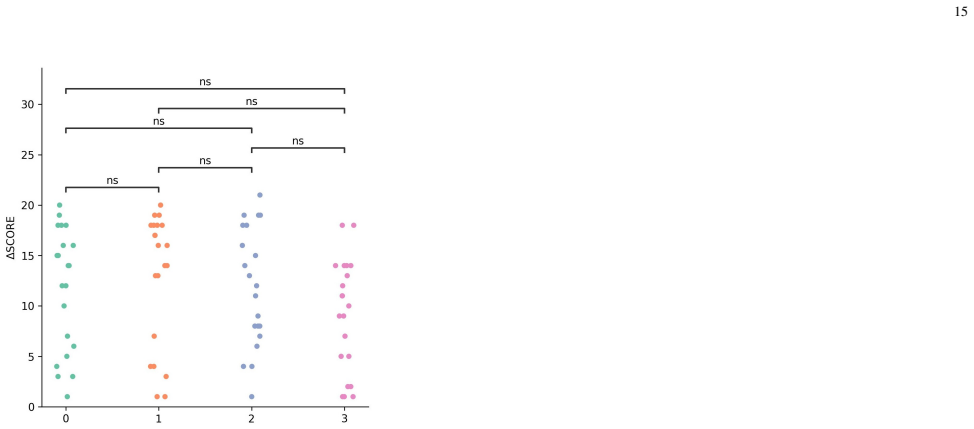
- [Fig. 9; Table XI] The caption of Figure 9 states 'no change was found for PLANNING or REFLECTION,' but Table XI reports a significant increase for PLANNING (Est=1.35, p=0.033). Please correct the caption to match the table.
- [Sec. IV-C3] The text reads 'changes prefrontal cortex hemoglobin concentration' (missing 'in') and later refers to 'the VLFO band' (should be VLF). Please proofread for typos; also the IBI exclusion threshold '[1, 125] ms' appears suspiciously low and should be clarified (e.g., whether seconds or another unit was intended).
- [Supplementary Sec. XIII] The section titled 'POTENTIAL CONFOUND ANALYSIS' is empty; if no confound analysis was performed, the section should be removed or explicitly stated as not applicable, rather than left blank.
- [Table XIV] The task-order analysis reports partial eta-squared confidence intervals of [0.00, 1.0], which are uninformative; report a proper bootstrap or omit the CI.
- [References] The reference list contains stray double spaces and inconsistent formatting; a final proofread is recommended.
- [Discussion/Conclusion] The paper would benefit from a dedicated Limitations subsection, as several limitations (novice POEM writers, small fNIRS n, lack of manipulation check) are only mentioned in passing in the Discussion and Conclusion.
Circularity Check
No significant circularity: the empirical findings are self-contained, with episodic-memory labeling an interpretive assumption rather than a circular derivation.
full rationale
The paper makes no formal derivation; its results are empirical contrasts from linear mixed models (Formula 1: DV ~ CONDITION*TASK + (1|PID/TASK)). No parameter is fitted to the target claim and then reported as a prediction. The behavioral findings (TLX reductions absent for REFLECTION, enjoyment unchanged, quality unchanged) are direct measurements, not constructed from assumptions. The only candidate for circularity is the episodic-memory interpretation: Section IV-A defines REFLECTION as "designed to maximally engage purely subjective, autobiographical episodic memory," and Section V-B2 interprets the right-PFC VLF contrast as "likely results from the REFLECTION task's engagement of episodic memory." This is an untested construct label, not a reduction: the behavioral "no benefit" result is independent of that label, and the fNIRS TASK effect is a separate empirical contrast. A manipulation check would strengthen validity, but its absence is a correctness/validity limitation, not circularity. Self-citations [31] and [33] support background claims about fNIRS usability and do not carry the load-bearing argument. Therefore no circular step can be exhibited; score 1 reflects the minor interpretive labeling rather than a circular derivation.
Assumptions & free parameters
assumptions (4)
- domain assumption The four tasks form a single gradient of subjectivity that maps onto distinct cognitive systems, with REFLECTION maximally engaging episodic memory.
- domain assumption Decreased log total power in the VLF band of fNIRS indicates increased prefrontal cortical activation.
- domain assumption The dual-slope method adequately removes extracerebral artifacts without short-separation channels.
- domain assumption Empatica E4 IBI can serve as NN intervals for HRV after device preprocessing.
Cite this review
Pith. "Pith review of Neural and Cognitive Impacts of AI: The Influence of Task Subjectivity on Human-LLM Collaboration." pith.science (2026). https://pith.science/paper/CL6LY4TZ
@misc{pith2026250604167,
  author       = {Pith},
  title        = {Pith review of: Neural and Cognitive Impacts of AI: The Influence of Task Subjectivity on Human-LLM Collaboration},
  year         = {2026},
  howpublished = {\url{https://pith.science/paper/CL6LY4TZ}},
  note         = {Machine review of arXiv:2506.04167}
}
read the original abstract
AI-based interactive assistants are advancing human-augmenting technology, yet their effects on users' mental and physiological states remain under-explored. We address this gap by analyzing how Copilot for Microsoft Word, a LLM-based assistant, impacts users. Using tasks ranging from objective (SAT reading comprehension) to subjective (personal reflection), and with measurements including fNIRS, Empatica E4, NASA-TLX, and questionnaires, we measure Copilot's effects on users. We also evaluate users' performance with and without Copilot across tasks. In objective tasks, participants reported a reduction of workload and an increase in enjoyment, which was paired with objective performance increases. Participants reported reduced workload and increased enjoyment with no change in performance in a creative poetry writing task. However, no benefits due to Copilot use were reported in a highly subjective self-reflection task. Although no physiological changes were recorded due to Copilot use, task-dependent differences in prefrontal cortex activation offer complementary insights into the cognitive processes associated with successful and unsuccessful human-AI collaboration. These findings suggest that AI assistants' effectiveness varies with task type-particularly showing decreased usefulness in tasks that engage episodic memory-and presents a brain-network based hypothesis of human-AI collaboration.
Figures


Figures from the paper (9 more)


Reference graph
Works this paper leans on
-
[1]
A survey on evaluation of large language models,
Y . Chang, X. Wang, J. Wang, Y . Wu, L. Yang, K. Zhu, H. Chen, X. Yi, C. Wang, Y . Wang, W. Ye, Y . Zhang, Y . Chang, P. S. Yu, Q. Yang, and X. Xie, “A survey on evaluation of large language models,”ACM Trans. Intell. Syst. Technol., jan 2024. [Online]. Available: https://doi.org/10.1145/3641289
doi:10.1145/3641289 2024
-
[2]
Wordcraft: Story writing with large language models,
A. Yuan, A. Coenen, E. Reif, and D. Ippolito, “Wordcraft: Story writing with large language models,” in27th International Conference on Intelligent User Interfaces, ser. IUI ’22. New York, NY , USA: Association for Computing Machinery, 2022, p. 841–852. [Online]. Available: https://doi.org/10.1145/3490099.3511105
arXiv 2022
-
[3]
Navigating the Jagged Technological Frontier: Field Experimental Evidence of the Effects of AI on Knowledge Worker Productivity and Quality,
F. Dell’Acqua, E. McFowland, E. R. Mollick, H. Lifshitz-Assaf, K. Kellogg, S. Rajendran, L. Krayer, F. Candelon, and K. R. Lakhani, “Navigating the Jagged Technological Frontier: Field Experimental Evidence of the Effects of AI on Knowledge Worker Productivity and Quality,” Rochester, NY , Sep. 2023. [Online]. Available: https://papers.ssrn.com/abstract=4573321
2023
-
[4]
Experimental evidence on the productivity effects of generative artificial intelligence,
S. Noy and W. Zhang, “Experimental evidence on the productivity effects of generative artificial intelligence,”Science, vol. 381, no. 6654, pp. 187–192, 2023. [Online]. Available: https://www.science.org/doi/abs/ 10.1126/science.adh2586
-
[5]
Where to hide a stolen elephant: Leaps in creative writing with multimodal machine intelligence,
N. Singh, G. Bernal, D. Savchenko, and E. L. Glassman, “Where to hide a stolen elephant: Leaps in creative writing with multimodal machine intelligence,”ACM Trans. Comput.-Hum. Interact., vol. 30, no. 5, 2023. [Online]. Available: https://doi.org/10.1145/3511599
doi:10.1145/3511599 2023
-
[6]
M. Reza, N. M. Laundry, I. Musabirov, P. Dushniku, Z. Y . M. Yu, K. Mittal, T. Grossman, M. Liut, A. Kuzminykh, and J. J. Williams, “Abscribe: Rapid exploration & organization of multiple writing variations in human-ai co-writing tasks using large language models,” inProceedings of the CHI Conference on Human Factors in Computing Systems, ser. CHI ’24. Ne...
arXiv 2024
-
[7]
V . E. Gunser, S. Gottschling, B. Brucker, S. Richter, D. C ¸akir, and P. Gerjets, “The pure poet: How good is the subjective credibility and stylistic quality of literary short texts written with an artificial intelligence tool as compared to texts written by human authors?”Proceedings of the Annual Meeting of the Cognitive Science Society, vol. 44, no. 44,
-
[8]
Generative ai at work,
E. Brynjolfsson, D. Li, and L. R. Raymond, “Generative ai at work,” National Bureau of Economic Research, Working Paper 31161, April
Show all 89 references
-
[9]
“it’s weird that it knows what i want
J. Prather, B. N. Reeves, P. Denny, B. A. Becker, J. Leinonen, A. Luxton-Reilly, G. Powell, J. Finnie-Ansley, and E. A. Santos, ““it’s weird that it knows what i want”: Usability and interactions with copilot for novice programmers,”ACM Trans. Comput.-Hum. Interact., vol. 31, ...
2023 doi
-
[10]
Why johnny can’t prompt: How non-ai experts try (and fail) to design llm prompts,
J. Zamfirescu-Pereira, R. Y . Wong, B. Hartmann, and Q. Yang, “Why johnny can’t prompt: How non-ai experts try (and fail) to design llm prompts,” inProceedings of the 2023 CHI Conference on Human Factors in Computing Systems, ser. CHI ’23. New York, NY , USA: Association for C...
2023
-
[11]
Measuring github copilot’s impact on productivity,
A. Ziegler, E. Kalliamvakou, X. A. Li, A. Rice, D. Rifkin, S. Simister, G. Sittampalam, and E. Aftandilian, “Measuring github copilot’s impact on productivity,”Commun. ACM, vol. 67, no. 3, p. 54–63, feb 2024. [Online]. Available: https://doi.org/10.1145/3633453
2024 doi
-
[12]
Un- derstanding how developers use large language models in programming tasks: A case study on github copilot,
A. T. Nguyen, A. M. Widyasari, D. S. Janzen, and M. A. A. Kabir, “Un- derstanding how developers use large language models in programming tasks: A case study on github copilot,” inProceedings of the 2023 CHI Conference on Human Factors in Computing Systems. Association for Com...
2023
-
[13]
“i want it that way
C. Lawless, J. Schoeffer, L. Le, K. Rowan, S. Sen, C. St. Hill, J. Suh, and B. Sarrafzadeh, ““i want it that way”: Enabling interactive decision support using large language models and constraint programming,” ACM Trans. Interact. Intell. Syst., aug 2024, just Accepted. [Onlin...
2024 doi
-
[14]
Enhancing ai-assisted group decision making through llm-powered devil’s advocate,
C.-W. Chiang, Z. Lu, Z. Li, and M. Yin, “Enhancing ai-assisted group decision making through llm-powered devil’s advocate,” in Proceedings of the 29th International Conference on Intelligent User Interfaces, ser. IUI ’24. New York, NY , USA: Association for Computing Machinery...
2024
-
[15]
Llms for financial advisement: A fairness and efficacy study in personal decision making,
K. Lakkaraju, S. E. Jones, S. K. R. Vuruma, V . Pallagani, B. C. Muppasani, and B. Srivastava, “Llms for financial advisement: A fairness and efficacy study in personal decision making,” inProceedings of the Fourth ACM International Conference on AI in Finance, ser. ICAIF ’23....
2023
-
[16]
Coaching copilot: Blended form of an llm-powered chatbot and a human coach to effectively support self-reflection for leadership growth,
R. Arakawa and H. Yakura, “Coaching copilot: Blended form of an llm-powered chatbot and a human coach to effectively support self-reflection for leadership growth,” inProceedings of the 6th ACM Conference on Conversational User Interfaces, ser. CUI ’24. New York, NY , USA: Ass...
2024
-
[17]
Chatbot and fatigued driver: Exploring the use of llm-based voice assistants for driving fatigue,
S. Huang, X. Zhao, D. Wei, X. Song, and Y . Sun, “Chatbot and fatigued driver: Exploring the use of llm-based voice assistants for driving fatigue,” inExtended Abstracts of the 2024 CHI Conference on Human Factors in Computing Systems, ser. CHI EA ’24. New York, NY , USA: Asso...
2024
-
[18]
Luminate: Structured generation and exploration of design space with large language models for human-ai co-creation,
S. Suh, M. Chen, B. Min, T. J.-J. Li, and H. Xia, “Luminate: Structured generation and exploration of design space with large language models for human-ai co-creation,” inProceedings of the CHI Conference on Human Factors in Computing Systems, ser. CHI ’24. New York, NY , USA:...
2024
-
[19]
Sensecape: Enabling multilevel exploration and sensemaking with large language models,
S. Suh, B. Min, S. Palani, and H. Xia, “Sensecape: Enabling multilevel exploration and sensemaking with large language models,” in Proceedings of the 36th Annual ACM Symposium on User Interface Software and Technology, ser. UIST ’23. New York, NY , USA: Association for Computi...
2023
-
[20]
The metacognitive demands and opportunities of generative ai,
L. Tankelevitch, V . Kewenig, A. Simkute, A. E. Scott, A. Sarkar, A. Sellen, and S. Rintel, “The metacognitive demands and opportunities of generative ai,” inProceedings of the CHI Conference on Human Factors in Computing Systems, ser. CHI ’24. New York, NY , USA: Association ...
2024
-
[21]
Frequency-domain techniques for cerebral and functional near-infrared spectroscopy,
S. Fantini and A. Sassaroli, “Frequency-domain techniques for cerebral and functional near-infrared spectroscopy,”Frontiers in neuroscience, vol. 14, p. 519087, 2020
2020
-
[22]
Implementation of fNIRS for Monitoring Levels of Expertise and Mental Workload,
S. C. Bunce, K. Izzetoglu, H. Ayaz, P. Shewokis, M. Izzetoglu, K. Pourrezaei, and B. Onaral, “Implementation of fNIRS for Monitoring Levels of Expertise and Mental Workload,” inFoundations of Augmented Cognition. Directing the Future of Adaptive Systems, D. D. Schmorrow and C....
2011
-
[23]
The role of the anterior prefrontal cortex in human cognition,
E. Koechlin, G. Basso, P. Pietrini, S. Panzer, and J. Grafman, “The role of the anterior prefrontal cortex in human cognition,”Nature, vol. 399, no. 6732, pp. 148–151, May 1999. [Online]. Available: https://doi.org/10.1038/20178
1999 doi
-
[24]
Anterior prefrontal cortex: insights into function from anatomy and neuroimaging,
N. Ramnani and A. M. Owen, “Anterior prefrontal cortex: insights into function from anatomy and neuroimaging,”Nature Reviews Neuroscience, vol. 5, no. 3, pp. 184–194, Mar. 2004. [Online]. Available: https://doi.org/10.1038/nrn1343
2004 doi
-
[25]
Prefrontal cortical contributions to working memory: evidence from event-related fMRI studies,
M. D’Esposito, B. R. Postle, and B. Rypma, “Prefrontal cortical contributions to working memory: evidence from event-related fMRI studies,”Experimental Brain Research, vol. 133, no. 1, pp. 3–11, Jul
-
[26]
Prefrontal cortex fMRI signal changes are correlated with working memory load,
D. S. Manoach, G. Schlaug, B. Siewert, D. G. Darby, B. M. Bly, A. Benfield, R. R. Edelman, and S. Warach, “Prefrontal cortex fMRI signal changes are correlated with working memory load,”NeuroReport, vol. 8, no. 2, 1997. 12 [Online]. Available: https://journals.lww.com/neurorep...
1997
-
[27]
Very-low-frequency oscillations of cerebral hemodynamics and blood pressure are affected by aging and cognitive load,
A. Vermeij, A. S. Meel-van den Abeelen, R. P. Kessels, A. H. van Beek, and J. A. Claassen, “Very-low-frequency oscillations of cerebral hemodynamics and blood pressure are affected by aging and cognitive load,”NeuroImage, vol. 85, pp. 608–615, 2014
2014
-
[28]
The cognitive neuroscience of creativity,
A. Dietrich, “The cognitive neuroscience of creativity,”Psychonomic Bulletin & Review, vol. 11, no. 6, pp. 1011–1026, Dec. 2004. [Online]. Available: https://doi.org/10.3758/BF03196731
2004 doi
-
[29]
Neural correlates of creative writing: An fMRI Study,
C. Shah, K. Erhard, H.-J. Ortheil, E. Kaza, C. Kessler, and M. Lotze, “Neural correlates of creative writing: An fMRI Study,”Human Brain Mapping, vol. 34, no. 5, pp. 1088–1101, 2013. [Online]. Available: https://onlinelibrary.wiley.com/doi/abs/10.1002/hbm.21493
2013 doi
-
[30]
Optical brain monitoring for operator training and mental workload assessment,
H. Ayaz, P. A. Shewokis, S. Bunce, K. Izzetoglu, B. Willems, and B. Onaral, “Optical brain monitoring for operator training and mental workload assessment,”NeuroImage, vol. 59, no. 1, pp. 36–47, 2012. [Online]. Available: https://www.sciencedirect.com/science/article/pii/ S105...
2012
-
[31]
Update of fnirs as an input to brain–computer interfaces: A review of research from the tufts human–computer interaction laboratory,
A. Bosworth, M. Russell, and R. J. K. Jacob, “Update of fnirs as an input to brain–computer interfaces: A review of research from the tufts human–computer interaction laboratory,”Photonics, vol. 6, no. 3, 2019. [Online]. Available: https://www.mdpi.com/2304-6732/6/3/90
2019
-
[32]
Distinguishing Difficulty Levels with Non- invasive Brain Activity Measurements,
A. Girouard, E. T. Solovey, L. M. Hirshfield, K. Chauncey, A. Sassaroli, S. Fantini, and R. J. K. Jacob, “Distinguishing Difficulty Levels with Non- invasive Brain Activity Measurements,” inHuman-Computer Interaction – INTERACT 2009, T. Gross, J. Gulliksen, P. Kotz ´e, L. Oest...
2009
-
[33]
This is your brain on interfaces: enhancing usability testing with functional near-infrared spectroscopy,
L. M. Hirshfield, R. Gulotta, S. Hirshfield, S. Hincks, M. Russell, R. Ward, T. Williams, and R. Jacob, “This is your brain on interfaces: enhancing usability testing with functional near-infrared spectroscopy,” in Proceedings of the SIGCHI Conference on Human Factors in Compu...
2011
-
[34]
Spontaneous low frequency oscillations of cerebral hemodynamics and metabolism in human adults,
H. Obrig, M. Neufang, R. Wenzel, M. Kohl, J. Steinbrink, K. Einh ¨aupl, and A. Villringer, “Spontaneous low frequency oscillations of cerebral hemodynamics and metabolism in human adults,”Neuroimage, vol. 12, no. 6, pp. 623–639, 2000
2000
-
[35]
Low-frequency spontaneous oscillations of cerebral hemodynamics investigated with near-infrared spectroscopy: A review,
A. Sassaroli, M. Pierro, P. R. Bergethon, and S. Fantini, “Low-frequency spontaneous oscillations of cerebral hemodynamics investigated with near-infrared spectroscopy: A review,”IEEE Journal of Selected Topics in Quantum Electronics, vol. 18, no. 4, pp. 1478–1492, 2012
2012
-
[36]
Copilot overview - azure cognitive services,
Microsoft, “Copilot overview - azure cognitive services,” https://learn. microsoft.com/en-us/copilot/overview, 2023, accessed: 2023-06-07
2023
-
[37]
Validating measures of electrodermal activity and heart rate variability derived from the empatica e4 utilized in research settings that involve interactive dyadic states,
N. Milstein and I. Gordon, “Validating measures of electrodermal activity and heart rate variability derived from the empatica e4 utilized in research settings that involve interactive dyadic states,”Frontiers in Behavioral Neuroscience, vol. 14, p. 148, 2020
2020
-
[38]
Validity of the empatica e4 wristband to measure heart rate variability (hrv) parameters: a comparison to electrocardiography (ecg),
A. A. T. Schuurmanset al., “Validity of the empatica e4 wristband to measure heart rate variability (hrv) parameters: a comparison to electrocardiography (ecg),”Journal of Medical Systems, vol. 44, no. 11, p. 190, Sep 2020
2020
-
[39]
Measuring emotions in education using wearable devices: A systematic review,
S. Ba and X. Hu, “Measuring emotions in education using wearable devices: A systematic review,”Computers & Education, vol. 200, p. 104797, 2023. [Online]. Available: https://www.sciencedirect.com/ science/article/pii/S036013152300074X
2023
-
[40]
Wearable-based affect recognition—a review,
P. Schmidt, A. Reiss, R. D ¨urichen, and K. Laerhoven, “Wearable-based affect recognition—a review,”Sensors, vol. 19, p. 4079, 2019. [Online]. Available: https://doi.org/10.3390/s19194079
2019 doi
-
[41]
Smart devices and wearable technologies to detect and monitor mental health conditions and stress: A systematic review,
B. Hickey, T. Chalmers, P. Newton, C.-T. Lin, D. Sibbritt, C. McLachlan, R. Clifton-Bligh, J. Morley, and S. Lal, “Smart devices and wearable technologies to detect and monitor mental health conditions and stress: A systematic review,”Sensors, vol. 21, p. 3461, 2021. [Online]....
2021 doi
-
[42]
Development of a statistical model to classify driving stress levels using galvanic skin responses,
J. Kim, J. Park, and J. Park, “Development of a statistical model to classify driving stress levels using galvanic skin responses,”Human Factors and Ergonomics in Manufacturing & Service Industries, vol. 30, no. 5, pp. 321–328, 2020
2020
-
[43]
No great equalizer: Experimental evidence on ai in the uk labor market,
M. Haslberger, J. Gingrich, and J. Bhatia, “No great equalizer: Experimental evidence on ai in the uk labor market,” 2023. [Online]. Available: http://dx.doi.org/10.2139/ssrn.4594466
2023 doi
-
[44]
Automated cortical projection of eeg sensors: anatomical correlation via the international 10-10 system,
L. Koessler, L. Maillard, A. Benhadid, J. Vignal, J. Felblinger, H. Vespig- nani, and M. Braun, “Automated cortical projection of eeg sensors: anatomical correlation via the international 10-10 system,”Neuroimage, vol. 46, no. 1, pp. 64–72, May 2009
2009
-
[45]
Phase dual-slopes in frequency-domain near-infrared spectroscopy for enhanced sensitivity to brain tissue: First applications to human subjects,
G. Blaney, A. Sassaroli, T. Pham, C. Fernandez, and S. Fantini, “Phase dual-slopes in frequency-domain near-infrared spectroscopy for enhanced sensitivity to brain tissue: First applications to human subjects,”Journal of Biophotonics, vol. 13, no. 1, p. e201960018, 2020
2020
-
[46]
Taming fnirs-based bci input for better calibration and broader use,
L. Wang, Z. Huang, Z. Zhou, D. McKeon, G. Blaney, M. C. Hughes, and Robert, “Taming fnirs-based bci input for better calibration and broader use,” Oct 2021
2021
-
[47]
Signal processing in fnirs: a case for the removal of systemic activity for single trial data,
F. Klein and C. Kranczioch, “Signal processing in fnirs: a case for the removal of systemic activity for single trial data,”Frontiers in human neuroscience, vol. 13, p. 331, 2019
2019
-
[48]
Activation of the rostromedial prefrontal cortex during the experience of positive emotion in the context of esthetic experience. an fNIRS study,
U. Kreplin and S. H. Fairclough, “Activation of the rostromedial prefrontal cortex during the experience of positive emotion in the context of esthetic experience. an fNIRS study,”Frontiers in Human Neuroscience, vol. 7, p. 879, 2013
2013
-
[49]
D. B. Percival and A. T. Walden,Spectral Analysis for Physical Applica- tions: Multitaper and Conventional Univariate Techniques. Cambridge; New York: Cambridge University Press, 1993
1993
-
[50]
Multitaper spectral estimation: An alternative to the welch periodogram approach,
J. Candy, “Multitaper spectral estimation: An alternative to the welch periodogram approach,” Lawrence Livermore National Lab.(LLNL), Livermore, CA (United States), Tech. Rep., 2019
2019
-
[51]
Cross-subject eeg-based emotion recognition through neural networks with stratified normalization,
J. Fdez, N. Guttenberg, O. Witkowski, and A. Pasquali, “Cross-subject eeg-based emotion recognition through neural networks with stratified normalization,”Frontiers in neuroscience, vol. 15, p. 626277, 2021
2021
-
[52]
An overview of heart rate variability metrics and norms,
F. Shaffer and J. Ginsberg, “An overview of heart rate variability metrics and norms,”Frontiers in Public Health, vol. 5, p. 258, Sep 2017
2017
-
[53]
Power spectral density analysis of electrodermal activity for sympathetic function assessment,
H. Posada-Quintero, J. Florian, A. Orjuela-Ca ˜n´on, and et al., “Power spectral density analysis of electrodermal activity for sympathetic function assessment,”Annals of Biomedical Engineering, vol. 44, pp. 3124–3135,
-
[54]
How high is high? a meta-analysis of nasa-tlx global workload scores,
R. A. Grier, “How high is high? a meta-analysis of nasa-tlx global workload scores,” inProceedings of the human factors and ergonomics society annual meeting, vol. 59, no. 1. Sage Publications Sage CA: Los Angeles, CA, 2015, pp. 1727–1731
2015
-
[55]
The intraclass correlation coefficient as a measure of reliability,
J. J. Bartko, “The intraclass correlation coefficient as a measure of reliability,”Psychological reports, vol. 19, no. 1, pp. 3–11, 1966
1966
-
[56]
A guideline of selecting and reporting intraclass correlation coefficients for reliability research,
T. K. Koo and M. Y . Li, “A guideline of selecting and reporting intraclass correlation coefficients for reliability research,”Journal of chiropractic medicine, vol. 15, no. 2, pp. 155–163, 2016
2016
-
[57]
Linear mixed effects models,
A. L. Oberg and D. W. Mahoney, “Linear mixed effects models,”Topics in biostatistics, pp. 213–234, 2007
2007
-
[58]
Likelihood ratio tests for model selection and non-nested hypotheses,
Q. H. Vuong, “Likelihood ratio tests for model selection and non-nested hypotheses,”Econometrica, vol. 57, no. 2, pp. 307–333, 1989
1989
-
[59]
A simple method for removing bias from a popular measure of standardized effect size: Adjusted partial eta squared,
J. T. Mordkoff, “A simple method for removing bias from a popular measure of standardized effect size: Adjusted partial eta squared,” Advances in Methods and Practices in Psychological Science, vol. 2, no. 3, pp. 228–232, Jul. 2019
2019
-
[60]
Sampling characteristics of kelley’s ε and hays’ ω,
R. M. Carroll and L. A. Nordholm, “Sampling characteristics of kelley’s ε and hays’ ω,”Educational and Psychological Measurement, vol. 35, no. 3, pp. 541–554, Oct. 1975
1975
-
[61]
Data Structures for Statistical Computing in Python,
Wes McKinney, “Data Structures for Statistical Computing in Python,” inProceedings of the 9th Python in Science Conference, St ´efan van der Walt and Jarrod Millman, Eds., 2010, pp. 56 – 61
2010
-
[62]
Array programming with NumPy,
C. R. Harris, K. J. Millman, S. J. van der Walt, R. Gommers, P. Virtanen, D. Cournapeau, E. Wieser, J. Taylor, S. Berg, N. J. Smith, R. Kern, M. Picus, S. Hoyer, M. H. van Kerkwijk, M. Brett, A. Haldane, J. F. del R ´ıo, M. Wiebe, P. Peterson, P. G ´erard-Marchant, K. Sheppard...
2020 doi
-
[63]
MEG and EEG data analysis with MNE-Python,
A. Gramfort, M. Luessi, E. Larson, D. A. Engemann, D. Strohmeier, C. Brodbeck, R. Goj, M. Jas, T. Brooks, L. Parkkonen, and M. S. H¨am¨al¨ainen, “MEG and EEG data analysis with MNE-Python,”Frontiers in Neuroscience, vol. 7, no. 267, pp. 1–13, 2013
2013
-
[64]
lmerTest package: Tests in linear mixed effects models,
A. Kuznetsova, P. B. Brockhoff, and R. H. B. Christensen, “lmerTest package: Tests in linear mixed effects models,”Journal of Statistical Software, vol. 82, no. 13, pp. 1–26, 2017
2017
-
[65]
R. V . Lenth,emmeans: Estimated Marginal Means, aka Least- Squares Means, 2024, r package version 1.10.1. [Online]. Available: https://CRAN.R-project.org/package=emmeans
2024
-
[66]
effectsize: Estimation of effect size indices and standardized parameters,
M. S. Ben-Shachar, D. L ¨udecke, and D. Makowski, “effectsize: Estimation of effect size indices and standardized parameters,”Journal of Open Source Software, vol. 5, no. 56, p. 2815, 2020. [Online]. Available: https://doi.org/10.21105/joss.02815
2020 doi
-
[67]
seaborn: statistical data visualization,
M. L. Waskom, “seaborn: statistical data visualization,”Journal of Open Source Software, vol. 6, no. 60, p. 3021, 2021. [Online]. Available: https://doi.org/10.21105/joss.03021
2021 doi
-
[68]
Bootstrap methods: Another look at the jackknife,
B. Efron, “Bootstrap methods: Another look at the jackknife,”The Annals of Statistics, vol. 7, no. 1, pp. 1–26, 1979. 13
1979
-
[69]
Mental workload during n-back task—quantified in the prefrontal cortex using fnirs,
C. Herff, D. Heger, O. Fortmann, J. Hennrich, F. Putze, and T. Schultz, “Mental workload during n-back task—quantified in the prefrontal cortex using fnirs,”Frontiers in human neuroscience, vol. 7, p. 935, 2014
2014
-
[70]
Microsoft new future of work report 2023,
J. Butler, S. Jaffe, N. Baym, M. Czerwinski, S. Iqbal, K. Nowak, R. Rintel, A. Sellen, M. V orvoreanu, B. Hecht, and J. Teevan, “Microsoft new future of work report 2023,” Microsoft Research, Tech Report MSR-TR-2023-34, 2023. [Online]. Available: https://aka.ms/nfw2023
2023
-
[71]
Functional specialization within rostral prefrontal cortex (area 10): A meta-analysis,
S. J. Gilbert, S. Spengler, J. S. Simons, J. D. Steele, S. M. Lawrie, C. D. Frith, and P. W. Burgess, “Functional specialization within rostral prefrontal cortex (area 10): A meta-analysis,”Journal of Cognitive Neuroscience, vol. 18, no. 6, pp. 932–948, 2006
2006
-
[72]
The role of prefrontal cortex during tests of episodic memory,
S. F. Nolde, M. K. Johnson, and C. L. Raye, “The role of prefrontal cortex during tests of episodic memory,”Trends in cognitive sciences, vol. 2, no. 10, pp. 399–406, 1998
1998
-
[73]
Hemi- spheric encoding/retrieval asymmetry in episodic memory: positron emission tomography findings
E. Tulving, S. Kapur, F. Craik, M. Moscovitch, and S. Houle, “Hemi- spheric encoding/retrieval asymmetry in episodic memory: positron emission tomography findings.”Proceedings of the National Academy of Sciences, vol. 91, no. 6, pp. 2016–2020, 1994
2016
-
[74]
20 years of the default mode network: A review and synthesis,
V . Menon, “20 years of the default mode network: A review and synthesis,” Neuron, 2023. 14 Supplementary Material IX. PLANNINGTASKS A. Planning Task A: Future Leaders Retreat Construct a short (½ - 1 page) plan for a ”Future Leaders Re- treat” intended for emerging student le...
2023
-
[79]
A reflective name for the retreat that resonates with personal growth
-
[80]
Agenda highlights such as mindfulness sessions, per- sonal leadership journey sharing, and resilience building workshops
-
[81]
A specific serene location (on or off campus) conducive to introspection and inner growth
-
[82]
Considerations required for the holistic development and well-being of the attendees
-
[83]
Plan for candidate selection for the retreat. B. Planning Task B: Alumni Leadership Summit: REDACTED University Elite Networking Event Draft a short (½ - 1 page) plan for an exclusive business networking event targeting REDACTED University alumni in leadership positions. Your ...
-
[84]
A dynamic event name that signifies industry leadership and networking
-
[85]
Keynote speakers of interest, industry panel discussions, and insights into business trends
-
[86]
A location near or on REDACTED University that embodies a business-centric environment
-
[87]
Strategies to promote inter-industry networking and engagement between alumni and ambitious students
-
[88]
Note that you may pick an area of expertise for the summit which relates to your field of study (or possible majors for you if undecided). X. POETRYTASKS A. Poetry Task A: Nature Write a brief (10–15 line) poem on the beauty of nature. B. Poetry Task B: Joy Imagine a moment of...
2020
-
[89]
None of the contrasts demonstrated significance. TABLE XIV: Post-Hoc Contrast Results forTASK_NUM Contrast Estimate SE df t.ratio p.value p.sigη 2p 95% CI tasknum1 - tasknum3 3.76 1.66 60.00 2.26 0.119 ns 0.08 [0.0,1.0] tasknum2 - tasknum3 2.81 1.66 60.00 1.69 0.339 ns 0.05 [0...
-
[2000]
Available: https://doi.org/10.1007/s002210000395
[Online]. Available: https://doi.org/10.1007/s002210000395
-
[2016]
Available: https://doi.org/10.1007/s10439-016-1606-6
[Online]. Available: https://doi.org/10.1007/s10439-016-1606-6
-
[2022]
Available: https://escholarship.org/uc/item/1wx3983m
[Online]. Available: https://escholarship.org/uc/item/1wx3983m
-
[2023]
Available: http://www.nber.org/papers/w31161
[Online]. Available: http://www.nber.org/papers/w31161
Reviewed August 7, 2026 · model on record in the stance chip above.
Discussion (0). Sign in to comment.