REVIEW 2 major objections 5 minor 39 references
A MUSCL-Hancock scheme for non-local conservation laws
T0 review · 2 major / 5 minor · reviewed 2026-08-07 · deepseek-v4-flash
Pith's one-line read This paper proposes and proves convergence of a MUSCL-Hancock-type second-order scheme for non-local conservation laws.
desk verdict Solid a priori analysis for a new MUSCL-Hancock scheme, but the entropy convergence theorem only covers a slope-capped variant that is not the scheme implemented or tested. read the letter →
The pith
A machine-rendered reading of the paper's core claim, the machinery that carries it, and where it could break.
The reading
What carries the argument
The object that carries the argument is the MUSCL-Hancock update: a piecewise-linear reconstruction with minmod slopes, a Taylor-series predictor that advances interface values to the half time level $t^{n+\frac{1}{2}}$, and a corrector that evaluates a Lax-Friedrichs flux. The convolution $A=\mu\ast\rho$ is discretized so that the interface data remain second-order consistent: midpoint quadrature at cell centers, a central-difference correction for the left/right interface values, and trapezoidal quadrature for the half-time convolutions. The proof also relies on the mesh-dependent slope limiter (5.4), which caps the reconstructed slopes at $K(\Delta x)^\delta$; this cap is what makes the correction relative to the first-order scheme small enough to fit the entropy-transfer theorem.
What would settle it
On a sequence of meshes $\Delta x \to 0$ with the same initial datum, compare the scheme with modified slopes (5.4) against the scheme with the implemented slopes (3.2): if the correction term $e^{n+1}_{j+\frac{1}{2}}$ computed with (3.2) fails to be uniformly $O((\Delta x)^\delta)$, or if the two schemes' solutions differ in $L^1$ by more than $O((\Delta x)^\delta)$, then the entropy-convergence theorem does not cover the code that was actually run.
Extended reading notes
Core claim
The central claim is Theorem 5.2: for nonnegative initial datum $\rho_0 \in L^\infty \cap BV(\mathbb{R};\mathbb{R}_+)$, if the CFL condition (4.12) holds, then the piecewise-constant approximations produced by the scheme (3.5) with the modified slopes (5.4) converge in $L^1_{\mathrm{loc}}$ to the unique entropy solution of (2.1). The proof rewrites the second-order update as a first-order Lax-Friedrichs update plus a correction term, bounds that correction uniformly by $K(\Delta x)^\delta$, and invokes an entropy-transfer theorem that turns such a small correction, together with the $L^\infty$, BV, and time-continuity estimates, into full entropy convergence. The same estimates also show, without the slope modification, that the scheme converges to a weak solution; the numerical experiments indicate that the implemented scheme attains the expected second order.
Load-bearing premise
The entropy proof analyzes slopes clipped by a fixed constant $K$, but the implemented slopes (3.2) are recovered only when the mesh is not too fine; the step from the analyzed scheme to the implemented scheme as $\Delta x \to 0$ is asserted in a remark, not proved.
Editorial extensions
If this is right
- Within the problem class (2.1), users can replace a first-order Lax-Friedrichs scheme by this MUSCL-Hancock scheme and keep a convergence guarantee under the CFL condition (4.12).
- The mesh-dependent slope modification gives a general recipe: any second-order scheme whose flux correction over a first-order base is $O((\Delta x)^\delta)$ inherits entropy convergence from Theorem 5.1.
- Because the modified-slope scheme is only used for the proof and the practical slopes are recovered on every fixed mesh, the method is expected to converge to entropy-admissible shocks and rarefactions rather than to a spurious weak solution.
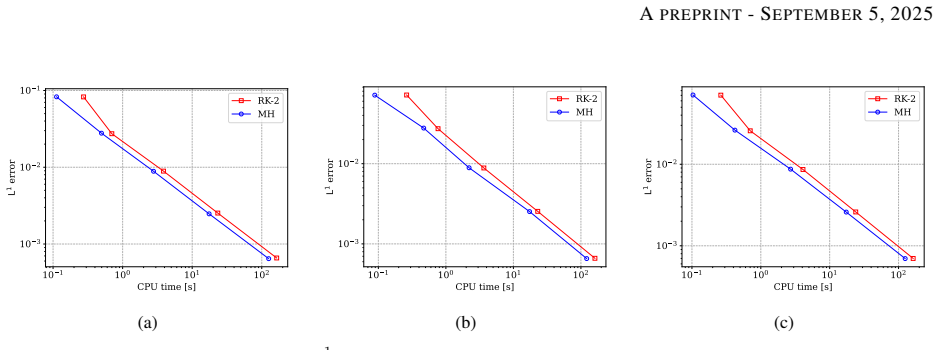
- The single-stage predictor-corrector structure makes the method cheaper per time step than a two-stage Runge-Kutta MUSCL scheme, and the numerical section reports this as a lower $L^1$ error for the same CPU time.
- Even if the slope modification were dropped, the compactness estimates in the paper still produce convergence of a subsequence to a weak solution, so the scheme is not unstable without the modification.
Reading between the lines
- As $\Delta x$ shrinks past any fixed $K$, the modified slopes (5.4) stop coinciding with the implemented slopes (3.2), so the entropy convergence of the implemented scheme is an extrapolation from the analyzed scheme rather than a proved consequence.
- The same quadrature-plus-correction template could be applied to other single-stage or two-stage MUSCL variants, including the Runge-Kutta MUSCL scheme that the paper compares numerically, if a matching $O((\Delta x)^\delta)$ correction bound can be verified.
- A practical check of the proof's bridge would be to monitor $\|e^{n+1}_{j+\frac{1}{2}}\|_{L^\infty}$ on the implemented slopes over refining meshes; the paper's entropy argument requires this quantity to decay like a fixed power of the mesh size.
- The final claim is conditional on the entropy-transfer theorem imported from earlier work, so a self-contained proof of that transfer result would remove the main external dependency.
Editorial analysis
A structured set of objections, weighed in public.
Referee Report
Summary. The paper proposes a single-stage MUSCL-Hancock-type second-order finite volume scheme for scalar non-local conservation laws of the form (2.1), with the convolution appearing in the flux. The scheme uses a Lax-Friedrichs-type numerical flux and carefully designed discrete convolutions in the predictor and corrector steps. The authors derive positivity preservation, L1-stability, an L∞ bound, a BV estimate, and an L1-Lipschitz time-continuity estimate under an explicit CFL condition (4.12), and use Kolmogorov compactness to obtain convergence to a weak solution. Entropy convergence is then claimed for a slope-modified variant (5.4) by writing the scheme as a perturbation of a first-order Lax-Friedrichs scheme and invoking a perturbation theorem (Theorem 5.1) from the authors' earlier work [35]. Numerical experiments for smooth and discontinuous data compare the method with a first-order scheme and a MUSCL-Runge-Kutta scheme.
Significance. If the entropy convergence were established for the scheme that is actually proposed and tested, this would be a valuable contribution: it would provide a provably entropy-stable second-order method for a general class of non-local conservation laws, with detailed a priori estimates and explicit constants. The paper's strengths include the careful construction of the discrete convolutions, the explicit CFL condition, the positivity-preservation and BV/time-continuity analysis, and the numerical comparison with a first-order scheme and a MUSCL-RK2 scheme. The perturbation framework of Theorem 5.1 is a useful structural tool. However, the main advertised result is proved only for a slope-capped variant, and the bridge to the implemented scheme is not valid in the convergence limit, so the central claim is currently not established for the method used in Section 6.
major comments (2)
- [§5 (Theorem 5.2 and Remark 5)] The entropy convergence theorem is proved only for the scheme (3.5) with the modified slopes (5.4), in which the limiter is capped by sgn(ρ_{j+1}-ρ_j) K (Δx)^δ for fixed K>0 and δ∈(0,1). The numerical experiments in Section 6, however, use the uncapped slopes (3.2). At a discontinuity these slopes are O(1), so the correction terms e^{n+1}_{j+1/2} in (5.3) are O(1), not O((Δx)^δ). Remark 5 attempts to bridge this gap by choosing K large for each mesh, but the required K grows like Δx^{-δ} and is therefore not independent of Δx, as Theorem 5.1(ii) explicitly demands. Consequently, Theorem 5.2 does not apply to the scheme actually implemented and tested, and Remark 6 only asserts weak-solution convergence for the uncapped scheme. The paper's central claim that the proposed MUSCL-Hancock scheme converges to the unique entropy solution is therefore not established for the method presented in Section 6. The authors should either prove entropy convergence for the uncapped slopes (3.2) by a different argument or implement and test the modified scheme (5.4) with a fixed K.
- [§5 (Lemma 5.1)] The proof of Lemma 5.1 defines the constant K in terms of itself. In the estimate (5.8), the bound on |ρ^{n+1/2,-}_{j+1/2}-ρ^n_j| contains the term (1/2 + λ/2 ‖∂_ρ f‖) K (Δx)^δ, and the constant ilde K is then defined with this K. After (5.10), the final constant is set to K = (λ‖∂_ρ f‖+α+2M‖μ‖L_μ) ilde K, which makes K appear on both sides. The existence of a fixed K is not established; one either needs to verify a fixed-point condition for the coefficient on K or, more simply, distinguish the slope-cap constant from the constant in the correction bound and show that a sufficiently large cap yields a uniform bound. This is a load-bearing point because Lemma 5.1 supplies hypothesis (ii) of Theorem 5.1.
minor comments (5)
- [Abstract and Conclusion] The abstract and the conclusion state that the scheme converges to the entropy solution without mentioning that this is proved only for the mesh-dependent slope modification (5.4), while the numerical experiments use the unmodified limiter (3.2). The statements should be qualified to match the theorems.
- [§5 (Theorem 5.1)] Theorem 5.1 is quoted from the authors' earlier paper [35] and its proof is not included; since it is a published result this is acceptable, but the manuscript should state explicitly which properties of the base scheme are inherited and perhaps include a proof or a precise reference to the corresponding theorem in [35].
- [§5 (Lemma 5.1)] In the estimate (5.8), the final inequality Δx ≤ (Δx)^δ requires Δx ≤ 1, which is not stated. Since the argument is intended for the limit Δx→0, the condition should be made explicit.
- [§6 (Numerical experiments)] The numerical experiments set α=0.16 and use Δt = Δx/20, but the text does not verify that this choice satisfies the CFL condition (4.12) for the flux functions and kernels used. A short check or statement would be helpful.
- [§6 (Examples)] Example 2 says 'the same setup as in Example 2' but clearly means Example 1; and the sentence before Theorem 5.2 says 'we are now in a position to use Theorem 5.2' where Theorem 5.1 is meant. These should be corrected.
Circularity Check
No significant circularity: entropy convergence is anchored in an external first-order LF scheme and a Vila-type perturbation lemma.
full rationale
The derivation chain is not circular. Theorem 5.2 establishes entropy convergence for the slope-capped scheme by writing (3.5) in the perturbative form (5.2)-(5.3), where the base scheme is the first-order Lax-Friedrichs scheme (3.15) whose convergence to the entropy solution is cited to external sources [6,3,1]. The perturbation lemma (Theorem 5.1) is quoted as originally established by Vila [37] and adapted in the authors' prior [35]; its assumptions (base entropy convergence, an O(Delta x^delta) correction, and L-infinity/BV/time-Lipschitz bounds) do not contain the target conclusion, so invoking it is independent support rather than circularity. Lemma 5.1 directly proves the required O(Delta x^delta) bound from the explicit cap (5.4); the cap is a sufficient condition, not a fitted parameter. The numerical EOA uses a fine-mesh solution of the same scheme as a reference, but that is a self-convergence diagnostic, not one of the analytical claims. Finally, the gap between the analyzed capped slopes (5.4) and the implemented slopes (3.2) (Remark 5 requires K to grow as Delta x tends to 0, while Theorem 5.1(ii) needs a fixed K) is a correctness limitation in the theorem's applicability, not a circular reduction of the conclusion to an input.
Assumptions & free parameters
free parameters (3)
- alpha (numerical viscosity coefficient) =
0.16 in experiments; theory requires alpha in (0, 8/27)
- theta (slope limiter angle) =
not reported in experiments; theory requires theta in [0, 0.5]
- K and delta (mesh-dependent slope modification) =
unspecified; K > 0, delta in (0,1)
assumptions (5)
- domain assumption Theorem 5.1 (entropy-consistency perturbation criterion) from [35]
- domain assumption First-order Lax-Friedrichs scheme (3.15) converges to the entropy solution of (2.1), per [6,3,1]
- domain assumption Entropy solutions of (2.1) are unique, per [6,7]
- standard math Kolmogorov compactness theorem
- domain assumption Hypotheses H1-H4 on the flux f and kernel mu
Cite this review
Pith. "Pith review of A MUSCL-Hancock scheme for non-local conservation laws." pith.science (2026). https://pith.science/paper/CL2MEWPA
@misc{pith2026250604176,
  author       = {Pith},
  title        = {Pith review of: A MUSCL-Hancock scheme for non-local conservation laws},
  year         = {2026},
  howpublished = {\url{https://pith.science/paper/CL2MEWPA}},
  note         = {Machine review of arXiv:2506.04176}
}
abstract
In this article, we propose a MUSCL-Hancock-type second-order scheme for the discretization of a general class of non-local conservation laws and present its convergence analysis. The main difficulty in designing a MUSCL-Hancock-type scheme for non-local equations lies in the discretization of the convolution term, which we carefully formulate to ensure second-order accuracy and facilitate rigorous convergence analysis. We derive several essential estimates including $\mathrm{L}^\infty,$ bounded variation ($\mathrm{BV}$) and $\mathrm{L}^1$- Lipschitz continuity in time, which together with the Kolmogorov's compactness theorem yield the convergence of the approximate solutions to a weak solution. Further, by incorporating a mesh-dependent modification in the slope limiter, we establish convergence to the entropy solution. Numerical experiments are provided to validate the theoretical results and to demonstrate the improved accuracy of the proposed scheme over its first-order counterpart.
Figures


Figures from the paper (1 more)

Reference graph
Works this paper leans on
-
[35]
G. D. VEERAPPAGOWDA, K. SUDARSHANKUMAR,ANDN. MANOJ,Convergence of a second-order scheme for non-local conservation laws, ESAIM Math. Model. Numer. Anal., 57 (2023), pp. 3439–3481
work page 2023
-
[1]
A. AGGARWAL, R. M. COLOMBO,ANDP. GOATIN,Nonlocal systems of conservation laws in several space dimensions, SIAM J. Numer. Anal., 53 (2015), pp. 963–983
work page 2015
-
[2]
A. AGGARWAL, H. HOLDEN,ANDG. VAIDYA,On the accuracy of the finite volume approximations to nonlocal conservation laws, Numer. Math., 156 (2024), pp. 237–271
work page 2024
- [3]
-
[4]
A. BAYEN, J.-M. CORON, N. DENITTI, A. KEIMER,ANDL. PFLUG,Boundary controllability and asymptotic stabilization of a nonlocal traffic flow model, Vietnam J. Math., 49 (2021), pp. 957–985
work page 2021
-
[5]
BERTHON,Why the MUSCL-Hancock scheme isL 1-stable, Numer
C. BERTHON,Why the MUSCL-Hancock scheme isL 1-stable, Numer. Math., 104 (2006), pp. 27–46
work page 2006
-
[6]
F. BETANCOURT, R. BÜRGER, K. H. KARLSEN,ANDE. M. TORY,On nonlocal conservation laws modelling sedimentation, Nonlinearity, 24 (2011), pp. 855–885
work page 2011
-
[7]
S. BLANDIN ANDP. GOATIN,Well-posedness of a conservation law with non-local flux arising in traffic flow modeling, Numer. Math., 132 (2016), pp. 217–241
work page 2016
Show all 39 references
-
[8]
BÜRGER, P
R. BÜRGER, P. GOATIN, D. INZUNZA,ANDL. M. VILLADA,A non-local pedestrian flow model accounting for anisotropic interactions and domain boundaries, Math. Biosci. Eng., 17 (2020), pp. 5883–5906
2020
-
[9]
CHALONS, P
C. CHALONS, P. GOATIN,ANDL. M. VILLADA,High-order numerical schemes for one-dimensional nonlocal conservation laws, SIAM J. Sci. Comput., 40 (2018), pp. A288–A305
2018
-
[10]
CHANDRASHEKAR, B
P. CHANDRASHEKAR, B. NKONGA, A. K. MEENA,ANDA. BHOLE,A path conservative finite volume method for a shear shallow water model, J. Comput. Phys., 413 (2020), pp. 109457, 29
2020
-
[11]
F. A. CHIARELLO ANDP. GOATIN,Global entropy weak solutions for general non-local traffic flow models with anisotropic kernel, ESAIM Math. Model. Numer. Anal., 52 (2018), pp. 163–180
2018
-
[12]
Networks and Heterogeneous Media, to appear, Aug
,Non-local multi-class traffic flow models. Networks and Heterogeneous Media, to appear, Aug. 2018
2018
-
[13]
F. A. CHIARELLO ANDA. TOSIN,Macroscopic limits of non-local kinetic descriptions of vehicular traffic, Kinet. Relat. Models, 16 (2023), pp. 540–564
2023
-
[14]
CIOTIR, R
I. CIOTIR, R. FAYAD, N. FORCADEL,ANDA. TONNOIR,A non-local macroscopic model for traffic flow, ESAIM Math. Model. Numer. Anal., 55 (2021), pp. 689–711
2021
-
[15]
R. M. COLOMBO, M. GARAVELLO,ANDM. LÉCUREUX-MERCIER,A class of nonlocal models for pedestrian traffic, Math. Models Methods Appl. Sci., 22 (2012), pp. Paper No. 1150023, 34
2012
-
[16]
R. M. COLOMBO, M. HERTY,ANDM. MERCIER,Control of the continuity equation with a non local flow, ESAIM Control Optim. Calc. Var., 17 (2011), pp. 353–379
2011
-
[17]
R. M. COLOMBO ANDM. LÉCUREUX-MERCIER,Nonlocal crowd dynamics models for several populations, Acta Math. Sci. Ser. B (Engl. Ed.), 32 (2012), pp. 177–196
2012
-
[18]
FRIEDRICH ANDO
J. FRIEDRICH ANDO. KOLB,Maximum principle satisfying CWENO schemes for nonlocal conservation laws, SIAM J. Sci. Comput., 41 (2019), pp. A973–A988
2019
-
[19]
FRIEDRICH, O
J. FRIEDRICH, O. KOLB,ANDS. GÖTTLICH,A Godunov type scheme for a class of LWR traffic flow models with non-local flux, Netw. Heterog. Media, 13 (2018), pp. 531–547
2018
-
[20]
FRIEDRICH, S
J. FRIEDRICH, S. SUDHA,ANDS. RATHAN,Numerical schemes for a class of nonlocal conservation laws: a general approach, Netw. Heterog. Media, 18 (2023), pp. 1335–1354
2023
-
[21]
GODLEWSKI ANDP.-A
E. GODLEWSKI ANDP.-A. RAVIART,Hyperbolic systems of conservation laws, vol. 3/4 of Mathématiques & Applications (Paris) [Mathematics and Applications], Ellipses, Paris, 1991
1991
-
[22]
GOTTLIEB ANDC.-W
S. GOTTLIEB ANDC.-W. SHU,Total variation diminishing runge-kutta schemes, Math. Comput., 67 (1998), pp. 73–85
1998
-
[23]
GUINOT ANDC
V. GUINOT ANDC. DELENNE,MUSCL schemes for the shallow water sensitivity equations with passive scalar transport, Comput. & Fluids, 59 (2012), pp. 11–30
2012
-
[24]
KEIMER ANDL
A. KEIMER ANDL. PFLUG,Existence, uniqueness and regularity results on nonlocal balance laws, J. Differential Equations, 263 (2017), pp. 4023–4069
2017
-
[25]
,On approximation of local conservation laws by nonlocal conservation laws, J. Math. Anal. Appl., 475 (2019), pp. 1927–1955
2019
-
[26]
KEIMER, L
A. KEIMER, L. PFLUG,ANDM. SPINOLA,Existence, uniqueness and regularity of multi-dimensional nonlocal balance laws with damping, J. Math. Anal. Appl., 466 (2018), pp. 18–55
2018
-
[27]
A. Y. LEROUX,Convergence of an accurate scheme for first order quasilinear equations, RAIRO Anal. Numér., 15 (1981), pp. 151–170
1981
-
[28]
MANOJ, G
N. MANOJ, G. V. GOWDA,ANDS. K. KENETTINKARA,A positivity preserving second-order scheme for multi-dimensional system of non-local conservation laws, arXiv preprint arXiv:2412.18475v2, (2024)
2024 arXiv
-
[29]
SHU ANDS
C.-W. SHU ANDS. OSHER,Efficient implementation of essentially nonoscillatory shock-capturing schemes, J. Comput. Phys., 77 (1988), pp. 439–471. 28 APREPRINT- SEPTEMBER5, 2025
1988
-
[30]
SOPASAKIS ANDM
A. SOPASAKIS ANDM. A. KATSOULAKIS,Stochastic modeling and simulation of traffic flow: asymmetric single exclusion process with Arrhenius look-ahead dynamics, SIAM J. Appl. Math., 66 (2006), pp. 921–944
2006
-
[31]
W. TONG, R. YAN,ANDG. CHEN,On a class of robust bound-preserving MUSCL-Hancock schemes, J. Comput. Phys., 474 (2023), pp. Paper No. 111805, 21
2023
-
[32]
,A class of bound-preserving MUSCL-Hancock schemes in two dimensions, J. Comput. Phys., 498 (2024), pp. Paper No. 112668, 28
2024
-
[33]
B.VANLEER,Towards the ultimate conservative difference scheme. v. a second-order sequel to godunov’s method, J. Comput. Phys., 32 (1979), pp. 101–136
1979
-
[34]
,On the relation between the upwind-differencing schemes of Godunov, Engquist-Osher and Roe, SIAM J. Sci. Statist. Comput., 5 (1984), pp. 1–20
1984
-
[36]
VIALLON,Convergence of the two-point upstream weighting scheme, Math
M.-C. VIALLON,Convergence of the two-point upstream weighting scheme, Math. Comp., 57 (1991), pp. 569– 584
1991
-
[37]
VILA,High-order schemes and entropy condition for nonlinear hyperbolic systems of conservation laws, Math
J.-P. VILA,High-order schemes and entropy condition for nonlinear hyperbolic systems of conservation laws, Math. Comp., 50 (1988), pp. 53–73
1988
-
[38]
,An analysis of a class of second-order accurate Godunov-type schemes, SIAM J. Numer. Anal., 26 (1989), pp. 830–853
1989
-
[39]
WAAGAN,A positive MUSCL-Hancock scheme for ideal magnetohydrodynamics, J
K. WAAGAN,A positive MUSCL-Hancock scheme for ideal magnetohydrodynamics, J. Comput. Phys., 228 (2009), pp. 8609–8626. 29
2009
Reviewed August 7, 2026 · model on record in the stance chip above.
Discussion (0). Sign in to comment.