REVIEW 4 major objections 4 minor 29 references
ExDiff: A Framework for Simulating Diffusion Processes on Complex Networks with Explainable AI Integration
T0 review · 4 major / 4 minor · reviewed 2026-08-07 · deepseek-v4-flash
Pith's one-line read ExDiff integrates SIRVD simulation, graph neural networks, and explainable AI into one modular framework for studying diffusion on complex networks.
desk verdict A well-organized integration of existing tools with a promising scaffold, but the case study provides no quantitative evidence and the manuscript is unfinished; the central claims about classification and structural determinants are not demonstrated. read the letter →
The pith
A machine-rendered reading of the paper's core claim, the machinery that carries it, and where it could break.
The reading
What carries the argument
The carrying mechanism is the ExDiff pipeline itself: a Network Analysis module constructs and measures graphs, a Simulation module runs compartmental dynamics (SIRVD) on the graph under configurable vaccination strategies, a Neural Network module trains a k-GCN—a graph convolutional network that aggregates features over node neighborhoods—to predict each node's compartmental state at a given timestep, and an Explainability module applies attribution methods to those predictions. The key design choice is that the same graph structure that drives the simulation also feeds the learner and the explainer, so structural features such as centrality can be related directly to predicted infection states. The simulation engine extends a network dynamics class to support node- and edge-level temporal changes and targeted immunization based on rankings like betweenness centrality. The framework is accessed through an interactive browser-based notebook interface, and modularity lets users swap network models and parameters without rebuilding the pipeline.
What would settle it
Run ExDiff on a real contact-tracing dataset with observed infection times and compare the predicted node states and XAI-identified critical edges against the empirically known transmission tree; if the predictions diverge sharply from observed spread, the framework's practical insight claim would fail.
Extended reading notes
Core claim
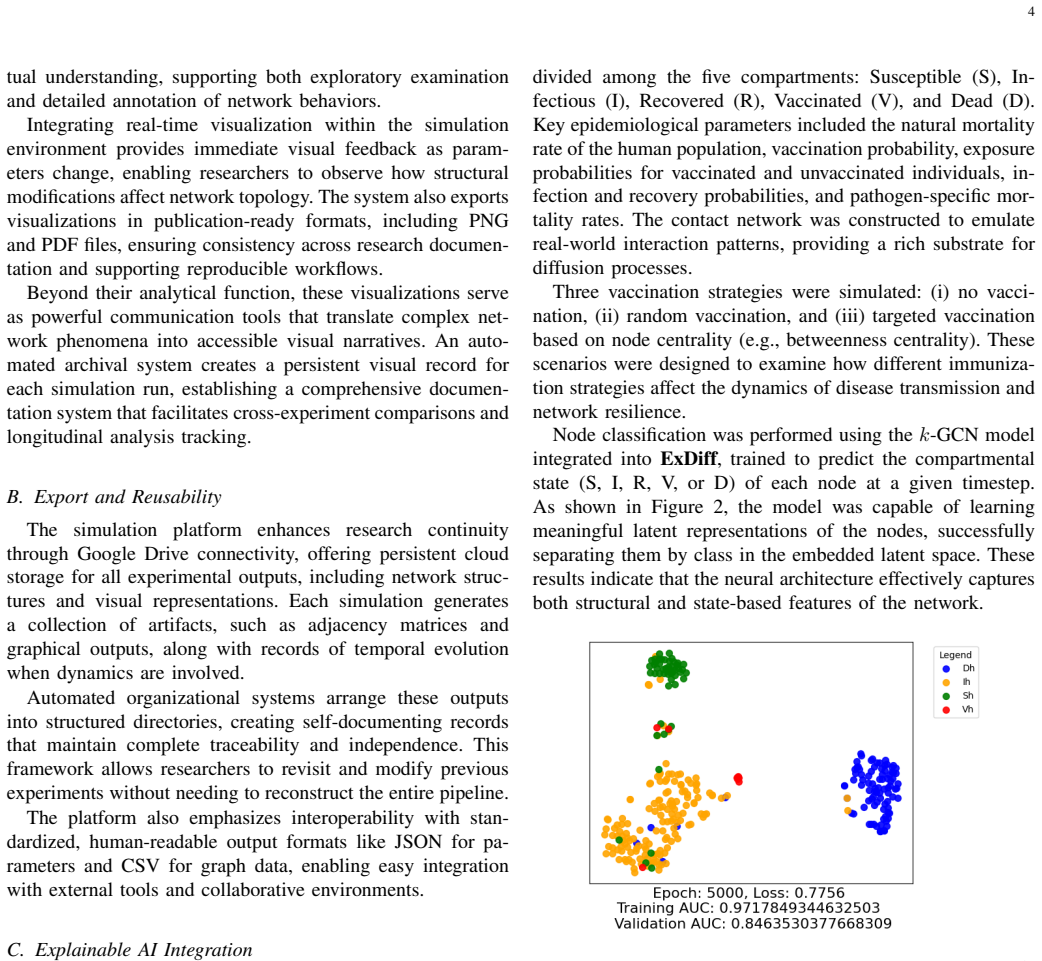
The paper's central discovery is that the four-module design—network analysis, neural networks, explainability, and simulation—can be wired together so that simulated diffusion curves feed a graph neural network whose node-state predictions are then interpreted with attribution methods. In the SIRVD case study, the k-GCN learns latent representations that separate Susceptible, Infectious, Recovered, Vaccinated, and Dead nodes into distinct clusters, and Integrated Gradients and Layer-wise Relevance Propagation highlight the connections most responsible for infection spread. The simulation engine natively compares no, random, and centrality-targeted vaccination strategies, using node rankings to identify super-spreaders. The paper thus establishes that ExDiff provides a usable, modular pipeline that unifies simulation and interpretability for diffusion processes on arbitrary network topologies.
Load-bearing premise
The load-bearing premise is that the hand-constructed contact network and hand-set SIRVD parameters used in the case study emulate real-world interaction patterns closely enough that the conclusions about spread and intervention transfer to actual populations.
Editorial extensions
If this is right
- A researcher can simulate an outbreak on Erdős–Rényi, stochastic block model, or random geometric graphs and compare how network topology changes the spread.
- Users can evaluate no, random, and centrality-targeted vaccination strategies side by side and rank nodes by their role in transmission.
- The k-GCN node classifier provides per-timestep state predictions whose latent space visibly separates the five SIRVD compartments.
- XAI attributions turn the classifier's decisions into concrete statements about which edges and nodes matter, making the structural determinants of contagion inspectable.
- Because outputs are exported in standard formats, simulations can be archived, revisited, and compared across runs.
Reading between the lines
- Inference: because the modules are decoupled, the same pipeline could be repurposed for information diffusion or cyber-spread by swapping the SIRVD compartments for other state machines, though the paper does not demonstrate this.
- Inference: the XAI-highlighted edges could be compared against structural metrics like betweenness or edge centrality to test whether the explanations align with known diffusion bottlenecks; the paper does not run this validation.
- Inference: the authors report that standard GCNs suffered from over-smoothing while the k-GCN did not; this suggests that preserving local heterogeneity is important for learning on diffusion dynamics, a design lesson that could transfer to other graph-learning tasks.
- Inference: since the case study uses a hypothetical contact network, a natural next test is to run ExDiff on empirical contact-tracing data and check whether simulated intervention rankings match observed outbreak outcomes; the paper's practical claims would be strengthened or bounded by that comparison.
Editorial analysis
A structured set of objections, weighed in public.
Referee Report
Summary. The paper presents ExDiff, an open-source modular framework that combines network simulation (SIR/SIRVD compartmental models), a k-GCN neural module for node-state classification, and XAI tools for interpretability. The architecture consists of four modules (Network Analysis, NN, Explainability, Simulation) with a Google Colab interface. A case study on SIRVD over a hand-constructed contact network simulates three vaccination strategies, trains a k-GCN to classify node states, and claims to identify influential nodes and edges via Integrated Gradients and Layer-wise Relevance Propagation. The central claim is that ExDiff can simulate diffusion, evaluate interventions, classify node states, and reveal structural determinants of contagion.
Significance. If substantiated with quantitative evaluation, ExDiff would be a useful open-source platform bridging simulation, graph deep learning, and interpretability for network diffusion research. The paper has the merit of releasing code and building on a modular design that is potentially reproducible in Google Colab. However, the current manuscript provides only qualitative support for its central capability claims: there are no accuracy numbers, baseline comparisons, statistical tests, or explanation-quality metrics. The explicit placeholder in Figure 1 and the internal inconsistency between Section IV-C ('aims to incorporate') and Section IV-D ('Integrated Gradients and Layer-wise Relevance Propagation were used') weaken the demonstration. The significance of the claimed contribution is therefore currently not established.
major comments (4)
- [Section IV-D, Figure 2] The node-classification claim is not supported by any quantitative result. The paper states that the k-GCN model 'was capable of learning meaningful latent representations' and 'successfully separating' classes, but Figure 2 is a qualitative t-SNE/embedding plot. Please report classification accuracy, macro-F1, per-class precision/recall, a confusion matrix, the train/validation/test split, and comparisons with baselines (e.g., degree-based or feature-based classifiers, standard GCN, node2vec plus logistic regression). Without these numbers, the claim that ExDiff can classify node states is not demonstrated.
- [Section IV-D, Figure 3] The explainability results are presented only as a visual highlight of edges. No explanation-quality metrics are given (e.g., fidelity/faithfulness, sparsity, stability, or agreement with known super-spreaders or with edges that actually transmitted infection in the simulator). Since the simulation provides ground-truth transmission events, the authors should quantify whether the highlighted edges correspond to true transmission pathways. This is necessary to support the abstract's claim that ExDiff can 'reveal the structural determinants of contagion through XAI techniques.'
- [Section IV-C and Section IV-D] There is a direct internal inconsistency: Section IV-C states that ExDiff 'aims to incorporate' SHAP, counterfactual analysis, and causal inference, while Section IV-D asserts that Integrated Gradients and Layer-wise Relevance Propagation were used in the case study. Please clarify which XAI methods are actually implemented and used, update the text accordingly, and ensure the linked repository matches the described functionality. The current wording mixes intentions with implemented features, making the evaluation ambiguous.
- [Section IV-D, vaccination strategies] The evaluation of vaccination strategies is described only narratively. No comparisons of epidemic size, peak incidence, deaths, or time-to-extinction are reported for the three strategies (no vaccination, random, targeted). Adding these quantitative outcomes is essential for the claim that ExDiff can 'evaluate intervention strategies.' In addition, the case-study network is asserted, without validation, to 'emulate real-world interaction patterns'; the authors should either provide empirical data or clearly state that this is a synthetic illustration with no claim of transferability to real contact networks.
minor comments (4)
- [Figure 1] The caption explicitly labels the architecture diagram as 'a placeholder and should be redesigned for publication.' For a journal submission, this placeholder undermines the presentation of the system architecture and must be replaced.
- [Section III, User Interaction] The workflow description says 'the resulting diffusion curves are used to train the k-GCN model'; it is unclear whether the GNN is trained on node states aggregated over time or on static final states. Please specify the input features, target labels, and temporal granularity.
- [Section IV, network models] The bullet list has a formatting artifact: 'Erd˝os–R´enyi (ER): . [29]' contains a stray period after the colon. Also, the ER model citation [29] points to Menczer et al.'s textbook rather than to the original Erdős–Rényi papers; please update the reference.
- [Section I and author affiliation] The author affiliation includes '(e-mail: hguzzi.com)', which is incomplete; a full email address should be provided. In addition, the phrase 'Magna Graecua University' appears to be a typo for 'Magna Graecia University.'
Circularity Check
The case-study evaluation is self-referential: the k-GCN is trained on the simulator's own diffusion curves and the XAI explanations are of that same model, so the node-classification and structural-determinant claims reduce to in-sample fits with no external ground truth.
-
fitted input called prediction
[Section III (User Interaction and Workflow) and Section IV-D (A Case Study)]
"The resulting diffusion curves are used to train the k-GCN model for predicting individual node states (Susceptible, Infected, Recovered, Vaccinated, Dead) at any given time point. ... As shown in Figure 2, the model was capable of learning meaningful latent representations of the nodes, successfully separating them by class in the embedded latent space."
The k-GCN's supervision consists of the compartmental states produced by ExDiff's own SIRVD simulation. The case study then presents the model's successful separation of these training labels as evidence of node-classification capability. No held-out test set, accuracy, F1, baseline comparison, or temporal generalization is reported, so the claimed 'predicting individual node states' is an in-sample fit to the very simulation output that generated the labels. The classification capability therefore reduces to the simulator's own output by construction.
-
self definitional
[Section IV-D, final paragraph; Abstract]
"To complement the classification analysis, the explainability module was employed to interpret the model's predictions. Using methods such as Integrated Gradients and Layer-wise Relevance Propagation, the framework identified critical nodes and edges contributing to the spread of infection."
The 'critical nodes and edges' are obtained by explaining the k-GCN, which was trained on the SIRVD simulation's own outputs. The case study's parameters were 'set to reflect a realistic, though hypothetical, outbreak scenario' and the contact network 'was constructed to emulate real-world interaction patterns,' but no empirical epidemic data or independent super-spreader ground truth is used. Thus the 'structural determinants of contagion' revealed by XAI are the model's learned encoding of the simulation that generated its labels; the explanation target is defined by the simulator's transition rules, making the reveal claim self-referential rather than a validated finding about real diffusion.
full rationale
ExDiff is a software-framework paper, so most of its content is architectural description rather than a scientific derivation. There is no load-bearing self-citation chain, no imported uniqueness theorem, and no ansatz smuggled in via citation: the framework builds on standard, externally established tools (NetworkX, PyTorch Geometric, Captum, SIRVD). The circularity lies in the case study's evaluation loop. The simulator generates the diffusion curves; the k-GCN is trained on those same curves to 'predict' compartmental states; and the XAI module then explains that same trained model. Figure 2 is offered as evidence of classification success, but it only shows in-sample latent-space separation, not prediction on unseen data or against any external benchmark. Similarly, the explanation of critical edges is an explanation of the model's learned decision boundary, not an independent measurement of contagion determinants; no comparison to observed outbreaks, known super-spreaders, or alternative ground truth is provided. These two steps make the abstract's claims of 'classify node states' and 'reveal the structural determinants of contagion' partially circular: they demonstrate that the pipeline can fit and re-describe its own synthetic data, not that it yields externally validated predictions or insights. Additional correctness risks (not circularity) include the contradiction between Section IV-C, where XAI is only 'aims to incorporate' SHAP/counterfactuals/causal inference, and Section IV-D, which asserts Integrated Gradients and LRP were used, and the placeholder label in Figure 1. Overall, the simulation component itself is an independent implementation of a known model, so the paper is not entirely circular; the circularity is partial, concentrated in the predictive and explanatory evaluation claims.
Assumptions & free parameters
free parameters (3)
- SIRVD transition probabilities =
not reported
- Network generation parameters =
not reported
- k-GCN hyperparameters =
not reported
assumptions (3)
- domain assumption Network diffusion can be modeled by compartmental states on a static or time-varying graph.
- domain assumption SIRVD compartmental dynamics on a network is an adequate model of disease spread.
- domain assumption GNN message passing and XAI attribution methods reliably identify causal structural determinants.
Cite this review
Pith. "Pith review of ExDiff: A Framework for Simulating Diffusion Processes on Complex Networks with Explainable AI Integration." pith.science (2026). https://pith.science/paper/7BAFE6PY
@misc{pith2026250604271,
  author       = {Pith},
  title        = {Pith review of: ExDiff: A Framework for Simulating Diffusion Processes on Complex Networks with Explainable AI Integration},
  year         = {2026},
  howpublished = {\url{https://pith.science/paper/7BAFE6PY}},
  note         = {Machine review of arXiv:2506.04271}
}
read the original abstract
Understanding and controlling diffusion processes in complex networks is critical across domains ranging from epidemiology to information science. Here, we present ExDiff, an interactive and modular computational framework that integrates network simulation, graph neural networks (GNNs), and explainable artificial intelligence (XAI) to model and interpret diffusion dynamics. ExDiff combines classical compartmental models with deep learning techniques to capture both the structural and temporal characteristics of diffusion across diverse network topologies. The framework features dedicated modules for network analysis, neural modeling, simulation, and interpretability, all accessible via an intuitive interface built on Google Colab. Through a case study of the Susceptible Infectious Recovered Vaccinated Dead (SIRVD) model, we demonstrate the capacity to simulate disease spread, evaluate intervention strategies, classify node states, and reveal the structural determinants of contagion through XAI techniques. By unifying simulation and interpretability, ExDiff provides a powerful, flexible, and accessible platform for studying diffusion phenomena in networked systems, enabling both methodological innovation and practical insight.
Figures


Reference graph
Works this paper leans on
-
[1]
Dis- ease spreading modeling and analysis: A survey
Pietro Hiram Guzzi, Francesco Petrizzelli, and Tommaso Mazza. Dis- ease spreading modeling and analysis: A survey. Briefings in Bioinfor- matics, 23(4):bbac230, 2022
work page 2022
-
[2]
Pcn-miner: An open-source extensible tool for the analysis of protein contact networks
Pietro Hiram Guzzi, Luisa Di Paola, Alessandro Giuliani, and Pierangelo Veltri. Pcn-miner: An open-source extensible tool for the analysis of protein contact networks. Bioinformatics, 38(17):4235–4237, 2022
work page 2022
-
[3]
Francesco Petrizzelli, Pietro Hiram Guzzi, and Tommaso Mazza. Be- yond covid-19 pandemic: Topology-aware optimization of vaccination strategy for minimizing virus spreading. Computational and Structural Biotechnology Journal, 2022
work page 2022
-
[4]
The physics of spreading processes in multilayer networks
Manlio De Domenico, Clara Granell, Mason A Porter, and Alex Arenas. The physics of spreading processes in multilayer networks. Nature Physics, 12(10):901–906, 2016
work page 2016
-
[5]
L Abenavoli, C Luigiano, PH Guzzi, N Milic, C Morace, L Stelitano, P Consolo, S Miraglia, S Fagoonee, C Virgilio, et al. Serum adipokine levels in overweight patients and their relationship with non-alcoholic fatty liver disease. Panminerva medica, 56(2):189–193, 2014
work page 2014
-
[6]
Paul Humphreys. Computational models. Philosophy of science , 69(S3):S1–S11, 2002
work page 2002
-
[7]
An extensive assessment of network alignment algorithms for comparison of brain connectomes
Marianna Milano, Pietro Hiram Guzzi, Olga Tymofieva, Duan Xu, Christofer Hess, Pierangelo Veltri, and Mario Cannataro. An extensive assessment of network alignment algorithms for comparison of brain connectomes. BMC bioinformatics, 18:31–45, 2017
work page 2017
-
[8]
Pietro Hiram Guzzi and Tijana Milenkovi ´c. Survey of local and global biological network alignment: the need to reconcile the two sides of the same coin. Briefings in bioinformatics , 19(3):472–481, 2018
work page 2018
Show all 29 references
-
[9]
Graph mod- elling for tracking the covid-19 pandemic spread
Rasim Alguliyev, Ramiz Aliguliyev, and Farhad Yusifov. Graph mod- elling for tracking the covid-19 pandemic spread. Infectious Disease Modelling, 6:112–122, 2021
2021
-
[10]
Modelling the dispersion of sars- cov-2 on a dynamic network graph
Patrick Bryant and Arne Elofsson. Modelling the dispersion of sars- cov-2 on a dynamic network graph. medRxiv, 2020
2020
-
[11]
A social network model of covid-19
Alexander Karaivanov. A social network model of covid-19. Plos one, 15(10):e0240878, 2020
2020
-
[12]
Simulation of the covid-19 epidemic on the social network of slovenia: Estimating the intrinsic forecast uncertainty
ˇZiga Zaplotnik, Aleksandar Gavri ´c, and Luka Medic. Simulation of the covid-19 epidemic on the social network of slovenia: Estimating the intrinsic forecast uncertainty. PloS one, 15(8):e0238090, 2020
2020
-
[13]
Analyzing host-viral interactome of sars-cov-2 for identifying vulnerable host pro- teins during covid-19 pathogenesis
Jayanta Kumar Das, Swarup Roy, and Pietro Hiram Guzzi. Analyzing host-viral interactome of sars-cov-2 for identifying vulnerable host pro- teins during covid-19 pathogenesis. Infection, Genetics and Evolution , page 104921, 2021
2021
-
[14]
Assessing the interplay between travel patterns and sars-cov-2 outbreak in realistic urban setting
Rohan Patil, Raviraj Dave, Harsh Patel, Viraj M Shah, Deep Chakrabarti, and Udit Bhatia. Assessing the interplay between travel patterns and sars-cov-2 outbreak in realistic urban setting. Applied Network Science , 6(1):1–19, 2021
2021
-
[15]
Comparative analysis of nuclear estrogen receptor alpha and beta interactomes in breast cancer cells
Giovanni Nassa, Roberta Tarallo, Pietro H Guzzi, Lorenzo Ferraro, Francesca Cirillo, Maria Ravo, Ernesto Nola, Marc Baumann, Tuula A Nyman, Mario Cannataro, et al. Comparative analysis of nuclear estrogen receptor alpha and beta interactomes in breast cancer cells. Molecular B...
2011
-
[16]
K. Chow, A. Sarkar, R. Elhesha, P. Cinaglia, A. Ay, and T. Kahveci. ANCA: Alignment-Based Network Construction Algorithm. IEEE/ACM Trans Comput Biol Bioinform , 18(2):512–524, 2021
2021
-
[17]
Ndlib: a python library to model and analyze diffusion processes over complex networks
Giulio Rossetti, Letizia Milli, and Salvatore Rinzivillo. Ndlib: a python library to model and analyze diffusion processes over complex networks. In Companion Proceedings of the The Web Conference 2018, pages 183– 186, 2018
2018
-
[18]
The graph neural network model
Franco Scarselli, Marco Gori, Ah Chung Tsoi, Markus Hagenbuchner, and Gabriele Monfardini. The graph neural network model. IEEE Transactions on Neural Networks , 20(1):61–80, 2009
2009
-
[19]
Empirical compar- ison of algorithms for network community detection
Jure Leskovec, Kevin J Lang, and Michael Mahoney. Empirical compar- ison of algorithms for network community detection. In Proceedings of the 19th international conference on World wide web , pages 631–640. ACM, 2010
2010
-
[20]
Editorial deep learning and graph embeddings for network biology
Pietro Hiram Guzzi and Marinka Zitnik. Editorial deep learning and graph embeddings for network biology. IEEE/ACM Transactions on Computational Biology and Bioinformatics , 19(2):653–654, 2022
2022
-
[21]
M-finder: Uncovering functionally associated proteins from interactome data integrated with go annotations
Young-Rae Cho, Marco Mina, Yanxin Lu, Nayoung Kwon, and Pietro H Guzzi. M-finder: Uncovering functionally associated proteins from interactome data integrated with go annotations. Proteome science, 11:1– 12, 2013
2013
-
[22]
Understanding complex systems through differen- tial causal networks
Annamaria Defilippo, Federico Manuel Giorgi, Pierangelo Veltri, and Pietro Hiram Guzzi. Understanding complex systems through differen- tial causal networks. Scientific Reports, 14(1):27431, 2024
2024
-
[23]
Leveraging graph neural networks for supporting automatic triage of patients
Annamaria Defilippo, Pierangelo Veltri, Pietro Li ´o, and Pietro Hiram Guzzi. Leveraging graph neural networks for supporting automatic triage of patients. Scientific Reports, 14(1):12548, 2024
2024
-
[24]
Kipf and Max Welling
Thomas N. Kipf and Max Welling. Semi-supervised classification with graph convolutional networks. In International Conference on Learning Representations, 2017
2017
-
[25]
A contribution to the mathematical theory of epidemics
William Ogilvy Kermack and Anderson G McKendrick. A contribution to the mathematical theory of epidemics. Proceedings of the royal society of london. Series A, Containing papers of a mathematical and physical character, 115(772):700–721, 1927
1927
-
[26]
Modeling partial lockdowns in multiplex networks using partition strategies
Adri `a Plazas, Irene Malvestio, Michele Starnini, and Albert D ´ıaz- Guilera. Modeling partial lockdowns in multiplex networks using partition strategies. Applied network science , 6(1):1–15, 2021
2021
-
[27]
Reaction–diffusion processes and metapopulation models in heteroge- neous networks
Vittoria Colizza, Romualdo Pastor-Satorras, and Alessandro Vespignani. Reaction–diffusion processes and metapopulation models in heteroge- neous networks. Nature Physics, 3(4):276–282, 2007
2007
-
[28]
A systematic framework of modelling epidemics on temporal networks
Rory Humphries, Kieran Mulchrone, Jamie Tratalos, Simon J More, and Philipp H ¨ovel. A systematic framework of modelling epidemics on temporal networks. Applied Network Science , 6(1):1–19, 2021
2021
-
[29]
A first course in network science
Filippo Menczer, Santo Fortunato, and Clayton A Davis. A first course in network science . Cambridge University Press, 2020
2020
Reviewed August 7, 2026 · model on record in the stance chip above.
Discussion (0). Sign in to comment.