REVIEW 5 major objections 5 minor 69 references
Experience Paper: Scaling WiFi Sensing to Millions of Commodity Devices for Ubiquitous Home Monitoring
T0 review · 5 major / 5 minor · reviewed 2026-08-07 · deepseek-v4-flash
Pith's one-line read WiFi sensing on ordinary home devices detects human motion at 92.61% accuracy across real homes, and the system is already deployed at millions-unit scale.
desk verdict Field measurements are the real contribution; the headline accuracy numbers are not yet testable as defined. read the letter →
The pith
A machine-rendered reading of the paper's core claim, the machinery that carries it, and where it could break.
The reading
What carries the argument
The load-bearing object is the autocorrelation function (ACF) of the CSI power $G(t,f)=|H(t,f)|^2$. Under the statistical electromagnetic model, static CSI power follows a Gaussian distribution $N(\mu(f),\sigma^2(f))$, so the motion statistic $\phi(f)=\rho_G(\Delta t,f)$ is near zero when nobody moves and positive when motion perturbs the multipath; comparing it with a universal threshold $\eta$ performs motion detection without calibration. The same ACF, combined over subcarriers by maximal ratio combining, produces a speed estimate from the first peak of the Bessel function $J_0(kv\tau)$, and the pattern of speed over time yields gait features. The mechanism that separates humans from pets and robots is the physical difference in locomotion—bipedal stride, quadrupedal gait, and wheeled rotation—encoded as seven physical features and six statistical features fed to a support vector machine (SVM) classifier. This is what allows the system to keep human detection accuracy high while suppressing non-human false alarms.
What would settle it
Take a low-cost WiFi IoT device from a vendor outside the 280-device fleet, place it in a home at the recommended 3–6.5 m distance from the router, and log the static CSI power distribution for one hour with nobody present; if the distribution is clearly non-Gaussian or the motion statistic crosses the universal threshold during AGC gain steps or clock corrections, the calibration-free foundation fails. A second decisive test is to run the published SVM protocol on homes where a pet and a person move simultaneously in the same room and check whether the human-detection accuracy remains above the reported 90.4%.
Extended reading notes
Core claim
The central claim is that a calibration-free WiFi sensing system built on commodity hardware can monitor real homes reliably enough for commercial use. The paper reports a 92.61% motion detection rate for human motion across 15 homes, 280 devices, and 16 scenarios, with false alarms from non-human movement reduced from 63.1% to 8.4% under a leave-one-environment-out protocol. The discovery that makes this possible is that movement mechanics, not signal strength or speed alone, separate humans from other movers: humans produce bipedal stance–swing cycles, pets produce quadrupedal gaits, and wheeled robots produce steady speeds with collision-induced jumps, and these differences appear in stride length, stride cycle time, speed percentiles, and ACF-derived statistics. Because the system relies on CSI power statistics that are phase-agnostic and on a statistical electromagnetic model of multipath, it is claimed to transfer across chipset and layout differences without per-home calibration. A hybrid edge-cloud design keeps motion detection and proximity on the device while offloading only compact ACF queues for subject recognition, which is how the system scales to millions of deployed devices.
Load-bearing premise
The load-bearing assumption is that the statistical electromagnetic model holds on all commodity chipsets and in all home layouts: static CSI power is Gaussian with a single universal detection threshold, so motion statistics and gait features trained on one device population transfer to any home without recalibration.
Editorial extensions
If this is right
- A single router–IoT device pair can cover a typical home, and adding one extra sensing device expands the reliably covered area; edge devices should sit within about 10 meters of the router and preferably under 6.5 meters.
- Because the detection and classification pipeline is calibration-free and phase-agnostic, it can be pre-installed on a device and switched on without a site survey, which is what makes deployment at millions of units feasible.
- Uploading only ACF queues, and only when motion is detected, cuts per-device uplink traffic by 99.72%, so cloud-based subject recognition can run over ordinary residential internet connections.
- WiFi sensing at 100 Hz coexists with normal data traffic, while higher-rate sensing (e.g., 1500 Hz) degrades VoIP jitter; an Origin-Aggregated deployment mode reduces that impact in heavy-traffic homes.
- The same architecture and statistical foundation apply beyond home monitoring to occupancy detection, smart building control, and health-related activity monitoring.
Reading between the lines
- Editorial inference: the strongest independent check of the paper's central claim would be a blind reproduction of the leave-one-environment-out SVM protocol on a device fleet built from chipsets and home layouts the authors did not use; if accuracy stays near 92.61% without retraining, the universal-threshold and Gaussian-statistics assumptions are broadly confirmed.
- Editorial inference: the reported false-alarm reduction was measured with pets as the main non-human movers; homes with several pets moving at once, or with fans, robot vacuums, and humans in the same room, provide a harder stress test for the movement-mechanics classifier.
- Editorial inference: because only processed ACF statistics leave the home, the architecture may be able to support formal privacy guarantees (such as differential privacy on the uploaded features) with little change to the sensing pipeline, a direction the paper mentions but does not develop.
- Editorial inference: the 'millions of devices' number is a deployment claim rather than an experimental measurement; an independent audit sampling a subset of those deployed homes would be the natural way to verify that the reported accuracy survives outside the 15-home study.
Editorial analysis
A structured set of objections, weighed in public.
Referee Report
Summary. The paper is an experience report from the authors' commercial deployment of WiFi-based home monitoring. It describes a system that uses CSI amplitude statistics from commodity WiFi devices to detect motion and to distinguish human motion from pets and appliances. The authors report a 92.61% motion detection rate from two years of data across 280 IoT devices in 15 homes, a reduction of non-human false alarms from 63.1% to 8.4% via an SVM classifier with leave-one-environment-out evaluation, a device quality-scoring scheme, a hybrid edge-cloud architecture, and measurements of joint sensing/communication interference. The paper claims this is the first WiFi sensing system deployed at scale, with over 10 million routers and 100 million smart bulbs in operation.
Significance. If the reported figures are reliable, the paper would be an important data point showing that WiFi sensing can move from laboratory prototypes to commodity home deployments, with accuracy comparable to dedicated sensors and a clear account of practical obstacles (pet false alarms, hardware heterogeneity, multi-user scenarios, edge constraints). The paper's strengths include a genuinely large deployment dataset (280 devices, 15 homes, over 4 million motion samples), a clear presentation of four real-world challenges, and honest discussion of edge-computing and communication trade-offs. The deployment architecture and the joint sensing/communication measurements (e.g., the VoIP jitter comparison in Figs. 17-18) are useful contributions. However, the central quantitative claims are not backed by a precisely defined evaluation protocol, and several key components (the Gaussian CSI model, the universal threshold, the SVM features, the quality-score weights) are imported from prior work or left unspecified, which limits the testability of the headline numbers.
major comments (5)
- [§2.3 and Abstract] The headline claim of a 92.61% motion detection rate is not defined with enough precision to be reproduced or falsified. The text does not specify the unit of analysis (per 6-second window, per motion event, per day, or per household), the ground-truth labeling procedure, the class balance of positive vs. negative samples, the decision threshold used for the final alert, or whether the number is an average across homes/devices weighted by samples or by events. No confusion matrix, per-home breakdown, or confidence intervals are provided. Since the paper's central claim—that WiFi sensing is practical at scale—rests on this number, the evaluation protocol must be stated in full, ideally in a dedicated section or appendix.
- [§3, Fig. 7] The subject-recognition evaluation (63.1%→8.4% false-alarm reduction and 37.9%→90.4% accuracy) is described only at a high level. The leave-one-environment-out procedure is stated, but the paper does not give the SVM kernel, hyperparameters, the exact list of the 13 features, feature normalization, or the per-environment confusion matrices. The temporal confidence scoring used to produce the final alert is also unspecified: the aggregation window, the fusion rule across receivers, and the alert threshold are not given. Without these details, the reported accuracy and false-alarm numbers cannot be checked, and the claim that the approach generalizes to unseen environments is not fully supported.
- [§4, §4.2] The sensing quality score is introduced as a weighted average of CSI-level and application-level scores, but the weights, the normalization ranges, and the exact formulas for 'CSI Stability', 'Motion Detection', and 'Human Detection' are not provided. The qualification criterion (score above 60, packet loss below 10%, 80% accuracy in both motion detection and human classification) appears to be justified only by 'analysis of extensive data' with no supporting table or statistical evidence. Because the score and threshold are free parameters defined by the authors, the conclusion that 'every device achieves a score above 60' is not independently verifiable. The paper should document the scoring formulas and, ideally, provide the per-device score distributions.
- [§2.2] The Gaussian model for static CSI power, the universal threshold η, and the Bessel-function ACF are all cited to the authors' prior work [51,59,60]. This is legitimate, but the current paper applies the model to low-cost commodity chipsets and heterogeneous IoT devices without presenting any direct goodness-of-fit evidence for those devices. If AGC gain steps, packet discontinuities, or chipset-specific distortions cause the static power distribution to deviate from Gaussian, then the motion statistic, the speed estimator, and the gait features built on this model lose validity. The paper should include at least a representative quantitative validation of the Gaussian assumption and of the threshold behavior on a few different commodity chipsets.
- [§1 and §9] The claims of deployment scale ('over 10 million actively connected routers' and 'more than 100 million bulbs') and the statement that 'our system is the first WiFi sensing solution that has been deployed at scale' are asserted without any supporting evidence in this preprint. No deployment timeline, partner names, aggregate statistics from production, or operational metrics are provided. For an experience paper, such claims should either be substantiated with data or clearly qualified as company-reported operational figures that are not part of the controlled evaluation. As written, the scale claim cannot be assessed by a reader.
minor comments (5)
- [Table 1] The 'Pricing' column for WiFi sensing reads '$9, ESP32 Whole Home', which appears to be a formatting error; the pricing and 'Coverage' entries should be formatted consistently.
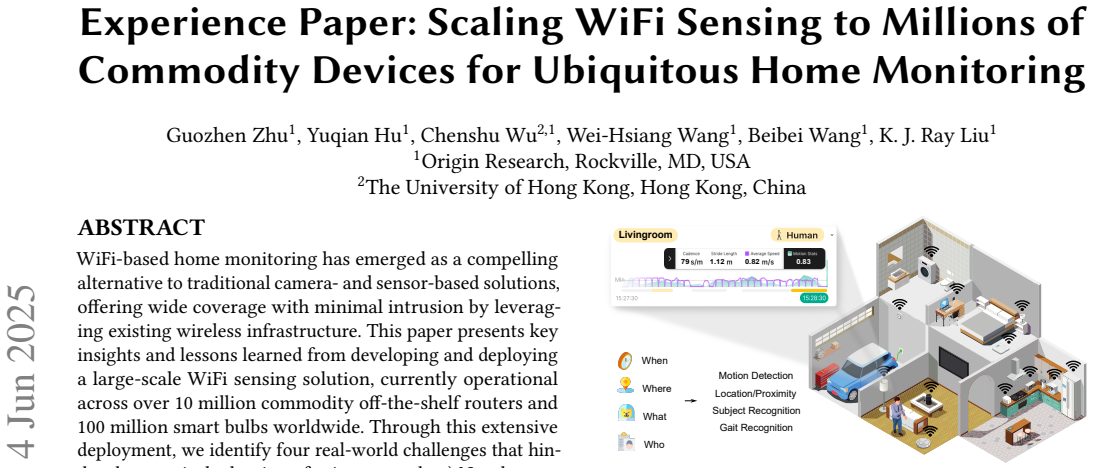
- [Fig. 1 caption] The caption of Figure 1 is incomplete and garbled: it lists 'What Where When Who' and a set of numbers '79 1.12 0.82 0.83' without explanation. This should be rewritten to describe the figure content.
- [§6.2, Fig. 14] The CPU utilization numbers for SVM-enabled processing at 2, 5, and 10 bots are reported as point values, but no error bars or repeated-measurement details are given. A short description of how many trials were averaged would improve interpretability.
- [§5, Fig. 13] Subfigure labels are inconsistent: the text refers to '(b1)(b2)' and '(c1)(c3)', while the figure shows labels like '(C3)' and '(C4)'. Please unify the label style.
- [§4.2, Fig. 9] The left panel of Figure 9 shows 'Top 10 Popular Devices' and 'Other Devices' but the legend and the mapping from device type numbers to device names are placed in the caption and are easy to miss; consider labeling the axes and bars directly.
Circularity Check
No significant circularity: the reported deployment metrics are new field measurements, and the cited foundation module is prior peer-reviewed work rather than a parameter fitted to the headline results.
full rationale
This is an experience paper, not a derivation paper. The foundation module in §2.2 is explicitly built on, and cited to, earlier peer-reviewed publications by the same group ([51,59,60]) that contain their own models and experiments; the present paper does not pretend to derive the Gaussian CSI-power model, Bessel ACF, or the universal threshold η from scratch. Under the reviewing rules, such citations count as real evidence when they are externally falsifiable, as those prior papers are. The headline numbers (92.61% motion detection over 15 homes/280 devices; 90.4% human-vs-nonhuman accuracy and 8.4% false-alarm rate over 7 homes/2.4M samples) are measured outcomes of a deployed system, not quantities that equal the cited equations by construction. The threshold η is a fixed empirical parameter taken from prior work, not refit to the reported statistics, so the detection rate is an evaluation of a fixed system rather than a fit renamed as a prediction. The §4.2 sensing-quality score includes motion-detection and human-classification components, and the statement that scores above 60 correspond to 80% accuracy in those metrics is a calibration consistency check rather than an independent scientific prediction; it does not affect the paper's central scalability claim. The main weakness—absence of a precise evaluation protocol for the headline rates—is a reproducibility/correctness concern, not a circularity concern. No load-bearing step in the paper reduces, by equation or by self-citation, to its own inputs.
Assumptions & free parameters
free parameters (5)
- universal motion detection threshold η =
not disclosed (shared global value)
- sensing quality score weights =
not disclosed
- device qualification threshold =
60
- human-alert confidence threshold =
not disclosed (0-99 scale)
- coverage region threshold =
80% detection probability
assumptions (4)
- domain assumption CSI power under static conditions follows a Gaussian distribution G(t,f) ~ N(μ(f), σ²(f))
- domain assumption Motion-induced ACF decays as a Bessel function J0(kvτ), giving speed from the first ACF peak
- domain assumption Var(ρ_G(τ)) ∝ 1/N as the number of perturbed multipath paths N grows
- domain assumption The 7 test homes and 40-user survey are representative of the global deployment population
Cite this review
Pith. "Pith review of Experience Paper: Scaling WiFi Sensing to Millions of Commodity Devices for Ubiquitous Home Monitoring." pith.science (2026). https://pith.science/paper/NLQWFYGU
@misc{pith2026250604322,
  author       = {Pith},
  title        = {Pith review of: Experience Paper: Scaling WiFi Sensing to Millions of Commodity Devices for Ubiquitous Home Monitoring},
  year         = {2026},
  howpublished = {\url{https://pith.science/paper/NLQWFYGU}},
  note         = {Machine review of arXiv:2506.04322}
}
read the original abstract
WiFi-based home monitoring has emerged as a compelling alternative to traditional camera- and sensor-based solutions, offering wide coverage with minimal intrusion by leveraging existing wireless infrastructure. This paper presents key insights and lessons learned from developing and deploying a large-scale WiFi sensing solution, currently operational across over 10 million commodity off-the-shelf routers and 100 million smart bulbs worldwide. Through this extensive deployment, we identify four real-world challenges that hinder the practical adoption of prior research: 1) Non-human movements (e.g., pets) frequently trigger false positives; 2) Low-cost WiFi chipsets and heterogeneous hardware introduce inconsistencies in channel state information (CSI) measurements; 3) Motion interference in multi-user environments complicates occupant differentiation; 4) Computational constraints on edge devices and limited cloud transmission impede real-time processing. To address these challenges, we present a practical and scalable system, validated through comprehensive two-year evaluations involving 280 edge devices, across 16 scenarios, and over 4 million motion samples. Our solutions achieve an accuracy of 92.61% in diverse real-world homes while reducing false alarms due to non-human movements from 63.1% to 8.4% and lowering CSI transmission overhead by 99.72%. Notably, our system integrates sensing and communication, supporting simultaneous WiFi sensing and data transmission over home WiFi networks. While focused on home monitoring, our findings and strategies generalize to various WiFi sensing applications. By bridging the gaps between theoretical research and commercial deployment, this work offers practical insights for scaling WiFi sensing in real-world environments.
Figures


Figures from the paper (11 more)





Reference graph
Works this paper leans on
-
[1]
IEEE P802.11 - Task Group BF (WLAN Sensing) - Meeting Update
2025. IEEE P802.11 - Task Group BF (WLAN Sensing) - Meeting Update. (2025). https://www.ieee802.org/11/Reports/tgbf_update.htm
work page 2025
-
[2]
Morita, Alexander Wong, Jennifer Boger, and George Shaker
Hajar Abedi, Ahmad Ansariyan, Plinio P. Morita, Alexander Wong, Jennifer Boger, and George Shaker. 2023. AI-Powered Noncontact In-Home Gait Monitoring and Activity Recognition System Based on mm-Wave FMCW Radar and Cloud Computing.IEEE Internet of Things Journal10, 11 (2023), 9465–9481. https://doi.org/10.1109/JIOT.2023. 3235268
-
[3]
Fadel Adib and Dina Katabi. 2013. See Through Walls with WiFi! SIGCOMM Comput. Commun. Rev.43, 4 (Aug. 2013), 75–86
work page 2013
-
[4]
Liu, Wei Wang, and Muhammad Shahzad
Kamran Ali, Alex X. Liu, Wei Wang, and Muhammad Shahzad. 2015. Keystroke Recognition Using WiFi Signals. InProceedings of the 21st Annual International Conference on Mobile Computing and Networking (MobiCom ’15). Association for Computing Machinery, New York, NY, USA, 90–102
work page 2015
-
[5]
Mishaal Mofleh Almutairi, Adnan Ahmed Abi Sen, and Mohammad Yamin. 2021. Survey of PIR Approach and its Techniques for Preserving Privacy in IoT. In2021 8th International Conference on Computing for Sustainable Global Development (INDIACom). IEEE, 417–421
work page 2021
-
[6]
Get that Camera Out of My House!
Katrin Arning and Martina Ziefle. 2015. “Get that Camera Out of My House!” Conjoint Measurement of Preferences for Video-Based Healthcare Monitoring Systems in Private and Public Places. InIn- clusive Smart Cities and e-Health. Springer International Publishing, Cham, 152–164
work page 2015
-
[7]
Aditya Arun, William Hunter, Roshan Ayyalasomayajula, and Dinesh Bharadia. 2024. WAIS: Leveraging WiFi for Resource-Efficient SLAM. InProceedings of the 22nd Annual International Conference on Mobile Systems, Applications and Services (MOBISYS ’24). Association for Com- puting Machinery, New York, NY, USA, 561–574
work page 2024
-
[8]
Kelly Caine, Selma Šabanovic, and Mary Carter. 2012. The Effect of Monitoring by Cameras and Robots on the Privacy Enhancing Behav- iors of Older Adults. InProceedings of the Seventh Annual ACM/IEEE International Conference on Human-Robot Interaction (HRI ’12). As- sociation for Computing Machinery, New York, NY, USA, 343–350. https://doi.org/10.1145/2157...
arXiv 2012
Show all 69 references
-
[9]
McClure, Ludy Shih, Daniel Tarsy, Matt Welsh, and Paolo Bonato
Bor-Rong Chen, Shyamal Patel, Thomas Buckley, Ramona Rednic, Douglas J. McClure, Ludy Shih, Daniel Tarsy, Matt Welsh, and Paolo Bonato. 2011. A Web-Based System for Home Monitoring of Patients With Parkinson’s Disease Using Wearable Sensors.IEEE Transactions on Biomedical Engi...
2011
-
[10]
C. Chen, Y. Chen, Y. Han, H. Q. Lai, F. Zhang, and K. J. R. Liu. 2017. Achieving Centimeter-Accuracy Indoor Localization on WiFi Plat- forms: A Multi-Antenna Approach.IEEE Internet of Things Journal4 (Feb 2017), 122–134
2017
-
[11]
Djuraev, J.G
S. Djuraev, J.G. Choi, and K.S. Sohn. 2018. Channel Hopping Scheme to Mitigate Jamming Attacks in Wireless LANs.Wireless Networks 2018 (2018), 11
2018
-
[12]
Sven Fleck and Wolfgang Straßer. 2008. Smart Camera Based Monitor- ing System and Its Application to Assisted Living.Proc. IEEE96, 10 (2008), 1698–1714
2008
-
[13]
Munkhjargal Gochoo, Tan-Hsu Tan, Vijayalakshmi Velusamy, Shing- Hong Liu, Damdinsuren Bayanduuren, and Shih-Chia Huang. 2018. Device-Free Non-Privacy Invasive Classification of Elderly Travel Pat- terns in a Smart House Using PIR Sensors and DCNN.IEEE Sensors Jour- nal18, 1 (2...
2018
-
[14]
Sergio González-Valenzuela, Min Chen, and Victor C. M. Leung. 2011. Mobility Support for Health Monitoring at Home Using Wearable Sensors.IEEE Transactions on Information Technology in Biomedicine 15, 4 (2011), 539–549. https://doi.org/10.1109/TITB.2010.2104326
2011
-
[15]
Tan, Richmond Y
Neilly H. Tan, Richmond Y. Wong, Audrey Desjardins, Sean A. Mun- son, and James Pierce. 2022. Monitoring Pets, Deterring Intruders, and Casually Spying on Neighbors: Everyday Uses of Smart Home Cameras. InProceedings of the 2022 CHI Conference on Human Factors in Computing Sys...
2022
-
[16]
Stephan Hengstler, Daniel Prashanth, Sufen Fong, and Hamid Aghajan
-
[17]
David A. Hill. 2009.Electromagnetic Fields in Cavities: Deterministic and Statistical Theories. Vol. 35. John Wiley & Sons
2009
-
[18]
Toke Høiland-Jørgensen, Carlo Augusto Grazia, Per Hurtig, and Anna Brunstrom. 2017. Flent: The FLExible Network Tester(V ALUETOOLS 2017). Association for Computing Machinery, New York, NY, USA, 120–125
2017
-
[19]
Cecilie Holländer-Mieritz, Emma Balch Steen-Olsen, Claus Andrup Kristensen, Christoffer Johansen, Ivan Richter Vogelius, and Helle Pappot. 2023. Feasibility of Using Wearables for Home Monitoring during Radiotherapy for Head and Neck Cancer—Results from the OncoWatch 1.0 Study...
2023
-
[20]
Jingzhi Hu, Tianyue Zheng, Zhe Chen, Hongbo Wang, and Jun Luo
-
[21]
Yuqian Hu, Muhammed Zahid Ozturk, Beibei Wang, Chenshu Wu, Feng Zhang, and K. J. Ray Liu. 2023. Robust Passive Proximity De- tection Using Wi-Fi.IEEE Internet of Things Journal10, 7 (2023), 6221–6234
2023
-
[22]
Yuqian Hu, Guozhen Zhu, Beibei Wang, and K. J. Ray Liu. 2023. Robust Proximity Detection Using On-Device Gait Monitoring. In2023 IEEE 9th World Forum on Internet of Things (WF-IoT). 01–06
2023
-
[23]
Yuqian Hu, Guozhen Zhu, Wei-Hsiang Wang, Beibei Wang, and K. J. Ray Liu. 2024. What You Need is A Good CSI. InProceedings of the 30th Annual International Conference on Mobile Computing and Networking (ACM MobiCom ’24). Association for Computing Machin- ery, New York, NY, USA,...
2024 doi
-
[24]
Wenjun Jiang, Hongfei Xue, Chenglin Miao, Shiyang Wang, Sen Lin, Chong Tian, Srinivasan Murali, Haochen Hu, Zhi Sun, and Lu Su. 2020. Towards 3D human pose construction using wifi. InProceedings of the 26th Annual International Conference on Mobile Computing and Networking (Mo...
2020
-
[25]
Xin Jin, Soumalya Sarkar, Asok Ray, Shalabh Gupta, and Thyagaraju Damarla. 2012. Target Detection and Classification Using Seismic and PIR Sensors.IEEE Sensors Journal12, 6 (2012), 1709–1718. https: //doi.org/10.1109/JSEN.2011.2177257
2012
-
[26]
Daejin Kim, Hongyi Bian, Carl K Chang, Liang Dong, and Jennifer Margrett. 2022. In-Home Monitoring Technology for Aging in Place: Scoping Review.Interact J Med Res11, 2 (1 Sep 2022), e39005
2022
-
[27]
Hao Kong, Cheng Huang, Jiadi Yu, and Xuemin Shen. 2025. A Survey of mmWave Radar-Based Sensing in Autonomous Vehicles, Smart Homes and Industry.IEEE Communications Surveys & Tutorials27, 1 (2025), 463–508. https://doi.org/10.1109/COMST.2024.3409556
2025
-
[28]
Karanam, Hong Cai, and Yasamin Mostofi
Belal Korany, Chitra R. Karanam, Hong Cai, and Yasamin Mostofi. 2019. XModal-ID: Using WiFi for Through-Wall Person Identification from ArXiv preprint, 2025 Zhu et al. Candidate Video Footage. InThe 25th Annual International Conference on Mobile Computing and Networking (MobiC...
2019
-
[29]
Josephine Lau, Benjamin Zimmerman, and Florian Schaub. 2018. Alexa, Are You Listening? Privacy Perceptions, Concerns and Privacy-seeking Behaviors with Smart Speakers.Proceedings of the ACM on Human- Computer Interaction2, CSCW, Article 102 (Nov. 2018), 31 pages
2018
-
[30]
Changming Li, Mingjing Xu, Yicong Du, Limin Liu, Cong Shi, Yan Wang, Hongbo Liu, and Yingying Chen. 2024. Practical Adversarial Attack on WiFi Sensing Through Unnoticeable Communication Packet Perturbation. InProceedings of the 30th Annual International Conference on Mobile Co...
2024
-
[31]
Jinyang Li, Zhenyu Li, Gareth Tyson, and Gaogang Xie. 2020. Your Privilege Gives Your Privacy Away: An Analysis of a Home Security Camera Service. InIEEE INFOCOM 2020 - IEEE Conference on Computer Communications. 387–396. https://doi.org/10.1109/INFOCOM41043. 2020.9155516
2020
-
[32]
Jinyang Li, Zhenyu Li, Gareth Tyson, and Gaogang Xie. 2022. Charac- terising Usage Patterns and Privacy Risks of a Home Security Camera Service.IEEE Transactions on Mobile Computing21, 7 (2022), 2344–2357. https://doi.org/10.1109/TMC.2020.3039787
2022
-
[33]
Xiang Li, Daqing Zhang, Qin Lv, Jie Xiong, Shengjie Li, Yue Zhang, and Hong Mei. 2017. IndoTrack: Device-Free Indoor Human Tracking with Commodity Wi-Fi.Proc. ACM Interact. Mob. Wearable Ubiquitous Technol.1, 3, Article 72 (Sept. 2017), 22 pages
2017
-
[34]
Yuxiang Lin, Yi Gao, Bingji Li, and Wei Dong. 2020. Revisiting Indoor Intrusion Detection With WiFi Signals: Do Not Panic Over a Pet!IEEE Internet of Things Journal7, 10 (2020), 10437–10449
2020
-
[35]
K. J. Ray Liu and Beibei Wang. 2019.Wireless AI: Wireless Sensing, Positioning, IoT, and Communications. Cambridge University Press
2019
-
[36]
K Moore, E O’Shea, L Kenny, et al. 2021. Older Adults’ Experiences With Using Wearable Devices: Qualitative Systematic Review and Meta-synthesis.JMIR Mhealth Uhealth9, 6 (2021), e23832. https: //doi.org/10.2196/23832
2021 doi
-
[37]
Venkatesha Prasad, Vijay S
Sujay Narayana, R. Venkatesha Prasad, Vijay S. Rao, T. V. Prabhakar, Sripad S. Kowshik, and Madhuri Sheethala Iyer. 2015. PIR sensors: characterization and novel localization technique. InProceedings of the 14th International Conference on Information Processing in Sensor Netw...
2015
-
[38]
Neal Patwari and Joey Wilson. 2011. Spatial Models for Human Motion- Induced Signal Strength Variance on Static Links.IEEE Transactions on Information Forensics and Security6, 3 (2011), 791–802. https://doi. org/10.1109/TIFS.2011.2146774
2011
-
[39]
Philip, Joel J
Nada Y. Philip, Joel J. P. C. Rodrigues, Honggang Wang, Simon James Fong, and Jia Chen. 2021. Internet of Things for In-Home Health Mon- itoring Systems: Current Advances, Challenges and Future Directions. IEEE Journal on Selected Areas in Communications39, 2 (2021), 300–310. ...
2021
-
[40]
Philip, Joel J
Nada Y. Philip, Joel J. P. C. Rodrigues, Honggang Wang, Simon James Fong, and Jia Chen. 2021. Internet of Things for In-Home Health Monitoring Systems: Current Advances, Challenges and Future Direc- tions.IEEE Journal on Selected Areas in Communications39, 2 (2021), 300–310
2021
-
[41]
Kun Qian, Chenshu Wu, Yi Zhang, Guidong Zhang, Zheng Yang, and Yunhao Liu. 2018. Widar2.0: Passive Human Tracking with a Single Wi-Fi Link. InProceedings of ACM MobiSys
2018
-
[42]
Reviews.org. 2024. Most Popular Smart Home Device Sta- tistics. (2024). https://www.reviews.org/home-security/ most-popular-smart-home-device-statistics/
2024
-
[43]
Bhavya, S
Suresh S., J. Bhavya, S. Sakshi, K. Varun, and G. Debarshi. 2016. Home Monitoring and Security system. In2016 International Conference on ICT in Business Industry & Government (ICTBIG). 1–5. https://doi.org/ 10.1109/ICTBIG.2016.7892665
2016
-
[44]
Khirod Chandra Sahoo and Umesh Chandra Pati. 2017. IoT based Intrusion Detection System Using PIR Sensor. In2017 2nd IEEE In- ternational Conference on Recent Trends in Electronics, Information & Communication Technology (RTEICT). 1641–1645. https://doi.org/10. 1109/RTEICT.201...
2017
-
[45]
Shumway and David S
Robert H. Shumway and David S. Stoffer. 2011. Time Series Regres- sion and Exploratory Data Analysis. InTime Series Analysis and Its Applications. Springer, 47–82
2011
-
[46]
2001.Digital Communications
Bernard Sklar. 2001.Digital Communications. Vol. 2. Prentice Hall, Upper Saddle River, NJ
2001
-
[47]
Elena Vildjiounaite, Satu-Marja Mäkelä, Tommi Keränen, Vesa Kyllö- nen, Ville Huotari, Sari Järvinen, and Georgy Gimel’farb. 2017. Unsu- pervised Illness Recognition via In-home Monitoring by Depth Cam- eras.Pervasive and Mobile Computing38 (2017), 166–187
2017
-
[48]
Xuanzhi Wang, Kai Niu, Jie Xiong, Bochong Qian, Zhiyun Yao, Tairong Lou, and Daqing Zhang. 2022. Placement Matters: Understanding the Effects of Device Placement for WiFi Sensing. 6, 1, Article 32 (March 2022), 25 pages. https://doi.org/10.1145/3517237
2022 doi
-
[49]
Weisstein
Eric W. Weisstein. 2002. Bessel Function of the First Kind. (2002)
2002
-
[50]
Au, and K.J
Chenshu Wu, Beibei Wang, Oscar C. Au, and K.J. Ray Liu. 2022. Wi-Fi Can Do More: Toward Ubiquitous Wireless Sensing.IEEE Communi- cations Standards Magazine6, 2 (2022), 42–49
2022
-
[51]
Chenshu Wu, Feng Zhang, Yuqian Hu, and K. J. Ray Liu. 2020. GaitWay: Monitoring and Recognizing Gait Speed Through the Walls.IEEE Transactions on Mobile Computing(2020)
2020
-
[52]
Chenshu Wu, Feng Zhang, Beibei Wang, and K. J. Ray Liu. 2020. Ea- siTrack: Decimeter-Level Indoor Tracking With Graph-Based Parti- cle Filtering.IEEE Internet of Things Journal7, 3 (2020), 2397–2411. https://doi.org/10.1109/JIOT.2019.2958040
2020
-
[53]
Chenshu Wu, Feng Zhang, Beibei Wang, and K. J. Ray Liu. 2020. mm- Track: Passive Multi-Person Localization Using Commodity Millimeter Wave Radio. InIEEE INFOCOM 2020 - IEEE Conference on Computer Communications. 2400–2409. https://doi.org/10.1109/INFOCOM41043. 2020.9155293
2020
-
[54]
Binbin Xie, Minhao Cui, Deepak Ganesan, and Jie Xiong. 2024. Wall Matters: Rethinking the Effect of Wall for Wireless Sensing.Proc. ACM Interact. Mob. Wearable Ubiquitous Technol.7, 4, Article 190 (Jan. 2024), 22 pages. https://doi.org/10.1145/3631417
2024 doi
-
[55]
Yaxiong Xie, Zhenjiang Li, and Mo Li. 2015. Precise Power Delay Profiling with Commodity WiFi. InProceedings of the 21st Annual international conference on Mobile Computing and Networking. 53–64
2015
-
[56]
Kangwei Yan, Fei Wang, Bo Qian, Han Ding, Jinsong Han, and Xing Wei. 2024. Person-in-WiFi 3D: End-to-End Multi-Person 3D Pose Estimation with Wi-Fi. InProceedings of the IEEE/CVF Conference on Computer Vision and Pattern Recognition (CVPR). 969–978
2024
-
[57]
Liu, and Lingtao Kong
Nan Yu, Wei Wang, Alex X. Liu, and Lingtao Kong. 2018. QGesture: Quantifying Gesture Distance and Direction with WiFi Signals.Proc. ACM Interact. Mob. Wearable Ubiquitous Technol.2, 1, Article 51 (March 2018), 23 pages
2018
-
[58]
Daqing Zhang, Dan Wu, Kai Niu, Xuanzhi Wang, Fusang Zhang, Jian Yao, Dajie Jiang, and Fei Qin. 2022. Practical Issues and Challenges in CSI-based Integrated Sensing and Communication. In2022 IEEE Inter- national Conference on Communications Workshops (ICC Workshops). 836–841. ...
2022
-
[59]
Feng Zhang, Chen Chen, Beibei Wang, and K. J. Ray Liu. 2018. WiSpeed: A Statistical Electromagnetic Approach for Device-Free Indoor Speed Estimation.IEEE Internet of Things Journal5, 3 (2018), 2163–2177. https://doi.org/10.1109/JIOT.2018.2826227
2018
-
[60]
Feng Zhang, Chenshu Wu, Beibei Wang, Hung-Quoc Lai, Yi Han, Experience: Scaling WiFi Sensing to Millions of Commodity Devices ArXiv preprint, 2025 and K. J. Ray Liu. 2019. WiDetect: Robust Motion Detection with a Statistical Electromagnetic Model.Proc. ACM Interact. Mob. Weara...
2025
-
[61]
Tianyang Zhang, Bozhong Yu, Yaxiong Xie, and Huanle Zhang. 2024. Privacy Protection in WiFi Sensing via CSI Fuzzing. In2024 IEEE/ACM Symposium on Edge Computing (SEC). 410–416
2024
-
[62]
Yuxuan Zhou, Chenggao Li, Huangxun Chen, and Qian Zhang. 2024. RIStealth: Practical and Covert Physical-Layer Attack against WiFi- based Intrusion Detection via Reconfigurable Intelligent Surface. In Proceedings of the 21st ACM Conference on Embedded Networked Sensor Systems (...
2024
-
[63]
Guozhen Zhu, Yuqian Hu, Beibei Wang, Chenshu Wu, Xiaolu Zeng, and K. J. Ray Liu. 2024. Wi-MoID: Human and Nonhuman Motion Discrimination Using WiFi With Edge Computing.IEEE Internet of Things Journal11, 8 (2024), 13900–13912
2024
-
[64]
Guozhen Zhu, Chenshu Wu, Beibei Wang, and K. J. Ray Liu. 2023. EZMap: Boosting Automatic Floor Plan Construction With High- Precision Robotic Tracking.IEEE Internet of Things Journal10, 8 (2023), 6988–6998. https://doi.org/10.1109/JIOT.2022.3228740
2023
-
[65]
Guozhen Zhu, Chenshu Wu, Xiaolu Zeng, Beibei Wang, and K. J. Ray Liu. 2022. Who Moved My Cheese? Human and Non-human Motion Recognition with WiFi. In2022 IEEE 19th International Conference on Mobile Ad Hoc and Smart Systems (MASS). 476–484. https://doi.org/10. 1109/MASS56207.2...
2022
-
[66]
Yanzi Zhu, Zhujun Xiao, Yuxin Chen, Zhijing Li, Max Liu, Ben Zhao, and Heather Zheng. 2020. Et Tu Alexa? When Commodity WiFi Devices Turn into Adversarial Motion Sensors
2020
-
[67]
Andrii Zhuravchak, Oleg Kapshii, and Evangelos Pournaras. 2022. Human Activity Recognition based on Wi-Fi CSI Data -A Deep Neural Network Approach.Procedia Computer Science198 (2022), 59–66. https://doi.org/10.1016/j.procs.2021.12.211
2022 doi
-
[2007]
InProceedings of the 6th International Conference on Information Processing in Sensor Networks (IPSN ’07)
MeshEye: a Hybrid-Resolution Smart Camera Mote for Applica- tions in Distributed Intelligent Surveillance. InProceedings of the 6th International Conference on Information Processing in Sensor Networks (IPSN ’07). Association for Computing Machinery, New York, NY, USA, 360–369
-
[2023]
InProceedings of the 29th Annual International Conference on Mobile Computing and Networking (ACM MobiCom ’23)
MUSE-Fi: Contactless MUti-person SEnsing Exploiting Near-field Wi-Fi Channel Variation. InProceedings of the 29th Annual International Conference on Mobile Computing and Networking (ACM MobiCom ’23). Association for Computing Machinery, New York, NY, USA, Article 75, 15 pages....
Reviewed August 7, 2026 · model on record in the stance chip above.
Discussion (0). Sign in to comment.