REVIEW 4 major objections 5 minor 54 references
Detailed Time Resolved Spectral and Temporal Investigations of SGR J1550-5418 Bursts Detected with Fermi/Gamma-ray Burst Monitor
T0 review · 4 major / 5 minor · reviewed 2026-08-07 · deepseek-v4-flash
Pith's one-line read Using hardness-ratio light curves, this paper identifies five candidate quasi-periodic spectral oscillations in SGR J1550-5418 bursts, at about 15-68 Hz, with the strongest at 15.73 Hz and p = 0.0001.
desk verdict A solid time-resolved spectral study whose QPSO candidates are under-supported by the quoted statistics; only the red-noise-corrected candidate may survive a global trials correction. read the letter →
The pith
A machine-rendered reading of the paper's core claim, the machinery that carries it, and where it could break.
The reading
What carries the argument
Two procedures carry the argument. First, spectral segmentation: overlapping time segments of at least 1200 background-subtracted counts are fit with COMPT, BB+BB, and MBB-RCS models; the COMPT parameters Epeak and photon index, together with segment midpoint times, are fed to k-means clustering, whose cluster boundaries define non-overlapping segments of varying length that mark genuine spectral change points. Second, the QPSO search: for each burst the hardness ratio HR = counts(Epiv−200 keV)/counts(8−Epiv) is built at 4 ms resolution for 16 pivot energies Epiv, detrended with a cubic polynomial, and searched between 10 and 250 Hz with both a Lomb-Scargle periodogram (with Baluev false-alarm probabilities) and the weighted wavelet Z-transform; for the red-noise-dominated QPSOb, significance is reassessed with the Torrence and Compo wavelet method. The key identity is the use of hardness ratio as a proxy for Epeak, justified by the near-constant photon index and validated on SGR J1935+2154 data.
What would settle it
Re-run the wavelet and Lomb-Scargle searches on simulated red-noise hardness-ratio light curves matched burst-by-burst in duration, sampling, and count statistics, applying the same 16-pivot scan and 10-250 Hz frequency grid, and count how often peaks as strong as the five reported ones appear anywhere in the search; if that global rate matches or exceeds the quoted p-values, the candidates should be regarded as noise. A simpler check: apply the same pipeline to the same bursts after randomizing the hardness-ratio phase ordering, and see whether any candidate survives.
Extended reading notes
Core claim
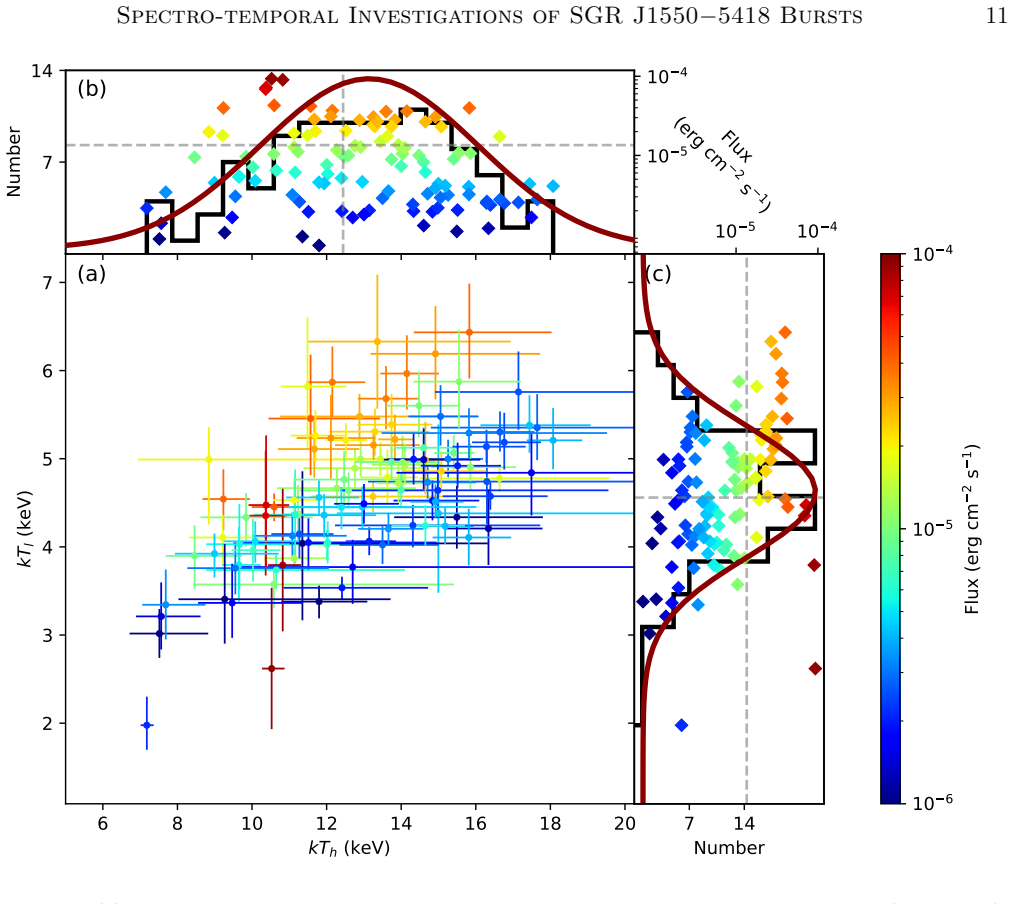
The central discovery the authors seek to establish is that SGR J1550-5418, a magnetar that emitted hundreds of bursts in 2008-2009, shows quasi-periodic oscillations not only in its light curves but in the spectral hardness of its bursts. Because the bursts yield too few spectral segments to track Epeak directly, the authors use the hardness ratio between counts above and below a pivot energy, scanning pivots from 15 to 30 keV, and analyse the detrended hardness curves with a Lomb-Scargle periodogram and a weighted wavelet transform. They report five candidate oscillations at 15.2-67.8 Hz across five bursts, each with coherence Q > 2 and single-trial p-values between 0.0001 and 0.13; the most secure candidate, QPSOb, is a 15.73 Hz oscillation in the brightest unsaturated burst, with p = 0.0001 computed with a red-noise wavelet method. The accompanying spectral analysis establishes that COMPT is the preferred model for about 93-95% of time segments, with Epeak distributed as a Gaussian of mean about 30 keV and photon index about -0.5, and that the BB+BB and MBB-RCS thermal parameters follow the distributions summarized in the paper.
Load-bearing premise
The QPSO claim rests on treating each candidate's p-value as a single pre-chosen trial even though the analysis scanned 44 bursts, 16 pivot energies, and the 10-250 Hz band; without a correction for those many trials, several of the five candidates could be chance fluctuations.
Editorial extensions
If this is right
- If the QPSO candidates are real, SGR J1550-5418 becomes the second magnetar with quasi-periodic spectral oscillations, so the phenomenon is not unique to SGR J1935+2154.
- The clustering of three candidates near 28 Hz, with one at about 15 Hz and one near 60 Hz, suggests a possible harmonic or subharmonic pattern, with roughly 28 Hz as a fundamental.
- Under the flux-tube acoustic model, the observed frequencies translate to flux-tube lengths of roughly 90-260 neutron-star radii, giving a geometric probe of the burst emission region.
- The spectral analysis confirms COMPT as the dominant emission model and shows that the Epeak-flux relation in this source is consistent with a single power law, placing a constraint on the earlier broken-power-law interpretation.
- The success of hardness-ratio oscillations in tracking spectral variations means future QPSO searches need not require long, individually fit Epeak light curves.
Reading between the lines
- Editorial inference: because the quoted p-values are single-trial and the search scanned 44 bursts at 16 pivot energies, the expected number of chance peaks with p < 0.13 is substantial; a global false-discovery correction might leave only QPSOb standing.
- Editorial inference: if the ~28 Hz frequency is reproducible in future bursts from this source and from SGR J1935+2154's ~42 Hz, the ratio between the two sources' fundamental frequencies could encode a structural property such as magnetic field or crust thickness, a test that requires more bursts.
- Editorial inference: the same hardness-ratio pipeline could be applied to the full 386-burst catalog, including weaker bursts, to estimate the true QPSO occurrence rate; the prediction is that the rate is low, on the order of a few percent, if the five candidates are real but partially spurious.
Editorial analysis
A structured set of objections, weighed in public.
Referee Report
Summary. This paper presents a time-resolved spectral and temporal analysis of bright bursts from SGR J1550-5418 observed with Fermi/GBM. The authors use a two-stage approach: first fitting overlapping time segments, then applying k-means clustering to define non-overlapping segments, and fitting COMPT, BB+BB, and MBB-RCS models. They report Gaussian distributions of COMPT Epeak and photon index, correlations among BB+BB temperatures, and MBB-RCS temperature behavior. The final part searches for quasi-periodic spectral oscillations (QPSOs) using hardness-ratio light curves and reports five candidate QPSOs at frequencies between about 15 and 68 Hz.
Significance. If the QPSO candidates are real, this would be the first systematic report of quasi-periodic spectral oscillations in SGR J1550-5418 and would extend the QPSO phenomenon beyond SGR J1935+2154, with implications for magnetar flux-tube models. The spectral analysis is methodologically careful in several respects: the use of C-stat with the Kaastra correction, BIC-based model comparison, jackknife resampling for break-point stability, and fitting of three physically distinct spectral models. The analysis uses public Fermi/GBM data and is broadly reproducible. However, the QPSO search currently lacks a global statistical treatment, and several of the reported candidates rest on per-trial p-values that are not corrected for the large search volume. The central new claim therefore needs additional support before the paper can be accepted.
major comments (4)
- [Section 4, Table 1]
- [Section 4, QPSOb paragraph and Table 1]
- [Section 4, hardness ratio validation]
- [Section 5, harmonic interpretation]
minor comments (5)
- [Section 3.1]
- [Section 5, last paragraph]
- [Section 4, LSP description]
- [Section 3.2, COMPT correlation]
- [Figure 6]
Circularity Check
No significant circularity: the spectral fits and QPSO search are conducted against public Fermi/GBM data with independent statistical methods, and the self-citations used are methodological or model citations, not load-bearing proofs of the paper's claims.
full rationale
The paper's derivation chain is not circular. The clustering-based segmentation (Keskin et al. 2024) is a methodology citation; it does not assert a result that the paper then 'predicts.' The MBB-RCS model (Yamasaki et al. 2020) is applied as an external spectral model, and its R2-kT comparison is a model-parameter trend, not a fitted input renamed as a prediction. The QPSO search uses hardness ratios; the claim that HR tracks Epeak is tested independently on SGR J1935+2154 data, where the authors recover the Roberts et al. (2023) frequency, so the premise is not defined in terms of the SGR J1550-5418 claim. No equation in the paper reduces to another by construction: the Lomb-Scargle and wavelet significances are computed from the HR time series, and the frequencies in Table 1 are peak positions from periodograms, not parameters fit to the same data used to define the claim. The absence of a global trials correction for the 16-pivot and 74-burst search is a statistical robustness concern, not a circularity: the quoted p-values are still computed from the data, and overcorrecting or undercorrecting them does not make the search equivalent to its inputs. Self-citations (Keskin et al. 2024; Yamasaki et al. 2020) are used for technique and model context, and the central spectral and QPSO results remain independently testable from the same public data.
Assumptions & free parameters
free parameters (5)
- 1200-count threshold =
1200 background-subtracted counts
- Cluster number k for k-means =
2 to 9 per burst, mean 3
- QPSO pivot energy Epiv =
15, 18, 29, 29, 15 keV for the five candidates
- Wavelet window size c =
0.005
- Source distance =
5 kpc
assumptions (4)
- domain assumption COMPT, BB+BB, and MBB-RCS are the correct emission models for magnetar burst spectra.
- domain assumption Hardness ratio evolution tracks Epeak evolution, i.e., photon index is nearly constant.
- standard math Standard statistical methods are valid: C-stat with Kaastra correction, BIC, Lomb-Scargle, WWZ, and Torrence-Compo wavelet for red noise.
- domain assumption Data calibration and background subtraction from Bayesian Blocks are correct.
Cite this review
Pith. "Pith review of Detailed Time Resolved Spectral and Temporal Investigations of SGR J1550-5418 Bursts Detected with Fermi/Gamma-ray Burst Monitor." pith.science (2026). https://pith.science/paper/HEYEK4LJ
@misc{pith2026250604414,
  author       = {Pith},
  title        = {Pith review of: Detailed Time Resolved Spectral and Temporal Investigations of SGR J1550-5418 Bursts Detected with Fermi/Gamma-ray Burst Monitor},
  year         = {2026},
  howpublished = {\url{https://pith.science/paper/HEYEK4LJ}},
  note         = {Machine review of arXiv:2506.04414}
}
abstract
We have conducted a time-resolved spectral analysis of magnetar bursts originating from SGR J1550-5418. Our analysis utilizes a two-step methodology for temporal segmentation of the data. We first generated and fitted overlapping time segments. Subsequently, we obtained non-overlapping time segments with varying lengths based on their spectral evolution patterns, employing a machine learning algorithm called k-means clustering. For the fitting process, we employed three distinct models, namely a modified blackbody (MBB-RCS), a double blackbody (BB+BB), and a power law with an exponential cut-off (COMPT) model. We found that nearly all of the time segments fit well with the COMPT model. Both the average peak energy in the ${\nu}$F${\nu}$ spectra (Epeak) and Photon Index parameters follow a Gaussian distribution with the means ${\sim}$30 keV and -0.5, respectively. Furthermore, there is a strong positive correlation between the cooler and hotter temperature parameters of the BB+BB model, and both two parameters show a Gaussian distribution with peaks ${\sim}$4 keV and 12 keV, respectively. Additionally, we found that the distribution of the temperature parameter of the MBB-RCS model can be fitted with a skewed Gaussian function with a peak ${\sim}$9-10 keV. Lastly, we searched for quasiperiodic spectral oscillations (QPSOs) in the hardness ratio evolution of the bursts. We identified five potential QPSO candidates at frequencies ranging from ${\sim}$15 Hz to ${\sim}$68 Hz. We discuss and compare these results with previous studies.
Figures


Figures from the paper (5 more)


Reference graph
Works this paper leans on
-
[1]
, " * write output.state after.block = add.period write newline
ENTRY address archivePrefix author booktitle chapter doi edition editor eprint howpublished institution journal key month number organization pages publisher school series title misctitle type volume year version url label extra.label sort.label short.list INTEGERS output.state before.all mid.sentence after.sentence after.block FUNCTION init.state.consts ...
-
[2]
write newline
" write newline "" before.all 'output.state := FUNCTION format.url url empty "" new.block "" url * "" * if FUNCTION format.eprint eprint empty "" archivePrefix empty "" archivePrefix "arXiv" = new.block " " eprint * " " * new.block " " eprint * " " * if if if FUNCTION format.doi doi empty "" " " doi * " " * if FUNCTION format.pid doi empty eprint empty ur...
-
[3]
+ ͋ Pq6 c˟0 =.p A &ѕir-ޚ/ [s| 듉 (PB G;-ǽ 뵿r: 2 qw eܰC\ \[N1,ߧ( e/a:|)`4 y#(WU2t ec QAF4 c Z Oc bro v 6/G; _ұ1 N3Y bI]ZU
thebibliography [1] 20pt to REFERENCES 6pt =0pt -12pt 10pt plus 3pt =0pt =0pt =1pt plus 1pt =0pt =0pt -12pt =13pt plus 1pt =20pt =13pt plus 1pt \@M =10000 =-1.0em =0pt =0pt 0pt =0pt =1.0em @enumiv\@empty 10000 10000 `\.\@m \@noitemerr \@latex@warning Empty `thebibliography' environment \@ifnextchar \@reference \@latexerr Missing key on reference command E...
2021
-
[4]
Astropy Collaboration , Price-Whelan , A. M., Lim , P. L., et al. 2022, , 935, 167, 10.3847/1538-4357/ac7c74
-
[5]
L., Boer , M., Hurley , K., et al
Atteia , J. L., Boer , M., Hurley , K., et al. 1987, , 320, L105, 10.1086/184984
-
[6]
Atwood , W. B., Abdo , A. A., Ackermann , M., et al. 2009, , 697, 1071, 10.1088/0004-637X/697/2/1071
-
[7]
Baluev , R. V. 2008, , 385, 1279, 10.1111/j.1365-2966.2008.12689.x
arXiv 2008
-
[8]
Bochenek , C. D., Ravi , V., Belov , K. V., et al. 2020, , 587, 59, 10.1038/s41586-020-2872-x
Show all 54 references
-
[9]
M., Halpern, J
Camilo, F., Ransom, S. M., Halpern, J. P., & Reynolds, J. 2007, The Astrophysical Journal, 666, 10.1086/521826
2007 doi
- [10]
-
[11]
C., Kouveliotou, C., Horst, A
Collazzi, A. C., Kouveliotou, C., Horst, A. J., et al. 2015, The Astrophysical Journal Supplement Series, 218, 11, 10.1088/0067-0049/218/1/11
2015 doi
-
[12]
Duncan , R. C. 1998, , 498, L45, 10.1086/311303
1998 doi
- [13]
-
[14]
A., Massaro, E., Mereghetti, S., & Woods, P
Feroci, M., Caliandro, G. A., Massaro, E., Mereghetti, S., & Woods, P. M. 2004, The Astrophysical Journal, 612, 408–413, 10.1086/422405
2004 doi
- [15]
-
[16]
L., Uttley , P., et al
Huppenkothen , D., Watts , A. L., Uttley , P., et al. 2013, , 768, 87, 10.1088/0004-637X/768/1/87
2013 doi
-
[17]
L., et al
Huppenkothen , D., D'Angelo , C., Watts , A. L., et al. 2014, , 787, 128, 10.1088/0004-637X/787/2/128
2014 doi
-
[18]
1999, , 397, 41, 10.1038/16199
Hurley , K., Cline , T., Mazets , E., et al. 1999, , 397, 41, 10.1038/16199
1999 doi
-
[19]
L., Belloni , T., Stella , L., et al
Israel , G. L., Belloni , T., Stella , L., et al. 2005, , 628, L53, 10.1086/432615
2005 doi
-
[20]
L., Romano, P., Mangano, V., et al
Israel, G. L., Romano, P., Mangano, V., et al. 2008, The Astrophysical Journal, 685, 1114–1128, 10.1086/590486
2008 doi
-
[21]
Kaastra , J. S. 2017, , 605, A51, 10.1051/0004-6361/201629319
2017 doi
-
[22]
2010, , 710, 1335, 10.1088/0004-637X/710/2/1335
Kaneko , Y., G \"o g \"u s , E., Kouveliotou , C., et al. 2010, , 710, 1335, 10.1088/0004-637X/710/2/1335
2010 doi
-
[23]
E., & Raftery, A
Kass, R. E., & Raftery, A. E. 1995, Journal of the American Statistical Association, 90, 773, 10.1080/01621459.1995.10476572
1995
-
[24]
O ., G \
Keskin , \"O ., G \"o g \"u s , E., Kaneko , Y., et al. 2024, , 965, 130, 10.3847/1538-4357/ad2fce
2024 doi
-
[25]
2017, The Astrophysical Journal Supplement Series, 232, 17, 10.3847/1538-4365/aa88b7
Kırmızıbayrak, D., Şaşmaz Muş, S., Kaneko, Y., & Göğüş, E. 2017, The Astrophysical Journal Supplement Series, 232, 17, 10.3847/1538-4365/aa88b7
2017 doi
-
[26]
C., & Markert, T
Lamb, R. C., & Markert, T. H. 1981, The Astrophysical Journal, 244, 94, 10.1086/158688
1981 doi
-
[27]
G., Fenimore, E
Laros, J. G., Fenimore, E. E., Klebesadel, R. W., et al. 1987, The Astrophysical Journal, 320, 10.1086/184985
1987 doi
-
[28]
2022, , 931, 56, 10.3847/1538-4357/ac6587
Li , X., Ge , M., Lin , L., et al. 2022, , 931, 56, 10.3847/1538-4357/ac6587
2022 doi
-
[29]
G., et al
Lin, L., Kouveliotou, C., Baring, M. G., et al. 2011, The Astrophysical Journal, 739, 87, 10.1088/0004-637x/739/2/87
2011 doi
-
[30]
G., et al
Lin , L., G \"o g \"u s , E., Baring , M. G., et al. 2012, , 756, 54, 10.1088/0004-637X/756/1/54
2012 doi
-
[31]
Lomb , N. R. 1976, , 39, 447, 10.1007/BF00648343
1976 doi
-
[32]
Lyubarsky, Y. E. 2002, Monthly Notices of the Royal Astronomical Society, 332, 199–204, 10.1046/j.1365-8711.2002.05290.x
2002
-
[33]
2003, , 346, 540, 10.1046/j.1365-2966.2003.07110.x
Lyutikov , M. 2003, , 346, 540, 10.1046/j.1365-2966.2003.07110.x
2003
-
[34]
MacQueen, J. B. 1967, in Proc. of the fifth Berkeley Symposium on Mathematical Statistics and Probability, ed. L. M. L. Cam & J. Neyman, Vol. 1 (University of California Press), 281--297
1967
-
[35]
P., Golenetskii, S
Mazets, E. P., Golenetskii, S. V., Il’inskii, V. N., Aptekar’, R. L., & Guryan, Y. A. 1979, Nature, 282, 587–589, 10.1038/282587a0
1979 doi
-
[36]
N., et al
Meegan , C., Lichti , G., Bhat , P. N., et al. 2009, , 702, 791, 10.1088/0004-637X/702/1/791
2009 doi
-
[37]
2009, , 696, L74, 10.1088/0004-637X/696/1/L74
Mereghetti , S., G \"o tz , D., Weidenspointner , G., et al. 2009, , 696, L74, 10.1088/0004-637X/696/1/L74
2009 doi
-
[38]
M., Barthelmy , S., Gehrels , N., et al
Palmer , D. M., Barthelmy , S., Gehrels , N., et al. 2005, , 434, 1107, 10.1038/nature03525
2005 doi
-
[39]
2011, Journal of Machine Learning Research, 12, 2825
Pedregosa, F., Varoquaux, G., Gramfort, A., et al. 2011, Journal of Machine Learning Research, 12, 2825. http://jmlr.org/papers/v12/pedregosa11a.html
2011
-
[40]
J., Baring, M
Roberts, O. J., Baring, M. G., Huppenkothen, D., et al. 2023, The Astrophysical Journal Letters, 956, L27, 10.3847/2041-8213/acfcad
2023 doi
-
[41]
Scargle , J. D. 1982, , 263, 835, 10.1086/160554
1982 doi
-
[42]
D., Norris , J
Scargle , J. D., Norris , J. P., Jackson , B., & Chiang , J. 2013, , 764, 167, 10.1088/0004-637X/764/2/167
2013 doi
-
[43]
1978, Annals of Statistics, 6, 461
Schwarz , G. 1978, Annals of Statistics, 6, 461
1978
- [44]
- [45]
-
[46]
Thompson, C., & Duncan, R. C. 1995, Monthly Notices of the Royal Astronomical Society, 275, 255–300, 10.1093/mnras/275.2.255
1995 doi
-
[47]
Torrence , C., & Compo , G. P. 1998, Bulletin of the American Meteorological Society, 79, 61, 10.1175/1520-0477(1998)079<0061:APGTWA>2.0.CO;2
1998 doi
-
[48]
Tukey, J. W. 1958, The Annals of Mathematical Statistics, 29, 614 , 10.1214/aoms/1177706647
1958
-
[49]
J., Kouveliotou , C., Gorgone , N
van der Horst , A. J., Kouveliotou , C., Gorgone , N. M., et al. 2012, , 749, 122, 10.1088/0004-637X/749/2/122
2012 doi
-
[50]
2006, in Compact stellar X-ray sources, ed
van der Klis , M. 2006, in Compact stellar X-ray sources, ed. W. H. G. Lewin & M. van der Klis , Vol. 39, 39--112
2006
-
[51]
2012, , 755, 150, 10.1088/0004-637X/755/2/150
von Kienlin , A., Gruber , D., Kouveliotou , C., et al. 2012, , 755, 150, 10.1088/0004-637X/755/2/150
2012 doi
-
[52]
2024, , 527, 11915, 10.1093/mnras/stae009
Xiao , S., Li , X.-B., Xue , W.-C., et al. 2024, , 527, 11915, 10.1093/mnras/stae009
2024 doi
-
[53]
2020, , 498, 484, 10.1093/mnras/staa2223
Yamasaki , S., Lyubarsky , Y., Granot , J., & G \"o g \"u s , E. 2020, , 498, 484, 10.1093/mnras/staa2223
2020 doi
-
[54]
J., et al
Younes , G., Kouveliotou , C., van der Horst , A. J., et al. 2014, , 785, 52, 10.1088/0004-637X/785/1/52
2014 doi
Reviewed August 7, 2026 · model on record in the stance chip above.
Discussion (0). Sign in to comment.