REVIEW 4 major objections 7 minor 128 references
Fast Luminous Extragalactic Transients in the VLA Sky Survey: Implications for the rates of Accretion-Induced Collapse Events, Fast Blue Optical Transients and Gamma Ray Burst Afterglows
T0 review · 4 major / 7 minor · reviewed 2026-08-07 · deepseek-v4-flash
Pith's one-line read The paper finds six luminous radio transients that appear in only the middle of three VLASS epochs, classifies them through host galaxies and radio energetics, and converts the sample into upper limits on the volumetric rates of…
desk verdict Genuinely useful VLASS fast-transient sample and host-galaxy work, but the headline rate limits rest on an unstable luminosity-function extrapolation and need reworking before they can be trusted. read the letter →
The pith
A machine-rendered reading of the paper's core claim, the machinery that carries it, and where it could break.
The reading
What carries the argument
The search design is the key instrument: a transient must appear in VLASS epoch 2.1 but be absent in both epoch 1.1 and epoch 3.1, selecting events with characteristic timescales of about three years or less. The rate analysis converts each detection into a volumetric rate through a power-law luminosity function dN/dL proportional to L^$\alpha$ with $\alpha$ about -1.32, an effective sky fraction f_eff of about 0.41, a maximum detectable luminosity distance per source, and an assumed visibility timescale tau per transient class. The classification machinery is a probabilistic host comparison: chance-coincidence probabilities from archival imaging, host stellar masses, star formation rates, and host-normalized offsets are compared with the distributions of Type Ia supernovae, core-collapse supernovae, long and short GRBs, LFBOTs, and ULX sources, supplemented by shock energetics under the Chevalier/Ho synchrotron model and the Piro and Kulkarni pulsar wind nebula model.
What would settle it
Observe one securely classified accretion-induced-collapse event, such as a millisecond-magnetar pulsar wind nebula, within the VLASS search volume at z below about 0.3 and above the survey's luminosity threshold: that single event would already exceed the claimed 0.2%-of-Type-Ia ceiling. Alternatively, directly measure any class's true visibility time from repeated radio monitoring and rescale the quoted limits by the ratio of measured to assumed times.
Extended reading notes
Core claim
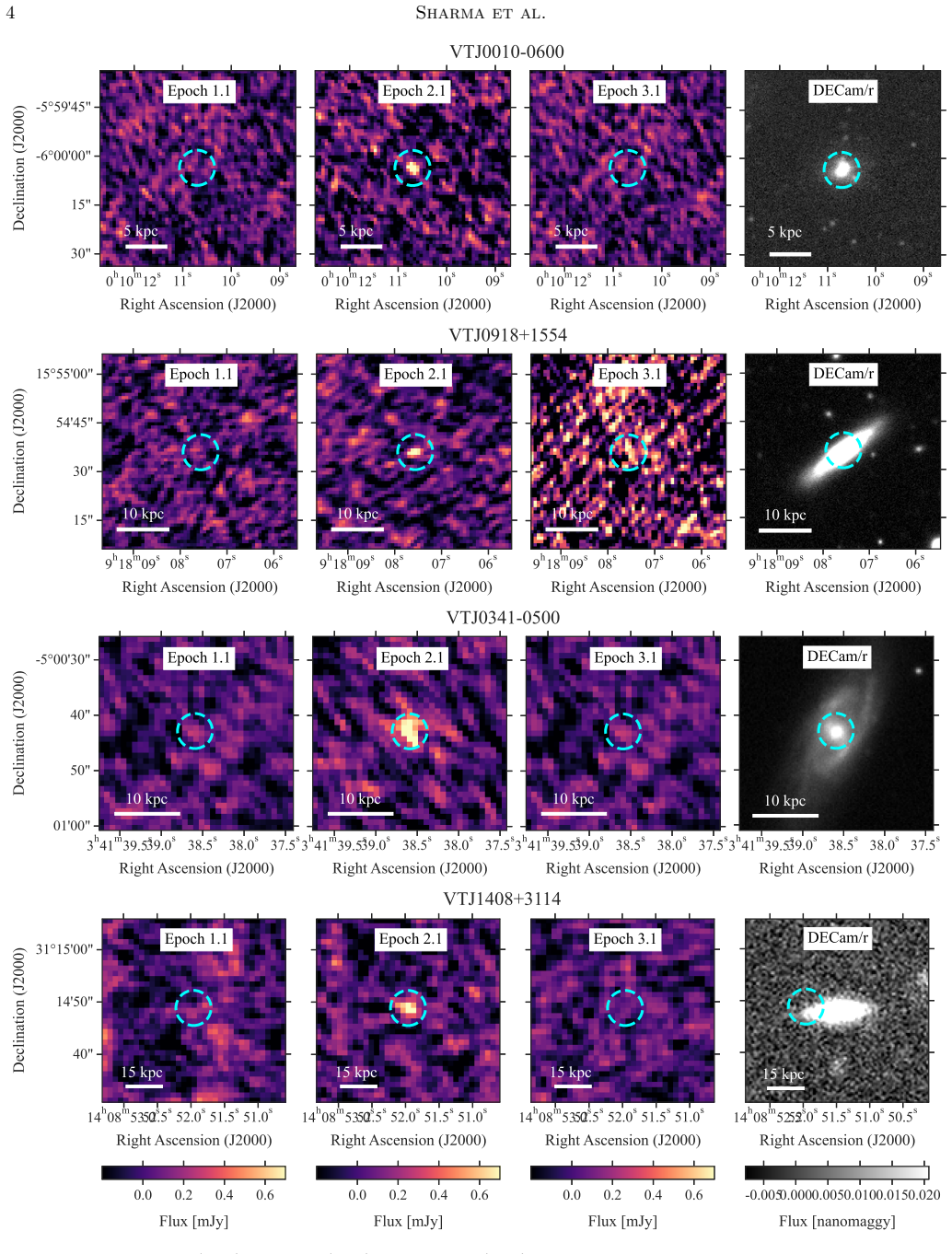
Searching the first halves of the three VLASS epochs for sources detected at >7 $\sigma$ in epoch 2.1 but undetected at 3 $\sigma$ in epochs 1.1 and 3.1, with host galaxies at z<=0.3, yields six luminous radio transients, one of which is the previously known SN 2019xhb. The chance-coincidence probability of host association is below 0.001 for all six. Using a fitted luminosity function dN/dL proportional to $L^{-1}$.32 and class-specific visibility timescales, the paper derives upper limits: AIC events with dense CSM interaction at no more than 1.10% of the Type Ia supernova rate, AIC events producing PWNe at no more than 0.20%, radio-bright AT2018cow-like LFBOTs at no more than 0.02% of the core-collapse supernova rate, and beaming-corrected local rates for long and short GRBs of 11.46 and 80.88 $Gpc^{-3}$ $yr^{-1}$, respectively. The central claim is that none of these exotic classes is common enough to have produced more than a handful of the detected events, and the survey's non-detections therefore sharpen the rate ceilings.
Load-bearing premise
All quoted rate ceilings assume each transient class stays radio-bright for a specific visibility time (6 months for AIC-PWN, 2 years for AIC-CSM, 1.5 years for LFBOTs, 10 months for GRBs) and that the beaming corrections from afterglow simulations are correct; if those assumed times or viewing angles are wrong, the ceilings move by the same factor.
Editorial extensions
If this is right
- Accretion-induced collapse of white dwarfs must be rare: at most about 1.1% of the Type Ia supernova rate for dense-CSM events and about 0.2% for pulsar-wind-nebula events, matching theoretical expectations below 1%.
- Radio-bright AT2018cow-like LFBOTs occur in under 0.02% of core-collapse supernovae, so either optically selected LFBOTs are usually radio-faint or LFBOTs are rarer than earlier optical estimates suggested.
- Beaming-corrected local rates for long and short GRBs sit below about 11.5 and 81 Gpc^-3 yr^-1, with the short-GRB ceiling consistent with gravitational-wave constraints.
- The VLASS search geometry is sensitive to off-axis GRBs, with median detectable viewing angles near 0.4 and 0.3 radians, so the non-detections constrain jet opening angles and emission geometry.
- Host-galaxy properties and offsets are decisive for radio-only transients: they allow provisional classification and rate estimation even when no multi-wavelength counterpart is detected.
Reading between the lines
- If the assumed visibility timescales are ever replaced with measured lightcurve durations, the same search becomes a direct rate measurement rather than an upper limit; a factor-of-two error in any assumed tau would shift every quoted rate by that same factor.
- The paper's reported absence of X-ray and gamma-ray counterparts for the unclassified transients hints that many fast luminous radio events may be off-axis or heavily absorbed; a future campaign that catches one in the act could distinguish beamed from isotropic scenarios.
- A deeper radio survey with similar cadence should recover a clean sample of these events, and comparing their host-offset distribution with Type Ia supernovae would test whether the AIC candidates truly trace Type Ia environments.
Editorial analysis
A structured set of objections, weighed in public.
Referee Report
Summary. The paper presents a systematic search for fast (≲3 yr) luminous radio transients in the first half of three VLASS epochs, requiring a >7σ detection in E2.1 and non-detections in E1.1 and E3.1, restricted to z≤0.3. Six sources pass the selection; for each, the authors obtain optical host spectroscopy, measure host stellar-population properties, compute host-association probabilities (P_cc<0.001), and fit radio synchrotron models. They then use probabilistic host-galaxy and energetics comparisons to classify the sources as possible AIC events with dense CSM or PWN emission, LFBOTs, and long/short GRB afterglows, and derive volumetric rate upper limits for each class using a power-law luminosity function, assumed visibility timescales from unpublished lightcurve simulations, and beaming corrections from afterglow simulations. The headline constraints are that AIC rates are ≲1.10% and ≲0.20% of the Type Ia SN rate, radio-bright LFBOTs are ≲0.02% of the CC SN rate, and beaming-corrected long- and short-GRB rates are ≲11.46 and ≲80.88 Gpc^-3 yr^-1.
Significance. If the rate constraints are robust, this is a valuable first radio-selected census of fast extragalactic transients: it places the first direct limits on the rates of AIC events with PWN or dense-CSM radio emission and on radio-bright LFBOTs, and it constrains off-axis GRB rates from an unbiased VLASS search rather than from targeted follow-up. The paper's strengths include a clean search definition, strong host associations, real Keck/LRIS spectroscopy for five hosts, careful stellar-population modeling with Prospector, and an explicit treatment of false-alarm statistics. However, the central rate claims are conditional on several layers of model input: a luminosity-function slope fit to 1–5 sources and extrapolated to luminosities below the observed range, visibility timescales taken from simulations reported only in 'Sharma et al. (in prep)', beaming fractions from the same simulation suite, and probabilistic classifications whose overlap is not fully propagated. The discovery sample and host-galaxy analysis are likely to stand, but the rate limits need substantial revision or reframing before they can be taken as the paper's primary quantitative result.
major comments (4)
- [§2.4 and §5] The quoted 'upper limits' are not Poisson counting limits: they are integrals of a fitted power-law luminosity function dN/dL ∝ L^α, extrapolated down to L_min ≈ 5×10^27 erg s^-1 Hz^-1. The combined fit gives α = −1.32^{+0.25}_{−0.28}, and the class-specific fits used in §5.1 and §5.4 are even less constrained (e.g., α = −1.57^{+1.12}_{−1.10} for AIC/PWN, whose 68% range extends above −1). For α > −1, the integral ∫_{L_min}^∞ L^α dL diverges, so the finite reported bounds require an upper truncation or a prior that is not described. Because the integrated rate is extremely sensitive to α and to L_min, the headline fractions (1.10%, 0.20%, 0.02%) are model-dependent extrapolations rather than guaranteed observational upper limits. Please report the exact integration limits and the class-specific fits for every rate, and provide a sensitivity test to L_min and to the presence of a low-luminosity break.
- [§2.1, §2.4, and §5] Every class-specific rate limit scales linearly with an assumed visibility timescale τ (6 months for AIC/PWN, 2 yr for AIC/CSM, 1.5 yr for LFBOTs, 10 months for GRBs), and the GRB beaming corrections use median detectable viewing angles of 0.41 and 0.34 rad from the same simulation suite. These inputs are summarized only in §2.1 and are attributed to 'Sharma et al. (in prep)', with no simulation outputs, no distribution of τ, and no sensitivity test. A factor-of-two error in τ or in the beaming fraction changes every quoted limit by the same factor. Please either include the simulation details and the implied τ distributions in this paper, or present the rates as explicitly conditional on these unpublished inputs.
- [§5.1–§5.4] The candidate membership underlying each rate is not consistently defined, and the same host-galaxy comparisons are used both to classify sources and to set the rates. §5.1 identifies three AIC/PWN candidates and fits α to those sources, whereas §5.4 and the conclusion refer to 'four potential LFBOT candidates' even though the reported probabilities are p<0.001 for three of the five transients and only p=0.024 and p=0.041 for the other two; the text never states which sources enter the LFBOT luminosity-function fit. The AIC-CSM limit in §5.1 is instead derived after excluding all sources, using an assumed maximum luminosity of 10^28 erg s^-1 Hz^-1, rather than the §2.4 procedure. For each rate, please specify exactly which sources are included, how the probability thresholds were chosen, and whether the quoted bound is a frequentist upper limit, a Bayesian posterior interval, or a posterior predictive interval.
- [Abstract and §5] The notation '≲ 1.10^{+2.60}_{−0.90}%' is internally ambiguous: a genuine upper limit is a single number with an associated confidence level, while the asymmetric errors suggest a posterior distribution of the inferred rate. The same issue affects all five headline constraints. Please state the confidence level of each upper limit explicitly and separate the posterior median/credible interval from the upper bound, so that a reader can tell whether the quoted values are 95% limits or best-fit rates with error bars.
minor comments (7)
- [Abstract vs. §2.2 and §6] The abstract says the search reports 'five such transients', while §2.2 and §6 report six sources in the sample; please clarify whether the abstract excludes the known SN 2019xhb and make the count consistent throughout.
- [§2.4] The text says the expected rate 'in a differential luminosity bindLatL' is approximated by the displayed expression, but the expression appears to be a volume per transient multiplied by t_span/τ, not a differential luminosity-function density; please define the estimator precisely and show how the power-law luminosity function is combined with it.
- [§5.1] The AIC-CSM rate is quoted as '339.211^{+780.02}_{−280.6} Gpc^-3 yr^-1', which carries excessive significant figures; please round to a physically meaningful precision.
- [§5.2] The text says the long-GRB beaming correction is f_b ≈ 10, but 1/(1−cos 0.41 rad) ≈ 12, and the ratio of the corrected to uncorrected long-GRB rate is 11.46/0.95 ≈ 12; please make the stated correction factor and the rates consistent.
- [§5.1, §5.2, and §5.3] The statement that a probability p<0.001 rules out membership 'with more than 6σ confidence' is not correct: p<0.001 corresponds to roughly 3.3σ, and 6σ would require p<2×10^-9; please quote the actual probabilities or use a correct significance conversion.
- [Figure 2 and §2.4] The red data points in Figure 2 are described as observed number densities, but the text does not state how the 1–5 sources are binned in luminosity or how the plotted error bars combine Poisson and measurement uncertainties; please add this information to the caption or text.
- [§2.2 and §2.1] The detection pipeline is attributed to 'Dong et al. (in prep)' and the lightcurve simulations to 'Sharma et al. (in prep)'; if these works are not yet public, please state their availability or include enough detail for the search and rate inputs to be reproduced.
Circularity Check
The volumetric-rate upper limits reduce to a luminosity-function fit performed on the same sample, and the beaming and visibility corrections are taken from an unpublished same-author simulation paper.
-
fitted input called prediction
[§2.4 (rate equation) and §5.4 (LFBOT rate)]
"we calculate the upper limit on the rate of AT2018cow-like events with luminosities ≳2×10^28 erg s−1 Hz−1 as R_FBOTs ≲59.92^{+972.18}_{−34.14} (τ/1.5 yr)−1 Gpc−3 yr−1, where the constrained power-law index of the luminosity function is α=−1.29^{+0.38}_{−0.43}."
The rate is obtained by integrating the power-law luminosity function whose index α and normalization were fitted to the same candidate detections that define the rate. The resulting 'upper limit' is therefore the best-fit integral of the input sample under the assumed functional form, not an independent Poisson bound. The same construction is used for the all-source rate in §2.4 (α=−1.32 fit to the six detections) and for the AIC/PWN limit in §5.1 (α=−1.57 fit to three candidates). The quoted uncertainty is the fit uncertainty propagated through the same data, so the limit is forced by the fit rather than by an external benchmark.
-
self citation load bearing
[§2.1 and §5.2 (beaming correction for long GRBs)]
"The details of the lightcurve simulations will be discussed in Sharma et al. (in prep). Here we summarize the key insights from that analysis. ... For VLASS, the median observing angle is ⟨θ_obs⟩=0.41 radians (see §2.1), thus implying a correction factor of f_b≈10."
The headline beaming-corrected GRB rates are obtained by multiplying the observed rate by f_b≈10, where f_b is set by the median detectable viewing angle from afterglow simulations cited only as 'Sharma et al. (in prep)'—an unpublished paper by the same authors. No simulation output or sensitivity test is given, so the central rate constraint rests on a self-citation whose content is not independently verifiable. The visibility timescales τ that linearly rescale every rate limit are likewise drawn from those simulations, making the quoted limits depend on the authors' own modeling at each step.
full rationale
The discovery of the six transients and the direct observed rates are genuine and could be checked against the VLASS data. However, the paper's central quantitative claims—the volumetric-rate upper limits—are not independent of the model inputs. The luminosity-function slope α is fitted to the same sample whose rate is then computed by integrating that function, so the 'upper limits' reduce to the fitted model's own integral rather than to Poisson counting statistics. In addition, the beaming corrections and visibility timescales that enter every rate limit are taken from 'Sharma et al. (in prep)', a same-author unpublished work with no provided simulation output; this is load-bearing self-citation. The 68% ranges for α even extend above −1 (e.g., −1.57+1.12 = −0.45), where the integral ∫ L^α dL diverges, so the finite quoted bounds require an undocumented truncation or prior. These issues make the rate constraints model-dependent extrapolations, though the paper does compare some results to independent literature values (e.g., Pescalli 2016; LIGO/Virgo), which is why the score is 5 rather than higher.
Assumptions & free parameters
free parameters (8)
- Luminosity function power-law index alpha =
-1.32 (+0.25, -0.28)
- Visibility timescale tau (total sample) =
1 yr
- Visibility timescale tau (AIC-PWN) =
6 months
- Visibility timescale tau (AIC-CSM) =
2 yr
- Visibility timescale tau (LFBOT) =
1.5 yr
- Visibility timescale tau (GRBs) =
10 months
- Median detectable viewing angle for long GRBs =
0.41 rad
- Median detectable viewing angle for short GRBs =
0.34 rad
assumptions (8)
- domain assumption Single power-law luminosity function dN/dL proportional to L^alpha with fitted alpha, valid down to L_min.
- ad hoc to paper Assumed visibility timescales come from lightcurve simulations.
- domain assumption AIC host galaxy environments and offsets mirror those of Type Ia SNe.
- domain assumption Optical host completeness within 10 arcsec and r < 23.5 mag at z <= 0.3.
- domain assumption Synchrotron self-absorbed shock model (Chevalier 1998; Ho et al. 2019) with chosen energy partition fractions.
- domain assumption Piro and Kulkarni (2013) pulsar wind nebula spin-down model.
- domain assumption GRB afterglow simulations (van Eerten et al. 2012) with observed parameter distributions.
- domain assumption Local Type Ia SN rate of about 3e4 Gpc^-3 yr^-1 and CCSN rate of about 3e5 Gpc^-3 yr^-1.
Cite this review
Pith. "Pith review of Fast Luminous Extragalactic Transients in the VLA Sky Survey: Implications for the rates of Accretion-Induced Collapse Events, Fast Blue Optical Transients and Gamma Ray Burst Afterglows." pith.science (2026). https://pith.science/paper/AK72VZAO
@misc{pith2026250604522,
  author       = {Pith},
  title        = {Pith review of: Fast Luminous Extragalactic Transients in the VLA Sky Survey: Implications for the rates of Accretion-Induced Collapse Events, Fast Blue Optical Transients and Gamma Ray Burst Afterglows},
  year         = {2026},
  howpublished = {\url{https://pith.science/paper/AK72VZAO}},
  note         = {Machine review of arXiv:2506.04522}
}
abstract
Radio wavelengths offer a unique window into high-energy astrophysical phenomena that may be obscured or too rapidly evolving to be captured at other wavelengths. Leveraging data from the Very Large Array Sky Survey, we perform a systematic search for fast, luminous transients with characteristic timescales $\lesssim 3$ years in the nearby universe ($z \leq 0.3$). We report the discovery of five such transients, and classify them based on their synchrotron emission energetics and host galaxy properties. From this sample, we derive observational constraints on the volumetric rates of certain corresponding transient classes. We limit the rates of accretion-induced collapse of white dwarfs with dense circumstellar medium interaction (and those producing pulsar wind nebulae) at $\lesssim 1.10_{-0.90}^{+2.60}$% ($\lesssim 0.20_{-0.10}^{+5.80}$%) of the local Type Ia supernova rate, respectively, broadly consistent with theoretical predictions. For AT2018cow-like radio-bright luminous fast blue optical transients, we estimate a rare occurrence rate of $\lesssim 0.02_{-0.01}^{+0.32}$% of the local core-collapse supernova rate. We constrain the local volumetric rates of long- and short-duration gamma-ray bursts (GRBs) to be $\lesssim 11.46_{-9.48}^{+26.28}$~Gpc$^{-3}$~yr$^{-1}$ and $\lesssim 80.88_{-66.90}^{+185.87}$~Gpc$^{-3}$~yr$^{-1}$, respectively. These estimates incorporate beaming corrections, with median detectable viewing angles derived from afterglow simulations of $\sim 0.4$ and $\sim 0.3$ radians for long- and short-duration GRBs. Our findings highlight the potential of radio surveys to uncover rare, energetic transients. We emphasize the critical role of coordinated multi-wavelength follow-up in fully characterizing these enigmatic events.
Figures


Figures from the paper (7 more)


Reference graph
Works this paper leans on
-
[1]
Abbott, R., Abbott, T. D., Acernese, F., et al. 2023, Physical Review X, 13, 011048, doi: 10.1103/PhysRevX.13.011048
-
[2]
Abbott, T. M. C., Abdalla, F. B., Allam, S., et al. 2018, ApJS, 239, 18, doi: 10.3847/1538-4365/aae9f0
-
[3]
Ajello, M., Atwood, W. B., Axelsson, M., et al. 2021, ApJS, 256, 12, doi: 10.3847/1538-4365/ac0ceb
-
[4]
Alam, S., Albareti, F. D., Allende Prieto, C., et al. 2015, ApJS, 219, 12, doi: 10.1088/0067-0049/219/1/12 20Sharma et al
-
[5]
Balasubramanian, A., Corsi, A., Mooley, K. P., et al. 2021, ApJL, 914, L20, doi: 10.3847/2041-8213/abfd38
-
[6]
Baldwin, J. A., Phillips, M. M., & Terlevich, R. 1981, PASP, 93, 5, doi: 10.1086/130766
doi:10.1086/130766 1981
-
[7]
2021, MNRAS, 500, 1633, doi: 10.1093/mnras/staa2587
Beck, R., Szapudi, I., Flewelling, H., et al. 2021, MNRAS, 500, 1633, doi: 10.1093/mnras/staa2587
-
[8]
Bellm, E. C., Kulkarni, S. R., Graham, M. J., et al. 2019, PASP, 131, 018002, doi: 10.1088/1538-3873/aaecbe
Show all 128 references
- [9]
-
[10]
K., Berger, E., & Fong, W.-f
Blanchard, P. K., Berger, E., & Fong, W.-f. 2016, ApJ, 817, 144, doi: 10.3847/0004-637X/817/2/144
2016 doi
-
[11]
S., Kulkarni, S
Bloom, J. S., Kulkarni, S. R., & Djorgovski, S. G. 2002, AJ, 123, 1111, doi: 10.1086/338893
2002 doi
-
[12]
C., et al
Calzetti, D., Armus, L., Bohlin, R. C., et al. 2000, ApJ, 533, 682, doi: 10.1086/308692
2000 doi
-
[13]
2017, MNRAS, 466, 798, doi: 10.1093/mnras/stw3020 —
Cappellari, M. 2017, MNRAS, 466, 798, doi: 10.1093/mnras/stw3020 —. 2022, arXiv e-prints, arXiv:2208.14974. https://arxiv.org/abs/2208.14974
2017 arXiv
-
[14]
L., & Rawlings, S
Carilli, C. L., & Rawlings, S. 2004, NewAR, 48, 979, doi: 10.1016/j.newar.2004.09.001
2004 doi
-
[15]
W., McNamara, B
Cavagnolo, K. W., McNamara, B. R., Nulsen, P. E. J., et al. 2010, ApJ, 720, 1066, doi: 10.1088/0004-637X/720/2/1066
2010 doi
-
[16]
C., Magnier, E
Chambers, K. C., Magnier, E. A., Metcalfe, N., et al. 2016, arXiv e-prints, arXiv:1612.05560. https://arxiv.org/abs/1612.05560
2016 arXiv
-
[17]
A., Chugai, N., Milisavljevic, D., & Fransson, C
Chandra, P., Chevalier, R. A., Chugai, N., Milisavljevic, D., & Fransson, C. 2020, ApJ, 902, 55, doi: 10.3847/1538-4357/abb460
2020 doi
-
[18]
Chandra, P., & Frail, D. A. 2012, ApJ, 746, 156, doi: 10.1088/0004-637X/746/2/156
2012 doi
-
[19]
Chevalier, R. A. 1977, in Astrophysics and Space Science
1977
-
[20]
66, Supernovae, ed
Library, Vol. 66, Supernovae, ed. D. N. Schramm, 53, doi: 10.1007/978-94-010-1229-4 5
-
[21]
Chevalier, R. A. 1998, ApJ, 499, 810, doi: 10.1086/305676
1998 doi
-
[22]
A., Coppejans, D
Chrimes, A. A., Coppejans, D. L., Jonker, P. G., et al. 2024a, A&A, 691, A329, doi: 10.1051/0004-6361/202451172
-
[23]
A., Jonker, P
Chrimes, A. A., Jonker, P. G., Levan, A. J., et al. 2024b, MNRAS, 527, L47, doi: 10.1093/mnrasl/slad145
-
[24]
L., Margutti, R., Terreran, G., et al
Coppejans, D. L., Margutti, R., Terreran, G., et al. 2020, ApJL, 895, L23, doi: 10.3847/2041-8213/ab8cc7
2020 doi
-
[25]
A., et al
Corbel, S., Dubus, G., Tomsick, J. A., et al. 2012, MNRAS, 421, 2947, doi: 10.1111/j.1365-2966.2012.20517.x
2012
-
[26]
O., Gal-Yam, A., et al
Corsi, A., Ofek, E. O., Gal-Yam, A., et al. 2014, ApJ, 782, 42, doi: 10.1088/0004-637X/782/1/42
2014 doi
-
[27]
P., Werner, M., Akeson, R., et al
Crill, B. P., Werner, M., Akeson, R., et al. 2020, in Society of Photo-Optical Instrumentation Engineers (SPIE) Conference Series, Vol. 11443, Space Telescopes and Instrumentation 2020: Optical, Infrared, and Millimeter Wave, ed. M. Lystrup & M. D. Perrin, 114430I, doi: 10.111...
2020 doi
-
[28]
M., Wright, E
Cutri, R. M., Wright, E. L., Conrow, T., et al. 2021, VizieR Online Data Catalog, II/328
2021
-
[29]
G., et al
Dahlen, T., Strolger, L.-G., Riess, A. G., et al. 2012, ApJ, 757, 70, doi: 10.1088/0004-637X/757/1/70 Dall’Osso, S., & Stella, L. 2022, in Astrophysics and Space Science Library, Vol. 465, Astrophysics and Space Science Library, ed. S. Bhattacharyya, A. Papitto, & D. Bhattacha...
2012 doi
-
[30]
J., Lang, D., et al
Dey, A., Schlegel, D. J., Lang, D., et al. 2019, AJ, 157, 168, doi: 10.3847/1538-3881/ab089d
2019 doi
-
[31]
Dong, D. Z. 2023, Dissertation (ph.d.), California Institute of Technology, doi: 10.7907/xwy9-tc17
2023 doi
-
[32]
Z., & Hallinan, G
Dong, D. Z., & Hallinan, G. 2023, ApJ, 948, 119, doi: 10.3847/1538-4357/acc06c
2023 doi
-
[33]
Z., Hallinan, G., Nakar, E., et al
Dong, D. Z., Hallinan, G., Nakar, E., et al. 2021, Science, 373, 1125, doi: 10.1126/science.abg6037
2021 doi
- [34]
-
[35]
P., Andrews, S
Driver, S. P., Andrews, S. K., Davies, L. J., et al. 2016, ApJ, 827, 108, doi: 10.3847/0004-637X/827/2/108
2016 doi
-
[36]
Duncan, K. J. 2022, MNRAS, 512, 3662, doi: 10.1093/mnras/stac608
2022 doi
- [37]
-
[38]
2017, ApJ, 849, 162, doi: 10.3847/1538-4357/aa90b9
Eftekhari, T., & Berger, E. 2017, ApJ, 849, 162, doi: 10.3847/1538-4357/aa90b9
2017 doi
-
[39]
Alexander, K. D. 2018, ApJ, 854, 86, doi: 10.3847/1538-4357/aaa8e0
2018 doi
-
[40]
2015, SSRv, 191, 77, doi: 10.1007/s11214-015-0138-y
Ferrario, L., Melatos, A., & Zrake, J. 2015, SSRv, 191, 77, doi: 10.1007/s11214-015-0138-y
2015 doi
-
[41]
Fong, W., Berger, E., Margutti, R., & Zauderer, B. A. 2015, ApJ, 815, 102, doi: 10.1088/0004-637X/815/2/102
2015 doi
-
[42]
E., Dong, Y., et al
Fong, W.-f., Nugent, A. E., Dong, Y., et al. 2022, ApJ, 940, 56, doi: 10.3847/1538-4357/ac91d010.48550/arXiv.2206. 01763
2022 doi
-
[43]
E., Pignata, G., et al
Forster, F., Bauer, F. E., Pignata, G., et al. 2019, Transient Name Server Discovery Report, 2019-2663, 1 Gaia Collaboration, Prusti, T., de Bruijne, J. H. J., et al. 2016, A&A, 595, A1, doi: 10.1051/0004-6361/201629272 Gaia Collaboration, Vallenari, A., Brown, A. G. A., et al...
2019 doi
-
[44]
Gallazzi, A., Charlot, S., Brinchmann, J., White, S. D. M., & Tremonti, C. A. 2005, MNRAS, 362, 41, doi: 10.1111/j.1365-2966.2005.09321.x
2005
-
[45]
D., Slane, P
Gelfand, J. D., Slane, P. O., & Zhang, W. 2009, ApJ, 703, 2051, doi: 10.1088/0004-637X/703/2/2051
2009 doi
-
[46]
A., & Wiersema, K
Wynn, G. A., & Wiersema, K. 2015, MNRAS, 448, 629, doi: 10.1093/mnras/stu2752
2015 doi
-
[47]
C., Fong, W.-f., Kilpatrick, C
Gordon, A. C., Fong, W.-f., Kilpatrick, C. D., et al. 2023, ApJ, 954, 80, doi: 10.3847/1538-4357/ace5aa
2023 doi
-
[48]
Green, D. A. 2019, Journal of Astrophysics and Astronomy, 40, 36, doi: 10.1007/s12036-019-9601-6
2019 doi
-
[49]
E., Strader, J., & Ho, L
Greene, J. E., Strader, J., & Ho, L. C. 2020, ARA&A, 58, 257, doi: 10.1146/annurev-astro-032620-021835
2020 doi
- [50]
-
[51]
2020, The Astronomer’s Telegram, 14020, 1
Hallinan, G., Mooley, K., Dong, D., et al. 2020, The Astronomer’s Telegram, 14020, 1
2020
-
[52]
Ho, A. Y. Q., Phinney, E. S., Ravi, V., et al. 2019, ApJ, 871, 73, doi: 10.3847/1538-4357/aaf473
2019 doi
-
[53]
Ho, A. Y. Q., Perley, D. A., Kulkarni, S. R., et al. 2020, ApJ, 895, 49, doi: 10.3847/1538-4357/ab8bcf
2020 doi
-
[54]
Ho, A. Y. Q., Perley, D. A., Yao, Y., et al. 2022, ApJ, 938, 85, doi: 10.3847/1538-4357/ac8bd0
2022 doi
-
[55]
Ho, A. Y. Q., Perley, D. A., Gal-Yam, A., et al. 2023, ApJ, 949, 120, doi: 10.3847/1538-4357/acc533 Ivezi´ c,ˇZ., Kahn, S. M., Tyson, J. A., et al. 2019, ApJ, 873, 111, doi: 10.3847/1538-4357/ab042c
2023 doi
-
[56]
D., Leja, J., Conroy, C., & Speagle, J
Johnson, B. D., Leja, J., Conroy, C., & Speagle, J. S. 2021, ApJS, 254, 22, doi: 10.3847/1538-4365/abef67
2021 doi
-
[57]
M., & Beloborodov, A
Kaspi, V. M., & Beloborodov, A. M. 2017, ARA&A, 55, 261, doi: 10.1146/annurev-astro-081915-023329
2017 doi
-
[58]
M., Tremonti, C., et al
Kauffmann, G., Heckman, T. M., Tremonti, C., et al. 2003, MNRAS, 346, 1055, doi: 10.1111/j.1365-2966.2003.07154.x
2003
-
[59]
L., & Kirshner, R
Kelly, P. L., & Kirshner, R. P. 2012, ApJ, 759, 107, doi: 10.1088/0004-637X/759/2/107
2012 doi
-
[60]
Kennicutt, Robert C., J., Tamblyn, P., & Congdon, C. E. 1994, ApJ, 435, 22, doi: 10.1086/174790
1994 doi
-
[61]
J., Dopita, M
Kewley, L. J., Dopita, M. A., Sutherland, R. S., Heisler, C. A., & Trevena, J. 2001, ApJ, 556, 121, doi: 10.1086/321545
2001 doi
-
[63]
J., et al
Kovlakas, K., Zezas, A., Andrews, J. J., et al. 2020, MNRAS, 498, 4790, doi: 10.1093/mnras/staa2481
2020 doi
-
[64]
2001, MNRAS, 322, 231, doi: 10.1046/j.1365-8711.2001.04022.x
Kroupa, P. 2001, MNRAS, 322, 231, doi: 10.1046/j.1365-8711.2001.04022.x
2001
-
[65]
A., Chandler, C
Lacy, M., Baum, S. A., Chandler, C. J., et al. 2020, PASP, 132, 035001, doi: 10.1088/1538-3873/ab63eb
2020 doi
-
[66]
J., Ilbert, O., et al
Laigle, C., McCracken, H. J., Ilbert, O., et al. 2016, ApJS, 224, 24, doi: 10.3847/0067-0049/224/2/24
2016 doi
-
[67]
C., et al
Lampeitl, H., Smith, M., Nichol, R. C., et al. 2010, ApJ, 722, 566, doi: 10.1088/0004-637X/722/1/56610.48550/ arXiv.1005.4687
2010
- [68]
-
[69]
2018, ApJL, 866, L22, doi: 10.3847/2041-8213/aae5f3
Sironi, L. 2018, ApJL, 866, L22, doi: 10.3847/2041-8213/aae5f3
2018 doi
-
[70]
S., Johnson, B
Leja, J., Speagle, J. S., Johnson, B. D., et al. 2020, ApJ, 893, 111, doi: 10.3847/1538-4357/ab7e27
2020 doi
-
[71]
S., Ting, Y.-S., et al
Leja, J., Speagle, J. S., Ting, Y.-S., et al. 2022, ApJ, 936, 165, doi: 10.3847/1538-4357/ac887d
2022 doi
-
[72]
2011, MNRAS, 412, 1473, doi: 10.1111/j.1365-2966.2011.18162.x
Li, W., Chornock, R., Leaman, J., et al. 2011, MNRAS, 412, 1473, doi: 10.1111/j.1365-2966.2011.18162.x
2011
-
[73]
D., et al
Lien, A., Sakamoto, T., Barthelmy, S. D., et al. 2016, ApJ, 829, 7, doi: 10.3847/0004-637X/829/1/7
2016 doi
-
[74]
2015, ApJ, 804, 90, doi: 10.1088/0004-637X/804/2/90
Lunnan, R., Chornock, R., Berger, E., et al. 2015, ApJ, 804, 90, doi: 10.1088/0004-637X/804/2/90
2015 doi
-
[75]
2011, ApJ, 731, 53, doi: 10.1088/0004-637X/731/1/53
Mainzer, A., Bauer, J., Grav, T., et al. 2011, ApJ, 731, 53, doi: 10.1088/0004-637X/731/1/53
2011 doi
-
[76]
N., Hobbs, G
Manchester, R. N., Hobbs, G. B., Teoh, A., & Hobbs, M. 2005, AJ, 129, 1993, doi: 10.1086/428488
2005 doi
-
[77]
G., Fong, W.-f., Simha, S., et al
Mannings, A. G., Fong, W.-f., Simha, S., et al. 2021, ApJ, 917, 75, doi: 10.3847/1538-4357/abff56
2021 doi
- [78]
-
[79]
D., Margalit, B., Kasen, D., & Quataert, E
Metzger, B. D., Margalit, B., Kasen, D., & Quataert, E. 2015a, MNRAS, 454, 3311, doi: 10.1093/mnras/stv2224
-
[80]
D., Piro, A
Metzger, B. D., Piro, A. L., & Quataert, E. 2009, MNRAS, 396, 1659, doi: 10.1111/j.1365-2966.2009.14909.x
2009
-
[81]
D., Williams, P
Metzger, B. D., Williams, P. K. G., & Berger, E. 2015b, ApJ, 806, 224, doi: 10.1088/0004-637X/806/2/224
-
[82]
Moriya, T. J. 2016, ApJL, 830, L38, doi: 10.3847/2041-8205/830/2/L38
2016 doi
-
[83]
J., Bennett, C., et al
Mosby, G., Rauscher, B. J., Bennett, C., et al. 2020, Journal of Astronomical Telescopes, Instruments, and Systems, 6, 046001, doi: 10.1117/1.JATIS.6.4.046001
2020 doi
-
[84]
2022, MNRAS, 511, 3795, doi: 10.1093/mnras/stac285
Curd, B. 2022, MNRAS, 511, 3795, doi: 10.1093/mnras/stac285
2022 doi
-
[85]
2008, ApJ, 685, 160, doi: 10.1086/590483 22Sharma et al
Elitzur, M. 2008, ApJ, 685, 160, doi: 10.1086/590483 22Sharma et al
2008 doi
-
[86]
2017, ApJ, 850, 55, doi: 10.3847/1538-4357/aa9334
Nicholl, M., Guillochon, J., & Berger, E. 2017, ApJ, 850, 55, doi: 10.3847/1538-4357/aa9334
2017 doi
-
[87]
E., Fong, W.-F., Dong, Y., et al
Nugent, A. E., Fong, W.-F., Dong, Y., et al. 2022, ApJ, 940, 57, doi: 10.3847/1538-4357/ac91d1
2022 doi
-
[88]
B., Cohen, J
Oke, J. B., Cohen, J. G., Carr, M., et al. 1995, PASP, 107, 375, doi: 10.1086/133562
1995 doi
-
[89]
A., & Kaspi, V
Olausen, S. A., & Kaspi, V. M. 2014, ApJS, 212, 6, doi: 10.1088/0067-0049/212/1/6
2014 doi
-
[90]
2005, arXiv e-prints, cs/0502072
OMullane, W., Li, N., Nieto-Santisteban, M., et al. 2005, arXiv e-prints, cs/0502072. https://arxiv.org/abs/cs/0502072
2005 arXiv
-
[91]
Pacholczyk, A. G. 1970, Radio astrophysics. Nonthermal processes in galactic and extragalactic sources
1970
-
[92]
Perley, D. A. 2019, PASP, 131, 084503, doi: 10.1088/1538-3873/ab215d
2019 doi
-
[93]
A., Mazzali, P
Perley, D. A., Mazzali, P. A., Yan, L., et al. 2019, MNRAS, 484, 1031, doi: 10.1093/mnras/sty3420
2019 doi
-
[94]
A., Ho, A
Perley, D. A., Ho, A. Y. Q., Yao, Y., et al. 2021, MNRAS, 508, 5138, doi: 10.1093/mnras/stab2785
2021 doi
-
[95]
2016, A&A, 587, A40, doi: 10.1051/0004-6361/201526760
Pescalli, A., Ghirlanda, G., Salvaterra, R., et al. 2016, A&A, 587, A40, doi: 10.1051/0004-6361/201526760
2016 doi
-
[96]
L., & Kulkarni, S
Piro, A. L., & Kulkarni, S. R. 2013, ApJL, 762, L17, doi: 10.1088/2041-8205/762/2/L17 Planck Collaboration, Aghanim, N., Akrami, Y., et al. 2020, A&A, 641, A6, doi: 10.1051/0004-6361/201833910
2013 doi
-
[97]
2018, MNRAS, 481, 894, doi: 10.1093/mnras/sty2309
Pursiainen, M., Childress, M., Smith, M., et al. 2018, MNRAS, 481, 894, doi: 10.1093/mnras/sty2309
2018 doi
-
[98]
V., Hurley, K., & Lichti, G
Rau, A., Kienlin, A. V., Hurley, K., & Lichti, G. G. 2005, A&A, 438, 1175, doi: 10.1051/0004-6361:20053159
2005 doi
-
[99]
2010, Science, 330, 944, doi: 10.1126/science.1196088
Rea, N., Esposito, P., Turolla, R., et al. 2010, Science, 330, 944, doi: 10.1126/science.1196088
2010 doi
-
[100]
P., & Chevalier, R
Reynolds, S. P., & Chevalier, R. A. 1984, ApJ, 278, 630, doi: 10.1086/161831
1984 doi
-
[101]
T., Metzger, B
Rowlinson, A., O’Brien, P. T., Metzger, B. D., Tanvir, N. R., & Levan, A. J. 2013, MNRAS, 430, 1061, doi: 10.1093/mnras/sts683
2013 doi
-
[102]
B., & Lightman, A
Rybicki, G. B., & Lightman, A. P. 1979, Radiative processes in astrophysics S´ anchez-Bl´ azquez, P., Peletier, R. F., Jim´ enez-Vicente, J., et al. 2006, MNRAS, 371, 703, doi: 10.1111/j.1365-2966.2006.10699.x
1979
-
[103]
O., Page, M
Schady, P., Mason, K. O., Page, M. J., et al. 2007, MNRAS, 377, 273, doi: 10.1111/j.1365-2966.2007.11592.x
2007
-
[104]
2021, ApJS, 255, 29, doi: 10.3847/1538-4365/abff5e
Schulze, S., Yaron, O., Sollerman, J., et al. 2021, ApJS, 255, 29, doi: 10.3847/1538-4365/abff5e
2021 doi
-
[105]
2014, PASJ, 66, 87, doi: 10.1093/pasj/psu063
Serino, M., Sakamoto, T., Kawai, N., et al. 2014, PASJ, 66, 87, doi: 10.1093/pasj/psu063
2014 doi
-
[106]
2024, Nature, 635, 61, doi: 10.1038/s41586-024-08074-9
Sharma, K., Ravi, V., Connor, L., et al. 2024, Nature, 635, 61, doi: 10.1038/s41586-024-08074-9
2024 doi
-
[107]
W., Young, D
Shingles, L., Smith, K. W., Young, D. R., et al. 2021, Transient Name Server AstroNote, 7, 1
2021
-
[108]
E., Whitaker, K
Skelton, R. E., Whitaker, K. E., Momcheva, I. G., et al. 2014, ApJS, 214, 24, doi: 10.1088/0067-0049/214/2/24
2014 doi
-
[109]
F., Cutri, R
Skrutskie, M. F., Cutri, R. M., Stiening, R., et al. 2006, AJ, 131, 1163, doi: 10.1086/498708
2006 doi
-
[110]
Frail, D. A. 2006a, ApJ, 651, 1005, doi: 10.1086/507571
-
[111]
M., Kulkarni, S
Soderberg, A. M., Kulkarni, S. R., Berger, E., et al. 2005, ApJ, 621, 908, doi: 10.1086/427649
2005 doi
-
[112]
M., Kulkarni, S
Soderberg, A. M., Kulkarni, S. R., Nakar, E., et al. 2006b, Nature, 442, 1014, doi: 10.1038/nature05087
-
[113]
M., Chakraborti, S., Pignata, G., et al
Soderberg, A. M., Chakraborti, S., Pignata, G., et al. 2010, Nature, 463, 513, doi: 10.1038/nature08714
2010 doi
- [114]
-
[115]
Speagle, J. S. 2020, Monthly Notices of the Royal Astronomical Society, 493, 3132–3158, doi: 10.1093/mnras/staa278
2020 doi
-
[116]
M., et al
Tacchella, S., Conroy, C., Faber, S. M., et al. 2022, ApJ, 926, 134, doi: 10.3847/1538-4357/ac449b
2022 doi
-
[117]
Tachibana, Y., & Miller, A. A. 2018, PASP, 130, 128001, doi: 10.1088/1538-3873/aae3d9
2018 doi
-
[118]
Taggart, K., & Perley, D. A. 2021, MNRAS, 503, 3931, doi: 10.1093/mnras/stab174
2021 doi
-
[119]
D., Giannios, D., & Kelley, L
Tchekhovskoy, A., Metzger, B. D., Giannios, D., & Kelley, L. Z. 2014, MNRAS, 437, 2744, doi: 10.1093/mnras/stt2085
2014 doi
-
[120]
Teboul, O., & Metzger, B. D. 2023, ApJL, 957, L9, doi: 10.3847/2041-8213/ad0037
2023 doi
-
[121]
Thompson, C., & Duncan, R. C. 1993, ApJ, 408, 194, doi: 10.1086/172580
1993 doi
-
[122]
L., Denneau, L., Heinze, A
Tonry, J. L., Denneau, L., Heinze, A. N., et al. 2018, PASP, 130, 064505, doi: 10.1088/1538-3873/aabadf
2018 doi
-
[123]
A., Burns, C
Uddin, S. A., Burns, C. R., Phillips, M. M., et al. 2020, ApJ, 901, 143, doi: 10.3847/1538-4357/abafb7 van Eerten, H., van der Horst, A., & MacFadyen, A. 2012, ApJ, 749, 44, doi: 10.1088/0004-637X/749/1/44
2020 doi
-
[124]
D., Salvaterra, R., Japelj, J., et al
Vergani, S. D., Salvaterra, R., Japelj, J., et al. 2015, A&A, 581, A102, doi: 10.1051/0004-6361/20142501310.48550/ arXiv.1409.7064
2015
- [125]
-
[126]
L., Eisenhardt, P
Wright, E. L., Eisenhardt, P. R. M., Mainzer, A. K., et al. 2010, AJ, 140, 1868, doi: 10.1088/0004-6256/140/6/1868
2010 doi
-
[127]
T., Murase, K., & Zhang, B
Yuan, C., Winter, W., Zhang, B. T., Murase, K., & Zhang, B. 2025, ApJ, 982, 196, doi: 10.3847/1538-4357/adbbde VLASS F ast Luminous Extragalactic Transients23
2025 doi
-
[128]
1998, ApJ, 497, 168, doi: 10.1086/305455
Yungelson, L., & Livio, M. 1998, ApJ, 497, 168, doi: 10.1086/305455
1998 doi
-
[129]
2017, PASP, 129, 064101, doi: 10.1088/1538-3873/aa65ba
Zou, H., Zhou, X., Fan, X., et al. 2017, PASP, 129, 064101, doi: 10.1088/1538-3873/aa65ba
2017 doi
Reviewed August 7, 2026 · model on record in the stance chip above.
Discussion (0). Sign in to comment.