REVIEW 3 major objections 4 minor 54 references
Optimized and regularly repeated lattice-based Latin hypercube designs for large-scale computer experiments
T0 review · 3 major / 4 minor · reviewed 2026-08-07 · deepseek-v4-flash
Pith's one-line read Restricting Latin hypercube search to good lattice point sets, with new O(n) and O(log n) formulas for space-filling criteria, gives designs that beat numerically optimized LHDs for n ≥ 100 and one-inversion fitting of local Gaussian…
desk verdict Useful theory and new constructions for lattice-based LHDs; the empirical 'outperform' claims are stronger than the evidence because the OLHD baseline is unconverged. read the letter →
The pith
A machine-rendered reading of the paper's core claim, the machinery that carries it, and where it could break.
The reading
What carries the argument
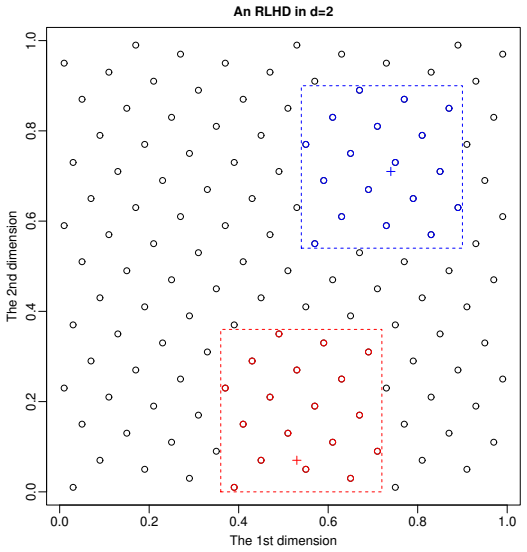
The central object is the good-lattice-point (GLP) Latin hypercube, defined by $$L(n,v,\delta)=\{z+iv/n+\delta/n+\mathbf{1}_d/(2n): z\in\mathbb{Z}^d,\ i\in\mathbb{Z}\}+[0,1]^d,$$ where every entry of $v$ is coprime to $n$ and $w(\cdot)$ is the wrap-around distance on the torus; it is an LHD because reducing $iv/n$ modulo 1 permutes the $n$ levels in each coordinate. The load-bearing identities are Theorem 3.1's reduction of the wrap-around criteria to sums over the $n-1$ lattice displacements, for example $$c_{\mathrm{WS}}(L)=\min_{i=1}^{n-1}\Bigl(\sum_{k=1}^d w(iv_k/n)^2\Bigr)^{-1/2},$$ and Algorithm 4's use of Gaussian lattice-basis reduction to get the two-dimensional separation distance in $O(\log n)$ steps. The companion object for emulation is the regularly repeated design $$R(n,m,v,\delta)=\{zm/n+iv/n+\delta/n+\mathbf{1}_d/(2n)\}+[0,1]^d,$$ whose Theorem 3.5 and Theorem 3.6 structure makes every local $m$-point subdesign a translate of the same LHD. That translation invariance is what converts many local Gaussian process fits into one shared matrix inverse.
What would settle it
Take a deliberately non-stationary test function, for instance one with a sharp ridge in one corner and smooth behavior elsewhere, and compare an RLHD emulator that reuses a single shared correlation inverse against local Gaussian processes whose correlation parameters and inverses are re-estimated in each neighborhood; if the shared-inverse predictions are materially less accurate, the stationarity premise behind the one-inversion trick has failed.
Extended reading notes
Core claim
The paper's central claim is that the lattice constraint is not a restriction to be tolerated but the mechanism that makes large-scale design and estimation feasible. For any good-lattice-point Latin hypercube $L(n,v,\delta)$ with generator $v$, Theorem 3.1 expresses the wrap-around separation, wrap-around $\phi_p$, wrap-around projection, and wrap-around discrepancy as functions of the $n-1$ displacements $iv/n$ only, reducing evaluation from $O(n^2d)$ to $O(nd)$; Theorem 3.2 and Algorithm 4 further reduce the bivariate separation and fill-distance criteria to $O(\log n)$ via shortest-vector computation. The criteria are shift-invariant, and the paper reports that they are positively correlated on lattice designs, so Algorithm 3 can optimize the generator alone and the resulting LLHDs have lower criterion values than optimized unrestricted LHDs for $n\ge 100$ in the reported comparisons. The paper's second claim is that the design $R(n,m,v,\delta)=\{zm/n+iv/n+\delta/n+\mathbf{1}_d/(2n)\}$ contains an $m$-point LHD in every hypercube of width $m/n$ (Theorem 3.5), and that the local designs are exact translations whenever the hypercube origins differ by a lattice vector (Theorem 3.6). Consequently Algorithm 5 fits all local Gaussian process models with one inversion of a single $m\times m$ correlation matrix, and the reported emulation comparisons show lower prediction error than partitioned, nearest-neighbor, local approximate, or sparse-grid alternatives.
Load-bearing premise
The single-inversion speedup for emulation rests on the assumption that the correlation function describing the simulation output is stationary, meaning the statistical relationship between nearby runs is the same everywhere in the input space; if the output behaves very differently in different regions, the translated local designs no longer share a common correlation matrix and Algorithm 5's cost saving evaporates.
Editorial extensions
If this is right
- For sample sizes of 100 and above, restricting the search to good lattice point sets gives designs with lower wrap-around discrepancy, projective separation, and $\phi_p$ values than the same number of iterations of unrestricted LHD optimization, and the gap widens as $n$ grows.
- Because the wrap-around criteria are positively correlated on lattice designs, optimizing a single cheap criterion such as the bivariate separation distance also improves the other space-filling properties, so practitioners can use the cheapest criterion without sacrificing overall quality.
- The optimized lattice designs reduce mean absolute integration error in uncertainty quantification and lower the training error of physics-informed neural networks compared with random LHDs, optimized LHDs, and power-generator lattice designs on the tested PDEs.
- For large-scale emulation, RLHDs make the cost of fitting local Gaussian process models at many prediction sites essentially the cost of one $m$-point model, while achieving lower prediction error than partitioned, nearest-neighbor, local approximate, and sparse-grid emulators in the reported test functions.
- Every lattice-based LHD with composite $n$ is automatically a sliced LHD whose slices have identical space-filling properties, so sliced designs for multi-fidelity or sequential experiments come for free from the same construction.
Reading between the lines
- The paper's final remarks only gesture at other lattice families, such as densest-packing, interleaved, and sphere-packing lattices; if the translation argument carries over to those families, the RLHD machinery should extend well beyond GLP generators, and a concrete check is whether the positive correlation among criteria persists there.
- The reported correlations suggest a cheap-proxy strategy: optimize WS2 and inherit good WD and WP behavior. The paper's own tables show this proxy weakens at $n=1000$, $d=10$, so a useful extension is to map exactly where the proxy stops being reliable as dimension grows.
- The integration-accuracy gains plausibly extend beyond the two PINN examples to any training objective that approximates an integral by a weighted sum over design points, since low wrap-around discrepancy is exactly what such sums need; this is an inference, not a claim the paper tests.
- Because design evaluation no longer dominates the computation for very large $n$, the practical bottleneck shifts to materializing the $O(nd)$ design points and to nearest-lattice-point queries during prediction, so memory layout and spatial indexing become the next scalability question.
Editorial analysis
A structured set of objections, weighed in public.
Referee Report
Summary. The manuscript proposes two families of lattice-based Latin hypercube designs: optimized LLHDs and regularly repeated RLHDs. For the former, the authors derive shortcut formulas (Theorems 3.1–3.3) that reduce the per-evaluation cost of several wrap-around space-filling criteria from O(n^2 d) to O(nd) or O(log(n)d^2), and they embed these formulas in a neighborhood search (Algorithm 3). For the latter, they show that RLHDs contain many translated m-point local LHDs, so that a moving-window Gaussian process predictor can share one correlation-matrix inverse (Theorems 3.5–3.7, Algorithm 5). The numerical sections compare LLHDs with OLHDs, PLHDs, and other designs for space-filling criteria, uncertainty quantification, PINN training, and large-scale emulation. Proofs are provided in a supplementary file, and R code is supplied.
Significance. The theoretical contribution is real and useful: if the formulas are correct, they make it feasible to search much larger classes of lattice LHDs than before, and the RLHD translation property is an elegant way to reduce local GP fitting costs under stationarity. The supplementary proofs and the accompanying R package are strengths. The empirical part, however, does not yet establish the broad claim that the designs 'consistently outperform others for n>=100', because the OLHD baseline is not converged and because almost no replication uncertainty is reported. These issues are fixable with additional experiments and more careful wording; they do not invalidate the theorems.
major comments (3)
- [Section 4, Figures 2-4] The main empirical support for the abstract's claim that LLHDs consistently outperform others for n>=100 is a comparison with OLHD after exactly 10^5 iterations of Algorithm 2. Figure 2 shows that the OLHD algorithm has not converged within 10^5 iterations in any tested case. Since every LLHD is an LHD (Lemma 2.1), a globally optimized OLHD can never be worse than the best LLHD on the criterion being optimized; the observed LLHD advantage therefore reflects the incompleteness of the OLHD optimization, not an intrinsic superiority of the lattice restriction. The same limited-budget OLHD-WD design is carried into the uncertainty-quantification comparison in Figure 4. Please either run the OLHD baseline to a much larger budget or to an explicit convergence criterion using a state-of-the-art LHD optimizer, or explicitly rephrase the conclusions as valid only for a fixed small optimization budget. This is the load-bearing point for the headline empirical claim.
- [Section 4, Figures 4-5 and Table 3] The applied comparisons report only point estimates, with no replication count, standard error, or statistical test. In Figure 5 the PINN training is stochastic, and in Table 3 the test points are randomly generated; differences such as 0.478 versus 0.510 for Emichalewicz, or several close curves in Figure 4, may be within noise. Please report means and standard errors (or boxplots) over at least 10 independent replications and state the number of replications in the captions. Without this, the statements that LLHD-WD 'clearly indicates' superiority and that RLHD 'achieves the smallest RMSE' are not supported.
- [Sections 3.1 and 4] Algorithm 3 is a heuristic neighborhood search, and the recommendation to use Q = max(ceil(T/(5p(n)d)), 1) rests entirely on the statement in Section 3.1 that '5p(n)d iterations seem to be enough,' with no formal convergence guarantee and no diagnostic table. Yet Section 4 repeatedly refers to 'the optimal LLHD' and uses that term to conclude that PLHDs are inferior. Unless the supplementary material provides evidence that the algorithm certifies local (or global) optimality for the tested cases, please replace 'optimal' by 'optimized' throughout and support the 5p(n)d heuristic with a small convergence study.
minor comments (4)
- [Theorem 3.3 and Algorithm 4] Theorem 3.3 refers to 'the a and b are computed from the end of Algorithm 4,' but Algorithm 4 as written returns only ||a||; please return a and b or state the quantities explicitly in the theorem.
- [Algorithm 5] Line 2 of Algorithm 5 contains the typo 'corvariance'; it should be 'covariance'.
- [Throughout] The text contains many OCR or encoding artifacts, such as '±' used for assignment, '2' for the minus sign, 'f' for less-than-or-equal-to, and garbled mathematical expressions (e.g., Algorithm 1). The final typeset version should be carefully proofread.
- [Section 3.3] The stationarity assumption behind the shared-inverse trick in Algorithm 5 is stated in Section 3.3, but the abstract and Section 4 could briefly note that the RLHD speedup applies to stationary correlation functions; a short discussion of behavior when the output is nonstationary would help readers judge the method's scope.
Circularity Check
No significant circularity: criteria are external benchmarks, theorems are direct derivations, and the RLHD single-inversion claim explicitly assumes stationarity.
full rationale
The main derivations are self-contained. Theorems 3.1-3.3 evaluate wrap-around criteria (WS, WA, WP, WD, WS2/WF2) for lattice-based LHDs by substituting the lattice parametrization L(n,v,delta) from (1) into the externally defined criterion formulas; the supplementary proofs perform direct algebraic reductions, using Lemma 2.1 (Fang et al. 2018) and standard lattice-basis facts (Bremner 2011), with no free parameters fitted to the conclusions. Theorem 3.2's equivalence cWS=cRS for two-dimensional LLHDs is proven by an explicit lattice-geometry argument, not imported. Theorems 3.4-3.7 establish slicedness, translation equivalence, and expected size by set-theoretic identities from the definitions of R(n,m,v,delta) and L(m,v,cdot); Theorem 3.6 is a direct "if and only if" statement about lattice translations. Algorithm 5's claim that all local GPs share one correlation-matrix inversion is exactly the translation property of Theorem 3.6 applied under the paper's explicit stationarity assumption ("Since our method makes no assumption about the correlation kernel other than stationarity"); stationarity is an assumption, not a conclusion derived from the design. The numerical sections compare designs on externally fixed test functions (Prpeak, G, Borehole, Oscil, Burgers, wave, Ackley, Shekel, Emichalewicz) and external benchmarks (OLHD, PLHD, laGP, SG); these are empirical evaluations rather than predictions whose constants were set by the method. The self-citations to He (2017a,b, 2019a,b, 2021) appear in final-remarks suggestions for future lattice constructions and are not load-bearing for any theorem or numerical claim. Concerns that the OLHD baseline may be under-optimized after 10^5 iterations, or that non-stationary outputs would break the single-inversion trick, are legitimate empirical or assumption limitations but not circularity: the paper does not define its criteria in terms of its conclusions, fit parameters to target results, or import an unverified self-cited theorem as the basis of the derivation.
Assumptions & free parameters
free parameters (1)
- iteration multiplier 5 =
5
assumptions (5)
- domain assumption Wrap-around distance based criteria (WD, WS, WA, WP) are appropriate for constructing statistically-uniform designs and are nearly optimal under the standard CD, RS, AS, PS criteria.
- domain assumption The correlation function of the simulation output is stationary, so all translated local designs have identical correlation matrices.
- domain assumption Lower-order interactions are more important than higher-order interactions (effect hierarchy principle), justifying WS2 and WF2 criteria.
- standard math Lattice basis reduction (Gaussian algorithm) correctly computes the shortest vector in a 2D lattice in O(log n) steps.
- ad hoc to paper The heuristic that 5p(n)d iterations suffice for convergence of Algorithm 3.
Cite this review
Pith. "Pith review of Optimized and regularly repeated lattice-based Latin hypercube designs for large-scale computer experiments." pith.science (2026). https://pith.science/paper/KN5P7ZJ2
@misc{pith2026250604582,
  author       = {Pith},
  title        = {Pith review of: Optimized and regularly repeated lattice-based Latin hypercube designs for large-scale computer experiments},
  year         = {2026},
  howpublished = {\url{https://pith.science/paper/KN5P7ZJ2}},
  note         = {Machine review of arXiv:2506.04582}
}
read the original abstract
Computer simulations serve as powerful tools for scientists and engineers to gain insights into complex systems. Less costly than physical experiments, computer experiments sometimes involve large number of trials. Conventional design optimization and model fitting methods for computer experiments are inefficient for large-scale problems. In this paper, we propose new methods to optimize good lattice point sets, using less computation to construct designs with enhanced space-filling properties such as high separation distance, low discrepancy, and high separation distance on projections. These designs show promising performance in uncertainty quantification as well as physics-informed neural networks. We also propose a new type of space-filling design called regularly repeated lattice-based Latin hypercube designs, which contain lots of local space-filling Latin hypercube designs as subdesigns. Such designs facilitate rapid fitting of multiple local Gaussian process models in a moving window type of modeling approach and thus are useful for large-scale emulation problems.
Figures


Figures from the paper (3 more)


Reference graph
Works this paper leans on
-
[1]
Ba, S. (2015). SLHD: Maximin-distance (sliced) L atin hypercube designs . R package version 2.1-1
work page 2015
-
[2]
Ba, S., Brenneman, W. A., and Myers, W. R. (2015). Optimal sliced L atin hypercube designs. Technometrics , 57(4):479--487
work page 2015
-
[3]
Ba, S. and Joseph, V. R. (2015). MaxPro: Maximum projection designs . R package version 3.1-2
work page 2015
-
[4]
Bremner, M. R. (2011). Lattice Basis Reduction: An Introduction to the LLL Algorithm and Its Applications . Boca Raton: CRC Press
work page 2011
-
[5]
Chen, H., Ding, L., and Tuo, R. (2022). Kernel packet: An exact and scalable algorithm for G aussian process regression with M at\'ern correlations. Journal of Machine Learning Research , 23(127):1--32
work page 2022
-
[6]
Cressie, N. and Johannesson, G. (2008). Efficient emulators of computer experiments using compactly supported correlation functions, with an application to cosmology. Journal of the Royal Statistical Society, Series B , 70:209–226
work page 2008
-
[7]
Eliáš, J., Vořechovský, M., and Sadílek, V. (2020). Periodic version of the minimax distance criterion for M onte C arlo integration. Advances in Engineering Software , 149:102900
work page 2020
-
[8]
Fang, K. F., Liu, M. Q., Qin, H., and Zhou, Y. D. (2018). Theory and Application of Uniform Experimental Designs . Singapore: Springer
work page 2018
Show all 54 references
-
[9]
F., Maringer, D., Tang, Y., and Winker, P
Fang, K. F., Maringer, D., Tang, Y., and Winker, P. (2006). Lower bounds and stochastic optimization algorithms for uniform designs with three or four levels. Mathematics of Computation , 75(254):859--878
2006
-
[10]
Franco, J., Dupuy, D., Roustant, O., Damblin, G., and Iooss., B. (2014). DiceDesign: Designs of Computer Experiments . R package version 1.6
2014
-
[11]
and Apley, D
Gramacy, R. and Apley, D. (2015). Local G aussian process approximation for large computer experiments. Journal of Computational and Graphical Statistics , 24:561--578
2015
-
[12]
and Sun, F
Gramacy, R. and Sun, F. (2023). laGP: Local Approximate G aussian Process Regression . R package version 1.5-0
2023
-
[13]
Gramacy, R. B. (2020). Surrogates: G aussian Process Modeling, Design, and Optimization for the Applied Sciences . New York: Chapman and Hall/CRC, 1st edition
2020
-
[14]
Gramacy, R. B. and Lee, H. K. H. (2008). Bayesian treed G aussian process models with an application to computer modeling. Journal of the American Statistical Association , 103(483):1119--1130
2008
-
[15]
Haaland, B., Wang, W., and Maheshwari, V. (2018). A framework for controlling sources of inaccuracy in G aussian process emulation of deterministic computer experiments. SIAM/ASA Journal on Uncertainty Quantification , 6(2):497--521
2018
-
[16]
He, X. (2017a). Interleaved lattice-based minimax distance designs. Biometrika , 104(3):713--725
2017
-
[17]
He, X. (2017b). Rotated sphere packing designs. Journal of the American Statistical Association , 112(520):1612--1622
2017
-
[18]
He, X. (2019a). Interleaved lattice-based maximin distance designs. Biometrika , 106(2):453--464
2019
-
[19]
He, X. (2019b). Sliced rotated sphere packing designs. Technometrics , 61(1):66--76
2019
-
[20]
He, X. (2021). Lattice-based designs possessing quasi-optimal separation distance on all projections. Biometrika , 108(2):443–454
2021
-
[21]
and Tang, B
He, Y. and Tang, B. (2013). Strong orthogonal arrays and associated L atin hypercubes for computer experiments. Biometrika , 100:254--260
2013
-
[22]
Hickernell, F. J. (1998). Lattice Rules: How Well Do They Measure Up? , page 109–166. Springer, 1st edition
1998
-
[23]
Hua, L. K. and Wang, Y. (1981). Applications of Number Theory to Numerical Analysis . Berlin: Springer
1981
-
[24]
C., Chen, W., and Sudjianto, A
Jin, R. C., Chen, W., and Sudjianto, A. (2005). An efficient algorithm for constructing optimal design of computer experiments. Journal of Statistical Planning and Inference , 134(1):268--287
2005
-
[25]
E., Moore, L
Johnson, M. E., Moore, L. M., and Ylvisaker, D. (1990). Minimax and maximin distance designs. Journal of Statistical Planning and Inference , 26:131--148
1990
-
[26]
G., Bingham, D., Habib, S., Heitmann, K., and Frieman, J
Kaufman, C. G., Bingham, D., Habib, S., Heitmann, K., and Frieman, J. A. (2011). Efficient emulators of computer experiments using compactly supported correlation functions, with an application to cosmology. Annals of Applied Statistics , 5(4):2470--2492
2011
-
[27]
K., and Holmes, C
Kim, H.-M., Mallick, B. K., and Holmes, C. C. (2005). Analyzing nonstationary spatial data using piecewise G aussian processes. Journal of the American Statistical Association , 100(470):653--668
2005
-
[28]
Korobov, N. M. (1959). The approximate computation of multiple integrals. Doklady Akademii Nauk SSSR , 124:1207--1210
1959
-
[29]
and Yaguchi, T
Matsubara, T. and Yaguchi, T. (2023). Good lattice accelerates physics-informed neural networks. In 1st Workshop on the Synergy of Scientific and Machine Learning Modeling @ ICML2023
2023
-
[30]
D., Beckman, R
McKay, M. D., Beckman, R. J., and Conover, W. J. (1979). A comparison of three methods for selecting values of input variables in the analysis of output from a computer code. Technometrics , 21:239--45
1979
-
[31]
Morris, M. D. and Mitchell, T. J. (1995). Exploratory designs for computational experiments. Journal of Statistical Planning and Inference , 43(3):381--402
1995
-
[32]
Mullen, K. M. (2014). Continuous global optimization in R . Journal of Statistical Software , 060(1):1--45
2014
-
[33]
Z., and Ding, Y
Park, C., Huang, J. Z., and Ding, Y. (2011). Domain decomposition approach for fast G aussian process regression of large spatial data sets. Journal of Machine Learning Research , 12(47):1697--1728
2011
-
[34]
Plumlee, M. (2014). Fast prediction of deterministic functions using sparse grid experimental designs. Journal of Computational and Graphical Statistics , 109:1581--1591
2014
-
[35]
Qian, P. Z. G. (2012). Sliced L atin hypercube designs. Journal of the American Statistical Association , 107(497):393--399
2012
-
[36]
Raissi, M., Perdikaris, P., and Karniadakis, G. E. (2019). Physics-informed neural networks: A deep learning framework for solving forward and inverse problems involving nonlinear partial differential equations. Journal of Computational physics , 378:686--707
2019
-
[37]
J., Mitchell, T
Sacks, J., Welch, W. J., Mitchell, T. J., and Wynn, H. (1989). Design and analysis of computer experiments. Statistical Science , 4:409--423
1989
-
[38]
J., Williams, B
Santner, T. J., Williams, B. J., and Notz, W. I. (2018). The Design and Analysis of Computer Experiments . New York: Springer, 2nd edition
2018
-
[39]
and Xu, H
Shi, C. and Xu, H. (2024). A Projection Space-Filling Criterion and Related Optimality Results . Journal of the American Statistical Association , 119(548):2658--2669
2024
-
[40]
Sloan, I. H. and Joe, S. (1994). Lattice methods for multiple integration . Oxford: Oxford University Press
1994
-
[41]
Sun, F., Wang, Y., and Xu, H. (2019). Uniform projection designs. Annals of Statistics , 47(1):641--661
2019
-
[42]
and Bingham, D
Surjanovic, S. and Bingham, D. (2013). Virtual library of simulation experiments: Test functions and datasets
2013
-
[43]
Tang, B. (1993). Orthogonal array-based Latin hypercubes. Journal of the American Statistical Association , 88(424):1392--1397
1993
-
[44]
and Wang, W
Tuo, R. and Wang, W. (2020). K riging prediction with isotropic M atern correlations: Robustness and experimental designs. Journal of Machine Learning Research , 21(187):1--38
2020
-
[45]
and Xu, H
Vazquez, A. and Xu, H. (2024). An integer programming algorithm for constructing maximin distance designs from good lattice point sets. Statistica Sinica , 34:1347--1366
2024
-
[46]
and Eliáš, J
Vořechovský, M. and Eliáš, J. (2020). Modification of the maximin and _p (phi) criteria to achieve statistically uniform distribution of sampling points. Technometrics , 62(3):371--386
2020
-
[47]
Wang, L., Xiao, Q., and Xu, H. (2018). Optimal maximin L_1 -distance L atin hypercube designs based on good lattice point designs. Annals of Statistics , 46(6B):3741--3766
2018
-
[48]
and Haaland, B
Wang, W. and Haaland, B. (2019). Controlling sources of inaccuracy in stochastic K riging. Technometrics , 61(3):309--321
2019
-
[49]
Wang, Y., Sun, F., and Xu, H. (2022). On design orthogonality, maximin distance, and projection uniformity for computer experiments. Journal of the American Statistical Association , 117(537):375--385
2022
-
[50]
Wu, C., Zhu, M., Tan, Q., Kartha, Y., and Lu, L. (2023). A comprehensive study of non-adaptive and residual-based adaptive sampling for physics-informed neural networks. Computer Methods in Applied Mechanics and Engineering , 403:115671
2023
-
[51]
and Xu, H
Xiao, Q. and Xu, H. (2017). Construction of maximin distance L atin squares and related L atin hypercube designs . Biometrika , 104(2):455--464
2017
-
[52]
and Xu, H
Xiao, Q. and Xu, H. (2018). Construction of maximin distance designs via level permutation and expansion . Statistica Sinica , 28:1395--1414
2018
-
[53]
Zhou, W., Yang, J., and Liu, M. (2020). Optimal maximin L_2 -distance L atin hypercube designs. Journal of Statistical Planning and Inference , 207:113--122
2020
-
[54]
and Xu, H
Zhou, Y. and Xu, H. (2015). Space-filling properties of good lattice point sets . Biometrika , 102(4):959--966
2015
Reviewed August 7, 2026 · model on record in the stance chip above.
Discussion (0). Sign in to comment.