REVIEW 5 major objections 7 minor 39 references
Real-Time LPV-Based Non-Linear Model Predictive Control for Robust Trajectory Tracking in Autonomous Vehicles
T0 review · 5 major / 7 minor · reviewed 2026-08-07 · deepseek-v4-flash
Pith's one-line read A curvature-tuned, LPV-based model predictive controller tracks a real autonomous vehicle with mean cross-track error below 0.3 m on six test trajectories.
desk verdict A real vehicle experiment that deserves a referee, but the LPV derivation has a load-bearing gap and the tuning is evaluated in-sample. read the letter →
The pith
A machine-rendered reading of the paper's core claim, the machinery that carries it, and where it could break.
The reading
What carries the argument
The load-bearing mechanism is the LPV state-space model of the vehicle, in which the nonlinear kinematic-bicycle equations are packed into velocity-dependent matrices A(v) and B(v), so the optimizer sees a 'linear-like' prediction model at each step. A second named mechanism is the curvature-based tuning rule: the path's sharpest curvature selects the diagonal entries of the state-weight matrix Q and the terminal-weight matrix S, so sharp turns are penalized more heavily. The resulting receding-horizon optimization is solved symbolically at each sample, and the whole pipeline is split into concurrent processes so that state estimation and control computation run in parallel and only the first control input is applied to the vehicle.
What would settle it
Inspect the optimizer's internal dynamics: if the implemented predictor is the nonlinear function x_{k+1}=f(x_k,u_k) rather than the constant-matrix A_d x_k + B_d u_k of Eq. (20), then the LPV machinery is not what achieves the reported accuracy. A direct test is to run the controller on a sharp turn (e.g., trajectory T1) with the LPV prediction model forced to use the frozen matrices, and compare the predicted next state against the actual vehicle state; a divergence larger than the reported cross-track error would falsify the claim that the LPV representation alone supports the tracking performance.
Extended reading notes
Core claim
On the paper's own terms, the central discovery is that an NMPC controller whose internal model is the LPV form of the kinematic bicycle dynamics—velocity-dependent system matrices A(v) and B(v)—can be made to track six distinct reference paths on a drive-by-wire vehicle with mean cross-track error at or under about 0.26 m and mean orientation error at or under 0.13 rad, while keeping the maximum cross-track error below about 2.9 m. The authors attribute this performance to a curvature-based weight-tuning scheme: the sharpest curvature of each path selects the state-weight (Q) and terminal-weight (S) matrices, so sharper turns are penalized more heavily in the cost function. The claimed outcome is that simulation and real-time results align closely, meaning the controller transfers from a virtual model to the actual vehicle with only modest degradation from sensor noise and actuation delay.
Load-bearing premise
The load-bearing premise is that the nonlinear vehicle dynamics can be represented, over each prediction horizon, by a linear model with fixed matrices A_d and B_d; if the real motion during a sharp turn departs from this frozen model, the controller's predicted states no longer match the vehicle.
Editorial extensions
If this is right
- Both fixed-speed and variable-speed operation are handled by the same controller, so a single MPC can slow the vehicle into sharp turns and accelerate on straights without reconfiguration.
- Curvature-based tuning is claimed to generalize to new trajectories: compute the path's sharpest curvature, choose the matching weight matrices, and run the controller without manual re-tuning.
- The reported closeness between simulation and real-time results means the development loop can be largely closed on a virtual vehicle, with real-vehicle runs used only to fine-tune for actuation delay.
- On the most aggressive trajectory (T1), the real-time maximum cross-track error is 2.86 m, so the worst-case excursions are substantially larger than the mean errors across all six paths.
Reading between the lines
- Editorial inference: the constant-matrix prediction formula in Eq. (20) is not consistent with the state- and input-dependent matrices A and B in Eqs. (12)–(13); if the deployed solver actually propagates states with the nonlinear function f(x_k,u_k), then the LPV derivation is not the operative predictor and the reported performance is produced by the nonlinear model instead.
- Editorial inference: a direct testable extension, which the paper lists as future work, is to make the curvature-based tuning online and receding-horizon, so Q and S adapt to local curvature rather than to the path's single sharpest point.
- Editorial inference: the reported real-time maximum cross-track errors imply that on roads narrower than about 3 m the controller would need either stronger position weights or tighter bounds; a narrow-track test would directly probe how much of the claimed tracking performance survives a harder geometry.
Editorial analysis
A structured set of objections, weighed in public.
Referee Report
Summary. The paper proposes a Linear Parameter Varying (LPV) based Nonlinear Model Predictive Control (NMPC) framework for trajectory tracking in autonomous vehicles. The authors formulate a bicycle model with lateral tire forces in an LPV state-space form, introduce a curvature-based method for tuning the MPC weight matrices, and implement the controller in a ROS-based architecture with parallel state estimation and optimization. The system is evaluated in simulation and in real-time experiments on a drive-by-wire vehicle at the TiHAN testbed, using six trajectories of varying curvature and speed. Performance is reported in terms of cross-track error, lateral error, and orientation error for both simulation and real-time runs. The central claims are that the LPV formulation enables real-time computation and that the curvature-based tuning generalizes across trajectories.
Significance. The experimental effort is a clear strength: the authors demonstrate a complete MPC stack on a real vehicle, integrating GPS/IMU state estimation, CasADi optimization, and ROS communication, and they report detailed per-trajectory error metrics. The idea of scheduling MPC weights on path curvature is practically appealing and, if properly validated, could be a useful engineering contribution. However, the LPV derivation is internally inconsistent, the discrete-time prediction model is not specified with adequate rigor, and the tuning evaluation is in-sample. As presented, the paper does not support the stated LPV-based contribution or the generalization claim about tuning. The paper would be suitable for a major revision if the authors can resolve these issues and add appropriate validation.
major comments (5)
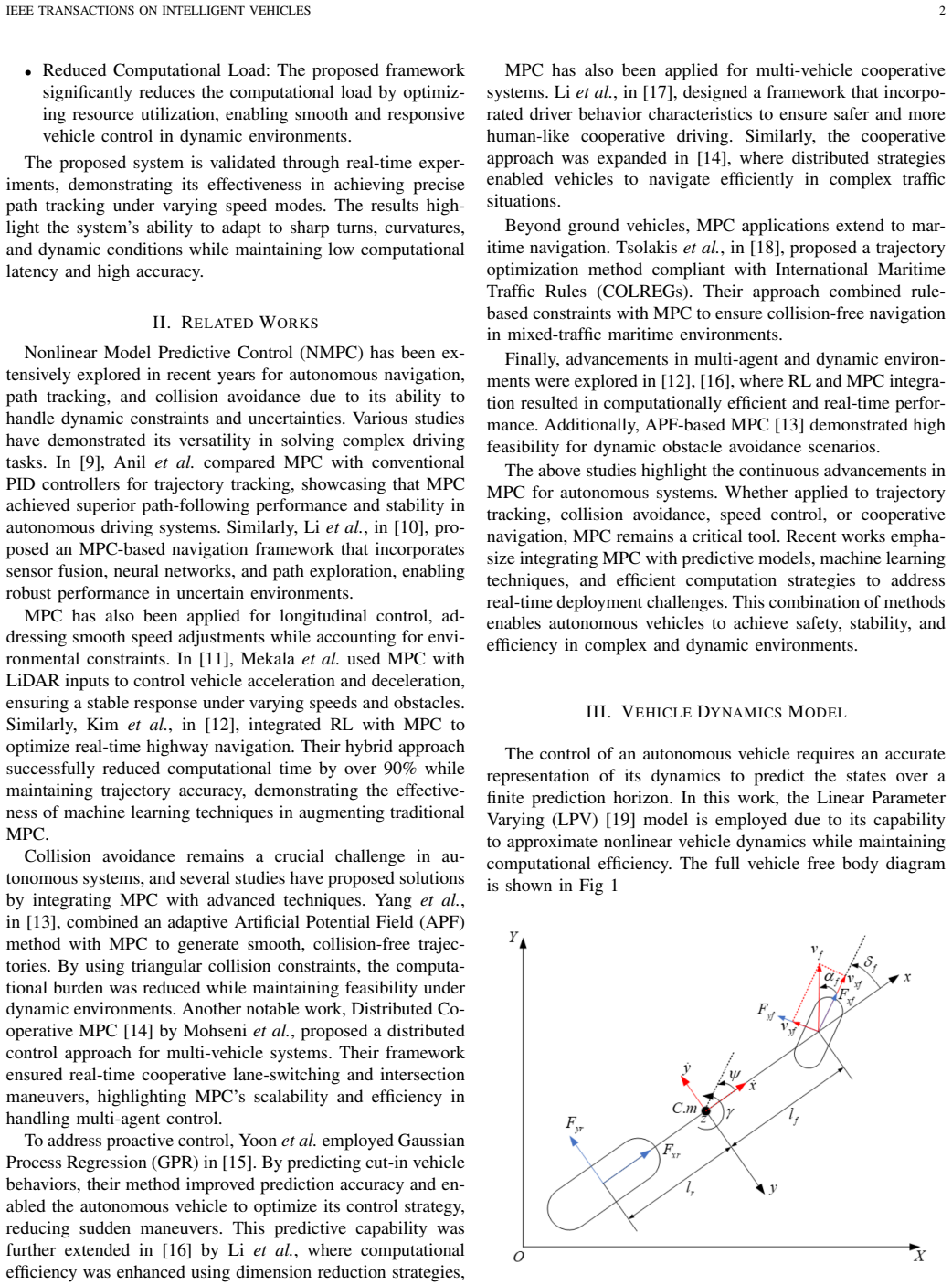
- [Sec. IV-B, Eqs. (19)-(20)] The prediction formula x_k = A^k x0 + sum_{i=0}^{k-1} A^{k-1-i} B u_i is valid only if A_d and B_d are constant over the prediction horizon. However, the continuous-time matrices in Eqs. (12)-(13) are explicit functions of the state (1/x_dot, y_dot, psi) and of the control input delta. Since delta is one of the optimization variables, the closed-form matrix powers in Eq. (20) are not well-defined. The manuscript itself states in Sec. III-A that 'A is a function of X and B is the function of u.' This is an internal inconsistency that must be resolved: either define a genuinely parameter-varying model with a scheduling variable independent of u, or use the nonlinear propagation f(x_k, u_k) in CasADi and remove the LPV claim from the contribution.
- [Sec. III-A and Eq. (11)] The state vector is defined inconsistently. The text in Sec. III-A lists x = [x, y, psi, v]^T, while Eq. (11) defines x = [x_dot, y_dot, psi, psi_dot, X, Y]^T. The cost function in Eq. (22) uses four error states (x_dot, psi, X, Y), but the system matrices in Eqs. (12)-(13) are 6x6 and 6x2. The dimensions of A_d, B_d, C, Q, S, and the error vector are therefore ambiguous. Specify the exact state dimension and ensure that all matrices and cost-function terms conform to that dimension.
- [Sec. IV-A] The discretization procedure is not described. The sentence 'The discrete system matrices A_d and B_d are derived directly from the continuous-time counterparts' leaves open whether forward Euler, zero-order hold, or a matrix exponential was used. This matters because the continuous matrices are state- and input-dependent, and a standard LTI discretization does not apply. The sampling time T_s is also never given. Without this information, the prediction model cannot be reproduced, which directly affects the validity of the reported simulation and real-time results.
- [Sec. V-C and Table III] The weight matrices Q and S are tuned using the curvature of the same six trajectories on which the controller is then evaluated. This makes the error metrics in Table III in-sample results and does not provide evidence that the curvature-based tuning generalizes to unseen paths. The actual weight values and the curvature thresholds of the 'generalized framework' are not reported. To substantiate the generalization claim, the authors should either evaluate on held-out trajectories or provide a cross-validation study, and they should disclose the tuned weights and thresholds.
- [Sec. VI] The real-time claim is not quantified. No computation time per MPC iteration is reported, even though real-time performance is a stated contribution. Moreover, no baseline controller (e.g., PID, linear MPC, or a standard NMPC) is compared, so the 'robustness' and 'high accuracy' claims are relative only to the reference trajectory and not to a competing method. Please add timing data and at least one baseline comparison.
minor comments (7)
- [Sec. IV-B] The text after Eq. (18) says 'the discrete-time state-space equations are expressed in Eq 18', but the state equation is Eq. (17). Please correct the cross-reference.
- [References] Several references are duplicated: [8] and [14] are the same paper, [10] and [23] are the same paper, and [13] and [25] are the same paper. Please deduplicate the bibliography.
- [Eq. (12)] The (2,2) entry of matrix A appears to have a typo: 'C_alpha_f + C_alpha_f cos(delta)' is likely meant to be 'C_alpha_f + C_alpha_r cos(delta)'. Please check the notation carefully.
- [Sec. III-A] The sentence 'A is a function of X and B is the function of u' is unclear and grammatically awkward; moreover, the scheduling variable v in A(v) and B(v) is never defined. Please clarify the scheduling parameter and its role in the LPV model.
- [Table II] The columns 'Max. long. Acceleration' and 'Max. lat. Acceleration' are given without units. Please add units (m/s^2) for completeness.
- [Sec. V-C] In the definition of s_i, the word 'parameters' should be singular: 'the parameter s represents the cumulative arc length.'
- [Figs. 7-8] The y-axis labels 'lateral error' and 'orientation error' are undefined; please specify whether these are signed errors, absolute errors, or normalized values, and give units.
Circularity Check
Curvature-tuned weights are fit to the same six trajectories used for evaluation, and Eq. (20)'s predictor silently freezes the A and B matrices that the paper itself says depend on state and control input.
-
fitted input called prediction
[Section V-C 'Tuning Weight Matrices' and Section VI, Tables II-III]
"Weight parameters were iteratively adjusted based on the vehicle's performance in following the trajectory. ... For predefined curvature thresholds, corresponding weight matrices were applied, ensuring robust performance across a range of trajectories. ... TABLE II TRAJECTORIES USED IN OPTIMIZATION AND EXPERIMENTAL TESTS."
The same six trajectories serve as both the tuning set and the evaluation set. Section V-C says the weights Q and S were iteratively adjusted based on closed-loop performance on the trajectory, and Table II labels the six paths as 'used in optimization and experimental tests.' Table III then reports the controller's max/mean CTE, MLE, MOE, and AOE on exactly those paths. These numbers are therefore in-sample performance of a controller whose weights were selected using those same trajectories; they do not validate the claimed generalized 'curvature-based tuning' rule on any held-out path. The reported accuracy is partly manufactured by per-trajectory weight adjustment rather than being an independent prediction of the autotuning method.
-
other
[Section III-A and III-E (Eqs. 12-13), Section IV-B (Eqs. 19-20), Section IV-E]
"Here A and B are not constants, rather A is a function of X and B is the function of u. Hence a non-linear model are packed in a linear like model. ... x_k = A^k x_0 + sum_{i=0}^{k-1} A^{k-1-i} B u_i"
The closed-form prediction in Eq. (19) is built from matrix powers A^k and products A^{k-1-i}B, which are well-defined only if A and B are fixed over the prediction horizon. But the paper's own Eqs. (12)-(13) define A(v) with entries involving 1/x_dot, y_dot, sin(delta), cos(delta), and B(v) with sin(delta), cos(delta), where delta is an optimization variable. The text explicitly says A is a function of X and B is a function of u. Thus Eq. (20) is not a consequence of the stated LPV/nonlinear dynamics; it is, by construction, a frozen-LTI predictor. If the CasADi implementation really uses x_{k+1}=f(x_k,u_k) as also stated, then the LPV expansion in Eqs. (17)-(20) is a presentation layer that does not support the claimed LPV-based NMPC contribution.
full rationale
The paper's central claim is not self-contained in the way it is presented. The clearest circularity is the tuning/evaluation protocol: the weights are adjusted using the same trajectories on which the controller is then evaluated (Section V-C versus Table II/III), so the reported errors in Table III are in-sample and cannot by themselves validate the generality of the curvature-based autotuning. A second load-bearing problem is that the prediction derivation treats A and B as constant powers over the horizon even though the paper explicitly states that A depends on the state and B depends on the control input; the matrix-power formula therefore reduces to a frozen-linear predictor, not the nonlinear/LPV model claimed. These issues affect the two main advertised contributions: real-time LPV-based NMPC and curvature-based adaptive tuning. The paper's self-citations with overlapping authorship (e.g., [4], [5], [40]) are not load-bearing for the control derivation and do not contribute to this score. No uniqueness theorem or external self-citation chain is invoked, so the circularity is partial rather than total: score 6, not 8 or 10.
Assumptions & free parameters
free parameters (3)
- Q and S weight matrices (per curvature regime)
- Curvature thresholds for the generalized tuning framework
- Lateral velocity constraint factor 0.17 =
0.17
assumptions (4)
- ad hoc to paper The nonlinear dynamics can be embedded in LPV matrices A(v), B(v) while retaining a linear-in-input prediction model.
- ad hoc to paper The discrete-time matrices A_d, B_d are obtained from continuous-time counterparts by an unspecified discretization that preserves the form of Eq. (17).
- ad hoc to paper Curvature-based tuning of weights generalizes across trajectories.
- domain assumption Linear tire-force model with constant cornering stiffness C_alpha_f, C_alpha_r is adequate at the tested speeds.
Cite this review
Pith. "Pith review of Real-Time LPV-Based Non-Linear Model Predictive Control for Robust Trajectory Tracking in Autonomous Vehicles." pith.science (2026). https://pith.science/paper/EMLOW5FO
@misc{pith2026250604684,
  author       = {Pith},
  title        = {Pith review of: Real-Time LPV-Based Non-Linear Model Predictive Control for Robust Trajectory Tracking in Autonomous Vehicles},
  year         = {2026},
  howpublished = {\url{https://pith.science/paper/EMLOW5FO}},
  note         = {Machine review of arXiv:2506.04684}
}
read the original abstract
This paper presents the development and implementation of a Model Predictive Control (MPC) framework for trajectory tracking in autonomous vehicles under diverse driving conditions. The proposed approach incorporates a modular architecture that integrates state estimation, vehicle dynamics modeling, and optimization to ensure real-time performance. The state-space equations are formulated in a Linear Parameter Varying (LPV) form, and a curvature-based tuning method is introduced to optimize weight matrices for varying trajectories. The MPC framework is implemented using the Robot Operating System (ROS) for parallel execution of state estimation and control optimization, ensuring scalability and minimal latency. Extensive simulations and real-time experiments were conducted on multiple predefined trajectories, demonstrating high accuracy with minimal cross-track and orientation errors, even under aggressive maneuvers and high-speed conditions. The results highlight the robustness and adaptability of the proposed system, achieving seamless alignment between simulated and real-world performance. This work lays the foundation for dynamic weight tuning and integration into cooperative autonomous navigation systems, paving the way for enhanced safety and efficiency in autonomous driving applications.
Figures


Figures from the paper (5 more)


Reference graph
Works this paper leans on
-
[1]
H. Guo, C. Shen, H. Zhang, H. Chen, and R. Jia, “Simultaneous trajectory planning and tracking using an MPC method for cyber- physical systems: A case study of obstacle avoidance for an intelligent vehicle,” IEEE Trans. Ind. Informat., vol. 14, no. 9, pp. 4273–4283, Sep. 2018
work page 2018
-
[2]
Active safety control of auto- mated electric vehicles at driving limits: A tube-based MPC approach,
P. Hang, X. Xia, G. Chen, and X. Chen, “Active safety control of auto- mated electric vehicles at driving limits: A tube-based MPC approach,” IEEE Trans. Transport. Electrific., vol. 8, no. 1, pp. 1338–1349, Mar. 2022
work page 2022
-
[3]
C.-L. Hwang, C.-C. Yang, and J. Y . Hung, “Path tracking of an au- tonomous ground vehicle with different payloads by hierarchical im- proved fuzzy dynamic sliding-mode control,” IEEE Trans. Fuzzy Syst., vol. 26, no. 2, pp. 899–914, Apr. 2018. IEEE TRANSACTIONS ON INTELLIGENT VEHICLES 11
work page 2018
-
[4]
A. Thakur, C. A. R. Ram, S. Sathvik and P. Rajalakshmi, ”LiDAR-GNSS Fusion to Initiate Localization at Intermediate Points on a 3D Point Cloud Map,” 2024 IEEE 100th Vehicular Technology Conference (VTC2024- Fall), Washington, DC, USA, 2024, pp. 1-5, doi: 10.1109/VTC2024- Fall63153.2024.10757568
arXiv 2024
-
[5]
A. Thakur, C. A. R. Ram, S. Sathvik, B. Badugu, S. Shinde and P. Rajalakshmi, ”Autonomous Cooperative Platooning Powered by LiDAR- Guided Adaptive Cruise Control,” 2024 IEEE 99th Vehicular Technology Conference (VTC2024-Spring), Singapore, Singapore, 2024, pp. 1-5, doi: 10.1109/VTC2024-Spring62846.2024.10683147
arXiv 2024
-
[6]
Planning and Tracking Control of Full Drive-by-Wire Electric Vehicles in Unstructured Scenario
G. Chen, M. Hua, W. Liu, J. Wang, S. Song, and C. Liu, “Planning and tracking control of full drive-by-wire electric vehicles in unstructured scenario,” 2023, arXiv:2301.02753
work page Pith review arXiv 2023
-
[7]
N.H. Amer, et al., ”Modelling and control strategies in path tracking control for autonomous ground vehicles: A review of state of the art and challenges,” Int. J. Robot. Syst., vol. 8(6), pp. 225–254, 2017
work page 2017
-
[9]
A. Anil and V . R. Jisha, ”Trajectory Tracking Control of an Au- tonomous Vehicle using Model Predictive Control and PID Con- troller,” 2023 International Conference on Control, Communication and Computing (ICCC), Thiruvananthapuram, India, 2023, pp. 1-6, doi: 10.1109/ICCC57789.2023.10164867
Show all 39 references
-
[11]
G. K. Mekala, N. R. Sarugari and A. Chavan, ”Speed Control in Longitu- dinal Plane of Autonomous Vehicle Using MPC,” 2020 IEEE International Conference for Innovation in Technology (INOCON), Bangluru, India, 2020, pp. 1-5, doi: 10.1109/INOCON50539.2020.9298213
2020
-
[14]
Mohseni, E
F. Mohseni, E. Frisk and L. Nielsen, ”Distributed Cooperative MPC for Autonomous Driving in Different Traffic Scenarios,” in IEEE Transactions on Intelligent Vehicles, vol. 6, no. 2, pp. 299-309, June 2021, doi: 10.1109/TIV .2020.3025484
2021
-
[18]
Tsolakis, R
A. Tsolakis, R. R. Negenborn, V . Reppa and L. Ferranti, ”Model Predictive Trajectory Optimization and Control for Autonomous Surface Vessels Considering Traffic Rules,” in IEEE Transactions on Intelligent Transportation Systems, vol. 25, no. 8, pp. 9895-9908, Aug. 2024, doi: ...
2024
-
[19]
Morsi, H
A. Morsi, H. S. Abbas, S. M. Ahmed and A. M. Mohamed, ”Model Predictive Control Based on Linear Parameter-Varying Models of Active Magnetic Bearing Systems,” in IEEE Access, vol. 9, pp. 23633-23647, 2021, doi: 10.1109/ACCESS.2021.3056323
2021
-
[20]
C. Jia, J. Cui, W. Qiao and L. Qu, ”Real-Time Model Predictive Control for Battery-Supercapacitor Hybrid Energy Storage Systems Using Linear Parameter-Varying Models,” in IEEE Journal of Emerging and Selected Topics in Power Electronics, vol. 11, no. 1, pp. 251-263, Feb. 2023,...
2023
-
[21]
Elkamel, A
A. Elkamel, A. Morsi, M. Darwish, H. S. Abbas and M. H. Amin, ”Model Predictive Control of Linear Parameter-Varying Systems Using Gaussian Processes,” 2022 26th International Conference on System Theory, Control and Computing (ICSTCC), Sinaia, Romania, 2022, pp. 452-457, doi: ...
2022
-
[22]
Y . Yoon, C. Kim, J. Lee and K. Yi, ”Interaction-Aware Probabilistic Trajectory Prediction of Cut-In Vehicles Using Gaussian Process for Proactive Control of Autonomous Vehicles,” in IEEE Access, vol. 9, pp. 63440-63455, 2021, doi: 10.1109/ACCESS.2021.3075677
2021
-
[23]
J. Li, K. Wu, Y . Jiang and F. Meng, ”Design of Autonomous Vehicle Trajectory Tracking System Based on MPC in Unknown Environment,” 2022 41st Chinese Control Conference (CCC), Hefei, China, 2022, pp. 3812-3819, doi: 10.23919/CCC55666.2022.9902834
2022
-
[24]
Y . Kim, D. -S. Pae, S. -H. Jang, S. -W. Kang and M. -T. Lim, ”Re- inforcement Learning for Autonomous Vehicle using MPC in Highway Situation,” 2022 International Conference on Electronics, Information, and Communication (ICEIC), Jeju, Korea, Republic of, 2022, pp. 1-4, doi: 1...
2022
-
[25]
H. Yang, Y . He, Y . Xu and H. Zhao, ”Collision Avoidance for Autonomous Vehicles Based on MPC With Adaptive APF,” in IEEE Transactions on Intelligent Vehicles, vol. 9, no. 1, pp. 1559-1570, Jan. 2024, doi: 10.1109/TIV .2023.3337417
2024
-
[26]
H. Li, T. Zhang, S. Zheng and C. Sun, ”Distributed MPC for Multi- Vehicle Cooperative Control Considering the Surrounding Vehicle Per- sonality,” in IEEE Transactions on Intelligent Transportation Systems, vol. 25, no. 3, pp. 2814-2826, March 2024, doi: 10.1109/TITS.2023.3253878
2024
-
[27]
Li et al., ”Fast Online Computation of MPC-based Integrated Decision Control for Autonomous Vehicles,” in IEEE Transactions on Intelligent Vehicles, doi: 10.1109/TIV .2024.3393013
S. Li et al., ”Fast Online Computation of MPC-based Integrated Decision Control for Autonomous Vehicles,” in IEEE Transactions on Intelligent Vehicles, doi: 10.1109/TIV .2024.3393013
2024
-
[28]
IEEE Trans
Funke, J., et al.: Collision Avoidance and Stabilization for Autonomous Vehicles in Emergency Scenarios. IEEE Trans. Control Syst. Technol. 25(4), 1204–1216 (2017)
2017
-
[29]
Artu ˜nedo, M
A. Artu ˜nedo, M. Moreno-Gonzalez, and J. Villagra, ”Lateral control for autonomous vehicles: A comparative evaluation,” Annual Reviews in Control, vol. 57, article 100910, 2024. ISSN 1367-5788
2024
-
[30]
Rokonuzzaman, N
M. Rokonuzzaman, N. Mohajer, and S. Nahavandi, ”NMPC-based controller for autonomous vehicles considering handling performance,” in Proc. IEEE 7th International Conference on Control, Mechatronics and Automation, Delft, 2019
2019
-
[31]
Tang, et al., ”An improved kinematic model predictive control for high-speed path tracking of autonomous vehicles,” IEEE Access, vol
L. Tang, et al., ”An improved kinematic model predictive control for high-speed path tracking of autonomous vehicles,” IEEE Access, vol. 8, pp. 51400-51413, 2020
2020
-
[32]
Rajagopalan, ”Slip-aware model predictive optimal control for path following,” in IEEE International Conference on Robotics and Automation (ICRA), Stockholm, 2016
K.A. Rajagopalan, ”Slip-aware model predictive optimal control for path following,” in IEEE International Conference on Robotics and Automation (ICRA), Stockholm, 2016
2016
-
[33]
Stochastic model predictive control for driver assistance control of intelligent vehicles considering uncertain driving environment,
Y . Chen, Y . Song, L. Shi, and J. Gao, “Stochastic model predictive control for driver assistance control of intelligent vehicles considering uncertain driving environment,” J. Vib. Control, vol. 29, nos. 3–4, 2022, Art. no. 10775463211052353
2022
-
[34]
In: IEEE International Conference on Mechatronics and Automation, Niagara Falls (2005)
Kuhne, F., Lages, W.F., Silva, J.M.G.d.: Point stabilization of mobile robots with nonlinear model predictive control. In: IEEE International Conference on Mechatronics and Automation, Niagara Falls (2005)
2005
-
[35]
Katriniok, et al., ”Optimal vehicle dynamics control for combined longitudinal and lateral autonomous vehicle guidance,” in Proc
A. Katriniok, et al., ”Optimal vehicle dynamics control for combined longitudinal and lateral autonomous vehicle guidance,” in Proc. European Control Conference (ECC), Zurich, 2013
2013
-
[36]
Rokonuzzaman, N
M. Rokonuzzaman, N. Mohajer, S. Nahavandi, and S. Mohamed, ”Review and performance evaluation of path tracking controllers of autonomous vehicles,” IET Intelligent Transport Systems, vol. 15, no. 5, pp. 646-670, 2021. ISSN 1751-956X
2021
-
[37]
Liu et al., ”A Systematic Survey of Control Techniques and Ap- plications in Connected and Automated Vehicles,” in IEEE Internet of Things Journal, vol
W. Liu et al., ”A Systematic Survey of Control Techniques and Ap- plications in Connected and Automated Vehicles,” in IEEE Internet of Things Journal, vol. 10, no. 24, pp. 21892-21916, 15 Dec.15, 2023, doi: 10.1109/JIOT.2023.3307002
2023
-
[38]
Andersson, J
J. Andersson, J. ˚Akesson and M. Diehl, ”Dynamic optimiza- tion with CasADi,” 2012 IEEE 51st IEEE Conference on Deci- sion and Control (CDC), Maui, HI, USA, 2012, pp. 681-686, doi: 10.1109/CDC.2012.6426534
2012
-
[39]
Fevre, P
M. Fevre, P. M. Wensing and J. P. Schmiedeler, ”Rapid Bipedal Gait Optimization in CasADi,” 2020 IEEE/RSJ International Conference on Intelligent Robots and Systems (IROS), Las Vegas, NV , USA, 2020, pp. 3672-3678, doi: 10.1109/IROS45743.2020.9341586
2020
-
[40]
Pawar, D.S., Singh, A., Rajalakshmi, P. (2023). Connected Autonomous Vehicles (CA V) Testbed at IIT Hyderabad. In: Rastogi, R., Bharath, G., Singh, D. (eds) Recent Trends in Transportation Infrastructure, V olume
2023
-
[41]
Lecture Notes in Civil Engineering, vol 354
TIPCE 2022. Lecture Notes in Civil Engineering, vol 354. Springer, Singapore
2022
-
[42]
Technology Innovation Hub on Autonomous Navigation and Data Acqui- sition Systems, ”TiHAN, IIT Hyderabad” https://tihan.iith.ac.in/
-
[43]
F. B. Romero, I. E. Soriano, R. Marotta and L. De Mat- teis, ”Optimizing Motion Planning for Autonomous Vehicles: Path IEEE TRANSACTIONS ON INTELLIGENT VEHICLES 12 Planning, Curvature Analysis, and Steering Control,” 2024 Interna- tional Symposium on Power Electronics, Electri...
2024
-
[44]
4514-4519, doi: 10.1109/WCICA.2010.5554096
Nengjian Wang, Defu Zhang, Lijie Zhou and Qinhui Liu, ”Near optimal path planning for vehicle with heading and curvature constraints,” 2010 8th World Congress on Intelligent Control and Automation, Jinan, 2010, pp. 4514-4519, doi: 10.1109/WCICA.2010.5554096
2010
-
[45]
Upadhyay and A
S. Upadhyay and A. Ratnoo, ”Continuous-Curvature Path Planning With Obstacle Avoidance Using Four Parameter Logistic Curves,” in IEEE Robotics and Automation Letters, vol. 1, no. 2, pp. 609-616, July 2016, doi: 10.1109/LRA.2016.2521165
2016
-
[46]
W. Yao, N. Qi, C. Yue and N. Wan, ”Curvature-Bounded Lengthening and Shortening for Restricted Vehicle Path Planning,” in IEEE Transac- tions on Automation Science and Engineering, vol. 17, no. 1, pp. 15-28, Jan. 2020, doi: 10.1109/TASE.2019.2916855. IX. BIOGRAPHYSECTION Nitis...
2020
Reviewed August 7, 2026 · model on record in the stance chip above.
Discussion (0). Sign in to comment.