REVIEW 4 major objections 4 minor 4 references
Neuronal avalanches as a predictive biomarker of BCI performance: towards a tool to guide tailored training program
T0 review · 4 major / 4 minor · reviewed 2026-08-07 · deepseek-v4-flash
Pith's one-line read The paper claims that avalanche-like EEG cascades can predict who will master a motor-imagery BCI in the next session, with accuracy up to 91%.
desk verdict Worth serious attention, but the 88–91% one-session-ahead accuracy is not backed by the analysis as reported because feature selection leaks outcome information into the cross-validation folds. read the letter →
The pith
A machine-rendered reading of the paper's core claim, the machinery that carries it, and where it could break.
The reading
What carries the argument
The load-bearing objects are neuronal avalanches: sequences in which source-reconstructed EEG activity crosses a z-threshold in at least one of 68 cortical regions and continues until all regions fall silent. Detection depends on two parameters, the z-threshold and a minimum avalanche duration, and the paper restricts analysis to the ten parameter pairs that yield avalanches with physiologically plausible durations. From detected avalanches the authors compute mean avalanche length and a length-weighted activation count per trial, average these per session and condition, and form the rest-minus-imagery differences Δavalanche length and Δactivations. Repeated-measures correlation selects which parameter pairs and features track BCI scores, and the predictive stage relies on Longitudinal Support Vector Regression and Classification, which model each subject's sessions as a temporally weighted combination and are validated with leave-one-subject-out cross-validation.
What would settle it
Re-run the full pipeline with strictly nested cross-validation: inside each training fold, choose the z-threshold, minimum duration, and ROI set using only that fold's data or only the first three sessions, then predict the held-out session; if accuracy falls toward the shuffled-session control (84%) or the standard SVC baseline (59%), the selection step is inflating the 91% figure.
Extended reading notes
Core claim
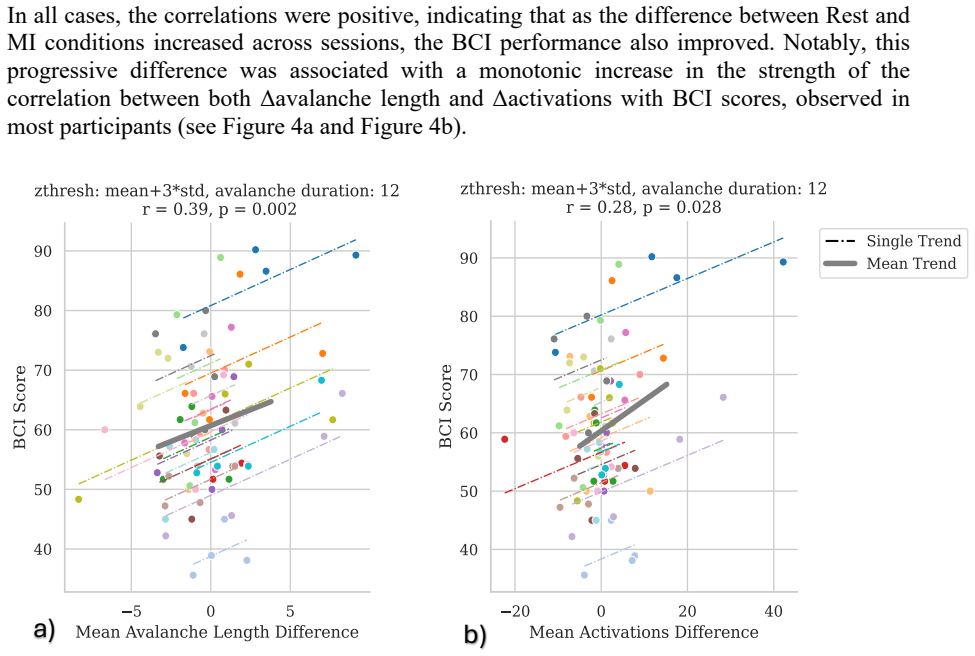
The central claim is that neuronal avalanche dynamics in source-reconstructed EEG form a longitudinal biomarker of BCI learning. Over four sessions, motor-imagery avalanches grow longer and more numerous relative to rest, and the per-session difference between rest and motor imagery in both features correlates positively with BCI scores. Those same difference features, used as inputs to Longitudinal Support Vector Regression and Classification models that encode session order through a learned temporal trend, predict one-session-ahead performance: classification accuracy reaches 88% without ROI selection and 91% with a selected set of cortical regions, against 41% and 59% for standard non-longitudinal baselines. The authors interpret this as evidence that avalanche-based features capture both task-state separation and the progression of individual learning.
Load-bearing premise
The reported 88–91% accuracy assumes that selecting the avalanche-detection parameters and the regions of interest after seeing the target session's BCI scores does not leak information into the prediction; if it does, the model's performance on a genuinely new user would be lower.
Editorial extensions
If this is right
- BCI success one session ahead can be forecast from the previous sessions' rest-versus-imagery avalanche differences, so training does not need to be fixed in advance.
- Because task-condition and learning effects emerge mainly in the fourth session, at least three completed sessions are needed before the model can give a reliable prediction.
- Restricting features to a small set of task-relevant regions of interest improves accuracy (from 88% to 91%) and reduces computing cost, which matters for real-time BCI use.
- The ordering of sessions carries information: shuffling session order lowers accuracy, so the model is reading genuine change over time rather than stable individual traits alone.
- Using the 57% chance-level threshold, the classifier can flag users who are unlikely to gain control next session, allowing trainers to intervene or extend practice.
Reading between the lines
- If replicated, the approach suggests a practical stopping rule: after each session, refit the longitudinal model from accumulated Δ-features and continue training only until it predicts above-chance control, which could cut both frustration and cost for fast learners.
- The bimodal distribution of motor-imagery avalanche lengths in the final session hints that responders and non-responders form distinct subgroups; clustering on Δ-feature trajectories could identify users who need a different task or feedback modality before they fail.
- A natural extension the paper does not test is using avalanche transition matrices, the propagation probabilities between regions, as additional inputs, since those may predict not only success but also which brain networks a given user is recruiting.
- The central numbers are likely sensitive to the choices of z-threshold, minimum duration, and ROI set; an external multi-session dataset with pre-registered parameters would clarify whether 91% reflects true generalization or selection within this sample.
Editorial analysis
A structured set of objections, weighed in public.
Referee Report
Summary. The paper proposes using neuronal avalanche features (avalanche length and activation count) extracted from EEG during motor-imagery BCI training as biomarkers of learning and as predictors of one-session-ahead BCI performance. Using data from 20 healthy participants across four sessions, the authors report significant task-condition and learning effects, repeated-measures correlations between session-to-session changes in these features and BCI scores, and longitudinal SVR/SVC models that predict future BCI success with up to 91% accuracy after region-of-interest (ROI) selection.
Significance. If the predictive results were valid, this would be a practically useful contribution to personalized BCI training, addressing the 'BCI inefficiency' problem with a novel dynamical feature set. The study has several strengths: a longitudinal design, the use of repeated-measures correlation, explicit comparison against non-longitudinal baselines, a session-shuffling control, and a detailed description of the avalanche-detection pipeline. The core limitation is methodological: the feature, parameter, and ROI selection steps are performed on the full dataset—including the target sessions and target BCI scores—before the leave-one-out evaluation, so the reported accuracy figures do not demonstrate out-of-sample generalization. The central claim is therefore not supported as written, though it could in principle be tested with a properly nested cross-validation scheme.
major comments (4)
- [§2.4, §3.4] The ROI selection procedure uses within-subject paired t-tests computed independently for each session and a two-way ANOVA across all subjects, sessions, and conditions; this includes the target session and the held-out subject before the LOO split. Because the features are then recomputed on the selected ROIs, the held-out subject's own condition contrast and session-specific variability influence the feature space. The 91% LSVC accuracy reported in §3.4 therefore does not reflect generalization to new subjects; the ROI mask must be selected inside each training fold.
- [§2.5, §3.2] The predictive models are restricted to parameter combinations showing significant repeated-measures correlations with BCI scores computed over all subjects and sessions (e.g., z-threshold μ+3σ, minimum duration 12). This is a selection-on-the-outcome leak: the target scores are used to choose the features, and no adjustment is made for the 10 candidate parameter pairs. The LOO-CV in §3.3 and §3.4 evaluates only the final model, not the selection process, so the reported accuracy is optimistically biased.
- [§3.3, §3.4] The session-shuffling control does not remove the selection leak because it reuses the outcome-selected parameters and the outcome-selected ROI mask. Moreover, after ROI selection the shuffled accuracy is 84%, only 7 points below the reported 91%, which suggests that the longitudinal contribution to classification accuracy is modest and that the control cannot support the claim that the prediction generalizes to unseen subjects.
- [§3.1, §2.3.1] The permutation-based global ANOVA found no significant effects for any parameter combination before ROI selection, yet the paper emphasizes significant local effects (session-4 Wilcoxon tests, MI Friedman tests) without correcting for the multiple comparisons across the 10 parameter pairs and the multiple tests performed. The evidence for the claimed 'significant training and task-condition effects' is therefore weaker than the current presentation suggests.
minor comments (4)
- [§2.2.2] The formula for weighted mean activations contains a typo ('Weigthed') and the fraction format is garbled; please rewrite Equation (1) in standard notation.
- [Figures] There are two figures numbered 'Figure 5' (one in §3.3 and one in §3.4); renumber them sequentially and ensure all in-text references match.
- [§2.4] The normalization baseline 'maximum activation observed during the first Rest session' is a reasonable choice, but the sentence claiming that mean/median/minimum would give equivalent results should be supported with evidence or removed, as it is not self-evident.
- [References] Reference [8] cites 'Hardman et al. (1997)' but the text attributes it to 'Nan et al., 2012'; please correct the citation-text mismatch.
Circularity Check
ROI and avalanche-parameter selection on the full dataset, including target-session outcomes, makes the reported 91% one-session-ahead prediction an inflated in-sample selection estimate rather than a validated forecast.
-
fitted input called prediction
[Section 3.2–3.3 (Repetead Correlation / Predictive Model), with methods in Section 2.5]
"Using the coupled parameters that yielded significant correlations with BCI performance, we implemented two longitudinal predictive models: a regression model (Longitudinal Support Vector Regression, LSVR) and a classification model (Longitudinal Support Vector Classifier, LSVC). These models were designed to predict each subject’s BCI score one session ahead based on data acquired up to the previous session."
The 'coupled parameters' were not fixed a priori. In Section 3.2 the parameter pairs that enter the models are exactly those whose repeated-measures correlation with BCI score is significant (e.g., z-threshold μ+3σ, min. length 12: r=0.39, p=0.00181), computed over all subjects and all sessions used in the LOO-CV. Hence the held-out subject's target-session BCI score participates in choosing the input features, and LOO-CV evaluates only the final selected model, not the selection rule. The session-shuffle control reuses the same outcome-selected parameters, so it cannot correct the leak. This makes the reported accuracy an optimistic in-sample selection estimate rather than a prediction of future BCI success from prior data alone.
-
fitted input called prediction
[Section 2.4 (ROIs selection) and Section 3.4 (Selected ROIs)]
"The resulting t-value maps—one per subject and session—were then used as input for a two-way ANOVA, to jointly consider task condition effect and learning effect across subjects. This process ultimately yielded a set of significant ROIs that were robust across both individuals and training sessions. ... Following the ROI selection process described in the Materials and Methods, we identified a common set of significant ROIs across all subjects for each parameter combination."
ROI masks are derived from per-subject per-session t-tests and a two-way ANOVA computed on all four sessions and all 20 subjects, i.e., before the leave-one-subject-out split. For a held-out subject, that subject's own session-4 MI-vs-Rest contrast is inside the ANOVA that decides which ROIs are kept; the same mask is then used to recompute Δavalanche_length and Δactivations whose classification is reported as 91% in Section 3.4. The improvement from 88% to 91% after ROI selection is therefore not evidence that spatial filtering helps forecasting; it is a feature-selection step that has already seen the target session and the target outcome-informative contrast. This is the fitted-input-called-prediction pattern applied to the spatial mask.
full rationale
The central derivation is not self-contained as a predictive claim: the reported 88–91% one-session-ahead accuracy is obtained after selecting avalanche parameters and ROI masks on the full dataset, including the sessions and BCI scores that the models are then said to predict. This is a selection-on-outcome leak, not a formal self-definition of the features themselves. The models do ingest only prior-session Δ features within each LOO fold, and the longitudinal/SVC architecture is a genuine supervised procedure; moreover, the self-citations (Corsi et al. 2024; Mannino et al. 2024) support feature plausibility but are not load-bearing for the prediction. However, because both the parameter pairs (§3.2) and the ROI set (§2.4/§3.4) are chosen with the held-out subjects' target-session data, the 91% figure cannot be read as a generalization estimate. A nested cross-validation that re-runs parameter and ROI selection inside each LOO fold, or a fully pre-registered fixed feature definition, would be required to support the predictive claim. The paper's own limitation section notes only the small number of sessions, not this leakage, so the stated limitation does not rescue the forecast as an honest out-of-sample result.
Assumptions & free parameters
free parameters (6)
- z-threshold for avalanche detection =
best: μ+2σ to μ+3σ
- Minimum avalanche duration =
best: 12 samples (about 50 ms)
- ROI selection significance threshold =
p<0.05 (two-way ANOVA), uncorrected
- BCI success threshold for classification =
57%
- SVM hyperparameters =
not reported
- Normalization baseline for ROI activations =
maximum activation in first Rest session
assumptions (5)
- domain assumption Thresholded, z-scored source-reconstructed EEG activity adequately represents neuronal avalanches.
- domain assumption The 5/50/80 ms minimum durations map to physiologically meaningful motor-processing phases.
- domain assumption BCI score at the 57% threshold is a valid binary measure of BCI control.
- standard math Standard statistical and SVM machinery is appropriate for n=20 with repeated measures.
- ad hoc to paper Learning across the four sessions follows a smooth trajectory captured by longitudinal weights.
Cite this review
Pith. "Pith review of Neuronal avalanches as a predictive biomarker of BCI performance: towards a tool to guide tailored training program." pith.science (2026). https://pith.science/paper/KJRHQITI
@misc{pith2026250604745,
  author       = {Pith},
  title        = {Pith review of: Neuronal avalanches as a predictive biomarker of BCI performance: towards a tool to guide tailored training program},
  year         = {2026},
  howpublished = {\url{https://pith.science/paper/KJRHQITI}},
  note         = {Machine review of arXiv:2506.04745}
}
abstract
Brain-Computer Interfaces (BCIs) based on motor imagery (MI) hold promise for restoring control in individuals with motor impairments. However, up to 30% of users remain unable to effectively use BCIs-a phenomenon termed ''BCI inefficiency.'' This study addresses a major limitation in current BCI training protocols: the use of fixed-length training paradigms that ignore individual learning variability. We propose a novel approach that leverages neuronal avalanches-spatiotemporal cascades of brain activity-as biomarkers to characterize and predict user-specific learning mechanism. Using electroencephalography (EEG) data collected across four MI-BCI training sessions in 20 healthy participants, we extracted two features: avalanche length and activations. These features revealed significant training and taskcondition effects, particularly in later sessions. Crucially, changes in these features across sessions ($\Delta$avalanche length and $\Delta$activations) correlated significantly with BCI performance and enabled prediction of future BCI success via longitudinal Support Vector Regression and Classification models. Predictive accuracy reached up to 91%, with notable improvements after spatial filtering based on selected regions of interest. These findings demonstrate the utility of neuronal avalanche dynamics as robust biomarkers for BCI training, supporting the development of personalized protocols aimed at mitigating BCI illiteracy.
Figures


Figures from the paper (2 more)


Reference graph
Works this paper leans on
-
[10]
Vuckovic, A. & Osuagwu, B. A. Using a motor imagery questionnaire to estimate the performance of a Brain–Computer Interface based on object oriented motor imagery. Clin. Neurophysiol. 124, 1586–1595 (2013). 11. Blankertz, B. et al. Neurophysiological predictor of SMR-based BCI performance. NeuroImage 51, 1303–1309 (2010). 12. Halder, S. et al. Neural mech...
work page 2013
-
[20]
Mohanty, R., Sethares, W. A., Nair, V . A. & Prabhakaran, V . Rethinking Measures of Functional Connectivity via Feature Extraction. Sci. Rep. 10, 1298 (2020). 21. Gonzalez-Astudillo, J., Cattai, T., Bassignana, G., Corsi, M.-C. & Fallani, F. D. V . Network-based brain–computer interfaces: principles and applications. J. Neural Eng. 18, 011001 (2021). 22....
work page 2020
-
[31]
Hannah, R., Cavanagh, S. E., Tremblay, S., Simeoni, S. & Rothwell, J. C. Selective Suppression of Local Interneuron Circuits in Human Motor Cortex Contributes to Movement Preparation. J. Neurosci. 38, 1264–1276 (2018). 32. Endo, H., Kizuka, T., Masuda, T. & Takeda, T. Automatic activation in the human primary motor cortex synchronized with movement prepar...
-
[40]
Ahn, M., Cho, H., Ahn, S. & Jun, S. C. High Theta and Low Alpha Powers May Be Indicative of BCI-Illiteracy in Motor Imagery. PLoS ONE 8, e80886 (2013). 41. Stiso, J. et al. Learning in brain-computer interface control evidenced by joint decomposition of brain and behavior. J. Neural Eng. 17, 046018 (2020). 42. Jeunet, C., Jahanpour, E. & Lotte, F. Why sta...
work page 2013
Reviewed August 7, 2026 · model on record in the stance chip above.
Discussion (0). Sign in to comment.