REVIEW 3 major objections 4 minor 103 references
The Centre of Attention: a Powerful Radio Galaxy Pinpoints a NIR-Dark Protocluster at z~3.9
T0 review · 3 major / 4 minor · reviewed 2026-08-07 · deepseek-v4-flash
Pith's one-line read A powerful radio galaxy at z=3.879 pinpoints a protocluster containing a near-infrared-dark ~10^12-solar-mass galaxy, a system projected to evolve into a Coma-like cluster by z=0.
desk verdict A careful, honest ALMA line-scan discovery of a z=3.9 protocluster around a powerful radio galaxy, with two secure redshifts and a single-line membership issue that needs a blind re-check. read the letter →
The pith
A machine-rendered reading of the paper's core claim, the machinery that carries it, and where it could break.
The reading
What carries the argument
The central tracer is the CO(4-3) line, the J=4→3 rotational transition of carbon monoxide at ~94.5 GHz, a standard probe of molecular gas at high redshift. The ALMA Band 3 scan covers 84.2–114.9 GHz, catching this line and the [CI] (3P1→3P0) fine-structure line for the two brightest sources, which anchors their redshift at z=3.879. The five single-line candidates are assigned to the same transition because their frequencies cluster within ~700 km/s; their reliability is checked with a source-purity calculation following Aravena et al. (2016) and an interloper estimate from the Riechers et al. (2019) CO luminosity function. Photometry from DES and HAWK-I feeds the BEAGLE SED code, which yields stellar masses and dust optical depths, and the resulting distribution is compared to TNG300 to project the halo's future mass.
What would settle it
Targeted deep spectroscopy that searches for a second line (such as [CI](3P1→3P0) or CO(1-0)) at the positions of J0053d–h would settle the membership: if two or more of the candidates show a second line at a frequency implying a different redshift, the overdensity would shrink substantially. For the massive galaxy claim, JWST/NIRSpec spectroscopy of J0053d could test its z=3.879 redshift directly.
Extended reading notes
Core claim
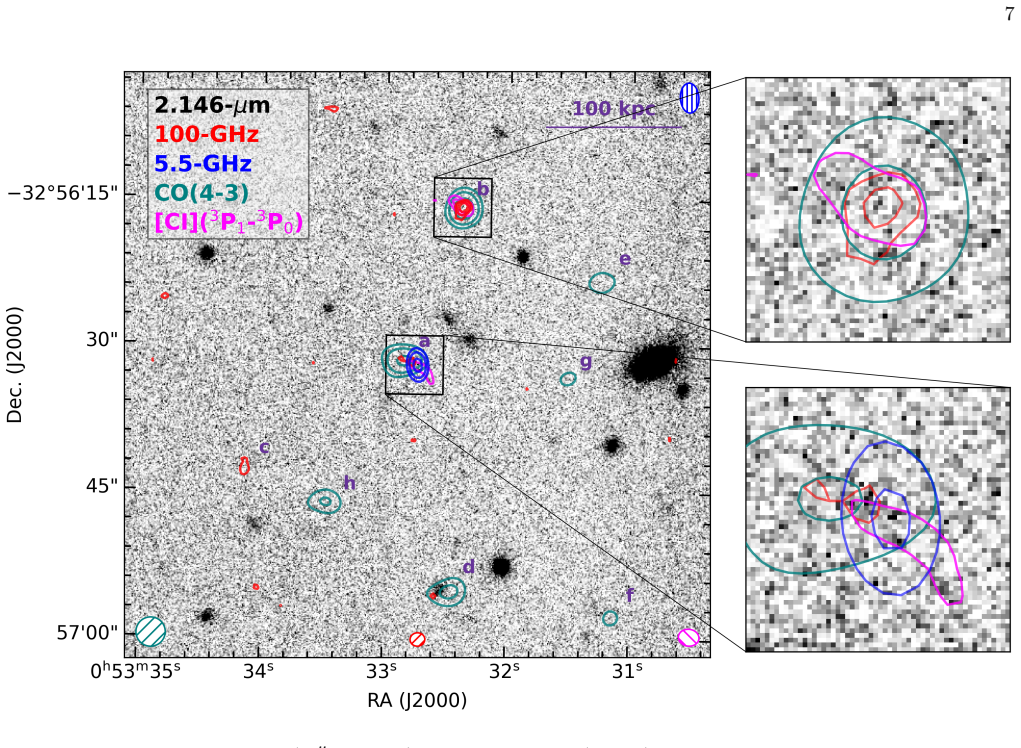
In the paper's own terms, J0053 is a z=3.879 powerful radio galaxy (L_500MHz = 1.3e28 W/Hz) whose CO(4-3) emission splits into two kinematic components, interpreted as in-falling gas from a recent merger. A second, radio-quiet sub-millimetre galaxy, J0053b, is confirmed at the same redshift by both CO(4-3) and [CI](1-0), and five further CO(4-3) emitters plus one continuum-only candidate complete a set of up to eight protocluster members, all within ~1.1 arcminutes and within ~700 km/s. The most massive member is the near-infrared-dark J0053d, with stellar mass log(M*/Msun)=12.12(+0.17,-0.20) from BEAGLE, whose host would be a galaxy of ~$10^{12}$ solar masses. Using the TNG300 simulation as a guide, the paper assigns the protocluster a dark matter halo of ~3e13 solar masses that grows to ~$10^{15}$ solar masses by z=0, a Coma-cluster-sized descendant.
Load-bearing premise
The five candidates J0053d–h are counted as protocluster members only because their single detected emission lines sit at frequencies within ~700 km/s of the two spectroscopically confirmed CO(4-3) lines; if any of those single lines is actually a different CO transition at a different redshift, that source would not be part of the protocluster.
Editorial extensions
If this is right
- If the protocluster is real, it is one of the youngest known precursors of a Coma-mass cluster, offering a direct view of hierarchical assembly at z~4.
- The radio galaxy's two-component CO emission supports the idea that mergers trigger powerful radio activity and provide the dense gas supply of a forming cluster core.
- The presence of a ~10^12-solar-mass NIR-dark member implies that some of the most massive z~4 galaxies are completely hidden from rest-frame UV/optical surveys and are only found through their molecular gas.
- The wide-band ALMA scan strategy used here can be applied to other radio-selected sources to build a statistical sample of protoclusters at z>3, mapping how often powerful radio galaxies pinpoint overdensities.
- The measured molecular gas lower limits (>5.5e10 solar masses in the field) show that the protocluster core contains enough fuel to sustain the star formation and black hole growth expected in a forming massive cluster.
Reading between the lines
- Beyond the paper: Confirming the single-line members with a second transition would make J0053 a benchmark z~4 protocluster, on par with the densest known examples, and would sharpen the overdensity and halo-mass estimates.
- Beyond the paper: If J0053d is truly as massive as ~10^12 solar masses at z=3.9, current stellar-mass functions from UV-selected samples are likely incomplete at the high-mass end, since such galaxies would be missed by almost all deep surveys.
- Beyond the paper: The TNG300-based halo projection could be tested independently with a velocity-dispersion measurement of the confirmed members or with a search for extended SZ/X-ray emission, both of which would directly probe the halo mass.
- Beyond the paper: Observing the remaining GLEAM-selected targets with the same ALMA strategy could determine whether the J0053 protocluster is typical or extreme, turning a single pointing into a census of early cluster formation.
Editorial analysis
A structured set of objections, weighed in public.
Referee Report
Summary. The paper reports ALMA Band 3 spectral scans of the candidate high-redshift radio galaxy GLEAM J005332-325630 (J0053). The authors detect CO(4-3) and [CI](1-0) emission in both the radio galaxy (J0053a) and a nearby 100-GHz continuum source (J0053b), placing both at z~3.88. They further identify five additional CO(4-3) candidate members (J0053d-h) from single lines near 94.5 GHz, plus one continuum-only source (J0053c), and claim an overdensity of 12-20 times the CANDELS field density. Aperture photometry and BEAGLE SED fitting are used to identify J0053d as a rare, optically dark, very massive galaxy with log M*/Msun = 12.12, which the authors compare with TNG300 to argue that the system is a Coma-type progenitor.
Significance. If the full membership holds, this is a valuable example of a z~3.9 radio-galaxy-centred protocluster containing molecular gas reservoirs and a very massive obscured galaxy; the two-line spectroscopic confirmation of J0053a and J0053b is solid, and the authors deserve credit for presenting explicit purity and interloper calculations and for using external calibrators (ALESS templates, Riechers et al. CO luminosity function, TNG300) rather than fitting away their own signal. The central discovery is plausible, but the headline member count and the J0053d mass rest on assumptions whose sensitivity is not yet demonstrated. With a careful re-accounting of secure members and a prior-robustness check, the core result is likely to stand, so the paper merits a major revision rather than rejection.
major comments (3)
- [§3.2.2, Table 5] The five single-line members J0053d-h are identified by searching in frequency around the confirmed CO(4-3) lines of J0053a/b, so their concentration at 94.5 GHz is partly a selection effect rather than independent confirmation. The claimed <0.01 expected blind interlopers in 3.865<z<3.885 is computed for a blind search, whereas the actual search window was defined a posteriori from the detections themselves; the same is true of the velocity clustering cited in support of membership. The purity analysis in §3.2.2 itself admits that about two of the seven positive detections in the nominal linemap are spurious at S/N>=3.2. Because the 12-20x overdensity figure counts up to eight candidates, the manuscript should either report a full-band blind source search at the same S/N threshold showing that 94.5 GHz is the only frequency with such a concentration of lines, or conservatively restrict secure membership to sources with S/N>=5.7 or with independent photometric support and recompute the overdensity accordingly.
- [§4.2, §5] J0053c is included in the 'up to eight' protocluster count and in the 12-20x overdensity, yet Section 4.2 explicitly states that no redshift is determined for this source and that it may not be part of the same structure. Since the overdensity is computed per redshift bin, a source with unknown redshift cannot be counted as a member. The '20x' end of the claimed range is therefore not supported. Please remove J0053c from the overdensity calculation, or present that value only as an explicit upper limit obtained by arbitrarily assigning z=3.879 to the source.
- [§3.3, Table 6, §4.5] The headline stellar mass of J0053d, log M*/Msun = 12.12 (+0.17,-0.20), is derived from a single strong Ks-band detection (6.12±0.57 uJy) together with marginal r/i fluxes, while z and Y are consistent with noise. The quoted 68% credible interval is likely to be strongly influenced by the BEAGLE prior range (log M*=9-13) and by the imposed star-formation timescale cap described in Section 2.3.2 and Table 3. The PEGASE mass-to-light estimate in Section 4.1 gives log M* ~ 11.6, which the authors accept as a lower limit, but the difference is comparable to the quoted uncertainty. Please show a prior-sensitivity test (e.g., varying the upper mass prior and the tau cap) or weaken the claim to log M*/Msun ~ 11.6-12.1. The TNG300 comparison and the 'Coma-like progenitor' conclusion depend on this specific mass value.
minor comments (4)
- [Throughout] The neutral carbon transition is referred to as [Ci], [CI], and [C i] in different places; please standardize the notation.
- [§3.2] The description of the manual line-search procedure would be clearer if it stated the number of independent frequency and spatial trials performed, so that the look-elsewhere penalty can be evaluated; this is related to Major Comment 1.
- [Figure 4] The binned spectra in Figure 4 are hard to compare because the continuum levels and vertical scales differ between panels; adding a zero-flux reference line and a ±1-sigma noise band in each panel would help the reader judge the reality of the weaker features.
- [Table 1] The observing log lists dates in a way that is readable only by re-deriving them from the prose; adding an explicit 'Date(s)' column header would improve the table.
Circularity Check
Candidate protocluster members are selected by frequency proximity to the confirmed CO lines, and that same proximity is then recycled as an 'external prior' and as velocity-clustering/overdensity evidence; the central two-line confirmation retains independent content, so circularity is partial.
-
other
[Section 3.2.1 ('Statistical analysis concerning the weak detection of the carbon line'), paragraph beginning 'Given there are at least five detections...']
"Given there are at least five detections of CO emission within approximately 1 arcmin2 at similar frequency, the probability of physical association in an overdensity outweighs the probability of random alignment of all the detections. Hence these identical lines become an external prior."
The five detections invoked as an 'external prior' are the single-line candidates whose identification as CO(4-3) at z≈3.88 rests entirely on their frequency proximity to the two CO lines of J0053a/b: Section 3.2 states 'The remaining five emission lines (S/N 4−6) are assumed to be CO(4-3) due to their similar frequency to the two confirmed CO(4-3) sources and hence lie at very similar redshift.' Using those candidates to argue that the low-S/N [CI] detections are real, where those [CI] detections in turn confirm the CO(4-3) redshifts on which the candidates depend, closes a support loop.
full rationale
The paper's core spectroscopic confirmation of J0053a and J0053b has independent content: the observed frequency ratio between the strong CO lines and the weaker [CI] lines matches the CO(4-3)/[CI](1-0) rest-frame ratio, and the blind CO luminosity-function calculation uses an external Schechter function from Riechers et al. (2019). The stellar masses, SFRs, and gas masses are derived from external templates (BEAGLE, ALESS, Pégase) and standard conversion factors, not from parameters fitted to the protocluster claim itself. The sample originates in the same group's prior papers (B22/B24), but the protocluster conclusion does not depend on any self-cited uniqueness theorem or fitted prediction. The one genuine circular element is the treatment of the five single-line candidates: their redshifts are assumed from their proximity to the confirmed lines, and that same proximity is then used as evidence of physical association via the 'external prior' argument and as the velocity/overdensity signal. Because this loop affects the extension from two secure members to up to eight candidate members, but not the independent confirmation of the radio galaxy redshift or the external calibrations, the circularity is partial rather than total.
Assumptions & free parameters
free parameters (2)
- BEAGLE prior ranges for galaxy properties =
log M*/Msun uniform in [9,13]; log tau/yr in [8,9.15]; log psi in [1,3.5]; tau_V in [-1,7]
- Star formation timescale cap =
tau_max = t_H(z=3.879) - 200 Myr
assumptions (7)
- domain assumption Single-line detections (J0053d-h) are CO(4-3) at z~3.87-3.88
- domain assumption Thermalised CO SLED with r_41=1 and alpha_CO=0.8 for gas mass estimates
- domain assumption ALESS SED templates are applicable to J0053a/b at z=3.88 for SFR estimates
- domain assumption BEAGLE SED models with Bruzual & Charlot 2003, MILES library, Chabrier IMF, solar metallicity, constant SFH
- domain assumption Riechers et al. (2019) CO luminosity function with no evolution and thermalised SLED for interloper estimate
- domain assumption TNG300 simulation is representative for the rarest galaxies at z=4
- domain assumption Flat LCDM cosmology with H0=70, Omega_M=0.3, Omega_L=0.7
Cite this review
Pith. "Pith review of The Centre of Attention: a Powerful Radio Galaxy Pinpoints a NIR-Dark Protocluster at z~3.9." pith.science (2026). https://pith.science/paper/BV2F3B2J
@misc{pith2026250604747,
  author       = {Pith},
  title        = {Pith review of: The Centre of Attention: a Powerful Radio Galaxy Pinpoints a NIR-Dark Protocluster at z~3.9},
  year         = {2026},
  howpublished = {\url{https://pith.science/paper/BV2F3B2J}},
  note         = {Machine review of arXiv:2506.04747}
}
abstract
We report the discovery of a $z\sim3.9$ protocluster identified from Atacama Large Millimetre/sub-millimetre Array Band 3 spectral scans of a bright radio source selected from the GaLactic and Extra-galactic All-sky Murchison Widefield Array (GLEAM) survey. Extended CO(4-3) and [CI](1-0) line emission was detected in GLEAM J005332$-$325630 confirming it to be a $z=3.879$ powerful radio galaxy with luminosity, $L_{500 MHz}=1.3\times10^{28}$ ${W Hz}^{-1}$. This source is part of a sample of candidate high redshift radio galaxies with bright radio fluxes, $S_{150MHz}>0.1$ Jy, but host galaxies with $K_s({AB})\gtrsim23$ mag. The molecular gas associated with the radio galaxy host has two kinematically separate components, likely in-falling and indicative of a recent interaction or merger with another galaxy. One 100-GHz continuum source $\sim120$ pkpc away is found to have both CO(4-3) and [CI](1-0) emission lines and a further five protocluster members are identified from CO(4-3) emission alone, all at similar redshift ($\Delta v<700$ km s$^{-1}$) and within a radius of $1.1^{\prime}$. Using photometry from the High Acuity Widefield K-band Imager $K_s$-band and the Dark Energy Survey $g, r, i, z$ and $Y$ bands, we find this protocluster harbours a rare, optically-dark, very massive $M_*\sim10^{12}$ ${M}_\odot$ galaxy. Comparisons with the TNG300 cosmological simulation puts this galaxy in a dark matter halo of $M_{DM}\sim3\times10^{13}$ ${M}_\odot$ which will evolve into a Coma-like DM halo ($M_{DM}\sim10^{15}$ ${M}_\odot$) by the present day.
Figures


Figures from the paper (2 more)


Reference graph
Works this paper leans on
-
[1]
Abbott, T. M. C., Adam´ ow, M., Aguena, M., et al. 2021, ApJS, 255, 20, doi: 10.3847/1538-4365/ac00b3
-
[2]
2016, ApJ, 833, 71, doi: 10.3847/1538-4357/833/1/71 Astropy Collaboration, Robitaille, T
Aravena, M., Decarli, R., Walter, F., et al. 2016, ApJ, 833, 71, doi: 10.3847/1538-4357/833/1/71 Astropy Collaboration, Robitaille, T. P., Tollerud, E. J., et al. 2013, A&A, 558, A33, doi: 10.1051/0004-6361/201322068 Astropy Collaboration, Price-Whelan, A. M., Sip˝ ocz, B. M., et al. 2018, AJ, 156, 123, doi: 10.3847/1538-3881/aabc4f Astropy Collaboration,...
-
[3]
Aversa, R., Lapi, A., de Zotti, G., Shankar, F., & Danese, L. 2015, ApJ, 810, 74, doi: 10.1088/0004-637X/810/1/74 Ba˜ nados, E., Mazzucchelli, C., Momjian, E., et al. 2021, ApJ, 909, 80, doi: 10.3847/1538-4357/abe239 Ba˜ nados, E., Schindler, J.-T., Venemans, B. P., et al. 2023, ApJS, 265, 29, doi: 10.3847/1538-4365/acb3c7 Ba˜ nados, E., Khusanova, Y., De...
-
[4]
Barro, G., P´ erez-Gonz´ alez, P. G., Kocevski, D. D., et al. 2024, ApJ, 963, 128, doi: 10.3847/1538-4357/ad167e
-
[5]
Barrufet, L., Oesch, P. A., Marques-Chaves, R., et al. 2025, MNRAS, 537, 3453, doi: 10.1093/mnras/staf013
-
[6]
2023, A&A, 669, A134, doi: 10.1051/0004-6361/202243855
Belladitta, S., Moretti, A., Caccianiga, A., et al. 2023, A&A, 669, A134, doi: 10.1051/0004-6361/202243855
-
[7]
Birkin, J. E., Weiss, A., Wardlow, J. L., et al. 2021, MNRAS, 501, 3926, doi: 10.1093/mnras/staa3862 2 http://www.astropy.org Bogd´ an,´A., Goulding, A. D., Natarajan, P., et al. 2024, Nature Astronomy, 8, 126, doi: 10.1038/s41550-023-02111-9
-
[8]
2019, A&A, 622, A103, doi: 10.1051/0004-6361/201834156
Boquien, M., Burgarella, D., Roehlly, Y., et al. 2019, A&A, 622, A103, doi: 10.1051/0004-6361/201834156
Show all 103 references
-
[9]
2022, astropy/photutils: 1.6.0, 1.6.0, Zenodo, doi: 10.5281/zenodo.7419741
Bradley, L., Sip˝ ocz, B., Robitaille, T., et al. 2022, astropy/photutils: 1.6.0, 1.6.0, Zenodo, doi: 10.5281/zenodo.7419741
2022 doi
-
[11]
Briggs, D. S. 1995, PhD thesis, New Mexico Institute of Mining and Technology
1995
-
[12]
W., Drouart, G., Seymour, N., et al
Broderick, J. W., Drouart, G., Seymour, N., et al. 2022, PASA, 39, e061, doi: 10.1017/pasa.2022.42
2022 doi
-
[13]
W., Seymour, N., Drouart, G., et al
Broderick, J. W., Seymour, N., Drouart, G., et al. 2024, PASA, 41, e071, doi: 10.1017/pasa.2024.55
2024 doi
-
[14]
2003, MNRAS, 344, 1000, doi: 10.1046/j.1365-8711.2003.06897.x
Bruzual, G., & Charlot, S. 2003, MNRAS, 344, 1000, doi: 10.1046/j.1365-8711.2003.06897.x
2003
-
[15]
2005, MNRAS, 360, 1413, doi: 10.1111/j.1365-2966.2005.09131.x
Burgarella, D., Buat, V., & Iglesias-P´ aramo, J. 2005, MNRAS, 360, 1413, doi: 10.1111/j.1365-2966.2005.09131.x
2005
-
[16]
C., et al
Calzetti, D., Armus, L., Bohlin, R. C., et al. 2000, ApJ, 533, 682, doi: 10.1086/308692
2000 doi
-
[17]
J., Katz, H., Witten, C., et al
Cameron, A. J., Katz, H., Witten, C., et al. 2024, MNRAS, 534, 523, doi: 10.1093/mnras/stae1547
2024 doi
-
[18]
M., Narayanan, D., & Cooray, A
Casey, C. M., Narayanan, D., & Cooray, A. 2014, PhR, 541, 45, doi: 10.1016/j.physrep.2014.02.009
2014 doi
-
[19]
1998, A&A, 331, 451
Casoli, F., Sauty, S., Gerin, M., et al. 1998, A&A, 331, 451
1998
-
[20]
2003, PASP, 115, 763, doi: 10.1086/376392
Chabrier, G. 2003, PASP, 115, 763, doi: 10.1086/376392
2003 doi
-
[21]
C., Hill, R., Aravena, M., et al
Chapman, S. C., Hill, R., Aravena, M., et al. 2024, ApJ, 961, 120, doi: 10.3847/1538-4357/ad0b77 21
2024 doi
-
[22]
2016, MNRAS, 462, 1415, doi: 10.1093/mnras/stw1756 da Cunha, E., Walter, F., Smail, I
Chevallard, J., & Charlot, S. 2016, MNRAS, 462, 1415, doi: 10.1093/mnras/stw1756 da Cunha, E., Walter, F., Smail, I. R., et al. 2015, ApJ, 806, 110, doi: 10.1088/0004-637X/806/1/110
2016 doi
-
[23]
D., De Breuck, C., et al
Dannerbauer, H., Kurk, J. D., De Breuck, C., et al. 2014, A&A, 570, A55, doi: 10.1051/0004-6361/201423771 De Breuck, C., Seymour, N., Stern, D., et al. 2010, ApJ, 725, 36, doi: 10.1088/0004-637X/725/1/36
2014 doi
-
[24]
Downes, D., & Solomon, P. M. 1998, ApJ, 507, 615, doi: 10.1086/306339
1998 doi
-
[25]
2016, A&A, 593, A109, doi: 10.1051/0004-6361/201526880
Drouart, G., Rocca-Volmerange, B., De Breuck, C., et al. 2016, A&A, 593, A109, doi: 10.1051/0004-6361/201526880
2016 doi
-
[26]
J., et al
Drouart, G., Seymour, N., Galvin, T. J., et al. 2020, PASA, 37, e026, doi: 10.1017/pasa.2020.6
2020 doi
-
[27]
Emonts, B. H. C., Piqueras-L´ opez, J., Colina, L., et al. 2014, A&A, 572, A40, doi: 10.1051/0004-6361/201423805
2014 doi
-
[28]
Emonts, B. H. C., Feain, I., R¨ ottgering, H. J. A., et al. 2013, MNRAS, 430, 3465, doi: 10.1093/mnras/stt147
2013 doi
-
[29]
Emonts, B. H. C., De Breuck, C., Lehnert, M. D., et al. 2015a, A&A, 584, A99, doi: 10.1051/0004-6361/201526090
-
[30]
Emonts, B. H. C., Mao, M. Y., Stroe, A., et al. 2015b, MNRAS, 451, 1025, doi: 10.1093/mnras/stv930
-
[31]
Emonts, B. H. C., Lehnert, M. D., Villar-Mart ´ ın, M., et al. 2016, Science, 354, 1128, doi: 10.1126/science.aag0512
2016 doi
-
[32]
Emonts, B. H. C., Lehnert, M. D., Dannerbauer, H., et al. 2018, MNRAS, 477, L60, doi: 10.1093/mnrasl/sly034
2018 doi
-
[33]
Emonts, B. H. C., Lehnert, M. D., Lebowitz, S., et al. 2023, ApJ, 952, 148, doi: 10.3847/1538-4357/acde53
2023 doi
-
[34]
P., Lyu, J., et al
Endsley, R., Stark, D. P., Lyu, J., et al. 2023, MNRAS, 520, 4609, doi: 10.1093/mnras/stad266 European Southern Observatory. 1998, The VLT White Book
2023 doi
-
[35]
E., Bialek, J., Busha, M., et al
Evrard, A. E., Bialek, J., Busha, M., et al. 2008, ApJ, 672, 122, doi: 10.1086/521616
2008 doi
-
[36]
D., et al
Falkendal, T., De Breuck, C., Lehnert, M. D., et al. 2019, A&A, 621, A27, doi: 10.1051/0004-6361/201732485
2019 doi
-
[37]
L., Bagley, M
Finkelstein, S. L., Bagley, M. B., Ferguson, H. C., et al. 2023, ApJL, 946, L13, doi: 10.3847/2041-8213/acade4
2023 doi
-
[38]
2019, A&A, 623, A143, doi: 10.1051/0004-6361/201833556
Fioc, M., & Rocca-Volmerange, B. 2019, A&A, 623, A143, doi: 10.1051/0004-6361/201833556
2019 doi
-
[39]
T., Honscheid, K., et al
Flaugher, B., Diehl, H. T., Honscheid, K., et al. 2015, AJ, 150, 150, doi: 10.1088/0004-6256/150/5/150
2015 doi
-
[40]
H., Brooks, J
Frater, R. H., Brooks, J. W., & Whiteoak, J. B. 1992, Journal of Electrical and Electronics Engineering Australia, 12, 103
1992
-
[41]
2016, pvextractor: Position-Velocity Diagram Extractor, Astrophysics Source Code Library, record ascl:1608.010
Ginsburg, A., Robitaille, T., & Beaumont, C. 2016, pvextractor: Position-Velocity Diagram Extractor, Astrophysics Source Code Library, record ascl:1608.010
2016
-
[42]
2015, in Astronomical Society of the Pacific Conference Series, Vol
Ginsburg, A., Robitaille, T., Beaumont, C., et al. 2015, in Astronomical Society of the Pacific Conference Series, Vol. 499, Revolution in Astronomy with ALMA: The Third Year, ed. D. Iono, K. Tatematsu, A. Wootten, & L. Testi, 363–364
2015
-
[43]
J., Duncan, K
Gloudemans, A. J., Duncan, K. J., Saxena, A., et al. 2022, A&A, 668, A27, doi: 10.1051/0004-6361/202244763
2022 doi
-
[44]
D., Greene, J
Goulding, A. D., Greene, J. E., Setton, D. J., et al. 2023, ApJL, 955, L24, doi: 10.3847/2041-8213/acf7c5
2023 doi
-
[45]
A., Kocevski, D
Grogin, N. A., Kocevski, D. D., Faber, S. M., et al. 2011, ApJS, 197, 35, doi: 10.1088/0067-0049/197/2/35 G¨ usten, R., Nyman, L.˚A., Schilke, P., et al. 2006, A&A, 454, L13, doi: 10.1051/0004-6361:20065420
2011 doi
-
[46]
R., Millman, K
Harris, C. R., Millman, K. J., van der Walt, S. J., et al. 2020, Nature, 585, 357, doi: 10.1038/s41586-020-2649-2
2020 doi
-
[47]
A., Karim, A., Smail, I., et al
Hodge, J. A., Karim, A., Smail, I., et al. 2013, ApJ, 768, 91, doi: 10.1088/0004-637X/768/1/91
2013 doi
-
[48]
Hunter, J. D. 2007, Computing in Science & Engineering, 9, 90, doi: 10.1109/MCSE.2007.55
2007 doi
-
[49]
2021, A&A, 647, L11, doi: 10.1051/0004-6361/202140362
Ighina, L., Belladitta, S., Caccianiga, A., et al. 2021, A&A, 647, L11, doi: 10.1051/0004-6361/202140362
2021 doi
-
[50]
2023, MNRAS, 519, 2060, doi: 10.1093/mnras/stac3668
Ighina, L., Caccianiga, A., Moretti, A., et al. 2023, MNRAS, 519, 2060, doi: 10.1093/mnras/stac3668
2023 doi
-
[51]
K., Broderick, J
Ighina, L., Leung, J. K., Broderick, J. W., et al. 2022, A&A, 663, A73, doi: 10.1051/0004-6361/202142733
2022 doi
-
[52]
2024, A&A, 687, A242, doi: 10.1051/0004-6361/202449369
Ighina, L., Caccianiga, A., Moretti, A., et al. 2024, A&A, 687, A242, doi: 10.1051/0004-6361/202449369
2024 doi
-
[53]
K., Shimizu, I., Iwata, I., & Tanaka, M
Inoue, A. K., Shimizu, I., Iwata, I., & Tanaka, M. 2014, MNRAS, 442, 1805, doi: 10.1093/mnras/stu936
2014 doi
-
[54]
J., Smail, I., Amblard, A., et al
Ivison, R. J., Smail, I., Amblard, A., et al. 2012, MNRAS, 425, 1320, doi: 10.1111/j.1365-2966.2012.21544.x
2012
-
[55]
B., Jeon, M., Song, H., & Bromm, V
Jeong, T. B., Jeon, M., Song, H., & Bromm, V. 2025, ApJ, 980, 10, doi: 10.3847/1538-4357/ada27d
2025 doi
-
[56]
F., Casali, M., et al
Kissler-Patig, M., Pirard, J. F., Casali, M., et al. 2008, A&A, 491, 941, doi: 10.1051/0004-6361:200809910
2008 doi
-
[57]
H., Newman, J
Kodra, D., Andrews, B. H., Newman, J. A., et al. 2023, ApJ, 942, 36, doi: 10.3847/1538-4357/ac9f12
2023 doi
-
[58]
2023, MNRAS, 525, 5831, doi: 10.1093/mnras/stad2647
Kolwa, S., De Breuck, C., Vernet, J., et al. 2023, MNRAS, 525, 5831, doi: 10.1093/mnras/stad2647
2023 doi
-
[59]
2015, in Advancing Astrophysics with the Square Kilometre Array (AASKA14), 1, doi: 10.22323/1.215.0001
Koopmans, L., Pritchard, J., Mellema, G., et al. 2015, in Advancing Astrophysics with the Square Kilometre Array (AASKA14), 1, doi: 10.22323/1.215.0001
2015 doi
- [60]
-
[61]
2014, AJ, 147, 108, doi: 10.1088/0004-6256/147/5/108
Lang, D. 2014, AJ, 147, 108, doi: 10.1088/0004-6256/147/5/108
2014 doi
-
[62]
M., et al
Lebowitz, S., Emonts, B., Terndrup, D. M., et al. 2023, ApJ, 951, 73, doi: 10.3847/1538-4357/acd3ed
2023 doi
-
[63]
2021, ApJ, 909, 56, doi: 10.3847/1538-4357/abd801 22
Liu, D., Daddi, E., Schinnerer, E., et al. 2021, ApJ, 909, 56, doi: 10.3847/1538-4357/abd801 22
2021 doi
-
[64]
S., Cooray, A., Ma, J., et al
Long, A. S., Cooray, A., Ma, J., et al. 2020, ApJ, 898, 133, doi: 10.3847/1538-4357/ab9d1f
2020 doi
-
[65]
Marigo, P., Bressan, A., Nanni, A., Girardi, L., & Pumo, M. L. 2013, MNRAS, 434, 488, doi: 10.1093/mnras/stt1034
2013 doi
-
[66]
2007, in Astronomical Society of the Pacific Conference Series, Vol
Golap, K. 2007, in Astronomical Society of the Pacific Conference Series, Vol. 376, Astronomical Data Analysis Software and Systems XVI, ed. R. A. Shaw, F. Hill, & D. J. Bell, 127
2007
-
[67]
2008, A&A Rv, 15, 67, doi: 10.1007/s00159-007-0008-z
Miley, G., & De Breuck, C. 2008, A&A Rv, 15, 67, doi: 10.1007/s00159-007-0008-z
2008 doi
-
[68]
K., Overzier, R
Miley, G. K., Overzier, R. A., Zirm, A. W., et al. 2006, ApJL, 650, L29, doi: 10.1086/508534
2006 doi
-
[69]
B., Chapman, S
Miller, T. B., Chapman, S. C., Aravena, M., et al. 2018, Nature, 556, 469, doi: 10.1038/s41586-018-0025-2
2018 doi
-
[70]
Ryder, S. D. 2022, in Society of Photo-Optical Instrumentation Engineers (SPIE) Conference Series, Vol. 12189, Software and Cyberinfrastructure for Astronomy VII, 121892S, doi: 10.1117/12.2642065
2022 doi
-
[71]
2021, AJ, 161, 207, doi: 10.3847/1538-3881/abe6ae
Mazzucchelli, C. 2021, AJ, 161, 207, doi: 10.3847/1538-3881/abe6ae
2021 doi
-
[72]
2023, lmfit/lmfit-py: 1.2.2, 1.2.2, Zenodo, doi: 10.5281/zenodo.8145703
Newville, M., Otten, R., Nelson, A., et al. 2023, lmfit/lmfit-py: 1.2.2, 1.2.2, Zenodo, doi: 10.5281/zenodo.8145703
2023 doi
-
[73]
2016, ApJ, 830, 90, doi: 10.3847/0004-637X/830/2/90
Noirot, G., Vernet, J., De Breuck, C., et al. 2016, ApJ, 830, 90, doi: 10.3847/0004-637X/830/2/90
2016 doi
-
[74]
2018, ApJ, 859, 38, doi: 10.3847/1538-4357/aabadb
Noirot, G., Stern, D., Mei, S., et al. 2018, ApJ, 859, 38, doi: 10.3847/1538-4357/aabadb
2018 doi
-
[75]
2009, A&A, 507, 1793, doi: 10.1051/0004-6361/200912497
Noll, S., Burgarella, D., Giovannoli, E., et al. 2009, A&A, 507, 1793, doi: 10.1051/0004-6361/200912497
2009 doi
-
[76]
Oke, J. B. 1974, ApJS, 27, 21, doi: 10.1086/190287
1974 doi
-
[77]
J., Dunne, L., et al
Oteo, I., Ivison, R. J., Dunne, L., et al. 2018, ApJ, 856, 72, doi: 10.3847/1538-4357/aaa1f1 P´ erez-Gonz´ alez, P. G., Barro, G., Annunziatella, M., et al. 2023, ApJL, 946, L16, doi: 10.3847/2041-8213/acb3a5
2018 doi
-
[78]
2018, MNRAS, 475, 648, doi: 10.1093/mnras/stx3112
Pillepich, A., Nelson, D., Hernquist, L., et al. 2018, MNRAS, 475, 648, doi: 10.1093/mnras/stx3112
2018 doi
-
[79]
A., Pavesi, R., Sharon, C
Riechers, D. A., Pavesi, R., Sharon, C. E., et al. 2019, ApJ, 872, 7, doi: 10.3847/1538-4357/aafc27
2019 doi
-
[80]
2004, A&A, 415, 931, doi: 10.1051/0004-6361:20031717
Rocca-Volmerange, B., Le Borgne, D., De Breuck, C., Fioc, M., & Moy, E. 2004, A&A, 415, 931, doi: 10.1051/0004-6361:20031717
2004 doi
-
[81]
Salpeter, E. E. 1955, ApJ, 121, 161, doi: 10.1086/145971 S´ anchez, E., & DES Collaboration. 2010, in Journal of Physics Conference Series, Vol. 259, Journal of Physics Conference Series (IOP), 012080, doi: 10.1088/1742-6596/259/1/012080 S´ anchez-Bl´ azquez, P., Peletier, R. ...
1955
-
[82]
2016, ApJ, 820, 83, doi: 10.3847/0004-637X/820/2/83
Scoville, N., Sheth, K., Aussel, H., et al. 2016, ApJ, 820, 83, doi: 10.3847/0004-637X/820/2/83
2016 doi
-
[83]
2015, MNRAS, 448, 1922, doi: 10.1093/mnras/stv079
Serra, P., Westmeier, T., Giese, N., et al. 2015, MNRAS, 448, 1922, doi: 10.1093/mnras/stv079
2015 doi
-
[84]
2007, ApJS, 171, 353, doi: 10.1086/517887
Seymour, N., Stern, D., De Breuck, C., et al. 2007, ApJS, 171, 353, doi: 10.1086/517887
2007 doi
-
[85]
2012, ApJ, 755, 146, doi: 10.1088/0004-637X/755/2/146
Seymour, N., Altieri, B., De Breuck, C., et al. 2012, ApJ, 755, 146, doi: 10.1088/0004-637X/755/2/146
2012 doi
-
[86]
2009, A&A, 497, 945, doi: 10.1051/0004-6361/200811454
Siringo, G., Kreysa, E., Kov´ acs, A., et al. 2009, A&A, 497, 945, doi: 10.1051/0004-6361/200811454
2009 doi
-
[87]
2019, Contemporary Physics, 60, 111, doi: 10.1080/00107514.2019.1615715
Smith, A., & Bromm, V. 2019, Contemporary Physics, 60, 111, doi: 10.1080/00107514.2019.1615715
2019
-
[88]
2017, Astronomy and Geophysics, 58, 3.22, doi: 10.1093/astrogeo/atx099
Smith, A., Bromm, V., & Loeb, A. 2017, Astronomy and Geophysics, 58, 3.22, doi: 10.1093/astrogeo/atx099
2017 doi
-
[89]
M., & Vanden Bout, P
Solomon, P. M., & Vanden Bout, P. A. 2005, ARA&A, 43, 677, doi: 10.1146/annurev.astro.43.051804.102221
2005 arXiv
-
[90]
S., Marrone, D
Spilker, J. S., Marrone, D. P., Aguirre, J. E., et al. 2014, ApJ, 785, 149, doi: 10.1088/0004-637X/785/2/149
2014 doi
-
[91]
Taylor, M. B. 2005, in Astronomical Society of the Pacific Conference Series, Vol. 347, Astronomical Data Analysis Software and Systems XIV, ed. P. Shopbell, M. Britton, & R. Ebert, 29
2005
-
[92]
P., Kurk, J
Venemans, B. P., Kurk, J. D., Miley, G. K., et al. 2002, ApJL, 569, L11, doi: 10.1086/340563
2002 doi
-
[93]
P., R¨ ottgering, H
Venemans, B. P., R¨ ottgering, H. J. A., Miley, G. K., et al. 2007, A&A, 461, 823, doi: 10.1051/0004-6361:20053941
2007 doi
-
[94]
E., et al
Virtanen, P., Gommers, R., Oliphant, T. E., et al. 2020, Nature Methods, 17, 261, doi: 10.1038/s41592-019-0686-2
2020 doi
-
[95]
2012, Science, 337, 544, doi: 10.1126/science.1220843
Volonteri, M. 2012, Science, 337, 544, doi: 10.1126/science.1220843
2012 doi
-
[96]
2021, ApJL, 907, L1, doi: 10.3847/2041-8213/abd8c6 Weiß, A., Kov´ acs, A., Coppin, K., et al
Wang, F., Yang, J., Fan, X., et al. 2021, ApJL, 907, L1, doi: 10.3847/2041-8213/abd8c6 Weiß, A., Kov´ acs, A., Coppin, K., et al. 2009, ApJ, 707, 1201, doi: 10.1088/0004-637X/707/2/1201 Weiß, A., De Breuck, C., Marrone, D. P., et al. 2013, ApJ, 767, 88, doi: 10.1088/0004-637X/767/1/88
2021 doi
-
[97]
2021, MNRAS, 506, 3962, doi: 10.1093/mnras/stab1881
Westmeier, T., Kitaeff, S., Pallot, D., et al. 2021, MNRAS, 506, 3962, doi: 10.1093/mnras/stab1881
2021 doi
-
[98]
C., Alberts, S., Ji, Z., et al
Williams, C. C., Alberts, S., Ji, Z., et al. 2024, ApJ, 968, 34, doi: 10.3847/1538-4357/ad3f17
2024 doi
-
[99]
Wootten, A., & Thompson, A. R. 2009, IEEE Proceedings, 97, 1463, doi: 10.1109/JPROC.2009.2020572
2009
-
[100]
L., Eisenhardt, P
Wright, E. L., Eisenhardt, P. R. M., Mainzer, A. K., et al. 2010, AJ, 140, 1868, doi: 10.1088/0004-6256/140/6/1868
2010 doi
-
[101]
2013, ApJ, 769, 79, doi: 10.1088/0004-637X/769/1/79 23
Wylezalek, D., Galametz, A., Stern, D., et al. 2013, ApJ, 769, 79, doi: 10.1088/0004-637X/769/1/79 23
2013 doi
-
[102]
2014, ApJ, 786, 17, doi: 10.1088/0004-637X/786/1/17
Wylezalek, D., Vernet, J., De Breuck, C., et al. 2014, ApJ, 786, 17, doi: 10.1088/0004-637X/786/1/17
2014 doi
- [103]
-
[104]
S., & Scoville, N
Young, J. S., & Scoville, N. Z. 1991, ARA&A, 29, 581, doi: 10.1146/annurev.aa.29.090191.003053 24 APPENDIX A.SUPPLEMENTARY TABLES & FIGURES Figure A1.Position-velocity diagram (PVD) of the CO(4-3) associated with J0053b in the cube, after smoothing to the smallest common resol...
1991
Reviewed August 7, 2026 · model on record in the stance chip above.
Discussion (0). Sign in to comment.