REVIEW 4 major objections 4 minor 54 references
The structural and kinematical properties of NGC 5634, a globular cluster associated with the Sagittarius dwarf galaxy?
T0 review · 4 major / 4 minor · reviewed 2026-08-07 · deepseek-v4-flash
Pith's one-line read The paper argues that globular cluster NGC 5634, long thought to have been captured from the Sagittarius dwarf galaxy, instead sits with the Gaia-Sausage-Enceladus or Helmi accretion events.
desk verdict A careful multi-probe study that makes a plausible but non-decisive case against NGC 5634 being a Sagittarius cluster, with the key caveat acknowledged in the text. read the letter →
The pith
A machine-rendered reading of the paper's core claim, the machinery that carries it, and where it could break.
The reading
What carries the argument
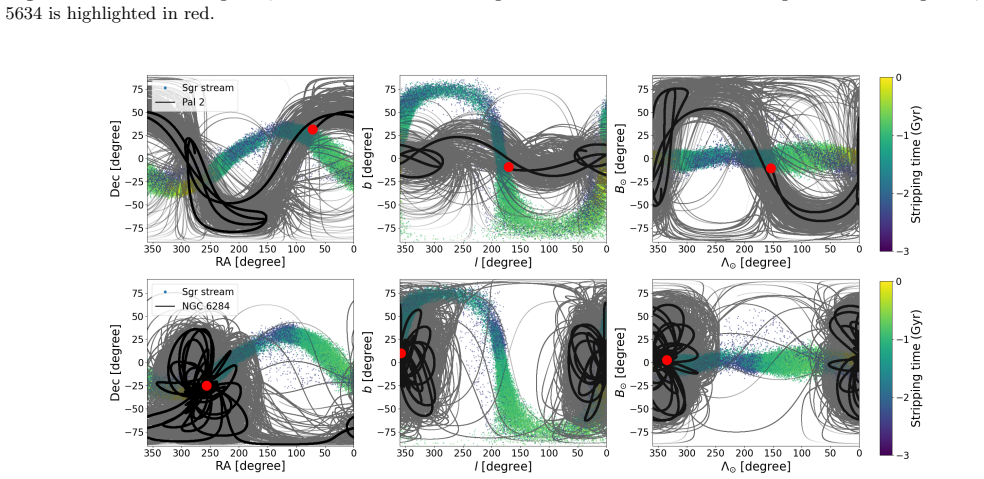
The argument turns on two matched tools. First is a matched-filter map: a background-subtracted Hess diagram of the cluster (stars within $3'$–$5.73'$ of the center, $g<23$ and $r<22.5$) becomes a template, and each pixel's signal-to-noise ratio $\mathrm{SNR}=(\alpha_{\rm bin}-\alpha_{\rm bck})/\alpha_{\rm std}$ tests for tidal tails or extra-tidal debris beyond the adopted tidal radius of $8.35'$. Second is orbital reconstruction: 6D phase-space data are integrated backward 3 Gyr through a triaxial, evolving Galactic potential that includes the Large Magellanic Cloud's perturbation, with 100 error-sampled orbits per cluster drawn from the uncertainties in distance, proper motion, and radial velocity. Orbits are compared with the Sgr stream in sky coordinates, Galactic coordinates, and stream-aligned $(\Lambda_\odot, B_\odot)$ coordinates, and the final dynamical comparison is the $L_z$–$E$ plane, total orbital energy versus angular momentum about the Galactic pole, where confirmed Sgr clusters form a tight group and NGC 5634 falls into the overlapping GSE/Helmi region.
What would settle it
Simulate the Sgr accretion event with NGC 5634 stripped at a range of early times and progenitor masses, and ask whether any run can land the cluster on its observed 6D phase-space while stream stars follow the adopted Sgr stream model; if such a run exists, the paper's central exclusion of Sgr would be overturned.
Extended reading notes
Core claim
The paper's central claim is that the accumulated evidence for NGC 5634 belonging to the Sagittarius system fails under combined morphology, kinematics, and dynamics. The matched-filter search finds no significant extra-tidal structure, so morphology cannot confirm a Sgr link. The orbit, integrated through three different Galactic potentials with a Large Magellanic Cloud perturbation, diverges from the Sgr stream over long timescales while the six confirmed Sgr clusters remain stream-aligned. In orbital-parameter space and in $L_z$–$E$ space, NGC 5634 resembles GSE and Helmi clusters more than Sgr clusters. The paper therefore concludes that the previous classification as a strong Sgr candidate is not supported by the new evidence and that an origin with the Gaia-Sausage-Enceladus or Helmi accretion is more likely, while acknowledging that definitive proof requires further data.
Load-bearing premise
The comparison assumes that a cluster stripped from the Sgr dwarf would still move with today's stream debris, but if NGC 5634 was liberated early, its orbit would have been shaped by the more massive, early-stage progenitor; the paper explicitly does not model this mass-evolution effect, so the orbital divergence alone does not close the case against Sgr.
Editorial extensions
If this is right
- NGC 5634 should not be counted among Sagittarius-associated clusters in studies of the Sgr accretion event.
- The cluster's compact, inner-halo orbit implies it was accreted from an inner-halo progenitor such as GSE or Helmi, not from the outer-halo Sagittarius system.
- The absence of detectable extra-tidal structure, combined with the very low inferred mass loss, suggests NGC 5634 has been dynamically sheltered; any future search for its debris will need deeper imaging and surface-brightness modeling.
- The same three-part test, matched-filter morphology, long-integration orbit comparison, and $L_z$–$E$ placement, can be applied to other Sgr candidates whose membership rests only on position and velocity.
Reading between the lines
- The paper's key unmodeled escape hatch is early stripping: if NGC 5634 was detached from Sgr while the dwarf was still massive, its present orbit need not follow the current stream. A decisive simulation would strip the cluster at several progenitor masses and check whether the observed 6D state is reachable.
- Because NGC 5634 sits where the GSE and Helmi boxes overlap in $L_z$–$E$ space, the dynamical evidence cannot by itself choose between those two progenitors; abundance ratios that differ between the two systems would be the natural tie-breaker.
- The same analysis applied to NGC 4147 gives a GSE-like result, suggesting that several clusters historically assigned to Sgr on spatial and kinematic grounds may actually belong to inner-halo accretion events, so Sgr's cluster census may shrink as these tests are run.
- A testable extension: re-run the orbital comparison using alternative published distances and proper motions for NGC 5634; if any plausible 6D variant realigns the orbit with the Sgr stream, the exclusion would lose force.
Editorial analysis
A structured set of objections, weighed in public.
Referee Report
Summary. The paper investigates the origin of the globular cluster NGC 5634 using DESI Legacy Survey photometry and Gaia astrometry. The authors redetermine the cluster's age, metallicity, and distance by isochrone fitting; search for extra-tidal structures with a matched-filter technique and find none above 3σ; compute orbits in the Vasiliev et al. (2021) potential with Monte Carlo sampling of 6D uncertainties and tests of two alternative potentials; and compare the orbit, apocenter/pericenter, semi-major axis, eccentricity, inclination, and Lz–E position of NGC 5634 with confirmed Sgr clusters and with GSE/Helmi cluster samples. They conclude that NGC 5634 is not strongly associated with the Sagittarius system and is more consistent with GSE or Helmi, while noting that further evidence is needed. The central negative claim rests on the orbital divergence from the current Sgr stream model, an assumption the authors themselves qualify in Section 3.3.
Significance. If the conclusion holds, the paper would reassign a well-known Sgr candidate cluster to GSE or Helmi, affecting the census of clusters associated with each accretion event. The analysis has genuine strengths: it uses public data, tests three Galactic potentials, propagates 6D uncertainties through Monte Carlo sampling, and does not repackage fitted parameters as predictions. The orbital integration and the Lz–E comparison are appropriate tools for this question. However, the significance is conditional because the main kinematic argument assumes that a cluster captured from Sgr would today remain aligned with the present-day stream debris; Section 3.3 explicitly identifies a scenario in which this assumption fails, and the paper does not model it quantitatively. The stress-test concern about early stripping therefore lands: the orbital-divergence evidence can at best disfavor recent stripping, not exclude Sgr origin at the strength stated in the Summary.
major comments (4)
- [§3.3, The mass evolution of the progenitor] The paper states that if NGC 5634 was stripped at an early stage, it would have been affected by the potential of a more massive progenitor, so its present-day kinematics could differ from the stream stars. This is precisely the scenario that matters for an old, metal-poor cluster, yet no quantitative treatment is provided. Because the V21 stream model contains particles unbound at a range of times, comparing the cluster's present-day orbit with the full present-day stream in §3.2 and Figure 7 only tests consistency with recently stripped debris; an early-stripped cluster could plausibly occupy the lower-energy, lower-angular-momentum region where NGC 5634 is found. The orbital-divergence evidence is therefore not sufficient to support the Summary item 4 claim that NGC 5634 is 'unlikely to have originated from the Sgr system.' The authors should either model stripping-epoch effects (e.g., integrate cluster orbits starting from snapshots of the progenitor at different times) or explicitly restrict the conclusion to 'the data do not support association with the present Sgr stream and cannot distinguish early stripping.'
- [§3.2, Figures 6–8] The claim that the six confirmed Sgr clusters 'closely align' with the Sgr stream while NGC 5634 'diverges significantly' is based on visual inspection of the plotted orbits. No quantitative criterion is given, such as a minimum separation in stream coordinates, the fraction of the orbit within a stream mask, or a comparison of orbital actions/angles, and no table of such values is provided. Since this visual comparison is the primary kinematic evidence against a Sgr origin, a well-defined metric with a threshold is needed to make the claim reproducible and testable.
- [§3.4, Figure 10] The GSE and Helmi regions are displayed as dashed boxes attributed to Massari et al. (2019), but the construction of those boxes is not described and no membership probability is computed. NGC 5634 falls in the overlap of the GSE and Helmi boxes, so the statement that it is 'more likely associated with the GSE or Helmi stream' than with Sgr is only a qualitative separation from the Sgr group. Please state how the box boundaries were defined and provide a simple statistic, such as the distance in (Lz,E) normalized by each population's scatter, to support the claimed alignment.
- [§3.2, Monte Carlo uncertainty treatment] The text says 100 random values were drawn from the error distributions, but it does not report whether the uncertainties in distance, proper motion, and radial velocity were treated as independent, whether covariances were included, or whether the results were stable across repeated draws. Given that the orbital comparison is central, a short statement on the sampling scheme and its robustness would strengthen the reproducibility of the uncertainty bands in Figures 6–8.
minor comments (4)
- [§2.2.3 and Table 1] The adopted cluster center is (RA, Dec) = (217.405125°, -5.976416°), but the sample rows in Table 1 show coordinates near RA ≈ 214.9°, Dec ≈ -4.37°. These are field stars in the 5°×5° catalog, but the juxtaposition may confuse readers; a sentence clarifying that Table 1 lists sources in the surrounding field rather than cluster members would help.
- [§3.1] The matched-filter search is restricted to the magnitude ranges with 100% completeness (g<23, r<22.5) and excludes the crowded central region; the non-detection of extra-tidal structures is therefore a limited constraint. It would be useful to state explicitly that the absence of a 3σ detection does not rule out faint tidal debris below the completeness or contrast limits.
- [Eq. (4)] The expression for M_dis/M_ini is easy to misread because M_ev = 0.5*M_ini is introduced only in the preceding text. Writing M_dis/M_ini = 1/2 - M_GC/M_ini with an explicit derivation or a re-arranged equation would improve clarity.
- [§1 and §3.3] The phrase 'the Sgr stream (Sgr stream)' is redundant; use 'the Sagittarius stream' consistently. Also, the discussion of the mass-evolution caveat in §3.3 is the right place to state that the adopted comparison assumes the cluster and stream stars were released at similar times; consider moving part of that caveat into §3.2 where the comparison is first presented.
Circularity Check
No significant circularity: the analysis uses independent external models and publicly fitted data, and the central claim is not reduced to its own inputs.
full rationale
The paper's derivation chain is self-contained against external benchmarks. The fundamental parameters (age, metallicity, distance modulus) are obtained by isochrone fitting to DESI photometry, and these are not used as the output of the origin analysis. The matched-filter search uses a CMD template built from cluster stars, but the non-detection of extra-tidal structure is an honest null result, not a prediction forced by the template. The orbital comparison uses the external V21 Sgr stream model and independent Gaia/Baumgardt 6D data; the agreement of confirmed Sgr clusters with the stream is a check of the method, not an input to the conclusion about NGC 5634. The Lz-E comparison uses parameter-space regions from Massari et al. (2019) and cluster samples from Massari et al. (2019) and Forbes (2020), which are external classifications. The self-citations to Nie et al. (2022) and Zhang et al. (2024) are methodological and not load-bearing for the central claim. The explicit caveat in Section 3.3 that early stripping from a more massive progenitor could decouple present-day kinematics from the stream is a genuine inferential limitation, but it is acknowledged rather than hidden, and it concerns the strength of the empirical comparison rather than any circular reduction. No fitted parameter is relabeled as a prediction, and no conclusion is forced by definition or by a self-citation chain.
Assumptions & free parameters
free parameters (3)
- age =
12.8 Gyr
- metallicity [Fe/H] =
-1.8 dex
- distance modulus =
17.0 mag (d=25.12 kpc)
assumptions (5)
- domain assumption The adopted Milky Way potentials (V21, MWPotential2014, McMillan2017) correctly describe the Galactic potential over the past 3 Gyr.
- domain assumption The V21 model accurately represents the spatial distribution of Sgr stream debris.
- domain assumption Present-day phase-space of a cluster is sufficient to trace its origin; early stripping from a massive progenitor does not significantly alter its orbit relative to stream debris.
- domain assumption The Lz-E regions for GSE and Helmi from Massari et al. (2019) correctly identify members of those systems.
- domain assumption Isochrone fitting with PARSEC models and Salpeter IMF correctly yields the cluster's fundamental parameters.
Cite this review
Pith. "Pith review of The structural and kinematical properties of NGC 5634, a globular cluster associated with the Sagittarius dwarf galaxy?." pith.science (2026). https://pith.science/paper/N5VVWLUK
@misc{pith2026250604806,
  author       = {Pith},
  title        = {Pith review of: The structural and kinematical properties of NGC 5634, a globular cluster associated with the Sagittarius dwarf galaxy?},
  year         = {2026},
  howpublished = {\url{https://pith.science/paper/N5VVWLUK}},
  note         = {Machine review of arXiv:2506.04806}
}
read the original abstract
We investigate the origin of NGC 5634 through a comprehensive analysis of its morphology, kinematics and dynamics. Utilizing data from the DESI Legacy Survey, we refined its fundamental parameters (age t = 12.8 +/- 0.3 Gyr, metallicity [Fe/H] = -1.8 +/- 0.1 dex, distance modulus dm = 17.0 +/- 0.1 mag) and constructed matched-filter template based on the combination of these parameters to search for extra-tidal structures. However, no significant features were detected above a 3 sigma signal-to-noise threshold, which limits our ability to further investigate the association between NGC 5634 and the Sagittarius (Sgr) stream based on morphological evidence. Incorporating GAIA data, we further examine the orbital path of NGC 5634. We found that its orbit only briefly intersects with the Sgr stream and diverges significantly over long-term integrations. This behavior contrasts with that of confirmed Sgr-associated clusters, whose orbits remain closely aligned with the stream throughout their orbital evolution. Additionally, NGC 5634 exhibits a relatively shorter semi-major axis and smaller apocenter and pericenter distances compared to Sgr clusters. These orbital characteristics are more consistent with clusters associated with the Gaia-Sausage-Enceladus (GSE) or the Helmi streams. From a dynamical perspective, in the Lz-E space, NGC 5634 is also distinctly different from Sgr clusters and aligns more closely with the GSE and Helmi regions. Taken together, these findings do not support a strong connection between NGC 5634 and the Sgr dSph, but instead suggest a potential association with another progenitor system, such as GSE or Helmi stream. Nevertheless, further evidence is needed to definitively establish its origin.
Figures


Figures from the paper (7 more)




Reference graph
Works this paper leans on
-
[1]
Astropy Collaboration, Price-Whelan, A. M., Sip˝ ocz, B. M., et al. 2018, AJ, 156, 123, doi: 10.3847/1538-3881/aabc4f
-
[2]
2019, MNRAS, 482, 5138, doi: 10.1093/mnras/sty2997
Baumgardt, H., Hilker, M., Sollima, A., & Bellini, A. 2019, MNRAS, 482, 5138, doi: 10.1093/mnras/sty2997
-
[3]
2021, MNRAS, 505, 5957, doi: 10.1093/mnras/stab1474
Baumgardt, H., & Vasiliev, E. 2021, MNRAS, 505, 5957, doi: 10.1093/mnras/stab1474
-
[4]
Bellazzini, M., Ferraro, F. R., & Ibata, R. 2002, AJ, 124, 915, doi: 10.1086/341755 —. 2003, AJ, 125, 188, doi: 10.1086/344072
doi:10.1086/341755 2002
-
[5]
2020, A&A, 636, A107, doi: 10.1051/0004-6361/202037621
Bellazzini, M., Ibata, R., Malhan, K., et al. 2020, A&A, 636, A107, doi: 10.1051/0004-6361/202037621
-
[6]
Belokurov, V., Zucker, D. B., Evans, N. W., et al. 2006, ApJL, 642, L137, doi: 10.1086/504797
doi:10.1086/504797 2006
-
[7]
Belokurov, V., Koposov, S. E., Evans, N. W., et al. 2014, MNRAS, 437, 116, doi: 10.1093/mnras/stt1862
-
[8]
1996, A&AS, 117, 393, doi: 10.1051/aas:1996164
Bertin, E., & Arnouts, S. 1996, A&AS, 117, 393, doi: 10.1051/aas:1996164
Show all 54 references
-
[9]
2022, MNRAS, 516, 4560, doi: 10.1093/mnras/stac2578
Boldrini, P., & Bovy, J. 2022, MNRAS, 516, 4560, doi: 10.1093/mnras/stac2578
2022 doi
-
[10]
2015, ApJS, 216, 29, doi: 10.1088/0067-0049/216/2/29
Bovy, J. 2015, ApJS, 216, 29, doi: 10.1088/0067-0049/216/2/29
2015 doi
-
[11]
2012, MNRAS, 427, 127, doi: 10.1111/j.1365-2966.2012.21948.x
Bressan, A., Marigo, P., Girardi, L., et al. 2012, MNRAS, 427, 127, doi: 10.1111/j.1365-2966.2012.21948.x
2012
-
[12]
M., Cautun, M., Deason, A
Callingham, T. M., Cautun, M., Deason, A. J., et al. 2022, MNRAS, 513, 4107, doi: 10.1093/mnras/stac1145
2022 doi
-
[14]
2017, A&A, 600, A118, doi: 10.1051/0004-6361/201630004
Carretta, E., Bragaglia, A., Lucatello, S., et al. 2017, A&A, 600, A118, doi: 10.1051/0004-6361/201630004
2017 doi
-
[15]
2015, MNRAS, 452, 1068, doi: 10.1093/mnras/stv1281
Chen, Y., Bressan, A., Girardi, L., et al. 2015, MNRAS, 452, 1068, doi: 10.1093/mnras/stv1281
2015 doi
-
[16]
2014, MNRAS, 444, 2525, doi: 10.1093/mnras/stu1605
Chen, Y., Girardi, L., Bressan, A., et al. 2014, MNRAS, 444, 2525, doi: 10.1093/mnras/stu1605
2014 doi
-
[17]
F., & Djorgovski, S
Chernoff, D. F., & Djorgovski, S. 1989, ApJ, 339, 904, doi: 10.1086/167344
1989 doi
-
[18]
2010, ApJ, 721, 329, doi: 10.1088/0004-637X/721/1/329
Varghese, A. 2010, ApJ, 721, 329, doi: 10.1088/0004-637X/721/1/329
2010 doi
-
[19]
J., Lang, D., et al
Dey, A., Schlegel, D. J., Lang, D., et al. 2019, AJ, 157, 168, doi: 10.3847/1538-3881/ab089d
2019 doi
-
[20]
2016, A&A, 590, A9, doi: 10.1051/0004-6361/201526765
Dias, B., Barbuy, B., Saviane, I., et al. 2016, A&A, 590, A9, doi: 10.1051/0004-6361/201526765
2016 doi
-
[21]
2023, A&A, 673, A44, doi: 10.1051/0004-6361/202244141
Ferrone, S., Di Matteo, P., Mastrobuono-Battisti, A., et al. 2023, A&A, 673, A44, doi: 10.1051/0004-6361/202244141
2023 doi
-
[22]
Forbes, D. A. 2020, MNRAS, 493, 847, doi: 10.1093/mnras/staa245
2020 doi
-
[23]
A., & Bridges, T
Forbes, D. A., & Bridges, T. 2010, MNRAS, 404, 1203, doi: 10.1111/j.1365-2966.2010.16373.x Gaia Collaboration, Prusti, T., de Bruijne, J. H. J., et al. 2016, A&A, 595, A1, doi: 10.1051/0004-6361/201629272 Gaia Collaboration, Brown, A. G. A., Vallenari, A., et al. 2021, A&A, 64...
2010
-
[24]
R., Minniti, D., G´ omez, M., & Alonso-Garc ´ ıa, J
Garro, E. R., Minniti, D., G´ omez, M., & Alonso-Garc ´ ıa, J. 2021, A&A, 654, A23, doi: 10.1051/0004-6361/202141067
2021 doi
-
[25]
F., & Stolte, A
Ibata, R., Irwin, M., Lewis, G. F., & Stolte, A. 2001, ApJL, 547, L133, doi: 10.1086/318894
2001 doi
-
[26]
A., Gilmore, G., & Irwin, M
Ibata, R. A., Gilmore, G., & Irwin, M. J. 1994, Nature, 370, 194, doi: 10.1038/370194a0
1994 doi
- [27]
-
[28]
2019, A&A, 625, A5, doi: 10.1051/0004-6361/201834769
Bastian, U. 2019, A&A, 625, A5, doi: 10.1051/0004-6361/201834769
2019 doi
-
[29]
E., Hewitt, A
Kron, G. E., Hewitt, A. V., & Wasserman, L. H. 1984, PASP, 96, 198, doi: 10.1086/131322
1984 doi
-
[30]
R., & Majewski, S
Law, D. R., & Majewski, S. R. 2010a, ApJ, 714, 229, doi: 10.1088/0004-637X/714/1/229 —. 2010b, ApJ, 718, 1128, doi: 10.1088/0004-637X/718/2/1128
-
[31]
Ostheimer, J. C. 2003, ApJ, 599, 1082, doi: 10.1086/379504
2003 doi
-
[32]
A., Sharma, S., et al
Malhan, K., Ibata, R. A., Sharma, S., et al. 2022, ApJ, 926, 107, doi: 10.3847/1538-4357/ac4d2a
2022 doi
-
[33]
H., & Helmi, A
Massari, D., Koppelman, H. H., & Helmi, A. 2019, A&A, 630, L4, doi: 10.1051/0004-6361/201936135
2019 doi
-
[34]
E., & van der Marel, R
McLaughlin, D. E., & van der Marel, R. P. 2005, ApJS, 161, 304, doi: 10.1086/497429
2005 doi
-
[35]
McMillan, P. J. 2017, MNRAS, 465, 76, doi: 10.1093/mnras/stw2759
2017 doi
-
[36]
2019, MNRAS, 488, 1235, doi: 10.1093/mnras/stz1770
Belokurov, V. 2019, MNRAS, 488, 1235, doi: 10.1093/mnras/stz1770
2019 doi
-
[37]
J., Yanny, B., Cole, N., et al
Newberg, H. J., Yanny, B., Cole, N., et al. 2007, ApJ, 668, 221, doi: 10.1086/521068
2007 doi
-
[38]
J., Yanny, B., Rockosi, C., et al
Newberg, H. J., Yanny, B., Rockosi, C., et al. 2002, ApJ, 569, 245, doi: 10.1086/338983
2002 doi
-
[39]
2022, ApJ, 930, 23, doi: 10.3847/1538-4357/ac6264
Nie, J., Tian, H., Li, J., et al. 2022, ApJ, 930, 23, doi: 10.3847/1538-4357/ac6264
2022 doi
-
[40]
W., & Pe˜ narrubia, J
Niederste-Ostholt, M., Belokurov, V., Evans, N. W., & Pe˜ narrubia, J. 2010, ApJ, 712, 516, doi: 10.1088/0004-637X/712/1/516
2010 doi
-
[41]
2019, MNRAS, 485, 5666, doi: 10.1093/mnras/stz725 Pe˜ narrubia, J., & Petersen, M
Pastorelli, G., Marigo, P., Girardi, L., et al. 2019, MNRAS, 485, 5666, doi: 10.1093/mnras/stz725 Pe˜ narrubia, J., & Petersen, M. S. 2021, MNRAS, 508, L26, doi: 10.1093/mnrasl/slab090
2019 doi
-
[42]
E., & Carballo-Bello, J
Piatti, A. E., & Carballo-Bello, J. A. 2020, A&A, 637, L2, doi: 10.1051/0004-6361/202037994 18W ang et al
2020 doi
-
[43]
E., Webb, J
Piatti, A. E., Webb, J. J., & Carlberg, R. G. 2019, MNRAS, 489, 4367, doi: 10.1093/mnras/stz2499
2019 doi
-
[44]
M., Odenkirchen, M., Grebel, E
Rockosi, C. M., Odenkirchen, M., Grebel, E. K., et al. 2002, AJ, 124, 349, doi: 10.1086/340957
2002 doi
-
[45]
2005, Evolution of Stars and Stellar Populations
Salaris, M., & Cassisi, S. 2005, Evolution of Stars and Stellar Populations
2005
-
[46]
2012, MNRAS, 421, 960, doi: 10.1111/j.1365-2966.2011.20354.x
Salinas, R., J ´ ılkov´ a, L., Carraro, G., Catelan, M., & Amigo, P. 2012, MNRAS, 421, 960, doi: 10.1111/j.1365-2966.2011.20354.x
2012
-
[47]
Salpeter, E. E. 1955, ApJ, 121, 161, doi: 10.1086/145971
1955 doi
-
[48]
2015, A&A, 579, A104, doi: 10.1051/0004-6361/201425509
Sbordone, L., Monaco, L., Moni Bidin, C., et al. 2015, A&A, 579, A104, doi: 10.1051/0004-6361/201425509
2015 doi
-
[49]
J., Finkbeiner, D
Schlegel, D. J., Finkbeiner, D. P., & Davis, M. 1998, ApJ, 500, 525, doi: 10.1086/305772
1998 doi
-
[50]
T., Watkins, L
Sohn, S. T., Watkins, L. L., Fardal, M. A., et al. 2018, ApJ, 862, 52, doi: 10.3847/1538-4357/aacd0b
2018 doi
-
[51]
2023, Research in Astronomy and Astrophysics, 23, 015013, doi: 10.1088/1674-4527/ac9e91
Sun, G., Wang, Y., Liu, C., et al. 2023, Research in Astronomy and Astrophysics, 23, 015013, doi: 10.1088/1674-4527/ac9e91
2023 doi
-
[52]
2014, MNRAS, 445, 4287, doi: 10.1093/mnras/stu2029
Tang, J., Bressan, A., Rosenfield, P., et al. 2014, MNRAS, 445, 4287, doi: 10.1093/mnras/stu2029
2014 doi
-
[53]
2019a, MNRAS, 484, 2832, doi: 10.1093/mnras/stz171 —
Vasiliev, E. 2019a, MNRAS, 484, 2832, doi: 10.1093/mnras/stz171 —. 2019b, MNRAS, 482, 1525, doi: 10.1093/mnras/sty2672
-
[54]
2021, MNRAS, 501, 2279, doi: 10.1093/mnras/staa3673
Vasiliev, E., Belokurov, V., & Erkal, D. 2021, MNRAS, 501, 2279, doi: 10.1093/mnras/staa3673
2021 doi
-
[55]
2024, AJ, 168, 237, doi: 10.3847/1538-3881/ad8128
Zhang, Y.-H., Nie, J., Tian, H., & Liu, C. 2024, AJ, 168, 237, doi: 10.3847/1538-3881/ad8128
2024 doi
Reviewed August 7, 2026 · model on record in the stance chip above.
Discussion (0). Sign in to comment.