REVIEW 3 major objections 5 minor 30 references
Vanishing arcs for isolated plane curve singularities
T0 review · 3 major / 5 minor · reviewed 2026-08-07 · deepseek-v4-flash
Pith's one-line read Vanishing arcs reproduce A'Campo's vanishing cycles.
desk verdict A genuinely new arc-level refinement of vanishing cycles with a substantial A'Campo divide construction, but the main 'geometric' theorem is stated beyond the hypotheses its proof supports for A_n and D_n singularities. read the letter →
The pith
A machine-rendered reading of the paper's core claim, the machinery that carries it, and where it could break.
The reading
What carries the argument
The load-bearing objects are the geometric variation operator, which forms a closed curve from an arc and its monodromy image, and the arcset, a finite disjoint collection of properly embedded arcs whose surgery produces a simple closed curve. The combinatorial engine is the A'Campo-Gusein-Zade diagram $\mathrm{A}\Gamma(D_f)$ of a divide, whose vertices are double points and signed bounded regions of the divide and whose edges record adjacencies. For each vertex, the paper chooses a good path descending through depths to an outer vertex and assigns one basic arc to each edge of the path; the nesting and disjointness of good paths, together with intersection computations between basic arcs and their monodromy images, arrange the arcsets into a topological exceptional collection.
What would settle it
Take any A'Campo divide, draw its A'Campo-Gusein-Zade diagram, and check whether every depth-$k$ vertex is adjacent to a depth-$(k-1)$ vertex of the required sign; a single counterexample invalidates Lemma 11.2 and with it the universal form of Theorem 7.7.
Extended reading notes
Core claim
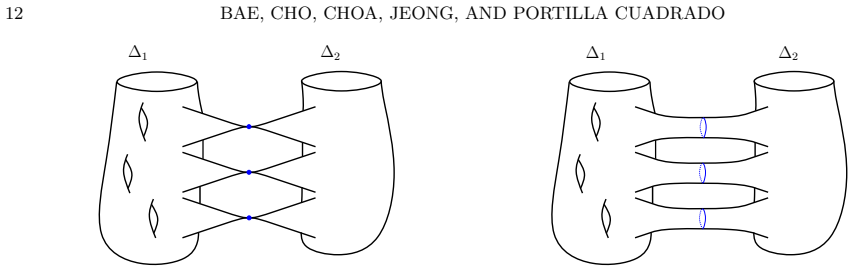
The paper's central claim is that the classical data of vanishing cycles around an isolated plane curve singularity can be lifted to relative homology in a geometrically faithful way. The geometric variation operator $\operatorname{Var}_f(a) = \varphi_f(a) * (-a)$ sends properly embedded arcs to closed curves, and the paper characterizes when such an image is a geometric vanishing cycle purely by the intersection number $i(a, \varphi_f(a)) = 0$. For the more flexible notion of an arcset, the only requirement is that the variation image be a single non-separating simple closed curve. The article then proves that, given any A'Campo divide, one can choose good paths in the associated A'Campo-Gusein-Zade diagram and attach a basic arc to each edge so that the resulting ordered collection of arcsets is adapted to A'Campo's distinguished vanishing cycles and the geometric variation images are isotopic to them. This is the content of Theorem 7.7.
Load-bearing premise
The construction assumes a combinatorial property of A'Campo-Gusein-Zade diagrams: every vertex of depth $k$ has an edge to a vertex of depth $k-1$ with the prescribed sign ($+$ to $-$ or $-$ to $+$, and $0$ to either), and the resulting good paths are disjoint or nested; this property is stated without proof and the arcset construction collapses if it fails.
Editorial extensions
If this is right
- For any A'Campo divide, the paper constructs an ordered family of disjoint arc collections, one per vertex of the A'Campo-Gusein-Zade diagram, whose geometric variation images are isotopic to A'Campo's distinguished vanishing cycles.
- A single properly embedded arc is a geometric vanishing arc exactly when $i(a, \varphi_f(a)) = 0$, for singularities outside the $A_n$ and $D_n$ families with Milnor fiber genus at least 5.
- Any disjoint arc collection whose variation image is one non-separating simple closed curve is a geometric vanishing arcset, and no further condition is needed.
- A separating simple closed curve can never be the geometric variation image of a single arc, so the geometric variation operator is not a bijection even though the classical homology variation operator is an isomorphism.
- The Seifert form is non-degenerate and triangular on the basis $\{\operatorname{Var}_f(K_1), \dots, \operatorname{Var}_f(K_\mu)\}$, matching the algebraic structure of an exceptional collection.
Reading between the lines
- If the same good-path combinatorics holds for diagrams arising from non-totally-real real plane curves, the construction would extend whenever a real Morsification exists; the paper notes that existence is still open in general.
- The characterization turns a search problem, finding an arc whose variation image is a given vanishing cycle, into an intersection-number check on one arc against its monodromy image, which is directly computable in explicit models such as Brieskorn-Pham fibers.
- The linear ordering imposed on arcsets is a topological counterpart of an exceptional collection in a triangulated category; a testable consequence is that braid group actions on distinguished vanishing cycles lift to braid actions on the corresponding arcsets.
Editorial analysis
A structured set of objections, weighed in public.
Referee Report
Summary. The paper introduces a geometric variation operator Varf that takes properly embedded arcs in the Milnor fiber of an isolated plane curve singularity to closed curves, and defines vanishing arcsets as collections of arcs whose variation image is a geometric vanishing cycle. The main results are: (1) Theorem 5.1, a characterization, under restrictions excluding An and Dn and requiring genus at least 5, of when a single arc is a geometric vanishing arc in terms of the intersection number i(a, φf(a)); (2) Theorem 5.5, an extension to arcsets claiming that the variation image is a geometric vanishing cycle exactly when the surgered collection is a single non-separating simple closed curve; (3) Theorem 7.7, which asserts that for any A'Campo divide there is a topological exceptional collection of geometric vanishing arcsets whose variation images are isotopic to A'Campo's distinguished collection of vanishing cycles. The proof of Theorem 7.7 proceeds by choosing 'good paths' in the A'Campo–Gusein-Zade diagram, associating basic arcs to edges, grouping them into arcsets, and checking adaptedness and linearity.
Significance. If the results are correct, the paper gives a new relative-homology refinement of the classical vanishing-cycle picture: arcs and arcsets provide geometric representatives for the inverse variation operator, and the construction from A'Campo divides is explicit and potentially useful for symplectic and Fukaya-categorical applications. The intersection-number characterization in Theorem 5.1 is a clean criterion, and the higher-depth construction in Sections 10–11 is a genuine extension of the adaption framework from [BCCJ23]. The paper is also honest in Remark 5.2 about the known scope of the underlying criterion [PCS21a]. However, the proof of the main theorem currently applies Theorem 5.5 outside the cases where Theorem 5.1 is proved, and the existence of good paths is assumed without proof; these are load-bearing gaps that make the principal claim conditional.
major comments (3)
- [§5, Theorem 5.5 and §7, Lemma 7.2]
- [§11, Definition 11.1 and Lemma 11.2]
- [§5, Theorem 5.1 proof]
minor comments (5)
- [§6]
- [§7, Definition 7.1]
- [§8]
- [§10, Definition 10.1]
- [§5 and §1]
Circularity Check
No significant circularity; the arcset construction is a genuinely new argument, with only minor self-citation dependencies and a non-circular correctness gap from applying Theorem 5.5 beyond its stated hypotheses.
full rationale
Central derivation is not circular. Theorem 5.1 obtains a genuine iff statement from the cited criterion [PCS21a, Theorem B] (whose restrictions the paper itself records in Remark 5.2) together with winding-number and bigon arguments; Theorem 5.5's passage from single arcs to arcsets is via the surgery identity (5.3) and the same geometric conditions, not by defining 'geometric vanishing arcset' to be the conclusion. The positive-depth construction for Theorem 7.7 is new: Proposition 11.7 verifies the adapted intersection conditions directly against the A'Campo vanishing cycles, Proposition 11.12 proves linearity from local monodromy computations (Lemma 11.8), and the final isotopy of variation images is checked by explicit surgeries. The imports from [BCCJ23] (Definition 9.1, Proposition 9.2, and the depth-zero case) and from [PCS21a] are prior stated results with their own assumptions; the present paper's conclusion is not one of those assumptions, and the main construction is then verified in this paper rather than assumed. Thus no Eq. X = Eq. Y by construction, no fitted parameter renamed as prediction, and no uniqueness theorem invoked to forbid alternatives are present. Two weaknesses are flagged but are not circularity: (a) Theorem 5.5 is stated without the A_n/D_n and genus-at-least-5 restrictions that Theorem 5.1 explicitly needs, so Lemma 7.2's unconditional use of Theorem 5.5 leaves Theorem 7.7 unproved for those divides; this is a correctness gap, not a reduction-by-definition. (b) Definition 11.1 assumes without proof the existence of good paths with adjacent opposite-sign depth-(k-1) vertices, which is a load-bearing combinatorial property of AΓ(Df) but again an omitted proof, not a circular step. The low non-zero score reflects only the non-load-bearing self-citation dependencies in the framework.
Assumptions & free parameters
assumptions (5)
- domain assumption The classical variation operator V_f is an isomorphism for isolated hypersurface singularities.
- domain assumption For f not A_n or D_n with g(Σ_f) ≥ 5, a simple closed curve is a geometric vanishing cycle iff it is non-separating and has winding number zero.
- domain assumption The geometric monodromy is isotopic to the identity on the boundary of the Milnor fiber.
- ad hoc to paper Every vertex of depth k in an A'Campo-Gusein-Zade diagram has a depth k-1 neighbor of the prescribed sign type.
- domain assumption For totally real singularities, a real Morsification and an A'Campo divide exist.
invented entities (3)
-
geometric vanishing arcset
-
topological exceptional collection of arcsets
-
linear arcset
Cite this review
Pith. "Pith review of Vanishing arcs for isolated plane curve singularities." pith.science (2026). https://pith.science/paper/7BX4PD77
@misc{pith2026250604917,
  author       = {Pith},
  title        = {Pith review of: Vanishing arcs for isolated plane curve singularities},
  year         = {2026},
  howpublished = {\url{https://pith.science/paper/7BX4PD77}},
  note         = {Machine review of arXiv:2506.04917}
}
read the original abstract
The variation operator associated with an isolated hypersurface singularity is a classical topological invariant that relates relative and absolute homologies of the Milnor fiber via a non trivial isomorphism. Here we work with a topological version of this operator that deals with proper arcs and closed curves instead of homology cycles. Building on the classical framework of geometric vanishing cycles, we introduce the concept of vanishing arcsets as their counterpart using this geometric variation operator. We characterize which properly embedded arcs are sent to geometric vanishing cycles by the geometric variation operator in terms of intersections numbers of the arcs and their images by the geometric monodromy. Furthermore, we prove that for any distinguished collection of vanishing cycles arising from an A'Campo's divide, there exists a topological exceptional collection of arcsets whose variation images match this collection.
Figures


Figures from the paper (38 more)






Reference graph
Works this paper leans on
-
[1]
Le nombre de Lefschetz d'une monodromie
Norbert A'Campo. Le nombre de Lefschetz d'une monodromie. Nederl. Akad. Wet., Proc., Ser. A , 76:113--118, 1973
work page 1973
-
[2]
Le groupe de monodromie du d \'e ploiement des singularit \'e s isol \'e es de courbes planes I
Norbert A'Campo. Le groupe de monodromie du d \'e ploiement des singularit \'e s isol \'e es de courbes planes I . Mathematische Annalen , 213:1--32, 1975
work page 1975
-
[3]
Real deformations and complex topology of plane curve singularities
Norbert A'Campo. Real deformations and complex topology of plane curve singularities. In Annales de la Facult \'e des sciences de Toulouse: Math \'e matiques , volume 8, pages 5--23, 1999
work page 1999
-
[4]
T \^e te- \`a -t \^e te twists, monodromies and representation of elements of mapping class group
Norbert A'Campo, Javier Fern \'a ndez de Bobadilla, Maria Pe Pereira, and Pablo Portilla Cuadrado. T \^e te- \`a -t \^e te twists, monodromies and representation of elements of mapping class group. Ann. Inst. Fourier , 71(6):2649--2710, 2021
work page 2021
-
[5]
V. I. Arnold, S Guse n-Zade , and Varchenko. Singularities of Differentiable Maps. Vol . II , volume 83 of Monographs in Mathematics . Birkh \"a user Boston, Inc., Boston, MA, 1988
work page 1988
-
[6]
Monodromy F ukaya category of an isolated singularity
Hanwool Bae, Cheol-Hyun Cho, Dongwook Choa, and Wonbo Jeong. Monodromy F ukaya category of an isolated singularity. in preparation
-
[7]
Floer theory for the variation operator of an isolated singularity
Hanwool Bae, Cheol-Hyun Cho, Dongwook Choa, and Wonbo Jeong. Floer theory for the variation operator of an isolated singularity. arXiv preprint arXiv:2310.17453 , 2023
-
[8]
Raoul Bott and Loring W. Tu. Differential forms in algebraic topology , volume 82 of Grad. Texts Math. Springer, Cham, 1982
work page 1982
Show all 30 references
-
[9]
Fukaya category for L andau- G inzburg orbifolds
Cheol-Hyun Cho, Dongwook Choa, and Wonbo Jeong. Fukaya category for L andau- G inzburg orbifolds. arXiv preprint arXiv:2010.09198
2010 arXiv
-
[10]
D. R. J. Chillingworth. Winding numbers on surfaces, I . Mathematische Annalen , 196(3):218--249, September 1972
1972
-
[11]
D. R. J. Chillingworth. Winding numbers on surfaces. II . Mathematische Annalen , 199(3):131--153, September 1972
1972
-
[12]
Framed mapping class groups and the monodromy of strata of abelian differentials
Aaron Calderon and Nick Salter. Framed mapping class groups and the monodromy of strata of abelian differentials. J. Eur. Math. Soc. (JEMS) , 25(12):4719--4790, 2023
2023
-
[13]
A Primer on Mapping Class Groups , volume 49 of Princeton Mathematical Series
Benson Farb and Dan Margalit. A Primer on Mapping Class Groups , volume 49 of Princeton Mathematical Series . Princeton University Press, Princeton, NJ, 2012
2012
-
[14]
A. M. Gabri\`elov. Bifurcations, D ynkin diagrams and the modality of isolated singularities. Funkcional. Anal. i Prilo zen. , 8(2):7--12, 1974
1974
-
[15]
T \^e te- \`a -t \^e te graphs and twists
Christian Graf. T \^e te- \`a -t \^e te graphs and twists. Preprint, arXiv :1408.1865 [math. GT ] (2014), 2014
2014 arXiv
-
[16]
S. M. Gusein-Zade. Dynkin diagrams for singularities of functions of two variables. Functional Analysis and Its Applications , 8(4):295--300, 1974
1974
-
[17]
S. M. Gusein-Zade. Intersection matrices for certain singularities of functions of two variables. Functional Analysis and Its Applications , 8(1):10--13, 1974
1974
-
[18]
W. J. Harvey. Boundary structure of the modular group. Riemann surfaces and related topics: Proc . 1978 Stony Brook Conf ., Ann . Math . Stud . 97, 245-251 (1981)., 1981
1981
-
[19]
John L. Harer. The virtual cohomological dimension of the mapping class group of an orientable surface. Invent. Math. , 84:157--176, 1986
1986
-
[20]
Humphries and Dennis Johnson
Stephen P. Humphries and Dennis Johnson. A Generalization of Winding Number Functions on Surfaces . Proceedings of the London Mathematical Society , s3-58(2):366--386, 1989
1989
-
[21]
The Seifert form of a plane curve singularity determines its intersection multiplicities
Rainer Kaenders. The Seifert form of a plane curve singularity determines its intersection multiplicities. Indagationes Mathematicae , 7(2):185--197, June 1996
1996
-
[22]
First variation of holomorphic forms and some applications
Bahman Khanedani and Tatsuo Suwa. First variation of holomorphic forms and some applications. Hokkaido Math. J. , 26(2):323--335, 1997
1997
-
[23]
Morsifications of real plane curve singularities
Peter Leviant and Eugenii Shustin. Morsifications of real plane curve singularities. J. Singul. , 18:307--328, 2018
2018
-
[24]
John W. Milnor. Singular points of complex hypersurfaces , volume 61 of Ann. Math. Stud. Princeton University Press, Princeton, NJ, 1968
1968
-
[25]
William H. III. Meeks and Julie Patrusky. Representing homology classes by embedded circles on a compact surface. Ill. J. Math. , 22:262--269, 1978
1978
-
[26]
Vanishing cycles, plane curve singularities and framed mapping class groups
Pablo Portilla Cuadrado and Nick Salter. Vanishing cycles, plane curve singularities and framed mapping class groups. Geom. Topol. , 25(6):3179--3228, 2021
2021
-
[27]
Mixed t \^e te- \`a -t \^e te twists as monodromies associated with holomorphic function germs
Pablo Portilla Cuadrado and Baldur Sigur sson. Mixed t \^e te- \`a -t \^e te twists as monodromies associated with holomorphic function germs. Geom. Dedicata , 210:43--64, 2021
2021
-
[28]
Reinhart
Bruce L. Reinhart. Further remarks on the winding number. Ann. Inst. Fourier (Grenoble) , 13:155--160, 1963
1963
-
[29]
E. Selling. On binary and ternary quadratic forms. J. Reine Angew. Math. , 77:143--229, 1873
-
[30]
The geometry of the monodromy theorem
L \^e D \ u ng Tr \'a ng. The geometry of the monodromy theorem. C. P . Ramanujam . - A tribute. Collect . Publ . of C . P . Ramanujam and Pap . in his Mem ., Tata Inst . fundam. Res ., Stud . Math . 8, 157-173 (1978)., 1978
1978
Reviewed August 7, 2026 · model on record in the stance chip above.
Discussion (0). Sign in to comment.