Becoming Immutable: How Ethereum is Made
Pith reviewed 2026-05-19 11:27 UTC · model grok-4.3
The pith
Non-winning Ethereum blocks reveal that 21% of user transactions are delayed by fragmented routing and that execution quality varies with block composition.
A machine-rendered reading of the paper's core claim, the machinery that carries it, and where it could break.
Core claim
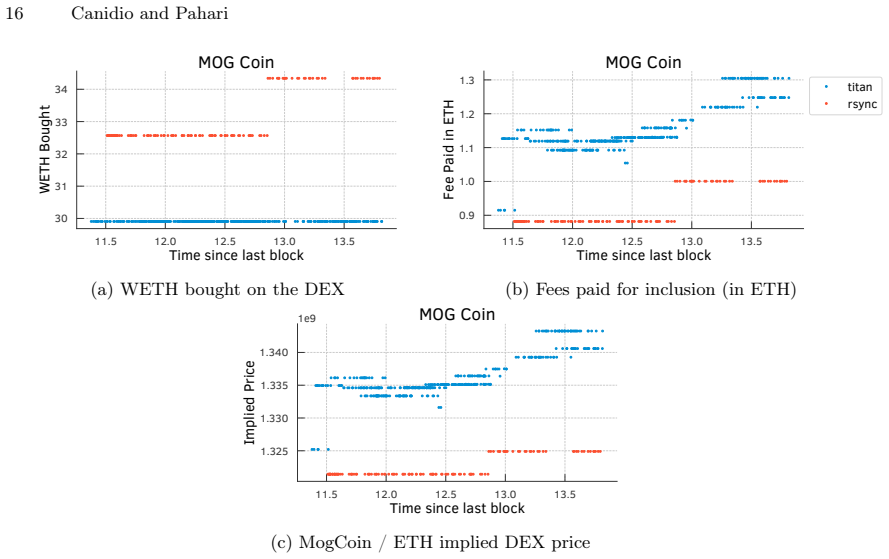
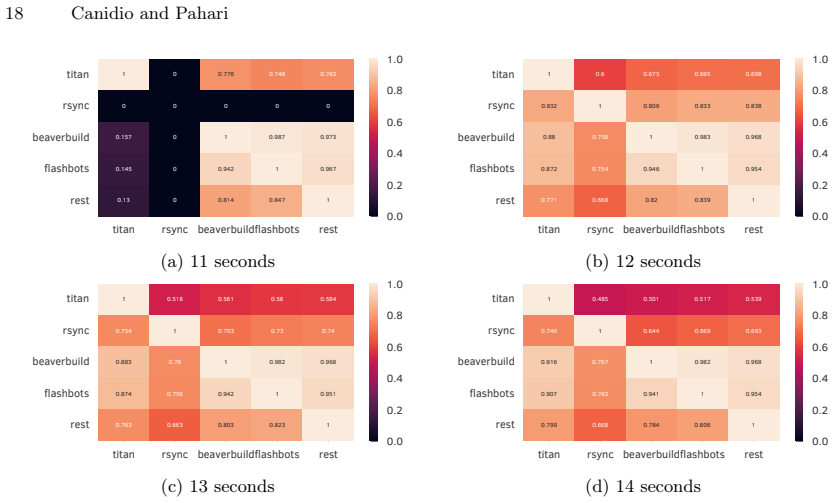
The paper constructs a novel dataset of 15,097 non-winning Ethereum blocks to study the otherwise unobservable path transactions take through intermediaries. It shows that 21% of user transactions are delayed because they reach candidate blocks but not the selected block. For identical swaps, execution probability and price vary substantially across proposed blocks. When arbitrage bots are also present, user swaps in the same direction as the bots execute less often and at worse prices, while opposite-direction swaps execute more often and at better prices.
What carries the argument
Dataset of non-winning blocks that makes visible the transactions routed through intermediaries but excluded from the final chain.
If this is right
- 21% of user transactions experience inclusion delays because they reach candidate blocks but not the winning block.
- For the same swap, execution probability and price differ across different proposed blocks.
- User swaps in the same direction as arbitrage bots are less likely to execute and receive worse prices.
- User swaps in the opposite direction to arbitrage bots are more likely to execute and receive better prices.
Where Pith is reading between the lines
- Transaction routers become a key determinant of user outcomes, suggesting users may benefit from selecting routers that minimize competition exposure.
- Block composition effects point to potential market-design improvements that reduce adverse interactions between user trades and bot activity.
- The findings extend to other blockchains with proposer-builder separation, where similar routing fragmentation could affect execution.
Load-bearing premise
The 15,097 non-winning blocks are representative of all proposed blocks and that observed differences in execution stem from routing and bot competition rather than other selection effects.
What would settle it
A larger or differently sampled set of non-winning blocks showing no 21% delay rate or no systematic execution differences once routing paths are fully accounted for.
Figures








read the original abstract
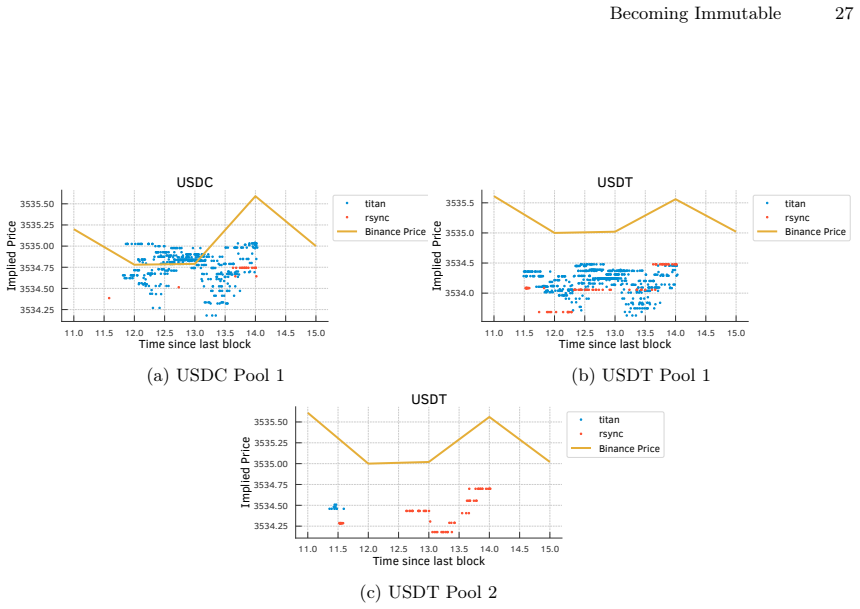
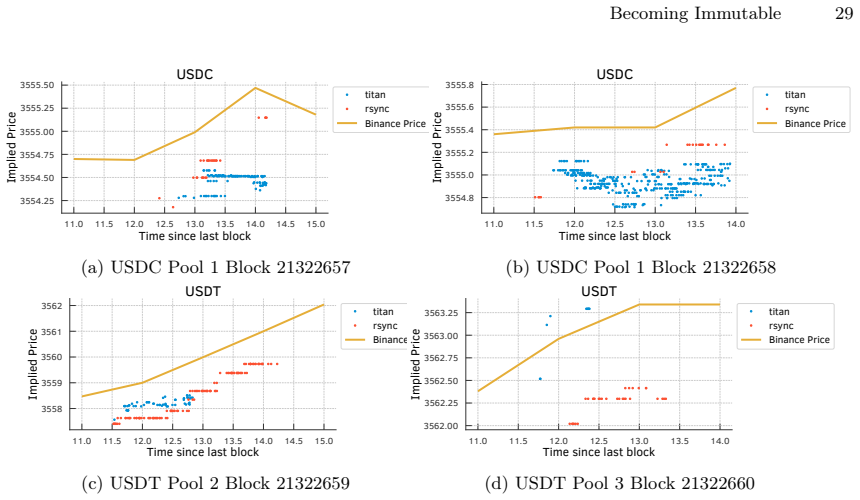
Blockchain's economic value lies in enabling financial and economic transactions without relying on trusted, centralized intermediaries. In practice, however, transactions pass through a fragmented chain of intermediaries before being included on-chain. Because standard blockchain data reveal only the winning block, this process is largely unobservable. We address this limitation by constructing a novel dataset of 15,097 non-winning Ethereum blocks, that is, blocks proposed but not selected for inclusion. We show that 21% of user transactions are delayed: they appear in candidate blocks but not in the winning block, implying that fragmented routing materially affects inclusion time. We further show that execution quality varies substantially across candidate blocks: for the same swap, both execution probability and execution price differ across proposed blocks. To study these differences, we examine competition between two arbitrage bots trading between decentralized and centralized exchanges. We find that, conditional on inclusion in a block that also contains transactions from these bots, user swaps in the same (opposite) direction are less likely (more likely) to execute and receive worse (better) prices. These results show that routing and block composition are central determinants of execution quality and market quality in on-chain markets.
Editorial analysis
A structured set of objections, weighed in public.
Referee Report
Summary. The manuscript constructs a novel dataset of 15,097 non-winning Ethereum blocks (i.e., blocks proposed but not selected for inclusion) to examine transaction routing and execution in a fragmented intermediary environment. It reports that 21% of user transactions appear in candidate blocks but not the winning block, implying material delays from routing fragmentation. It further documents substantial cross-block variation in swap execution probability and price, and shows that co-inclusion with two arbitrage bots reduces (increases) execution likelihood and worsens (improves) prices for same-direction (opposite-direction) user swaps.
Significance. If the dataset is representative and the attribution to routing and bot competition is robust, the paper offers a rare empirical window into the unobservable pre-inclusion stage of Ethereum transactions. This is valuable for understanding how intermediaries affect inclusion times and market quality in on-chain trading. The creation of a new data source on non-winning blocks is a clear strength that could enable follow-on work.
major comments (1)
- [Dataset construction and methods] The central quantitative claims (21% delay rate; substantial variation in execution quality; conditional bot effects) rest on the 15,097 non-winning blocks being representative of the full population of proposed but unselected blocks. The data-collection pipeline is not described in sufficient detail to rule out selection bias arising from monitoring only a subset of relays and builders. If unobserved proposals differ systematically in transaction mix, gas usage, or competitive intensity, the reported delay frequency and bot-conditional effects could be artifacts rather than consequences of fragmented routing. Please add a dedicated methods subsection detailing the relays, builders, and observers used, coverage statistics, and any validation (e.g., comparison of observable block characteristics to known Ethereum proposer statistics).
minor comments (2)
- [Abstract] The abstract refers to 'two arbitrage bots' without naming them or providing a brief characterization; adding this context would improve accessibility for readers outside the narrow DeFi bot literature.
- [Results on transaction delays] Table or figure presenting the 21% delay statistic should include the exact numerator/denominator and any conditioning variables used in the calculation.
Simulated Author's Rebuttal
We thank the referee for their constructive comments and recommendation for major revision. We agree that greater transparency on data collection is needed to evaluate representativeness and will revise the manuscript accordingly.
read point-by-point responses
-
Referee: The central quantitative claims (21% delay rate; substantial variation in execution quality; conditional bot effects) rest on the 15,097 non-winning blocks being representative of the full population of proposed but unselected blocks. The data-collection pipeline is not described in sufficient detail to rule out selection bias arising from monitoring only a subset of relays and builders. If unobserved proposals differ systematically in transaction mix, gas usage, or competitive intensity, the reported delay frequency and bot-conditional effects could be artifacts rather than consequences of fragmented routing. Please add a dedicated methods subsection detailing the relays, builders, and observers used, coverage statistics, and any validation (e.g., comparison of observable block characteristics to known Ethereum proposer statistics).
Authors: We agree that a dedicated methods subsection is warranted. Although the current manuscript briefly notes the use of multiple relays and builders in the Data section, we did not provide exhaustive coverage statistics or formal validation against the full population of proposed blocks. In the revision we will add a new subsection 'Data Collection Pipeline and Coverage' that specifies the exact relays (Flashbots, BloXroute, Eden, and others) and builders monitored, the observer infrastructure, the fraction of total proposed blocks captured during the sample window, and validation comparisons of observable characteristics (gas usage, transaction counts, and proposer distributions) to publicly available beacon-chain data on all proposed blocks. This will allow readers to assess potential selection bias directly. revision: yes
Circularity Check
No circularity: purely empirical dataset construction and descriptive analysis
full rationale
The paper constructs a novel dataset of 15,097 non-winning Ethereum blocks via direct observation of candidate blocks and reports empirical frequencies (21% user transaction delay) plus conditional effects on execution probability and price. These quantities are computed directly from the collected data without any fitted parameters renamed as predictions, self-definitional constructs, or load-bearing self-citations. No equations or derivations appear that reduce the reported results to the inputs by construction. The analysis is self-contained against external benchmarks of block proposal data.
Axiom & Free-Parameter Ledger
Lean theorems connected to this paper
-
IndisputableMonolith/Foundation/AbsoluteFloorClosure.leanreality_from_one_distinction unclear?
unclearRelation between the paper passage and the cited Recognition theorem.
We show that 21% of user transactions are delayed: they appear in candidate blocks but not in the winning block... execution quality varies substantially across candidate blocks
-
IndisputableMonolith/Cost/FunctionalEquation.leanwashburn_uniqueness_aczel unclear?
unclearRelation between the paper passage and the cited Recognition theorem.
We identify two arbitrage bots... implied CEX price... between 3.4 and 4.2 basis points better than Binance
What do these tags mean?
- matches
- The paper's claim is directly supported by a theorem in the formal canon.
- supports
- The theorem supports part of the paper's argument, but the paper may add assumptions or extra steps.
- extends
- The paper goes beyond the formal theorem; the theorem is a base layer rather than the whole result.
- uses
- The paper appears to rely on the theorem as machinery.
- contradicts
- The paper's claim conflicts with a theorem or certificate in the canon.
- unclear
- Pith found a possible connection, but the passage is too broad, indirect, or ambiguous to say the theorem truly supports the claim.
Reference graph
Works this paper leans on
- [1]
-
[2]
Bahrani, M., P. Garimidi, and T. Roughgarden (2024). Centralization in block building and proposer-builder separation. arXiv preprint arXiv:2401.12120
- [3]
-
[4]
Capponi, A., R. Jia, and Y. Wang (2023). Blockchain private pools and price discovery.AEA Papers and Proceedings 113, 253–56
work page 2023
-
[5]
Capponi, A., R. Jia, and S. Yu (2024). Price discovery on decentralized exchanges.Available at SSRN 4236993
work page 2024
-
[6]
Fritsch, R. and A. Canidio (2024). Measuring arbitrage losses and profitability of amm liquidity. In Companion Proceedings of the ACM Web Conference 2024 , pp. 1761–1767
work page 2024
- [7]
-
[8]
Heimbach, L., V. Pahari, and E. Schertenleib (2024). Non-atomic arbitrage in decentralized finance. arXiv preprint arXiv:2401.01622
-
[9]
Janicot, P. and A. Vinyas (2025). Private mev protection rpcs: Benchmark stud. John,K.,B.Monnot,P.Mueller,F.Saleh,andC.Schwarz-Schilling(2025). Economicsofethereum. Journal of Corporate Finance 91 , 102718
work page 2025
-
[10]
Milionis, J., C. C. Moallemi, T. Roughgarden, and A. L. Zhang (2022). Automated market making and loss-versus-rebalancing. arXiv preprint arXiv:2208.06046 . Öz, B., B. Kraner, N. Vallarano, B. S. Kruger, F. Matthes, and C. J. Tessone (2023). Time moves faster when there is nothing you anticipate: The role of time in mev rewards. InProceedings of the 2023 ...
-
[11]
Pai, M. and M. Resnick (2024). Structural advantages for integrated builders in mev-boost. In International Conference on Financial Cryptography and Data Security , pp. 128–132. Springer
work page 2024
-
[12]
Schwarz-Schilling, C., F. Saleh, T. Thiery, J. Pan, N. Shah, and B. Monnot (2023). Time is money: Strategic timing games in proof-of-stake protocols.arXiv preprint arXiv:2305.09032 . Titan and Frontier Research (2023). Builder Dominance and Searcher Dependence. https:// frontier.tech/builder-dominance-and-searcher-dependence. [Online; accessed 8-January-2...
- [13]
-
[14]
Yang, S., K. Nayak, and F. Zhang (2024). Decentralization of ethereum’s builder market.arXiv preprint arXiv:2405.01329. 26 Canidio and Pahari A Competition between Rsync-bot and Titan-bot on the same pool during the same slot 11 12 13 14 15 16 Time since last block 3527 3528 3529 3530Implied Price USDC titan rsync Binance Price (a) USDC Pool 1 11 12 13 14...
discussion (0)
Sign in with ORCID, Apple, or X to comment. Anyone can read and Pith papers without signing in.