REVIEW 5 major objections 5 minor 52 references
Distribution System State and Impedance Estimation Augmented with Carson's Equations
T0 review · 5 major / 5 minor · reviewed 2026-08-07 · deepseek-v4-flash
Pith's one-line read This paper claims that ordinary smart-meter data, combined with Carson's equations inside a nonlinear optimizer, can learn usable four-wire impedance matrices for low-voltage distribution networks without phasor measurements.
desk verdict A genuinely useful engineering step for smart-meter-based impedance estimation, but the entirely synthetic, same-model validation leaves the 'fit for power system calculations' claim only partly supported. read the letter →
The pith
A machine-rendered reading of the paper's core claim, the machinery that carries it, and where it could break.
The reading
What carries the argument
Carson's equations, reparameterizing branch series impedance as a function of physical line and cable construction variables, together with the multiconductor current-voltage (IVR) power-flow formulation. Carson's equations give each self- and mutual impedance from conductor resistance, geometric mean radius, and inter-conductor distances, so the unknowns become a small set of construction-code properties and branch lengths instead of every entry of every four-wire impedance matrix. The IVR formulation, using rectangular current and voltage coordinates with an explicit neutral, avoids spurious solutions that arise when neutral voltage is allowed to be zero in power-voltage variables. Together these two components make the estimation problem dramatically smaller and let prior knowledge about cable practice be imposed as simple bound and equality constraints.
What would settle it
Take a feeder with known true cable codes, deliberately swap the construction-code labels on a few branches before running the estimation, and compare power-flow validation errors against the correct-label run; if the mislabeled run still validates well, the assumption is not load-bearing, and if it degrades sharply, the central claim's reliance on exact code assignment is exposed.
Extended reading notes
Core claim
The central claim is that joint distribution system state and impedance estimation can be solved in a four-wire setting by writing branch impedance matrices as functions of construction-code variables through Carson's equations and estimating those variables together with the electrical state. Using only 15-minute averages of active power, reactive power, and phase-to-neutral voltage magnitude, the method yields impedance models whose power-flow validation errors are small, and it reduces computational time by one to two orders of magnitude compared with the authors' earlier direct-estimation approach. The paper also claims that the construction-code parameterization makes domain knowledge easy to impose, through cross-section and geometry constraints, which lowers solve times and reduces overfitting without changing the power-flow results. The existence of multiple equivalent solutions is treated as intrinsic to the problem and as an argument for reporting construction-property estimates rather than unique branch impedances.
Load-bearing premise
The estimator must be told the number of distinct cable and line construction codes and exactly which code each branch uses; if that assignment is wrong, every learned impedance is biased, and the paper offers no sensitivity analysis for misassigned codes.
Editorial extensions
If this is right
- Utilities can re-estimate feeder impedances on data they already have: smart-meter active power, reactive power, and voltage magnitude, without installing phasor measurement units.
- Four-wire networks with sparsely grounded neutrals can be represented without Kron reduction, so neutral-grounding assumptions no longer distort power-flow results.
- The one-to-two-orders-of-magnitude speedup over the previous method moves impedance learning from an offline study task toward a practical, repeatable workflow.
- Because the estimated variables are physical cable properties rather than bare matrix entries, the resulting models can be re-evaluated at other frequencies, for example for harmonic studies.
- The formulation generalizes to three-phase three-wire and single-phase two-wire segments by dropping the corresponding conductors, so one model covers mixed-conductor feeders.
Reading between the lines
- If construction-code assignment is itself uncertain, a natural extension the paper leaves open is to estimate the assignment as categorical variables; the paper's variable counts suggest the optimizer could still handle it, but the paper does not solve that problem.
- The paper's acceptance of multiple equivalent solutions implies that individual branch lengths recovered by the method are not physically meaningful; utilities wanting accurate per-branch lengths would need additional data such as high-resolution voltage events or probing.
- A testable prediction of the parameterization is that estimation accuracy should improve automatically as electrification raises feeder loading, because higher voltage drops raise the measurement signal-to-noise ratio; this follows from the paper's load-multiplication experiment but is not framed there as a forecast.
- The same construction-code reduction could be applied to admittance or shunt-parameter estimation in networks where neutral-ground admittances are non-negligible, which the paper explicitly leaves to future work.
Editorial analysis
A structured set of objections, weighed in public.
Referee Report
Summary. The paper proposes a joint distribution system state and impedance estimation method for unbalanced four-wire low-voltage networks. Instead of estimating impedance matrix entries directly, the method optimizes construction-code parameters (branch lengths, conductor cross-sections, and geometry) and maps them to 4x4 series impedance matrices using Carson's equations (13)-(20). The estimation uses smart-meter-type active power, reactive power, and phase-to-neutral voltage magnitude measurements in an IVR power-flow formulation with a weighted least-absolute-value objective. Experiments on two synthetic ENWL-derived feeders with Australian cable construction codes report cumulative impedance errors around 10% in the 30L case and smaller in the EU case, voltage validation errors below 0.5 V, and one-to-two order-of-magnitude speedups over the authors' previous direct impedance estimation. The code and data are openly available.
Significance. If the practical claim is accepted, the contribution is significant: it extends impedance estimation to 4x4 phase-space matrices, reduces the variable count through construction codes, and makes code and data openly available. The held-out validation and explicit acknowledgment of non-uniqueness are strengths. However, the evidence is entirely synthetic and generated with the same Carson model family used by the estimator, so "fit for power system calculations" is not yet established for real networks.
major comments (5)
- [§3 (Fig. 6), §2.2 (Eqs. 13-20)] The synthetic ground truth is generated by applying Carson's equations (13)-(20) to the same construction-code variables (cross-sections, geometry, material, temperature) that the estimator treats as unknowns. This is not a full inverse crime because the true parameter values are not revealed to the estimator, but it means that no model mismatch is tested. Real LV cables and overhead lines differ from the simplified Carson model (stranding, screens/armour, installation geometry, temperature drift, non-zero shunt admittance), and under such mismatch the optimizer could compensate by biasing other variables. Please add at least one mismatch experiment (e.g., ground truth from a different impedance model or structured perturbations in geometry and resistance) or field-data validation, and report whether cumulative impedance and power-flow accuracy survive.
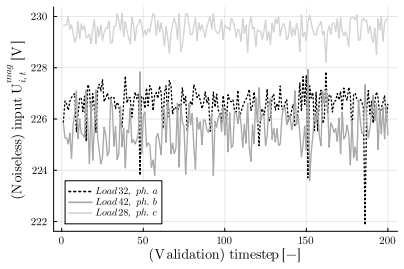
- [§3, §4.2] The training set is the 200 most loaded time steps and the validation set is the subsequent 400 most loaded time steps, so both phases of the evaluation are concentrated in high-SNR periods. The paper acknowledges that time-step selection greatly affects estimation quality, and Fig. 8 shows that tripling loads markedly improves the estimates. A single Gaussian noise realization (Section 3) is used without error bars. Please repeat the experiments over multiple noise seeds and include random or lower-loaded validation periods; otherwise the quantitative accuracy claims are conditional on unusually favorable data.
- [§4.2, §4.3] Validation is limited to cumulative path impedances and voltage magnitudes. Section 4.2 states that individual branch impedances are "inaccurate/meaningless", and branch flows and losses are never compared. The abstract's "fit for power system calculations" is broader than what is validated, because OPF, protection, and loss studies depend on branch-level quantities. Please either validate branch flows and losses (showing that the equivalent solutions preserve them) or narrow the claim to voltage-magnitude and cumulative-impedance accuracy.
- [§2.5, Assumption 3] The estimator requires exact knowledge of the number of construction codes and their assignment to every branch. The paper states that utilities have reliable data, but no sensitivity analysis is provided for a wrong linecode assignment; an incorrect assignment would bias every impedance estimate. Since mislabeled branches are a plausible real-world failure mode, please add a robustness test with one or more misassigned codes, or with unknown codes treated as separate variables.
- [§4.3, abstract] The abstract claims "significantly improving on our previous work both in terms of accuracy and computational time." Computational time is compared to the 13603 s figure from [7] in Section 4.1, but the accuracy comparison with [7] is only a qualitative sentence ("The IE accuracy with Carson is overall superior to our previous work [7]") with no quantitative side-by-side results on the same feeder, data, and metrics. Please add a direct comparison table or figure for the [7] method on the same cases, or soften the accuracy-improvement claim.
minor comments (5)
- [§2.2, Eq. (19)] The stranded-conductor GMR formula has a typo: the exponent 1/S appears inside the product and the index j in the inner product is undefined; the root should be applied to the entire product. Please fix the notation.
- [§2.2] "International system version" should be "SI version"; the constants c1 and c2 are stated without derivation, so a brief explanation or reference for the unit conversion would improve reproducibility.
- [§2.1, Table 2] The "worst case with Carson" row assumes no prior linecode assignment, but Section 2.5 lists the linecode assignment as known; clarify whether this row is a hypothetical bound and not a tested scenario.
- [§4.4] The subsection title "Construction code estimation accuracy" is somewhat misleading because Figs. 12-14 show that geometry estimates often have large errors; a title like "Construction code impedance estimation" would better reflect the content.
- [§4.1] Computational times are reported for a single solve per case; adding a second solve or reporting solver iterations would help assess variance.
Circularity Check
Mild circularity: validation uses the same Carson model family as the estimator, and the training-time-step heuristic is self-cited; the core estimation is still independent.
-
other
[Section 3 (Data and Case Studies Set-up), Fig. 6; Section 2.2 Eqs. (13)-(20)]
"Here, we use the 50 Hz, International system version of Carson (Australian and European case), derived by Cleenwerck et al. [34]: ... Synthetic measurement data is created by adding Gaussian noise to power flow inputs (P, Q) and outputs (U mag,pn). The maximum errors (i.e., 3 σ) for U mag,pn, P and Q are, respectively, 0.5%, 1%, and 2%. ... The overall IE process: generation of synthetic measurements, IE model building, solving, and result validation, is illustrated in Fig. 6."
The ground-truth impedances used to synthesize the measurements are computed from the same Carson parameterization, Eqs. (13)-(20), that the estimator uses as its forward model. Both the data-generation 'ground-truth' and the estimated impedances are therefore restricted to exactly the same model family by construction. The validation can only show self-consistency inside the Carson model; it cannot detect errors in Carson's assumptions themselves. Thus the abstract's claim that the models are 'fit for power system calculations' is supported only under the model already assumed, not by an independent external benchmark.
-
self citation load bearing
[Section 3 (Data and Case Studies Set-up), time-step selection paragraph]
"In [7], choosing the 200 time steps with higher total power flows ensured IE with acceptable quality, as power flows are a proxy for voltage drops. Developing improved time step selection for IE would be greatly beneficial, however, for the purpose of this work, we rely on our previous results [7] and pick the 200 most loaded time steps as training data."
The heuristic that selects which smart-meter time steps enter the training set is taken directly from the authors' previous paper [7] rather than derived or independently benchmarked. Since the training-set composition strongly affects the estimation quality, the reported performance inherits this self-cited choice. This is a minor, non-fatal dependency: the impedance estimates themselves are still fit to noisy measurements and checked on held-out validation time steps, so the central result is not forced by the citation.
full rationale
The estimation problem is not circular in the strongest sense: measurements are generated by running power flow with true impedances, and the optimizer fits construction-code variables to noisy P/Q/U data, with results checked against held-out time steps. No fitted parameter is renamed as a prediction, and no equation identity forces the learned impedances to equal the ground truth. The main circularity-adjacent issue is validation: the 'ground-truth' network impedances are produced by the same Carson equations, Eqs. (13)-(20), that the estimator assumes, so the numerical tests measure self-consistency within the Carson model family rather than external correctness. In addition, the training-time-step rule is imported from the authors' prior work [7]. These are genuine limitations, but the central optimization derivation is nontrivial, reproducible from the open repository, and does not reduce to its inputs by construction.
Assumptions & free parameters
free parameters (4)
- Branch length ell_l per branch =
Not reported; estimated for each branch, bounded by 0.7 to 1.3 times true length
- Phase conductor cross-section A_p,k per construction code =
Reported in Figs. 12-14
- Neutral conductor cross-section A_n,k per construction code =
Reported in Figs. 12-14
- Conductor geometry (coordinates x_p, y_p or distances D_pq,k) =
Reported in Figs. 12-14 as distances
assumptions (9)
- domain assumption Carson's equations (13)-(16) accurately describe the series impedance of LV cables and overhead lines.
- domain assumption Network topology and phase connectivity are known inputs.
- domain assumption The number of unique construction codes and their assignment to branches is known.
- domain assumption Conductor material (resistivity and temperature coefficient) is known or selected by combinatorial check.
- domain assumption Shunt admittances are zero except at the transformer bus, i.e., neutral-ground connections are neglected.
- domain assumption Temperature is constant at 65 degrees Celsius, with resistance error below 0.5 percent.
- domain assumption Skin and proximity effects are negligible in LV cables.
- domain assumption Measurement noise on synthetic data is Gaussian with max errors 0.5 percent for voltage, 1 percent for P, and 2 percent for Q.
- ad hoc to paper The 200 most loaded training time steps and the subsequent 400 most loaded validation steps provide enough signal-to-noise to learn impedances.
Cite this review
Pith. "Pith review of Distribution System State and Impedance Estimation Augmented with Carson's Equations." pith.science (2026). https://pith.science/paper/P6JORHBP
@misc{pith2026250604949,
  author       = {Pith},
  title        = {Pith review of: Distribution System State and Impedance Estimation Augmented with Carson's Equations},
  year         = {2026},
  howpublished = {\url{https://pith.science/paper/P6JORHBP}},
  note         = {Machine review of arXiv:2506.04949}
}
read the original abstract
The impedances of cables and lines used in (multi-conductor) distribution networks are usually unknown or approximated, and may lead to problematic results for any physics-based power system calculation, e.g., (optimal) power flow. Learning parameters from time series data is one of the few available options to obtain improved impedance models. This paper presents an approach that combines statistical learning concepts with the exploitation of domain knowledge, in the form of Carson's equations, through nonlinear mathematical optimization. The proposed approach derives impedance matrices for up-to-four-wire systems, using measurement data like those obtained from smart meters. Despite the lack of phasor measurements, the low signal-to-noise ratio of smart meter measurements, and the inherent existence of multiple equivalent solutions, our method produces good quality impedance models that are fit for power system calculations, significantly improving on our previous work both in terms of accuracy and computational time.
Figures


Figures from the paper (11 more)




Reference graph
Works this paper leans on
-
[7]
Combined unbalanced distribution system state and line impedance matrix estimation,
M. Vanin, F. Geth, R. D’hulst, and D. Van Hertem, “Combined unbalanced distribution system state and line impedance matrix estimation,” Int. J. Electr. Power Energy Syst., vol. 151, p. 109155, 2023
work page 2023
-
[1]
Wave propagation in overhead wires with ground return,
J. R. Carson, “Wave propagation in overhead wires with ground return,” The Bell System Technical Journal, vol. 5, no. 4, pp. 539–554, 1926
work page 1926
-
[2]
Distribution system modeling and analysis
W. H. Kersting, “Distribution system modeling and analysis.” CRC press, 2018
work page 2018
-
[3]
Data quality challenges in existing distribution network datasets,
F. Geth, M. Vanin, and D. Van Hertem, “Data quality challenges in existing distribution network datasets,” in CIRED 2023, Rome, Italy
work page 2023
-
[4]
Fundamental research challenges for distribution state estimation to enable high-performing grids,
“Fundamental research challenges for distribution state estimation to enable high-performing grids,” NY- SERDA, Technical Report, 2018
work page 2018
-
[5]
Misestimation of impedance values within a distribution network optimal power flow,
G. Ch´ erot, et al., “Misestimation of impedance values within a distribution network optimal power flow,” in IEEE PowerTech, 2023, pp. 1–6
work page 2023
-
[6]
Inverter probing for power distribution network topology processing,
G. Cavraro and V. Kekatos, “Inverter probing for power distribution network topology processing,” IEEE Control Netw. Syst., vol. 6, no. 3, pp. 980–992, 2019
work page 2019
-
[8]
Distribution network admittance matrix estimation with linear regression,
J. Zhang, et al., “Distribution network admittance matrix estimation with linear regression,” IEEE Trans. Power Syst., vol. 36, no. 5, pp. 4896–4899, 2021
work page 2021
Show all 52 references
-
[9]
Topology identification and line parameter estimation for non- pmu distribution network: A numerical method,
J. Zhang, Y. Wang, Y. Weng, and N. Zhang, “Topology identification and line parameter estimation for non- pmu distribution network: A numerical method,” IEEE Trans. Smart Grid, vol. 11, no. 5, pp. 4440–4453, 2020
2020
-
[10]
Distribution grid modeling using smart meter data,
Y. Guo, et al., “Distribution grid modeling using smart meter data,” IEEE Trans. Power Syst., vol. 37, no. 3, pp. 1995–2004, 2022
1995
-
[11]
Reconstruction of low-voltage networks with limited observability,
D. Marulli, et al., “Reconstruction of low-voltage networks with limited observability,” in IEEE PES ISGT Europe, 2021, pp. 1–5
2021
-
[12]
Maximum likelihood estimation of state variables and line parameters in distribution grid with a non-linear model,
S. Kapoor, et al., “Maximum likelihood estimation of state variables and line parameters in distribution grid with a non-linear model,” Authorea Preprints, 2024. 19
2024
-
[13]
Circuit-theoretic joint parameter-state estimation—balancing optimality and ac feasibility,
P. Sang and A. Pandey, “Circuit-theoretic joint parameter-state estimation—balancing optimality and ac feasibility,” Electr. Power Syst. Res., vol. 235, p. 110637, 2024
2024
-
[14]
Distribution line parameters estimation framework with correlated injections using smart meter measurements,
S. Mittal, P. Pareek, and A. Verma, “Distribution line parameters estimation framework with correlated injections using smart meter measurements,” Electr. Power Syst. Res., vol. 228, p. 110083, 2024
2024
-
[15]
Reverse identification method of line parameters in distribution network with multi-t nodes based on partial measurement data,
X. Li, S. Wang, and Z. Lu, “Reverse identification method of line parameters in distribution network with multi-t nodes based on partial measurement data,” Electr. Power Syst. Res., vol. 204, p. 107691, 2022
2022
-
[16]
Compound admittance matrix estimation of three-phase untransposed power distribution grids using synchrophasor measurements,
R. Gupta, et al., “Compound admittance matrix estimation of three-phase untransposed power distribution grids using synchrophasor measurements,” IEEE Trans. Instrum. Meas., vol. 70, pp. 1–13, 2021
2021
-
[17]
Unsupervised impedance and topology estimation of distribution networks—limitations and tools,
K. Moffat, M. Bariya, and A. Von Meier, “Unsupervised impedance and topology estimation of distribution networks—limitations and tools,” IEEE Trans. Smart Grid, vol. 11, no. 1, pp. 846–856, 2020
2020
-
[18]
Line parameter estimation in multi-phase distribution networks without voltage angle mea- surements,
S. Claeys, et al., “Line parameter estimation in multi-phase distribution networks without voltage angle mea- surements,” in CIRED 2021, pp. 1186–1190
2021
-
[19]
Parameter estimation of distribution lines using scada measurements,
R. Dutta, et al., “Parameter estimation of distribution lines using scada measurements,” IEEE Trans. Instrum. Meas., vol. 70, pp. 1–11, 2021
2021
-
[20]
Parameter estimation in three-phase power distribution networks using smart meter data,
W. Wang and N. Yu, “Parameter estimation in three-phase power distribution networks using smart meter data,” in Int. Conf. Probabilistic Methods Appl. Power Syst., 2020, pp. 1–6
2020
-
[21]
AMI data-driven strategy for hierarchical estimation of distribution line impedances,
J. Ban, et al., “AMI data-driven strategy for hierarchical estimation of distribution line impedances,” IEEE Trans. Power Del., pp. 1–13, 2022
2022
-
[22]
Distribution system model calibration with big data from AMI and PV inverters,
J. Peppanen, et al., “Distribution system model calibration with big data from AMI and PV inverters,” IEEE Trans. Smart Grid, vol. 7, no. 5, pp. 2497–2506, 2016
2016
-
[23]
Three-phase feeder parameter estimation using radial basis function neural networks and multi-run optimisation method with bad data preparation,
N.-C. Yang, et al., “Three-phase feeder parameter estimation using radial basis function neural networks and multi-run optimisation method with bad data preparation,” IET GTD, vol. 16, no. 2, pp. 351–363, 2022
2022
-
[24]
Identification and correction of transmission line parameter errors using scada and syn- chrophasor measurements,
L. Costa, et al., “Identification and correction of transmission line parameter errors using scada and syn- chrophasor measurements,” Int. J. Electr. Power Energy Syst., vol. 135, p. 107509, 2022
2022
-
[25]
Advanced metering for phase identification, transformer identification, and secondary modeling,
T. A. Short, “Advanced metering for phase identification, transformer identification, and secondary modeling,” IEEE Trans. Smart Grid, vol. 4, no. 2, pp. 651–658, 2013
2013
-
[26]
Distribution system parameter and topology estimation applied to resolve low-voltage circuits on three real distribution feeders,
M. Lave, et al., “Distribution system parameter and topology estimation applied to resolve low-voltage circuits on three real distribution feeders,” IEEE Trans. Sustain. Energy, vol. 10, no. 3, pp. 1585–1592, 2019
2019
-
[27]
A new framework for detection and identification of network parameter errors,
Y. Lin and A. Abur, “A new framework for detection and identification of network parameter errors,” IEEE Trans. Smart Grid, vol. 9, no. 3, pp. 1698–1706, 2018
2018
-
[28]
Abur and A
A. Abur and A. G´ omez-Exp´ osito,Power System State Estimation: Theory and Implementation, Book, CRC Press, 2004
2004
-
[29]
Decoupled state and line parameter estimation in three-phase unbalanced distribution system,
M. T. Alam and B. Das, “Decoupled state and line parameter estimation in three-phase unbalanced distribution system,” Electr. Power Syst. Res., vol. 229, p. 110127, 2024
2024
-
[30]
Inverse power flow problem,
Y. Yuan, S. H. Low, O. Ardakanian, and C. J. Tomlin, “Inverse power flow problem,” IEEE Trans. Control Network Syst., pp. 1–12, 2022. 20
2022
-
[31]
Learning graph parameters from linear measurements: Fundamental trade- offs and application to electric grids,
T. Li, L. Werner, and S. H. Low, “Learning graph parameters from linear measurements: Fundamental trade- offs and application to electric grids,” in IEEE 58th Conf. Decision Control, 2019, pp. 6554–6559
2019
-
[32]
Power grid parameter estimation without phase measurements: Theory and empirical validation,
J.-S. Brouillon, K. Moffat, F. D¨ orfler, and G. Ferrari-trecate, “Power grid parameter estimation without phase measurements: Theory and empirical validation,” Power Systems Comp. Conf., 2024
2024
-
[33]
Automated determination of topology and line parameters in low voltage systems using smart meters measurements,
V. Cunha, et al., “Automated determination of topology and line parameters in low voltage systems using smart meters measurements,” IEEE Trans. Smart Grid, vol. 11, no. 6, pp. 5028–5038, 2020
2020
-
[34]
An approach to the impedance modelling of low-voltage cables in digital twins,
R. Cleenwerck, et al., “An approach to the impedance modelling of low-voltage cables in digital twins,” Electric Power Syst. Res., vol. 210, p. 108075, 2022
2022
-
[35]
The application of carson’s equation to the steady-state analysis of distri- bution feeders,
W. H. Kersting and R. K. Green, “The application of carson’s equation to the steady-state analysis of distri- bution feeders,” in IEEE/PES Power Syst. Conf. Expo., 2011, pp. 1–6
2011
-
[36]
The inverse carson’s equations problem: Definition, implementation and experiments,
C. H. Tam, et al., “The inverse carson’s equations problem: Definition, implementation and experiments,” preprint: arXiv:2404.08210, 2024
2024 arXiv
-
[37]
Optimal power flow in four-wire distribution networks: Formulation and benchmarking,
S. Claeys, F. Geth, and G. Deconinck, “Optimal power flow in four-wire distribution networks: Formulation and benchmarking,” Electr. Power Syst. Res., vol. 213, p. 108522, 2022
2022
-
[38]
Earthing systems worldwide and evolutions,
B. Lacroix and C. R., “Earthing systems worldwide and evolutions,” no. 173, 1995. [Online]. Available: https://www.studiecd.dk/cahiers techniques/System earthings worldwide and evolutions.pdf
1995
-
[39]
Admittance matrix estimation of radial distribution grids using power and voltage magnitude measurements,
M. Rayati, M. Bozorg, and O. Alizadeh-Mousavi, “Admittance matrix estimation of radial distribution grids using power and voltage magnitude measurements,” accepted for Power Syst. Comp. Conf.,, 2024
2024
-
[40]
Series impedance of distribution cables with sector-shaped conductors,
A. J. Urquhart and M. Thomson, “Series impedance of distribution cables with sector-shaped conductors,” IET Gener. Transm. Distr., vol. 9, no. 16, pp. 2679–2685, 2015
2015
-
[41]
Estimating grounding resistance of medium voltage cables using mea- sured sheaths current,
A. Ghaderi Baayeh and M. Kleemann, “Estimating grounding resistance of medium voltage cables using mea- sured sheaths current,” in Int. Conf. Smart Grid Metrology, 2023, pp. 1–5
2023
-
[42]
Reverse kron reduction of multi-phase radial network,
S. H. Low, “Reverse kron reduction of multi-phase radial network,” preprint: arXiv:2403.17391, 2024
2024 arXiv
-
[43]
Pitfalls of zero voltage values in optimal power flow problems,
F. Geth, “Pitfalls of zero voltage values in optimal power flow problems,” IEEE PES General Meeting, 2023
2023
-
[44]
Learning distribution grid topologies: A tutorial,
D. Deka, et al., “Learning distribution grid topologies: A tutorial,” IEEE Trans. Smart Grid, vol. 15, no. 1, pp. 999–1013, 2024
2024
-
[45]
Phase identification of distribution system users through a MILP extension of state estimation,
M. Vanin, T. Van Acker, R. D’hulst, and D. Van Hertem, “Phase identification of distribution system users through a MILP extension of state estimation,” Elect. Power Syst. Res., vol. 229, p. 110107, 2024
2024
-
[46]
A framework for constrained static state estimation in unbalanced distribution networks,
M. Vanin, T. Van Acker, R. D’hulst, and D. Van Hertem, “A framework for constrained static state estimation in unbalanced distribution networks,” IEEE Trans. Power Syst., vol. 37, no. 3, pp. 2075–2085, 2022
2022
-
[47]
Representative residential lv feeders: A case study for the north west of england,
V. Rigoni, et al., “Representative residential lv feeders: A case study for the north west of england,” IEEE Trans. Power Syst., vol. 31, no. 1, pp. 348–360, 2016
2016
-
[48]
End-use load profiles for the u.s. building stock,
E. Wilson, et al., “End-use load profiles for the u.s. building stock,” 10 2021. [Online]. Available: https://data.openei.org/submissions/4520 21
2021
-
[49]
JuMP: A modeling language for mathematical optimization,
I. Dunning, et al., “JuMP: A modeling language for mathematical optimization,” SIAM Rev., vol. 59, no. 2, pp. 295–320, 2017
2017
-
[50]
PowerModelsDistribution.jl: An open-source framework for exploring distribution power flow formulations,
D. M. Fobes, S. Claeys, F. Geth, and C. Coffrin, “PowerModelsDistribution.jl: An open-source framework for exploring distribution power flow formulations,” Electr. Power Syst. Res., vol. 189, p. 106664, 2020
2020
-
[51]
On the implementation of an interior-point filter line-search algorithm for large- scale nonlinear programming,
A. W¨ achter and L. Biegler, “On the implementation of an interior-point filter line-search algorithm for large- scale nonlinear programming,” Math. Program., vol. 106, no. 1, pp. 25–57, 2006
2006
-
[52]
HSL. A collection of fortran codes for large scale scientific computation,
“HSL. A collection of fortran codes for large scale scientific computation,” Accessed: Apr. 2024. [Online]. Available: http://www.hsl.rl.ac.uk/. 22
2024
Reviewed August 7, 2026 · model on record in the stance chip above.
Discussion (0). Continue with ORCID to comment.