REVIEW 3 major objections 5 minor 68 references
Hausdorff Dimension of non-conical and Myrberg limit sets
T0 review · 3 major / 5 minor · reviewed 2026-08-07 · deepseek-v4-flash
Pith's one-line read This paper proves that non-conical, uniformly conical, and Myrberg limit sets have the same Hausdorff dimension in proper non-elementary hyperbolic actions, and that the non-conical set of a geometrically infinite Kleinian group has full…
desk verdict Strong paper with a real but repairable gap in the Myrberg dimension proof; deserves refereeing. read the letter →
The pith
A machine-rendered reading of the paper's core claim, the machinery that carries it, and where it could break.
The reading
What carries the argument
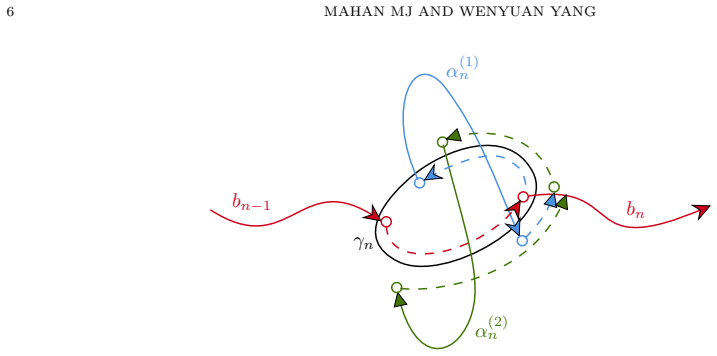
The central tool is a quasi-radial tree: an injectively embedded rooted metric tree whose root-to-vertex paths are uniform quasi-geodesics in the ambient space. It is built from annular sets $A_n$ of group elements with $|A_n| \geq e^{L_n\omega_n}$, repeated $K_n$ times to make loops, with bridges $b_n$ connecting successive levels. Two balance conditions force the tree boundary to have Hausdorff dimension at least $\omega/\epsilon$: the length of each bridge must be small relative to the total loop length, and the next level's length must be small relative to the accumulated length. The tree boundary embeds into the Gromov boundary, and each boundary ray projects to an escaping or Myrberg geodesic depending on how the bridges are chosen. Counting shortest arcs between closed geodesics provides the annular sets in manifolds and graphs, and geometric limits provide them in the Kleinian case.
What would settle it
Compute the Hausdorff dimension of the Myrberg limit set for a free group on two generators acting on its Cayley tree, listing all loxodromic elements as bridges in increasing translation length and choosing $L_n$ so large that the annular sets satisfy $|A(L_n,\Delta,o)| \geq e^{L_n \omega}$. If the ratio $B_n/L_n$ can be made to diverge while the equality in Theorem 1.10 still holds, the bridge-compensation conditions are unnecessary; if the dimension drops, they are essential.
Extended reading notes
Core claim
For a proper non-elementary action of a group on a Gromov hyperbolic space, the paper claims the equality of Hausdorff dimensions $\mathrm{Hdim}(\Lambda_c G) = \mathrm{Hdim}(\Lambda_u G) = \mathrm{Hdim}(\Lambda_m G) = \omega_G/\epsilon$, where $\omega_G$ is the critical exponent and $\epsilon$ is the visual-metric parameter. It also claims that for a finitely generated geometrically infinite Kleinian group the non-conical limit set has $\mathrm{Hdim}(\Lambda_{nc} G) = 2$, the full dimension of the sphere at infinity. The mechanism is to embed a rooted tree quasi-radially into the space so that every boundary ray lands in the desired set, while the tree has enough branching to make its boundary dimension equal to $\omega_G/\epsilon$. Counting results for shortest arcs between closed geodesics supply the branching, and in the Kleinian case geometric limits of the ends of the manifold, obtained from model manifold technology, provide the needed families of arcs. The same construction, with loxodromic elements as bridges, gives the Myrberg dimension theorem.
Load-bearing premise
The proof assumes that at every stage the bridges connecting the loop families are short enough compared with the total loop length, as quantified by the two balance conditions in Lemmas 3.7 and 3.8; if bridges are too long relative to the loops, the lower-bound estimate on the boundary dimension collapses.
Editorial extensions
If this is right
- For any proper non-elementary action on a hyperbolic space, Myrberg points are as numerous in Hausdorff dimension as uniformly conical points, so transitive geodesics carry full fractal weight.
- For a finitely generated geometrically infinite Kleinian group, the escaping geodesic rays have Hausdorff dimension 2 and Lebesgue measure zero, yielding a trichotomy with finite-volume and Ahlfors-regular cases.
- Amenable quotients in dimension 1 and 2 force the non-conical limit set to have maximal dimension: $\log(d-1)$ for $d$-regular trees and 1 for hyperbolic surfaces.
- In Floyd boundaries of finitely generated groups with nontrivial Floyd boundary, the Myrberg limit set has dimension $\omega_G/(-\log \lambda)$, the full dimension of the boundary.
- For infinite-index normal subgroups with the same critical exponent as the ambient group, the non-conical limit set has maximal dimension in the ambient boundary.
Reading between the lines
- The same quasi-radial tree construction may yield dimension lower bounds in CAT(0) or Teichmüller settings where a visual metric is missing, using contracting elements and convergence boundaries; the paper takes a step in that direction, but a full dimension statement would need a metric analogue of the shadow estimates.
- A natural test is whether the Myrberg equality still holds when bridge lengths are not compensated; if it does, the mechanism is more flexible than the two balance conditions suggest, and if it fails, those conditions are essential.
- For groups with contracting elements but trivial Floyd boundary, the growth rate of the quasi-radial tree may serve as a proxy for the dimension of Myrberg points in other boundaries, such as horofunction boundaries.
Editorial analysis
A structured set of objections, weighed in public.
Referee Report
Summary. This paper develops quasi-radial tree techniques to estimate the Hausdorff dimension of non-conical and Myrberg limit sets for proper actions on Gromov hyperbolic spaces and related metric boundaries. The main abstract results assert that under various geometric hypotheses the non-conical limit set has maximal Hausdorff dimension, with the strongest theorem being the equality Hdim(Λ_ncG)=2 for finitely generated geometrically infinite Kleinian groups, and that the Myrberg limit set satisfies Hdim(Λ_mG)=ω_G/ε in the Gromov hyperbolic setting, confirming a conjecture of Falk and Matsuzaki.
Significance. If the results are correct, Theorem 1.10 resolves the Falk–Matsuzaki conjecture for Myrberg limit sets in Gromov hyperbolic boundaries, and Theorem 1.5 completes a line of work by Bishop–Jones and Kapovich–Liu on non-conical limit sets. The paper's Lemmas 3.7 and 3.8 provide a clean, parameter-explicit tree-boundary criterion, and the counting lemmas for shortest arcs in Section 4 are likely to be useful beyond this paper. However, several load-bearing hypotheses in the proofs are not verified as written, so the central claims are not yet fully supported.
major comments (3)
- [Section 7, just before Lemma 7.5] The proof asserts that the chosen parameters with K_n=1 satisfy assumptions (1) and (4) of Lemmas 3.7 and 3.8. The displayed condition in Section 7 is exactly condition (4) of Lemma 3.8, but Lemma 3.7(1) requires Δ_n/L_n+B_n/(K_nL_n)→0, which for K_n=1 includes B_n/L_n→0. Condition (4) does not imply this: with Δ fixed, B_n=n^{10} and L_n=n, one has L_{m+1}/∑_{n≤m}(L_n+Δ+B_n)→0 while B_n/L_n→∞. Since inequality (2) in Lemma 3.7 is used to prove both the growth estimate and the dimension bound in Lemma 3.8, the lower bound Hdim(Λ_mG)≥ω_G/ε is not established unless the enumeration of B and the choice of L_n are arranged so that B_n/L_n→0, or repetitions K_n are used. This is the central gap in Theorem 1.10.
- [Proofs of Theorems 5.15 and 5.17] After the choices 'L_n→∞ so that Δ_n/L_n→0 and K_n→∞ so that B_n/(K_nL_n)→0 and (4) holds', the proofs do not verify the hypothesis ~L_n−L_n−Δ_n→∞ of Proposition 5.3. This hypothesis is the stated mechanism for concluding that every radial ray in the quasi-radial tree projects to an escaping ray and hence ends at a non-conical limit point. Because L_n is the length of the looping portion, a ray can backtrack into every compact set unless L_n is chosen much smaller than the distance from o to γ_n. The proofs should state an explicit choice such as L_n≤(~L_n−Δ_n)/2, which is possible since Lemma 4.7 and its surface analogue hold for all sufficiently large t, followed by a subsequence if necessary.
- [Section 6.4, proof of Theorem 6.19] The passage from hierarchy data to the geometric limit is not fully justified. In the second case, one needs to show that the minimality of ζ0 implies the hypotheses of Theorem 6.22(2) for the chosen subsurfaces W_n, namely d_W(τ,L)≤R for every proper non-annular subsurface W of W_n; boundedness of ℓ(g_W) for lower-complexity subsurfaces is asserted but not explicitly translated into bounds on d_W(τ,L). In addition, the claim that the geometric limit of the bi-Lipschitz submodels Φ(E_m(W_n)) is a truncated hyperbolic manifold homeomorphic to a drilled product and admits a generalized i-bounded geometry model is only sketched. Since Theorem 6.19 is the only bridge from Minsky's model to Corollary 6.3, these steps need to be written out in detail.
minor comments (5)
- [Abstract and Theorem 1.3] There are typos: 'subgroups' should be 'subgroups' in the abstract, and Theorem 1.3 contains 'Then Then'.
- [Section 3.1, metric on the tree] In the displayed formula for d_T(W_0,W), the sum stops at m−1 although the displayed admissible word includes b_m; either the word should end before b_m or the term B_m should be included.
- [Section 4.2, Lemma 4.4] The notation F^{n0} is not defined; it is ambiguous whether it means powers of elements of F with exponent bounded by n0 or elements of F at distance at most n0 from the basepoint.
- [Section 7, proof of Theorem 7.1] The proof establishes only the lower bound Hdim(Λ_mG)≥ω_G/ε; the matching upper bound is standard but should be cited explicitly in the proof of Theorem 7.1.
- [Example 6.23 and Definition 5.4] Example 6.23 contains 'surface surface', and Definition 5.4 has a garbled line 'Ci ⊆ Ni C ⊆ N' that should read 'Ci ⊆ C ⊆ N' or similar.
Circularity Check
No circular derivation: dimension equalities follow from the independently defined critical exponent and visual parameter; the Section 7 proof has a non-circular gap about B_n/L_n.
full rationale
The central results are not circular. The paper's lower bounds are obtained by constructing quasi-radial trees from orbit elements in annular sets A(L_n, Δ, o); the tree boundary dimension is then estimated from ω_G and the visual parameter ε through Poincaré-series and shadow arguments (Lemmas 3.7, 3.8, 7.5). The critical exponent is an independently defined invariant of the action, and no target dimension is used as an input or fitted constant. Reliance on Bishop-Jones, Minsky, BCM12, and earlier work by the same authors (Mj11, Mj14a, Mj24, PY19, Yan23) supplies model-manifold, ending-lamination, and Floyd-boundary ingredients that are established results rather than restatements of Theorems 1.5 or 1.10; the self-citations are not the argument that forces the dimension equality. Following the reviewing rule, I flag an omitted verification that is not circularity: in Section 7, after choosing L_n so that (L_{m+1}+Δ_{m+1})/Σ_{n≤m}(L_n+Δ+B_n)→0, the paper asserts 'Thus, the parameters (L_n, Δ, K_n) with K_n=1 satisfy the assumptions (1) (4) of Lemmas 3.7 and 3.8.' Lemma 3.7's condition (1) requires Δ_n/L_n + B_n/(K_n L_n)→0, equivalently B_n/L_n→0 for K_n=1, and this is not verified from B_n=d(o,b_n o). This is a completeness gap in the proof of the Myrberg lower bound, not a circular reduction: no displayed equation becomes its own input, and the gap is in principle repairable by ordering or choosing L_n differently or allowing repetitions, as in the geometric-limit arguments. Thus the circularity score is low.
Assumptions & free parameters
assumptions (7)
- standard math Bishop-Jones: for any Kleinian group, Hdim(Λ_cG)=ω_G; for geometrically infinite Kleinian groups ω_G=2.
- domain assumption Minsky model manifold and BCM12 bi-Lipschitz model theorem: a degenerate end is bi-Lipschitz to a combinatorial model built from thick and thin blocks governed by tight geodesics.
- domain assumption Ending Lamination Theorem and tameness (Ago04, CG06, BCM12): ends of hyperbolic 3-manifolds are topologically tame and classified by ending laminations.
- standard math Grigorchuk co-growth formula (13) and Mohar inequalities for graphs.
- standard math Elstrodt-Patterson-Sullivan-Corlette formula (14) and Cheeger-Buser inequality.
- domain assumption Amenability theorem of Coulon-Dougall-Schapira-Tapie [CDST25]: for a normal cover, Γ/G amenable iff ω_Γ=ω_G.
- domain assumption Adams-Morgan classification of Cheeger minimizers in geometrically finite hyperbolic surfaces (Theorem 5.16).
Cite this review
Pith. "Pith review of Hausdorff Dimension of non-conical and Myrberg limit sets." pith.science (2026). https://pith.science/paper/P4XINF7I
@misc{pith2026250604955,
  author       = {Pith},
  title        = {Pith review of: Hausdorff Dimension of non-conical and Myrberg limit sets},
  year         = {2026},
  howpublished = {\url{https://pith.science/paper/P4XINF7I}},
  note         = {Machine review of arXiv:2506.04955}
}
abstract
In this paper, we develop techniques to study the Hausdorff dimensions of non-conical and Myrberg limit sets for groups acting on negatively curved spaces. We establish maximality of the Hausdorff dimension of the non-conical limit set of $G$ in the following cases. 1. $M$ is a finite volume complete Riemannian manifold of pinched negative curvature and $G$ is an infinite normal subgroups of infinite index in $\pi_1(M)$. 2. $G$ acts on a regular tree $X$ with $X/G$ infinite and amenable (dimension 1). 3. $G$ acts on the hyperbolic plane $\mathbb H^2$ such that $\mathbb H^2/G$ has Cheeger constant zero (dimension 2). 4. $G$ is a finitely generated geometrically infinite Kleinian group (dimension 3). We also show that the Hausdorff dimension of the Myrberg limit set is the same as the critical exponent, confirming a conjecture of Falk-Matsuzaki.
Figures


Reference graph
Works this paper leans on
- [1]
-
[2]
Recurrent geodesics and controlled concentration points
Beat Aebischer, Sungbok Hong, and Darryl McCullough. Recurrent geodesics and controlled concentration points. Duke Math. J. , 75(3):759--774, 1994
work page 1994
-
[3]
Isoperimetric curves on hyperbolic surfaces
Colin Adams and Frank Morgan. Isoperimetric curves on hyperbolic surfaces. Proc. Amer. Math. Soc. , 127(5):1347--1356, 1999
work page 1999
-
[4]
J. F. Brock, R. D. Canary, and Y. N. Minsky. The C lassification of K leinian surface groups II : T he E nding L amination C onjecture. Ann. of Math. 176 (1), arXiv:math/0412006 , pages 1--149, 2012
work page Pith review arXiv 2012
-
[5]
A. F. Beardon. Inequalities for certain F uchsian groups. Acta Math. , 127:221--258, 1971
work page 1971
-
[6]
M. Bestvina and K. Fujiwara. Bounded cohomology of subgroups of mapping class groups. Geom. Topol. , pages 69--89, 2002
work page 2002
-
[7]
Bridson and Andr\'e Haefliger
Martin R. Bridson and Andr\'e Haefliger. Metric spaces of non-positive curvature , volume 319 of Grundlehren der mathematischen Wissenschaften [Fundamental Principles of Mathematical Sciences] . Springer-Verlag, Berlin, 1999
1999
-
[8]
Christopher J. Bishop and Peter W. Jones. Hausdorff dimension and K leinian groups. Acta Math. , 179(1):1--39, 1997
work page 1997
Show all 68 references
-
[9]
Bishop and Peter W
Christopher J. Bishop and Peter W. Jones. The law of the iterated logarithm for K leinian groups. In Lipa's legacy ( N ew Y ork, 1995) , volume 211 of Contemp. Math. , pages 17--50. Amer. Math. Soc., Providence, RI, 1997
1995
-
[10]
Beardon and B
A. Beardon and B. Maskit. Limit sets of kleinain groups and finite sided fundamental polyhedra. Acta. Math. , 132:1--12, 1974
1974
-
[11]
F. Bonahon. Bouts de varietes hyperboliques de dimension 3. Ann. Math. vol.124 , pages 71--158, 1986
1986
-
[12]
R. D. Canary. Ends of hyperbolic 3 manifolds. J. Amer. Math. Soc. , pages 1--35, 1993
1993
-
[13]
Twisted P atterson- S ullivan measures and applications to amenability and coverings
R\'emi Coulon, Rhiannon Dougall, Barbara Schapira, and Samuel Tapie. Twisted P atterson- S ullivan measures and applications to amenability and coverings. Mem. Amer. Math. Soc. , 305(1539):v+93, 2025
2025
-
[14]
Calegari and D
D. Calegari and D. Gabai. Shrink-wrapping and the Taming of Hyperbolic 3-manifolds . J. Amer. Math. Soc. 19, no. 2 , pages 385--446, 2006
2006
-
[15]
Mesures de P atterson- S ullivan sur le bord d'un espace hyperbolique au sens de G romov
Michel Coornaert. Mesures de P atterson- S ullivan sur le bord d'un espace hyperbolique au sens de G romov. Pacific J. Math. , 159(2):241--270, 1993
1993
-
[16]
Corlette
K. Corlette. Hausdorff dimensions of limit sets I . Invent. math. , 102:521--542, 1990
1990
-
[17]
Fern\' o s, J
T. Fern\' o s, J. L\' e cureux, and F. Math\' e us. Random walks and boundaries of CAT(0) cubical complexes. Comment. Math. Helv. , 93(2):291--333, 2018
2018
-
[18]
W. Floyd. Group completions and limit sets of K leinian groups. Inventiones Math. , 57:205--218, 1980
1980
-
[19]
Fern\' a ndez and Mar\' a V
Jos\' e L. Fern\' a ndez and Mar\' a V. Meli\' a n. Escaping geodesics of R iemannian surfaces. Acta Math. , 187(2):213--236, 2001
2001
-
[20]
On horospheric limit sets of K leinian groups
Kurt Falk and Katsuhiko Matsuzaki. On horospheric limit sets of K leinian groups. J. Fractal Geom. , 7(4):329--350, 2020
2020
-
[21]
Diophantine approximation and the geometry of limit sets in G romov hyperbolic metric spaces
Lior Fishman, David Simmons, and Mariusz Urba\'nski. Diophantine approximation and the geometry of limit sets in G romov hyperbolic metric spaces. Mem. Amer. Math. Soc. , 254(1215):v+137, 2018
2018
-
[22]
Dimension of escaping geodesics
Zsuzsanna G\" o nye. Dimension of escaping geodesics. Trans. Amer. Math. Soc. , 360(10):5589--5602, 2008
2008
-
[23]
Ghys and P
E. Ghys and P. de la Harpe(eds.). Sur les groupes hyperboliques d'apres M ikhael G romov. Progress in Math. vol 83, Birkhauser, Boston Ma. , 1990
1990
-
[24]
Grigorchuk and P
R. Grigorchuk and P. de la Harpe. On problems related to growth, entropy and spectrum in group theory. J. Dyn. Control Syst. , 3(1):51 -- 89, 1997
1997
-
[25]
Floyd maps for relatively hyperbolic groups
Victor Gerasimov. Floyd maps for relatively hyperbolic groups. Geom. Funct. Anal. , 22(5):1361--1399, 2012
2012
-
[26]
Gerasimov and L
V. Gerasimov and L. Potyagailo. Quasi-isometries and F loyd boundaries of relatively hyperbolic groups. J. Eur. Math. Soc. , 15:2115 -- 2137, 2013
2013
-
[27]
On the rigidity of discrete isometry groups of negatively curved spaces
Sa'ar Hersonsky and Fr\'ed\'eric Paulin. On the rigidity of discrete isometry groups of negatively curved spaces. Comment. Math. Helv. , 72(3):349--388, 1997
1997
-
[28]
Han, W.Y
S.Z. Han, W.Y. Yang, and Y.Q. Zou. Counting double cosets with application to generic 3-manifolds, 2023
2023
-
[29]
Rough isometries, and combinatorial approximations of geometries of noncompact R iemannian manifolds
Masahiko Kanai. Rough isometries, and combinatorial approximations of geometries of noncompact R iemannian manifolds. J. Math. Soc. Japan , 37(3):391--413, 1985
1985
-
[30]
Karlsson
A. Karlsson. Free subgroups of groups with non-trivial F loyd boundary. Comm. Algebra. , 31:5361--5376, 2003
2003
-
[31]
Geometric finiteness in negatively pinched H adamard manifolds
Michael Kapovich and Beibei Liu. Geometric finiteness in negatively pinched H adamard manifolds. Ann. Acad. Sci. Fenn. Math. , 44(2):841--875, 2019
2019
-
[32]
Hausdorff dimension of non-conical limit sets
Michael Kapovich and Beibei Liu. Hausdorff dimension of non-conical limit sets. Trans. Amer. Math. Soc. , 373(10):7207--7224, 2020
2020
-
[33]
Kaimanovich and H
V. Kaimanovich and H. Masur. The poisson boundary of the mapping class group. Invent. math. , 125:221--264, 1996
1996
-
[34]
Karlsson and G
A. Karlsson and G. Noskov. Some groups having only elementary actions on metric spaces with hyperbolic boundaries. Geom. Dedicata , 104:119--137, 2004
2004
-
[35]
Thick groups have trivial F loyd boundary
Ivan Levcovitz. Thick groups have trivial F loyd boundary. Proc. Amer. Math. Soc. , 148(2):513--521, 2020
2020
-
[36]
Function theory, random paths and covering spaces
Terry Lyons and Dennis Sullivan. Function theory, random paths and covering spaces. J. Differential Geom. , 19(2):299--323, 1984
1984
-
[37]
u ller metric. In Handbook of T eichm\
L.X. Liu and W.X. Su. The horofunction compactification of the T eichm\" u ller metric. In Handbook of T eichm\" u ller theory. V ol. IV , volume 19 of IRMA Lect. Math. Theor. Phys. , pages 355--374. Eur. Math. Soc., Z\" u rich, 2014
2014
-
[38]
H. Masur. Uniquely ergodic quadratic differentials. Comment. Math. Helv. , 55(2):255--266, 1980
1980
-
[39]
Y. N. Minsky. Teichmuller G eodesics and E nds of 3- M anifolds. Topology , pages 1--25, 1992
1992
-
[40]
Y. N. Minsky. On R igidity, L imit S ets, and E nd I nvariants of H yperbolic 3- M anifolds. J. Amer.Math.Soc., vol.7 , pages 539--588, 1994
1994
-
[41]
Y. Minsky. Quasi-projections in T eichm\" u ller space. J. Reine Angew. Math. , 473:121--136, 1996
1996
-
[42]
Y. N. Minsky. The C lassification of P unctured T orus G roups. Ann. of Math.149 , pages 559--626, 1999
1999
-
[43]
Y. N. Minsky. Bounded geometry in K leinian groups. Invent. Math. 146 , pages 143--192, 2001
2001
-
[44]
Y. N. Minsky. The Classification of Kleinian surface groups I: Models and Bounds . Ann. of Math. 171(1), math.GT/0302208 , pages 1--107, 2010
2010
-
[45]
M. Mitra. Cannon- T hurston M aps for T rees of H yperbolic M etric S paces. Jour. Diff. Geom.48 , pages 135--164, 1998
1998
-
[46]
M. Mj. Cannon-Thurston Maps and Bounded Geometry . Teichmuller theory and moduli problem, Ramanujan Math. Soc. Lect. Notes Ser., 10, Ramanujan Math. Soc., Mysore, arXiv:math.GT/0603729 , pages 489--511, 2010
2010
-
[47]
M. Mj. Cannon-Thurston Maps, i-bounded Geometry and a Theorem of McMullen . Actes du s\'eminaire Th\'eorie spectrale et g\'eom\'etrie, Grenoble, vol 28, 2009-10, arXiv:math.GT/0511104 , pages 63--108, 2011
2009
-
[48]
M. Mj. Cannon-Thurston Maps for Surface Groups . Ann. of Math., 179(1) , pages 1--80, 2014
2014
-
[49]
M. Mj. Ending Laminations and Cannon-Thurston Maps, with an appendix by S. Das and M. Mj . Geom. Funct. Anal. 24 , pages 297--321, 2014
2014
-
[50]
M. Mj. Cannon-Thurston Maps for Surface Groups: An Exposition of Amalgamation Geometry and Split Geometry . Geometry, Topology, and Dynamics in Negative Curvature, London Mathematical Society Lecture Note Series volume 425, arXiv:math.GT/0512539 , pages 221--271, 2016
2016
-
[51]
Cannon- T hurston maps for K leinian groups
Mahan Mj. Cannon- T hurston maps for K leinian groups. Forum Math. Pi , 5:e1, 49, 2017
2017
-
[52]
Cubulating surface-by-free groups
Mahan Mj. Cubulating surface-by-free groups. J. Topol. , 17(4):Paper No. e70011, 65 pp.;, 2024. With an appendix by Jason Manning, Mj, and Michah Sageev
2024
-
[53]
H. A. Masur and Y. N. Minsky. Geometry of the complex of curves I : H yperbolicity. Invent. Math.138 , pages 103--139, 1999
1999
-
[54]
H. A. Masur and Y. N. Minsky. Geometry of the complex of curves I : H ierarchical structure. Geom. Funct. Anal. 10 , pages 902--974, 2000
2000
-
[55]
Isoperimetric inequalities, growth, and the spectrum of graphs
Bojan Mohar. Isoperimetric inequalities, growth, and the spectrum of graphs. Linear Algebra Appl. , 103:119--131, 1988
1988
-
[56]
Meli\' a n, Jos\' e M
Mar\' a V. Meli\' a n, Jos\' e M. Rodr\' guez, and Eva Tour\' s. Escaping geodesics in R iemannian surfaces with variable negative curvature. Adv. Math. , 345:928--971, 2019
2019
-
[57]
A survey on spectra of infinite graphs
Bojan Mohar and Wolfgang Woess. A survey on spectra of infinite graphs. Bull. London Math. Soc. , 21(3):209--234, 1989
1989
-
[58]
P. J. Myrberg. Ein A pproximationssatz f\" u r die F uchsschen G ruppen. Acta Math. , 57(1):389--409, 1931
1931
-
[59]
S. J. Patterson. The limit set of a F uchsian group. Acta Math. , 136(3-4):241--273, 1976
1976
-
[60]
F. Paulin. On the critical exponent of a discrete group of hyperbolic isometries. Differential Geom. Appl. , pages 231--236, 1997
1997
-
[61]
Counting arcs in negative curvature
Jouni Parkkonen and Fr\' e d\' e ric Paulin. Counting arcs in negative curvature. In Geometry, topology, and dynamics in negative curvature , volume 425 of London Math. Soc. Lecture Note Ser. , pages 289--344. Cambridge Univ. Press, Cambridge, 2016
2016
-
[62]
Hausdorff dimension of boundaries of relatively hyperbolic groups
Leonid Potyagailo and Wen-yuan Yang. Hausdorff dimension of boundaries of relatively hyperbolic groups. Geom. Topol. , 23(4):1779--1840, 2019
2019
-
[63]
Sullivan
D. Sullivan. The density at infinity of a discrete group of hyperbolic motions. Publ. Math. IHES , pages 171--202, 1979
1979
-
[64]
W. P. Thurston. The G eometry and T opology of 3- M anifolds. Princeton University Notes , 1980
1980
-
[65]
C. Walsh. The asymptotic geometry of the T eichm\" u ller metric. Geom. Dedicata , 200:115--152, 2019
2019
-
[66]
Growth tightness for groups with contracting elements
Wenyuan Yang. Growth tightness for groups with contracting elements. Math. Proc. Cambridge Philos. Soc , 157:297 -- 319, 2014
2014
-
[67]
Statistically convex-cocompact actions of groups with contracting elements
Wen-yuan Yang. Statistically convex-cocompact actions of groups with contracting elements. Int. Math. Res. Not. IMRN , (23):7259--7323, 2019
2019
-
[68]
Conformal dynamics at infinity for groups with contracting elements
Wenyuan Yang. Conformal dynamics at infinity for groups with contracting elements. arXiv: 2208.04861, 2023
2023 arXiv
Reviewed August 7, 2026 · model on record in the stance chip above.
Discussion (0). Sign in to comment.