REVIEW 4 major objections 4 minor 22 references
En Route Path-planning for Partially Occupied Vehicles in Ride-pooling Systems
T0 review · 4 major / 4 minor · reviewed 2026-08-07 · deepseek-v4-flash
Pith's one-line read For partially occupied ride-pooling vehicles, the route that maximizes the chance of an en-route second pickup is not the shortest path; the paper plans it as an integer linear program and shows it improves service in simulation.
desk verdict A plausible ride-pooling detour planner with a real formal flaw: the ILP does not enforce a single path, and the validation is too thin to support the claims. read the letter →
The pith
A machine-rendered reading of the paper's core claim, the machinery that carries it, and where it could break.
The reading
What carries the argument
The load-bearing mechanism is the per-edge match probability of Eq. (6): $P^t_{ij} = 1 - (1 - p^t_{\mathrm{edge}}(i,j,O_A,D_A))^{\hat{T}(i,j)}$, where $p^t_{\mathrm{edge}}$ is the average of the node-level match probabilities at the two endpoints. The node-level probability (Eq. (1)) is $1 - \zeta \exp(-\lambda_{\mathrm{Att}} / (\eta n_t(i)))$, in which $\lambda_{\mathrm{Att}}$ is the expected compatible passenger demand weighted by how efficiently the two trips can be pooled, and $n_t(i)$ counts nearby empty, dropping-off, and partially occupied vehicles. By assuming match opportunities occur independently over time, the route-level probability of no match becomes the product over edges of $(1 - P^t_{ij})$, and the small-probability logarithm approximation turns the objective into a linear sum, making the planning problem an instance of the Arc Orienteering Problem cast as ILP (11), whose optimal path is the route that most improves the chance of a second pickup within the detour budget.
What would settle it
Run the same Shenzhen simulator with demand arriving in short bursts or with vehicles clustering, and compare the realized fraction of trips that gain a second passenger under routes chosen by the ILP versus routes chosen by shortest path. If the ILP routes do not yield a higher realized match rate, the independence product (Eq. (6) and (8)) mis-ranks routes and the central claim is not robust.
Extended reading notes
Core claim
The central claim is that en-route path planning for partially occupied vehicles should maximize the sum of edge-level match probabilities, subject to flow and detour constraints, and that solving this ILP yields routes that measurably improve service. Specifically, the paper solves $\max \sum_{(i,j)\in E} P^t_{ij} x_{ij}$ with binary edge variables, start/end constraints, flow conservation, no cycles, and total length at most $\alpha$ times the shortest-path length. The probabilities $P^t_{ij}$ combine a passenger-demand attractiveness term with a vehicle-competition repulsiveness term. In the reported Shenzhen case study, the proposed policy achieves an 81.4% answer rate versus 80.0% for the shortest-path policy, a shorter average waiting time (151.3 s versus 153.8 s), more shared orders (656 versus 614), longer total shared distance, and lower empty distance. A corollary emphasized by the authors is that serving the same share of requests without ride-pooling would need a fleet about 20% larger, with much more empty driving.
Load-bearing premise
The decisive assumption is that the chance of failing to find a match on one road edge is independent of the chance on every other edge, so the route-level probability is just the product of per-edge probabilities; in reality nearby matching opportunities are correlated in time and space.
Editorial extensions
If this is right
- Ride-pooling fleets can raise the share of trips that become shared without waiting for passive batch matching: the planned detour is computed at pickup time and can be updated as conditions change.
- Because routes avoid areas already crowded with other partially occupied vehicles, the method acts as a lightweight coordination mechanism across the fleet, reducing oversupply and undersupply.
- The detour budget adapts to demand: in the case study the planned path is longer in the low-demand hour (10.39 km) than in the high-demand hour (10.29 km), both within the 20% threshold.
- Without ride-sharing, matching the same answer rate requires about 20% more vehicles and much more empty driving, so the routing gains translate directly into fleet-size and congestion savings.
Reading between the lines
- Editorial inference: the independence assumption is the most exposed part of the model; a natural test is to compute route-level no-match probabilities by simulation instead of by multiplication and see whether the ILP's ranking of candidate routes changes.
- Editorial inference: the same attractiveness/repulsiveness machinery could be applied to empty-vehicle repositioning or to the final drop-off leg, not only to partially occupied vehicles; the paper does not explore these.
- Editorial inference: the reported gains are obtained under a first-come-first-served matching policy that does not itself optimize for pooling, so the benefits might change under a proactive matching policy; extending the comparison would clarify how much of the gain is routing versus matching.
- Editorial inference: using an online predictor of demand instead of historical averages, as the paper notes as future work, could make the edge probabilities time-consistent with bursty arrivals; such an extension is testable with the same ILP.
Editorial analysis
A structured set of objections, weighed in public.
Referee Report
Summary. The paper proposes an en-route path-planning algorithm for partially occupied vehicles in ride-pooling systems. A matching probability model is introduced that combines "attractiveness" of demand and "repulsiveness" of competing vehicles, and the route choice is formulated as an integer linear program (ILP) maximizing the sum of edge-level match probabilities under a detour budget. The method is evaluated in an agent-based simulator on a Shenzhen road network, with results reported in Table I. The central claim is that the proposed ILP-based routing yields higher answer rates, shorter waiting times, and more shared trips than a shortest-path policy.
Significance. If the central claim held, the paper would offer a practical and computationally tractable approach to real-time detour planning for ride-pooling, and the joint modeling of passenger demand and vehicle competition is a reasonable idea worth exploring. The use of a realistic simulator on a real urban network is a strength. However, the current manuscript does not yet support the central claim because the ILP as stated may not produce a valid path, the linearization underlying the objective is not justified, and the calibration/evaluation setup may bias the reported improvements. These issues are load-bearing for the claim that the proposed method outperforms the shortest-path baseline.
major comments (4)
- [Section III-B, Eqs. (11c)-(11e)] The ILP formulation does not enforce that the selected edges form a single simple path from OA to DA. Constraint (11d) imposes flow balance only at intermediate nodes, and (11e) bounds the in-degree and out-degree of each node by one, but this does not rule out directed cycles that are disjoint from the main path, or cycles attached at OA or DA, or a cycle passing through OA or DA. Since the objective coefficients P^t_ij are nonnegative, adding such a cycle never decreases the objective and, whenever the detour budget (11f) has slack, the ILP optimum will include extra cycle edges that are not on the OA-DA route. The statement in Section III-B that (11e) "prevent[s] cycles in the path" is therefore incorrect, and the claim that the route rcurrent is "constructed by sequentially connecting these selected edges" is not well-defined. Consequently, Table I may be evaluating a trajectory that differs from the ILP optimum, so the reported performance of the proposed method is not attributable to the algorithm as stated. Subtour-elimination constraints or an explicit path-based formulation are needed.
- [Section III-A, Eqs. (9)-(10)] The transformation from the multiplicative objective (8) to the linear objective (10) relies on the approximation log(1-y) ≈ -y, which is valid only when all P^t_ij · x_ij are close to zero. The paper does not report typical values of P^t_ij for the Shenzhen case study, and if some edge probabilities are not small (e.g., above 0.1), this approximation can change the ranking of candidate routes and hence the optimal solution. The authors should either justify the small-probability regime using the actual data, solve the exact nonlinear objective (8), or provide a sensitivity analysis comparing the solutions of (8) and (10). Without this, the claim that the ILP maximizes the likelihood of picking up a second passenger is unsupported.
- [Section IV-B, Experimental setup] The hyperparameters ζ and η are selected via grid search to maximize the answer rate, which is also the primary metric used for comparison in Table I. The paper does not describe a separate calibration/validation split or report how sensitive the comparative results are to ζ and η. As a result, the reported improvement of the proposed method over the shortest-path policy could be at least partly an artifact of tuning to the evaluation metric rather than a genuine advantage of the routing mechanism. Please clarify whether the tuning was performed on a period disjoint from the evaluation scenarios, or report results across a range of hyperparameter values.
- [Section II-C, Eq. (6)] The route-level probability of no match is computed as the product of per-edge no-match probabilities, which assumes that match opportunities on different edges are statistically independent. In the simulator, however, requests arrive in the network and the matching process is centralized and sequential (Section IV-A), and the presence of other vehicles creates spatial and temporal correlation in match opportunities. Under such correlation, the product form is not the true probability and can mis-rank routes. The authors should justify the independence assumption or test its impact, for example by comparing the optimized routes with routes selected using a simulator-based estimate of the actual route-level match probability.
minor comments (4)
- [Section III-B, after Eq. (11f)] The sentence "Constraint (11e) ensures that each node is visited at most once, preventing cycles in the path" should be revised, since (11e) only bounds degrees and does not prevent disconnected or attached cycles; this is already covered in the major comments but the wording should be corrected.
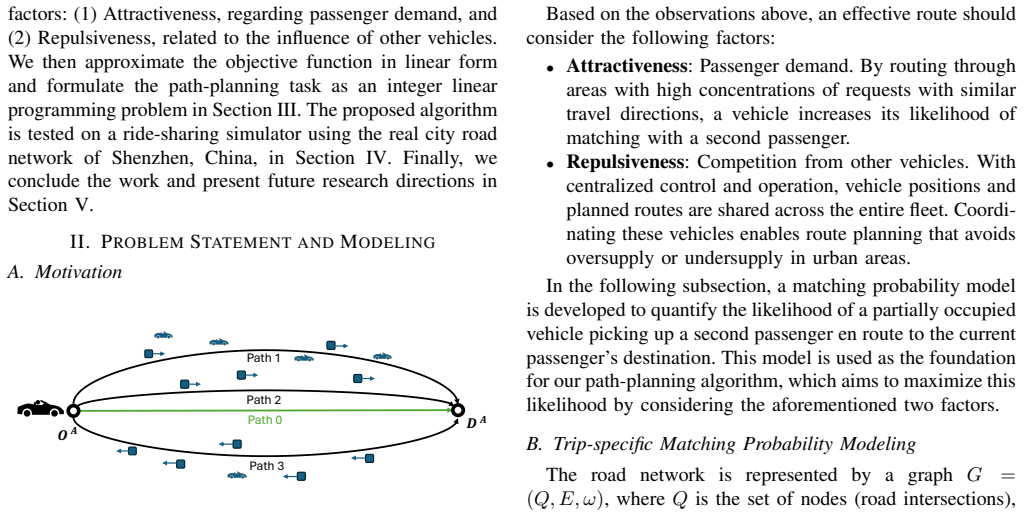
- [Fig. 1 caption] The caption describes Path 3 as having passengers traveling "in the opposite direction of the current trip, from OA to DA"; the phrase "from OA to DA" appears to mean the opposite direction of the current origin-destination pair, but the wording is confusing and should be clarified.
- [Table I] The row label "No share ( f leet+ 20%)" should be typeset as "No share (fleet + 20%)" for consistency, and the meaning of the +20% fleet scenario could be spelled out explicitly in the table caption.
- [Section IV-B, Algorithm 1] In Algorithm 1, the update step augments R with rcurrent but does not specify when routes are removed; a brief comment on the lifecycle of planned routes would improve reproducibility.
Circularity Check
Partial circularity: match-probability hyperparameters are tuned to maximize the very answer-rate metric that Table I then reports as evidence, though the ILP routing mechanism itself is independent.
-
fitted input called prediction
[Section IV-B (Experimental setup) and Table I in Section IV-C (Results and Analysis)]
"In our method, other parameters such as ζ and η are tuned via grid search, evaluating performance across combinations to maximize the answer rate."
The model's two free parameters are selected by grid search to maximize the 'answer rate' metric in the same simulator that is later used to evaluate the method. Table I then reports 'Answer rate (%) Proposed 81.4 Shortest 80.0' as headline evidence of superiority. This makes the reported answer-rate gain an in-sample tuning artifact rather than an independent prediction of the model. The circularity is partial because the ILP route optimization is a separate mechanism and other metrics (waiting time, shared orders) are not directly the tuning objective.
full rationale
The ILP path-planning model is built from explicit modeling assumptions, Eqs. (1)-(6), and external references ([7], [18]) rather than from the performance metrics it is claimed to improve. The logarithmic transformation and linearization in Eqs. (8)-(10) are standard algebraic steps and do not make the objective equivalent to the simulation outcome by construction. The route-selection mechanism, ILP (11), is a distinct algorithmic component not defined in terms of the evaluation metrics. The only near-circular step is the grid-search tuning of ζ and η to maximize the answer rate in the same simulator that later produces Table I; that makes the headline answer-rate improvement partly a fitting artifact, but it does not collapse the entire derivation into a tautology. The missing subtour-elimination constraint is a correctness concern, not a circularity. No load-bearing self-citation, imported uniqueness theorem, or ansatz smuggled via citation is present, and the simulator [22] is an independent, previously published tool.
Assumptions & free parameters
free parameters (3)
- ζ (zeta) =
1
- η (eta) =
0.001
- Partial vehicle availability weight (0.5) =
0.5
assumptions (6)
- domain assumption Passenger requests arrive as independent Poisson processes with rate λ_t(i,j) estimated from historical data
- domain assumption Matching opportunities occur independently over time and across edges
- ad hoc to paper The functional form of matching probability in Eq. (1) (exponential in attractiveness/repulsiveness) is correct
- domain assumption Only two pooling sequences are considered (O_A→O_B→D_A→D_B and O_A→O_B→D_B→D_A)
- ad hoc to paper log(1-y) ≈ -y is valid for all edge probabilities encountered
- domain assumption Start and end nodes of an edge contribute equally to the match probability (Eq. 5)
Cite this review
Pith. "Pith review of En Route Path-planning for Partially Occupied Vehicles in Ride-pooling Systems." pith.science (2026). https://pith.science/paper/BNOSEA2X
@misc{pith2026250604968,
  author       = {Pith},
  title        = {Pith review of: En Route Path-planning for Partially Occupied Vehicles in Ride-pooling Systems},
  year         = {2026},
  howpublished = {\url{https://pith.science/paper/BNOSEA2X}},
  note         = {Machine review of arXiv:2506.04968}
}
read the original abstract
Ride-pooling services, such as UberPool and Lyft Shared Saver, enable a single vehicle to serve multiple customers within one shared trip. Efficient path-planning algorithms are crucial for improving the performance of such systems. For partially occupied vehicles with available capacity, we introduce a novel routing algorithm designed to maximize the likelihood of picking up additional passengers while serving the current passengers to their destination. Unlike traditional methods that group passengers and vehicles based on predefined time windows, our algorithm allows for immediate responses to passenger requests. Our approach optimizes travel time while dynamically considering passenger demand and coordinating with other vehicles. Formulated as an integer linear programming (ILP) problem, our method is computationally efficient and suitable for real-time applications. Simulation results demonstrate that our proposed method can significantly enhance service quality.
Figures


Reference graph
Works this paper leans on
-
[1]
On ride-pooling and traffic congestion,
J. Ke, H. Yang, and Z. Zheng, “On ride-pooling and traffic congestion,” Transportation Research Part B: Methodological , vol. 142, pp. 213– 231, 2020
work page 2020
-
[2]
A partition-based match making algorithm for dynamic ridesharing,
D. Pelzer, J. Xiao, D. Zehe, M. H. Lees, A. C. Knoll, and H. Aydt, “A partition-based match making algorithm for dynamic ridesharing,” IEEE Transactions on Intelligent Transportation Systems , vol. 16, no. 5, pp. 2587–2598, 2015
work page 2015
-
[3]
Predictive routing for autonomous mobility-on-demand systems with ride-sharing,
J. Alonso-Mora, A. Wallar, and D. Rus, “Predictive routing for autonomous mobility-on-demand systems with ride-sharing,” in 2017 IEEE/RSJ International Conference on Intelligent Robots and Systems (IROS), 2017, pp. 3583–3590
work page 2017
-
[4]
Optimizing vehicle dis- tributions and fleet sizes for shared mobility-on-demand,
A. Wallar, J. Alonso-Mora, and D. Rus, “Optimizing vehicle dis- tributions and fleet sizes for shared mobility-on-demand,” in 2019 International Conference on Robotics and Automation (ICRA) , 2019, pp. 3853–3859
work page 2019
-
[5]
Hierarchical control for vehicle repositioning in autonomous mobility-on-demand systems,
P. Zhu, G. Ferrari-Trecate, and N. Geroliminis, “Hierarchical control for vehicle repositioning in autonomous mobility-on-demand systems,” IEEE Transactions on Control Systems Technology , pp. 1–14, 2024
work page 2024
-
[6]
Incentive-driven transi- tion to high ride-sharing adoption,
D.-M. Storch, M. Timme, and M. Schr ¨oder, “Incentive-driven transi- tion to high ride-sharing adoption,” Nature Communications, vol. 12, 06 2021
work page 2021
-
[7]
J. Ke, Z. Zheng, H. Yang, and J. Ye, “Data-driven analysis on match- ing probability, routing distance and detour distance in ride-pooling services,” Transportation Research Part C: Emerging Technologies , vol. 124, p. 102922, 2021
work page 2021
-
[8]
Routing optimization with vehicle–customer coordination,
W. Zhang, A. Jacquillat, K. Wang, and S. Wang, “Routing optimization with vehicle–customer coordination,” Management Science , vol. 69, no. 11, pp. 6876–6897, 2023
work page 2023
Show all 22 references
-
[9]
Designing an on- line ride-sharing system,
B. Cici, A. Markopoulou, and N. Laoutaris, “Designing an on- line ride-sharing system,” in Proceedings of the 23rd SIGSPATIAL International Conference on Advances in Geographic Information Systems, ser. SIGSPATIAL ’15. New York, NY , USA: Association for Computing Machinery, 2015
2015
-
[10]
Price- aware real-time ride-sharing at scale: an auction-based approach,
M. Asghari, D. Deng, C. Shahabi, U. Demiryurek, and Y . Li, “Price- aware real-time ride-sharing at scale: an auction-based approach,” in Proceedings of the 24th ACM SIGSPATIAL International Conference on Advances in Geographic Information Systems , 2016
2016
-
[11]
The shared-taxi problem: Formulation and solution methods,
H. Hosni, J. Naoum-Sawaya, and H. Artail, “The shared-taxi problem: Formulation and solution methods,” Transportation Research Part B: Methodological, vol. 70, pp. 303–318, 2014
2014
-
[12]
A unified approach to route planning for shared mobility,
Y . Tong, Y . Zeng, Z. Zhou, L. Chen, J. Ye, and K. Xu, “A unified approach to route planning for shared mobility,” Proc. VLDB Endow., vol. 11, no. 11, p. 1633–1646, July 2018
2018
-
[13]
Ridesharing: The state-of-the-art and future directions,
M. Furuhata, M. Dessouky, F. Ord ´o˜nez, M.-E. Brunet, X. Wang, and S. Koenig, “Ridesharing: The state-of-the-art and future directions,” Transportation Research Part B: Methodological , vol. 57, pp. 28–46, 2013
2013
-
[14]
Neural approximate dynamic programming for on-demand ride-pooling,
S. Shah, M. Lowalekar, and P. Varakantham, “Neural approximate dynamic programming for on-demand ride-pooling,” Proceedings of the AAAI Conference on Artificial Intelligence , vol. 34, pp. 507–515, 2020
2020
-
[15]
Ppvf: A novel framework for supporting path planning over carpooling,
B. Wang, R. Zhu, S. Zhang, Z. Zhao, X. Yang, and G. Wang, “Ppvf: A novel framework for supporting path planning over carpooling,” IEEE Access, vol. 7, pp. 10 627–10 643, 2019
2019
-
[16]
A detour planning algorithm in crowd- sourcing systems for multimedia content gathering,
C.-C. Liao and C.-H. Hsu, “A detour planning algorithm in crowd- sourcing systems for multimedia content gathering,” in Proceedings of the 5th Workshop on Mobile Video , ser. MoVid ’13. New York, NY , USA: Association for Computing Machinery, 2013, p. 55–60
2013
-
[17]
The planning of cycle trips in the province of east flanders,
W. Souffriau, P. Vansteenwegen, G. Vanden Berghe, and D. Van Oudheusden, “The planning of cycle trips in the province of east flanders,” Omega, vol. 39, no. 2, pp. 209–213, 2011
2011
-
[18]
Spatial Equilibrium, Search Frictions, and Dynamic Efficiency in the Taxi Industry,
N. Buchholz, “Spatial Equilibrium, Search Frictions, and Dynamic Efficiency in the Taxi Industry,” The Review of Economic Studies , vol. 89, no. 2, pp. 556–591, 09 2021
2021
-
[19]
Dynamic pricing and matching in ride-hailing platforms,
C. Yan, H. Zhu, N. Korolko, and D. Woodard, “Dynamic pricing and matching in ride-hailing platforms,” Naval Research Logistics (NRL) , vol. 67, no. 8, pp. 705–724, 2020
2020
-
[20]
Algorithm 97: Shortest path,
R. W. Floyd, “Algorithm 97: Shortest path,” Commun. ACM, vol. 5, no. 6, p. 345, June 1962
1962
-
[21]
Travel time estimation of a path using sparse trajectories,
Y . Wang, Y . Zheng, and Y . Xue, “Travel time estimation of a path using sparse trajectories,” in Proceedings of the 20th ACM SIGKDD International Conference on Knowledge Discovery and Data Mining , ser. KDD ’14. New York, NY , USA: Association for Computing Machinery, 2014, p. 25–34
2014
-
[22]
On the inefficiency of ride- sourcing services towards urban congestion,
C. V . Beojone and N. Geroliminis, “On the inefficiency of ride- sourcing services towards urban congestion,” Transportation Research Part C: Emerging Technologies, vol. 124, p. 102890, 2021
2021
Reviewed August 7, 2026 · model on record in the stance chip above.
Discussion (0). Sign in to comment.