REVIEW 4 major objections 4 minor 53 references
K2 observations of five pulsating subdwarf B stars with white dwarf companions
T0 review · 4 major / 4 minor · reviewed 2026-08-07 · deepseek-v4-flash
Pith's one-line read Seismic analyses of five K2-observed sdBV stars with white dwarf companions show that all four with measurable rotational splittings rotate subsynchronously, and that LT Cnc rotates differentially with its envelope faster than its interior.
desk verdict Completes the K2 sdB+WD census with real new results, but the differential rotation and PB 6373 rotation claims are softer than the abstract suggests. read the letter →
The pith
A machine-rendered reading of the paper's core claim, the machinery that carries it, and where it could break.
The reading
What carries the argument
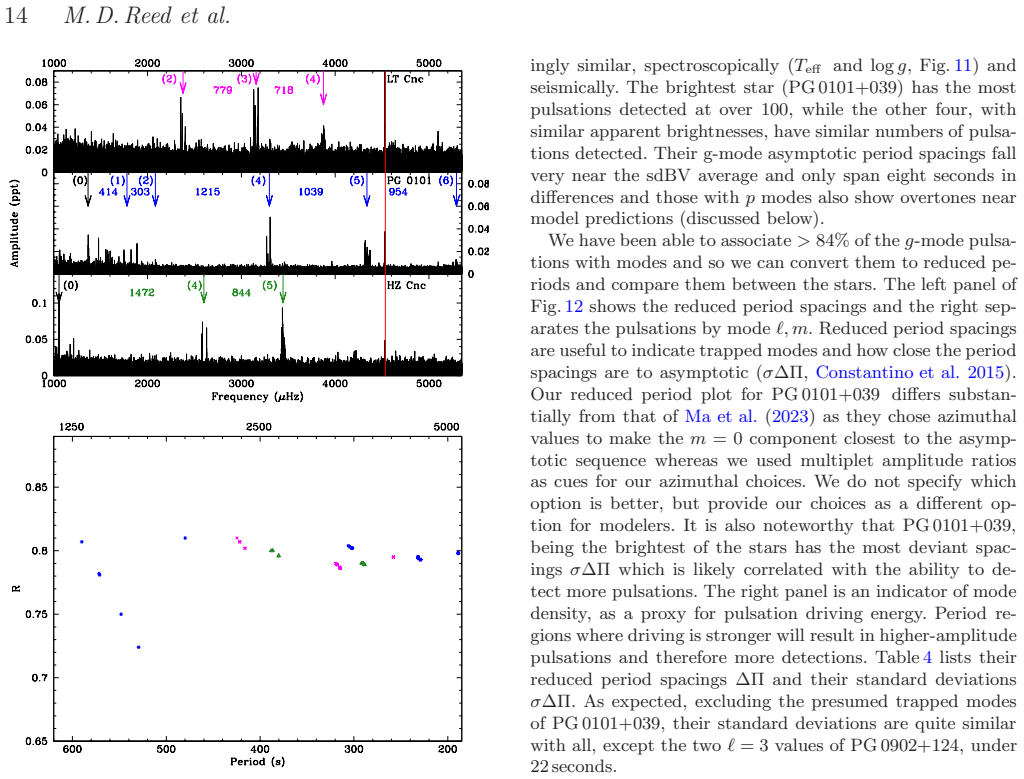
The load-bearing tool is rotational splitting of nonradial pulsation modes: a mode of degree $\ell$ is split into $2\ell+1$ azimuthal components separated by $\Delta\nu = \Delta m\, \Omega\, (1 - C_{n,\ell})$, where the Ledoux constant $C_{n,\ell} \approx 1/[\ell(\ell+1)]$ for g modes and is near zero for p modes. That relation converts a measured frequency separation into a spin period, and comparing p-mode (envelope) with g-mode (deep interior) periods yields radial differential rotation. A second tool assigns p-mode radial orders from the period ratio $(P_n/P_k)^{1/(n-k)} \approx R$, with $R \approx 0.79$–$0.81$, and from the asymptotic g-mode period-spacing relation $P_{\ell,n} = P_o \sqrt{\ell(\ell+1)}\, n + \epsilon$ with spacings near 250 seconds.
What would settle it
A continuous light curve of LT Cnc long enough to resolve every claimed multiplet (frequency resolution well below 0.1 microhertz) should show a consistent splitting and stable amplitude ratios; if the peaks instead appear and disappear independently or have unequal, variable spacings, they are not a rotationally split mode and the 18-day envelope rotation is not real.
Extended reading notes
Core claim
The paper's central discovery is that rotation in sdB+WD binaries is subsynchronous: in every one of the four stars where rotational frequency multiplets could be measured, the pulsating star rotates more slowly than it orbits its white dwarf companion. The paper determines this from rotational splittings of nonradial modes, using the Ledoux constant to convert frequency separations into spin periods. For PG 0101+039 the p- and g-mode multiplets give the same spin period, so the star rotates as a solid body; for LT Cnc the p-mode splittings give 18 days while the g-mode splittings give 35.5 days, interpreted as a radial gradient in which the envelope rotates faster than the core. The paper completes seismic analyses of all Kepler/K2-observed sdB+WD binaries, and it shows that the five stars share nearly identical atmospheric parameters, period spacings near 250 seconds, and p-mode overtone ratios consistent with R near 0.79.
Load-bearing premise
The spin periods and differential rotation rest on treating closely spaced frequency peaks as rotational multiplets of a single pulsation mode; if those peaks are actually unresolved independent modes or are produced by amplitude variability, the derived rotation and the LT Cnc gradient both collapse.
Editorial extensions
If this is right
- All twelve Kepler/K2-observed sdB+WD binaries now have published seismic analyses; every one with a measured spin rotates slower than its orbit, so subsynchronous rotation is the rule for this binary class.
- If LT Cnc's envelope/interior spin difference is real, angular momentum transport between the envelope and core is slow enough to preserve a rotation gradient over the star's lifetime.
- The overtone-ratio method provides a model-independent way to assign p-mode radial orders in hot subdwarfs, and its consistency with theory supports its use in other g-mode-dominated hybrid pulsators.
- The five stars' period spacings all fall within a narrow range near 250 seconds, suggesting that the core-to-envelope structure that sets g-mode spacing is similar across sdB+WD binaries regardless of orbital period.
Reading between the lines
- If subsynchronous rotation is universal, tidal torques from the white dwarf companion are too weak to synchronize the sdB star; this could mean the sdB star's spin reflects its post-common-envelope history rather than current tidal interaction.
- The differential rotation seen in LT Cnc, if confirmed by future observations, would make it a benchmark for testing angular momentum transport in low-mass stars with thin envelopes.
- PB 6373's splittings, which decrease with frequency and would imply a two-fold spin range within one mode type, are more plausibly due to unresolved mode structure or amplitude variability; a longer continuous light curve can distinguish these.
- The overtone-ratio method could be extended to other hot subdwarf classes; if R holds near 0.81 for BLAPs and sdBVs, it offers a quick way to estimate mean density from pulsation periods alone.
Editorial analysis
A structured set of objections, weighed in public.
Referee Report
Summary. The paper presents K2 light curves and follow-up spectroscopy for five pulsating subdwarf B stars with white dwarf companions. It reports g-mode period spacings near 250 s for all five, p-mode detection in three, rotation periods inferred from frequency multiplets for four stars, and claims that those four rotate subsynchronously to their binary periods. It further claims that PG 0101+039 rotates as a solid body while LT Cnc shows radial differential rotation, with the envelope (p modes) spinning faster than the deep interior (g modes). The paper also introduces a method to assign p-mode radial orders using period ratios, and compares the sample with other Kepler-observed sdBV stars.
Significance. If the rotation results are correct, the paper would provide the first complete set of seismic rotation measurements for K2-observed sdB+WD binaries and establish subsynchronous rotation as the norm for this class, with LT Cnc as a rare case of radial differential rotation. The strength of the paper is the careful Fourier analysis: detection limits, prewhitening, KS tests, echelle diagrams, and multiple independent splittings for some stars. The homogeneous spectroscopy and orbital fits add value, and the appendix tables of all detected frequencies and modes will be useful. However, the headline claims rest on multiplet identifications that are internally inconsistent for LT Cnc and self-described as unlikely to be rotation for PB 6373; these need to be addressed before the conclusions can be accepted.
major comments (4)
- [Section 2.2] The p-mode splittings used to derive the 18.0-day envelope rotation period of LT Cnc are not consistent with a single rotation multiplet. The text states that f9–f12 have Δm=2 splittings that are 'a little large,' that f14–f15 are split by 0.62 µHz while f15–f17 would require Δm>2, and the values are then averaged to 0.64±0.08 µHz. A rotationally split multiplet with a single Ω and a single Ledoux constant cannot skip intermediate m values or produce nonuniform spacings, so the average is not a clean rotation measurement. Because the radial differential rotation claim is the difference between this average and the g-mode value, that claim is not supported by the presented data unless a consistent multiplet identification is provided.
- [Sections 2.5, 4.2, and abstract] PB 6373 is counted among the four stars with subsynchronous rotation periods, using the averaged splitting of 0.39±0.10 µHz that gives 14.8 days. However, Section 4.2 explicitly states that the PB 6373 splittings decrease with frequency and that 'rotation is not likely to be the cause.' If the splittings are not rotational in origin, the 14.8-day period is not a rotation period; if they are rotational, the frequency-dependent trend contradicts the assumption of a single rotation rate. The abstract's claim that 'four stars' rotate subsynchronously is therefore not supported for PB 6373; the paper needs to resolve this contradiction or reduce the count.
- [Section 4.2] The g-mode rotation period for LT Cnc is quoted as 35.5±7.5 days in Section 2.2 but as 75±15 days in Section 4.2. The 75-day value appears to be the inverse of the ℓ=1 splitting (0.160 µHz) without applying the Ledoux correction factor (1−C_n,l)=1/2, which would give ~36 days. This factor-of-two error directly affects the stated magnitude of the differential rotation and must be corrected to agree with Section 2.2.
- [Section 4.1] The p-mode overtone method assigns radial orders using R≈0.81 from Jeffery (2025) and then computes R from those assignments, treating the agreement (R≈0.79) as 'substantial validation' of Eq. (1). This is partly circular because the assignments already assume a value of R. The independent period–mean-density check fails for PG 0101+039 and HZ Cnc: the observed longest p-mode periods are 12.19 and 15.77 min versus estimated fundamental periods of 6.11 and 6.93 min, as the authors acknowledge. The validation claim is therefore not established, and the n assignments in Tables A2, A4, and A6 should be presented as tentative rather than confirmed.
minor comments (4)
- [Section 2.2] The sentence 'f15-f17 would require Δm>2' is unclear; from Table A4, f15–f17 span 6.698 µHz, which requires Δm≈11 if the splitting is 0.62 µHz. Please clarify which pairs are meant.
- [Author list] The author list contains a formatting error: 'A. ,S. Baran' should be 'A. S. Baran'.
- [Title and text] The title uses 'subdwarf-B' with a hyphen while the text uses 'subdwarf B'; please unify the spelling.
- [Table A1] In Table A1, the column header 'MA' is undefined; consider renaming it to 'Ma23' or adding a footnote explaining that it lists identifications from Ma et al. (2023).
Circularity Check
P-mode overtone 'validation' is circular: radial orders are assigned using R≈0.81 from coauthor Jeffery (2025), then R≈0.81 is recomputed and presented as confirmation; the independent period–mean density check fails for two of three stars.
-
fitted input called prediction
[Section 4.1, Eq. (1), Fig. 13]
"Radial orders can then be estimated for all other modes from log(P/P0,0)/log(0.81) rounded to the nearest integer. ... This can be partly verified by computing the ratio R for all modes, and doing a consistency check. ... For modes identified as n ≥ 2 we obtain tight solutions 0.786 ≤ R ≤ 0.810, and mean values R = 0.794 ± 0.008, 0.793 ± 0.005, 0.792 ± 0.005 for LT Cnc, Hz Cnc and PG 0101+039 respectively. Given the higher gravity of sdBVs, these results are consistent with BLAP theory (Jeffery 2025) and substantially validate the prediction of Eqn. 1."
The radial order n is assigned by rounding log(P/P0)/log(0.81), i.e., by assuming R = 0.81. The 'consistency check' then computes R = (Pn/Pk)^(1/(n−k)) from those same n assignments; by construction each assigned mode gives R ≈ 0.81. The agreement is therefore an identity of the assignment rule, not an independent validation. The only independent check offered, the period–mean density estimate of P0,0, is stated to be inconsistent for PG 0101+039 and HZ Cnc ('The higher surface gravities for PG0101+039 and HZ Cnc are not consistent with the observed longest p-mode periods'), so the claim that Eqn. 1 is 'substantially validate[d]' rests on the circular consistency check. The R ≈ 0.81 input is also imported from Jeffery (2025), a coauthor of this paper.
full rationale
Most of the paper's core seismology — the g-mode period spacings, the rotation periods from multiplet splittings via the standard Ledoux relation, and the binary orbital fits — is derived from the K2 photometry and new radial velocities in a self-contained way; no circularity was found there. The one genuinely circular step is in Section 4.1: the 'new method' for p-mode radial orders adopts R ≈ 0.81 from coauthor Jeffery (2025) to assign n via log(P/P0)/log(0.81), then computes R from those assigned n and presents the resulting R ≈ 0.79 as 'substantially validat[ing]' Eqn. 1. That agreement is forced by the assignment rule. The independent period–mean density check explicitly fails for PG 0101+039 and HZ Cnc, leaving the circular consistency as the claimed validation. This does not affect the rotation-period or differential-rotation conclusions, which rest on frequency multiplets and the Ledoux relation rather than on the overtone numbering, so the circularity is partial. A separate non-circular concern: PB 6373's splittings are described as 'rotation is not likely to be the cause', yet the star is counted among the four subsynchronous rotators; this is an internal inconsistency, not a circularity.
Assumptions & free parameters
free parameters (2)
- R (radial overtone period ratio) =
0.81 (adopted from Jeffery 2025)
- P0,0 estimate via M = 0.475 M⊙ =
0.475 M⊙ (assumed classical mass)
assumptions (5)
- standard math Rotational splitting formula Δν = Δm Ω (1 - C_n,l) with C_n,l ≈ 1/[ℓ(ℓ+1)] for g modes and ≈0 for p modes (Ledoux 1951).
- domain assumption p modes are envelope modes while g modes probe deeper interior layers (Charpinet et al. 2014).
- domain assumption The companions are white dwarfs, inferred from binary properties and absence of other signatures (e.g., no NIR excess for PG 0902+124).
- domain assumption Jeffery (2025) relation (P_n/P_k)^(1/(n-k)) ≈ R with R≈0.81 holds for low-mass stars, and can be extended to sdBV stars.
- domain assumption Assumed mass M = 0.475 M⊙ for the period-mean density estimate of P0,0.
Cite this review
Pith. "Pith review of K2 observations of five pulsating subdwarf B stars with white dwarf companions." pith.science (2026). https://pith.science/paper/VALU66VU
@misc{pith2026250605033,
  author       = {Pith},
  title        = {Pith review of: K2 observations of five pulsating subdwarf B stars with white dwarf companions},
  year         = {2026},
  howpublished = {\url{https://pith.science/paper/VALU66VU}},
  note         = {Machine review of arXiv:2506.05033}
}
read the original abstract
We report seismic analyses of five pulsating subdwarf B (sdBV) stars observed during Kepler's K2 mission, each with a white dwarf companion. We find three of the five to be g-mode-dominated hybrid pulsators. For the other two, we only detect g modes. We determine rotation periods from frequency multiplets for four stars and each rotates subsynchronously to its binary period, including PG 0101+039 and PG 0902+124 both with binary periods near 0.57 days and spin periods near 9 days. We detect frequency multiplets in both p and g modes for PG 0101+039 and LT Cnc and determine that PG 0101+039 rotates like a solid body while LT Cnc rotates differentially radially with the envelope spinning faster than deeper layers. Mostly we find these five stars to be quite similar to one another, spectroscopically and seismically. We find the p modes of the three hybrid pulsators to have gaps between regions of power, which we interpret as overtones and apply a technique to assign modes. We examine their g mode period spacings and deviations thereof and again, find the stars to be similar with period spacings near the average of 250 s and deviations mostly under 25 s. We compare Kepler-observed sdBV stars of different binary types and likely-single pulsators.
Figures


Figures from the paper (12 more)




Reference graph
Works this paper leans on
-
[1]
Aerts C., Christensen-Dalsgaard J., Kurtz D. W., 2010, Asteroseismology . Springer
work page 2010
-
[2]
Baran A. S., Charpinet S., stensen R. H., Reed M. D., Van Grootel V., Lyu C., Telting J. H., N \'e meth P., 2024, , 686, A65
work page 2024
-
[3]
Baran A. S., Reed M. D., stensen R. H., Telting J. H., Jeffery C. S., 2017, A&A, 597, A95
work page 2017
-
[4]
Baran A. S., Reed M. D., Stello D., stensen R. H., Telting J. H., Pak s tien \"e E., O'Toole S. J., Silvotti R., Degroote P., Bloemen S., Hu H., Van Grootel V., Clarke B. D., Van Cleve J., Thompson S. E., Kawaler S. D., 2012, MNRAS, 424, 2686
work page 2012
-
[5]
S., Winans A., 2012, ActaAstron, 62, 343
Baran A. S., Winans A., 2012, ActaAstron, 62, 343
work page 2012
-
[6]
Charpinet S., Brassard P., Van Grootel V., Fontaine G., 2014, in van Grootel V., Green E., Fontaine G., Charpinet S., eds, 6th Meeting on Hot Subdwarf Stars and Related Objects Vol. 481 of Astronomical Society of the Pacific Conference Series, On Interpreting g-Mode Period Spacings in sdB Stars . p. 179
work page 2014
-
[7]
Charpinet S., Fontaine G., Brassard P., 2001, PASP, 113, 775
work page 2001
-
[8]
Charpinet S., Fontaine G., Brassard P., Dorman B., 2000, ApJS, 131, 223
work page 2000
Show all 53 references
-
[9]
M., Van Grootel V., Randall S
Charpinet S., Fontaine G., Brassard P., Green E. M., Van Grootel V., Randall S. K., Silvotti R., Baran A. S., stensen R. H., Kawaler S. D., Telting J. H., 2011, Nature, 480, 496
2011
-
[10]
W., Baglin A., eds, IAU Colloq
Christensen-Dalsgaard J., 1993, in Weiss W. W., Baglin A., eds, IAU Colloq. 137: Inside the Stars Vol. 40 of Astronomical Society of the Pacific Conference Series, Pulsation theory and stellar structure. . pp 483--496
1993
-
[11]
Constantino T., Campbell S., Christensen-Dalsgaard J., Lattanzio J., Stello D., 2015, MNRAS, 452, 123
2015
-
[12]
A., Andersen J., 2010, Astrophysics and Space Science Proceedings, 14, 211
Djupvik A. A., Andersen J., 2010, Astrophysics and Space Science Proceedings, 14, 211
2010
-
[13]
M., Chayer P., Bill \`e res M., Randall S
Fontaine G., Brassard P., Charpinet S., Green E. M., Chayer P., Bill \`e res M., Randall S. K., 2003, ApJ, 597, 518
2003
-
[14]
M., Reed M
Foster H. M., Reed M. D., Telting J. H., stensen R. H., Baran A. S., 2015, ApJ, 805, 94
2015
-
[15]
A., Webbink R
Ge H., Tout C. A., Webbink R. F., Chen X., Sarkar A., Li J., Li Z., Zhang L., Han Z., 2024, , 961, 202
2024
-
[16]
M., Fontaine G., Reed M
Green E. M., Fontaine G., Reed M. D., Callerame K., Seitenzahl I. R., White B. A., Hyde E. A., stensen R., Cordes O., Brassard P., Falter S., Jeffery E. J., Dreizler S., Schuh S. L., Giovanni M., Edelmann H., Rigby J., Bronowska A., 2003, ApJL, 583, L31
2003
-
[17]
Han Z., Podsiadlowski P., Maxted P. F. L., Marsh T. R., Ivanova N., 2002, MNRAS, 336, 449
2002
-
[18]
Heber U., 2016, , 128, 082001
2016
-
[19]
N., Werner K., 1999, A&A, 348, L25
Heber U., Reid I. N., Werner K., 1999, A&A, 348, L25
1999
-
[20]
B., Sobeck C., Haas M., Still M., Barclay T., Mullally F., Troeltzsch J., Aigrain S., Bryson S
Howell S. B., Sobeck C., Haas M., Still M., Barclay T., Mullally F., Troeltzsch J., Aigrain S., Bryson S. T., Caldwell D., Chaplin W. J., Cochran W. D., Huber D., Marcy G. W., Miglio A., Najita J. R., Smith M., Twicken J. D., Fortney J. J., 2014, PASP, 126, 398
2014
-
[21]
S., 2025, , 538, 2952
Jeffery C. S., 2025, , 538, 2952
2025
-
[22]
W., Reed M
Kern J. W., Reed M. D., Baran A. S., stensen R. H., Telting J. H., 2017, , 465, 1057
2017
-
[23]
W., Reed M
Kern J. W., Reed M. D., Baran A. S., Telting J. H., stensen R. H., 2018, , 474, 4709
2018
-
[24]
D., Baran A
Ketzer L., Reed M. D., Baran A. S., N \'e meth P., Telting J. H., stensen R. H., Jeffery C. S., 2017, , 467, 461
2017
-
[25]
M., 2010, MNRAS, 406, 2701
Koen C., Green E. M., 2010, MNRAS, 406, 2701
2010
-
[26]
H., Barlow B
Kupfer T., Geier S., Heber U., stensen R. H., Barlow B. N., Maxted P. F. L., Heuser C., Schaffenroth V., G \"a nsicke B. T., 2015, , 576, A44
2015
-
[27]
Ledoux P., 1951, ApJ, 114, 373
1951
-
[28]
Li Z., Zhang Y., Chen H., Ge H., Jiang D., Li J., Chen X., Han Z., 2024, , 964, 22
2024
-
[29]
Lightkurve Collaboration Cardoso J. V. d. M., Hedges C., Gully-Santiago M., Saunders N., Cody A. M., Barclay T., Hall O., Sagear S., Turtelboom E., Zhang J., Tzanidakis A., Mighell K., Coughlin J., Bell K., Berta-Thompson Z., Williams P., Dotson J., Barentsen G., , 2018, Light...
2018
-
[30]
Luger R., Agol E., Kruse E., Barnes R., Becker A., Foreman-Mackey D., Deming D., 2016, , 152, 100
2016
-
[31]
Luger R., Kruse E., Foreman-Mackey D., Agol E., Saunders N., 2018, , 156, 99
2018
-
[32]
Y., Zong W., Fu J
Ma X. Y., Zong W., Fu J. N., Charpinet S., Wang J., Xing K., 2023, , 680, A11
2023
-
[33]
Morales-Rueda L., Maxted P. F. L., Marsh T. R., North R. C., Heber U., 2003, MNRAS, 338, 752
2003
-
[34]
R., Saffer R
Moran C., Maxted P., Marsh T. R., Saffer R. A., Livio M., 1999, , 304, 535
1999
-
[35]
J., Shibahashi H., Kurtz D
Murphy S. J., Shibahashi H., Kurtz D. W., 2013, , 430, 2986
2013
-
[36]
H., Silvotti R., Charpinet S., et al
stensen R. H., Silvotti R., Charpinet S., et al. 2010, MNRAS, 409, 1470
2010
-
[37]
H., Silvotti R., Charpinet S., et al
stensen R. H., Silvotti R., Charpinet S., et al. 2011, MNRAS, 414, 2860
2011
-
[38]
K., Fontaine G., Brassard P., Bergeron P., 2005, ApJS, 161, 456
Randall S. K., Fontaine G., Brassard P., Bergeron P., 2005, ApJS, 161, 456
2005
-
[39]
D., Armbrecht E
Reed M. D., Armbrecht E. L., Telting J. H., Baran A. S., stensen R. H., Blay P., Kvammen A., Kuutma T., Pursimo T., Ketzer L., Jeffery C. S., 2018, , 474, 5186
2018
-
[40]
D., Baran A
Reed M. D., Baran A. S., stensen R. H., Telting J. H., Kern J. W., Bloemen S., Blay P., Pursimo T., Kuutma T., Slumstrup D., Saajasto M., Nielsen L. D., Harmanen J., Winans A. J., Foster H. M., Rowe L., 2016, MNRAS, 458, 1417
2016
-
[41]
D., Baran A
Reed M. D., Baran A. S., Telting J. H., stensen R. H., 2023, , 525, 1342
2023
-
[42]
D., Foster H., Telting J
Reed M. D., Foster H., Telting J. H., stensen R. H., Farris L. H., Oreiro R., Baran A. S., 2014, MNRAS, 440, 3809
2014
-
[43]
D., Harms S
Reed M. D., Harms S. L., Poindexter S., Zhou A. Y., Eggen J. R., et. al 2011, , 412, 371
2011
-
[44]
D., Kawaler S
Reed M. D., Kawaler S. D., Zola S., Jiang X. J., Dreizler S., et al. 2004, MNRAS, 348, 1164
2004
-
[45]
D., Slayton A., Baran A
Reed M. D., Slayton A., Baran A. S., Telting J. H., stensen R. H., Jeffery C. S., Uzundag M., Sanjayan S., 2021, , 507, 4178
2021
-
[46]
R., Vanderspek R., Winn J., et al
Ricker G. R., Vanderspek R., Winn J., et al. 2016, in Vol. 9904 of Society of Photo-Optical Instrumentation Engineers (SPIE) Conference Series, The Transiting Exoplanet Survey Satellite . p. 99042B
2016
-
[47]
N., Pelisoli I., Geier S., Kupfer T., 2023, , 673, A90
Schaffenroth V., Barlow B. N., Pelisoli I., Geier S., Kupfer T., 2023, , 673, A90
2023
-
[48]
H., stensen R
Telting J. H., stensen R. H., Baran A. S., Bloemen S., Reed M. D., Oreiro R., Farris L., Ottosen T. A., Aerts C., Kawaler S. D., Heber U., Prins S., Green E. M., Kalomeni B., O'Toole S. J., Mullally F., Sanderfer D. T., Smith J. C., Kjeldsen H., 2012, A&A, 544, A1
2012
-
[49]
H., stensen R
Telting J. H., stensen R. H., Oreiro R., Reed M., Farris L., O'Toole S., Aerts C., 2012, in Kilkenny D., Jeffery C. S., Koen C., eds, Fifth Meeting on Hot Subdwarf Stars and Related Objects Vol. 452 of Astronomical Society of the Pacific Conference Series, Orbits of Hot Subdwa...
2012
-
[50]
Uzundag M., Krzesinski J., Pelisoli I., N \'e meth P., Silvotti R., Vu c kovi \'c M., Dawson H., Geier S., 2024, , 684, A118
2024
-
[51]
A., 2014, , 126, 948
Vanderburg A., Johnson J. A., 2014, , 126, 948
2014
-
[52]
Vennes S., Kawka A., N \'e meth P., 2011, MNRAS, 410, 2095
2011
-
[53]
H., N \'e meth P., Green E
Vos J., stensen R. H., N \'e meth P., Green E. M., Heber U., Van Winckel H., 2013, , 559, A54, Paper II
2013
Reviewed August 7, 2026 · model on record in the stance chip above.
Discussion (0). Continue with ORCID to comment.