REVIEW 4 major objections 4 minor 1 cited by
Characterization of Infinite Ideal Polyhedra in Hyperbolic 3-Space via Combinatorial Ricci Flow
T0 review · 4 major / 4 minor · reviewed 2026-08-07 · deepseek-v4-flash
Pith's one-line read Rivin's characterization of ideal hyperbolic polyhedra is extended from finite to infinite decompositions, proven via combinatorial Ricci flow.
desk verdict Genuine new analytic results on infinite combinatorial Ricci flow, but the headline characterization of infinite ideal polyhedra is not proven: the embeddedness step is deferred and the main theorem's conditions don't match the engine. read the letter →
The pith
A machine-rendered reading of the paper's core claim, the machinery that carries it, and where it could break.
The reading
What carries the argument
The carrying object is the combinatorial Ricci flow for infinite ideal circle patterns, du_i/dt = −K_i, the infinite version of Chow–Luo's flow, together with its curvature function K_i = 2π − σ(v_i), where σ(v_i) is the total angle around a primal vertex v_i in Thurston's triangulated construction. The paper builds solutions by exhausting the infinite complex by finite decompositions, applying Arzelà–Ascoli to extract a global flow, and using maximum principles on infinite graphs for uniqueness and convergence. The character L_i(D,Θ), the sum of edge angles incident to vertex i, supplies the local combinatorial condition that guarantees an initial metric with non-positive curvature. Finally, Thurston's half-space correspondence, which converts an ideal circle pattern on the sphere into the intersection of hyperbolic half-spaces with matching dihedral angles, is the bridge from circle patterns to infinite ideal polyhedra.
What would settle it
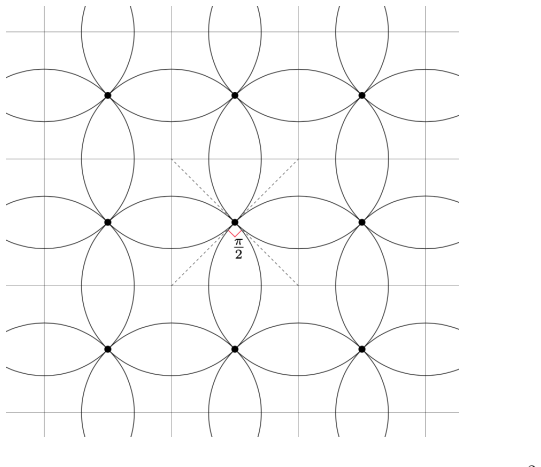
Take a concrete locally finite infinite decomposition, for instance the square grid with Θ_e = π/2, run the flow of Theorem 4.1, and test whether the limiting ideal circle pattern is embedded; if a self-intersecting limit appears for any admissible initial data satisfying the theorem's hypotheses, the claimed existence of an embedded polyhedron fails in that case.
Extended reading notes
Core claim
On the paper's own terms, the central discovery is that Rivin's finite characterization extends to the infinite setting: Theorem 1.1 asserts that for a locally finite connected infinite cellular decomposition D of the sphere with edge angles Θ_e in a uniform (δ, π−δ) window, the conditions that vertex coboundaries sum to 2π, that each face boundary satisfies Σ Θ_e ≤ (|γ|−2)π + K̂_f, and that some metric r has K(r) ≥ K̂, force the existence of an infinite ideal hyperbolic polyhedron combinatorially equivalent to D with exterior dihedral angles Θ_e. Theorem 1.2 gives the analogous statement for half-infinite ideal polyhedra, where a unique face contains all limit points of the vertices. The flow-theoretic mechanism also yields a constructive algorithm: convergence of the infinite combinatorial Ricci flow produces a good ideal circle pattern, which the Thurston correspondence turns into the desired polyhedron.
Load-bearing premise
The load-bearing premise, explicitly deferred to a forthcoming paper, is that the zero-curvature infinite ideal circle pattern produced by the flow can be chosen without self-intersections; Remark 4.3 concedes that the constructed patterns may be self-intersecting, in which case the Thurston half-space intersection would not be a genuine embedded polyhedron.
Editorial extensions
If this is right
- Rivin's open problem (i) is resolved affirmatively for locally finite infinite cellular decompositions under the stated conditions.
- The combinatorial Ricci flow provides a constructive procedure for finding the polyhedron: starting from a metric with non-positive curvature, the flow converges to a zero-curvature ideal circle pattern, which is then converted to the polyhedron.
- The hypotheses are local, separable, and checkable at each vertex and face, in contrast to the global cocycle conditions of Rivin's finite theorem.
- The half-infinite case is covered as a separate existence theorem, with the same flow machinery in hyperbolic background geometry.
- Together with the announced companion work, the paper expects to settle the equivalence among VEL-parabolicity, recurrence or transience of the 1-skeleton, embedded circle patterns, and convergence of the Ricci flow.
Reading between the lines
- If the embeddedness deferral is resolved, the same flow likely yields a uniformization-type dichotomy: the Euclidean-background flow converges exactly when the combinatorics are VEL-parabolic, matching the recurrent or transient dichotomy of the 1-skeleton.
- The face-boundary inequality in Theorem 1.1, involving K̂_f, is likely not sharp; testing whether it can be replaced by a condition holding only outside a finite subcomplex is a concrete next step.
- The self-intersection caveat suggests that the existence question for embedded infinite polyhedra may depend not only on the angles but on a global embeddedness condition on the circle pattern; one could probe this by numerically computing flow limits for the square-grid family and checking whether any intersections persist.
Editorial analysis
A structured set of objections, weighed in public.
Referee Report
Summary. The paper develops an infinite-vertex analogue of combinatorial Ricci flow for ideal circle patterns and uses it to claim a characterization of infinite ideal hyperbolic polyhedra, thereby purporting to solve Rivin's open problem (i). The main results are: long-time existence and uniqueness of the infinite combinatorial Ricci flow in hyperbolic and Euclidean background geometries (Theorems 1.4–1.6); convergence to zero-curvature 'good' circle patterns under character-type conditions (Theorems 1.7–1.12); and, in Section 4, existence theorems for infinite ideal polyhedra (Theorem 1.1) and half-infinite ideal polyhedra (Theorem 1.2). The proof route is to construct a prescribed-curvature zero-curvature circle pattern in the plane or disk via the flow, project it to the sphere, and then invoke Thurston's half-space correspondence to obtain an ideal hyperbolic polyhedron.
Significance. If fully established, the paper would provide the first infinite analogue of Rivin's characterization and would answer a long-standing open problem. The paper contains substantial new technical material: the exhaustion-by-finite-decompositions argument for long-time existence, the maximum principle for weighted Laplacians on infinite graphs, and the character-based criteria for the existence of good circle patterns. These components are potentially valuable even independently of the polyhedral application. However, the central polyhedral existence claim is not proven in the submitted manuscript: the final embeddedness step is explicitly deferred to the authors' forthcoming paper [18], and Remark 4.3 concedes that the constructed circle patterns may be self-intersecting. Consequently the advertised solution to Rivin's problem is conditional on an external, unpublished result.
major comments (4)
- [Section 4.2, Remark 4.3; Theorem 1.1] The proof of Theorem 1.1 is incomplete in a load-bearing way. After Theorem 4.2 the text states that an infinite ideal circle pattern on the sphere is obtained and that 'according to the correspondence described in Subsection 4.1, we can prove Theorem 1.1.' But the correspondence in Subsection 4.1 produces a polyhedron by intersecting the half-spaces determined by the ideal circle pattern, and this yields an embedded polyhedron only if the pattern is embedded. Remark 4.3 explicitly acknowledges: 'those infinite ideal circle patterns may have self-intersections, see [38], which do not correspond to a real IIP,' and states that the avoidance of self-intersections will be proved in the forthcoming paper [18]. Since Theorem 1.1 is the paper's central claim, it is not established by the arguments in this manuscript.
- [Theorem 4.2 vs. Theorem 1.1] There is a formal mismatch between the conditions of Theorem 4.2 and those of Theorem 1.1, so Theorem 4.2 does not directly imply Theorem 1.1 even if the embeddedness gap were repaired. Theorem 4.2 condition (2) requires the face-boundary equality Σ Θ_e = (|γ|−2)π, while Theorem 1.1 condition (3) is an inequality Σ Θ_e ≤ (|γ|−2)π + K̂_f. Moreover, K̂ and K in Theorem 1.1 are defined on faces in equations (1)–(2), whereas the quantity K̂ in Theorem 4.2 is defined on vertices in equation (101). The text gives no argument bridging these vertex and face formulations, so the claimed derivation of Theorem 1.1 from Theorem 4.2 is not a straightforward substitution.
- [Section 4.3; Theorem 1.2] Theorem 1.2 is asserted in a single sentence: 'if we consider the dual infinite cellular decomposition, according to the correspondence described in Subsection 4.1, from Theorem 1.10, we can prove Theorem 1.2.' This is not a proof. Theorem 1.10 assumes the face condition (C1), i.e., equality Σ Θ_e = (|γ|−2)π, whereas Theorem 1.2 condition (3) is the weaker inequality Σ Θ_e ≤ (|γ|−2)π + |γ|c. No argument is supplied to show that the inequality case yields a zero-curvature hyperbolic circle pattern, nor that the resulting pattern is embedded and gives a genuine half-infinite ideal polyhedron. The same deferred embeddedness issue as in Remark 4.3 therefore applies to Theorem 1.2.
- [Section 3.3, proof of Theorem 1.7] The maximum-principle step in the proof of Theorem 1.7 is written incorrectly. The text says: 'Since f[n](0)≥0, the maximum principle (Lemma 2.15) implies f[n](t)≥0', but Lemma 2.15 as stated concludes f≤0 from f(0)≤0; the application should be to −f[n]. The same sign bookkeeping appears in Section 3.2, where after equation (38) the authors assert that Lemma 2.3 gives g_i(t)≤0, whereas in hyperbolic background geometry the relevant sums have the opposite sign. These sign issues appear correctable because the maximum principle only requires an upper bound on g, but as written the proof of monotone convergence in Theorem 1.7 contains a genuine gap that should be repaired.
minor comments (4)
- [Section 3.1, Lemma 3.1] In the proof of Lemma 3.1 the text says 'Since D is finite', but D is the infinite decomposition; the intended statement is that each approximating decomposition D[n] is finite.
- [Section 3.4, Theorems 1.8 and 3.9] The notation l^2(H) appears without definition; the surrounding text uses l^2(V), and H seems to be a typo for the vertex set V of the square lattice.
- [Introduction] There are several typos and minor infelicities: 'seperating' in the paragraph after Conjecture 1.3, 'on studied' in the introduction, and inconsistent phrasing of positive versus negative constants in Theorem 1.11 and Lemma 3.11.
- [References] Reference [18] is 'in preparation' and is cited for an essential step of the main theorem; the paper should not rely on an unpublished work for a load-bearing part of the proof. If the embeddedness result is needed, it should be proved in this manuscript or the statements should be made conditional.
Circularity Check
Theorem 1.1 and 1.2 are not established in this paper: the bridging circle patterns in §4.2 are admitted to be possibly self-intersecting, and the embeddedness needed for an infinite ideal polyhedron is deferred to the authors' forthcoming [18].
-
self citation load bearing
[Section 4.2, after Theorem 4.2; Remark 4.3]
"Therefore, we can get an infinite ideal circle pattern on the sphere. According to the correspondence described in Subsection 4.1, we can prove Theorem 1.1. Remark 4.3: It is worth noting that those infinite ideal circle patterns may have self-intersections, see [38], which do not correspond to a real IIP. However, in the forthcoming paper [18], we can prove that the self-intersections can be avoided."
The proof route for Theorem 1.1 is: Theorem 4.2 supplies an infinite ideal circle pattern; Subsection 4.1's half-space construction then yields the polyhedron. But that construction produces an embedded polyhedron only when the circle pattern is embedded. Remark 4.3 concedes that the produced patterns may be self-intersecting, hence 'do not correspond to a real IIP,' and says the avoidance proof is in [18], a forthcoming paper by overlapping authors. No embeddedness argument is given in the present paper, so the central existence claim is carried by a self-citation to unpublished work rather than by the theorems proved here. This is load-bearing self-citation, not a derivation from the paper's own hypotheses.
-
self citation load bearing
[Section 4.3, proof of Theorem 1.2]
"If we consider the dual infinite cellular decomposition, according to the correspondence described in Subsection 4.1, from Theorem 1.10, we can prove Theorem 1.2."
Theorem 1.2 is asserted by a one-paragraph appeal to the same half-space correspondence. That correspondence is only a genuine polyhedron correspondence for embedded circle patterns, and embeddedness is exactly the deferred [18] step flagged in Remark 4.3. Therefore Theorem 1.2 inherits the same load-bearing reliance on the authors' forthcoming paper; its conclusion is not independently established here.
full rationale
The Ricci-flow core of the paper (Theorems 1.4-1.12 and Section 3) is substantially self-contained and is not circular: long-time existence, uniqueness, and convergence are proved directly via finite-dimensional approximations and maximum principles. The circularity is concentrated in the final bridge from circle patterns to polyhedra. Theorem 1.1 is not obtained by a direct proof; the paper asserts Theorem 4.2 plus the §4.1 correspondence, and then admits in Remark 4.3 that the produced patterns may be self-intersecting, with avoidance deferred to the same authors' forthcoming [18]. Since [18] is in preparation and not externally available or machine-checked, the citation cannot serve as independent evidence. Thus the central existence theorem is not fully grounded in the present paper. I also note a separate, non-circular gap: Theorem 4.2 assumes face-boundary equality sum Θ_e = (|γ|-2)π, while Theorem 1.1 assumes an inequality involving RK_f, so the formal implication is not immediate even if embeddedness were granted. These issues are correctness and completeness defects rather than a reduction of a prediction to a fitted input, which is why the circularity score is moderate rather than extreme.
Assumptions & free parameters
assumptions (5)
- standard math Rivin's characterization of finite ideal polyhedra (Theorem 1.0, [30])
- standard math Thurston's half-space correspondence between ideal circle patterns on the sphere and ideal hyperbolic polyhedra
- ad hoc to paper The forthcoming paper [18] will prove that self-intersections in the constructed circle patterns can be avoided
- domain assumption Finite ideal circle pattern flow results from [16] and infinite disk triangulation flow results from [15] (same author group)
- domain assumption Character conditions from [17] and [25]
Cite this review
Pith. "Pith review of Characterization of Infinite Ideal Polyhedra in Hyperbolic 3-Space via Combinatorial Ricci Flow." pith.science (2026). https://pith.science/paper/JNS66GVQ
@misc{pith2026250605036,
  author       = {Pith},
  title        = {Pith review of: Characterization of Infinite Ideal Polyhedra in Hyperbolic 3-Space via Combinatorial Ricci Flow},
  year         = {2026},
  howpublished = {\url{https://pith.science/paper/JNS66GVQ}},
  note         = {Machine review of arXiv:2506.05036}
}
read the original abstract
In his seminal work \cite{Ri96}, Rivin characterized finite ideal polyhedra in three-dimensional hyperbolic space. However, the characterization of infinite ideal polyhedra, as proposed by Rivin, has remained a long-standing open problem. In this paper, we introduce the combinatorial Ricci flow for infinite ideal circle patterns, a discrete analogue of Ricci flow on non-compact Riemannian manifolds, and prove a characterization of such circle patterns under certain combinatorial conditions. Our results provide affirmative solutions to Rivin's problem.
Figures


Figures from the paper (3 more)


Forward citations
Cited by 1 Pith paper
-
Random infinite ideal angled graphs and ideal hyperbolic polyhedra
For random ideal hyperbolic polyhedra, the mean dihedral-angle sum around a face determines the conformal type, recurrence, and boundary behavior of the associated random walk.
Reference graph
Works this paper leans on
-
[18]
H. Ge, H. Yu and P. Zhou. Infinite ideal polyhedra and ideal circle patterns. In preparation
-
[38]
Schramm, Circle patterns with the combinatorics of the square grid
O. Schramm, Circle patterns with the combinatorics of the square grid. Duke Math. J. (1997), 347-389
work page 1997
-
[1]
A. D. Alexandrov. Convex polyhedra. Springer Verlag, 2005
work page 2005
-
[2]
A. D. Alexandrov. Existence of a convex polyhedron and of a convex surface with a given metric. Mat. Sb. (N.S.) 1942, 53(1): 15-65
work page 1942
-
[3]
E. M. Andreev. On convex polyhedra in Lobachevskii spaces. Mat. Sb. (N.S.) 1970, 123(3):445-478
work page 1970
-
[4]
E. M. Andreev. On convex polyhedra of finite volume in Lobachevskii spaces. Mat. Sb. (N.S.) 1970, 12(2): 255
work page 1970
-
[5]
X. Bao, F. Bonahon, Hyperideal polyhedra in hyperbolic 3-space. Bull. Soc. Math. Fr. 130 (2002) 457-491
work page 2002
-
[6]
A. I. Bobenko and I. Izmestiev. Alexandrov’s theorem, weighted Delaunay triangula- tions, and mixed volumes. Annales de l’Institut Fourier 58:2 (2008) 447-505
work page 2008
Show all 50 references
-
[7]
A. I. Bobenko, U. Pinkall and B. A. Springborn. Discrete conformal maps and ideal hyperbolic polyhedra. Geom. Topol. 19 (2015), no. 4, 2155-2215
2015
-
[8]
A. I. Bobenko and B. A. Springborn. Variational principles for circle patterns and Koebe’s theorem. Trans. Am. Math. Soc. 2004, 356(2): 659-689
2004
-
[9]
J. C. Bowers, P. L. Bowers and K. Pratt, Rigidity of circle polyhedra in the 2-sphere and of hyperideal polyhedra in hyperbolic 3-space. Trans. Amer. Math. Soc. 371 (2019), no. 6, 4215–4249
2019
-
[10]
Chow and F
B. Chow and F. Luo. Combinatorial Ricci flows on surfaces. J. Differential Geom., 2003, 63(1): 97-129
2003
-
[11]
Colin de Verdi` ere
Y. Colin de Verdi` ere. Un principe variationnel pour les empilements de cercles. In- vent. Math. 1991, 104(1): 655-669. 42
1991
-
[12]
P. J. Federico. Descartes on Polyhedra: A Study of the ”De solidorum elementis”. Sources in the History of Mathematics and Physical Sciences, 1982. Springer, p. 52
1982
-
[13]
H. Ge. Can a polyhedron be continuously deformed?(In Chinese). 2023. (BICMR) https://mp.weixin.qq.com/s/VFOE7z-NHS0sR4LJV4rvCA
2023
-
[14]
Ge and B
H. Ge and B. Hua. 3-dimensional combinatorial Yamabe flow in hyperbolic back- ground geometry. Trans. Amer. Math. Soc. 2020, 373(7): 5111-5140
2020
-
[15]
H. Ge, B. Hua, and P. Zhou. Combinatorial Ricci flows on infinite disk triangulations. arXiv.2504.05817, 2025
2025 arXiv
-
[16]
H. Ge, B. Hua and Z. Zhou. Combinatorial Ricci flows for ideal circle patterns. Adv. Math. 2021, 383: 107698
2021
-
[17]
H. Ge, A. Lin, The character of Thurston’s circle packings. Sci. China Math. 67 ( 2024), no. 7,1623-1640
2024
-
[19]
Hamilton
R. Hamilton. Three-manifolds with positive Ricci curvature. J. Differential Geom. 1982, 17(2): 255-306
1982
-
[20]
Hamilton
R. Hamilton. The Ricci flow on surfaces. Contemp. Math. 1988: 237-262
1988
-
[21]
Z. He. Rigidity of infinite disk patterns. Ann. of Math. (2), 149(1):1-33, 1999
1999
-
[22]
He and O
Z. He and O. Schramm, Hyperbolic and parabolic packings. Discrete Comput. Geom. 14 (1995), no. 2. 123-149
1995
-
[23]
Huang and J
X. Huang and J. Liu. Characterizations of circle patterns and finite convex polyhedra in hyperbolic 3-space. Math. Ann. (2017) 368:213–231
2017
-
[24]
P. Koebe. Kontaktprobleme der konformen abbildung. Ber. S¨ achs. Akad. Wiss. Leipzig, Math.Phys. Kl. 88, 1936
1936
-
[25]
C. Li, A. Lin and L. Shen. The character of ideal circle patterns. private communi- cation, 2025
2025
-
[26]
C. Li, Y. Lu and H. Yu. Infinite combinatorial Ricci flow in spherical background geometry. arxiv.2505.05925, 2025
2025 arXiv
-
[27]
Liu and Z
J. Liu and Z. Zhou. How many cages midscribe an egg. Invent. Math. 203 (2016), no. 2, 655–673
2016
-
[28]
Marden, B
A. Marden, B. Rodin, On Thurston’s formulation and proof of Andreev’s theorem. In: Computational Methods and Function Theory, Valparaso, 1989, in: Lecture Notes in Math., vol. 1435, Springer, Berlin, 1990, pp. 103-115
1989
-
[29]
I. Rivin. Euclidean structures of simplicial surfaces and hyperbolic volume. Ann. of Math. 1994, 139(3): 553-580. 43
1994
-
[30]
Rivin, A characterization of ideal polyhedra in hyperbolic 3-space
I. Rivin, A characterization of ideal polyhedra in hyperbolic 3-space. Ann. Math. 143 (1996) 51-70
1996
-
[31]
Rivin, Combinatorial optimization in geometry
I. Rivin, Combinatorial optimization in geometry. Adv. Appl. Math. 31 (2003) 242- 271
2003
-
[32]
Rivin, Intrinsic geometry of convex ideal polyhedra in hyperbolic 3-space
I. Rivin, Intrinsic geometry of convex ideal polyhedra in hyperbolic 3-space. In Anal- ysis, Algebra, and Computers in Mathematical Research. Lecture Notes in Pure and Appl. Math., vol. 156, pp. 275–291. Marcel Dekker, Inc., New York, 1994
1994
-
[33]
Rivin, C.D
I. Rivin, C.D. Hodgson, Characterization of compact convex polyhedra in hyperbolic 3-space. Invent. Math. 111 (1993) 77-111
1993
-
[34]
R. K. W. Roeder, J. H. Hubbard and W. D. Dunbar, Andreev’s Theorem on hyper- bolic polyhedra. Annales de l’institut Fourier, 57 no. 3, p. 825-882, 2007
2007
-
[35]
Rousset, Sur la rigidit´ e de poly` edres hyperboliques en dimension 3: cas de volume fini, cas hyperid´ eal, cas fuchsien
M. Rousset, Sur la rigidit´ e de poly` edres hyperboliques en dimension 3: cas de volume fini, cas hyperid´ eal, cas fuchsien. Bull. Soc. Math. Fr. 132 (2004), 233-261
2004
-
[36]
J. M. Schlenker, Dihedral angles of convex polyhedra. Discrete Comput. Geom. 23:409-417, 2000
2000
-
[37]
Schlenker, Hyperideal circle patterns
J.M. Schlenker, Hyperideal circle patterns. Math. Res. Lett. 12 (1) (2005), 85-102
2005
-
[39]
Schramm, How to cage an egg
O. Schramm, How to cage an egg. Invent. Math. (1992), 107, 543–560
1992
-
[40]
B. Oh. Some criteria for circle packing types and combinatorial Gauss-Bonnet The- orem. Trans. Amer. Math. Soc. 2022, 375(2): 753–797
2022
-
[41]
Springborn, Ideal hyperbolic polyhedra and discrete uniformization
B. Springborn, Ideal hyperbolic polyhedra and discrete uniformization. Discrete Comput. Geom. 64 (2020), no. 1, 63–108
2020
-
[42]
Springborn, A variational principle for weighted Delaunay triangulations and hyperideal polyhedra
B. Springborn, A variational principle for weighted Delaunay triangulations and hyperideal polyhedra. J. Differential Geom., 2008, 78(2), 333–367
2008
-
[43]
Rodin and D
B. Rodin and D. Sullivan, The convergence of circle packing to the Riemann map- ping. J Differential Geom., 26, 1987, 349-360
1987
-
[44]
W. Shi. Deforming the metric on complete Riemannian manifolds. J. Differential Geom., 30(1):223-301, 1989
1989
-
[45]
Stephenson, Introduction to circle packing
K. Stephenson, Introduction to circle packing. The theory of discrete analytic func- tions. Cambridge University Press, Cambridge, 2005
2005
-
[46]
J. Steiner. Systematische Entwicklung der Abh¨ angigkeit geometrischer Gestalten von einander. Reimer (Berlin), 1832. Appeared in Steiner’s collected works (1881)
-
[47]
Steinitz
E. Steinitz. ¨Uber isoperimetrische Probleme bei konvexen Polyedern. J. Reine Angew. Math., (159): (1928), 133-143. 44
1928
-
[48]
Thurston
W. Thurston. Geometry and topology of three-manifolds. Princeton Lecture Notes, 1976
1976
-
[49]
Zhao and P
X. Zhao and P. Zhou. A prescribed curvature flow on hyperbolic surfaces with infinite topological type. arXiv:2505.20091, 2025
2025 arXiv
-
[50]
Z. Zhou. Generalizing Andreev’s Theorem via circle patterns. arXiv:2308.14386, 2023. Huabin Ge, hbge@ruc.edu.cn School of Mathematics, Renmin University of China, Beijing 100872, P. R. China. Bobo Hua, bobohua@fudan.edu.cn School of Mathematical Sciences, LMNS, Fudan Universit...
2023 arXiv
Reviewed August 7, 2026 · model on record in the stance chip above.
Discussion (0). Sign in to comment.