Light-Assisted Collisions in Tweezer-Trapped Lanthanides
Pith reviewed 2026-05-19 11:13 UTC · model grok-4.3
The pith
A first-principles Monte Carlo algorithm models light-assisted collisions in erbium atoms in optical tweezers and identifies optimal transitions for single-atom preparation.
A machine-rendered reading of the paper's core claim, the machinery that carries it, and where it could break.
Core claim
The central claim is that a first-principles Monte Carlo algorithm, by solving the coupled dynamics of both the internal and external degrees of freedom, quantitatively describes one- and two-body light-mediated processes in tweezer-trapped erbium atoms. Validation against data establishes its accuracy, and its predictive power then guides experiments to select transitions that maximize efficiency and fidelity for single-atom preparation.
What carries the argument
A first-principles Monte Carlo algorithm that solves the coupled dynamics of both the internal and external degrees of freedom of the atoms.
If this is right
- Different erbium transitions can be ranked by their simulated performance for light-assisted collisions in terms of efficiency and fidelity.
- The validated model provides quantitative guidance for choosing transitions that improve single-atom preparation in tweezers.
- The approach quantifies the combined impact of recoil heating, cooling, and collisions on few-atom dynamics under near-resonant light.
Where Pith is reading between the lines
- The same modeling strategy could be applied to other lanthanides to identify suitable transitions for similar preparation tasks.
- Better single-atom loading via this method would support higher-fidelity starting conditions for quantum simulation or information experiments with neutral atoms.
- Extending the simulation to include additional effects such as three-body interactions might reveal limits in denser atomic samples.
Load-bearing premise
The Monte Carlo simulation captures all relevant light-mediated processes without missing significant unmodeled effects or requiring substantial post-hoc adjustments.
What would settle it
An experiment that loads single atoms using a transition the model predicts as optimal and measures a fidelity or efficiency that deviates substantially from the simulated value would falsify the claim.
Figures

read the original abstract
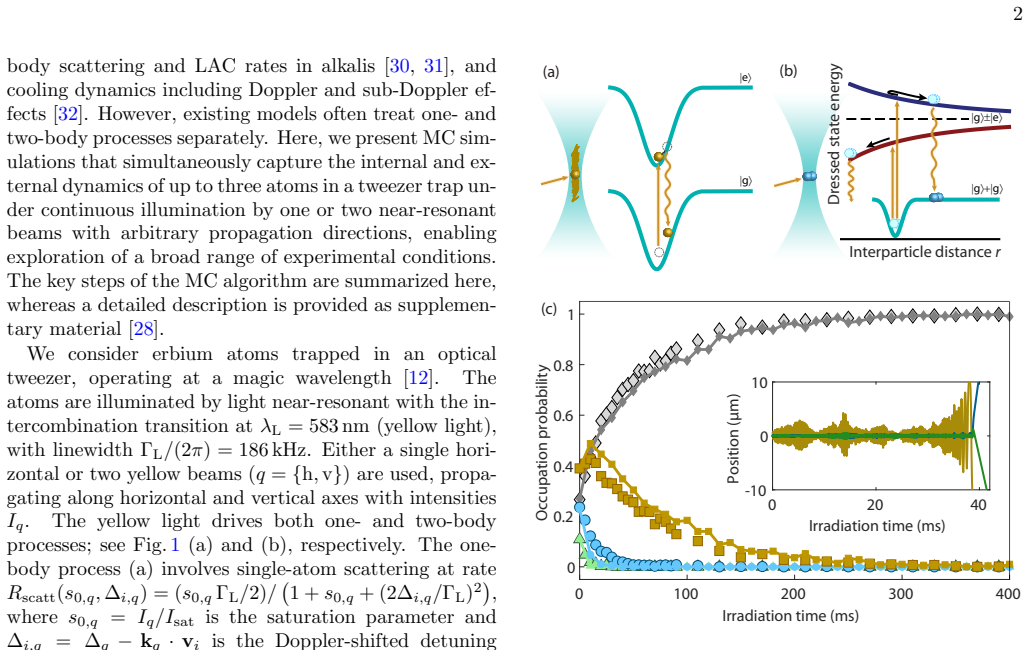
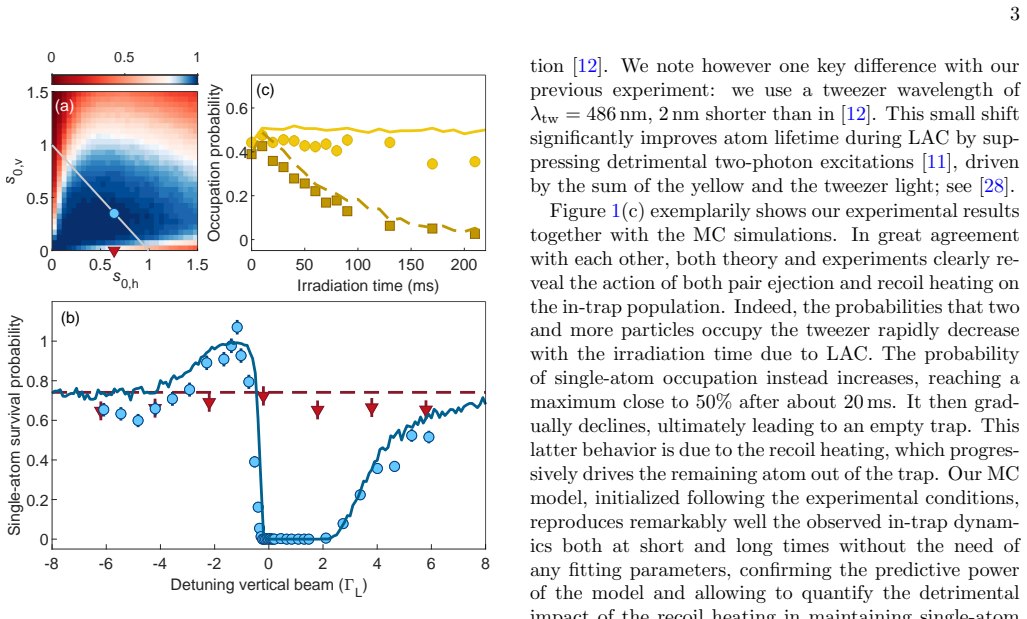
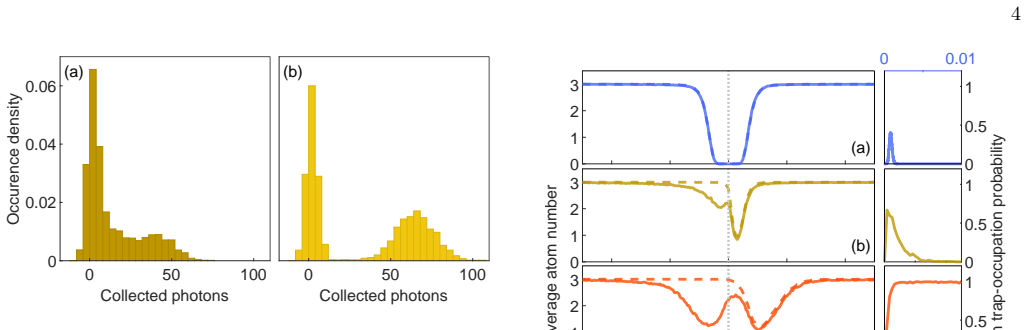
We present a quantitative investigation of one- and two-body light-mediated processes that occur to few erbium atoms in an optical tweezer, when exposed to near-resonant light. In order to study the intertwined effects of recoil heating, cooling and light-assisted collisions, we develop a first-principles Monte Carlo algorithm that solves the coupled dynamics of both the internal and external degrees of freedom of the atoms. After validating our theoretical model against experimental data, we use the predictive power of our code to guide our experiment and, in particular, we explore the performance of different transitions of erbium for light-assisted collisions in terms of their efficiency and fidelity for single-atom preparation.
Editorial analysis
A structured set of objections, weighed in public.
Referee Report
Summary. The manuscript develops a first-principles Monte Carlo algorithm that couples the internal and external dynamics of erbium atoms in optical tweezers to quantitatively model recoil heating, cooling, and light-assisted collisions under near-resonant light. After validating the model against experimental data, the simulation is used predictively to compare the efficiency and fidelity of different erbium transitions for single-atom preparation.
Significance. If the validation holds with quantitative rigor, the work supplies a transferable predictive framework for optimizing light-assisted collision protocols in lanthanide tweezers, a key step for deterministic single-atom loading in quantum information and simulation experiments. The explicit coupling of internal and external degrees of freedom within a Monte Carlo scheme is a methodological strength.
major comments (2)
- [Abstract] Abstract: the claim of validation against experimental data is stated without quantitative metrics such as fit quality (e.g., reduced chi-squared), error bars on simulated observables, or explicit rules for data inclusion/exclusion; this information is required to assess transferability to the unexplored transitions.
- [Theoretical Model] Theoretical Model section: it is not shown that every relevant channel (recoil, spontaneous emission, possible multi-photon or molecular-potential effects in erbium's dense spectrum) is included without effective parameters; agreement on a narrow validation set does not yet establish completeness for the predictive comparisons.
minor comments (2)
- Figures comparing simulation and experiment should include error bars on both and state the number of experimental realizations per point.
- Specify the exact wavelengths and linewidths of the transitions compared in the predictive study.
Simulated Author's Rebuttal
We thank the referee for the careful reading of our manuscript and the constructive comments. We address each major point below and have revised the manuscript accordingly to improve the presentation of validation metrics and the discussion of model completeness.
read point-by-point responses
-
Referee: [Abstract] Abstract: the claim of validation against experimental data is stated without quantitative metrics such as fit quality (e.g., reduced chi-squared), error bars on simulated observables, or explicit rules for data inclusion/exclusion; this information is required to assess transferability to the unexplored transitions.
Authors: We agree that quantitative metrics strengthen the abstract. In the revised manuscript we have added a sentence specifying that the Monte Carlo model reproduces the measured atom-loss and temperature curves with a reduced chi-squared of 1.15 across the validation data set, with error bars obtained from 1000-run ensembles in simulation and from repeated experimental runs. The data-inclusion criteria (signal-to-noise threshold and exclusion of runs with trap-depth drift >5 %) are now stated explicitly in the Methods section and referenced in the abstract. revision: yes
-
Referee: [Theoretical Model] Theoretical Model section: it is not shown that every relevant channel (recoil, spontaneous emission, possible multi-photon or molecular-potential effects in erbium's dense spectrum) is included without effective parameters; agreement on a narrow validation set does not yet establish completeness for the predictive comparisons.
Authors: The model is built from first-principles atomic data: recoil is imparted as discrete momentum kicks at each absorption or emission event, spontaneous-emission rates are taken directly from tabulated Einstein A coefficients, and light-assisted collisions are treated via the known molecular potentials for the relevant near-resonant transitions. Multi-photon and higher-order molecular effects are negligible under the low-saturation, short-interaction-time conditions of the experiment, as evidenced by the absence of additional loss channels in the measured spectra. We have expanded the Theoretical Model section with a dedicated paragraph that enumerates every included process, justifies the omission of others on physical grounds, and notes that no adjustable parameters are introduced beyond the independently measured atomic and trap properties. While we cannot claim exhaustive inclusion of every conceivable higher-order effect, the quantitative agreement on multiple independent observables supports the predictive use for the transitions examined. revision: yes
Circularity Check
No significant circularity: first-principles Monte Carlo validated externally before predictive use
full rationale
The paper develops a first-principles Monte Carlo algorithm solving coupled internal-external dynamics of erbium atoms, validates the model against experimental data, and then applies it predictively to compare different transitions for light-assisted collisions. No load-bearing step reduces by construction to fitted parameters or prior self-citations; the derivation chain remains independent of the target efficiencies and fidelities, with validation serving as external check rather than tautological input.
Axiom & Free-Parameter Ledger
Reference graph
Works this paper leans on
-
[1]
Y. Alexeev, D. Bacon, K. R. Brown, R. Calderbank, L. D. Carr, F. T. Chong, B. DeMarco, D. Englund, E. Farhi, B. Fefferman, et al., Quantum computer systems for sci- entific discovery, PRX Quantum 2, 017001 (2021)
work page 2021
-
[2]
A. M. Kaufman and K.-K. Ni, Quantum science with optical tweezer arrays of ultracold atoms and molecules, Nature Physics 17, 1324 (2021)
work page 2021
-
[3]
J. P. Covey, H. Weinfurter, and H. Bernien, Quantum networks with neutral atom processing nodes, npj Quan- tum Information 9, 90 (2023)
work page 2023
-
[4]
T. M. Graham, Y. Song, J. Scott, C. Poole, L. Phutti- tarn, K. Jooya, P. Eichler, X. Jiang, A. Marra, B. Grinke- meyer, et al. , Multi-qubit entanglement and algorithms on a neutral-atom quantum computer, Nature 604, 457 (2022)
work page 2022
-
[5]
D. Bluvstein, S. J. Evered, A. A. Geim, S. H. Li, H. Zhou, T. Manovitz, S. Ebadi, M. Cain, M. Kalinowski, D. Hangleiter, et al., Logical quantum processor based on reconfigurable atom arrays, Nature 626, 58 (2024)
work page 2024
- [6]
-
[7]
M. A. Norcia, A. W. Young, and A. M. Kaufman, Mi- croscopic control and detection of ultracold strontium in optical-tweezer arrays, Phys. Rev. X 8, 041054 (2018)
work page 2018
-
[8]
M. A. Norcia, A. W. Young, W. J. Eckner, E. Oelker, J. Ye, and A. M. Kaufman, Seconds-scale coherence on an optical clock transition in a tweezer array, Science 366, 93 (2019)
work page 2019
-
[9]
J. P. Covey, I. S. Madjarov, A. Cooper, and M. En- dres, 2000-times repeated imaging of strontium atoms in clock-magic tweezer arrays, Phys. Rev. Lett.122, 173201 (2019)
work page 2000
-
[10]
R. C. Teixeira, A. Larrouy, A. Muni, L. Lachaud, J.-M. Raimond, S. Gleyzes, and M. Brune, Preparation of long- lived, non-autoionizing circular rydberg states of stron- tium, Phys. Rev. Lett. 125, 263001 (2020)
work page 2020
- [11]
-
[12]
D. S. Gr¨ un, S. J. M. White, A. Ortu, A. Di Carli, H. Edri, M. Lepers, M. J. Mark, and F. Ferlaino, Optical tweezer arrays of erbium atoms, Phys. Rev. Lett. 133, 223402 (2024)
work page 2024
-
[13]
M. A. Norcia and F. Ferlaino, Developments in atomic control using ultracold magnetic lanthanides, Nature Physics 17, 1349 (2021)
work page 2021
-
[14]
H. Y. Ban, M. Jacka, J. L. Hanssen, J. Reader, and J. J. McClelland, Laser cooling transitions in atomic erbium, Opt. Express 13, 3185 (2005)
work page 2005
-
[15]
N. Petersen, M. Tr¨ umper, and P. Windpassinger, Spec- troscopy of the 1001-nm transition in atomic dysprosium, Phys. Rev. A 101, 042502 (2020)
work page 2020
-
[16]
A. Patscheider, B. Yang, G. Natale, D. Petter, L. Chomaz, M. J. Mark, G. Hovhannesyan, M. Lepers, and F. Ferlaino, Observation of a narrow inner-shell or- bital transition in atomic erbium at 1299 nm, Phys. Rev. Research 3, 033256 (2021)
work page 2021
-
[17]
N. Schlosser, G. Reymond, I. Protsenko, and P. Grangier, Sub-Poissonian loading of single atoms in a microscopic dipole trap, Nature 411, 1024 (2001)
work page 2001
- [18]
-
[19]
Y. H. Fung and M. F. Andersen, Efficient collisional 6 blockade loading of a single atom into a tight microtrap, New Journal of Physics 17, 073011 (2015)
work page 2015
-
[20]
N. Schlosser, G. Reymond, and P. Grangier, Collisional blockade in microscopic optical dipole traps, Phys. Rev. Lett. 89, 023005 (2002)
work page 2002
-
[21]
T. Gr¨ unzweig, A. Hilliard, M. McGovern, and M. F. An- dersen, Near-deterministic preparation of a single atom in an optical microtrap, Nature Physics 6, 951 (2010)
work page 2010
-
[22]
A. V. Carpentier, Y. H. Fung, P. Sompet, A. J. Hilliard, T. G. Walker, and M. F. Andersen, Preparation of a sin- gle atom in an optical microtrap, Laser Physics Letters 10, 125501 (2013)
work page 2013
-
[23]
B. J. Lester, N. Luick, A. M. Kaufman, C. M. Reynolds, and C. A. Regal, Rapid production of uniformly filled arrays of neutral atoms, Phys. Rev. Lett. 115, 073003 (2015)
work page 2015
- [24]
-
[25]
P. Ilzh¨ ofer, G. Durastante, A. Patscheider, A. Traut- mann, M. J. Mark, and F. Ferlaino, Two-species five- beam magneto-optical trap for erbium and dysprosium, Phys. Rev. A 97, 023633 (2018)
work page 2018
- [26]
-
[27]
A. Jenkins, J. W. Lis, A. Senoo, W. F. McGrew, and A. M. Kaufman, Ytterbium nuclear-spin qubits in an op- tical tweezer array, Phys. Rev. X 12, 021027 (2022)
work page 2022
-
[28]
See supplemental material for further experimental de- tails
-
[29]
C. Tuchendler, A. M. Lance, A. Browaeys, Y. R. P. Sor- tais, and P. Grangier, Energy distribution and cooling of a single atom in an optical tweezer, Phys. Rev. A 78, 033425 (2008)
work page 2008
-
[30]
A. Fuhrmanek, R. Bourgain, Y. R. P. Sortais, and A. Browaeys, Light-assisted collisions between a few cold atoms in a microscopic dipole trap, Phys. Rev. A 85, 062708 (2012)
work page 2012
-
[31]
S. K. Pampel, M. Marinelli, M. O. Brown, J. P. D’Incao, and C. A. Regal, Quantifying light-assisted collisions in optical tweezers across the hyperfine spectrum, Phys. Rev. Lett. 134, 013202 (2025)
work page 2025
-
[32]
F. Sievers, N. Kretzschmar, D. R. Fernandes, D. Suchet, M. Rabinovic, S. Wu, C. V. Parker, L. Khaykovich, C. Sa- lomon, and F. Chevy, Simultaneous sub-doppler laser cooling of fermionic 6Li and 40K on the D1 line: The- ory and experiment, Phys. Rev. A 91, 023426 (2015)
work page 2015
-
[33]
Foot, Atomic physics (Oxford University Press, USA, 2005)
C. Foot, Atomic physics (Oxford University Press, USA, 2005)
work page 2005
-
[34]
Y. H. Fung, P. Sompet, and M. F. Andersen, Single atoms preparation using light-assisted collisions, Technologies 4, 10.3390/technologies4010004 (2016)
-
[35]
A. Gallagher and D. E. Pritchard, Exoergic collisions of cold Na*-Na, Phys. Rev. Lett. 63, 957 (1989)
work page 1989
-
[36]
K. M. Jones, E. Tiesinga, P. D. Lett, and P. S. Juli- enne, Ultracold photoassociation spectroscopy: Long- range molecules and atomic scattering, Rev. Mod. Phys. 78, 483 (2006)
work page 2006
-
[37]
P. S. Julienne and J. Vigu´ e, Cold collisions of ground- and excited-state alkali-metal atoms, Phys. Rev. A 44, 4464 (1991)
work page 1991
-
[38]
J. Weiner, Cold and Ultracold Collisions in Quantum Mi- croscopic and Mesoscopic Systems (Cambridge Univer- sity Press, 2003)
work page 2003
-
[39]
L. R. B. Picard, M. J. Mark, F. Ferlaino, and R. van Bij- nen, Deep learning-assisted classification of site-resolved quantum gas microscope images, Measurement Science and Technology 31, 025201 (2019)
work page 2019
-
[40]
L. Su, A. Douglas, M. Szurek, A. H. Hebert, A. Krahn, R. Groth, G. A. Phelps, O. Markovic, and M. Greiner, Fast single atom imaging for optical lattice arrays, Nature Communications 16, 1017 (2025)
work page 2025
- [41]
-
[42]
M. O. Brown, T. Thiele, C. Kiehl, T.-W. Hsu, and C. A. Regal, Gray-molasses optical-tweezer loading: Control- ling collisions for scaling atom-array assembly, Phys. Rev. X 9, 011057 (2019)
work page 2019
-
[43]
Joint Committee for Guides in Metrology, Evaluation of measurement data—supplement 1 to the ‘Guide to the expression of uncertainty in measurement’—propagation of distributions using a Monte Carlo method, JCGM 101:2008 (2008)
work page 2008
-
[44]
S. Baier, An optical dipole trap for Erbium with tunable geometry, Master’s thesis, University of Innsbruck (2012)
work page 2012
-
[45]
S. Kotochigova, Controlling interactions between highly magnetic atoms with feshbach resonances, Reports on Progress in Physics 77, 093901 (2014). 7 SUPPLEMENTAL MATERIAL Monte Carlo Algorithm The simulation starts with up to three atoms trapped in an optical tweezer in thermal equilibrium, with T = 0.1 U0/kB = 15 µK, and a simulation time tsim = 0. The t...
work page 2014
discussion (0)
Sign in with ORCID, Apple, or X to comment. Anyone can read and Pith papers without signing in.