REVIEW 3 major objections 4 minor 50 references
Design of an Active Thomson Parabola for the detection of ions accelerated by laser: Numerical simulations and characterization of different solutions
T0 review · 3 major / 4 minor · reviewed 2026-08-07 · deepseek-v4-flash
Pith's one-line read A modular Thomson parabola with a thin scintillator and lens-based camera readout is the most practical configuration for high-repetition-rate laser-ion spectrometry.
desk verdict Useful, honest instrument study with a real configuration trade-off; the 'lens is best' claim needs realistic optics before it holds. read the letter →
The pith
A machine-rendered reading of the paper's core claim, the machinery that carries it, and where it could break.
The reading
What carries the argument
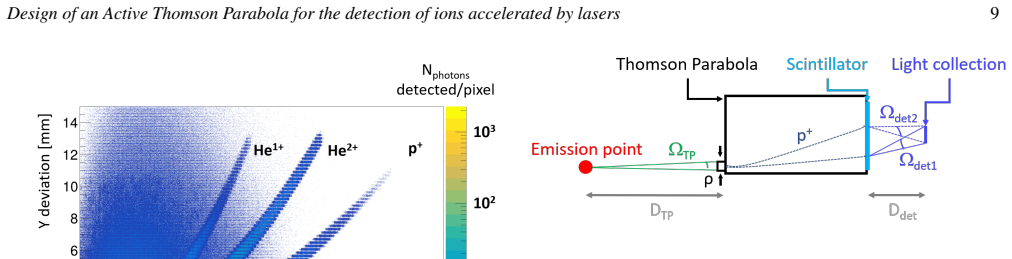
The central mechanism is the Thomson parabola itself: parallel electric and magnetic fields deflect ions along two perpendicular axes, mapping each ion species onto a parabola whose position encodes charge-to-mass ratio and energy, with the entrance pinhole setting the solid angle and hence the best possible energy resolution. What carries the new design is the modular detector cartridge and the optical readout chain: a scintillator converts ion energy into visible light, and a lens system (modeled as an ideal biconvex lens of f = 300 mm and numerical aperture 0.13 located 30 cm from the scintillator) relays that light to a CMOS camera outside the vacuum. Four readout geometries are compared in the same particle-transport and optical-photon simulation: direct contact, scintillating fibers, fiber-bundle light collection, and lens imaging; the comparison of collected photons, trace width, and X/γ background is what determines the ranking.
What would settle it
A direct measurement of trace width would settle it: record a monoenergetic ~10 MeV proton beam on the prototype with the real f = 300 mm lens and compare the full width at half maximum of the trace on the CMOS camera with the simulated width. If the real lens broadens the 10 MeV trace enough to push the energy resolution above roughly 0.5%, or if the photon signal falls below the detection threshold for a single laser shot, the 'most attractive' ranking would have to be revised.
Extended reading notes
Core claim
On the paper's own account, an active Thomson parabola built from a compact magnet (0.76 T over 40 mm), a 200 mm electrostatic deflector, and a 100 µm entrance pinhole can sort laser-accelerated ions up to the stated targets: 0.5% proton energy resolution at 10 MeV and proton/helium-2+ discrimination up to 26 MeV, with the minimum observable proton energy around 1 MeV. The central comparative claim is that among the four scintillator-based active readouts, the configuration in which a 0.1 mm plastic scintillator is imaged onto the CMOS camera through a lens-based optical system is the best overall compromise. It avoids the uncontrolled background and trace broadening of a camera in direct contact with the scintillator, avoids the 200 µm granularity and high-energy smearing of scintillating-fiber bundles, and offers excellent track quality at the cost of a lower photon signal; the authors therefore adopt it for their forthcoming active-mode tests.
Load-bearing premise
The ranking that makes the optical lens system the most attractive solution assumes the biconvex lens images the scintillator without real blur; the simulations use an ideal lens (f = 300 mm, NA = 0.13) and do not include aberrations, depth-of-field spread, or mechanical alignment tolerances, and the active mode has not yet been validated against real laser shots.
Editorial extensions
If this is right
- A laser facility operating at 10 Hz or higher can collect a complete ion spectrum on every shot, because the camera readout replaces imaging-plate removal and scanning.
- The demonstrated 0.5% energy resolution at 10 MeV and p+/He2+ separation to 26 MeV can be reached with the active design, not only with imaging plates, if the thin-scintillator lens readout is used.
- Scintillator thickness should stay near 0.1 mm; thicker screens increase photon signal only marginally while blurring traces and degrading resolution.
- Moving the camera outside the chamber and using plastic scintillators, which are nearly transparent to X/γ flashes, keeps electromagnetic-pulse and radiation background manageable.
- The modular cartridge design lets the same spectrometer be calibrated with an imaging plate and then switched to active readout without realigning the spectrometer.
Reading between the lines
- A real imaging lens will add point-spread blur, depth-of-field softening, and alignment errors that the ideal thin-lens model understates; the practical energy resolution is therefore likely to fall somewhat short of the simulated 0.5% until a lens characterization is folded into the comparison.
- Because the organic scintillator is almost transparent to X/γ (0.15% detection per photon versus roughly 2.6% for an inorganic crystal), an organic screen may remain the better choice in noisy laser environments even though its light yield is lower; the paper compares yields but leaves this background trade-off implicit.
- The observed degradation of the plastic scintillator above roughly one million accumulated protons implies that a repetition-rate diagnostic will need periodic in-situ calibration; the measured linear light response could be used to build an automated gain-monitoring procedure.
- The same lens-relay geometry could be tested with a fast-gated or intensified camera to gate out the X/γ flash, a step the paper does not simulate but that follows directly from putting the camera behind a relay.
Editorial analysis
A structured set of objections, weighed in public.
Referee Report
Summary. The manuscript describes the design of a modular active Thomson Parabola spectrometer for laser-driven ion spectroscopy, with emphasis on scintillator-based detection read out by a CMOS camera. The authors present the magnetic and electric deflection geometry, validate the design using imaging plates in a campaign at CLPU, and then use GEANT4 optical simulations to compare four active readout configurations: scintillator in direct contact with the camera, scintillating fibers, a non-scintillating fiber array, and a lens-based imaging system. The simulations rank the lens-based configuration as the most attractive overall because it preserves trace quality and energy resolution while allowing the camera to be placed outside the vacuum chamber and permitting flexible scintillator thickness. The paper also includes proton-beam characterization of several scintillators at the AIFIRA facility, reporting linearity, degradation under proton flux, and detection thresholds. The abstract and conclusion explicitly state that experimental validation of the active configuration under real laser conditions remains to be performed.
Significance. If the central conclusion is correct, the paper offers a practical route to high-repetition-rate Thomson Parabola spectrometry: a modular instrument with interchangeable detector cartridges, a magnetic field map validated by Hall-probe measurements, and an IP-based experimental benchmark at CLPU. The AIFIRA proton-beam data are genuine experimental results and include useful information on scintillator linearity and radiation damage. The GEANT4 simulations are built from independently specified inputs (TNSA-like spectra, vendor scintillator properties, measured magnetic field data) and the code is described in sufficient detail to be reproduced. The main weakness is that the ranking between configurations depends on an idealized optical model and on simulations that neglect Birks quenching; the paper is transparent about both limitations, but they are load-bearing for the central claim that the lens-based system is the most attractive solution.
major comments (3)
- [3.5–3.6] The central ranking of the lens-based configuration as 'the most attractive solution overall' (Section 3.6) rests on the GEANT4 optical model of Section 3.5, which treats the readout as an ideal biconvex lens (f = 300 mm, NA = 0.13) at 30 cm from the scintillator with no lens aberrations, no field curvature over the ~56 mm detector extent, and no quantitative depth-of-field treatment. For a real singlet at this aperture, the depth of field is of order lambda/NA^2, roughly 30–60 µm at visible wavelengths, much smaller than the 0.1–1 mm scintillator thickness, so photons emitted from different depths will blur the trace. The paper's own focal-depth caveat is stated but never modeled, and because Table 1 and Fig. 19 rank this configuration above the fiber-bundle option mainly on resolution, a realistic optical PSF could reverse the ranking. Please either include a realistic lens simulation (spherical aberration, field curvature, depth-of-field) or provide a bench measurement of trace width for the actual lens geometry.
- [3.7 and 3.1] All active-readout simulations neglect Birks quenching; Section 3.7 states this explicitly as an 'ultra-optimistic scenario.' Quenching reduces light yield most strongly for high-LET ions and for low-energy protons near the Bragg peak, so the photon-count comparisons in Figs. 18 and 20 and the sensitivity ranking in Table 1 are not quantitative. The authors do not provide a calibrated Birks constant or a bracketing estimate of the resulting uncertainty. Because the lens configuration is described as suffering from 'potential sensitivity issues,' the magnitude of that sensitivity disadvantage is currently unquantified. Please add a quenching correction based on a literature or measured Birks constant, or present the photon-count comparisons as a bounded sensitivity range with explicit limits.
- [Appendix A / Section 3.6] The experimental characterization in Appendix A is performed with a microscope objective collecting 1.88 sr, not with the lens configuration of Section 3.5 (NA = 0.13, collection solid angle roughly a factor of 35 smaller). Therefore the AIFIRA data validate the scintillator materials and the readout chain only in a different optical geometry; they do not validate the trace quality or sensitivity of the configuration that the paper ranks as most attractive. The statement in Section 3.6 that 'we chose to use this configuration' for the tests in Section A is misleading in this respect. Either repeat the calibration with the actual lens setup or explicitly state that Appendix A is a material characterization only and cannot be used to predict integrated gray values for the lens configuration.
minor comments (4)
- [Fig. 18 / Section 3.6] The stated 10% uncertainty band on the simulated photon-count curves is not derived anywhere in the text; please specify whether it comes from counting statistics, optical parameter variations, or track-fitting resolution.
- [Section 3.3] The phrase 'discrimination is no longer achievable with IPs' should specify which ion species (p+ versus He2+) and at which energy this refers to, and should cite the corresponding simulation result.
- [Section 3.7] The factor-of-10^7 estimate separating proton and X/gamma deposited energy is stated without details of the proton energy used; please provide the full simulation inputs for this comparison, including the proton spectrum and the X/gamma Boltzmann distribution parameters.
- [Section 2.2] The configuration bullets list a total length of 300 mm, but the individual contributions (LB = 40 mm, LE = 200 mm, DB = 265 mm, DE = 50 mm, plus the field-free gaps) do not obviously sum to that value; please clarify how the total length is defined.
Circularity Check
No significant circularity: the design-loop results are generated from independently specified inputs and externally benchmarked measurements, not from fitted or self-referential definitions.
full rationale
The paper's derivation chain is self-contained. The magnetic-field design uses an analytic permanent-magnet formula (Eq. 1, from ref. [35]), and the resulting 0.78 T value is independently confirmed by a Hall-probe measurement (Sec. 2.1.1), so the magnet input is not defined by the outcome it is used to predict. The active-detection comparison (Secs. 3.2-3.5) is a GEANT4 optical simulation driven by vendor scintillator properties (EJ-262, EJ-444, YAG:Ce), a TNSA-like input spectrum, a specified camera pitch and quantum efficiency, and stated lens parameters (f = 300 mm, NA = 0.13); the outputs (photon counts, trace widths, energy resolution) are not fed back into any fitted parameter and are not equal to the inputs by construction. The claim that the lens configuration preserves track quality is a simulation result under an explicitly idealized thin-lens model, and the paper itself notes the focal-depth and light-collection caveats (Sec. 3.5) as well as stating in the abstract that experimental validation under real conditions remains to be performed; these are modeling limitations that bear on correctness risk, not circularity. The AIFIRA scintillator characterization (Appendix A) is an external experimental benchmark using a different optical collection geometry, and it is not used to force the ranking. The few self-citations (refs. [35], [39]) are methodological or design-formula references and are not load-bearing uniqueness claims. No fitted quantity is relabeled as a prediction, so there is no reducible circular step.
Assumptions & free parameters
free parameters (4)
- TNSA-like proton spectrum cutoff energy =
110 MeV
- TNSA-like proton spectrum temperature E0 =
30 MeV
- Imaging lens focal length and NA =
f = 300 mm, NA = 0.13 at 30 cm
- Entrance pinhole diameter =
100 µm (200 µm in the CLPU test)
assumptions (5)
- standard math GEANT4 optical photon processes (Snell's law, Beer-Lambert absorption, Fermat propagation, Rayleigh scattering) are modeled correctly for the scintillator, fiber and lens materials.
- domain assumption The input ion spectrum is exponentially decaying with temperature E0=30 MeV and cutoff 110 MeV, representing TNSA-like laser-plasma ions.
- domain assumption The X/gamma background can be represented by a Boltzmann distribution with E0 = 805 keV from ref [45].
- ad hoc to paper Scintillation quenching (Birks' constant) is neglected in all simulations.
- ad hoc to paper The optical readout can be approximated as an ideal thin lens with no aberrations.
Cite this review
Pith. "Pith review of Design of an Active Thomson Parabola for the detection of ions accelerated by laser: Numerical simulations and characterization of different solutions." pith.science (2026). https://pith.science/paper/CPCGLZOU
@misc{pith2026250605220,
  author       = {Pith},
  title        = {Pith review of: Design of an Active Thomson Parabola for the detection of ions accelerated by laser: Numerical simulations and characterization of different solutions},
  year         = {2026},
  howpublished = {\url{https://pith.science/paper/CPCGLZOU}},
  note         = {Machine review of arXiv:2506.05220}
}
read the original abstract
This article describes the development of an active Thomson Parabola ion spectrometer designed to measure the energy spectra of different multi-MeV ion species generated in laser-plasmas interactions. To do so, GEANT4 optical simulations were carried out in order to design and build a spectrometer based on scintillator detectors capable of operating at rates comparable with the highest achievable at any existing or upcoming high intensity laser facilities. Details on the different configurations simulated and their characterization are discussed.
Figures


Figures from the paper (19 more)





Reference graph
Works this paper leans on
-
[1]
Compression of amplified chirped optical pulses,
D. Strickland and G. Mourou, “Compression of amplified chirped optical pulses,” Optics Communications 56, 219–221 (1985)
work page 1985
-
[2]
Generation and characterization of the highest laser intensities (1022 w /cm2),
S.-W. Bahk, P. Rousseau, T. A. Planchon, V . Chvykov, G. Kalintchenko, A. Maksimchuk, G. A. Mourou, and V . Yanovsky, “Generation and characterization of the highest laser intensities (1022 w /cm2),” Opt. Lett. 29, 2837–2839 (2004)
work page 2004
-
[3]
The apollon 10 pw laser: Experimental and theoretical investigation of the temporal characteristics,
D. Papadopoulos, J. Zou, C. Le Blanc, G. Cheriaux, P. Georges, F. Druon, G. Mennerat, L. Martin, A. Freneaux, A. Beluze, N. Lebas, P. Monot, F. Mathieu, and P. Audebert, “The apollon 10 pw laser: Experimental and theoretical investigation of the temporal characteristics,” High Power Laser Science and Engineering 4 (2016)
work page 2016
-
[4]
Elimaia: A laser-driven ion accelerator for multidisciplinary applications,
D. Margarone, G. Cirrone, G. Cuttone, A. Amico, L. And `o, M. Borghesi, S. Bulanov, S. Bulanov, D. Chatain, A. Fajstavr, L. Giu ffrida, F. Grepl, S. Kar, J. Krasa, D. Kramer, G. Larosa, R. Leanza, T. Levato, 16 A. Huber et al. M. Maggiore, L. Manti, G. Milluzzo, B. Odlozilik, V . Olsovcova, J. Perin, J. Pipek, J. Psikal, G. Petringa, J. Ridky, F. Romano, ...
work page 2018
-
[5]
10 pw peak power femtosecond laser pulses at eli-np,
C. Radier, O. Chalus, M. Charbonneau, S. Thambirajah, G. Deschamps, S. David, J. Barbe, E. Etter, G. Matras, S. Ricaud, and et al., “10 pw peak power femtosecond laser pulses at eli-np,” High Power Laser Science and Engineering 10, e21 (2022)
work page 2022
-
[6]
Commissioning experiments of vega-2 at centro de laseres pulsados (clpu),
M. Huault, G. Zeraouli, J. Ajates, J. Api ˜naniz, E. garcia garcia, I. Hern ´andez-Palmero, S. Malko, C. Mendez, J. Perez-Hern ´andez, J. Pisonero, C. Salgado-Lopez, X. Vaisseau, o. Varela, G. Gatti, L. V olpe, L. Roso, R. Fedosejevs, A. Longman, R. Shepherd, and W. Hill, “Commissioning experiments of vega-2 at centro de laseres pulsados (clpu),” (2017) p. FM2B.4
work page 2017
-
[7]
K. M. George, J. T. Morrison, S. Feister, G. K. Ngirmang, J. R. Smith, A. J. Klim, J. Snyder, D. Austin, W. Erbsen, K. D. Frische, and et al., “High-repetition-rate ( ⩾ khz) targets and optics from liquid microjets for high-intensity laser–plasma interactions,” High Power Laser Science and Engineering 7, e50 (2019)
work page 2019
-
[8]
P. Puyuelo-Valdes, D. de Luis, J. Hernandez, J. I. Api˜naniz, A. Curcio, J. L. Henares, M. Huault, J. A. Perez-Hern´andez, L. Roso, G. Gatti, and L. V olpe, “Implementation of a thin, flat water target capable of high-repetition-rate mev-range proton acceleration in a high-power laser at the clpu,” Plasma Physics and Controlled Fusion 64, 054003 (2022)
work page 2022
Show all 50 references
-
[9]
High-intensity laser induced ion acceleration from heavy-water droplets,
S. Karsch, S. D ¨usterer, H. Schwoerer, F. Ewald, D. Habs, M. Hegelich, G. Pretzler, A. Pukhov, K. Witte, and R. Sauerbrey, “High-intensity laser induced ion acceleration from heavy-water droplets,” Phys. Rev. Lett. 91, 015001 (2003)
2003
-
[10]
Laser proton acceleration in a water spray target,
S. Ter-Avetisyan, M. Schn ¨urer, P. V . Nickles, M. B. Smirnov, W. Sandner, A. Andreev, K. Platonov, J. Psikal, and V . Tikhonchuk, “Laser proton acceleration in a water spray target,” Physics of Plasmas 15, 083106 (2008)
2008
-
[11]
Proton acceleration driven by a nanosecond laser from a cryogenic thin solid-hydrogen ribbon,
D. Margarone, A. Velyhan, J. Dostal, J. Ullschmied, J. P. Perin, D. Chatain, S. Garcia, P. Bonnay, T. Pisarczyk, R. Dudzak, M. Rosinski, J. Krasa, L. Giu ffrida, J. Prokupek, V . Scuderi, J. Psikal, M. Kucharik, M. De Marco, J. Cikhardt, E. Krousky, Z. Kalinowska, T. Chodukows...
2016
-
[12]
Stability and debris-mitigation of a solid tape target delivery system for intense laser-matter interactions towards high-repetition-rate,
M. Ehret, D. de Luis, J. I. Api ˜naniz, J. L. Henares, R. Lera, J. A. Perez-Hern ´andez, P. Puyuelo-Valdes, L. V olpe, and G. Gatti, “Stability and debris-mitigation of a solid tape target delivery system for intense laser-matter interactions towards high-repetition-rate,” “bi...
2024
-
[13]
Kilohertz sources of hard x rays and fast ions with femtosecond laser plasmas,
A. e. Thoss, “Kilohertz sources of hard x rays and fast ions with femtosecond laser plasmas,” Journal of the Optical Society of America Part B, Optical Physics 20, 224–228 (2003)
2003
-
[14]
Liquid crystal films as on-demand, variable thickness (50–5000 nm) targets for intense lasers,
P. L. Poole, C. D. Andereck, D. W. Schumacher, R. L. Daskalova, S. Feister, K. M. George, C. Willis, K. U. Akli, and E. A. Chowdhury, “Liquid crystal films as on-demand, variable thickness (50–5000 nm) targets for intense lasers,” Physics of Plasmas 21, 063109 (2014)
2014
-
[15]
Monoenergetic proton beams accelerated by a radiation pressure driven shock,
C. A. J. Palmer, N. P. Dover, I. Pogorelsky, M. Babzien, G. I. Dudnikova, M. Ispiriyan, M. N. Polyanskiy, J. Schreiber, P. Shkolnikov, V . Yakimenko, and Z. Najmudin, “Monoenergetic proton beams accelerated by a radiation pressure driven shock,” Phys. Rev. Lett. 106, 014801 (2011)
2011
-
[16]
Collisionless shocks in laser-produced plasma generate monoenergetic high-energy proton beams,
D. Haberberger, S. Tochitsky, F. Fiuza, C. Gong, R. Fonseca, L. Silva, W. Mori, and C. Joshi, “Collisionless shocks in laser-produced plasma generate monoenergetic high-energy proton beams,” Nature Physics 8, 95–99 (2012)
2012
-
[17]
Development of gas jet targets for laser-plasma experiments at near-critical density,
J. L. Henares, P. Puyuelo-Valdes, F. Hannachi, T. Ceccotti, M. Ehret, F. Gobet, L. Lancia, J.-R. Marques, J. J. Santos, M. Versteegen, and M. Tarisien, “Development of gas jet targets for laser-plasma experiments at near-critical density,” Review of Scientific Instruments 90, ...
2019
-
[18]
Characterization and performance of the Apollon short-focal-area facility following its commissioning at 1 PW level,
K. Burdonov, A. Fazzini, V . Lelasseux, J. Albrecht, P. Antici, Y . Ayoul, A. Beluze, D. Cavanna, T. Ceccotti, M. Chabanis, A. Chaleil, S. N. Chen, Z. Chen, F. Consoli, M. Cuciuc, X. Davoine, J. Delaneau, E. D’humi `eres, J.-L. Dubois, C. Evrard, E. Filippov, A. Freneaux, P. F...
2021
-
[19]
Highly e fficient relativistic-ion generation in the laser-piston regime,
T. Esirkepov, M. Borghesi, S. Bulanov, G. Mourou, and T. Tajima, “Highly e fficient relativistic-ion generation in the laser-piston regime,” Physical review letters 92, 175003 (2004)
2004
-
[20]
High-energy ions from near-critical density plasmas via magnetic vortex acceleration,
T. Nakamura, S. V . Bulanov, T. Z. Esirkepov, and M. Kando, “High-energy ions from near-critical density plasmas via magnetic vortex acceleration,” Phys. Rev. Design of an Active Thomson Parabola for the detection of ions accelerated by lasers 17 Lett. 105, 135002 (2010)
2010
-
[21]
Laser-driven collisionless shock acceleration of protons from gas jets tailored by one or two nanosecond beams,
J. Bonvalet, P. Loiseau, J.-R. Marques, E. Atukpor, E. d’Humieres, J. Domange, P. Forestier-Colleoni, F. Hannachi, L. Lancia, D. Ra ffestin, M. Tarisien, V . Tikhonchuk, and P. Nicola ¨ı, “Laser-driven collisionless shock acceleration of protons from gas jets tailored by one o...
2021
-
[22]
Accurate spectra for high energy ions by advanced time-of-flight diamond-detector schemes in experiments with high energy and intensity lasers,
M. Salvadori, F. Consoli, C. Verona, M. Cipriani, M. P. Anania, P. Andreoli, P. Antici, F. Bisesto, G. Costa, G. Cristofari, R. De angelis, G. Giorgio, M. Ferrario, M. Galletti, D. Giulietti, M. Migliorati, R. Pompili, and A. Zigler, “Accurate spectra for high energy ions by a...
2021
-
[23]
Optimization of radiochromic film stacks to diagnose high-flux laser-accelerated proton beams,
C. B. Curry, C. A. S. Dunning, M. Gauthier, H.-G. J. Chou, F. Fiuza, G. D. Glenn, Y . Y . Tsui, M. Bazalova-Carter, and S. H. Glenzer, “Optimization of radiochromic film stacks to diagnose high-flux laser-accelerated proton beams,” Review of Scientific Instruments 91, 093303 (2020)
2020
-
[24]
Nuclear activation techniques for analysis of laser induced energetic protons,
M. Tarisien, F. Gobet, F. Hannachi, M. Al ´eonard, G. Claverie, M. Gerbaux, G. Malka, J. Scheurer, V . M ´eot, P. Morel, P. Audebert, E. Brambrink, P. Nicolai, V . Tikhonchuk, and K. Amthor, “Nuclear activation techniques for analysis of laser induced energetic protons,” 29th ...
2006
-
[25]
High-resolution Thomson parabola for ion analysis,
J. A. Cobble, K. A. Flippo, D. T. Offermann, F. E. Lopez, J. A. Oertel, D. Mastrosimone, S. A. Letzring, and N. Sinenian, “High-resolution Thomson parabola for ion analysis,” Review of Scientific Instruments 82, 113504 (2011)
2011
-
[26]
Calibration of a thomson parabola ion spectrometer and fujifilm imaging plate detectors for protons, deuterons, and alpha particles,
C. Freeman, G. Fiksel, C. Stoeckl, N. Sinenian, M. Canfield, G. Graeper, A. Lombardo, C. Stillman, S. Padalino, C. Mileham, T. Sangster, and J. Frenje, “Calibration of a thomson parabola ion spectrometer and fujifilm imaging plate detectors for protons, deuterons, and alpha pa...
2011
-
[27]
Modified Thomson spectrometer design for high energy, multi-species ion sources,
D. Gwynne, S. Kar, D. Doria, H. Ahmed, M. Cerchez, J. Fernandez, R. J. Gray, J. S. Green, F. Hanton, D. A. MacLellan, P. McKenna, Z. Najmudin, D. Neely, J. A. Ruiz, A. Schiavi, M. Streeter, M. Swantusch, O. Willi, M. Zepf, and M. Borghesi, “Modified Thomson spectrometer design...
2014
-
[28]
0.85 pw laser operation at 3.3 hz and high-contrast ultrahigh-intensity λ = 400 nm second-harmonic beamline,
Y . Wang, S. Wang, A. Rockwood, B. M. Luther, R. Hollinger, A. Curtis, C. Calvi, C. S. Menoni, and J. J. Rocca, “0.85 pw laser operation at 3.3 hz and high-contrast ultrahigh-intensity λ = 400 nm second-harmonic beamline,” Opt. Lett. 42, 3828–3831 (2017)
2017
-
[29]
Development and calibration of a thomson parabola with microchannel plate for the detection of laser-accelerated mev ions,
K. Michel, M. Schollmeier, E. Brambrink, P. Audebert, A. Blazevic, K. Flippo, D. Gautier, M. Geissel, B. Hegelich, F. N ¨urnberg, J. Schreiber, and M. Roth, “Development and calibration of a thomson parabola with microchannel plate for the detection of laser-accelerated mev io...
2008
-
[30]
Development of advanced thomson spectrometers for nuclear fusion experiments initiated by laser,
G. D. Giorgio, F. Consoli, R. D. Angelis, P. Andreoli, M. Cipriani, G. Cristofari, A. Bonasera, M. Salvadori, and J. Sura, “Development of advanced thomson spectrometers for nuclear fusion experiments initiated by laser,” Journal of Instrumentation15, C10013 (2020)
2020
-
[31]
Angular-resolved thomson parabola spectrometer for laser-driven ion accelerators,
C. Salgado-Lopez, J. Api ˜naniz, J. Henares, J. Perez-Hern´andez, D. de Luis, L. V olpe, and G. Gatti, “Angular-resolved thomson parabola spectrometer for laser-driven ion accelerators,” Sensors22, 3239 (2022)
2022
-
[32]
Compact high repetition rate Thomson parabola ion spectrometer,
R. Nedbailo, J. Park, R. Hollinger, S. Wang, D. Mariscal, J. Morrison, H. Song, G. Zeraouli, G. G. Scott, T. Ma, and J. J. Rocca, “Compact high repetition rate Thomson parabola ion spectrometer,” Review of Scientific Instruments 94, 023505 (2023)
2023
-
[33]
Laser proton acceleration from a near-critical imploding gas target,
O. Seemann, Y . Wan, S. Tata, E. Kroupp, and V . Malka, “Laser proton acceleration from a near-critical imploding gas target,” Phys. Rev. Lett. 133, 025001 (2024)
2024
-
[34]
Distortion of thomson parabolic-like proton patterns due to electromagnetic interference,
F. Grepl, J. Krasa, A. Velyhan, M. De Marco, J. Dost ´al, M. Pfeifer, and D. Margarone, “Distortion of thomson parabolic-like proton patterns due to electromagnetic interference,” Applied Sciences 11, 4484 (2021)
2021
-
[35]
Design for a thomson parabola ion spectrometer,
B. Zielbauer, “Design for a thomson parabola ion spectrometer,” (2022)
2022
-
[36]
Geant4-a simulation toolkit,
S. A. et al., “Geant4-a simulation toolkit,” “bibfield journal “bibinfo journal Nuclear Instruments and Methods in Physics Research Section A: Accelerators, Spectrometers, Detectors and Associated Equipment“ “textbf “bibinfo volume 506,“ “bibinfo pages 250 – 303 (“bibinfo year 2003)
2003
-
[37]
ROOT - A C ++ framework for petabyte data storage, statistical analysis and visualization,
I. Antcheva et al. , “ROOT - A C ++ framework for petabyte data storage, statistical analysis and visualization,” Comput. Phys. Commun. 182, 1384 – 1385 (2011)
2011
-
[38]
Experimental and computational evaluation of alpha particle production from laser-driven proton–boron nuclear reaction in hole-boring scheme,
M. Huault, T. Carriere, H. Larreur, P. Nicola ¨ı, D. Ra ffestin, D. Singappuli, E. D’Humieres, D. Dubresson, K. Batani, M. Cipriani, F. Filippi, M. Scisci `o, C. Verona, L. Giu ffrida, V . Kantarelou, S. Stancek, N. Boudjema, R. Lera, J. A. Perez-Hern´andez, L. V olpe, M. D. R...
2025
-
[39]
A. Huber, Recherche de la nature du neutrino avec le d´ etecteur SuperNEMO : simulations optiques pour l’optimisation du calorim` etre et performances attendues pour le 82Se , “bibinfo type Theses, Universit ´e de Bordeaux (2017)
2017
-
[40]
Eljen, https: //eljentechnology.com/products/ plastic-scintillators/ej-260-ej-262 ()
-
[41]
Eljen, https: //eljentechnology.com/products/ zinc-sulfide-coated/ej-444 ()
-
[42]
Crytur, https: //www.crytur.cz/materials/yagce/
-
[43]
Kuraray, http: //kuraraypsf.jp/
-
[44]
Absolute calibration up to 20 MeV of an online readout CMOS system suitable to detect high-power lasers accelerated protons,
K. Burdonov, R. Lelievre, P. Forestier-Colleoni, T. Ceccotti, M. Cuciuc, L. Lancia, W. Yao, and J. Fuchs, “Absolute calibration up to 20 MeV of an online readout CMOS system suitable to detect high-power lasers accelerated protons,” Review of Scientific Instruments 94, 083303 (2023)
2023
-
[45]
Observation of a highly directional γ-ray beam from ultrashort, ultraintense laser pulse interactions with solids,
P. A. Norreys, M. Santala, E. Clark, M. Zepf, I. Watts, F. N. Beg, K. Krushelnick, M. Tatarakis, A. E. Dangor, X. Fang, P. Graham, T. McCanny, R. P. Singhal, K. W. D. Ledingham, A. Creswell, D. C. W. Sanderson, J. Magill, A. Machacek, J. S. Wark, R. Allott, B. Kennedy, and D. ...
1999
-
[46]
Characterization and performance of the Apollon short-focal-area facility following its commissioning at 1 PW level,
K. Burdonov, A. Fazzini, V . Lelasseux, J. Albrecht, P. Antici, Y . Ayoul, A. Beluze, D. Cavanna, T. Ceccotti, M. Chabanis, A. Chaleil, S. N. Chen, Z. Chen, F. Consoli, M. Cuciuc, X. Davoine, J. P. Delaneau, E. d’Humieres, J.-L. Dubois, C. Evrard, E. Filippov, A. Freneaux, P. ...
2021
-
[47]
Aifira: a light ion beam facility for ion beam analysis and irradiation,
P. Barberet, J. Jouve, and S. e. a. Sorieul, “Aifira: a light ion beam facility for ion beam analysis and irradiation,” . Eur. Phys. J. Plus 136, 67 (2021)
2021
-
[48]
Pstar database,
NIST, “Pstar database,” https: //physics.nist.gov/ PhysRefData/Star/Text/PSTAR.html
-
[49]
Characterisation of plastic scintillators for detection of laser-accelerated protons,
J. S. Green, G. G. Scott, D. Neely, and D. Parker, “Characterisation of plastic scintillators for detection of laser-accelerated protons,” CLF Annual Report 2010-2011 (2011)
2011
-
[50]
Bayesian decision threshold, detection limit and confidence limits in ionising-radiation measurement
K. Weise, K. H ¨ubel, E. Rose, M. Schl ¨ager, D. Schrammel, M. T¨aschner, and R. Michel, “Bayesian decision threshold, detection limit and confidence limits in ionising-radiation measurement.” Radiation protection dosimetry 121 1, 52–63 (2006)
2006
Reviewed August 7, 2026 · model on record in the stance chip above.
Discussion (0). Sign in to comment.