Tensor network method for real-space topology in quasicrystal Chern mosaics
Pith reviewed 2026-05-19 10:43 UTC · model grok-4.3
The pith
A tensor-network method computes local topological invariants in quasicrystals with hundreds of millions of sites.
A machine-rendered reading of the paper's core claim, the machinery that carries it, and where it could break.
Core claim
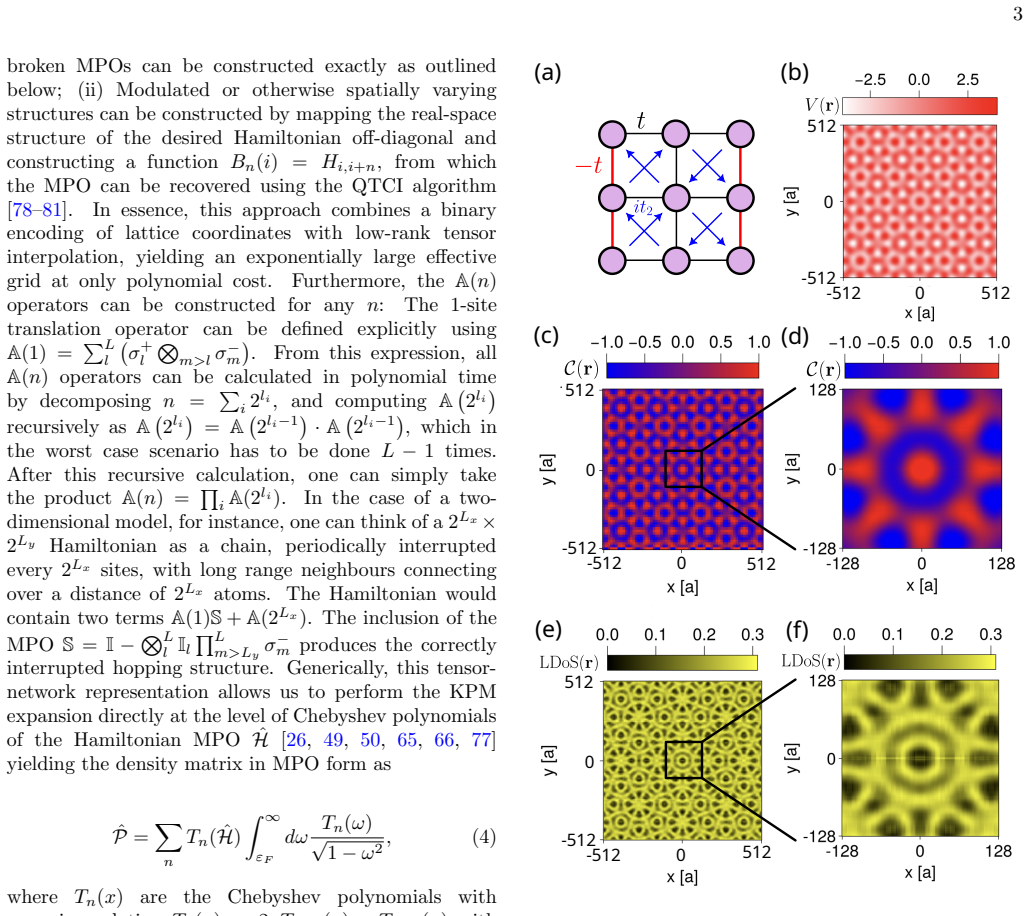
We establish a method to compute local topological invariants of exceptionally large systems using tensor networks, enabling the computation of invariants for Hamiltonians with hundreds of millions of sites, several orders of magnitude above the capabilities of conventional methodologies. Our approach leverages a tensor-network representation of the density matrix using a Chebyshev tensor network algorithm, enabling large-scale calculations of topological markers in quasicrystalline and moire systems. We demonstrate our methodology with two-dimensional quasicrystals featuring C8 and C10 rotational symmetries and mosaics of Chern phases.
What carries the argument
A Chebyshev tensor-network representation of the density matrix that approximates the projector onto occupied states for evaluating real-space topological markers.
If this is right
- Local Chern markers become computable for quasicrystals with C8 and C10 rotational symmetries at scales of hundreds of millions of sites.
- Chern phase mosaics in large super-moire and quasicrystalline lattices can be mapped in real space.
- Topological classification is now feasible for generic aperiodic Hamiltonians that previously exceeded computational limits.
- The same density-matrix construction supplies a route to other real-space invariants in non-periodic two-dimensional systems.
Where Pith is reading between the lines
- The approach could be combined with time-evolution tensor networks to study dynamical topology in driven quasicrystals.
- Similar density-matrix approximations might enable real-space invariants in three-dimensional or interacting aperiodic models.
- The method suggests that local topological markers could serve as diagnostic tools for experimental quasicrystal samples imaged at large length scales.
- Extensions to other spectral functions beyond the projector might allow computation of local density of states and transport coefficients in the same framework.
Load-bearing premise
The Chebyshev tensor-network approximation to the density matrix remains accurate enough to extract faithful local topological invariants when translational symmetry is absent and system size reaches hundreds of millions of sites.
What would settle it
Direct numerical comparison of the local topological markers produced by the tensor-network method against exact diagonalization results on smaller quasicrystal samples of matching symmetry and filling.
Figures


read the original abstract
Computing topological invariants in two-dimensional quasicrystals and super-moire matter is a remarkable open challenge, due to the absence of translational symmetry and the colossal number of sites inherent to these systems. Here, we establish a method to compute local topological invariants of exceptionally large systems using tensor networks, enabling the computation of invariants for Hamiltonians with hundreds of millions of sites, several orders of magnitude above the capabilities of conventional methodologies. Our approach leverages a tensor-network representation of the density matrix using a Chebyshev tensor network algorithm, enabling large-scale calculations of topological markers in quasicrystalline and moire systems. We demonstrate our methodology with two-dimensional quasicrystals featuring $C_8$ and $C_{10}$ rotational symmetries and mosaics of Chern phases. Our work establishes a powerful method to compute topological phases in exceptionally large-scale topological systems, providing the required tool to rationalize generic supe-moire and quasicrystalline topological matter.
Editorial analysis
A structured set of objections, weighed in public.
Referee Report
Summary. The paper claims to establish a tensor-network method using a Chebyshev tensor-network algorithm to represent the density matrix, enabling computation of local topological markers (such as Chern numbers) in two-dimensional quasicrystals with C8 and C10 symmetries and in Chern mosaics, for systems up to hundreds of millions of sites.
Significance. If the central approximation holds, the work would provide a scalable tool for real-space topology in aperiodic systems far beyond the reach of exact methods, addressing an open challenge in quasicrystalline and super-moiré topological matter. The application of standard tensor-network techniques to this domain is a clear strength.
major comments (2)
- [Abstract and results on C8/C10 quasicrystals] Abstract and demonstrations on C8/C10 quasicrystals: the claim that the method yields faithful local topological invariants at hundreds of millions of sites is not supported by any reported validation data, error analysis, or direct comparisons against exact results on smaller benchmark systems.
- [Chebyshev tensor-network algorithm] Chebyshev tensor-network algorithm section: error accumulation from polynomial truncation and tensor contraction is controlled only by bond dimension and order, yet no quantitative analysis is given of how these errors propagate through the aperiodic potential without the averaging provided by translational symmetry.
minor comments (1)
- [Abstract] The term 'supe-moire' in the abstract is a typographical error and should be corrected to 'super-moire'.
Simulated Author's Rebuttal
We thank the referee for their careful reading of the manuscript and for the constructive comments. We address each major comment below and have revised the manuscript to incorporate additional validation and error analysis.
read point-by-point responses
-
Referee: [Abstract and results on C8/C10 quasicrystals] Abstract and demonstrations on C8/C10 quasicrystals: the claim that the method yields faithful local topological invariants at hundreds of millions of sites is not supported by any reported validation data, error analysis, or direct comparisons against exact results on smaller benchmark systems.
Authors: We agree that explicit validation against exact results on smaller systems is necessary to support the large-scale claims. In the revised manuscript we have added a new subsection with direct comparisons for C8 and C10 quasicrystals of moderate size (approximately 10^4 sites), where exact computation of local Chern markers remains feasible. The tensor-network results reproduce the exact local invariants to within 1% relative error. We have also included convergence data with respect to bond dimension and Chebyshev order for the largest systems, showing that the reported markers remain stable once these parameters exceed the values used in the original calculations. These additions provide the requested support for the faithfulness of the results at hundreds of millions of sites. revision: yes
-
Referee: [Chebyshev tensor-network algorithm] Chebyshev tensor-network algorithm section: error accumulation from polynomial truncation and tensor contraction is controlled only by bond dimension and order, yet no quantitative analysis is given of how these errors propagate through the aperiodic potential without the averaging provided by translational symmetry.
Authors: This observation is correct; the original manuscript did not contain a dedicated quantitative study of error propagation in the aperiodic setting. In the revised version we have expanded the methods section with an analysis of truncation and contraction errors. We derive an upper bound on the local error that depends only on the Chebyshev order and bond dimension, independent of translational symmetry, and we present numerical tests on finite aperiodic patches of increasing size. These tests show that the error in the local topological markers remains bounded and does not grow with system size beyond the expected truncation threshold, consistent with the real-space locality of the markers. A brief discussion of why the absence of translational averaging does not lead to uncontrolled accumulation has also been added. revision: yes
Circularity Check
No circularity: standard tensor-network technique applied to quasicrystals without self-referential reduction
full rationale
The paper introduces a Chebyshev tensor-network representation of the density matrix to compute local topological markers in large quasicrystalline systems lacking translational symmetry. No equations, derivations, or claims in the abstract or summary reduce the reported invariants or method accuracy to fitted parameters, self-citations, or inputs by construction. The approach relies on established tensor-network algorithms extended to a new application domain, with demonstrations on C8/C10 quasicrystals and Chern mosaics serving as validation rather than tautological outputs. The central claim of scaling to hundreds of millions of sites is presented as an empirical capability of the approximation, independent of any load-bearing self-citation chain or definitional equivalence. This constitutes a self-contained methodological contribution against external benchmarks.
Axiom & Free-Parameter Ledger
axioms (1)
- domain assumption Tensor-network representations of the density matrix remain faithful for topological marker calculations when translational symmetry is broken.
Forward citations
Cited by 2 Pith papers
-
Tensor network approach to momentum-resolved spectroscopy in non-periodic super-moir\'e systems
A tensor network algorithm computes momentum-resolved spectral functions for large non-periodic super-moiré systems by mapping tight-binding problems to solvable quantum many-body simulations using kernel polynomial m...
-
Solving the Gross-Pitaevskii equation on multiple different scales using the quantics tensor train representation
A quantics tensor train solver resolves the Gross-Pitaevskii equation across seven orders of magnitude in length scale in one dimension and on grids larger than a trillion points in two dimensions.
Reference graph
Works this paper leans on
-
[1]
Mapping topological order in coordinate space,
Raffaello Bianco and Raffaele Resta, “Mapping topological order in coordinate space,” Phys. Rev. B 84, 241106 (2011)
work page 2011
-
[2]
Anyons in an exactly solved model and beyond,
Alexei Kitaev, “Anyons in an exactly solved model and beyond,” Annals of Physics 321, 2–111 (2006)
work page 2006
-
[3]
Topological models in rotationally symmetric quasicrystals,
Callum W. Duncan, Sourav Manna, and Anne E. B. Nielsen, “Topological models in rotationally symmetric quasicrystals,” Phys. Rev. B 101, 115413 (2020)
work page 2020
-
[4]
Local topological markers in odd dimensions,
Joseph Sykes and Ryan Barnett, “Local topological markers in odd dimensions,” Phys. Rev. B 103, 155134 (2021)
work page 2021
-
[5]
1d quasicrystals and topological markers,
Joseph Sykes and Ryan Barnett, “1d quasicrystals and topological markers,” Materials for Quantum Technology 2, 025005 (2022)
work page 2022
-
[6]
Local chern marker for periodic systems,
Nicolas Ba` u and Antimo Marrazzo, “Local chern marker for periodic systems,” Phys. Rev. B 109, 014206 (2024)
work page 2024
-
[7]
Wei Chen, “Universal topological marker,” Phys. Rev. B 107, 045111 (2023)
work page 2023
-
[8]
Kitaev formula for periodic, quasicrystal, and fractal floquet topological insulators,
Yan-kun Chen, Qing-hui Liu, Bingsuo Zou, and Yongyou Zhang, “Kitaev formula for periodic, quasicrystal, and fractal floquet topological insulators,” Phys. Rev. B 107, 054109 (2023)
work page 2023
-
[9]
Quantum hall effect and landau levels without spatial long-range correlations,
Isac Sahlberg, Moein N. Ivaki, Kim P¨ oyh¨ onen, and Teemu Ojanen, “Quantum hall effect and landau levels without spatial long-range correlations,” Phys. Rev. Res. 5, 033218 (2023)
work page 2023
-
[10]
Noncrystalline topological superconductors,
Sourav Manna, Sanjib Kumar Das, and Bitan Roy, “Noncrystalline topological superconductors,” Phys. Rev. B 109, 174512 (2024)
work page 2024
-
[11]
T. V. C. Ant˜ ao, D. A. Miranda, and N. M. R. Peres, “Coexistence of one-dimensional and two-dimensional topology and genesis of dirac cones in the chiral aubry- andr´ e model,” Phys. Rev. B109, 195436 (2024)
work page 2024
-
[12]
Mechanical su-schrieffer-heeger quasicrystal: Topology, localization, and mobility edge,
D. A. Miranda, T. V. C. Ant˜ ao, and N. M. R Peres, “Mechanical su-schrieffer-heeger quasicrystal: Topology, localization, and mobility edge,” Phys. Rev. B 109, 195427 (2024)
work page 2024
-
[13]
Chern mosaic and berry-curvature magnetism in magic-angle graphene,
Sameer Grover, Matan Bocarsly, Aviram Uri, Petr Stepanov, Giorgio Di Battista, Indranil Roy, Jiewen Xiao, Alexander Y. Meltzer, Yuri Myasoedov, Keshav Pareek, Kenji Watanabe, Takashi Taniguchi, Binghai Yan, Ady Stern, Erez Berg, Dmitri K. Efetov, and Eli Zeldov, “Chern mosaic and berry-curvature magnetism in magic-angle graphene,” Nature Physics 18, 885–8...
work page 2022
-
[14]
The marvels of moir´ e materials,
Eva Y. Andrei, Dmitri K. Efetov, Pablo Jarillo-Herrero, Allan H. MacDonald, Kin Fai Mak, T. Senthil, Emanuel Tutuc, Ali Yazdani, and Andrea F. Young, “The marvels of moir´ e materials,” Nature Reviews Materials 6, 201–206 (2021)
work page 2021
-
[15]
A microscopic perspective on moir´ e materials,
Kevin P Nuckolls and Ali Yazdani, “A microscopic perspective on moir´ e materials,” Nature Reviews Materials , 1–21 (2024)
work page 2024
-
[16]
Dodecagonal bilayer graphene quasicrystal and its approximants,
Guodong Yu, Zewen Wu, Zhen Zhan, Mikhail I. Katsnelson, and Shengjun Yuan, “Dodecagonal bilayer graphene quasicrystal and its approximants,” npj Computational Materials 5 (2019), 10.1038/s41524-019- 0258-0
-
[17]
Topological bands and correlated states in helical trilayer graphene,
Li-Qiao Xia, Sergio C. de la Barrera, Aviram Uri, Aaron Sharpe, Yves H. Kwan, Ziyan Zhu, Kenji Watanabe, Takashi Taniguchi, David Goldhaber-Gordon, Liang Fu, Trithep Devakul, and Pablo Jarillo-Herrero, “Topological bands and correlated states in helical trilayer graphene,” Nature Physics 21, 239–244 (2025)
work page 2025
-
[18]
Superconductivity and strong interactions in a tunable moir´ e quasicrystal,
Aviram Uri, Sergio C. de la Barrera, Mallika T. Randeria, Daniel Rodan-Legrain, Trithep Devakul, Philip J. D. Crowley, Nisarga Paul, Kenji Watanabe, Takashi Taniguchi, Ron Lifshitz, Liang Fu, Raymond C. Ashoori, and Pablo Jarillo-Herrero, “Superconductivity and strong interactions in a tunable moir´ e quasicrystal,” Nature 620, 762–767 (2023)
work page 2023
-
[19]
Robust flat bands in twisted trilayer graphene moir´ e quasicrystals,
Chen-Yue Hao, Zhen Zhan, Pierre A. Pantale´ on, Jia-Qi He, Ya-Xin Zhao, Kenji Watanabe, Takashi Taniguchi, Francisco Guinea, and Lin He, “Robust flat bands in twisted trilayer graphene moir´ e quasicrystals,” Nature Communications 15 (2024), 10.1038/s41467-024-52784- 7
-
[20]
Tuning commensurability in twisted van der waals bilayers,
Yanxing Li, Fan Zhang, Viet-Anh Ha, Yu-Chuan Lin, Chengye Dong, Qiang Gao, Zhida Liu, Xiaohui Liu, Sae Hee Ryu, Hyunsue Kim, Chris Jozwiak, Aaron Bostwick, Kenji Watanabe, Takashi Taniguchi, Bishoy Kousa, Xiaoqin Li, Eli Rotenberg, Eslam Khalaf, Joshua A. Robinson, Feliciano Giustino, and Chih-Kang Shih, “Tuning commensurability in twisted van der waals b...
work page 2024
-
[21]
Polar and quasicrystal vortex observed in twisted- 6 bilayer molybdenum disulfide,
Chi Shing Tsang, Xiaodong Zheng, Tong Yang, Zhangyuan Yan, Wei Han, Lok Wing Wong, Haijun Liu, Shan Gao, Ka Ho Leung, Chun-Sing Lee, Shu Ping Lau, Ming Yang, Jiong Zhao, and Thuc Hue Ly, “Polar and quasicrystal vortex observed in twisted- 6 bilayer molybdenum disulfide,” Science 386, 198–205 (2024)
work page 2024
-
[22]
The aubry–andr´ e model as a hobbyhorse for understanding the localization phenomenon,
G A Dom´ ınguez-Castro and R Paredes, “The aubry–andr´ e model as a hobbyhorse for understanding the localization phenomenon,” European Journal of Physics 40, 045403 (2019)
work page 2019
-
[23]
Hidden dualities in 1d quasiperiodic lattice models,
Miguel Gon¸ calves, Bruno Amorim, Eduardo Castro, and Pedro Ribeiro, “Hidden dualities in 1d quasiperiodic lattice models,” SciPost Physics 13 (2022), 10.21468/scipostphys.13.3.046
-
[24]
Critical phase dualities in 1d exactly solvable quasiperiodic models,
Miguel Gon¸ calves, Bruno Amorim, Eduardo V. Castro, and Pedro Ribeiro, “Critical phase dualities in 1d exactly solvable quasiperiodic models,” Phys. Rev. Lett. 131, 186303 (2023)
work page 2023
-
[25]
Incommensurability-induced enhancement of superconductivity in one dimensional critical systems,
Ricardo Oliveira, Miguel Gon¸ calves, Pedro Ribeiro, Eduardo V. Castro, and Bruno Amorim, “Incommensurability-induced enhancement of superconductivity in one dimensional critical systems,” (2023)
work page 2023
-
[26]
Topological spin excitations in harper-heisenberg spin chains,
J. L. Lado and Oded Zilberberg, “Topological spin excitations in harper-heisenberg spin chains,” Phys. Rev. Res. 1, 033009 (2019)
work page 2019
-
[27]
Maryam Khosravian and J. L. Lado, “Quasiperiodic criticality and spin-triplet superconductivity in superconductor-antiferromagnet moir´ e patterns,” Phys. Rev. Res. 3, 013262 (2021)
work page 2021
-
[28]
Chern networks: reconciling fundamental physics and device engineering,
Matthew J. Gilbert, “Chern networks: reconciling fundamental physics and device engineering,” Nature Communications 16 (2025), 10.1038/s41467-025-59162- x
-
[29]
Density matrix formulation for quantum renormalization groups,
Steven R. White, “Density matrix formulation for quantum renormalization groups,” Phys. Rev. Lett. 69, 2863–2866 (1992)
work page 1992
-
[30]
The density-matrix renormalization group in the age of matrix product states,
Ulrich Schollw¨ ock, “The density-matrix renormalization group in the age of matrix product states,” Annals of Physics 326, 96–192 (2011)
work page 2011
-
[31]
The density-matrix renormalization group,
U. Schollw¨ ock, “The density-matrix renormalization group,” Rev. Mod. Phys. 77, 259–315 (2005)
work page 2005
-
[32]
Tensor networks for complex quantum systems,
Rom´ an Or´ us, “Tensor networks for complex quantum systems,” Nature Reviews Physics 1, 538–550 (2019)
work page 2019
-
[33]
Time-evolution methods for matrix-product states,
Sebastian Paeckel, Thomas K¨ ohler, Andreas Swoboda, Salvatore R. Manmana, Ulrich Schollw¨ ock, and Claudius Hubig, “Time-evolution methods for matrix-product states,” Annals of Physics 411, 167998 (2019)
work page 2019
-
[34]
Time-dependent variational principle for quantum lattices,
Jutho Haegeman, J. Ignacio Cirac, Tobias J. Osborne, Iztok Piˇ zorn, Henri Verschelde, and Frank Verstraete, “Time-dependent variational principle for quantum lattices,” Phys. Rev. Lett. 107, 070601 (2011)
work page 2011
-
[35]
Marcel Niedermeier, Jose L. Lado, and Christian Flindt, “Simulating the quantum fourier transform, grover’s algorithm, and the quantum counting algorithm with limited entanglement using tensor networks,” Phys. Rev. Res. 6, 033325 (2024)
work page 2024
-
[37]
What limits the simulation of quantum computers?
Yiqing Zhou, E. Miles Stoudenmire, and Xavier Waintal, “What limits the simulation of quantum computers?” Phys. Rev. X 10, 041038 (2020)
work page 2020
-
[38]
Naoki Nakatani and Garnet Kin-Lic Chan, “Efficient tree tensor network states (ttns) for quantum chemistry: Generalizations of the density matrix renormalization group algorithm,” The Journal of Chemical Physics 138 (2013)
work page 2013
-
[39]
Tensor product methods and entanglement optimization for ab initio quantum chemistry,
Szil´ ard Szalay, Max Pfeffer, Valentin Murg, Gergely Barcza, Frank Verstraete, Reinhold Schneider, and ¨Ors Legeza, “Tensor product methods and entanglement optimization for ab initio quantum chemistry,” International Journal of Quantum Chemistry 115, 1342–1391 (2015)
work page 2015
-
[40]
Garnet Kin-Lic Chan, Anna Keselman, Naoki Nakatani, Zhendong Li, and Steven R. White, “Matrix product operators, matrix product states, and ab initio density matrix renormalization group algorithms,” The Journal of Chemical Physics 145 (2016)
work page 2016
-
[41]
Efficient parallelization of tensor network contraction for simulating quantum computation,
Cupjin Huang, Fang Zhang, Michael Newman, Xiaotong Ni, Dawei Ding, Junjie Cai, Xun Gao, Tenghui Wang, Feng Wu, Gengyan Zhang, Hsiang-Sheng Ku, Zhengxiong Tian, Junyin Wu, Haihong Xu, Huanjun Yu, Bo Yuan, Mario Szegedy, Yaoyun Shi, Hui-Hai Zhao, Chunqing Deng, and Jianxin Chen, “Efficient parallelization of tensor network contraction for simulating quantum...
work page 2021
-
[42]
Terry Farrelly, Robert J. Harris, Nathan A. McMahon, and Thomas M. Stace, “Tensor-network codes,” Phys. Rev. Lett. 127, 040507 (2021)
work page 2021
-
[43]
Parallel decoding of multiple logical qubits in tensor-network codes,
Terry Farrelly, Nicholas Milicevic, Robert J. Harris, Nathan A. McMahon, and Thomas M. Stace, “Parallel decoding of multiple logical qubits in tensor-network codes,” Phys. Rev. A 105, 052446 (2022)
work page 2022
-
[44]
Overcoming the zero-rate hashing bound with holographic quantum error correction,
Junyu Fan, Matthew Steinberg, Alexander Jahn, Chunjun Cao, and Sebastian Feld, “Overcoming the zero-rate hashing bound with holographic quantum error correction,” (2024), arXiv:2408.06232
-
[45]
Tt-cross approximation for multidimensional arrays,
Ivan Oseledets and Eugene Tyrtyshnikov, “Tt-cross approximation for multidimensional arrays,” Linear Algebra and its Applications 432, 70–88 (2010)
work page 2010
-
[46]
I. V. Oseledets, “Tensor-train decomposition,” SIAM Journal on Scientific Computing 33, 2295–2317 (2011)
work page 2011
-
[47]
Tensor train continuous time solver for quantum impurity models,
A. Erpenbeck, W.-T. Lin, T. Blommel, L. Zhang, S. Iskakov, L. Bernheimer, Y. N´ u˜ nez Fern´ andez, G. Cohen, O. Parcollet, X. Waintal, and E. Gull, “Tensor train continuous time solver for quantum impurity models,” Phys. Rev. B 107, 245135 (2023)
work page 2023
-
[48]
Nonequilibrium diagrammatic many-body simulations with quantics tensor trains,
Matthias Murray, Hiroshi Shinaoka, and Philipp Werner, “Nonequilibrium diagrammatic many-body simulations with quantics tensor trains,” Phys. Rev. B 109, 165135 (2024)
work page 2024
-
[49]
Many-body liouvillian dynamics with a non-hermitian tensor-network kernel polynomial algorithm,
Guangze Chen, Jose L. Lado, and Fei Song, “Many-body liouvillian dynamics with a non-hermitian tensor-network kernel polynomial algorithm,” Phys. Rev. Res. 6, 043182 (2024)
work page 2024
-
[50]
Guangze Chen, Fei Song, and Jose L. Lado, “Topological spin excitations in non-hermitian spin chains with a generalized kernel polynomial algorithm,” Phys. Rev. Lett. 130, 100401 (2023)
work page 2023
-
[52]
Data compression for quantum machine learning,
Rohit Dilip, Yu-Jie Liu, Adam Smith, and Frank Pollmann, “Data compression for quantum machine learning,” Phys. Rev. Res. 4, 043007 (2022)
work page 2022
-
[53]
Unsupervised generative modeling using matrix product states,
Zhao-Yu Han, Jun Wang, Heng Fan, Lei Wang, and Pan 7 Zhang, “Unsupervised generative modeling using matrix product states,” Phys. Rev. X 8, 031012 (2018)
work page 2018
-
[54]
Supervised learning with tensor networks,
Edwin Stoudenmire and David J Schwab, “Supervised learning with tensor networks,” in Advances in Neural Information Processing Systems , Vol. 29, edited by D. Lee, M. Sugiyama, U. Luxburg, I. Guyon, and R. Garnett (Curran Associates, Inc., 2016)
work page 2016
-
[55]
Quantum- inspired framework for computational fluid dynamics,
Raghavendra Dheeraj Peddinti, Stefano Pisoni, Alessandro Marini, Philippe Lott, Henrique Argentieri, Egor Tiunov, and Leandro Aolita, “Quantum- inspired framework for computational fluid dynamics,” Communications Physics 7 (2024)
work page 2024
-
[56]
Tensor networks enable the calculation of turbulence probability distributions,
Nikita Gourianov, Peyman Givi, Dieter Jaksch, and Stephen B. Pope, “Tensor networks enable the calculation of turbulence probability distributions,” Science Advances 11 (2025)
work page 2025
-
[57]
Marcel Niedermeier, Adrien Moulinas, Thibaud Louvet, Jose L. Lado, and Xavier Waintal, “Solving the gross-pitaevskii equation on multiple different scales using the quantics tensor train representation,” (2025), arXiv:2507.04262 [quant-ph]
work page internal anchor Pith review Pith/arXiv arXiv 2025
-
[58]
Quantics tensor train for solving gross-pitaevskii equation,
Aleix Bou-Comas, Marcin P lodzie´ n, Luca Tagliacozzo, and Juan Jos´ e Garc´ ıa-Ripoll, “Quantics tensor train for solving gross-pitaevskii equation,” (2025), arXiv:2507.03134 [cond-mat.quant-gas]
-
[59]
Qian-Can Chen, I-Kang Liu, Jheng-Wei Li, and Chia- Min Chung, “Solving the gross-pitaevskii equation with quantic tensor trains: Ground states and nonlinear dynamics,” (2025), arXiv:2507.04279 [cond-mat.quant- gas]
-
[60]
Tensor network methods for the Gross-Pitaevskii equation on fine grids,
Ryan J. J. Connor, Callum W. Duncan, and Andrew J. Daley, “Tensor network methods for the Gross-Pitaevskii equation on fine grids,” arXiv e-prints , arXiv:2507.01149 (2025), arXiv:2507.01149 [cond-mat.quant-gas]
-
[63]
Matthieu Jeannin, Yuriel N´ u˜ nez Fern´ andez, Thomas Kloss, Olivier Parcollet, and Xavier Waintal, “Cross- extrapolation reconstruction of low-rank functions and application to quantum many-body observables in the strong coupling regime,” Phys. Rev. B 110, 035124 (2024)
work page 2024
-
[65]
Adolfo O Fumega, Marcel Niedermeier, and Jose L Lado, “Correlated states in super-moir´ e materials with a kernel polynomial quantics tensor cross interpolation algorithm,” 2D Materials 12, 015018 (2024)
work page 2024
-
[66]
Yitao Sun, Marcel Niedermeier, Tiago V. C. Ant˜ ao, Adolfo O. Fumega, and Jose L. Lado, “Self- consistent tensor network method for correlated super- moir´ e matter beyond one billion sites,” arXiv e-prints , arXiv:2503.04373 (2025), arXiv:2503.04373 [cond- mat.str-el]
-
[67]
The ITensor Software Library for Tensor Network Calculations,
Matthew Fishman, Steven R. White, and E. Miles Stoudenmire, “The ITensor Software Library for Tensor Network Calculations,” SciPost Phys. Codebases , 4 (2022)
work page 2022
-
[68]
Quantized hall conductance in a two- dimensional periodic potential,
D. J. Thouless, M. Kohmoto, M. P. Nightingale, and M. den Nijs, “Quantized hall conductance in a two- dimensional periodic potential,” Phys. Rev. Lett. 49, 405–408 (1982)
work page 1982
-
[69]
Colloquium: Topological insulators,
M. Z. Hasan and C. L. Kane, “Colloquium: Topological insulators,” Rev. Mod. Phys. 82, 3045–3067 (2010)
work page 2010
-
[70]
Non- hermitian topological invariants in real space,
Fei Song, Shunyu Yao, and Zhong Wang, “Non- hermitian topological invariants in real space,” Phys. Rev. Lett. 123, 246801 (2019)
work page 2019
-
[71]
Real-space second Chern number using the kernel polynomial method,
Rui Chen and Bin Zhou, “Real-space second Chern number using the kernel polynomial method,” arXiv e-prints , arXiv:2507.18919 (2025), arXiv:2507.18919 [cond-mat.mes-hall]
-
[72]
Superfluidity in topologically nontrivial flat bands,
Sebastiano Peotta and P¨ aivi T¨ orm¨ a, “Superfluidity in topologically nontrivial flat bands,” Nature Communications 6 (2015), 10.1038/ncomms9944
-
[73]
Superconductivity, superfluidity and quantum geometry in twisted multilayer systems,
P¨ aivi T¨ orm¨ a, Sebastiano Peotta, and Bogdan A. Bernevig, “Superconductivity, superfluidity and quantum geometry in twisted multilayer systems,” Nature Reviews Physics 4, 528–542 (2022)
work page 2022
-
[74]
Scaling of the integrated quantum metric in disordered topological phases,
Jorge Mart´ ınez Romeral, Aron W. Cummings, and Stephan Roche, “Scaling of the integrated quantum metric in disordered topological phases,” Phys. Rev. B 111, 134201 (2025)
work page 2025
-
[75]
Mapping quantum geometry and quantum phase transitions to real space by a fidelity marker,
Matheus S. M. de Sousa, Antonio L. Cruz, and Wei Chen, “Mapping quantum geometry and quantum phase transitions to real space by a fidelity marker,” Phys. Rev. B 107, 205133 (2023)
work page 2023
-
[76]
Robustness of topological order against disorder,
Lucas A. Oliveira and Wei Chen, “Robustness of topological order against disorder,” Phys. Rev. B 109, 094202 (2024)
work page 2024
-
[77]
Chebyshev matrix product state approach for spectral functions,
Andreas Holzner, Andreas Weichselbaum, Ian P. McCulloch, Ulrich Schollw¨ ock, and Jan von Delft, “Chebyshev matrix product state approach for spectral functions,” Phys. Rev. B 83, 195115 (2011)
work page 2011
-
[78]
Learning feynman diagrams with tensor trains,
Yuriel N´ u˜ nez Fern´ andez, Matthieu Jeannin, Philipp T. Dumitrescu, Thomas Kloss, Jason Kaye, Olivier Parcollet, and Xavier Waintal, “Learning feynman diagrams with tensor trains,” Phys. Rev. X 12, 041018 (2022)
work page 2022
-
[79]
Marc K. Ritter, Yuriel N´ u˜ nez Fern´ andez, Markus Wallerberger, Jan von Delft, Hiroshi Shinaoka, and Xavier Waintal, “Quantics tensor cross interpolation for high-resolution parsimonious representations of multivariate functions,” Phys. Rev. Lett. 132, 056501 (2024)
work page 2024
-
[80]
Learning tensor networks with tensor cross interpolation: New algorithms and libraries,
Yuriel N´ u˜ nez Fern´ andez, Marc K. Ritter, Matthieu Jeannin, Jheng-Wei Li, Thomas Kloss, Thibaud Louvet, Satoshi Terasaki, Olivier Parcollet, Jan von Delft, Hiroshi Shinaoka, and Xavier Waintal, “Learning tensor networks with tensor cross interpolation: New algorithms and libraries,” SciPost Phys. 18, 104 (2025)
work page 2025
-
[81]
Matthieu Jeannin, Yuriel N´ u˜ nez Fern´ andez, Thomas Kloss, Olivier Parcollet, and Xavier Waintal, “Cross- extrapolation reconstruction of low-rank functions and application to quantum many-body observables in the strong coupling regime,” Phys. Rev. B 110, 035124 8 (2024)
work page 2024
-
[82]
Alexander Weiße, Gerhard Wellein, Andreas Alvermann, and Holger Fehske, “The kernel polynomial method,” Rev. Mod. Phys. 78, 275–306 (2006)
work page 2006
-
[83]
Marc Ritter and contributors, “Quanticstci.jl,” (2022), email: Ritter.Marc@physik.uni-muenchen.de
work page 2022
-
[84]
Marc Ritter and contributors, “Tensorcrossinterpolation.jl,” (2022), email: Ritter.Marc@physik.uni-muenchen.de
work page 2022
-
[85]
We take a value of Λ = 10 a, which leads to converged Chern markers
discussion (0)
Sign in with ORCID, Apple, or X to comment. Anyone can read and Pith papers without signing in.