REVIEW 4 major objections 5 minor 1 cited by
Unraveling the structure of the stratified ultra-fast outflows in PDS 456 with XRISM
T0 review · 4 major / 5 minor · reviewed 2026-08-07 · deepseek-v4-flash
Pith's one-line read PDS 456's five ultra-fast outflows form a stratified wind
desk verdict Solid XRISM analysis of PDS 456 outflows with a clever ordering analysis, but the headline stratification relation is not statistically significant and the abstract oversells it. read the letter →
The pith
A machine-rendered reading of the paper's core claim, the machinery that carries it, and where it could break.
The reading
What carries the argument
The load-bearing tool is PION, a self-consistent photoionization model that dynamically computes the ionization balance of each absorbing layer from the spectral energy distribution that actually reaches it, so an inner absorber that removes photons changes the ionization of the layers behind it. In spectral fitting, the six PION components are arranged in a multiplicative sequence, and the paper runs all 720 possible order permutations to see which radial ordering best matches the data. The order preference is read from C-statistic differences (up to $\Delta C = 22$ across sequences) and confirmed by Bayesian evidence comparisons among three representative orderings, with the preferred PION3 ordering (UFO 5-4-6-3-2-1) favored over the others by $\log B \geq 3$. Stability curves computed by PION identify which ionization states sit on thermally unstable branches of the heating-cooling equilibrium.
What would settle it
Observe PDS 456 with a high-resolution soft X-ray spectrometer capable of resolving the 0.7-1 keV band, such as XRISM with the gate valve open or NewAthena/X-IFU, for about 100 ks and repeat the six-component PION permutation analysis. The paper's own simulations predict that the correct sequence will be recoverable with $\Delta C \sim 900$ between orderings and that the soft X-ray outflow will be pinned to the third layer with $\Delta C \sim 100$; if the data instead leave the relative positions unconstrained or favor a different layer, the claimed stratification and the screening-based ordering method would be falsified.
Extended reading notes
Core claim
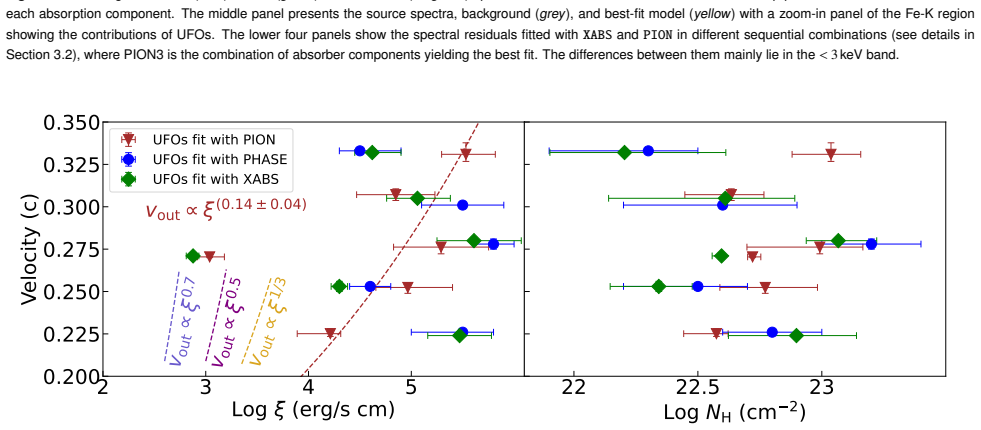
The central claim is that the five hard X-ray ultra-fast outflows in PDS 456, once modeled with the self-consistent photoionization code PION, show a stratified ionization structure in which outflow velocity increases with ionization parameter as $v_{\rm out} \propto \xi^{(0.14\pm 0.04)}$. The paper further claims that by permuting the order of the six PION absorption components along the line of sight, the data favor the slowest hard X-ray outflow ($\log\xi \sim 4.1$, $v \sim 0.23c$) at the innermost layer and the soft X-ray outflow ($\log\xi \sim 3$, $v \sim 0.27c$) in the middle layers, suggesting that slower outflows are launched closer to the supermassive black hole and accelerate as they propagate outward. The soft X-ray outflow is found to be thermally unstable in every ordering, while the hard X-ray outflows are thermally stable; its physical location remains uncertain between the broad-line region at sub-parsec scales and co-spatial with the hard X-ray outflows. The authors present this stratification as a tentative but physically plausible interpretation, supported by C-statistics and Bayesian model comparison.
Load-bearing premise
The stratification and ordering conclusions assume that each absorbing component fully covers the X-ray source and that the sequence of components in the spectral model corresponds one-to-one to their physical radial order along the line of sight; if the outflows are clumpy and only partially cover the source, the screening between layers that carries the ordering signal is not guaranteed.
Editorial extensions
If this is right
- The five hard X-ray UFOs should be treated as one stratified wind: velocity and ionization increase together, so measurements of one component can predict the others.
- Slower-outflow-closer-to-the-black-hole ordering implies outward acceleration, which matches radiatively driven wind models where terminal velocity grows with radius.
- Ignoring absorber order in photoionization fits, as pre-calculated codes do, can misassign ionization parameters in multi-absorber AGN, so future fits must treat screening explicitly.
- The thermally unstable soft X-ray outflow explains its observed rapid variability and suggests the wind fragments into multiple phases, connecting the UFO to warm absorber and BAL phenomena.
- If the same ordering analysis is repeated on other AGN, wind structure, not just wind presence, becomes measurable, allowing direct tests of feedback energetics.
Reading between the lines
- An implication the authors leave implicit is that the measured slope 0.14 could serve as a probe of the radial density and ionization profile of the wind, and comparing this slope across quasars may reveal whether the stratification is universal or tied to Eddington ratio.
- The order-permutation method could be exported to other AGN with multiple absorption systems once XRISM- or NewAthena-quality spectra are available, since the method only needs soft X-ray features sensitive to screening.
- If UFO6 is truly co-spatial with the hard X-ray UFOs, its high density and tiny clump size imply a fine-spray geometry, which would change how covering factors and column densities are interpreted in all UFO studies.
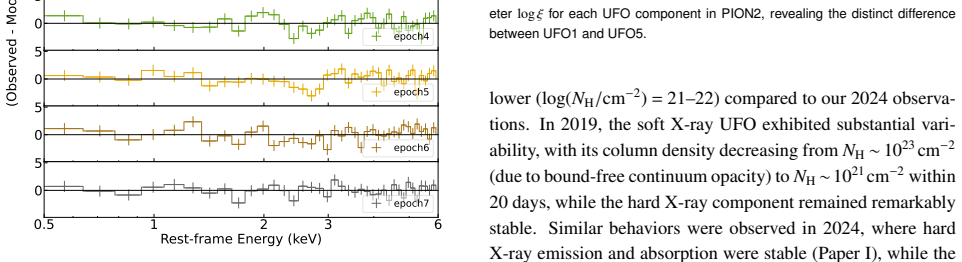
- A direct test of the stratification would be to check whether the velocity-ionization ordering persists during flaring and quiescent states separately, since the 0.8-0.9 keV residuals that drive the order preference appeared only during the flare.
Editorial analysis
A structured set of objections, weighed in public.
Referee Report
Summary. The paper analyzes coordinated XRISM, XMM-Newton, and NuSTAR observations of the luminous quasar PDS 456, modeling six ultrafast outflow (UFO) components with the self-consistent photoionization code PION in SPEX. By permuting the order of the six PION absorbers in the multiplicative spectral model, the authors investigate whether screening effects constrain the relative line-of-sight positions of the components. They report a power-law correlation between outflow velocity and ionization parameter for the five hard X-ray UFOs, vout ∝ ξ^(0.14±0.04), and use this, together with C-statistic histograms and a limited Bayesian analysis, to argue for a stratified outflow in which slower components lie closer to the supermassive black hole. The soft X-ray UFO is found to be thermally unstable in all orderings, though its radial location remains ambiguous. The paper also presents simulations of future XRISM (gate-valve open) and NewAthena observations to show how the order of absorbers could be better constrained.
Significance. If the stratified structure and the vout–ξ correlation are robust, they would constitute a rare, direct observational probe of UFO stratification and acceleration in a prototypical AGN, complementing the line-profile diagnostics of Gallo et al. (2023) and providing constraints on driving mechanisms. The systematic exploration of all 720 order permutations with PION, the use of Bayesian evidence for three representative orders, and the forward-modeling of future instruments are methodologically valuable and go beyond the earlier XRISM collaboration paper. The paper is honest in many places—notably in Sections 4.2 and 4.3 and in the conclusions—about the tentative nature of the sequence and the weakness of the correlation. However, the abstract and several interpretive passages state the stratification as an established result, which is not supported by the paper's own statistics. The work is a useful contribution, but its headline claims need to be brought into line with the evidence.
major comments (4)
- [Abstract; Section 4.3, Table 2] The abstract's claim that the results "reveal a stratified ionization structure, characterized by a relation vout ∝ ξ^(0.14±0.04)" overstates the statistical support. Table 2 reports Spearman ρ=0.70 (p=0.13) and Pearson ρ=0.81 (p=0.09) for n=5, and the text in Section 4.3 explicitly states that "none of the fits meet the conventional threshold for statistical significance (p<0.05)". The conclusion section properly uses "possibly stratified" and "tentative trend", so the abstract is inconsistent with the body. The central physical interpretation of a single stratified outflow rests on this correlation, so the abstract should be reworded to match the caveated language used in the conclusions.
- [Section 3.2.3; Section 4.1.5] The statistical preference for UFO6's layer is not as strong as claimed. The text states that for UFO6 "the best-fit statistics occur simultaneously when it is placed at the second and third layers, with a ΔC−stat = 2 improvement over the second-best position" and that "no specific sequential combination emerges as statistically superior to the others". The subsequent choice of the "layer with the highest occurrence within the best C-stat bin" is a histogram heuristic, not a model comparison, and a ΔC=2 difference is weak evidence. The abstract's phrase "statistically favored — based on the evidence from both the C-statistic and Bayesian analysis" is therefore an overinterpretation, especially because the Bayesian analysis in Section 4.1.5 computed evidence for only three of the 720 permutations (PION1, PION2, PION3) and cannot validate per-layer preferences across the full permutation space.
- [Section 4.1.4] The assumption CF=1 (full covering) is load-bearing for the physical interpretation of screening and radial ordering, but it is only weakly tested. When covering factors were freed, only UFO6 was well constrained (CF=0.88±0.02); for UFO1–5 only lower limits (CF>0.14 and CF>0.5) were obtained, with a total improvement of ΔC−stat/ν=15/6. As the text acknowledges, this "prevent[s] us from definitively distinguishing between scenarios of consecutive shells and clumpy outflows". Since the screening-based ordering analysis assumes that the multiplicative order corresponds one-to-one to radial order, this assumption needs to be stated as a caveat in the abstract and in Section 3.2, or the ordering conclusions should be made conditional on the full-covering scenario.
- [Section 4.3; Figure 2] The vout–ξ correlation is model-dependent and based on a very small, non-independent sample. The XABS and PHASE fits show no correlation (|ρ|<0.5, p>0.6), and the PION relation is a fit to model output rather than a model-independent measurement. Moreover, the five PION points come from a single joint spectral fit with shared continuum parameters, so the effective number of independent measurements is smaller than n=5. The paper notes the model dependence but still uses the relation as evidence for a single stratified outflow. A robustness test—for example, omitting each of the five points in turn and recomputing the ODR slope, or showing the influence of the assumed uncertainties on the slope error—should be included before presenting the relation as a kinematic signature.
minor comments (5)
- [Section 5, first bullet] "examing" should be "examining".
- [Appendix 2] The heading "Figure B1-B1" should read "B1–B3".
- [Section 3.2.3] The statement that "any sequential combination satisfying these three conditions results in at most a ΔC−stat = 2 difference" would be more informative if the number of such combinations were reported, since this directly indicates the degree of degeneracy among the 720 permutations.
- [Table 2] The p-values are quoted to two decimals; it would be useful to also state the effective number of independent measurements, given that the five points are derived from a joint fit with shared continuum parameters.
- [Section 4.1.5] The Bayesian evidence values are given as logZ ~ −516, −513, −508, and the text then reports log B3,2 = 5 and log B2,1 = 3. It would be clearer to define explicitly that logB refers to the difference in log-evidence, to avoid confusion between evidence and posterior odds.
Circularity Check
One presentation-level reduction: the abstract's 'revealed stratification' is the disclosed ODR regression of PION's own fitted outputs (p≈0.1, n=5); the underlying spectral fit and order analysis are self-contained and honest.
-
fitted input called prediction
[Abstract; Section 4.3, Eq. (2) and Table 2]
"Abstract: "Our results reveal a stratified ionization structure, characterized by a relation between wind velocity and ionization parameter vout∝ξ(0.14±0.04)." Section 4.3: "Although none of the fits meet the conventional threshold for statistical significance (p< 0.05), compared with XABS and PHASE (|ρsp/pear|< 0.5 and p> 0.6), the PION results display a marginally significant correlation (ρsp/pear> 0.7 and p∼ 0.1) between vout and ξ, indicating a stratified outflow.""
The headline relation is Eq. (2), an ODR regression of the five (ξ, vout) pairs that the same PION spectral fit returned (Table 1, PION3), so the 'stratified ionization structure' is, by construction, the regression line of the fitted outputs being described rather than an independent prediction. The reduction is partly disclosed (Section 4.3 labels it a fit and reports Spearman 0.70, p=0.13; Pearson 0.81, p=0.09), and it is not forced by the data alone since XABS and PHASE fits to the same spectra show no correlation, so the circularity is framing-level: the abstract presents a marginally significant (p≈0.1), n=5 regression of jointly fitted, statistically non-independent points as a 'revealed' result.
full rationale
Verdict: no definitional or load-bearing circularity; the derivation chain is self-contained against external benchmarks, so the score is low. (1) The headline vout−ξ relation is a disclosed post-fit regression of the five (ξ, vout) pairs returned by PION (Section 4.3, Eq. 2), with p-values reported and the explicit statement that no fit reaches p<0.05; the abstract's 'reveal a stratified ionization structure' is a presentation-level restatement of that fit, not a hidden derivation, and the manuscript itself supplies the limitation in Section 4.3. (2) The relation is not forced by the data by construction: XABS and PHASE fits to the same spectra give no correlation (Table 2), so the trend is a model-dependent emergent property of the PION decomposition rather than an identity. (3) The order-permutation analysis is a genuine model comparison over 720 discrete hypotheses with disclosed, small differences (ΔC=2–22 for the preferred positions); the paper openly notes UFO6's placement ambiguity (ΔC=2 over the second-best position) and that the Section 4.2 variability constraint (RUFO6>1000 Rg) contradicts the PION3 co-spatial scenario, an internal check showing the conclusion is not rigged. (4) PION is an external photoionization code (Miller et al. 2015; Mehdipour et al. 2016) with independent atomic data, so the S-curve thermal-stability result and screening computations are externally anchored rather than author-derived. (5) Self-citations (Paper I for the six-component inventory; R. Sato et al. in prep. for time-resolved variability) are supporting rather than load-bearing: the present paper re-derives all component parameters in its own fits, and the time-resolved residuals that validate the soft X-ray features are displayed in the paper's Figure 10, not merely cited. (6) The future-mission simulation section is a conditional forecast — spectra are generated from the PION3 best fit, so the recovered order preference and ΔC≈11–900 are guaranteed by the input; this is disclosed ('based on the best-fit parameters of PION3') and functions as a sensitivity check, not an empirical prediction. The only genuine concern is the abstract's wording converting a marginally significant regression into a 'revealed' structure; that framing is scored here as a minor, disclosed reduction and does not affect the underlying fit-based derivation.
Assumptions & free parameters
free parameters (5)
- Power-law slope alpha of vout proportional to xi^alpha =
0.14 +/- 0.04
- Ionization parameters log(xi)_i of UFO1-6 =
PION3 example: 5.53, 4.89, 5.29, 4.97, 4.21, 3.04 (Table 1)
- Outflow velocities vout_i of UFO1-6 =
PION3 example: -0.331c, -0.307c, -0.276c, -0.252c, -0.225c, -0.270c
- Column densities NH_i of UFO1-6 =
log NH,obs ~22.6-23.3 (Table 1)
- Turbulence velocity vturb (tied across UFO1-5) =
2900 km/s (PION1) or 2700 km/s (PION2/3)
assumptions (6)
- domain assumption PION photoionization code self-consistently computes ionization balance for each layer given the irradiating SED
- domain assumption Each absorber fully covers the X-ray source along the line of sight (CF=1, opening angle Omega=0)
- domain assumption The six-component decomposition (five hard X-ray UFOs from Paper I plus one soft X-ray UFO) is the correct spectral decomposition
- domain assumption The time-averaged spectra can be represented by static photoionization equilibrium
- standard math The S-curve stability analysis (Krolik et al. 1981) is valid for determining thermal stability
- domain assumption The continuum model (comt + dbb + gaus) and Galactic absorption model are correct
Cite this review
Pith. "Pith review of Unraveling the structure of the stratified ultra-fast outflows in PDS 456 with XRISM." pith.science (2026). https://pith.science/paper/SHK7YEKY
@misc{pith2026250605273,
  author       = {Pith},
  title        = {Pith review of: Unraveling the structure of the stratified ultra-fast outflows in PDS 456 with XRISM},
  year         = {2026},
  howpublished = {\url{https://pith.science/paper/SHK7YEKY}},
  note         = {Machine review of arXiv:2506.05273}
}
abstract
Multiple clumpy wind components ($v_{out}\sim0.2-0.3c$) in the luminous quasar PDS 456 have recently been resolved by XRISM in the Fe-K band for the first time. In this paper, we investigate the structure of ultra-fast outflows (UFOs) using coordinated observations from XRISM, XMM-Newton, and NuSTAR, along with the self-consistently calculated photoionization model \texttt{PION}. Our results reveal a stratified ionization structure, characterized by a relation between wind velocity and ionization parameter $v_{out}\propto\xi^{(0.14\pm0.04)}$. To evaluate the impact of the screening effect, we tested all possible order permutations of six \texttt{PION} components. We find that highly ionized UFOs ($\log\xi>4.5$) are insensitive to their relative positions, whereas the soft X-ray UFO ($\log\xi\sim3$ and $v_{out}\sim0.27c$) and the lowest-ionized hard X-ray UFO ($\log\xi\sim4.1$ and $v_ {out}\sim0.23c$) are statistically favored -- based on the evidence from both the C-statistic and Bayesian analysis -- to occupy the middle and innermost layers, respectively. This suggests a possible trend where slower UFOs are launched from regions closer to the supermassive black hole (SMBH). The soft X-ray UFO is found to be thermally unstable, regardless of its relative position. However, its location remains unclear. Our sequence analysis and its similarity to hard X-ray UFOs suggest that they may be co-spatial, while variability constraints support its location within the broad-line region at sub-parsec scales. Simulations with the gate-valve opened XRISM show that high-resolution soft X-ray data can enhance the reliability of our results. Furthermore, simulations with the future X-ray mission NewAthena demonstrate its capability to resolve the absorber sequence and spatial distributions, enabling the determination of UFO structures and their roles in AGN feedback.
Figures


Figures from the paper (8 more)


Forward citations
Cited by 1 Pith paper
-
Fe K$\alpha$ line from the Broad Line Region of PDS456 with XRISM/Resolve
XRISM/Resolve reveals a narrow, blueshifted neutral Fe Kα line (EW ≈ 9 eV, v_out ≈ 2700 km/s) in quasar PDS 456, likely from the outer Broad Line Region at the high-luminosity end of the X-ray Baldwin effect.
Reference graph
Works this paper leans on
-
[1]
, " * write output.state after.block = add.period write newline
ENTRY address archiveprefix author booktitle chapter edition editor howpublished institution eprint journal key month note number organization pages publisher school series title type volume year label extra.label sort.label short.list INTEGERS output.state before.all mid.sentence after.sentence after.block FUNCTION init.state.consts #0 'before.all := #1 ...
-
[2]
write newline
" write newline "" before.all 'output.state := FUNCTION n.dashify 't := "" t empty not t #1 #1 substring "-" = t #1 #2 substring "--" = not "--" * t #2 global.max substring 't := t #1 #1 substring "-" = "-" * t #2 global.max substring 't := while if t #1 #1 substring * t #2 global.max substring 't := if while FUNCTION word.in bbl.in " " * FUNCTION format....
-
[3]
, " * write output.state after.block = add.period write newline
ENTRY address archivePrefix author booktitle chapter doi edition editor eprint howpublished institution journal key month number organization pages publisher school series title misctitle type volume year version url label extra.label sort.label short.list INTEGERS output.state before.all mid.sentence after.sentence after.block FUNCTION init.state.consts ...
-
[4]
write newline
" write newline "" before.all 'output.state := FUNCTION format.url url empty "" new.block "" url * "" * if FUNCTION format.eprint eprint empty "" archivePrefix empty "" archivePrefix "arXiv" = new.block " " eprint * " " * new.block " " eprint * " " * if if if FUNCTION format.doi doi empty "" " " doi * " " * if FUNCTION format.pid doi empty eprint empty ur...
-
[5]
Computer Modern (defalt font)
\@bibitem \@bib@author\@prev@author \@set@biblabel \@lbibitem[#1] \@bib@parse#1()\@nil \@set@biblabel \@bib@parse#1(#2)#3\@nil \@bib@author #1 @edef\@bib@year @space#2 \@empty \@set@biblabel#1 \@bib@author\@empty \@latex@warning Author name should be given for reference entry ``#1'' \@bib@year\@empty \@latex@warning Publication year should be given for re...
-
[6]
" write newline "" before.all 'output.state := FUNCTION n.dashify 't := "" t empty not t #1 #1 substring "-" = t #1 #2 substring "--" = not "--" * t #2 global.max substring 't := t #1 #1 substring "-" = "-" * t #2 global.max substring 't := while if t #1 #1 substring * t #2 global.max substring 't := if while FUNCTION format.date year duplicate empty "emp...
- [7]
- [8]
Show all 85 references
-
[9]
2019, , 628, A118
Bischetti , M., Piconcelli , E., Feruglio , C., et al. 2019, , 628, A118
2019
-
[10]
J., Shen , Y., Blaes , O., et al
Burke , C. J., Shen , Y., Blaes , O., et al. 2021, Science, 373, 789
2021
-
[11]
1979, , 228, 939
Cash , W. 1979, , 228, 939
1979
-
[12]
2021, , 920, 24
Chartas , G., Cappi , M., Vignali , C., et al. 2021, , 920, 24
2021
-
[13]
2025, Nature Astronomy, 9, 36
Cruise , M., Guainazzi , M., Aird , J., et al. 2025, Nature Astronomy, 9, 36
2025
-
[14]
2005, , 433, 604
Di Matteo , T., Springel , V., & Hernquist , L. 2005, , 433, 604
2005
-
[15]
J., Korista , K
Ferland , G. J., Korista , K. T., Verner , D. A., et al. 1998, , 110, 761
1998
-
[16]
2022, , 940, 6
Fukumura , K., Dadina , M., Matzeu , G., et al. 2022, , 940, 6
2022
-
[17]
2010, , 715, 636
Fukumura , K., Kazanas , D., Contopoulos , I., & Behar , E. 2010, , 715, 636
2010
-
[18]
2018, , 864, L27
Fukumura , K., Kazanas , D., Shrader , C., et al. 2018, , 864, L27
2018
-
[19]
2015, , 805, 17
Fukumura , K., Tombesi , F., Kazanas , D., et al. 2015, , 805, 17
2015
-
[20]
C., Miller , J
Gallo , L. C., Miller , J. M., & Costantini , E. 2023, arXiv e-prints, arXiv:2302.10930
2023 arXiv
-
[21]
E., Bianchi , S., Petrucci , P.-O., et al
Gianolli , V. E., Bianchi , S., Petrucci , P.-O., et al. 2024, arXiv e-prints, arXiv:2403.09538
2024
-
[22]
N., McLaughlin , D
Gofford , J., Reeves , J. N., McLaughlin , D. E., et al. 2015, , 451, 4169
2015
-
[23]
N., Tombesi , F., et al
Gofford , J., Reeves , J. N., Tombesi , F., et al. 2013, , 430, 60
2013
-
[24]
2024, , 684, A167
GRAVITY Collaboration , Amorim , A., Bourdarot , G., et al. 2024, , 684, A167
2024
-
[25]
2023, , 669, A14
Gravity Collaboration , Amorim , A., Bourdarot , G., et al. 2023, , 669, A14
2023
-
[26]
Gu , L., Raassen , A. J. J., Mao , J., et al. 2019, , 627, A51
2019
-
[27]
& Maraschi , L
Haardt , F. & Maraschi , L. 1993, , 413, 507
1993
-
[28]
2015, , 446, 663
Hagino , K., Odaka , H., Done , C., et al. 2015, , 446, 663
2015
-
[29]
2016, , 461, 3954
Hagino , K., Odaka , H., Done , C., et al. 2016, , 461, 3954
2016
-
[30]
2018, , 476, 943
Hamann , F., Chartas , G., Reeves , J., & Nardini , E. 2018, , 476, 943
2018
-
[31]
Hopkins , P. F. & Elvis , M. 2010, , 401, 7
2010
-
[32]
L., Matzeu , G
Igo , Z., Parker , M. L., Matzeu , G. A., et al. 2020, , 493, 1088
2020
-
[33]
1961, Theory of probability, 3rd edn oxford: Oxford university press
Jeffreys, H. 1961, Theory of probability, 3rd edn oxford: Oxford university press
1961
-
[34]
Kaastra , J. S. & Bleeker , J. A. M. 2016, , 587, A151
2016
-
[35]
S., Mewe , R., & Nieuwenhuijzen , H
Kaastra , J. S., Mewe , R., & Nieuwenhuijzen , H. 1996, in UV and X-ray Spectroscopy of Astrophysical and Laboratory Plasmas, ed. K. Yamashita & T. Watanabe , 411--414
1996
-
[36]
& Bautista , M
Kallman , T. & Bautista , M. 2001, , 133, 221
2001
-
[37]
2004, , 605, 307
Kato , Y., Mineshige , S., & Shibata , K. 2004, , 605, 307
2004
-
[38]
& Pounds , K
King , A. & Pounds , K. 2015, , 53, 115
2015
-
[39]
R., Pringle , J
King , A. R., Pringle , J. E., & Livio , M. 2007, , 376, 1740
2007
-
[40]
R., Zubovas , K., & Power , C
King , A. R., Zubovas , K., & Power , C. 2011, , 415, L6
2011
-
[41]
J., et al
Kosec , P., Zoghbi , A., Walton , D. J., et al. 2020, , 495, 4769
2020
-
[42]
H., McKee , C
Krolik , J. H., McKee , C. F., & Tarter , C. B. 1981, , 249, 422
1981
-
[43]
S., et al
Krongold , Y., Nicastro , F., Brickhouse , N. S., et al. 2003, , 597, 832
2003
-
[44]
C., Chakravorty , S., & Kembhavi , A
Laha , S., Guainazzi , M., Dewangan , G. C., Chakravorty , S., & Kembhavi , A. K. 2014, , 441, 2613
2014
-
[45]
S., Reeves , J., et al
Laha , S., Reynolds , C. S., Reeves , J., et al. 2021, Nature Astronomy, 5, 13
2021
-
[46]
Lange, J. U. 2023, Monthly Notices of the Royal Astronomical Society, 525, 3181
2023
-
[47]
Lodders , K., Palme , H., & Gail , H. P. 2009, Landolt Börnstein, 4B, 712
2009
-
[48]
L., Krongold , Y., Guainazzi , M., et al
Longinotti , A. L., Krongold , Y., Guainazzi , M., et al. 2015, , 813, L39
2015
-
[49]
2021, , 646, A111
Luminari , A., Nicastro , F., Elvis , M., et al. 2021, , 646, A111
2021
-
[50]
2020, , 633, A55
Luminari , A., Tombesi , F., Piconcelli , E., et al. 2020, , 633, A55
2020
-
[51]
O., Breeveld , A., Much , R., et al
Mason , K. O., Breeveld , A., Much , R., et al. 2001, , 365, L36
2001
-
[52]
A., Brusa , M., Lanzuisi , G., et al
Matzeu , G. A., Brusa , M., Lanzuisi , G., et al. 2023, , 670, A182
2023
-
[53]
A., Reeves , J
Matzeu , G. A., Reeves , J. N., Braito , V., et al. 2017, , 472, L15
2017
-
[54]
S., & Kallman , T
Mehdipour , M., Kaastra , J. S., & Kallman , T. 2016, , 596, A65
2016
-
[55]
M., Kaastra , J
Miller , J. M., Kaastra , J. S., Miller , M. C., et al. 2015, , 526, 542
2015
-
[56]
N., Gofford , J., et al
Nardini , E., Reeves , J. N., Gofford , J., et al. 2015, Science, 347, 860
2015
-
[57]
2025, arXiv e-prints, arXiv:2502.08030
Noda , H., Mori , K., Tomida , H., et al. 2025, arXiv e-prints, arXiv:2502.08030
2025 arXiv
-
[58]
T., Reeves , J
O'Brien , P. T., Reeves , J. N., Simpson , C., & Ward , M. J. 2005, , 360, L25
2005
-
[59]
R., Reeves , J
Patrick , A. R., Reeves , J. N., Porquet , D., et al. 2012, , 426, 2522
2012
-
[60]
L., et al
Pinto , C., Alston , W., Parker , M. L., et al. 2018, , 476, 1021
2018
-
[61]
Pounds , K. A. & King , A. R. 2013, , 433, 1369
2013
-
[62]
M., & Kallman , T
Proga , D., Stone , J. M., & Kallman , T. R. 2000, , 543, 686
2000
-
[63]
N., Braito, V., Chartas, G., et al
Reeves, J. N., Braito, V., Chartas, G., et al. 2020, The Astrophysical Journal, 895, 37
2020
-
[64]
N., Braito , V., Nardini , E., et al
Reeves , J. N., Braito , V., Nardini , E., et al. 2016, , 824, 20
2016
-
[65]
N., Lobban , A., & Pounds , K
Reeves , J. N., Lobban , A., & Pounds , K. A. 2018, , 854, 28
2018
-
[66]
N., O'Brien , P
Reeves , J. N., O'Brien , P. T., Braito , V., et al. 2009, , 701, 493
2009
-
[67]
N., O'Brien , P
Reeves , J. N., O'Brien , P. T., & Ward , M. J. 2003, , 593, L65
2003
-
[68]
Schlafly , E. F. & Finkbeiner , D. P. 2011, , 737, 103
2011
-
[69]
2019, , 627, A121
Serafinelli , R., Tombesi , F., Vagnetti , F., et al. 2019, , 627, A121
2019
-
[70]
A., Proga , D., Miller , L., Long , K
Sim , S. A., Proga , D., Miller , L., Long , K. S., & Turner , T. J. 2010, , 408, 1396
2010
-
[71]
C., Kaastra , J
Steenbrugge , K. C., Kaastra , J. S., de Vries , C. P., & Edelson , R. 2003, , 402, 477
2003
-
[72]
2025, , 023
Tashiro, M., Kelley, R., Watanabe, S., et al. 2025, , 023
2025
-
[73]
2020, in Society of Photo-Optical Instrumentation Engineers (SPIE) Conference Series, Vol
Tashiro , M., Maejima , H., Toda , K., et al. 2020, in Society of Photo-Optical Instrumentation Engineers (SPIE) Conference Series, Vol. 11444, Space Telescopes and Instrumentation 2020: Ultraviolet to Gamma Ray, ed. J.-W. A. den Herder , S. Nikzad , & K. Nakazawa , 1144422
2020
-
[74]
2024, in Society of Photo-Optical Instrumentation Engineers (SPIE) Conference Series, Vol
Tashiro , M., Watanabe , S., Maejima , H., et al. 2024, in Society of Photo-Optical Instrumentation Engineers (SPIE) Conference Series, Vol. 13093, Space Telescopes and Instrumentation 2024: Ultraviolet to Gamma Ray, ed. J.-W. A. den Herder , S. Nikzad , & K. Nakazawa , 130931G
2024
-
[75]
N., et al
Tombesi , F., Cappi , M., Reeves , J. N., et al. 2013, , 430, 1102
2013
-
[76]
N., et al
Tombesi , F., Cappi , M., Reeves , J. N., et al. 2010, , 521, A57
2010
-
[77]
2015, , 519, 436
Tombesi , F., Mel \'e ndez , M., Veilleux , S., et al. 2015, , 519, 436
2015
-
[78]
Torres , C. A. O., Quast , G. R., Coziol , R., et al. 1997, , 488, L19
1997
-
[79]
2024, , 686, A250
Travascio , A., Piconcelli , E., Bischetti , M., et al. 2024, , 686, A250
2024
-
[80]
2025, , 641, 1132
XRISM Collaboration . 2025, , 641, 1132
2025
-
[81]
2021, , 508, 6049
Xu , Y., Pinto , C., Bianchi , S., et al. 2021, , 508, 6049
2021
-
[82]
2022, , 513, 1910
Xu , Y., Pinto , C., Kara , E., et al. 2022, , 513, 1910
2022
-
[83]
2024, , 687, A179
Xu , Y., Pinto , C., Rogantini , D., et al. 2024, , 687, A179
2024
-
[84]
2023, , 523, 2158
Xu , Y., Pinto , C., Rogantini , D., et al. 2023, , 523, 2158
2023
-
[85]
2024, , 274, 8
Yamada , S., Kawamuro , T., Mizumoto , M., et al. 2024, , 274, 8
2024
Reviewed August 7, 2026 · model on record in the stance chip above.
Discussion (0). Sign in to comment.