REVIEW 6 major objections 5 minor 77 references
Meta-analysis of Life Cycle Assessments for Li-Ion Batteries Production Emissions
T0 review · 6 major / 5 minor · reviewed 2026-08-07 · deepseek-v4-flash
Pith's one-line read Published lithium-ion battery production emissions per kilogram fall with production scale and grid carbon intensity, and a two-predictor regression explains 60 percent of yearly variation.
desk verdict The learning-effect claim collapses under the underlying data; the NMC811 LCA and meta-analysis are solid, reproducible work. read the letter →
The pith
A machine-rendered reading of the paper's core claim, the machinery that carries it, and where it could break.
The reading
What carries the argument
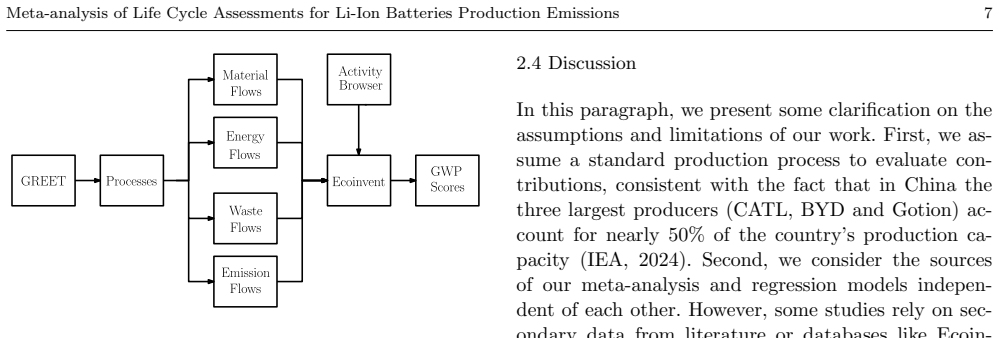
The central object is a yearly-averaged regression dataset built from the meta-analysis: for each year, the average mass-specific global warming potential (kg CO$_2$-eq/kg) is paired with annual battery production $Q_a$ (GWh) and the carbon intensity of the Chinese electricity mix $E_{ch}$ (g CO$_2$/kWh). The mechanism that carries the argument is ordinary least squares on the multivariate linear model $P_{gw} = \beta_0 + \beta_{Q_a} Q_a + \beta_{E_{ch}} E_{ch}$, whose coefficient signs are interpreted: a negative $\beta_{Q_a}$ indicates learning, and a positive $\beta_{E_{ch}}$ indicates dependence on grid carbon intensity. Supporting this is a cradle-to-gate LCA assembled from the cited battery-manufacturing inventories and life-cycle emission databases, run in open-source LCA software, which decomposes the total GWP and shows that cathode and cell production dominate.
What would settle it
Re-fit the model using cumulative battery production, the variable the classic learning curve actually uses, and extend the data beyond seven yearly averages; if the production coefficient loses its negative sign or a simple time trend explains the averaged emissions just as well, the learning-effect interpretation fails. A direct out-of-sample check is to predict cradle-to-gate LCAs published for 2021 through 2024 that were not in the training set and compare the residuals.
Extended reading notes
Core claim
On the paper's own terms, the discovery is that two variables — annual battery production volume and the carbon intensity of the Chinese electricity mix — jointly track the average per-kilogram global warming potential reported in the LCA literature. In the averaged dataset (seven yearly points after outlier removal), the multivariate model $P_{gw} = \beta_0 + \beta_{Q_a} Q_a + \beta_{E_{ch}} E_{ch}$ yields $R^2 = 0.6034$; the production coefficient is negative and the grid-intensity coefficient is positive, meaning larger output and cleaner grids both point to lower specific emissions. The accompanying LCA attributes most manufacturing emissions to cell production and, within it, cathode material processing, so switching assembly to a cleaner grid without decarbonizing upstream material production produces only modest savings. The authors conclude that production scale and grid decarbonization should be built into future LCA models, and they read the negative output coefficient as evidence of learning effects in battery manufacturing.
Load-bearing premise
The load-bearing premise is that each year's total battery output, rather than cumulative production experience or an unrelated trend, is what makes reported per-kilogram emissions fall; with only seven yearly averages in the regression, that link is not statistically secure.
Editorial extensions
If this is right
- Future LCA models that ignore production scale will misestimate specific manufacturing emissions, since the fitted model implies that larger annual output goes with lower per-kilogram global warming potential.
- Relocating final battery assembly to countries with very clean grids cuts total cradle-to-gate emissions only modestly, from 17.33 to 16.47 kg CO$_2$-eq/kg in the paper's case studies; meaningful cuts require decarbonizing upstream cathode and cell production in the actual supply chain.
- Given projected battery demand and Chinese grid intensity, the regression provides a direct way to forecast future average manufacturing emissions per kilogram of battery.
- The pooled median of 17.63 kg CO$_2$-eq/kg with a 7.34 standard deviation gives modelers a harmonized reference point for cradle-to-gate battery production GWP across different functional units.
- If the negative production coefficient reflects real learning, then early investment in large-scale battery plants carries an emissions dividend that grows as production volume expands.
Reading between the lines
- A natural test the paper leaves implicit is to fit a Wright-style learning curve on cumulative battery production rather than annual production; if the learning coefficient survives, the annual-production proxy is validated, and if not, the learning claim may be an artifact of the proxy.
- If the learning rate is real, it can be expressed as an emissions experience curve and combined with cost experience curves, allowing design and policy decisions that trade off cost and carbon explicitly.
- The model treats China's grid intensity as the relevant carbon signal for the whole supply chain; as battery supply chains diversify outside China, a multi-region intensity index would be needed to keep the predictor valid.
- Part of the regression's explanatory power may come from methodological harmonization trends in the LCA literature, such as shifting functional units and system boundaries, rather than from physical learning; restricting the analysis to cradle-to-gate studies with a common functional unit would help isolate the physical effect.
Editorial analysis
A structured set of objections, weighed in public.
Referee Report
Summary. The manuscript presents a meta-analysis of 40 life-cycle assessment (LCA) studies on lithium-ion battery production, converts reported global warming potentials to a mass-specific basis, and reports a median of 17.63 kg CO2-eq/kg after excluding four Chinese cradle-to-grave studies. It also develops a cradle-to-gate LCA for an NMC811 battery with a silicon-coated graphite anode under Chinese, South Korean, and Swedish electricity mixes, obtaining 17.33, 16.85, and 16.47 kg CO2-eq/kg, respectively. The paper then fits six regression models that link annual battery production and the carbon intensity of the Chinese electricity mix to yearly-averaged emissions, interpreting the negative coefficient on production volume as evidence of learning effects.
Significance. If the learning-effect result were sound, it would be a useful input to prospective LCA models, allowing production scale and grid decarbonization to be treated as dynamic variables. The assembled dataset and the LCA case study are potentially useful contributions: the median GWP aligns with prior literature, and the emission decomposition across electricity mixes is informative. However, the regression analysis is the paper's central claim, and it is not supported by the reported statistics; the paper's own study-level results contradict it. The significance of the paper therefore hinges on a component that is empirically unsubstantiated.
major comments (6)
- [Section 3.2, Table 3 and Table 5] The claim that the multivariate linear regression on yearly-averaged data shows statistical significance is not supported: the overall p-value is 0.1573, which is not significant at any conventional level. The statement that the fit is significant 'using a significance level (α) lower than what is typically applied' inverts the relationship between p-values and alpha; a p-value of 0.1573 means the null is rejected only at an unusually high alpha. Moreover, Table 5 contains an internal inconsistency: for β1,a = -1.2162 with σ = 0.50161, the t-statistic should be about -2.42, not the reported -3.4246; the p-value 0.0724 is consistent with t = -2.42. The abstract and conclusion nevertheless assert the presence of a learning effect, which is not justified by these statistics.
- [Section 3.2, Table 3] The same predictors applied to the N=36 study-level observations yield R² = 0.0034 and a model p-value of 0.9457, meaning no relationship exists at the individual-study level. The paper does not explain why the seven yearly means are the appropriate unit of analysis. Because Qa and Ech both trend strongly over time, the negative coefficient on Qa in the averaged regression can simply absorb a common downward drift in published GWP values (e.g., methodological harmonization, updated databases). Without a year effect or a nonparametric trend control, the learning coefficient is confounded with time; the reported result is an aggregation artifact rather than evidence of learning.
- [Section 2.3, Eq. (6) and Table 3] The paper motivates the analysis with Wright's learning curve, which is specified on cumulative production, but all models use annual production Qa. The power-law model with annual production (Eq. 6) is null even on the averaged data (R² = 0.0479, p = 0.9065). The paper never estimates a cumulative-production model, so it provides no evidence for a Wright-style learning effect. At best, the significant averaged linear model is a bivariate trend regression, not a learning-curve model.
- [Section 2.3, Eq. (3) and Section 2.1] The predictor Ech is the carbon intensity of the Chinese electricity mix, yet the dataset contains studies from many countries with heterogeneous electricity mixes (e.g., Norway, South Korea, USA). Averaging emissions across all studies and regressing them on China's grid intensity is an ecological regression: the predictor is not matched to the emissions of the individual studies. The paper should use each study's own production-location carbon intensity or a global average, and should test the sensitivity of the results to this choice.
- [Section 2.1 and Table 1] The conversion of functional units to mass-specific GWP relies on linearity in mass, capacity, and distance, which the authors themselves state is 'not universally applicable.' No details of the conversion factors (e.g., vehicle efficiency, battery energy density, lifetime kilometers) are provided, making the central dataset non-reproducible. Since the regression uses these converted values, the learning-effect claim is contingent on an unvalidated transformation.
- [Section 2.1 and Section 2.4] The exclusion of the four Chinese cradle-to-grave studies (Li et al., 2014; Wang et al., 2016; Yu et al., 2018) as 'outliers' is not statistically justified, and it is inconsistent with retaining other cradle-to-grave studies (e.g., Hawkins et al., 2013; Ellingsen et al., 2016; Giordano et al., 2018; Sun et al., 2020). The removal changes the median from 20.18 to 17.63 and defines the regression dataset; no sensitivity analysis is given. Additionally, the paper acknowledges in Section 2.4 that many studies rely on shared secondary sources (Ecoinvent, GREET, GaBi), violating the independence assumption on which the regression p-values rely.
minor comments (5)
- [Abstract and Section 2.1, Table 2] The abstract reports the median (17.63 kg CO2-eq/kg) and standard deviation (7.34) without stating that these values refer to the dataset after excluding four Chinese cradle-to-grave studies; the full dataset has median 20.18 and standard deviation 19.09. Please qualify the numbers in the abstract.
- [Table 1] The table header contains a typo: 'Y ear' should be 'Year'. Other typos in the text include 'green house gas emissions' in the Introduction and 'Swedish EnEnvironment Research Instiitute' in the reference list.
- [Section 3.2] The statement that the normal distribution of residuals 'wards off any concerns about heteroskedasticity' is not correct; normality and homoskedasticity are separate assumptions, and the small sample size makes such diagnostics unreliable.
- [Section 3.2 and Section 2.3] For reproducibility, the averaged yearly data (Pgw, Qa, Ech) used in the regressions should be provided in a table or supplementary material; currently the reader cannot reconstruct the N=7 dataset from the manuscript.
- [Section 3.2] The phrase 'using a significance level (α) lower than what is typically applied in conventional LCA studies' is confusing and should be rephrased; a p-value of 0.1573 does not become significant by invoking an unusually low alpha.
Circularity Check
No significant circularity: the regression uses external predictors, the learning effect is a fitted-coefficient interpretation, and the self-citations are methodological or motivational rather than load-bearing.
full rationale
No circular step is present. The central regression (Eq. 3) explains specific emissions Pgw using two external predictors, annual battery production Qa and Chinese electricity carbon intensity Ech, neither of which is constructed from the Pgw values being explained. The coefficients are fitted by least squares (Eq. 7) on the same yearly-averaged data, so the reported R^2 = 0.6034 is an in-sample goodness-of-fit rather than an out-of-sample prediction, but this is standard empirical modeling and does not make the result definitionally identical to its input. The negative Qa coefficient is interpreted as supporting a learning effect, but that is an inference from an estimated association, not a quantity that is equal to the model input by construction. The statistical weakness of the evidence (overall p = 0.1573 with N = 7, and near-zero fit on the N = 36 study-level data) is a robustness and significance concern, not a circularity concern. The self-citations to Clemente et al. 2025 and Maharjan et al. 2024 are used respectively for background on cost-learning and for the standard log-log regression technique; neither citation is the basis for the paper's own emissions-learning claim, which rests on the paper's own regression. Section 2.4 explicitly concedes that some meta-analyzed studies rely on shared secondary databases such as Ecoinvent, GREET, and GaBi, which weakens the independence assumption underlying the meta-analysis and the comparison of the authors' LCA with the literature median, but this is a stated limitation rather than a reduction of any derived result to its inputs. On the whole, the derivation chain is self-contained and not circular.
Assumptions & free parameters
free parameters (3)
- Intercept β0 =
-185.7
- Production coefficient β1,a =
-1.2162
- Carbon intensity coefficient β1,e =
0.38658
assumptions (5)
- ad hoc to paper Emissions scale linearly with mass, capacity, and distance for converting functional units
- ad hoc to paper Annual battery production is a valid proxy for cumulative production experience in learning curves
- domain assumption The carbon intensity of the Chinese electricity mix is representative of the grid supplying battery production globally
- ad hoc to paper The four excluded China cradle-to-grave studies are outliers and can be removed from the dataset
- domain assumption GREET inventory and Ecoinvent 3.8 accurately represent battery production material and energy flows
Cite this review
Pith. "Pith review of Meta-analysis of Life Cycle Assessments for Li-Ion Batteries Production Emissions." pith.science (2026). https://pith.science/paper/XPWGCTR2
@misc{pith2026250605531,
  author       = {Pith},
  title        = {Pith review of: Meta-analysis of Life Cycle Assessments for Li-Ion Batteries Production Emissions},
  year         = {2026},
  howpublished = {\url{https://pith.science/paper/XPWGCTR2}},
  note         = {Machine review of arXiv:2506.05531}
}
read the original abstract
This paper investigates the environmental impact of Li-Ion batteries by quantifying manufacturing-related emissions and analyzing how electricity mix and production scale affect emission intensity. To this end, we conduct a meta-analysis of life cycle assessments on lithium-ion batteries published over the past two decades, categorizing them by year, battery chemistry, functional unit, system boundaries, and electricity mix. We then carry out a cradle-to-gate assessment for a nickel manganese cobalt 811 battery with a silicon-coated graphite anode, analyzing how variations in the carbon intensity of the electricity mix affect emissions, with case studies for China, South Korea, and Sweden. Finally, we develop a set of regression models that link annual battery production and the carbon intensity of China's electricity mix to the average mass-specific emissions observed each year. The meta-analysis shows a median global warming potential of 17.63 kg CO2-eq./kg of battery, with a standard deviation of 7.34. Differences in electricity mix mainly influence emissions from the energy-intensive cell production, particularly from cathode material processing. We found that a multivariate linear regression using production volume and the carbon intensity of the Chinese electricity mix as predictors explains emissions with moderate accuracy. The environmental impact of battery manufacturing can be reduced by using clean energy sources in production processes. However, achieving substantial reductions requires clean energy throughout the entire supply chain, as importing materials from regions with carbon-intensive electricity mixes can undermine these efforts. Our findings also highlight the emission-reducing effect of learning associated with increased production scale, supporting the integration of learning effects in future life cycle assessment models.
Figures


Figures from the paper (4 more)


Reference graph
Works this paper leans on
-
[1]
(2006 a ) Environmental management - life cycle assessment - principles and framework
work page 2006
-
[2]
(2006 b ) Environmental management - life cycle assessment - requirements and guidelines management environnemental
work page 2006
-
[3]
://www.iso.org/standard/37456.html
(2006 c ) ISO 14040 environmental management — life cycle assessment — principles and framework. ://www.iso.org/standard/37456.html
work page 2006
-
[4]
(2020) Environmental management - vocabulary management environnemental
work page 2020
-
[5]
(2022) Mineral commodity summaries 2022. Tech. rep., USGS, Virginia
work page 2022
-
[6]
Aguirre K, Eisenhardt L, Lim C, Nelson B, Norring A, Slowik P, Tu N (2012) Lifecycle analysis comparison of a battery electric vehicle and a conventional gasoline vehicle. Tech. rep., California Air Resources Board, ://www.doksi.hu, advisor: Dr. Deepak Rajagopal
work page 2012
-
[7]
Aichberger C, Jungmeier G (2020) Environmental life cycle impacts of automotive batteries based on a literature review. Energies 13(23):6345
work page 2020
-
[8]
Amarakoon S, Smith J, Segal B (2012) Lithium-ion batteries and nanotechnology for electric vehicles: A life cycle assessment. Tech. rep., US EPA Design for the Environment Program Office of Pollution Prevention and Toxics and National Risk Management Research Laboratory Office of Research and Development
work page 2012
Show all 77 references
-
[9]
Arzoumanidis I, D'Eusanio M, Raggi A, Petti L (2020) Functional unit definition criteria in life cycle assessment and social life cycle assessment: A discussion pp 1--10
2020
-
[10]
Applied Energy 169(1):721--728
Bergesen JD, Suh S (2016) A framework for technological learning in the supply chain: A case study on CdTe photovoltaics. Applied Energy 169(1):721--728
2016
-
[11]
International Journal of Life Cycle Assessment (26):2024–2039
Chordia M, Nordelöf A, Ager-Wick Ellingsen L (2021) Environmental life cycle implications of upscaling lithium-ion battery production. International Journal of Life Cycle Assessment (26):2024–2039
2021
-
[12]
Phd thesis 1 (research tu/e / graduation tu/e), Mechanical Engineering, proefschrift
Clemente M (2025) Footprint-aware electric vehicle family design. Phd thesis 1 (research tu/e / graduation tu/e), Mechanical Engineering, proefschrift
2025
-
[13]
Applied Energy 379:124840, doi:10.1016/j.apenergy.2024.124840
Clemente M, Salazar M, Hofman T (2025) Concurrent D esign O ptimization of P owertrain C omponent M odules in a F amily of E lectric V ehicles. Applied Energy 379:124840, doi:10.1016/j.apenergy.2024.124840
2025
-
[14]
Journal of Cleaner Production 215(1):634--649, doi:https://doi.org/10.1016/j.jclepro.2019.01.056
Cusenza MA, Bobba S, Ardente F, Cellura M, Di Persio F (2019) Energy and environmental assessment of a traction lithium-ion battery pack for plug-in hybrid electric vehicles. Journal of Cleaner Production 215(1):634--649, doi:https://doi.org/10.1016/j.jclepro.2019.01.056
2019 doi
-
[15]
Dai Q, Dunn J, Kelly JC, Elgowainy A (2017) Update of life cycle analysis of lithium-ion batteries in the greet model. Tech. rep., Energy Systems Division, Argonne National Laboratory (ANL), IL, US
2017
-
[16]
Dai Q, Kelly JC, Dunn J, Benavides P (2018) Update of bill-of-materials and cathode materials production for lithium-ion batteries in the greet model. Tech. rep., Energy Systems Division, Argonne National Laboratory (ANL), IL, US
2018
-
[17]
Batteries 5(2):48
Dai Q, Kelly JC, Gaines L, Wang M (2019) Life cycle analysis of lithium-ion batteries for automotive applications. Batteries 5(2):48
2019
-
[18]
Environmental Research Communications 2(1), doi:10.1088/2515-7620/AB5E1E
Davidsson Kurland S (2020) Energy use for gwh-scale lithium-ion battery production. Environmental Research Communications 2(1), doi:10.1088/2515-7620/AB5E1E
2020 doi
-
[19]
Journal of Power Sources 343:284--295, doi:10.1016/j.jpowsour.2017.01.036
Deng Y, Li J, Li T, Gao X, Yuan C (2017) Life cycle assessment of lithium sulfur battery for electric vehicles. Journal of Power Sources 343:284--295, doi:10.1016/j.jpowsour.2017.01.036
2017 doi
-
[20]
ACS Sustainable Chemistry and Engineering 7:599--610
Deng Y, Ma L, Li T, Li J, Yuan C (2019) Life cycle assessment of silicon-nanotube-based lithium ion battery for electric vehicles. ACS Sustainable Chemistry and Engineering 7:599--610
2019
-
[21]
Dunn J, Gaines L, Barnes M, Sullivan J, Wang M (2014) Material and energy flows in the materials production, assembly, and end-of-life stages of the automotive lithium-ion battery life cycle. Tech. rep., Argonne National Library - Energy Systems Division
2014
-
[22]
Environ Res Lett 11:054010
Ellingsen LA, Singh B, Strømman AH (2016) The size and range effect: lifecycle greenhouse gas emissions of electric vehicles. Environ Res Lett 11:054010
2016
-
[23]
Journal of Industrial Ecology 17:53--64, doi:10.1111/jiec.12072
Ellingsen LAW, Singh B, Majeau-Bettez G, Srivastava AK, Valøen LO, Strømman AH (2013) Life cycle assessment of a lithium-ion battery vehicle pack. Journal of Industrial Ecology 17:53--64, doi:10.1111/jiec.12072
2013 doi
-
[24]
Journal of Power Sources 262:169--177, doi:10.1016/j.jpowsour.2014.03.092
Faria R, Marques P, Garcia R, Moura P, Freire F, Delgado J, Almeida AT (2014) Primary and secondary use of electric mobility batteries from a life cycle perspective. Journal of Power Sources 262:169--177, doi:10.1016/j.jpowsour.2014.03.092
2014 doi
-
[25]
International Journal of Life Cycle Assessment 10(1):3--9, doi:10.1065/LCA2004.10.181.1/METRICS, ://link.springer.com/article/10.1065/lca2004.10.181.1
Frischknecht R, Jungbluth N, Althaus HJ, Doka G, Dones R, Heck T, Hellweg S, Hischier R, Nemecek T, Rebitzer G, Spielmann M (2005) The ecoinvent database: Overview and methodological framework . International Journal of Life Cycle Assessment 10(1):3--9, doi:10.1065/LCA2004.10....
2005 doi
-
[26]
Transportation Research Part D: Transport and Environment 64
Giordano A, Fischbeck P, Matthews HS (2018) Environmental and economic comparison of diesel and battery electric delivery vans to inform city logistics fleet replacement strategies. Transportation Research Part D: Transport and Environment 64
2018
-
[27]
Sustainability 9:504, doi:10.3390/su9040504
Hao H, Mu Z, Jiang S, Liu Z, Zhao F (2017) Ghg emissions from the production of lithium-ion batteries for electric vehicles in china. Sustainability 9:504, doi:10.3390/su9040504
2017 doi
-
[28]
Journal of Industrial Ecology 17:53--64, doi:10.1111/j.1530-9290.2012.00532.x
Hawkins TR, Singh B, Majeau-Bettez G, Strømman AH (2013) Comparative environmental life cycle assessment of conventional and electric vehicles. Journal of Industrial Ecology 17:53--64, doi:10.1111/j.1530-9290.2012.00532.x
2013
-
[29]
Joule 3(6):1412--1414
Hoekstra A (2019) The underestimated potential of battery electric vehicles to reduce emissions. Joule 3(6):1412--1414
2019
-
[30]
International Journal of Life Cycle Assessment 22(2):138--147, doi:10.1007/S11367-016-1246-Y
Huijbregt M, Steinmann Z, Elshout P, Stam G, Verones F, Vieira M, Hollander A, zijp M, van Zelm R (2017) ReCiPe2016: a harmonised life cycle impact assessment method at midpoint and endpoint level . International Journal of Life Cycle Assessment 22(2):138--147, doi:10.1007/S11...
2017 doi
-
[31]
IEA (2020) Global EV outlook 2020. Tech. rep., International Energy Agency
2020
-
[32]
IEA (2021) Global EV outlook 2021. Tech. rep., International Energy Agency
2021
-
[33]
IEA (2024) Global ev outlook 2024. Tech. rep., IEA , https://www.iea.org/reports/global-ev-outlook-2024
2024
-
[34]
IPCC (2022) Climate Change 2022: Impacts, Adaptation, and Vulnerability, Cambridge University Press, Cambridge, UK and New York, NY, USA, contribution of working group ii to the sixth assessment report of the intergovernmental panel on climate change IPCC, 2022: Summary for Po...
2022
-
[35]
Energy Policy 36(1):138--162
Kahouli-Brahmi S (2008) Technological learning in energy–environment–economy modelling: A survey. Energy Policy 36(1):138--162
2008
-
[36]
Journal of Cleaner Production 254:120067, doi:10.1016/j.jclepro.2020.120067
Kallitsis E, Korre A, Kelsall G, Kupfersberger M, Nie Z (2020) Environmental life cycle assessment of the production in china of lithium-ion batteries with nickel-cobalt-manganese cathodes utilising novel electrode chemistries. Journal of Cleaner Production 254:120067, doi:10....
2020
-
[37]
Mitigation and Adaptation Strategies for Global Change 25:371--396, doi:10.1007/s11027-019-09869-2
Kelly JC, Dai Q, Wang M (2020) Globally regional life cycle analysis of automotive lithium-ion nickel manganese cobalt batteries. Mitigation and Adaptation Strategies for Global Change 25:371--396, doi:10.1007/s11027-019-09869-2
2020 doi
-
[38]
Environmental Science & Technology 50:7715--7722, doi:10.1021/acs.est.6b00830
Kim HC, Wallington TJ, Arsenault R, Bae C, Ahn S, Lee J (2016) Cradle-to-gate emissions from a commercial electric vehicle li-ion battery: A comparative analysis. Environmental Science & Technology 50:7715--7722, doi:10.1021/acs.est.6b00830
2016 doi
-
[39]
Environmental Science & Technology 48:3047--3055, doi:10.1021/es4037786
Li B, Gao X, Li J, Yuan C (2014) Life cycle environmental impact of high-capacity lithium ion battery with silicon nanowires anode for electric vehicles. Environmental Science & Technology 48:3047--3055, doi:10.1021/es4037786
2014 doi
-
[40]
In: The Future European Energy System: Renewable Energy, Flexibility Options and Technological Progress, pp 55--73
Louwen A, Junginger M (2021) Deriving experience curves and implementing technological learning in energy system models. In: The Future European Energy System: Renewable Energy, Flexibility Options and Technological Progress, pp 55--73
2021
-
[41]
LowCarbonPower (2024) Electricity in people's republic of china in 2023/2024. Online
2024
-
[42]
Materials Science Forum 847:403--410, doi:10.4028/www.scientific.net/MSF.847.403
Lu Q, Wu P, Shen W, Wang X, Zhang B, Wang C (2016) Life cycle assessment of electric vehicle power battery. Materials Science Forum 847:403--410, doi:10.4028/www.scientific.net/MSF.847.403
2016 doi
-
[43]
Technological Forecasting and Social Change 209:123795
Maharjan P, Hauck M, Kirkels A, Buettner B, de Coninck H (2024) Deriving experience curves: A structured and critical approach applied to pv sector. Technological Forecasting and Social Change 209:123795
2024
-
[44]
Environmental Science and Technology 45:4548--4554
Majeau-Bettez G, Hawkins TR, A HS (2011) Life cycle environmental assessment of lithium-ion and nickel metal hydride batteries for plug-in hybrid and battery electric vehicles. Environmental Science and Technology 45:4548--4554
2011
-
[45]
Energy and Environmental Science 14(1):4712--4739
Mauler L, Duffner F, Zeier W, Leker J (2021) Battery cost forecasting: a review of methods and results with an outlook to 2050. Energy and Environmental Science 14(1):4712--4739
2021
-
[46]
Available online at https://neonresearch.nl/
NEON Research (2021) Lighting the way to zero emission energy and mobility. Available online at https://neonresearch.nl/
2021
-
[47]
Journal of Environmental Science and Technology 44(17):6550–6556
Notter DA, Gauch M, Widmer R, Wager P, Stamp A, Zah R, Althaus HJ (2010) Contribution of li-ion batteries to the environmental impact of electric vehicles. Journal of Environmental Science and Technology 44(17):6550–6556
2010
-
[48]
Batteries 5(23):17
Philippot M, Alvarez G, Ayerbe E, Van Mierlo J, Messagie M (2019) Eco-efficiency of a lithium-ion battery for electric vehicles: Influence of manufacturing country and commodity prices on ghg emissions and costs. Batteries 5(23):17
2019
-
[49]
Placek M (2021) Projected global battery demand from 2020 to 2030, by application. Tech. rep., Statista, www.statista.com/statistics/1103218/global-battery-demand-forecast/
2021
-
[50]
Energy Procedia 105:3584--3595, doi:10.1016/j.egypro.2017.03.827
Qiao Q, Zhao F, Liu Z, Jiang S, Hao H (2017) Comparative study on life cycle co2 emissions from the production of electric and conventional vehicles in china. Energy Procedia 105:3584--3595, doi:10.1016/j.egypro.2017.03.827
2017 doi
-
[51]
Rawles C (2019) Who is winning the global lithium ion battery arms race? tech. rep. Tech. rep., Benchmarkminerals, www.benchmarkminerals.com/whois-winning-the-global-lithium-ion-battery-arms-race/
2019
-
[52]
Our World in Data Https://ourworldindata.org/co2-and-greenhouse-gas-emissions
Ritchie H, Roser M, Rosado P (2020) Co2 and greenhouse gas emissions. Our World in Data Https://ourworldindata.org/co2-and-greenhouse-gas-emissions
2020
-
[53]
Romare M, Dahllöf L (2017) The life cycle energy consumption and greenhouse gas emissions from lithium-ion batteries. Tech. rep., Swedish EnEnvironment Research Instiitute
2017
-
[54]
part i: Performance and energy requirements
Rydh CJ, Sanden B (2005) Energy analysis of batteries in photovoltaic systems. part i: Performance and energy requirements. Energy Conversion and Management 46:1957--1979
2005
-
[55]
Integrated Environmental Assessment and Management 16(3):314
Sohn J, Kalbar P, Goldstein B, Birkved M (2019) Defining temporally dynamic life cycle assessment: A review. Integrated Environmental Assessment and Management 16(3):314
2019
-
[56]
Journal of Cleaner Production 203:444--468
La Picirelli de Souza L, Silva Lora EE, Escobar Palacio JC, Rocha ML M Hand Grillo Reno, Venturini OJ (2018) Comparative environmental life cycle assessment of conventional vehicles with different fuel options, plug-in hybrid and electric vehicles for a sustainable transportat...
2018
-
[57]
Software Impacts 3, doi:10.1016/J.SIMPA.2019.100012
Steubing B, de Koning D, Haas A, Mutel CL (2020) The Activity Browser — An open source LCA software building on top of the brightway framework . Software Impacts 3, doi:10.1016/J.SIMPA.2019.100012
2020
-
[58]
Energy Conversion and Management 58:134--148, doi:10.1016/j.enconman.2012.01.001
Sullivan JL, Gaines L (2012) Status of life cycle inventories for batteries. Energy Conversion and Management 58:134--148, doi:10.1016/j.enconman.2012.01.001
2012 doi
-
[59]
Journal of Cleaner Production 273:123006, doi:10.1016/j.jclepro.2020.123006
Sun X, Luo X, Zhang Z, Meng F, Yang J (2020) Life cycle assessment of lithium nickel cobalt manganese oxide (ncm) batteries for electric passenger vehicles. Journal of Cleaner Production 273:123006, doi:10.1016/j.jclepro.2020.123006
2020
-
[60]
Chemical Engineering Research and Design (112):298--309
Tagliaferri C, Evangelisti S, Acconcia F, Domenech T, Ekins P, Barletta D, Lettieri P (2016) Life cycle assessment of future electric and hybrid vehicles: A cradle-to-grave systems engineering approach. Chemical Engineering Research and Design (112):298--309
2016
-
[61]
Environmental Science and Pollution Research 24:1251--1260, doi:10.1007/s11356-016-7849-9
Wang Y, Yu Y, Huang K, Chen B, Deng W, Yao Y (2016) Quantifying the environmental impact of a li-rich high-capacity cathode material in electric vehicles via life cycle assessment. Environmental Science and Pollution Research 24:1251--1260, doi:10.1007/s11356-016-7849-9
2016 doi
-
[62]
International Journal of Life Cycle Assessment 21(9):1218--1230
Wernet G, Bauer C, Steubing B, Reinhard J, Moreno-Ruiz E, Weidema B (2016) The ecoinvent database version 3 (part i): overview and methodology. International Journal of Life Cycle Assessment 21(9):1218--1230
2016
-
[63]
Journal of Aeronautical Sciences 3(4):122--128
Wright TP (1936) Factors affecting the cost of airplanes. Journal of Aeronautical Sciences 3(4):122--128
1936
-
[64]
Clean Technologies and Environmental Policy 20:1233--1244, doi:10.1007/s10098-018-1548-9
Wu Z, Kong D (2018) Comparative life cycle assessment of lithium-ion batteries with lithium metal, silicon nanowire, and graphite anodes. Clean Technologies and Environmental Policy 20:1233--1244, doi:10.1007/s10098-018-1548-9
2018 doi
-
[65]
Journal of Cleaner Production 227:960--971, doi:10.1016/j.jclepro.2019.04.186
Yin R, Hu S, Yang Y (2019) Life cycle inventories of the commonly used materials for lithium-ion batteries in china. Journal of Cleaner Production 227:960--971, doi:10.1016/j.jclepro.2019.04.186
2019 doi
-
[66]
Online, https://www.spglobal.com/marketintelligence/en/news-insights/blog/top-electric-vehicle-markets-dominate-lithium-ion-battery-capacity-growth
Yu A, Sumangil M (2021) Top electric vehicle markets dominate lithium-ion battery capacity growth. Online, https://www.spglobal.com/marketintelligence/en/news-insights/blog/top-electric-vehicle-markets-dominate-lithium-ion-battery-capacity-growth
2021
-
[67]
Transportation Research Part D 65:409--420, doi:10.1016/j.trd.2018.09.009
Yu A, Wei Y, Chen W, Peng N, Peng L (2018) Life cycle environmental impacts and carbon emissions: A case study of electric and gasoline vehicles in china. Transportation Research Part D 65:409--420, doi:10.1016/j.trd.2018.09.009
2018 doi
-
[68]
Zackrisson M (2016) Life cycle assessment of long life lithium electrode for electric vehicle batteries - 5 ah cell. Tech. Rep. 24603
2016
-
[69]
Journal of Cleaner Production 18(15):1519--1529
Zackrisson M, Avellan L, Orlenius J (2010) Life cycle assessment of lithium-ion batteries for plug-in hybrid electric vehicles - critical issues. Journal of Cleaner Production 18(15):1519--1529
2010
-
[70]
Journal of Energy Storage 43(1):103193
Zhao E, Walker P, Surawski N, NS B (2021) Assessing the life cycle cumulative energy demand and greenhouse gas emissions of lithium-ion batteries. Journal of Energy Storage 43(1):103193
2021
-
[71]
write newline
" write newline "" before.all 'output.state := FUNCTION n.dashify 't := "" t empty not t #1 #1 substring "-" = t #1 #2 substring "--" = not "--" * t #2 global.max substring 't := t #1 #1 substring "-" = "-" * t #2 global.max substring 't := while if t #1 #1 substring * t #2 gl...
-
[72]
, " * write output.state after.block = add.period write newline
ENTRY address archive author booktitle chapter doi edition editor eid eprint howpublished institution journal key month note number organization pages publisher school series title type url volume year label extra.label sort.label short.list INTEGERS output.state before.all mi...
-
[73]
write newline
" write newline "" before.all 'output.state := FUNCTION add.period duplicate empty 'skip "." * add.blank if FUNCTION if.digit duplicate "0" = swap duplicate "1" = swap duplicate "2" = swap duplicate "3" = swap duplicate "4" = swap duplicate "5" = swap duplicate "6" = swap dupl...
-
[74]
, " * write output.state after.block = add.period write newline
ENTRY address author booktitle chapter doi edition editor eid howpublished institution journal key month note number organization pages publisher school series title type url volume year label INTEGERS output.state before.all mid.sentence after.sentence after.block FUNCTION in...
-
[75]
write newline
" write newline "" before.all 'output.state := FUNCTION if.digit duplicate "0" = swap duplicate "1" = swap duplicate "2" = swap duplicate "3" = swap duplicate "4" = swap duplicate "5" = swap duplicate "6" = swap duplicate "7" = swap duplicate "8" = swap "9" = or or or or or or...
-
[76]
, " * write output.state after.block = add.period write newline
ENTRY address author booktitle chapter doi edition editor eid howpublished institution journal key month note number organization pages publisher school series title type url volume year label INTEGERS output.state before.all mid.sentence after.sentence after.block FUNCTION in...
-
[77]
write newline
" write newline "" before.all 'output.state := FUNCTION if.digit duplicate "0" = swap duplicate "1" = swap duplicate "2" = swap duplicate "3" = swap duplicate "4" = swap duplicate "5" = swap duplicate "6" = swap duplicate "7" = swap duplicate "8" = swap "9" = or or or or or or...
Reviewed August 7, 2026 · model on record in the stance chip above.
Discussion (0). Sign in to comment.