REVIEW 4 major objections 5 minor 68 references
Investigation of Neoclassical Tearing Mode Detection by ECE Radiometry in Tokamak Reactors via Asymptotic Matching Techniques
T0 review · 4 major / 5 minor · reviewed 2026-08-07 · deepseek-v4-flash
Pith's one-line read ECE radiometry can locate an NTM island O-point to within the diagnostic resolution, provided the inferred major radius is corrected from $R_\omega$ to $R_\omega - \Delta - \delta W/\sqrt{8}$.
desk verdict A careful forward model of multi-harmonic ECE from asymmetric NTMs with a concrete Berrino correction; the narrow-island claim needs a threshold check but the core result is sound. read the letter →
The pith
A machine-rendered reading of the paper's core claim, the machinery that carries it, and where it could break.
The reading
What carries the argument
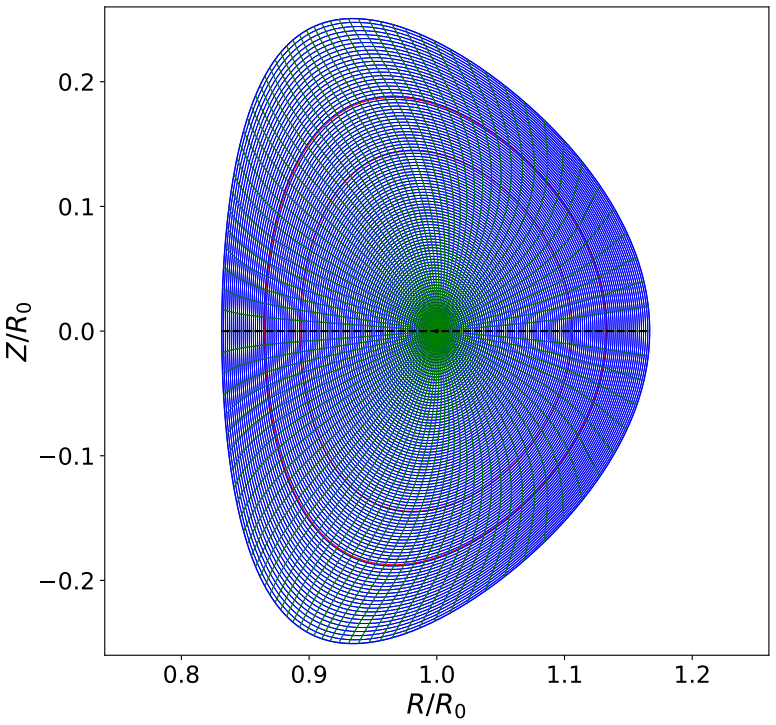
The machinery is an asymptotic matching calculation split at the NTM rational surface. In the outer region, linearized ideal-MHD equations for helical harmonics with the NTM's toroidal mode number but many poloidal mode numbers are coupled by the Shafranov shift, elongation, and triangularity; the toroidal tearing mode code integrates these and matches to a vacuum solution. In the inner region, the flux function $\Omega(X,\zeta)=8X^2+\cos(\zeta-\delta^2\sin\zeta)-2\sqrt{8}\,\delta X\cos\zeta+\delta^2\cos^2\zeta$ describes a radially asymmetric island chain whose O-points sit at $X=-\delta/\sqrt{8}$; the coordinate change $Y=X-\delta/\sqrt{8}\cos\zeta$, $\xi=\zeta-\delta^2\sin\zeta$ maps it to a symmetric island and yields the flux-width relation used in matching. On the diagnostic side, the ECE signal is a convolution of the matched temperature profile with a truncated Gaussian spatial convolution function $F(R_\omega,R)$ characterized by two parameters, the standard deviation $\sigma$ and the inward shift $\Delta$, derived from reabsorption theory for first-harmonic O-mode and second-harmonic X-mode. The Berrino algorithm takes the radial gradient of this convolved signal; its local minimum is the detection observable.
What would settle it
A tokamak comparison of the corrected ECE O-point radius $R_\omega-\Delta-\delta W/\sqrt{8}$ with an independent island-position measurement (e.g. ECE imaging or magnetic reconstruction) across a scan of island widths would settle the claim: if the residual offset exceeds the ECE spatial resolution, or grows linearly with $W$ rather than with $W/\sqrt{8}$, the asymmetry correction is not the right one.
Extended reading notes
Core claim
The paper's central claim is that the major radius of an NTM island O-point can be measured by ECE radiometry even when the island width is much smaller than the plasma minor radius, and that the correct estimator is the location of the local minimum of the Berrino signal after replacing the raw resonance radius $R_\omega$ by $R_\omega-\Delta-\delta W/\sqrt{8}$. Here $\Delta$ is the inward shift of the ECE spatial convolution function caused by the relativistic mass increase of emitting electrons, $W$ is the full island width, and $\delta$ is the island asymmetry parameter: the O-point of the inner-region solution lies at $X=-\delta/\sqrt{8}$, i.e. inward of the rational surface. The paper computes $\delta$ self-consistently from the matching of the inner and outer solutions using the toroidal tearing mode code employed for the calculation, and demonstrates for ITER-like $3,2$ and $2,1$ NTMs of width $W/a = 0.01$, $0.05$, and $0.1$ that the corrected minima lie almost exactly on the O-points, while the uncorrected minima lie outward of the rational surface.
Load-bearing premise
The load-bearing assumption is that outside the island the electron temperature perturbation is passive convection of the equilibrium gradient plus a single uniform core drop, with no perpendicular heat transport, and inside the separatrix the temperature is completely flattened even for $W/a=0.01$; if perpendicular transport matters at these widths, the predicted flattening and the O-point correction shift.
Editorial extensions
If this is right
- Detectability: NTMs as thin as $W/a=0.01$ produce a local minimum in the Berrino signal, so stabilizing ECCD can be turned on before the island significantly degrades confinement.
- Aiming: ECCD must land within roughly two standard deviations of the O-point in major radius and within $\pi/2$ in angular offset to suppress the mode, and the corrected radius makes those tolerances reachable.
- Mode choice: second-harmonic X-mode ECE has a narrower spatial convolution function than first-harmonic O-mode, so it gives better radial resolution for the corrected algorithm.
- Wide islands: as island width grows, the optimum ECCD aim point shifts inward from the rational surface, consistent with the O-point rather than the rational surface being the target.
Reading between the lines
- Because the ECE spatial convolution is well fitted by a truncated Gaussian, the same two parameters $\sigma$ and $\Delta$ could be precomputed for a given plasma state, letting the control system apply the O-point correction in real time without rerunning the matching calculation.
- A direct experimental check would be to compare the corrected Berrino minimum with an independent island-position diagnostic over a range of island widths; a residual that grows as $W$ rather than $W/\sqrt{8}$ would indicate that the asymmetry term is mis-modeled.
- The model assumes complete temperature flattening inside the separatrix even at $W/a=0.01$; for narrower islands, incomplete flattening would soften the signal and likely require a width-dependent correction beyond the one derived here.
Editorial analysis
A structured set of objections, weighed in public.
Referee Report
Summary. The paper presents a first-principles model of the ECE signals produced by neoclassical tearing modes in an ITER-like tokamak. The magnetic perturbation is computed with the TJ toroidal tearing mode code, which asymptotically matches a radially asymmetric magnetic island chain in the inner region to a linear ideal-MHD solution in the outer region. The perturbed electron temperature is obtained from the same matched solution, including the global core-temperature reduction associated with flattening inside the island. The model is then used to generate synthetic ECE signals for first-harmonic O-mode and second-harmonic X-mode, including relativistic downshifting and broadening of the emission. The paper's central diagnostic claim is that a Berrino-style algorithm applied to the simulated ECE signals can detect islands as narrow as 1% of the minor radius, and that the inferred O-point location can be corrected to R_ω - Δ - δW/√8, where Δ accounts for the relativistic inward shift of the emission and δW/√8 for the inward displacement of the O-point from the rational surface.
Significance. If the central claim holds, this is a useful step beyond earlier ECE calculations for NTM detection: it includes toroidal coupling of multiple poloidal harmonics, a self-consistent radial asymmetry of the island, and a quantitative treatment of relativistic ECE effects. The TJ code is publicly available, and the ECE calculation in Appendix A is presented in enough detail to be reproduced or adapted to other equilibria. The corrected Berrino-minimum formula is concrete and falsifiable against higher-fidelity simulations or experiment. However, the narrow-island claim (W/a = 0.01) rests on the wide-island complete-flattening limit, and the paper itself notes in Section IV.H that incomplete-flattening terms are neglected; no critical-width estimate is given. The quantitative claim is also undermined by an internal inconsistency between the text and Table II for the island asymmetry parameters of the 3,2 and 2,1 modes. These issues are load-bearing for the paper's main diagnostic message and need to be addressed before the result can be fully accepted.
major comments (4)
- [Section V.B / Table II] The text states that the asymmetry parameter for the 3,2 mode is δ = 0.272 and that for the 2,1 mode is δ = 0.150, but Table II lists δ = 0.150 for the 3,2 row and δ = 0.272 for the 2,1 row. The second row is also labeled '1 2' instead of '2 1'. This is not a purely cosmetic issue, because the proposed O-point correction is R_ω - Δ - δW/√8, and using the wrong δ changes the correction by almost a factor of two for each mode. Please reconcile the text, the table, and the parameters actually used in Figs. 18 and 19.
- [Section VI.E, with Section IV.F and Section IV.H] The claim that the Berrino algorithm can detect islands as narrow as W/a = 0.01 and that the corrected minima lie 'almost exactly' at the island O-points is made using the wide-island limit of Section IV.F, in which parallel transport dominates and the temperature is completely flattened inside the separatrix. Section IV.H explicitly states that incomplete temperature flattening is neglected because it is only important for very narrow islands, but no critical width is estimated. For the example equilibrium, W/a = 0.01 corresponds to W ≈ 1.2 cm, and the paper provides no argument that such an island is in the wide-island regime. With finite perpendicular transport, the flattening is partial, the Berrino minimum is shallower, and its location can shift relative to the O-point. Please provide a quantitative estimate of the critical island width (for example, in terms of the ratio of perpendicular to parallel heat transport or the incomplete-flattening correction to the Rutherford equation), or restrict the strong claim to islands that are demonstrably in the wide-island limit.
- [Section III.C, Eq. (24)] The outer-region temperature perturbation is modeled as passive convection plus a step-like uniform core reduction, δTe = -(dTe0/dr) ξr + δTe0 H(r - rl). This neglects perpendicular heat transport outside the island, which would smooth the step and modify the temperature gradient that the Berrino signal measures. Because the paper's quantitative claim is that the corrected signal minimum coincides with the O-point, the sensitivity of that minimum to this modeling assumption should be tested, for example by adding a finite perpendicular diffusivity in the outer region or by presenting the result explicitly as a large-χ_parallel limit. Without such a test, the 'almost exactly' wording is stronger than the model supports.
- [Section V.A / Table II] Table II gives the matching parameters for W/a = 0.1, while Figs. 18 and 19 present Berrino signals for W/a = 0.10, 0.05, and 0.01. The paper does not state how δ, δTe+ and δTe- are obtained for the smaller widths. If they are recomputed from Eqs. (46), (47), and (82) for each width, that should be stated explicitly; if they are rescaled from the W/a = 0.1 values, the scaling rule and its validity for W/a = 0.01 should be given. As written, the narrow-island curves are not fully reproducible from the information in the text.
minor comments (5)
- [Section VI.E] The text says 'Figures 19 and 17 show the perturbed and total electron temperatures,' but the perturbed temperatures are in Fig. 16 and the total temperatures in Fig. 17. The sentence 'Figure 17 shows our simulated Berrino algorithm' should refer to Fig. 18. Please correct the figure cross-references throughout Section VI.
- [Captions of Figs. 18 and 19] The captions refer to the bottom panels as '2nd harmonic O-mode signals,' but the text and the figure labels indicate that these are X-mode signals. Please make the mode labels consistent between text and captions.
- [Section VI.E and Fig. 19] The text defines the corrected radius as R_ω - Δ - δW/√8, but the horizontal-axis label in Fig. 19 as reproduced reads '(Rω - Δ - δW/√8)/R0' in some places and appears to omit Δ in others. Please ensure the axis label matches the formula used in the calculation.
- [Appendix A, Eqs. (A30) and (A40)] The fitting function uses P(Δ/σ) before P(x) is defined in Eq. (A32). Please define P(x) immediately before its first use or add a forward reference.
- [Section II.E] The example equilibrium uses a = 0.2 rather than the true ITER aspect ratio of 0.32, as the author acknowledges. This is a reasonable limitation given the TJ code, but the abstract and title should make clear that the quantitative ECE predictions are for an ITER-like a = 0.2 equilibrium, not for ITER itself, unless a STRIDE-based verification is added.
Circularity Check
No significant circularity; the only mild issue is that the corrected Berrino demonstration realigns the signal using the same model-defined O-point offset that generated the synthetic signal, making it a self-consistency check rather than an independent validation.
-
self definitional
[Sec. VI.E, Eqs. (125)-(127) and Fig. 19; island O-point definition in Eq. (28)]
"Figure 19 shows a corrected Berrino algorithm in which the inferred major radius of the signal is taken to be Rω − ∆ − δ W/√8, rather than Rω. In this case, the local minima of the signals lie almost exactly at the island O-points."
The correction subtracts δW/√8, which is precisely the inward O-point offset X = −δ/√8 already built into the model island flux function (Eq. 28), and subtracts ∆, the centroid shift of the same ECE convolution kernel used to generate the synthetic signal (Eqs. 125-126 and A30-A41). The synthetic signal is produced from the same inner-region temperature model (Eqs. 56-73), whose flat spot is centered on that O-point by construction. Therefore the alignment of the corrected Berrino minima with the island O-points is a self-consistency check of the model, not an independent prediction or measurement: the inferred quantity is corrected by exactly the offset that was put into the model.
full rationale
The paper's forward calculation is self-contained and parameter-free with respect to the target result: the ECE signals are computed from a first-principles relativistic emission model (Appendix A) applied to temperature perturbations obtained by asymptotic matching, with no parameter fitted to the Berrino output. The inner-region island solution (Eq. 28) and wide-island temperature flattening (Eqs. 56-73) are taken from the author's prior work, but the present paper re-derives the matching conditions and the synthetic diagnostic, so the central derivation does not reduce to a self-citation. The only mild circularity is the corrected Berrino demonstration: the correction formula Rω − ∆ − δW/√8 uses the same δW/√8 offset that defines the O-point in the model, so the plotted alignment in Fig. 19 is a consistency check rather than an independent validation. Separately, the W/a=0.01 panels inherit the wide-island complete-flattening limit, and Sec. IV.H explicitly neglects incomplete-flattening contributions, so the narrow-island claim is conditional on that assumption; that is a modeling limitation, not a circular reduction. Overall, no load-bearing step is forced by definition or by an unverified self-citation chain, so the circularity score is low.
Assumptions & free parameters
assumptions (5)
- domain assumption In the outer region, the electron temperature perturbation is passively convected: δTe = -(dTe0/dr) ξr + δTe0 H(r-rl) (Eq. 24).
- domain assumption The island flux surfaces are described by the single-helicity solution Ω = 8X^2 + cos(ζ - δ^2 sin ζ) - 2√8 δ X cos ζ + δ^2 cos^2 ζ (Eq. 28), with constant current on flux surfaces (Eq. 26).
- domain assumption The wide island limit applies, with complete electron temperature flattening inside the separatrix (Section IV.F).
- domain assumption Only the lth rational surface reconnects flux; all other rational surfaces respond ideally (Ψk=0 for k≠l, Section III.B).
- ad hoc to paper The TJ code's aspect-ratio expansion is valid for a=0.2, and the example equilibrium is representative of ITER despite the true aspect ratio 0.32.
Cite this review
Pith. "Pith review of Investigation of Neoclassical Tearing Mode Detection by ECE Radiometry in Tokamak Reactors via Asymptotic Matching Techniques." pith.science (2026). https://pith.science/paper/U5EROY4R
@misc{pith2026250605553,
  author       = {Pith},
  title        = {Pith review of: Investigation of Neoclassical Tearing Mode Detection by ECE Radiometry in Tokamak Reactors via Asymptotic Matching Techniques},
  year         = {2026},
  howpublished = {\url{https://pith.science/paper/U5EROY4R}},
  note         = {Machine review of arXiv:2506.05553}
}
read the original abstract
The TJ toroidal tearing mode code is used to make realistic predictions of the electron cyclotron emission (ECE) signals generated by neoclassical tearing modes (NTMs) in an ITER-like tokamak plasma equilibrium. In the so-called "outer region'', which comprises the bulk of the plasma, helical harmonics of the magnetic field with the same toroidal mode number as the NTM, but different poloidal mode numbers, are coupled together by the Shafranov shifts and shaping of the equilibrium magnetic flux-surfaces. In the "inner region'', which is localized in the vicinity of the NTM rational surface, helical harmonics whose poloidal and toroidal mode numbers are in the same ratio as those of the NTM are coupled together nonlinearly to produce a radially asymmetric magnetic island chain. The solutions in the inner and outer regions are asymptotically matched to one another. The asymptotic matching process determines the overall magnetic structure of the NTM, as well as the global perturbation to the electron temperature caused by the mode. A simulated ECE diagnostic is developed that accounts for the downshifting and broadening in frequency of the signal due to the relativistic mass increase of the emitting electrons.
Figures


Figures from the paper (19 more)


Reference graph
Works this paper leans on
-
[1]
T.C. Hender, J.C Wesley, J. Bialek, A. Bondeson, A.H. Boozer, R.J. Buttery, A. Garofalo, T.P Goodman, R.S. Granetz, Y. Gribov, O. Gruber, M. Gryaznevich, et al., Nucl.\ Fusion 47 , S128 (2007)
work page 2007
-
[2]
Wesson, Tokamaks , 4th Ed., (Oxford University Press, Oxford UK, 2011)
J.A. Wesson, Tokamaks , 4th Ed., (Oxford University Press, Oxford UK, 2011)
work page 2011
-
[3]
J.A. Wesson, R.D. Gill, M. Hugon, F.C. Sch\" u ller, J.A. Snipes, D.J. Ward, D.V. Bartlett, D.J. Campbell, P.A. Duperrex, A.W. Edwards, R.S. Granetz, N.A.O. Gottardi, T.C Hender, E. Lazzaro, P.J.. Lomas, N. Lopes Cardozo, K.F. Mast, M.F.F. Nave, N.A. Salmon, P. Smeulders, P.R. Thomas, B.J.D. Tubbing, M.F. Turner and A. Weller, Nucl.\ Fusion 29 641 (1989)
work page 1989
-
[4]
P.C. de Vries, M.F. Johnson, B. Alper, P. Buratti, T.C. Hender, H.R. Koslowski, V. Riccardo and JET-EFDA Contributors, Nucl.\ Fusion 51 , 053018 (2011)
work page 2011
-
[5]
S.A. Sabbagh, J.W. Berkery Y.S. Park, J. Butt. J.D. Riquezes, J.G. Bak. R.E. Bell, L. Delgado-Aparicio, S.P. Gerhardt, C.J. Ham, et al., Phys.\ Plasmas 30 , 032506 (2023)
work page 2023
- [6]
-
[7]
Rutherford, Phys.\ Fluids 16 , 1906 (1973)
P.H. Rutherford, Phys.\ Fluids 16 , 1906 (1973)
work page 1973
- [8]
Show all 68 references
-
[9]
Fitzpatrick, Phys.\ Plasmas 2 , 825 (1995)
R. Fitzpatrick, Phys.\ Plasmas 2 , 825 (1995)
1995
-
[10]
Bickerton, J.W
R.J. Bickerton, J.W. Connor and J.B. Taylor, Nat.\ Phys.\ Sci.\ 229 , 110 (1971)
1971
-
[11]
Chang, E.D
Z. Chang, E.D. Fredrickson, S.H. Batha, M.G. Bell, R.V. Budny, F.M. Levinton, K.M. McGuire, G. Taylor, M.C. Zarnstorff and the TFTR Group, Phys.\ Plasmas 5 , 1076 (1998)
1998
-
[12]
Hegna, Phys.\ Plasmas 5 , 1767 (1998)
C.C. Hegna, Phys.\ Plasmas 5 , 1767 (1998)
1998
-
[13]
Buttery, S
R.J. Buttery, S. G\" u nter, G. Giruzzi, T.C. Hender, D. Howell, G. Huysmans, R.J. La Haye, M. Maraschek, H. Reimerdes, O. Sauter, C.D. Warrick, H.R. Wilson and H. Zohm, Plasma Phys.\ Control.\ Fusion 42 , B61 (2000)
2000
-
[14]
Wilson, Fusion Science and Technology 61 , 113 (2012)
H.R. Wilson, Fusion Science and Technology 61 , 113 (2012)
2012
-
[15]
La Haye, Phys.\ Plasmas 13 , 055501 (2006)
R.J. La Haye, Phys.\ Plasmas 13 , 055501 (2006)
2006
-
[16]
Maraschek, Nucl.\ Fusion 52 , 074007 (2007)
M. Maraschek, Nucl.\ Fusion 52 , 074007 (2007)
2007
-
[17]
Sauter, E
O. Sauter, E. Westerhof, M.L. Mayoral, B. Alper, P.A. Belo, R.J. Buttery, A. Gondhalekar, T. Hellsten, T.C. Hender, D.F. Howell, T. Johnson, P. Lamalle, M.J. Mantsinen, F. Milani, M.F.F. Nave, F. Nguyen, A.L. Pecquet, S.D. Pinches, S. Podda and J. Rapp, Phys.\ Rev.\ Lett.\ 88 ...
2002
-
[18]
La Haye, C
R.J. La Haye, C. Chrystal, E.J. Strait, J.D. Callen, C.C. Hegna, E.C. Howell, M. Okabayashi and R.S. Wilcox, Nucl.\ Fusion 62 , 056017 (2022)
2022
-
[19]
Fitzpatrick, R
R. Fitzpatrick, R. Maingi, J.-K. Park and S. Sabbagh, Phys.\ Plasmas 30 , 072505 (2023)
2023
-
[20]
Fredrickson, Phys.\ Plasmas 9 , 548 (2002)
E.D. Fredrickson, Phys.\ Plasmas 9 , 548 (2002)
2002
-
[21]
Zohm, Phys.\ Plasmas 4 , 3433 (1997)
H. Zohm, Phys.\ Plasmas 4 , 3433 (1997)
1997
-
[22]
Prater, Phys.\ Plasmas 13 , 055501 (2006)
R. Prater, Phys.\ Plasmas 13 , 055501 (2006)
2006
-
[23]
Gantenbein, H
G. Gantenbein, H. Zohm, G. Giruzzi, S. G\" u nter, F. Leuterer, M. Maraschek, J. Meskat, Q. Yu, ASDEX Upgrade Team and ECRH-Group (AUG), Phys.\ Rev.\ Lett.\ 85 , 1242 (2000)
2000
-
[24]
Isayama, Y
A. Isayama, Y. Kamada, S. Ide, K. Hamamatsu, T. Oikawa, T. Suzuki, Y. Neyatani, T. Ozeki, Y. Ikeda, K. Kajiwara and the JT-60 team, Plasma Phys.\ Control.\ Fusion 42 , L37 (2000)
2000
-
[25]
La Haye, S
R.J. La Haye, S. G\" u nter, D.A. Humphreys, J. Lohr, T.C. Luce, M.E. Maraschek, C.C. Petty, R. Prater, J.T. Scoville and E.J. Strait, Phys.\ Plasmas 9 , 2051 (2002)
2002
-
[26]
Kong, T.C
M. Kong, T.C. Blanken, F. Felici, C. Galperti, E. Maljaars, O. Sauter, T. Vu, F. Carpanese, A. Merle, J.-M. Moret, F. Pesamosca, E. Poli, M. Reich, A.A. Teplukhina, the TCV Team and the EUROfusion MST Team, Nucl.\ Fusion 59 , 076035 (2019)
2019
-
[27]
Li, J.-Q
J.-C. Li, J.-Q. Dong, X.-Q. Ji and Y.-J. Hu, Chinese Phys.\ B 30 , 075203 (2021)
2021
-
[28]
Zhang, X.J
Y. Zhang, X.J. Wang, F. Hong, W. Zhang, H.D. Xu, T.H. Shi, E.Z. Li, Q. Ma, H.L. Zhao, S.X. Wang, Y.Q. Chu, H.Q. Liu, Y.W. Sun, X.D. Zhang, Q. Yu, J.P. Qian, X.Z. Gong, J.S. Hu, K. Lu, Y.T. Song and the EAST Team, Nucl.\ Fusion 64 , 076016 (2024)
2024
-
[29]
Park, M.H
Y.S. Park, M.H. Woo, S.A. Sabbagh, H.S. Han, B.H. Park, J.S. Kang and H.S. Kim, Plasma Phys.\ Control.\ Fusion 66 , 125013 (2024)
2024
-
[30]
van den Brand, M.R
H. van den Brand, M.R. de Baar, N.J. Lopes-Cardozo and E. Westerhof, Nucl.\ Fusion 53 , 013005 (2013)
2013
-
[31]
Bornatici, R
M. Bornatici, R. Cano, O. de Barbieri and F. Englemann, Nucl.\ Fusion 23 , 1153 (1983)
1983
-
[32]
Bornatici, F
M. Bornatici, F. Englemann and U. Ruffina, Sov.\ J.\ Quantum Electron.\ 13 , 68 (1983)
1983
-
[33]
Berrino, E
J. Berrino, E. Lazzaro, S. Cirant, G. D'Antona, F. Gandini, E. Minardi and G. Granuci, Nucl.\ Fusion 45 , 1350 (2005)
2005
-
[34]
Ziegel, W.L
J.P. Ziegel, W.L. Rowan and F.L. Waelbroeck, Nucl.\ Fusion 64 , 126032 (2024)
2024
-
[35]
Connor, R.J
J.W. Connor, R.J. Hastie and J.B. Taylor, Phys.\ Fluids B 3 , 1539 (1991)
1991
-
[36]
Connor, S.C
J.W. Connor, S.C. Cowley, R.J. Hastie, T.C. Hender, A. Hood and T.J. Martin, Phys.\ Fluids 31 , 577 (1988)
1988
-
[37]
Fitzpatrick, R.J
R. Fitzpatrick, R.J. Hastie, T.J. Martin and C.M. Roach, Nucl.\ Fusion 33 , 1533 (1993)
1993
-
[38]
Meskat, H
J.P. Meskat, H. Zohm, G. Gantenbein, S. G\" u nter, M. Maraschek, W. Suttrop, Q. Yu and ASDEX Upgrade Team, Plasma Phys.\ Control.\ Fusion 43 , 1325 (2001)
2001
-
[39]
De Lazzari and F
D. De Lazzari and F. Westerhof, Plasma Phys.\ Control.\ Fusion 53 , 035020 (2011)
2011
-
[40]
Ziegel, W.L
J.P. Ziegel, W.L. Rowan and F.L. Waelbroeck, Rev.\ Sci.\ Instrum.\ 95 , 073510 (2024)
2024
-
[41]
Pletzer and R.L
A. Pletzer and R.L. Dewar, J.\ Plasma Physics 45 , 427 (1991)
1991
-
[42]
Glasser, Z.R
A.H. Glasser, Z.R. Wang and J.-K. Park, Phys.\ Plasmas 23 , 112506 (2016)
2016
-
[43]
Glasser, E
A.S. Glasser, E. Kolemen and A.H. Glasser, Phys.\ Plasmas 25 , 032507 (2018)
2018
-
[44]
Glasser and E
A.S. Glasser and E. Koleman, Phys.\ Plasmas 25 , 082502 (2018)
2018
-
[45]
Fitzpatrick, Phys.\ Plasmas 31 , 102507 (2024)
R. Fitzpatrick, Phys.\ Plasmas 31 , 102507 (2024)
2024
-
[46]
Fitzpatrick, Investigation of Tearing Mode Stability Near Ideal Stability Boundaries Via Asymptotic Matching Techniques , submitted to Physics of Plasmas (2025)
R. Fitzpatrick, Investigation of Tearing Mode Stability Near Ideal Stability Boundaries Via Asymptotic Matching Techniques , submitted to Physics of Plasmas (2025)
2025
-
[47]
Fitzpatrick, Phys.\ Plasmas 23 , 122502 (2016)
R. Fitzpatrick, Phys.\ Plasmas 23 , 122502 (2016)
2016
-
[48]
Fitzpatrick, Phys.\ Plasmas 31 , 082505 (2024)
R. Fitzpatrick, Phys.\ Plasmas 31 , 082505 (2024)
2024
-
[49]
Mercier, Nucl.\ Fusion 1 , 47 (1960)
C. Mercier, Nucl.\ Fusion 1 , 47 (1960)
1960
-
[50]
Glasser, J.M
A.H. Glasser, J.M. Greene and J.L. Johnson, Phys.\ Fluids 18 , 875 (1975)
1975
-
[51]
Glasser, J.M
A.H. Glasser, J.M. Greene and J.L. Johnson, Phys.\ Fluids 19 , 567 (1976)
1976
-
[52]
Chang and J.D
Z. Chang and J.D. Callen, Nucl.\ Fusion 30 , 219 (1990)
1990
-
[53]
Fitzpatrick, Phys.\ Plasmas 29 , 092591 (2022)
R. Fitzpatrick, Phys.\ Plasmas 29 , 092591 (2022)
2022
-
[54]
White, D.A
R.B. White, D.A. Gates and D.P. Brennan, Phys.\ Plasmas 22 , 022514 (2015)
2015
-
[55]
Waelbroeck, Phys.\ Fluids B 1 , 2373 (1989)
F.L. Waelbroeck, Phys.\ Fluids B 1 , 2373 (1989)
1989
-
[56]
Brouwer and G.M
D. Brouwer and G.M. Clemance, Methods of Celestial Mechanics , (Academic Press, New York NY, 1961). Ch. II
1961
-
[57]
Gradshteyn and I.M
I.S. Gradshteyn and I.M. Ryzhik, Table of Integrals, Series, and Products , Corrected and Enlarged Edition, (Academic Press, New York NY, 1980). Sect. 3.719
1980
-
[58]
Rosenbluth, R.D
M.N. Rosenbluth, R.D. Hazeltine and F.L. Hinton, Phys.\ Fluids 15 , 116 (1972)
1972
-
[59]
Fitzpatrick, Tearing Mode Dynamics in Tokamak Plasmas , (IOP Publishing, Bristol UK, 2023)
R. Fitzpatrick, Tearing Mode Dynamics in Tokamak Plasmas , (IOP Publishing, Bristol UK, 2023)
2023
-
[60]
Carrera, R.D
R. Carrera, R.D. Hazeltine and M. Kotschenreuther, Phys.\ Fluids 29 , 899 (1986)
1986
-
[61]
Hazeltine, M
R.D. Hazeltine, M. Kotschenreuther and P.G. Morrison, Phys.\ Fluids 28 , 294 (1985)
1985
-
[62]
Wilson, Phys.\ Plasmas 8 , 2835 (2001)
J.W.Connor, F.L.Waelbroeck and H.R. Wilson, Phys.\ Plasmas 8 , 2835 (2001)
2001
-
[63]
Bornatici, R
M. Bornatici, R. Cano, O.\ De Barbieri and F. Engelmann, Nucl.\ Fusion 23 , 1153 (1983)
1983
-
[64]
Fitzpatrick, Plasma Physics: An Introduction , 2nd Ed., (CRC Press, Boca Raton FL, 2023)
R. Fitzpatrick, Plasma Physics: An Introduction , 2nd Ed., (CRC Press, Boca Raton FL, 2023)
2023
-
[65]
Fitzpatrick, Thermodynamics and Statistical Mechanics , (World Scientific, Singapore, 2020)
R. Fitzpatrick, Thermodynamics and Statistical Mechanics , (World Scientific, Singapore, 2020)
2020
-
[66]
Bekefi, Radiation Processes in Plasmas , (John Wiley & Sons, New York NY, 1966)
G. Bekefi, Radiation Processes in Plasmas , (John Wiley & Sons, New York NY, 1966)
1966
-
[67]
http://ab-initio.mit.edu/faddeeva/
-
[68]
Abramowitz and I.A
M. Abramowitz and I.A. Stegun, Handbook of Mathematical Functions . (Dover, New York NY, 1965.)
1965
Reviewed August 7, 2026 · model on record in the stance chip above.
Discussion (0). Sign in to comment.