REVIEW 2 major objections 3 minor 1 cited by
Dynamically stable topological edge states in an extended Su-Schrieffer-Heeger ladder with balanced perturbation
T0 review · 2 major / 3 minor · reviewed 2026-08-07 · deepseek-v4-flash
Pith's one-line read Balanced imaginary hopping and staggered potential can exactly preserve a spectrum while turning topological edge states into self-healing coalescing modes.
desk verdict Clean exact spectral result with an unsupported robustness claim; worth refereeing but needs softer wording and a local-disorder check. read the letter →
The pith
A machine-rendered reading of the paper's core claim, the machinery that carries it, and where it could break.
The reading
What carries the argument
The engine is a block reduction of $H$ into independent $2\times2$ sectors. Because the intersublattice hopping matrix $T$ is antisymmetric, diagonalizing $iT$ gives $N$ pairs of modes with energies $\pm E_n$, and in that basis each pair is governed by a $2\times2$ matrix $M_n$ with diagonal entries $E_n$ and $-E_n$ and off-diagonal entries $V+\gamma$ and $V-\gamma$. Its eigenvalues are $\pm\sqrt{E_n^2+V^2-\gamma^2}$, so setting $V=\pm\gamma$ makes the spectrum identical to $H_0$'s, while setting $E_n^2=\gamma^2-V^2$ makes $M_n$ nilpotent, meaning its square vanishes. At that nilpotent point the two eigenstates coalesce, and time evolution contains a term linear in $t$ that steers the normalized state toward the coalescing mode. This is the mechanism the paper calls exceptional-point dynamics, and it is what turns ordinary edge states into dynamically stable ones.
What would settle it
Compute the spectrum of the ladder at $V=\gamma+\varepsilon$ with $\varepsilon\neq0$: the edge-state energies become $\pm\sqrt{2\gamma\varepsilon+\varepsilon^2}$, so the zero-energy coalescence is replaced by a measurable split pair. A numerical diagonalization at fixed $\delta>0$ would immediately show whether the claimed spectrum identity between $H$ and $H_0$ holds only at exact balance.
Extended reading notes
Core claim
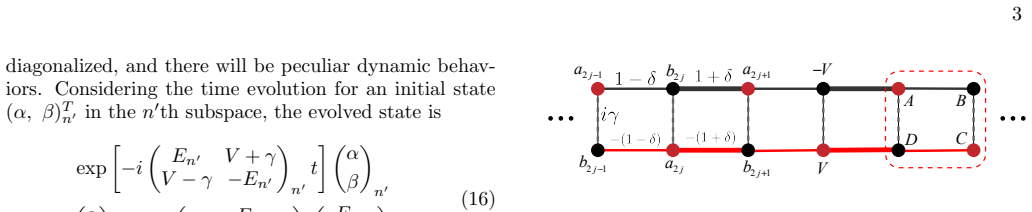
The central claim, stated on the paper's own terms, is that the non-Hermitian Hamiltonian $H=H_0+H_p$ has exactly the spectrum of its Hermitian counterpart $H_0$ whenever the staggered potential $V$ and the imaginary hopping strength $\gamma$ are balanced, $V=\pm\gamma$. Under that condition each two-level subspace of $H$ takes a defective (Jordan-block) form, so the zero modes of $H_0$ cease to be two degenerate eigenstates and instead coalesce into single exceptional-point states. For the extended SSH ladder the authors show that the sublattice winding number remains quantized and the bulk-boundary correspondence holds: when the dimerization $\delta>0$, two edge states are localized at each end, and at $V=\gamma$ these edge states coalesce in pairs. Numerical time evolution demonstrates that a point-like or random initial state converges to a stable edge state, and a global quench of $\delta$ from $0.2$ to $-0.2$ disrupts the edge state only until the system is switched back, after which it recovers.
Load-bearing premise
The central construction requires the staggered potential and the imaginary hopping to be exactly balanced ($V=\pm\gamma$); if the balance is broken the spectrum identity disappears, and the dynamical convergence statement additionally assumes that the initial state has a non-vanishing component in the direction that activates the exceptional-point linear growth.
Editorial extensions
If this is right
- For the extended SSH ladder with $\delta>0$, the sublattice winding number is $w^A=2$, so two edge states are localized at each end; this bulk-boundary correspondence is preserved despite the non-Hermitian perturbation.
- At $V=\gamma$, an initially localized or random state evolves under normalized non-Hermitian time evolution into a stable coalescing edge state rather than spreading into the bulk.
- The edge states are insensitive to a temporary quench into the trivial phase ($\delta<0$): numerical evolution shows the edge state is disrupted during the quench and recovers afterward, so the stability holds in the time domain.
- Exceptional points are tunable through $\gamma$ and $V$, and the same coalescence can be induced for bulk eigenpairs, not only for the zero-energy edge states.
- Because $H$ is pseudo-Hermitian, its spectrum is real or comes in complex-conjugate pairs, so the system keeps a line gap and does not develop the non-Hermitian skin effect.
Reading between the lines
- Beyond the paper: the same $2\times2$ block argument applies to any bipartite lattice with an antisymmetric inter-sublattice hopping matrix, so the balanced-perturbation construction should generate dynamically stable coalescing states in other lattice geometries, not only the SSH ladder.
- Beyond the paper: since the convergence mechanism is a Jordan-block linear-in-time growth rather than gain or loss, the effect should be reproducible in classical wave systems, such as coupled waveguides, acoustic lattices, or electrical circuits, where complex hoppings and staggered site energies can be engineered directly.
- Testable extension: the quench-and-recovery simulation can serve as a quantitative self-healing probe by measuring the return time of the edge-state overlap as a function of the duration of the trivial-phase excursion.
Editorial analysis
A structured set of objections, weighed in public.
Referee Report
Summary. The manuscript studies a class of non-Hermitian bipartite tight-binding Hamiltonians H = H0 + Hp, where Hp is a balanced perturbation consisting of a staggered on-site potential ±V and an imaginary inter-sublattice hopping iγ. It proves exactly that when V = ±γ, the spectrum of H coincides with that of the Hermitian H0 (Eq. 14), and the zero modes of H0 become coalescing modes located at exceptional points of H. The paper then applies this formalism to an extended SSH ladder, computes the sublattice winding number, solves the edge states exactly in Appendix B, and shows numerically that generic initial states converge under normalized time evolution to the coalescing edge states (Eq. 16 and Fig. 2). A global quench of the dimerization parameter δ is also used to argue for time-domain robustness (Fig. 3). The abstract and conclusion further claim robustness against local perturbations and that a trivial initial state can always evolve to a stable edge state.
Significance. If the claims are properly qualified, the paper provides a useful exact construction: a parameter-free family of non-Hermitian lattice models whose spectrum is pinned to that of an underlying Hermitian model under a global balance condition, with analytically solvable coalescing edge states and an explicit exceptional-point dynamics mechanism for preparing them. The analytic edge-state solution agrees with the sublattice winding-number count, so the bulk-boundary correspondence statement is well supported for the clean, balanced model. The main advertised advantage over the ordinary SSH chain, namely robustness against local perturbations, is not established and is in tension with the global-balance requirement on which the exact spectral identity and the Jordan-block dynamics rely.
major comments (2)
- [Abstract and Sec. IV, Eq. (16)] The abstract's statement that a trivial initial state can 'always' evolve to a stable edge state is stronger than the derivation supports. According to Eq. (16), convergence to the coalescing mode requires that the initial state have a nonzero component in the non-coalescing direction, i.e., α ≠ E_{n'}β/(V−γ) for the relevant n' block. If the initial state is exactly the coalescing mode, or has zero overlap with the beta direction, the linear-in-time growth responsible for the normalization-driven convergence does not occur. The claim should be qualified to generic initial states satisfying this condition.
- [Sec. IV, Fig. 3; Abstract and Conclusion] The advertised robustness against local perturbations is neither demonstrated nor derived. The only numerical perturbation considered in the manuscript is a global quench of δ in Fig. 3, which preserves the uniform balance V = γ. A local perturbation, such as changing V on a single site, breaks the global balance V = ±γ on which both the spectral identity in Eq. (14) and the 2×2 Jordan-block dynamics in Eq. (16) rely; the block decomposition of Sec. II then no longer applies, the edge-state energy generally shifts away from zero, and the normalization-driven convergence to a single coalescing mode is destroyed. Because the model lacks chiral symmetry, the sublattice winding number computed in Sec. III B is not a symmetry-protected invariant that would guarantee robustness against arbitrary local disorder. The authors should either provide local-disorder simulations supporting the claim or remove and qualify the local-robustness assertion.
minor comments (3)
- [Sec. II, Eqs. (13) and (15)] The operator notation in Eqs. (13) and (15) is inconsistent: Eq. (13) writes H as a sum of terms E_{n,ρ} D_{n,ρ} D_{n,ρ}, whereas the first line of Eq. (15) defines D_{n,±} as a linear combination of the creation operators D†_{n,±}; as written, the expression in Eq. (13) looks like a product of two creation-like operators rather than the expected biorthogonal normal-ordered form H = Σ E_{n,ρ} D†_{n,ρ} D_{n,ρ}. Please correct the dagger placement and clarify the biorthogonal convention.
- [Sec. III B] The choice of reference energy ε = ±√(V² − γ²) in Eq. (33) is introduced without explanation; since this is also the edge-state energy in Eq. (39), a sentence connecting these two points would improve the readability of the bulk-boundary correspondence argument.
- [Appendix B] The word 'detials' in the first sentence of Appendix B should be 'details'.
Circularity Check
No significant circularity: the spectral identity and edge-state count are derived in-paper; remaining caveats are accuracy/robustness, not circularity.
full rationale
The central derivations are self-contained and algebraic. Eq. (12) rewrites H in the eigenbasis of H0, and Eq. (14) gives E_{n,±} = ±√(E_n² + V² − γ²) by exact diagonalization of each 2×2 block; the result that V=±γ leaves the spectrum unchanged follows directly from this formula, with no fitted constants or imported uniqueness theorem. The sublattice winding number is evaluated at the reference energy ε=±√(V²−γ²), which is the edge-state energy obtained from Eq. (14) and lies in the bulk gap; the invariant is computed directly from h_k in Appendix A, and the edge states are then solved independently from the Schrödinger equation in Appendix B, so the match between w^A=2 and the two edge states per end is a genuine bulk-boundary check rather than an assumed conclusion. The EP dynamics in Eq. (16) is derived from the 2×2 Jordan block, not assumed. Self-citations [36,41,44–48] are background and context and are not load-bearing. Two non-circular caveats exist: the abstract's 'a trivial initial state can always evolve to a stable edge state' is broader than the condition in Eq. (16) that the initial state have nonzero overlap with the non-coalescing direction, and the advertised robustness against local perturbations is not directly tested numerically (the only such check is the global quench in Fig. 3). These are accuracy and evidence issues, not cases where a prediction reduces to its inputs by construction.
Assumptions & free parameters
free parameters (3)
- delta =
0.2 (numerics)
- V = gamma =
1 (numerics)
- N =
20 (numerics)
assumptions (5)
- domain assumption J_ij = -J_ji (antisymmetric hopping between sublattices)
- domain assumption Equal sublattice sizes N_a = N_b = N
- domain assumption Balanced perturbation condition V = +/- gamma
- domain assumption Absence of non-Hermitian skin effect (imaginary hoppings connect same-index sites)
- standard math Sublattice winding number characterizes the topology (following Refs [15-17])
Cite this review
Pith. "Pith review of Dynamically stable topological edge states in an extended Su-Schrieffer-Heeger ladder with balanced perturbation." pith.science (2026). https://pith.science/paper/6ZTKEMYV
@misc{pith2026250605666,
  author       = {Pith},
  title        = {Pith review of: Dynamically stable topological edge states in an extended Su-Schrieffer-Heeger ladder with balanced perturbation},
  year         = {2026},
  howpublished = {\url{https://pith.science/paper/6ZTKEMYV}},
  note         = {Machine review of arXiv:2506.05666}
}
read the original abstract
The on-site potentials may break the symmetry of a system, resulting in the loss of its original topology protected by the symmetry. In this work, we study the counteracting effect of non-Hermitian terms on real potentials, resulting in dynamically stable topological edge states. We show exactly for a class of systems that the spectrum remains unchanged in the presence of balanced perturbations. As a demonstration, we investigate an extended non-Hermitian Su-Schrieffer-Heeger(SSH) ladder. We find that the bulk-boundary correspondence still holds, and the zero-energy edge states become coalescing states. In comparison to the original SSH chain, such edge states are robust not only against local perturbations but also in the time domain. As a result, a trivial initial state can always evolve to a stable edge state. Our results provide insights for the application of time-domain stable topological quantum devices.
Figures


Forward citations
Cited by 1 Pith paper
-
Quantum dynamical signatures of non-Hermitian boundary modes
A solvable bosonic SSH chain with sublattice dissipation displays a positive Liouvillian separation gap that dynamically isolates the non-Hermitian boundary mode, yielding detectable density and polarization signatures.
Reference graph
Works this paper leans on
-
[1]
K. v. Klitzing, G. Dorda, and M. Pepper, New method for high-accuracy determination of the fine-structure con- stant based on quantized hall resistance, Phys. Rev. Lett. 45, 494 (1980)
1980
-
[2]
D. J. Thouless, M. Kohmoto, M. P. Nightingale, and M. den Nijs, Quantized hall conductance in a two- dimensional periodic potential, Phys. Rev. Lett.49, 405 (1982)
1982
-
[3]
Zak, Berry’s phase for energy bands in solids, Phys
J. Zak, Berry’s phase for energy bands in solids, Phys. Rev. Lett.62, 2747 (1989)
1989
-
[4]
A. Y. Kitaev, Unpaired majorana fermions in quantum wires, Phys. Usp.44, 131 (2001)
2001
-
[5]
Fu and C
L. Fu and C. L. Kane, Topological insulators with inver- sion symmetry, Phys. Rev. B76, 045302 (2007)
2007
-
[6]
Nayak, S
C. Nayak, S. H. Simon, A. Stern, M. Freedman, and S. Das Sarma, Non-abelian anyons and topological quan- tum computation, Rev. Mod. Phys.80, 1083 (2008)
2008
-
[7]
Qi and S.-C
X.-L. Qi and S.-C. Zhang, Topological insulators and su- perconductors, Rev. Mod. Phys.83, 1057 (2011)
2011
-
[8]
S. Matsuura, P.-Y. Chang, A. P. Schnyder, and S. Ryu, Protected boundary states in gapless topological phases, New J. Phys.15, 065001 (2013)
work page 2013
Show all 54 references
-
[9]
Chiu and A
C.-K. Chiu and A. P. Schnyder, Classification of reflection-symmetry-protected topological semimetals 8 and nodal superconductors, Phys. Rev. B90, 205136 (2014)
2014
-
[10]
S. D. Sarma, M. Freedman, and C. Nayak, Majorana zero modes and topological quantum computation, npj Quantum Information1, 1 (2015)
2015
-
[11]
C.-K. Chiu, J. C. Y. Teo, A. P. Schnyder, and S. Ryu, Classification of topological quantum matter with sym- metries, Rev. Mod. Phys.88, 035005 (2016)
2016
-
[12]
J. K. Asb´ oth, L. Oroszl´ any, and A. P´ alyi,A short course on topological insulators(Springer, 2016)
2016
-
[13]
Kobayashi, S
S. Kobayashi, S. Sumita, Y. Yanase, and M. Sato, Symmetry-protected line nodes and majorana flat bands in nodal crystalline superconductors, Phys. Rev. B97, 180504 (2018)
2018
-
[14]
L. Xie, L. Jin, and Z. Song, Antihelical edge states in two-dimensional photonic topological metals, Sci. Bull. 68, 255 (2023)
2023
-
[15]
J.-W. Rhim, J. Behrends, and J. H. Bardarson, Bulk- boundary correspondence from the intercellular zak phase, Phys. Rev. B95, 035421 (2017)
2017
-
[16]
Guzm´ an, D
M. Guzm´ an, D. Bartolo, and D. Carpentier, Geometry and topology tango in ordered and amorphous chiral mat- ter, SciPost Phys.12, 038 (2022)
2022
-
[17]
Verma and T
S. Verma and T. K. Ghosh, Bulk-boundary correspon- dence in extended trimer su-schrieffer-heeger model, Phys. Rev. B110, 125424 (2024)
2024
-
[18]
D. V. Else, P. Fendley, J. Kemp, and C. Nayak, Prether- mal strong zero modes and topological qubits, Phys. Rev. X7, 041062 (2017)
2017
-
[19]
M. C. Rechtsman, J. M. Zeuner, Y. Plotnik, Y. Lumer, D. Podolsky, F. Dreisow, S. Nolte, M. Segev, and A. Sza- meit, Photonic floquet topological insulators, Nature 496, 196 (2013)
2013
-
[20]
Lohse, C
M. Lohse, C. Schweizer, H. M. Price, O. Zilberberg, and I. Bloch, Exploring 4d quantum hall physics with a 2d topological charge pump, Nature553, 55 (2018)
2018
-
[21]
Sun, C.-R
W. Sun, C.-R. Yi, B.-Z. Wang, W.-W. Zhang, B. C. Sanders, X.-T. Xu, Z.-Y. Wang, J. Schmiedmayer, Y. Deng, X.-J. Liu, S. Chen, and J.-W. Pan, Uncover topology by quantum quench dynamics, Phys. Rev. Lett. 121, 250403 (2018)
2018
-
[22]
Zhang, Y.-Q
D.-W. Zhang, Y.-Q. Zhu, Y. Zhao, H. Yan, and S.-L. Zhu, Topological quantum matter with cold atoms, Adv. Phys.67, 253 (2018)
2018
-
[23]
J. Li, A. K. Harter, J. Liu, L. de Melo, Y. N. Joglekar, and L. Luo, Observation of parity-time symmetry breaking transitions in a dissipative Floquet system of ultracold atoms, Nat. Commun.10, 855 (2019)
2019
-
[24]
Barbarino, J
S. Barbarino, J. Yu, P. Zoller, and J. C. Budich, Prepar- ing atomic topological quantum matter by adiabatic nonunitary dynamics, Phys. Rev. Lett.124, 010401 (2020)
2020
-
[25]
M. S. Rudner and N. H. Lindner, Band structure engi- neering and non-equilibrium dynamics in floquet topo- logical insulators, Nat. Rev. Phys.2, 229 (2020)
2020
-
[26]
Zhang, L
L. Zhang, L. Zhang, and X.-J. Liu, Unified theory to char- acterize floquet topological phases by quench dynamics, Phys. Rev. Lett.125, 183001 (2020)
2020
-
[27]
Citro and M
R. Citro and M. Aidelsburger, Thouless pumping and topology, Nat. Rev. Phys.5, 87 (2023)
2023
-
[28]
Bin, L.-L
Q. Bin, L.-L. Wan, F. Nori, Y. Wu, and X.-Y. L¨ u, Out-of- time-order correlation as a witness for topological phase transitions, Phys. Rev. B107, L020202 (2023)
2023
-
[29]
T. L. M. Lane, M. Horv´ ath, and K. Patrick, Extended edge modes and disorder preservation of a symmetry- protected topological phase out of equilibrium, Phys. Rev. B110, 165139 (2024)
2024
-
[30]
Jin, Topological phases and edge states in a non- hermitian trimerized optical lattice, Phys
L. Jin, Topological phases and edge states in a non- hermitian trimerized optical lattice, Phys. Rev. A96, 032103 (2017)
2017
-
[31]
Takata and M
K. Takata and M. Notomi, Photonic topological insulat- ing phase induced solely by gain and loss, Phys. Rev. Lett.121, 213902 (2018)
2018
-
[32]
Harari, M
G. Harari, M. A. Bandres, Y. Lumer, M. C. Rechtsman, Y. D. Chong, M. Khajavikhan, D. N. Christodoulides, and M. Segev, Topological insulator laser: theory, Science 359, 10.1126/science.aar4003 (2018)
2018 doi
-
[33]
M. A. Bandres, S. Wittek, G. Harari, M. Parto, J. Ren, M. Segev, D. N. Christodoulides, and M. Khajavikhan, Topological insulator laser: Experiments, Science359, 10.1126/science.aar4005 (2018)
2018 doi
-
[34]
S. Yao, F. Song, and Z. Wang, Non-hermitian chern bands, Phys. Rev. Lett.121, 136802 (2018)
2018
-
[35]
Yao and Z
S. Yao and Z. Wang, Edge states and topological in- variants of non-hermitian systems, Phys. Rev. Lett.121, 086803 (2018)
2018
-
[36]
Jin and Z
L. Jin and Z. Song, Bulk-boundary correspondence in a non-hermitian system in one dimension with chiral inver- sion symmetry, Phys. Rev. B99, 081103 (2019)
2019
-
[37]
C. H. Lee and R. Thomale, Anatomy of skin modes and topology in non-hermitian systems, Phys. Rev. B99, 201103 (2019)
2019
-
[38]
Luo and C
X.-W. Luo and C. Zhang, Higher-order topological corner states induced by gain and loss, Phys. Rev. Lett.123, 073601 (2019)
2019
-
[39]
Zhang and J
X. Zhang and J. Gong, Non-hermitian floquet topological phases: Exceptional points, coalescent edge modes, and the skin effect, Phys. Rev. B101, 045415 (2020)
2020
-
[40]
Zhou and Q
L. Zhou and Q. Du, Non-hermitian topological phases and dynamical quantum phase transitions: A generic connection, New J. Phys.23, 063041 (2021)
2021
-
[41]
H. C. Wu, L. Jin, and Z. Song, Topology of an anti- parity-time symmetric non-hermitian su-schrieffer-heeger model, Phys. Rev. B103, 235110 (2021)
2021
-
[42]
Roccati, M
F. Roccati, M. Bello, Z. Gong, M. Ueda, F. Ciccarello, A. Chenu, and A. Carollo, Hermitian and non-hermitian topology from photon-mediated interactions, Nat. Com- mun.15, 2400 (2024)
2024
-
[43]
Huang, S
L. Huang, S. Huang, C. Shen, S. Yves, A. S. Pilipchuk, X. Ni, S. Kim, Y. K. Chiang, D. A. Powell, J. Zhu,et al., Acoustic resonances in non-hermitian open systems, Nat. Rev. Phys.6, 11 (2024)
2024
-
[44]
K. L. Zhang, P. Wang, and Z. Song, Exceptional-point- induced lasing dynamics in a non-hermitian su-schrieffer- heeger model, Phys. Rev. A99, 042111 (2019)
2019
-
[45]
K. L. Zhang, L. Jin, and Z. Song, Helical resonant trans- port and purified amplification at an exceptional point, Phys. Rev. B100, 144301 (2019)
2019
-
[46]
C. Wang, W. R. Sweeney, A. D. Stone, and L. Yang, Co- herent perfect absorption at an exceptional point, Science 373, 1261 (2021)
2021
-
[47]
P. Wang, K. L. Zhang, and Z. Song, Transition from degeneracy to coalescence: Theorem and applications, Phys. Rev. B104, 245406 (2021)
2021
-
[48]
Y. Shi, K. Zhang, and Z. Song, Exceptional spectrum and dynamic magnetization, J. Phys.:Condens. Matter 34, 485401 (2022)
2022
-
[49]
Longhi, Self-healing of non-hermitian topological skin 9 modes, Phys
S. Longhi, Self-healing of non-hermitian topological skin 9 modes, Phys. Rev. Lett.128, 157601 (2022)
2022
-
[50]
W.-T. Xue, F. Song, Y.-M. Hu, and Z. Wang, Non-bloch edge dynamics of non-hermitian lattices, arXiv preprint arXiv:2503.13671 (2025)
2025 arXiv
-
[51]
Y. Miao, Y. Zhao, Y. Wang, J. Qiao, X. Zhao, and X. Yi, Non-abelian gauge enhances self-healing for non-hermitian su–schrieffer–heeger chain, arXiv preprint arXiv:2503.23978 (2025)
2025
-
[52]
Mostafazadeh, Pseudo-hermiticity versus pt- symmetry iii: Equivalence of pseudo-hermiticity and the presence of antilinear symmetries, J
A. Mostafazadeh, Pseudo-hermiticity versus pt- symmetry iii: Equivalence of pseudo-hermiticity and the presence of antilinear symmetries, J. Math. Phys.43, 3944 (2002)
2002
-
[53]
W. P. Su, J. R. Schrieffer, and A. J. Heeger, Solitons in polyacetylene, Phys. Rev. Lett.42, 1698 (1979)
1979
-
[54]
M. J. Rice and E. J. Mele, Elementary excitations of a linearly conjugated diatomic polymer, Phys. Rev. Lett. 49, 1455 (1982)
1982
Reviewed August 7, 2026 · model on record in the stance chip above.
Discussion (0). Sign in to comment.