REVIEW 4 major objections 4 minor 65 references
A cautious user's guide in applying HMMs to physical systems
T0 review · 4 major / 4 minor · reviewed 2026-08-07 · deepseek-v4-flash
Pith's one-line read A cautious user's guide argues that HMM-inferred discrete states in continuous physical systems reflect measurement choices and modeling assumptions more than the underlying potential, and can be tuned by the data acquisition scheme.
desk verdict A genuinely useful cautionary simulation study whose qualitative message holds, but the headline claims about 'reproducible' and 'tuned a priori' need repeated-run statistics and shipped code to be fully earned. read the letter →
The pith
A machine-rendered reading of the paper's core claim, the machinery that carries it, and where it could break.
The reading
What carries the argument
The machinery is a side-by-side comparison of a continuous generative model—overdamped Langevin dynamics integrated with Itô discretization, producing trajectories with thermal fluctuations and optional Gaussian readout noise and boxcar binning—with several discrete inference models: a fixed 2-state HMM, a BIC-selected HMM, and a Beta-Bernoulli Bayesian nonparametric HMM. The mismatch that carries the argument is the HMM's assumption of instantaneous transitions between discrete states at measurement times versus the smooth, correlated barrier-crossing motion of Langevin dynamics. The paper varies barrier height and width, acquisition rate (via binning), and readout noise to show that the number and identity of inferred states is controlled by these measurement-side knobs rather than by the potential.
What would settle it
One concrete check is to analyze the same experimental single-molecule time trace with HMMs at several acquisition rates (or after different binning) and to count the inferred states. The paper's claim predicts that the BIC-selected or Bayesian nonparametric state count will shift with acquisition parameters; a finding that the state count is invariant across protocols for a known multi-state system would falsify the claim.
Extended reading notes
Core claim
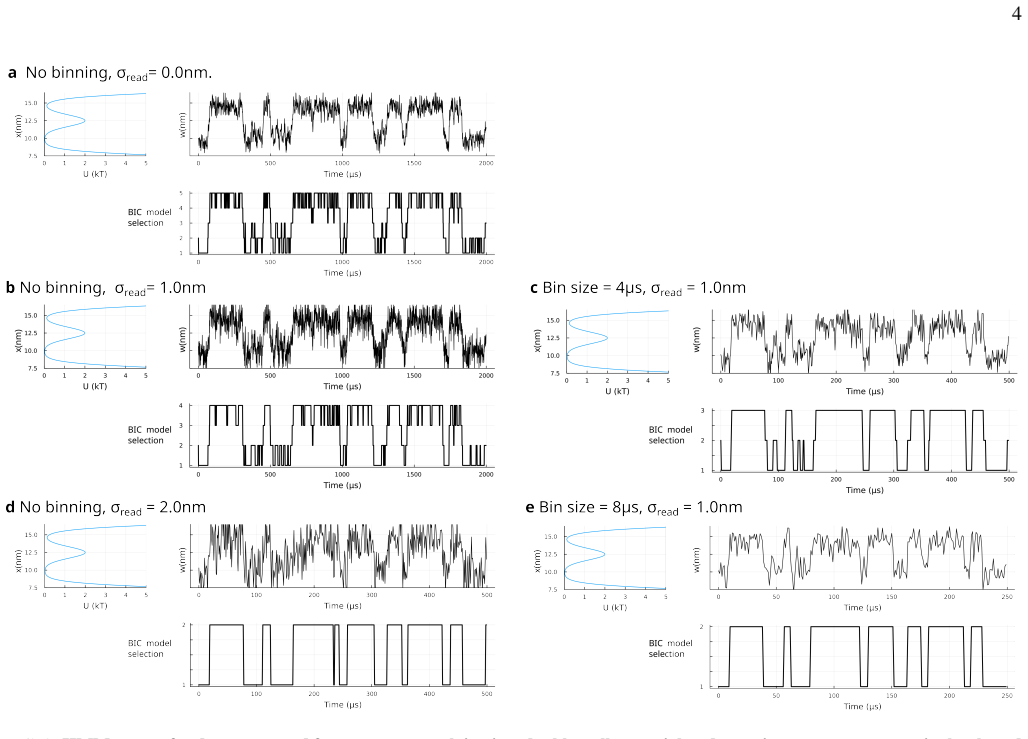
The paper claims that when a hidden Markov model is applied to continuous Langevin dynamics in smooth potentials, the inferred discrete states are primarily an abstraction of the measurement protocol and modeling choices rather than features of the physical potential. The authors show this by simulation: for a double well, high acquisition rate and no measurement noise—the apparent 'best case'—produces spurious extra states from smooth barrier crossings, while binning or added noise recovers the expected two basins. For a single well, 2-state and 3-state HMMs, BIC-selected models, and a Bayesian nonparametric HMM all return reproducible but entirely fictitious states, including a short-lived 'intermediate' state. The paper therefore concludes that HMM results on physical data need a well-calibrated emission model and that continuous-time or continuous-space generalizations are more faithful to the physics.
Load-bearing premise
The cautionary conclusion transfers from idealized one-dimensional overdamped Langevin simulations with Gaussian readout noise to real experiments only if those simulations capture the essential relationship between acquisition rate, noise, and the physical dynamics of actual single-molecule systems.
Editorial extensions
If this is right
- If HMM states are protocol-dependent, then comparing state counts across experiments requires identical acquisition parameters.
- BIC and Bayesian nonparametric HMMs can report reproducible but fictitious intermediate states for single-well dynamics, so model selection alone does not validate physical interpretation.
- Well-calibrated emission models, including detector integration over exposure windows, are necessary to attribute changes to physics rather than noise.
- Continuous-time (hidden Markov jump process) and continuous-space (Gaussian-process Langevin) generalizations avoid some but not all of these artifacts.
- The 'best case' of high acquisition rate and no measurement noise is not automatically the most trustworthy regime.
Reading between the lines
- The protocol-dependence likely extends to Markov state models of molecular dynamics, where state definitions are also chosen relative to a lag time and projection; varying the lag time may produce analogous spurious states.
- A testable extension is that a fixed physical system analyzed at two acquisition rates should yield different BIC-selected state numbers, an effect that could be quantified as a calibration curve.
- The paper's emphasis on emission models suggests a concrete best practice: report HMM results alongside synthetic-data controls using the same acquisition parameters, so artifacts can be spotted.
- Because the simulations are one-dimensional, an open question is whether multi-dimensional dynamics with hidden reaction coordinates produce more or fewer spurious states; the authors note the degeneracy of states with identical emission but distinct kinetics.
Editorial analysis
A structured set of objections, weighed in public.
Referee Report
Summary. The paper asks what happens when discrete-state, discrete-time hidden Markov models are applied to data generated by continuous Langevin dynamics. It simulates overdamped one-dimensional Langevin trajectories in double- and single-well potentials, with and without boxcar binning and Gaussian readout noise, and analyzes them with a fixed-state HMM, a BIC-corrected HMM, and a Beta-Bernoulli Bayesian nonparametric HMM. The authors report that HMM-inferred states often reflect the measurement protocol and modeling choices rather than the potential's basins, that binning or adding noise can reduce over-splitting, and that single-well dynamics can be spuriously split into reproducible-looking intermediate states. They then review continuous-time and continuous-space generalizations and argue for careful emission-model calibration.
Significance. If the empirical claims are properly supported, this is a valuable cautionary contribution for the single-molecule biophysics community. The paper's Table I crisply enumerates HMM assumptions against their physical implications, and Sections F and G constructively point to hidden Markov jump processes, Gaussian-process-based continuous-space models, and the central importance of calibrated emission distributions. The warning that discrete HMM states are abstractions rather than physical basins is important and likely to influence practice. However, the paper's main evidence is currently illustrative rather than statistical; the reproducibility and a-priori tunability claims need repeated-run support before the message can be fully convincing. With additional statistics and a complete parameter table, the paper could serve as a widely cited user's guide.
major comments (4)
- [Section C, Figs. 2-4] The abstract and Section C claim that HMM-recovered states are 'reproducibly' returned and can be 'tuned a priori' by the acquisition scheme, but every displayed condition is a single simulated trajectory analyzed once. No independent Langevin realizations, no distribution of BIC-selected state counts, and no measure of Viterbi-path stability across stochastic realizations are reported. Since both the dynamics and the inference are stochastic, a single run cannot establish reproducibility across data realizations, nor does it demonstrate a predictive mapping from binning or noise level to the recovered state count. Please add repeated-simulation statistics for the key scenarios in Figs. 2-4, such as histograms of selected state numbers and state-occupancy uncertainties.
- [Section C and Section H] The simulation parameters needed to reproduce the figures are not given in the text: the exact potential functional forms, barrier heights and widths, boxcar bin widths, sigma_read values, BIC state-count search range, and BNP hyperparameters are all absent, and Section H only promises code upon acceptance. This is load-bearing because the 'tuned a priori' claim requires a known mapping from acquisition parameters to outputs, and because the representativeness of the chosen examples cannot be checked. Add a parameter table or supplement, and make the code available at submission rather than only upon acceptance.
- [Section C, Fig. 2a] The sentence 'The analysis here identifies a 5-state model (the most complex model explored)' reveals that the BIC search was capped at five states. A selection at the upper boundary of the search range cannot be interpreted as BIC's preferred model; it only shows that the optimum was not found within the range considered. Please state the search range explicitly and extend it, or use a procedure that does not require a prespecified maximum, to determine where the BIC-optimal state count actually lies.
- [Sections B and G] The simulation evidence is restricted to one-dimensional overdamped Langevin dynamics with Gaussian readout noise and hand-chosen parameters, while the paper's title and discussion address physical systems broadly. The central claim that inferred states reflect measurement protocol more than the underlying potential would be more convincing if the authors either restricted the claim to the simulated class or added robustness tests for underdamped dynamics, colored noise, or multidimensional coordinates. As written, the scope of the conclusion exceeds the demonstrated regime, though this is fixable by additional simulations or by more careful qualifiers.
minor comments (4)
- [Abstract and Section A] The phrase 'drawn from from physical systems' repeats 'from'; this typo appears in both the abstract and the first paragraph of Section A and should be corrected.
- [Section D] The sentence 'These solutions throw rigor the wind' should read 'throw rigor to the wind', and 'only increase the complexity' should read 'only increases the complexity'.
- [Equations (12)-(13) and (16)-(18)] The display equations for the continuous-time transition rule are broken across equation numbers and contain an awkward prime in the summation symbol; please renumber and clarify the notation so that the categorical transition probability is presented as a single display equation.
- [Section E] The initial state vector is written with indices sigma_0 through sigma_M although the state space is earlier defined as sigma_1 through sigma_M; please make the indexing consistent.
Circularity Check
No significant circularity: the central claims rest on simulations with known ground truth, and self-citations are not load-bearing.
full rationale
The paper's main demonstration is a simulation experiment: Langevin trajectories are generated from known potentials (Eqs. 1-4), then HMM/BIC/BNP analyses are applied and compared to that ground truth. No parameter is fitted to a subset of data and then reported as a prediction of the same quantity; the state counts and Viterbi paths are outputs of independent inference tools applied to synthetic data. The self-citations (e.g., refs. 10-12, 30-32, 37, 42) describe specific nonparametric or GP methods used or referenced, but the main claims (states reflect measurement protocol, acquisition can be tuned, spurious intermediates appear in a single well) are demonstrated with standard parametric HMM and BIC as well as BNP, so the argument does not reduce to the authors' own prior work. The paper's stated limitations (1D overdamped dynamics, code availability in Sec. H) are caveats about scope and reproducibility, not circularity.
Assumptions & free parameters
free parameters (6)
- friction coefficient zeta =
0.0002 g/s
- integration time step Delta t =
1.0 microsecond
- double-well barrier height =
varied, e.g., about 2 kT
- double-well barrier width =
varied
- readout noise sigma_read =
varied from 0 to large
- boxcar averaging window =
varied (binned vs unbinned)
assumptions (4)
- domain assumption Overdamped Langevin dynamics in a 1D effective potential is a faithful minimal model for the physical systems HMMs are applied to.
- standard math Euler-Maruyama (Ito) integration with step Delta t correctly approximates the continuous Langevin dynamics at the measurement times.
- domain assumption The HMM inference algorithms, BIC model selection, and Beta-Bernoulli BNP HMM are implemented correctly and are representative of standard practice.
- domain assumption Gaussian readout noise model (Eq. 4) is representative of experimental measurement noise.
Cite this review
Pith. "Pith review of A cautious user's guide in applying HMMs to physical systems." pith.science (2026). https://pith.science/paper/COPR2WS7
@misc{pith2026250605707,
  author       = {Pith},
  title        = {Pith review of: A cautious user's guide in applying HMMs to physical systems},
  year         = {2026},
  howpublished = {\url{https://pith.science/paper/COPR2WS7}},
  note         = {Machine review of arXiv:2506.05707}
}
read the original abstract
Nature, as far as we know, evolves continuously through space and time. Yet the ubiquitous hidden Markov model (HMM)--originally developed for discrete time and space analysis in natural language processing--remains a central tool in interpreting time series data drawn from from physical systems. This raises a fundamental question: What are the implications of applying a discrete-state, discrete-time framework to analyze data generated by a continuously evolving system? Through synthetic data generated using Langevin dynamics in an effective potential, we explore under what circumstances HMMs yield interpretable results. Our analysis reveals that the discrete-state approximation acts primarily as an abstraction with the inferred states visited in time often more closely reflecting the measurement protocol and modeling choices than features of the underlying physical potential. Crucially, we demonstrate that the states visited over the course of a time series recovered by the HMM can be tuned a priori by adjusting the data acquisition scheme even misleadingly recovering reproducible "intermediate" states using different HMM tools for a system evolving in a single well potential. We conclude with a note of measured caution: while HMMs offer a mathematically elegant framework for time series inference, their use in physical modeling should be guided by an awareness of their limitations. In this light, we outline important generalizations of the HMM to continuous space and time and highlight the importance of a well calibrated measurement noise model.
Figures


Figures from the paper (1 more)

Reference graph
Works this paper leans on
-
[1]
author author L. E. \ Baum \ and\ author T. Petrie ,\ title title Statistical inference for probabilistic functions of finite state Markov chains , \ @noop journal journal The Annals of Mathematical Statistics \ volume 37 ,\ pages 1554 ( year 1966 ) NoStop
work page 1966
-
[2]
author author L. E. \ Baum , author T. Petrie , author G. Soules , \ and\ author N. Weiss ,\ title title A maximization technique occurring in the statistical analysis of probabilistic functions of Markov chains , \ @noop journal journal The Annals of Mathematical Statistics \ volume 41 ,\ pages 164 ( year 1970 ) NoStop
work page 1970
-
[3]
author author F. Jelinek ,\ @noop title Statistical methods for speech recognition \ ( publisher MIT press ,\ year 1998 ) NoStop
work page 1998
-
[4]
author author L. R. \ Rabiner ,\ title title A tutorial on hidden Markov models and selected applications in speech recognition , \ @noop journal journal Proceedings of the IEEE \ volume 77 ,\ pages 257 ( year 2002 ) NoStop
work page 2002
-
[5]
author author A. Krogh , author M. Brown , author I. S. \ Mian , author K. Sj \"o lander , \ and\ author D. Haussler ,\ title title Hidden Markov models in computational biology: Applications to protein modeling , \ @noop journal journal Journal of Molecular Biology \ volume 235 ,\ pages 1501 ( year 1994 ) NoStop
work page 1994
-
[6]
author author R. Durbin , author S. R. \ Eddy , author A. Krogh , \ and\ author G. Mitchison ,\ @noop title Biological sequence analysis: probabilistic models of proteins and nucleic acids \ ( publisher Cambridge university press ,\ year 1998 ) NoStop
work page 1998
-
[7]
author author S. A. \ McKinney , author C. Joo , \ and\ author T. Ha ,\ title title Analysis of single-molecule FRET trajectories using hidden Markov modeling , \ @noop journal journal Biophysical Journal \ volume 91 ,\ pages 1941 ( year 2006 ) NoStop
work page 1941
-
[8]
author author J. E. \ Bronson , author J. Fei , author J. M. \ Hofman , author R. L. \ Gonzalez , \ and\ author C. H. \ Wiggins ,\ title title Learning rates and states from biophysical time series: a Bayesian approach to model selection and single-molecule FRET data , \ @noop journal journal Biophysical Journal \ volume 97 ,\ pages 3196 ( year 2009 ) NoStop
work page 2009
Show all 65 references
-
[9]
Qin , author A
author author F. Qin , author A. Auerbach , \ and\ author F. Sachs ,\ title title Maximum likelihood estimation of aggregated Markov processes , \ @noop journal journal Proceedings of the Royal Society of London. Series B: Biological Sciences \ volume 264 ,\ pages 375 ( year 1...
1997
-
[10]
Safar , author A
author author M. Safar , author A. Saurabh , author B. Sarkar , author M. Fazel , author K. Ishii , author T. Tahara , author I. Sgouralis , \ and\ author S. Press \'e ,\ title title Single-photon smFRET. III . application to pulsed illumination , \ @noop journal journal Bioph...
2022
-
[11]
Sgouralis \ and\ author S
author author I. Sgouralis \ and\ author S. Press \'e ,\ title title An introduction to infinite HMMs for single-molecule data analysis , \ @noop journal journal Biophysical Journal \ volume 112 ,\ pages 2021 ( year 2017 a ) NoStop
2021
-
[12]
Sgouralis , author S
author author I. Sgouralis , author S. Madaan , author F. Djutanta , author R. Kha , author R. F. \ Hariadi , \ and\ author S. Press \'e ,\ title title A Bayesian nonparametric approach to single molecule forster resonance energy transfer , \ @noop journal journal The Journal ...
2018
-
[13]
Sgouralis \ and\ author S
author author I. Sgouralis \ and\ author S. Press \'e ,\ title title Icon: an adaptation of infinite HMMs for time traces with drift , \ @noop journal journal Biophysical Journal \ volume 112 ,\ pages 2117 ( year 2017 b ) NoStop
2017
-
[14]
Mor , author S
author author B. Mor , author S. Garhwal , \ and\ author A. Kumar ,\ title title A systematic review of hidden Markov models and their applications , \ @noop journal journal Archives of Computational Methods in Engineering \ volume 28 ,\ pages 1429 ( year 2021 ) NoStop
2021
-
[15]
Mazal \ and\ author G
author author H. Mazal \ and\ author G. Haran ,\ title title Single-molecule FRET methods to study the dynamics of proteins at work , \ @noop journal journal Current Opinion in Biomedical Engineering \ volume 12 ,\ pages 8 ( year 2019 ) NoStop
2019
-
[16]
Nettels , author N
author author D. Nettels , author N. Galvanetto , author M. T. \ Ivanovi \'c , author M. N \"u esch , author T. Yang , \ and\ author B. Schuler ,\ title title Single-molecule FRET for probing nanoscale biomolecular dynamics , \ @noop journal journal Nature Reviews Physics \ vo...
2024
-
[17]
Schanda \ and\ author G
author author P. Schanda \ and\ author G. Haran ,\ title title NMR and single-molecule FRET insights into fast protein motions and their relation to function , \ @noop journal journal Annual Review of Biophysics \ volume 53 ( year 2024 ) NoStop
2024
-
[18]
Grabenhorst , author F
author author L. Grabenhorst , author F. Sturzenegger , author M. Hasler , author B. Schuler , \ and\ author P. Tinnefeld ,\ title title Single-molecule FRET at 10 MHz count rates , \ @noop journal journal Journal of the American Chemical Society \ volume 146 ,\ pages 3539 ( y...
2024
-
[19]
author author A. K. \ Foote , author K. Ishii , author B. Cullinane , author T. Tahara , \ and\ author R. H. \ Goldsmith ,\ title title Quantifying microsecond solution-phase conformational dynamics of a DNA hairpin at the single-molecule level , \ @noop journal journal ACS Ph...
2024
-
[20]
Phelps , author B
author author C. Phelps , author B. Israels , author D. Jose , author M. C. \ Marsh , author P. H. \ von Hippel , \ and\ author A. H. \ Marcus ,\ title title Using microsecond single-molecule FRET to determine the assembly pathways of T4 ssDNA binding protein onto model DNA re...
2017
-
[21]
Maslov , author O
author author I. Maslov , author O. Volkov , author P. Khorn , author P. Orekhov , author A. Gusach , author P. Kuzmichev , author A. Gerasimov , author A. Luginina , author Q. Coucke , author A. Bogorodskiy , et al. ,\ title title Sub-millisecond conformational dynamics of th...
2023
-
[22]
Otosu , author K
author author T. Otosu , author K. Ishii , \ and\ author T. Tahara ,\ title title Microsecond protein dynamics observed at the single-molecule level , \ @noop journal journal Nature Communications \ volume 6 ,\ pages 7685 ( year 2015 ) NoStop
2015
-
[23]
Grimm , author T
author author M. Grimm , author T. Franosch , \ and\ author S. Jeney ,\ title title High-resolution detection of Brownian motion for quantitative optical tweezers experiments , \ @noop journal journal Physical Review E—Statistical, Nonlinear, and Soft Matter Physics \ volume 8...
2012
-
[24]
author author L. S. \ Madsen , author M. Waleed , author C. A. \ Casacio , author A. Terrasson , author A. B. \ Stilgoe , author M. A. \ Taylor , \ and\ author W. P. \ Bowen ,\ title title Ultrafast viscosity measurement with ballistic optical tweezers , \ @noop journal journa...
2021
-
[25]
author author C. J. \ Bustamante , author Y. R. \ Chemla , author S. Liu , \ and\ author M. D. \ Wang ,\ title title Optical tweezers in single-molecule biophysics , \ @noop journal journal Nature Reviews Methods Primers \ volume 1 ,\ pages 25 ( year 2021 ) NoStop
2021
-
[26]
author author W. P. \ Wong \ and\ author K. Halvorsen ,\ title title The effect of integration time on fluctuation measurements: calibrating an optical trap in the presence of motion blur , \ @noop journal journal Optics Express \ volume 14 ,\ pages 12517 ( year 2006 ) NoStop
2006
-
[27]
author author W. P. \ Wong \ and\ author K. Halvorsen ,\ title title Beyond the frame rate: measuring high-frequency fluctuations with light-intensity modulation , \ @noop journal journal Optics Letters \ volume 34 ,\ pages 277 ( year 2009 ) NoStop
2009
-
[28]
Beal , author Z
author author M. Beal , author Z. Ghahramani , \ and\ author C. Rasmussen ,\ title title The infinite hidden Markov model , \ @noop journal journal Advances in Neural Information Processing Systems \ volume 14 ( year 2001 ) NoStop
2001
-
[29]
Sgouralis , author M
author author I. Sgouralis , author M. Whitmore , author L. Lapidus , author M. J. \ Comstock , \ and\ author S. Press \'e ,\ title title Single molecule force spectroscopy at high data acquisition: A Bayesian nonparametric analysis , \ @noop journal journal The Journal of Che...
2018
-
[30]
Saurabh , author M
author author A. Saurabh , author M. Fazel , author M. Safar , author I. Sgouralis , \ and\ author S. Press \'e ,\ title title Single-photon smFRET. I : Theory and conceptual basis , \ @noop journal journal Biophysical Reports \ volume 3 ( year 2023 a ) NoStop
2023
-
[31]
Saurabh , author M
author author A. Saurabh , author M. Safar , author M. Fazel , author I. Sgouralis , \ and\ author S. Press \'e ,\ title title Single-photon smFRET: II . application to continuous illumination , \ @noop journal journal Biophysical Reports \ volume 3 ( year 2023 b ) NoStop
2023
-
[32]
Kilic , author I
author author Z. Kilic , author I. Sgouralis , \ and\ author S. Press \'e ,\ title title Generalizing HMMs to continuous time for fast kinetics: Hidden Markov jump processes , \ @noop journal journal Biophysical Journal \ volume 120 ,\ pages 409 ( year 2021 ) NoStop
2021
-
[33]
Schwarz ,\ title title Estimating the dimension of a model , \ @noop journal journal The Annals of Statistics \ ,\ pages 461 ( year 1978 ) NoStop
author author G. Schwarz ,\ title title Estimating the dimension of a model , \ @noop journal journal The Annals of Statistics \ ,\ pages 461 ( year 1978 ) NoStop
1978
-
[34]
author author H. Akaike ,\ title title Information theory and an extension of the maximum likelihood principle , \ in\ @noop booktitle Selected papers of hirotugu akaike \ ( publisher Springer ,\ year 1998 )\ p.\ pages 199 NoStop
1998
-
[35]
Pishro-Nik ,\ @noop title Introduction to probability, statistics, and random processes \ ( publisher Kappa Research, LLC Blue Bell, PA, USA ,\ year 2014 ) NoStop
author author H. Pishro-Nik ,\ @noop title Introduction to probability, statistics, and random processes \ ( publisher Kappa Research, LLC Blue Bell, PA, USA ,\ year 2014 ) NoStop
2014
-
[36]
author author R. D. \ Morey , author J.-W. \ Romeijn , \ and\ author J. N. \ Rouder ,\ title title The philosophy of Bayes factors and the quantification of statistical evidence , \ @noop journal journal Journal of Mathematical Psychology \ volume 72 ,\ pages 6 ( year 2016 ) NoStop
2016
-
[37]
Saurabh , author L
author author A. Saurabh , author L. W. \ Xu , \ and\ author S. Press \'e ,\ title title On the statistical foundation of a recent single molecule FRET benchmark , \ @noop journal journal Nature Communications \ volume 15 ,\ pages 3627 ( year 2024 ) NoStop
2024
-
[38]
Hirsch , author R
author author M. Hirsch , author R. J. \ Wareham , author M. L. \ Martin-Fernandez , author M. P. \ Hobson , \ and\ author D. J. \ Rolfe ,\ title title A stochastic model for electron multiplication charge-coupled devices--from theory to practice , \ @noop journal journal PLOS...
2013
-
[39]
Press \'e \ and\ author I
author author S. Press \'e \ and\ author I. Sgouralis ,\ @noop title Data Modeling for the Sciences: Applications, Basics, Computations \ ( publisher Cambridge University Press ,\ year 2023 ) NoStop
2023
-
[40]
author author D. T. \ Gillespie ,\ title title Exact stochastic simulation of coupled chemical reactions , \ @noop journal journal The Journal of Physical Chemistry \ volume 81 ,\ pages 2340 ( year 1977 ) NoStop
1977
-
[41]
Kilic , author I
author author Z. Kilic , author I. Sgouralis , author W. Heo , author K. Ishii , author T. Tahara , \ and\ author S. Press \'e ,\ title title Extraction of rapid kinetics from smFRET measurements using integrative detectors , \ @noop journal journal Cell Reports Physical Scien...
2021
-
[42]
author author J. S. \ Bryan , author I. Sgouralis , \ and\ author S. Press \'e ,\ title title Inferring effective forces for Langevin dynamics using Gaussian processes , \ @noop journal journal The Journal of Chemical Physics \ volume 152 ( year 2020 ) NoStop
2020
-
[43]
Williams \ and\ author C
author author C. Williams \ and\ author C. Rasmussen ,\ title title Gaussian processes for regression , \ @noop journal journal Advances in Neural Information Processing Systems \ volume 8 ( year 1995 ) NoStop
1995
-
[44]
o tz , author A. Barth , author S. S.-R. \ Bohr , author R. B \
author author M. G \"o tz , author A. Barth , author S. S.-R. \ Bohr , author R. B \"o rner , author J. Chen , author T. Cordes , author D. A. \ Erie , author C. Gebhardt , author M. C. \ Hadzic , author G. L. \ Hamilton , et al. ,\ title title A blind benchmark of analysis to...
2022
-
[45]
Agam , author C
author author G. Agam , author C. Gebhardt , author M. Popara , author R. M \"a chtel , author J. Folz , author B. Ambrose , author N. Chamachi , author S. Y. \ Chung , author T. D. \ Craggs , author M. de Boer , et al. ,\ title title Reliability and accuracy of single-molecul...
2023
-
[46]
Asadiatouei , author C.-B
author author P. Asadiatouei , author C.-B. \ Salem , author S. Wanninger , author E. Ploetz , \ and\ author D. C. \ Lamb ,\ title title Deep-LASI , single-molecule data analysis software , \ @noop journal journal Biophysical Journal \ volume 123 ,\ pages 2682 ( year 2024 ) NoStop
2024
-
[47]
Duncker , author G
author author L. Duncker , author G. Bohner , author J. Boussard , \ and\ author M. Sahani ,\ title title Learning interpretable continuous-time models of latent stochastic dynamical systems , \ in\ @noop booktitle International conference on machine learning \ ( organization ...
2019
-
[48]
author author R. G. \ Krishnan , author U. Shalit , \ and\ author D. Sontag ,\ title title Structured inference networks for nonlinear state space models , \ in\ https://ojs.aaai.org/index.php/AAAI/article/view/10779 booktitle Proceedings of the AAAI Conference on Artificial I...
2017
-
[49]
author author T. G. J. \ Rudner , author F. Bickford Smith , author Q. Feng , author Y. W. \ Teh , \ and\ author Y. Gal ,\ title title Learning interpretable continuous-time models of latent stochastic dynamical systems , \ in\ https://proceedings.mlr.press/v162/rudner22a.html...
2022
-
[50]
author author L. T. \ Niles \ and\ author H. F. \ Silverman ,\ title title Combining hidden Markov model and neural network classifiers , \ in\ @noop booktitle International Conference on Acoustics, Speech, and Signal Processing \ ( organization IEEE ,\ year 1990 )\ p.\ pages ...
1990
-
[51]
Tran , author R
author author D. Tran , author R. Ranganath , \ and\ author D. M. \ Blei ,\ title title The variational Gaussian process , \ @noop journal journal arXiv preprint arXiv:1511.06499 \ ( year 2015 ) NoStop
2015 arXiv
-
[52]
Bansal \ and\ author S
author author V. Bansal \ and\ author S. Zhou ,\ title title DEN-HMM : Deep emission network based hidden Markov model with time-evolving multivariate observations , \ @noop journal journal IISE Transactions \ ,\ pages 1 ( year 2024 ) NoStop
2024
-
[53]
Huggins , author K
author author J. Huggins , author K. Narasimhan , author A. Saeedi , \ and\ author V. Mansinghka ,\ title title JUMP-Means : Small-variance asymptotics for Markov jump processes , \ in\ @noop booktitle International Conference on Machine Learning \ ( organization PMLR ,\ year ...
2015
-
[54]
Metzner , author E
author author P. Metzner , author E. Dittmer , author T. Jahnke , \ and\ author C. Sch \"u tte ,\ title title Generator estimation of Markov jump processes , \ @noop journal journal Journal of Computational Physics \ volume 227 ,\ pages 353 ( year 2007 ) NoStop
2007
-
[55]
Hobolth \ and\ author E
author author A. Hobolth \ and\ author E. A. \ Stone ,\ title title Simulation from endpoint-conditioned, continuous-time Markov chains on a finite state space, with applications to molecular evolution , \ @noop journal journal The Annals of Applied Statistics \ volume 3 ,\ pa...
2009
-
[56]
Burzykowski , author J
author author T. Burzykowski , author J. P. \ Szubiakowski , \ and\ author T. Ryden ,\ title title Statistical analysis of data from single molecule experiment , \ in\ @noop booktitle IV Workshop on Atomic and Molecular Physics ,\ Vol.\ volume 5258 \ ( organization SPIE ,\ yea...
2003
-
[57]
Agarwal , author N
author author A. Agarwal , author N. W. \ Hengartner , author S. Gnanakaran , \ and\ author A. F. \ Voter ,\ title title Computing long time scale biomolecular dynamics using quasi-stationary distribution kinetic Monte Carlo (QSD-KMC) , \ @noop journal journal The Journal of C...
2019
-
[58]
author author A. V. \ Sinitskiy \ and\ author V. S. \ Pande ,\ title title Theoretical restrictions on longest implicit time scales in Markov state models of biomolecular dynamics , \ @noop journal journal The Journal of Chemical Physics \ volume 148 ( year 2018 ) NoStop
2018
-
[59]
V \"o gele , author N
author author M. V \"o gele , author N. J. \ Thomson , author S. T. \ Truong , author J. McAvity , author U. Zachariae , \ and\ author R. O. \ Dror ,\ title title Systematic analysis of biomolecular conformational ensembles with PENSA , \ @noop journal journal The Journal of C...
2025
-
[60]
No \'e , author H
author author F. No \'e , author H. Wu , author J.-H. \ Prinz , \ and\ author N. Plattner ,\ title title Projected and hidden Markov models for calculating kinetics and metastable states of complex molecules , \ @noop journal journal The Journal of Chemical Physics \ volume 13...
2013
-
[61]
author author C. R. \ Schwantes , author R. T. \ McGibbon , \ and\ author V. S. \ Pande ,\ title title Perspective: Markov models for long-timescale biomolecular dynamics , \ @noop journal journal The Journal of Chemical Physics \ volume 141 ( year 2014 ) NoStop
2014
-
[62]
Abdel-Hamid , author A.-r
author author O. Abdel-Hamid , author A.-r. \ Mohamed , author H. Jiang , \ and\ author G. Penn ,\ title title Applying convolutional neural networks concepts to hybrid NN-HMM model for speech recognition , \ in\ @noop booktitle 2012 IEEE international conference on Acoustics,...
2012
-
[63]
Li , author L
author author J. Li , author L. Zhang , author A. Johnson-Buck , \ and\ author N. G. \ Walter ,\ title title Automatic classification and segmentation of single-molecule fluorescence time traces with deep learning , \ @noop journal journal Nature Communications \ volume 11 ,\ ...
2020
-
[64]
Wanninger , author P
author author S. Wanninger , author P. Asadiatouei , author J. Bohlen , author C.-B. \ Salem , author P. Tinnefeld , author E. Ploetz , \ and\ author D. C. \ Lamb ,\ title title Deep-LASI : deep-learning assisted, single-molecule imaging analysis of multi-color DNA origami str...
2023
-
[65]
Chodera , author P
author author J. Chodera , author P. Elms , author F. No \'e , author B. Keller , author C. Kaiser , author A. Ewall-Wice , author S. Marqusee , author C. Bustamante , \ and\ author N. Singhal Hinrichs ,\ title title Bayesian hidden Markov model analysis of single-molecule for...
2011 arXiv
Reviewed August 7, 2026 · model on record in the stance chip above.
Discussion (0). Sign in to comment.