REVIEW 3 major objections 4 minor 60 references
Dynamical Phase Transition of Dissipative Fermionic Superfluids
T0 review · 3 major / 4 minor · reviewed 2026-08-07 · deepseek-v4-flash
Pith's one-line read A lossy BCS superfluid undergoes a generic dissipative dynamical phase transition at a finite critical time, with the order parameter vanishing non-analytically and the superfluid fraction's first derivative jumping.
desk verdict The generalized TDHFB framework is a real contribution and the one-body loss result is clean, but the two-body branch has a sign error in Eq. (21) that invalidates the universal transition as written. read the letter →
The pith
A machine-rendered reading of the paper's core claim, the machinery that carries it, and where it could break.
The reading
What carries the argument
The engine of the argument is the generalized time-dependent Hartree-Fock-Bogoliubov equation, Eq. (9), $i\hbar\dot{R} = [H_R, R] + i\hbar\{H_I, R\} + i\hbar J$. It follows from a least-action variational principle applied to the Lindblad master equation with a fermionic Gaussian density matrix and a quadratic auxiliary observable; the new ingredients beyond the closed-system equation are the anticommutator with the imaginary Hartree-Fock Hamiltonian $H_I$ and the quantum-jump term $J$. In the BCS limit with a homogeneous system, the equation reduces to a rate equation for the Bogoliubov quasiparticle distribution $\nu$, and the paper finds closed-form amplitudes $\alpha(t)$ for one-body and two-body loss whose common feature is $\alpha(t_c) = 1/2$. That value makes the order parameter $\Delta_R$ and the superfluid fraction $\zeta$ vanish at the same instant, producing the non-analytic behavior.
What would settle it
Numerically integrate the full generalized time-dependent Hartree-Fock-Bogoliubov equation (or a numerically exact Lindblad simulation for small systems) without imposing the Fermi-step ansatz; if the gap vanishes smoothly or the superfluid fraction derivative stays continuous, the claimed universality fails. In experiment, suddenly turn on one-body loss in a BCS gas and monitor the order parameter through rf spectroscopy: a kink at time $\ln(2)/(2\gamma)$ would confirm the transition, while a smooth decay would contradict it.
Extended reading notes
Core claim
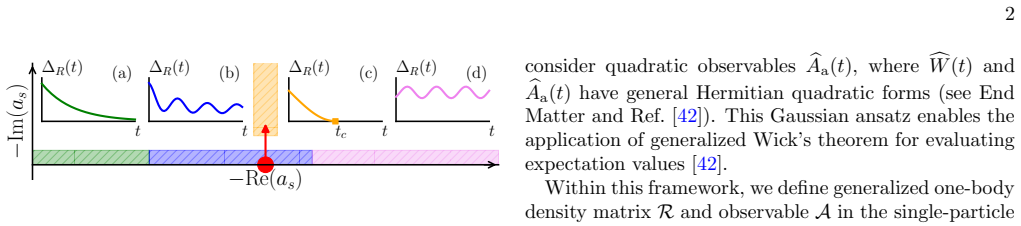
The paper's central discovery is that, in a homogeneous spin-balanced two-component Fermi superfluid in the BCS limit, suddenly switching on either one-body loss at rate $\gamma$ or two-body inelastic scattering with coupling $g_I = 4\pi\hbar\,\mathrm{Im}(a_s)/m$ makes the order parameter $\Delta_R(t)$ vanish non-analytically at a finite critical time. For one-body loss the critical time is $t_c = \ln(2)/(2\gamma)$; for two-body loss it is $t_c = -3\pi^2/(g_I k_F^3)$. At that same instant the superfluid fraction $\zeta(t)$ drops to zero with a discontinuous first derivative, and the quasiparticle distribution merges with the physical particle distribution. The transition is claimed to be universal for any BCS ground state because $t_c$ is independent of the elastic scattering length $\mathrm{Re}(a_s)$, which only controls the decay rate of the gap.
Load-bearing premise
The argument rests on assuming that the momentum distribution keeps the exact zero-temperature Fermi-step shape at all times; if the distribution deforms before the critical time, the non-analytic kink may be an artifact of that assumption.
Editorial extensions
If this is right
- One-body and two-body loss each drive a BCS superfluid to a normal fluid at a finite critical time $t_c$, with the order parameter vanishing non-analytically.
- The superfluid fraction's first time derivative is discontinuous at $t_c$, providing a sharp experimental signature of the dissipative dynamical phase transition.
- The transition occurs for any initial elastic scattering length in the BCS limit; only the decay rate of the gap, not the critical time, depends on $\mathrm{Re}(a_s)$.
- Below $t_c$ the gap decays faster than exponentially, in contrast to the exponential decay found in Hermitian order-parameter quenches.
- Above $t_c$ the generalized density matrix reduces to the normal-fluid one, and subsequent dynamics follow the non-Hermitian von Neumann equation for the normal phase.
Reading between the lines
- Away from the BCS limit, elastic dynamics are no longer exponentially slow and the Fermi-step ansatz breaks down; the paper's framework remains applicable in principle through numerical solution of Eq. (9), so whether the non-analytic cusp survives in the unitary or BEC regime is an open testable question.
- Because $t_c$ depends only on the dissipative parameters $\gamma$ or $\mathrm{Im}(a_s)$, a measured kink time in a cold-atom experiment would directly calibrate the inelastic loss rate, while a known loss rate predicts when superfluid signals disappear.
- The least-action route from the Lindblad equation to effective quasiparticle dynamics may extend to other ordered phases under loss, such as magnetic or charge-density-wave order, whenever the order parameter couples to a quasiparticle distribution in the same way.
Editorial analysis
A structured set of objections, weighed in public.
Referee Report
Summary. This manuscript extends the time-dependent Hartree-Fock-Bogoliubov (TDHFB) action principle to open quantum systems by adding Lindblad dissipators, obtaining Eq. (9) for the generalized density matrix. Specializing to homogeneous systems in the BCS limit with the step-function ansatz Eq. (19), the authors derive analytical expressions for the quasiparticle amplitude α(t) under one-body loss (Eq. (20)) and two-body loss (Eq. (21)). They identify a critical time tc (Eq. (23)) at which the order parameter vanishes non-analytically and the superfluid fraction has a discontinuous first derivative (Eqs. (24)-(25)), and they claim this dissipative dynamical phase transition is universal for BCS superfluids regardless of the initial elastic scattering length.
Significance. The variational derivation of Eq. (9) is a useful contribution: it provides a compact route to a dissipative TDHFB equation and reduces to the known closed-system equation when H_I and J vanish. The one-body branch is internally consistent, and the closed-form expressions are simple enough to be tested against future quantum-gas experiments. However, the two-body branch contains a sign inconsistency in Eq. (21) that invalidates the two-body part of the central claim as printed. The paper also does not address whether the step-function ansatz is stable against momentum-dependent fluctuations, which is central to the universality claim.
major comments (3)
- [Eqs. (21) and (23)] For a positive critical time in Eq. (23), one must have g_I < 0. For 0 ≤ t < tc, Eq. (21) then reduces to α(t) = -t/(tc - t): the absolute value in the numerator equals 9π^4(1 - t^2/t_c^2), and the denominator is [3π^2(1 - t/t_c)]^2. This α is negative for all t > 0 and diverges to -∞ as t → tc; it never equals 1/2. Consequently Eq. (21) does not satisfy Eq. (17), α(tc) = 1/2 is not obtained, and the two-body critical time and gap/superfluid-fraction formulas, Eqs. (23)-(25), are not established. The one-body result Eq. (20) is unaffected. Please correct the sign in the denominator (or in the definition of tc) and verify the substitution explicitly.
- [Eq. (19) and Eqs. (17)-(18)] The step-function ansatz in Eq. (19) is the load-bearing simplification. The text states that this ansatz 'obeys all required equations' but provides no proof that the solution is unique or stable. Because Eq. (17) is nonlinear and couples to the global density through ∫ ρ, it is not obvious that momentum-dependent perturbations of ν and ρ remain subleading on the dissipative time scale up to tc; the slowness of O(ℏ²) elastic collisions does not by itself control such perturbations. If such perturbations grow before tc, the nonanalytic vanishing at tc could be an artifact of the ansatz. A linear-stability analysis around the step solution, or a direct numerical solution of Eq. (9) in the homogeneous BCS limit, would address this load-bearing point.
- [Eq. (24)] The superfluid fraction formula ζ(t) = [1-2α(t)]/[1-α(t)] is derived from the step ansatz. In the two-body branch as printed, the negative α(t) obtained from Eq. (21) gives ζ(t) > 1 for t < tc, which is unphysical. This further confirms that the two-body inconsistency must be resolved before the claimed transition can be accepted.
minor comments (4)
- [Page 4, paragraph after Eq. (23)] The phrase 'the system completely losses its superfluidity' should read 'loses'.
- [Footnote [46]] The placeholder 'Supplemental Material at to-be-inserted-by-the-editor' should be updated with the actual reference information.
- [Eq. (19)] The notation in Eq. (19) uses pF as a dimensionful quantity while ν and ρ are phase-space distributions; please state the dimensional conventions explicitly, since this affects the correct interpretation of Eq. (17).
- [Fig. 2 caption] The phrase 'Left panel (a-d)' is confusing; each of the four panels should be labeled in the figure itself so the reader can follow the time evolution.
Circularity Check
No circular derivation: the dissipative transition time emerges from solving the equations of motion; no fitted parameters or load-bearing self-citations.
full rationale
The central chain is self-contained: Eq. (9) is obtained by a variational least-action principle from the Lindblad action, Eq. (13) follows by Wigner transform at O(ℏ), and in the BCS limit Eq. (17) is a closed differential equation for the quasiparticle distribution. The step-function ansatz Eq. (19) is not the target result; it is used to reduce Eq. (17) to an algebraic equation for α(t), and the critical time tc is determined by the condition α(tc)=1/2, not imposed as an input. The superfluid fraction and gap are then computed from independent definitions (Landau superfluid density and the BCS gap equation) rather than from the transition condition. No parameter is fitted to the phenomenon being predicted, and no claim rests on a citation to the authors' own prior work: all cited support (e.g., Refs. [35-38] for dynamics, [42] for HFB action, [49,50] for Gaussian preservation, [45] for complex contact interaction) is external or textbook. The paper's own two-body solution (Eq. (21)) appears internally inconsistent for the sign required by Eq. (23), yielding negative α and a divergence at tc instead of α(tc)=1/2; this is a mathematical/derivation defect in a specific channel, not a circular reduction of the conclusion to its inputs, and it leaves the circularity score at 0.
Assumptions & free parameters
assumptions (5)
- domain assumption Fermionic Gaussian ansatz for the density matrix (Hartree-Fock-Bogoliubov approximation).
- domain assumption Lindblad master equation structure for the open-system dynamics.
- domain assumption Truncation of the Wigner-Moyal expansion at first order in ℏ.
- domain assumption BCS limit with ΔR and ΔI approaching zero and coherence enhancement neglected.
- ad hoc to paper Step-function ansatz for ν and ρ in Eq. (19).
Cite this review
Pith. "Pith review of Dynamical Phase Transition of Dissipative Fermionic Superfluids." pith.science (2026). https://pith.science/paper/54FHWCFW
@misc{pith2026250605770,
  author       = {Pith},
  title        = {Pith review of: Dynamical Phase Transition of Dissipative Fermionic Superfluids},
  year         = {2026},
  howpublished = {\url{https://pith.science/paper/54FHWCFW}},
  note         = {Machine review of arXiv:2506.05770}
}
read the original abstract
Driven-dissipative open quantum many-body systems exhibit rich phases that are characterized by the steady states in the long-time dynamics. However, lossy open systems inevitably decay to the vacuum, making their transient evolution the primary focus. Assuming the Hartree-Fock-Bogoliubov ansatz, we derive a generalized time-dependent Hartree-Fock-Bogoliubov equation based on the least action principle for open quantum systems. By solving the quench dynamics after abruptly introducing inelastic scattering or one-body loss in the Bardeen-Cooper-Schrieffer limit, we reveal a generic dynamical phase transition: the superfluid order parameter vanishes non-analytically while the superfluid fraction's first-order time derivative undergoes a discontinuous change at a finite critical time. This marks a new paradigm of dynamical phase transitions, distinct from those in closed systems, where the initial state must be finely tuned.
Figures

Reference graph
Works this paper leans on
-
[1]
E. M. Kessler, G. Giedke, A. Imamoglu, S. F. Yelin, M. D. Lukin, and J. I. Cirac, Dissipative phase transition in a central spin system, Phys. Rev. A86, 012116 (2012)
2012
-
[2]
M. H¨ oning, M. Moos, and M. Fleischhauer, Critical exponents of steady-state phase transitions in fermionic lattice models, Phys. Rev. A86, 013606 (2012)
work page 2012
-
[3]
M. H¨ oning, D. Muth, D. Petrosyan, and M. Fleischhauer, Steady-state crystallization of Rydberg excitations in an optically driven lattice gas, Phys. Rev. A87, 023401 (2013)
work page 2013
-
[4]
Horstmann, J
B. Horstmann, J. I. Cirac, and G. Giedke, Noise-driven dynamics and phase transitions in fermionic systems, Phys. Rev. A87, 012108 (2013)
2013
-
[5]
E. G. D. Torre, S. Diehl, M. D. Lukin, S. Sachdev, and P. Strack, Keldysh approach for nonequilibrium phase transitions in quantum optics: Beyond the Dicke model in optical cavities, Phys. Rev. A87, 023831 (2013)
2013
-
[6]
L. M. Sieberer, S. D. Huber, E. Altman, and S. Diehl, Dynamical Critical Phenomena in Driven-Dissipative Systems, Phys. Rev. Lett.110, 195301 (2013)
work page 2013
-
[7]
J. Qian, L. Zhou, and W. Zhang, Quantum phases of strongly interacting Rydberg atoms in triangular lattices, Phys. Rev. A87, 063421 (2013)
work page 2013
-
[8]
A. Le Boit´ e, G. Orso, and C. Ciuti, Steady-State Phases and Tunneling-Induced Instabilities in the Driven Dissipative Bose-Hubbard Model, Phys. Rev. Lett.110, 233601 (2013)
work page 2013
Show all 60 references
-
[9]
T. E. Lee, S. Gopalakrishnan, and M. D. Lukin, Unconventional Magnetism via Optical Pumping of Interacting Spin Systems, Phys. Rev. Lett.110, 257204 (2013)
2013
-
[10]
C. Carr, R. Ritter, C. G. Wade, C. S. Adams, and K. J. Weatherill, Nonequilibrium Phase Transition in a Dilute Rydberg Ensemble, Phys. Rev. Lett.111, 113901 (2013)
2013
-
[11]
Joshi, F
C. Joshi, F. Nissen, and J. Keeling, Quantum correlations in the one-dimensional driven dissipative XYmodel, Phys. Rev. A88, 063835 (2013)
2013
-
[12]
Malossi, M
N. Malossi, M. M. Valado, S. Scotto, P. Huillery, P. Pillet, D. Ciampini, E. Arimondo, and O. Morsch, Full Counting Statistics and Phase Diagram of a Dissipative Rydberg Gas, Phys. Rev. Lett.113, 023006 (2014)
2014
-
[13]
Marcuzzi, E
M. Marcuzzi, E. Levi, S. Diehl, J. P. Garrahan, and I. Lesanovsky, Universal Nonequilibrium Properties of Dissipative Rydberg Gases, Phys. Rev. Lett.113, 210401 (2014)
2014
-
[14]
Lang and H
N. Lang and H. P. B¨ uchler, Exploring quantum phases by driven dissipation, Phys. Rev. A92, 012128 (2015)
2015
-
[15]
V. R. Overbeck, M. F. Maghrebi, A. V. Gorshkov, and H. Weimer, Multicritical behavior in dissipative Ising models, Phys. Rev. A95, 042133 (2017)
2017
-
[16]
Savona, Spontaneous symmetry breaking in a quadratically driven nonlinear photonic lattice, Phys
V. Savona, Spontaneous symmetry breaking in a quadratically driven nonlinear photonic lattice, Phys. Rev. A96, 033826 (2017)
2017
-
[17]
Tomita, S
T. Tomita, S. Nakajima, I. Danshita, Y. Takasu, and Y. Takahashi, Observation of the Mott insulator to superfluid crossover of a driven-dissipative Bose-Hubbard system, Sci. Adv.3, e1701513 (2017)
2017
-
[18]
Gao and Z
C. Gao and Z. Liang, Steady-state phase diagram of quantum gases in a lattice coupled to a membrane, Phys. Rev. A99, 013629 (2019)
2019
-
[19]
Huybrechts, F
D. Huybrechts, F. Minganti, F. Nori, M. Wouters, and N. Shammah, Validity of mean-field theory in a dissipative critical system: Liouvillian gap,PT- symmetric antigap, and permutational symmetry in the XY Zmodel, Phys. Rev. B101, 214302 (2020)
2020
-
[20]
H. H. Jen, Steady-state phase diagram of a weakly driven chiral-coupled atomic chain, Phys. Rev. Res.2, 013097 (2020)
2020
-
[21]
Landa, M
H. Landa, M. Schir´ o, and G. Misguich, Correlation- induced steady states and limit cycles in driven dissipative quantum systems, Phys. Rev. B102, 064301 (2020)
2020
-
[22]
X. Li, Y. Li, and J. Jin, Steady-state phases of the dissipative spin-1/2 XYZ model with frustrated interactions, Phys. Rev. B104, 155130 (2021)
2021
-
[23]
L. M. Sieberer, M. Buchhold, and S. Diehl, Keldysh field theory for driven open quantum systems, Rep. Prog. Phys.79, 096001 (2016)
2016
-
[24]
Weimer, Variational Principle for Steady States of Dissipative Quantum Many-Body Systems, Phys
H. Weimer, Variational Principle for Steady States of Dissipative Quantum Many-Body Systems, Phys. Rev. Lett.114, 040402 (2015)
2015
-
[25]
Finazzi, A
S. Finazzi, A. Le Boit´ e, F. Storme, A. Baksic, and C. Ciuti, Corner-Space Renormalization Method for Driven-Dissipative Two-Dimensional Correlated 7 Systems, Phys. Rev. Lett.115, 080604 (2015)
2015
-
[26]
J. Jin, A. Biella, O. Viyuela, L. Mazza, J. Keeling, R. Fazio, and D. Rossini, Cluster Mean-Field Approach to the Steady-State Phase Diagram of Dissipative Spin Systems, Phys. Rev. X6, 031011 (2016)
2016
-
[27]
Kshetrimayum, H
A. Kshetrimayum, H. Weimer, and R. Or´ us, A simple tensor network algorithm for two-dimensional steady states, Nat. Commun.8, 1291 (2017)
2017
-
[28]
K.-K. Ni, S. Ospelkaus, MHG. De Miranda, A. Pe’Er, B. Neyenhuis, JJ. Zirbel, S. Kotochigova, PS. Julienne, DS. Jin, and J. Ye, A high phase-space-density gas of polar molecules, Science322, 231 (2008)
2008
-
[29]
Pagano, M
G. Pagano, M. Mancini, G. Cappellini, L. Livi, C. Sias, J. Catani, M. Inguscio, and L. Fallani, Strongly Interacting Gas of Two-Electron Fermions at an Orbital Feshbach Resonance, Phys. Rev. Lett.115, 265301 (2015)
2015
-
[30]
Cappellini, L
G. Cappellini, L. F. Livi, L. Franchi, D. Tusi, D. Benedicto Orenes, M. Inguscio, J. Catani, and L. Fallani, Coherent Manipulation of Orbital Feshbach Molecules of Two-Electron Atoms, Phys. Rev. X9, 011028 (2019)
2019
-
[31]
Takasu, T
Y. Takasu, T. Yagami, Y. Ashida, R. Hamazaki, Y. Kuno, and Y. Takahashi, PT-symmetric non- Hermitian quantum many-body system using ultracold atoms in an optical lattice with controlled dissipation, Prog. Theor. Phys.2020, 12A110 (2020)
2020
-
[32]
Wang, X.-J
J. Wang, X.-J. Liu, and H. Hu, Photoexcitation measurement of Tan’s contact for a strongly interacting Fermi gas, Phys. Rev. A104, 063309 (2021)
2021
-
[33]
J¨ ager and J
M. J¨ ager and J. H. Denschlag, Methods for studying Tan’s contact in the BCS-BEC crossover, Phys. Rev. A 109, 063330 (2024)
2024
-
[34]
J¨ ager and J
M. J¨ ager and J. H. Denschlag, Precise Photoexcitation Measurement of Tan’s Contact in the Entire BCS-BEC Crossover, Phys. Rev. Lett.132, 263401 (2024)
2024
-
[35]
R. A. Barankov, L. S. Levitov, and B. Z. Spivak, Collective Rabi Oscillations and Solitons in a Time- Dependent BCS Pairing Problem, Phys. Rev. Lett.93, 160401 (2004)
2004
-
[36]
R. A. Barankov and L. S. Levitov, Synchronization in the BCS Pairing Dynamics as a Critical Phenomenon, Phys. Rev. Lett.96, 230403 (2006)
2006
-
[37]
E. A. Yuzbashyan and M. Dzero, Dynamical Vanishing of the Order Parameter in a Fermionic Condensate, Phys. Rev. Lett.96, 230404 (2006)
2006
-
[38]
D. J. Young, A. Chu, E. Y. Song, D. Barberena, D. Wellnitz, Z. Niu, V. M. Sch¨ afer, R. J. Lewis- Swan, A. M. Rey, and J. K. Thompson, Observing dynamical phases of BCS superconductors in a cavity QED simulator, Nature (London)625, 679 (2024)
2024
-
[39]
Yamamoto, M
K. Yamamoto, M. Nakagawa, K. Adachi, K. Takasan, M. Ueda, and N. Kawakami, Theory of Non- Hermitian Fermionic Superfluidity with a Complex- Valued Interaction, Phys. Rev. Lett.123, 123601 (2019)
2019
-
[40]
Yamamoto, M
K. Yamamoto, M. Nakagawa, N. Tsuji, M. Ueda, and N. Kawakami, Collective Excitations and Nonequilibrium Phase Transition in Dissipative Fermionic Superfluids, Phys. Rev. Lett.127, 055301 (2021)
2021
-
[41]
Mazza and M
G. Mazza and M. Schir` o, Dissipative dynamics of a fermionic superfluid with two-body losses, Phys. Rev. A 107, L051301 (2023)
2023
-
[42]
Blaizot and G
J.-P. Blaizot and G. Ripka,Quantum Theory of Finite Systems(The MIT Press, London, England, 1986)
1986
-
[43]
M. Heyl, A. Polkovnikov, and S. Kehrein, Dynamical Quantum Phase Transitions in the Transverse-Field Ising Model, Phys. Rev. Lett.110, 135704 (2013)
2013
-
[44]
Heyl, Dynamical quantum phase transitions: A review, Rep
M. Heyl, Dynamical quantum phase transitions: A review, Rep. Prog. Phys.81, 054001 (2018)
2018
-
[45]
C. Wang, C. Liu, and Z.-Y. Shi, Complex Contact Interaction for Systems with Short-Range Two-Body Losses, Phys. Rev. Lett.129, 203401 (2022)
2022
-
[46]
The Supplemental Material at to-be-inserted-by-the- editor contains details of Hartree-Fock-Bogoliubov approximation on auxiliary observable action, discussion of the semi-classic approximation, and calculation of superfluid fraction and gap
-
[47]
Peter and S
R. Peter and S. Peter,The Nuclear Many-Body Problem (Springer Berlin, Heidelberg, 1980)
1980
-
[48]
Urban and P
M. Urban and P. Schuck, Dynamics of a trapped Fermi gas in the BCS phase, Phys. Rev. A73, 013621 (2006)
2006
-
[49]
Bravyi, Lagrangian representation for fermionic linear optics, Quantum Inf
S. Bravyi, Lagrangian representation for fermionic linear optics, Quantum Inf. Comput.5, 216 (2005)
2005
-
[50]
Prosen, Third quantization: A general method to solve master equations for quadratic open Fermi systems, New J
T. Prosen, Third quantization: A general method to solve master equations for quadratic open Fermi systems, New J. Phys.10, 043026 (2008)
2008
-
[51]
B. J. Dalton, J. Jeffers, and S. M. Barnett,Phase Space Methods for Degenerate Quantum Gases, Vol. 163 (OUP Oxford, 2014)
2014
-
[52]
Betbeder-Matibet and P
O. Betbeder-Matibet and P. Nozieres, Transport equations in clean superconductors, Ann. Phys. (N. Y.) 51, 392 (1969)
1969
-
[53]
E. M. Lifshitz and L. P. Pitaevskii,Statistical Physics: Theory of the Condensed State(Elsevier, 2013)
2013
-
[54]
Fukushima, Y
N. Fukushima, Y. Ohashi, E. Taylor, and A. Griffin, Superfluid density and condensate fraction in the BCS- BEC crossover regime at finite temperatures, Phys. Rev. A75, 033609 (2007)
2007
-
[55]
Lindblad, On the generators of quantum dynamical semigroups, Commun
G. Lindblad, On the generators of quantum dynamical semigroups, Commun. Math. Phys.48, 119 (1976)
1976
-
[56]
A. J. Daley, Quantum trajectories and open many-body quantum systems, Adv. Phys.63, 77 (2014)
2014
-
[57]
Breuer and F
H.-P. Breuer and F. Petruccione,The Theory of Open Quantum Systems(Oxford University Press, 2002)
2002
-
[58]
Gardiner and P
C. Gardiner and P. Zoller,Quantum Noise: A Handbook of Markovian and Non-Markovian Quantum Stochastic Methods with Applications to Quantum Optics(Springer Science & Business Media, 2004)
2004
-
[59]
Roberts, A
D. Roberts, A. Lingenfelter, and A. Clerk, Hidden Time- Reversal Symmetry, Quantum Detailed Balance and Exact Solutions of Driven-Dissipative Quantum Systems, PRX Quantum2, 020336 (2021)
2021
-
[60]
Fazio, J
R. Fazio, J. Keeling, L. Mazza, and M. Schir` o, Many-Body Open Quantum Systems, (2024), arXiv:2409.10300. 8 Supplemental Material: Dynamical Phase Transition of Dissipative Fermionic Superfluids Hartree-F ock-Bogoliubov Approximation on Auxiliary Observable Action In this sec...
2024 arXiv
Reviewed August 7, 2026 · model on record in the stance chip above.
Discussion (0). Sign in to comment.